
Strategic Planning at Emory University School of Medicine



- Slides: 66
Strategic Planning at Emory University School of Medicine Department Administrators Training Program September 8, 2006 Presented by: Diane Cassels Administrator, SOM Departments of Radiation Oncology and Pediatrics Shari Capers Associate Vice President, WHSC Strategic Planning Office
Outline 1. Overview of Strategic Planning 4. Getting Ready for Implementation 2. Strategic Plans at Emory 5. Strategic Planning Office Resources Emory University WHSC Vision 2012 Emory Healthcare School of Medicine 3. Business Planning Data Certificate of Need The Planning Process – Department of Pediatrics Getting Organized Partnership Elements of a Plan Page 1 September 8, 2006
Outline Page 2 l Overview of Strategic Planning l Strategic Plans at Emory l The Planning Process – Department of Pediatrics l Getting Ready for Implementation l Strategic Planning Office Resources September 8, 2006
The Importance of Strategic Planning Drive thy business or it will drive you --Benjamin Franklin Page 3 l Aligns the vision and goals l Sets clear priorities and direction l Provides focus for necessary change l Assists in anticipating surprises l Creates a common framework for future direction and decision-making l Provides a context for operational and budget decisions September 8, 2006
Page 4 September 8, 2006
Issues/Barriers to Successful Planning Page 5 l Lack of designing the right approach l Not having the right people at the table l Incomplete and/or inconsistent information l Unclear link between planning and budgeting l Lack of setting the stage for plan implementation l No benchmarks or targets l Leadership has not bought in to the process September 8, 2006
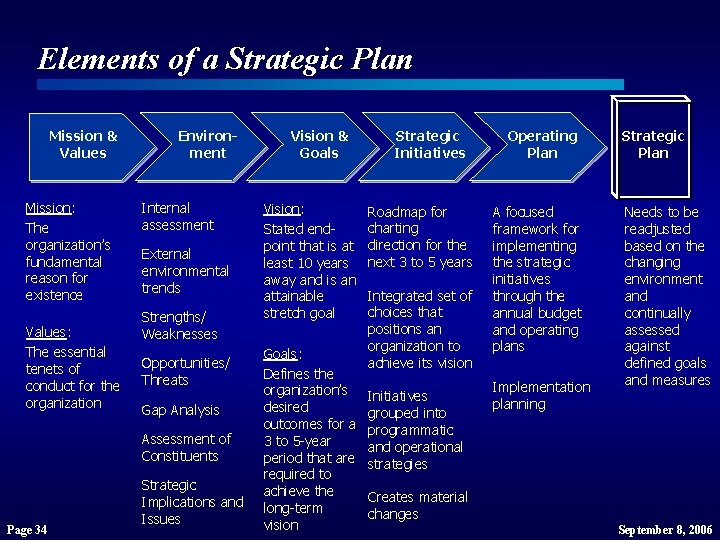
Elements of a Strategic Plan Mission & Values Mission: The organization’s fundamental reason for existence Values: The essential tenets of conduct for the organization Environment Internal assessment External environmental trends Strengths/ Weaknesses Opportunities/ Threats Gap Analysis Assessment of Constituents Page 6 Strategic Implications and Issues Vision & Goals Vision: Stated endpoint that is at least 10 years away and is an attainable stretch goal Goals: Defines the organization’s desired outcomes for a 3 to 5 -year period that are required to achieve the long-term vision Strategic Initiatives Roadmap for charting direction for the next 3 to 5 years Integrated set of choices that positions an organization to achieve its vision Initiatives grouped into programmatic and operational strategies Operating Plan A focused framework for implementing the strategic initiatives through the annual budget and operating plans Implementation planning Strategic Plan Needs to be readjusted based on the changing environment and continually assessed against defined goals and measures Creates material changes September 8, 2006
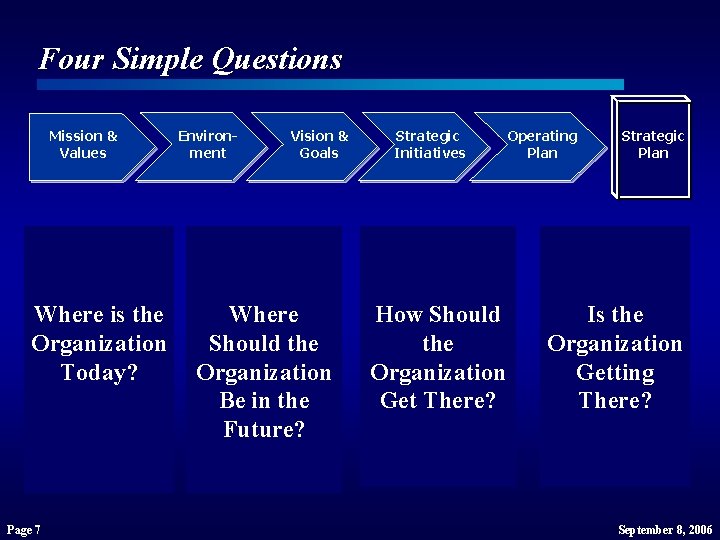
Four Simple Questions Mission & Values Environment Vision & Goals Where is the Where Organization Should the Today? Organization Be in the Future? Page 7 Strategic Initiatives Operating Plan How Should the Organization Get There? Strategic Plan Is the Organization Getting There? September 8, 2006
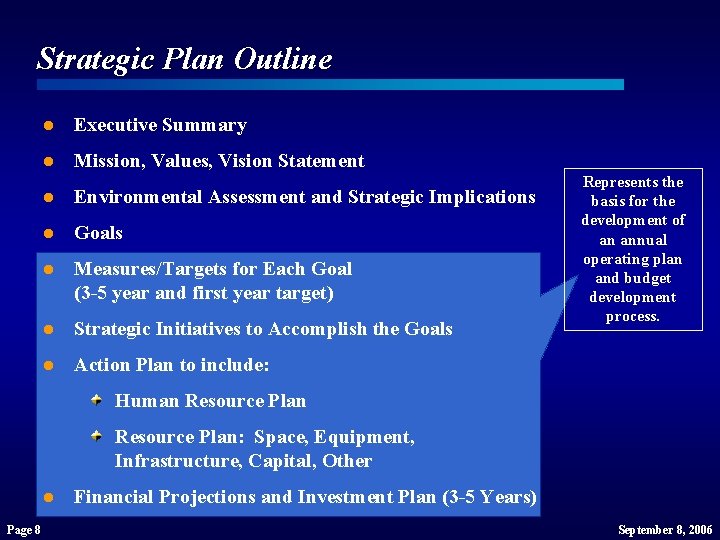
Strategic Plan Outline l Executive Summary l Mission, Values, Vision Statement l Environmental Assessment and Strategic Implications l Goals l Measures/Targets for Each Goal (3 -5 year and first year target) l Strategic Initiatives to Accomplish the Goals l Action Plan to include: Represents the basis for the development of an annual operating plan and budget development process. Human Resource Plan: Space, Equipment, Infrastructure, Capital, Other l Page 8 Financial Projections and Investment Plan (3 -5 Years) September 8, 2006
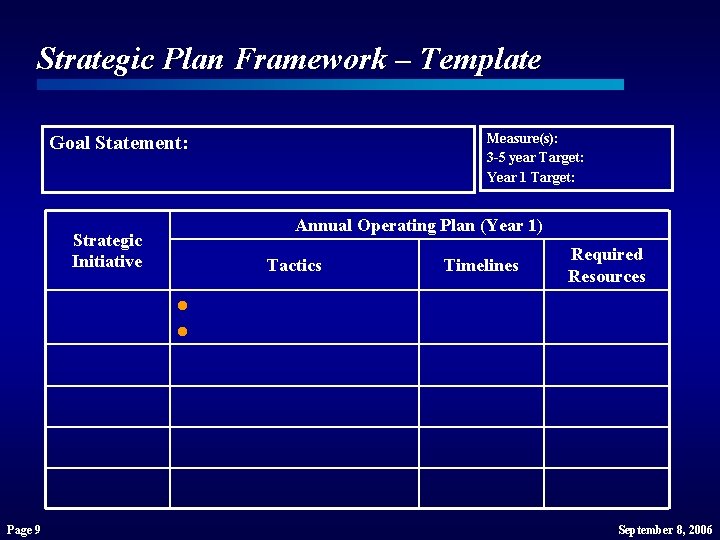
Strategic Plan Framework – Template Measure(s): 3 -5 year Target: Year 1 Target: Goal Statement: Annual Operating Plan (Year 1) Strategic Initiative Tactics Timelines Required Resources l l Page 9 September 8, 2006
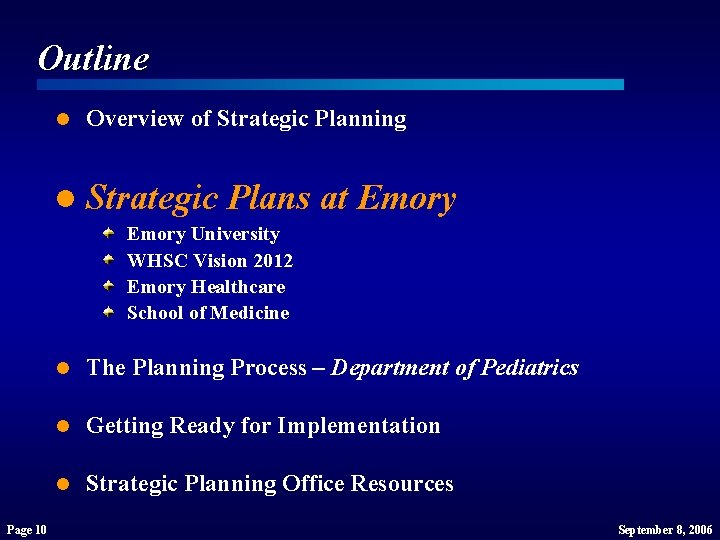
Outline l Overview of Strategic Planning l Strategic Plans at Emory University WHSC Vision 2012 Emory Healthcare School of Medicine Page 10 l The Planning Process – Department of Pediatrics l Getting Ready for Implementation l Strategic Planning Office Resources September 8, 2006
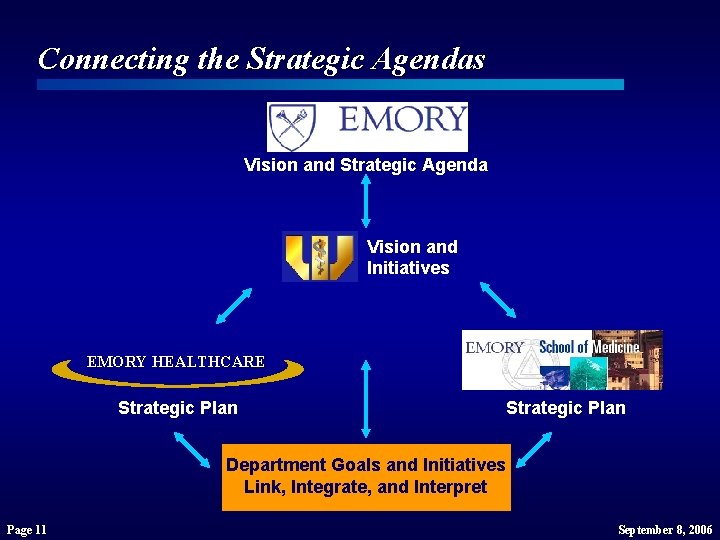
Connecting the Strategic Agendas Vision and Strategic Agenda Vision and Initiatives EMORY HEALTHCARE Strategic Plan Department Goals and Initiatives Link, Integrate, and Interpret Page 11 September 8, 2006
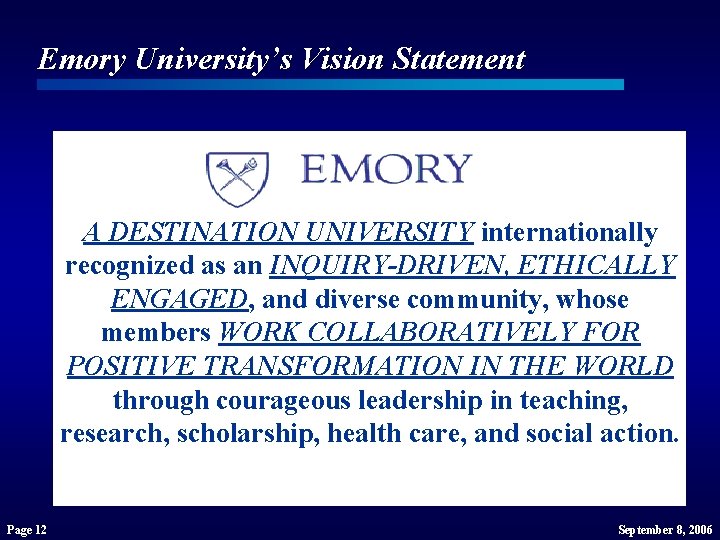
Emory University’s Vision Statement A DESTINATION UNIVERSITY internationally recognized as an INQUIRY-DRIVEN, ETHICALLY ENGAGED, and diverse community, whose members WORK COLLABORATIVELY FOR POSITIVE TRANSFORMATION IN THE WORLD through courageous leadership in teaching, research, scholarship, health care, and social action. Page 12 September 8, 2006
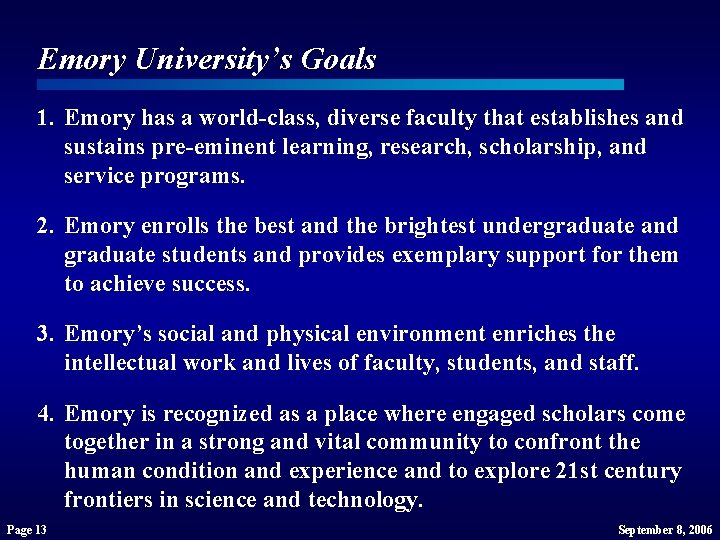
Emory University’s Goals 1. Emory has a world-class, diverse faculty that establishes and sustains pre-eminent learning, research, scholarship, and service programs. 2. Emory enrolls the best and the brightest undergraduate and graduate students and provides exemplary support for them to achieve success. 3. Emory’s social and physical environment enriches the intellectual work and lives of faculty, students, and staff. 4. Emory is recognized as a place where engaged scholars come together in a strong and vital community to confront the human condition and experience and to explore 21 st century frontiers in science and technology. Page 13 September 8, 2006
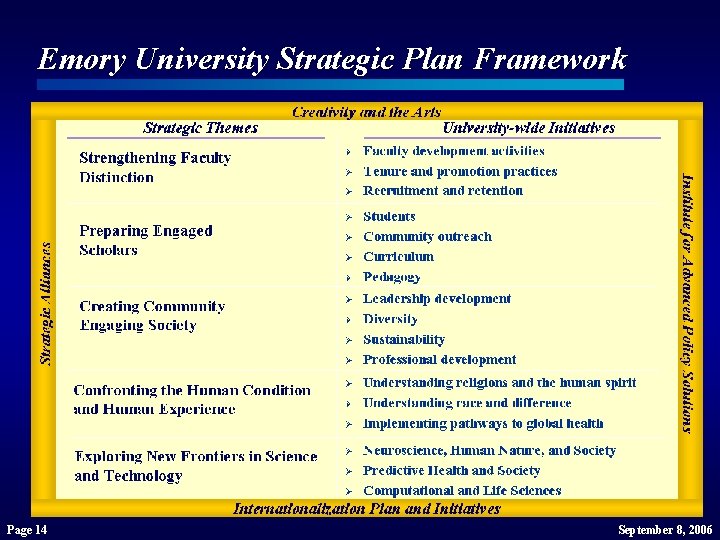
Emory University Strategic Plan Framework Page 14 September 8, 2006
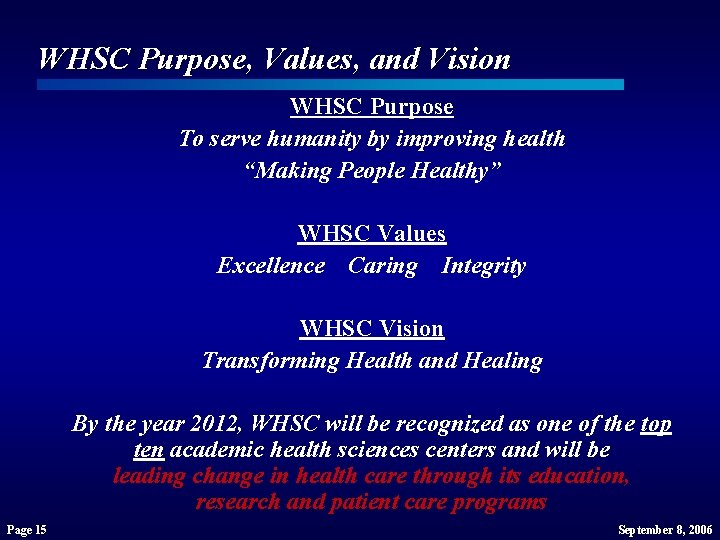
WHSC Purpose, Values, and Vision WHSC Purpose To serve humanity by improving health “Making People Healthy” WHSC Values Excellence Caring Integrity WHSC Vision Transforming Health and Healing By the year 2012, WHSC will be recognized as one of the top ten academic health sciences centers and will be leading change in health care through its education, research and patient care programs Page 15 September 8, 2006
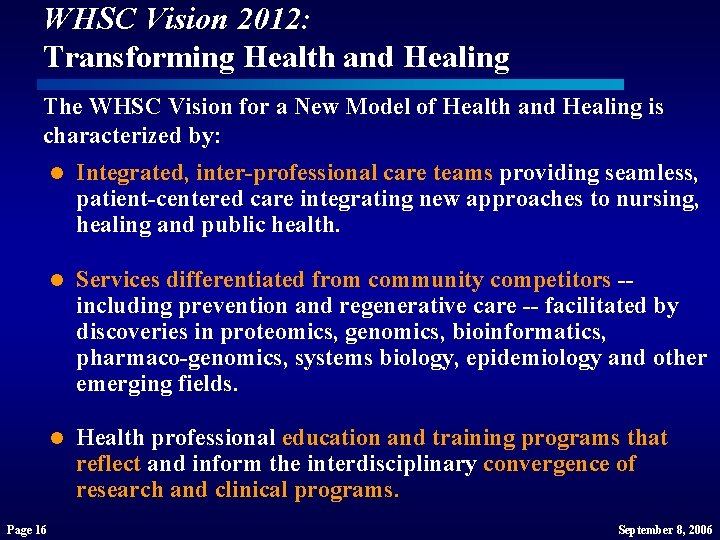
WHSC Vision 2012: Transforming Health and Healing The WHSC Vision for a New Model of Health and Healing is characterized by: Page 16 l Integrated, inter-professional care teams providing seamless, patient-centered care integrating new approaches to nursing, healing and public health. l Services differentiated from community competitors -- including prevention and regenerative care -- facilitated by discoveries in proteomics, genomics, bioinformatics, pharmaco-genomics, systems biology, epidemiology and other emerging fields. l Health professional education and training programs that reflect and inform the interdisciplinary convergence of research and clinical programs. September 8, 2006
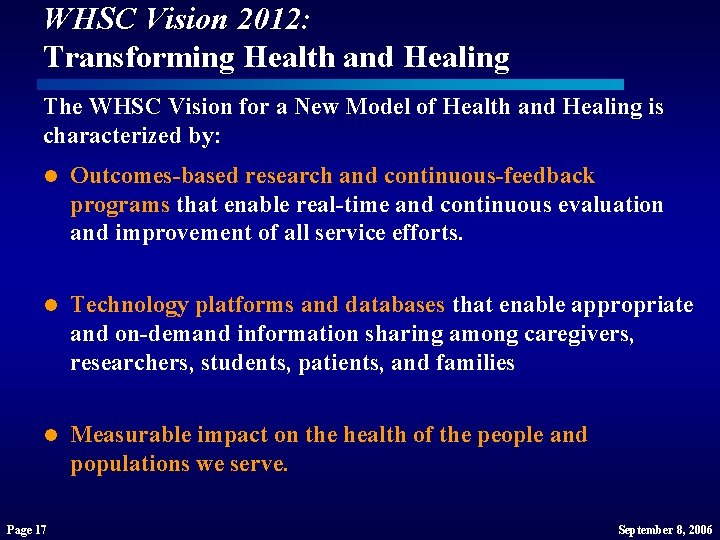
WHSC Vision 2012: Transforming Health and Healing The WHSC Vision for a New Model of Health and Healing is characterized by: l Outcomes-based research and continuous-feedback programs that enable real-time and continuous evaluation and improvement of all service efforts. l Technology platforms and databases that enable appropriate and on-demand information sharing among caregivers, researchers, students, patients, and families l Measurable impact on the health of the people and populations we serve. Page 17 September 8, 2006
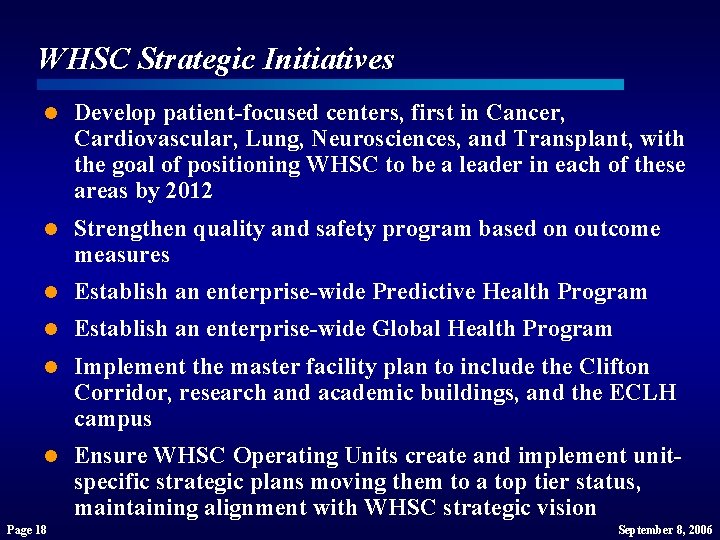
WHSC Strategic Initiatives l Develop patient-focused centers, first in Cancer, Cardiovascular, Lung, Neurosciences, and Transplant, with the goal of positioning WHSC to be a leader in each of these areas by 2012 l Strengthen quality and safety program based on outcome measures l Establish an enterprise-wide Predictive Health Program l Establish an enterprise-wide Global Health Program l Implement the master facility plan to include the Clifton Corridor, research and academic buildings, and the ECLH campus l Ensure WHSC Operating Units create and implement unitspecific strategic plans moving them to a top tier status, maintaining alignment with WHSC strategic vision Page 18 September 8, 2006
Emory Healthcare Vision To be recognized as the leading health care system in Atlanta and the Southeast, differentiated by discovery, innovation, and compassionate, patient-focused care. Page 19 September 8, 2006
EHC Core 4 People l EHC will be a talent magnet for patient-centered professionals, focused on the retention of its most valuable asset – its people. Department and individual goals should focus on making EMORY HEALTHCARE a great place to work. (EHC Metric: Turnover < 12. 2%) Quality l EHC will initiate focused efforts to positively impact quality at its facilities in the key quality areas of clinical outcomes, patient safety and service. Clinical Outcomes (EHC Metric: Risk Adjusted Mortality Ratio <. 89) Patient Safety (EHC Metric: Failure to Rescue (rate per 1, 000 at risk population < 121. 8) Service (EHC Metric: Meet Patient Satisfaction Targets for 80% of units) Page 20 September 8, 2006
EHC Core 4 Growth l EHC will achieve an operating margin of at least 6% in order to internally generate capital to invest in key future initiatives, including the Clifton Road Redevelopment Project. Department and individual goals should focus on growth, by growing volumes, revenue, or capacity, or by reducing expense. Innovation l Page 21 EHC will be innovative in development and implementation of new patient-centered care models, including new nursing models and the Vision 2012 Centers. Department or individual goals should focus on being innovative in their own work environment. September 8, 2006
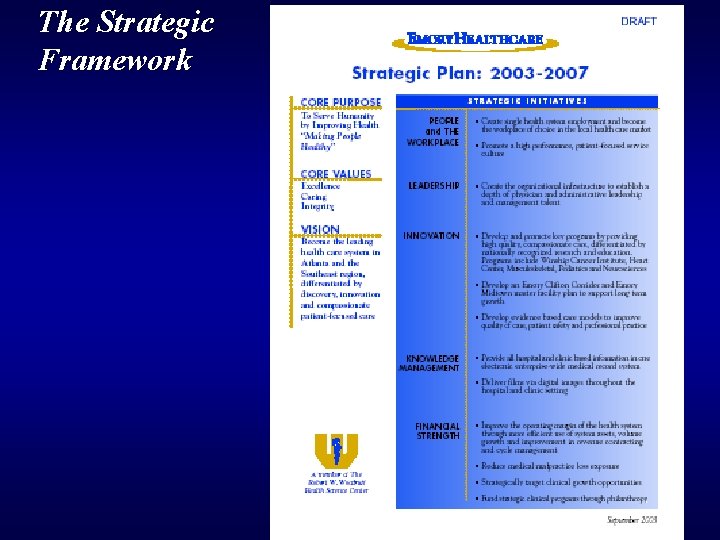
The Strategic Framework
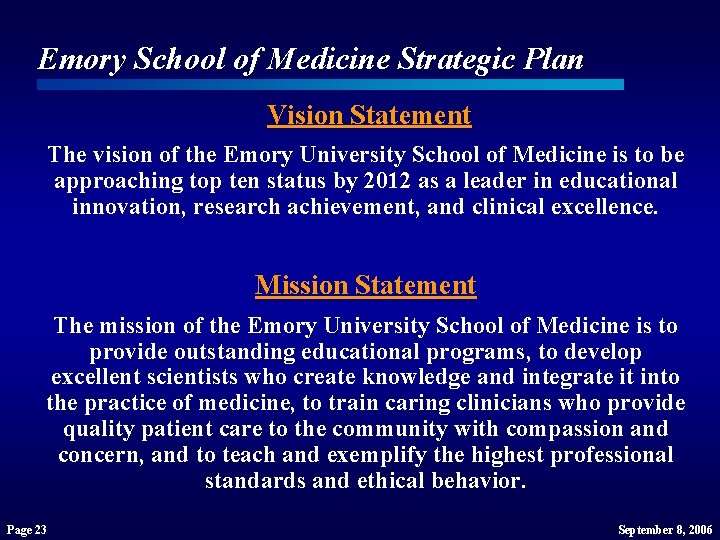
Emory School of Medicine Strategic Plan Vision Statement The vision of the Emory University School of Medicine is to be approaching top ten status by 2012 as a leader in educational innovation, research achievement, and clinical excellence. Mission Statement The mission of the Emory University School of Medicine is to provide outstanding educational programs, to develop excellent scientists who create knowledge and integrate it into the practice of medicine, to train caring clinicians who provide quality patient care to the community with compassion and concern, and to teach and exemplify the highest professional standards and ethical behavior. Page 23 September 8, 2006
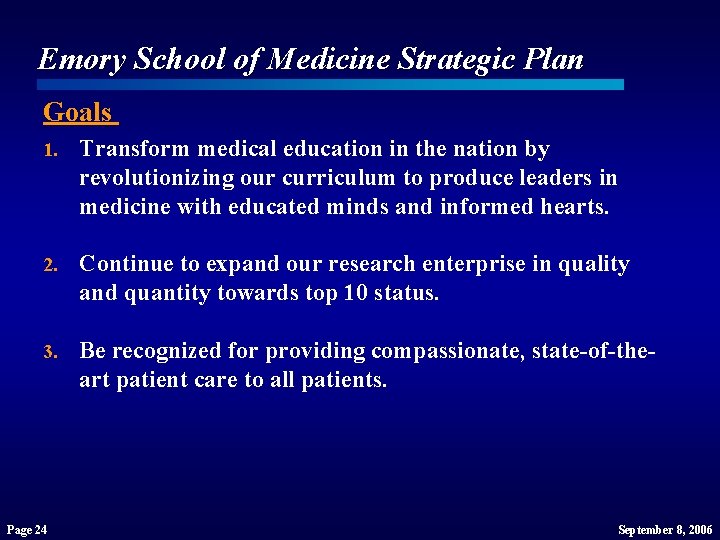
Emory School of Medicine Strategic Plan Goals 1. Transform medical education in the nation by revolutionizing our curriculum to produce leaders in medicine with educated minds and informed hearts. 2. Continue to expand our research enterprise in quality and quantity towards top 10 status. 3. Be recognized for providing compassionate, state-of-theart patient care to all patients. Page 24 September 8, 2006
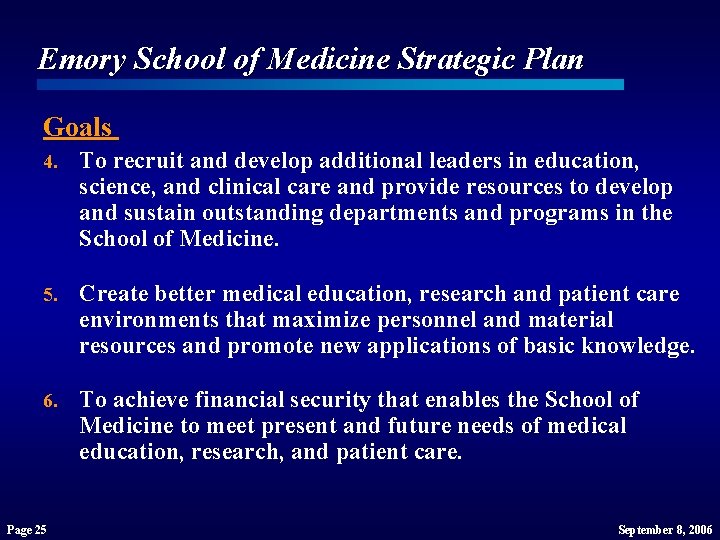
Emory School of Medicine Strategic Plan Goals 4. To recruit and develop additional leaders in education, science, and clinical care and provide resources to develop and sustain outstanding departments and programs in the School of Medicine. 5. Create better medical education, research and patient care environments that maximize personnel and material resources and promote new applications of basic knowledge. 6. To achieve financial security that enables the School of Medicine to meet present and future needs of medical education, research, and patient care. Page 25 September 8, 2006
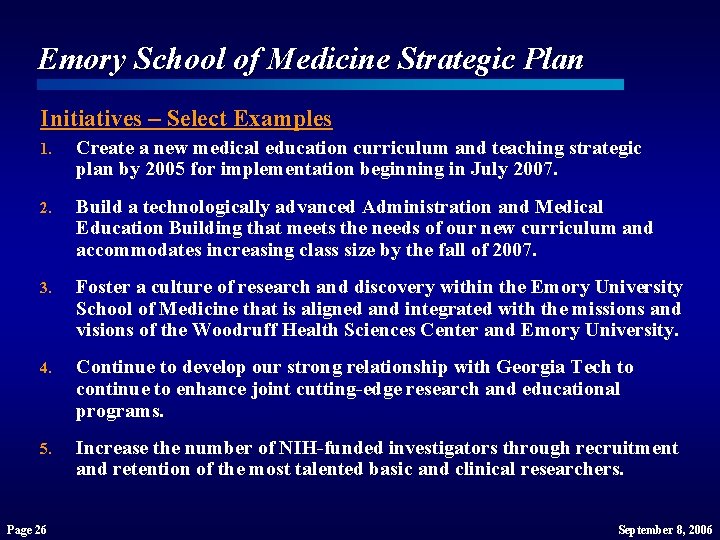
Emory School of Medicine Strategic Plan Initiatives – Select Examples 1. Create a new medical education curriculum and teaching strategic plan by 2005 for implementation beginning in July 2007. 2. Build a technologically advanced Administration and Medical Education Building that meets the needs of our new curriculum and accommodates increasing class size by the fall of 2007. 3. Foster a culture of research and discovery within the Emory University School of Medicine that is aligned and integrated with the missions and visions of the Woodruff Health Sciences Center and Emory University. 4. Continue to develop our strong relationship with Georgia Tech to continue to enhance joint cutting-edge research and educational programs. 5. Increase the number of NIH-funded investigators through recruitment and retention of the most talented basic and clinical researchers. Page 26 September 8, 2006
Outline l Overview of Strategic Planning l Strategic Plans at Emory l The Planning Process – Department of Pediatrics Getting Organized Partnership Elements of a Plan Page 27 l Getting Ready for Implementation l Strategic Planning Office Resources September 8, 2006
Getting Started – Get Organized l What is the desired outcome of the planning initiative? l What is the expected timing for plan completion? l How interactive should the process be within the organization? l Who should be involved? l What has been done already that can be built upon for the process? l If a plan has been done in the past – when? by whom? was it useful? implemented? Page 28 September 8, 2006
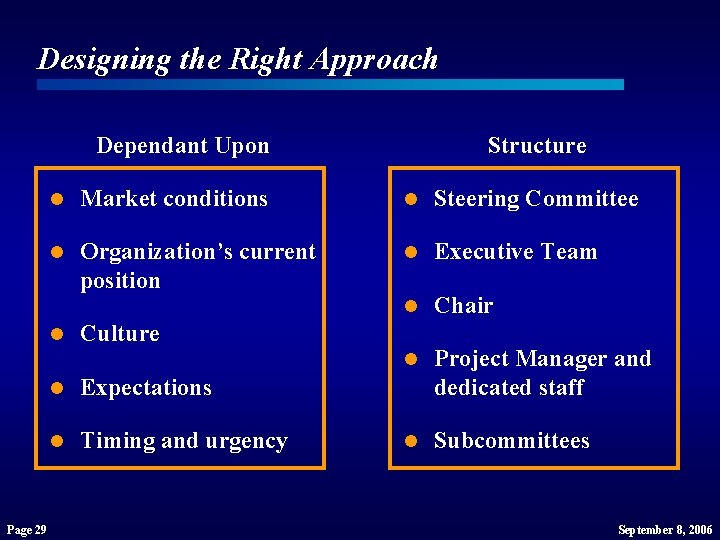
Designing the Right Approach Dependant Upon l Market conditions l Steering Committee l Organization’s current position l Executive Team l Chair l Project Manager and dedicated staff l Subcommittees l Page 29 Structure Culture l Expectations l Timing and urgency September 8, 2006
Check List l Clarify Expectations Timing Stakeholders – who needs to be involved and how? Key components of the end product l Preliminary resource constraints Additional resources? Space? Page 30 l Current organizational situation l Steering Committee to oversee and participate in plan development l Develop workplan – tasks, responsibilities, deadlines September 8, 2006
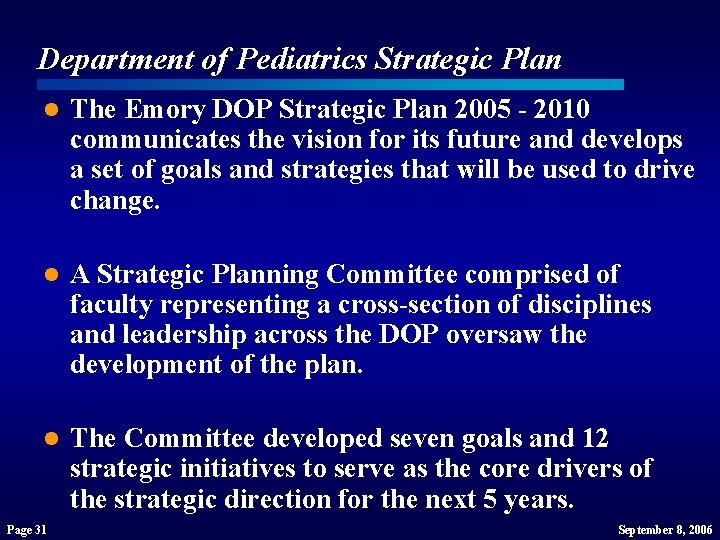
Department of Pediatrics Strategic Plan l The Emory DOP Strategic Plan 2005 - 2010 communicates the vision for its future and develops a set of goals and strategies that will be used to drive change. l A Strategic Planning Committee comprised of faculty representing a cross-section of disciplines and leadership across the DOP oversaw the development of the plan. l The Committee developed seven goals and 12 strategic initiatives to serve as the core drivers of the strategic direction for the next 5 years. Page 31 September 8, 2006
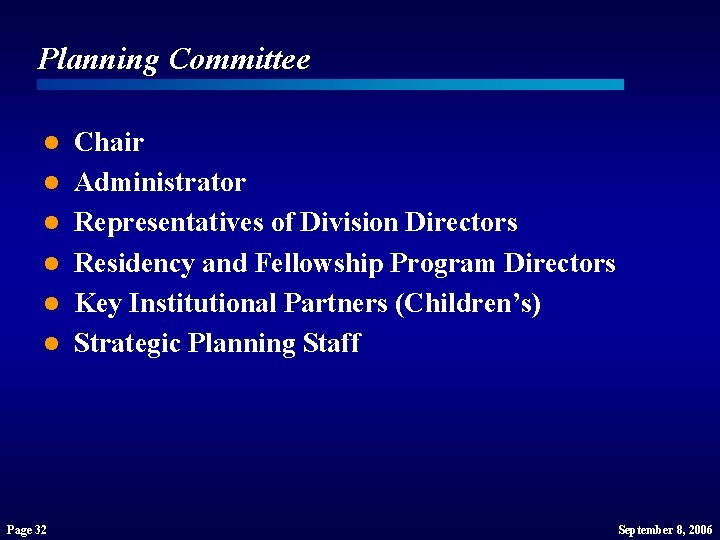
Planning Committee l l l Page 32 Chair Administrator Representatives of Division Directors Residency and Fellowship Program Directors Key Institutional Partners (Children’s) Strategic Planning Staff September 8, 2006
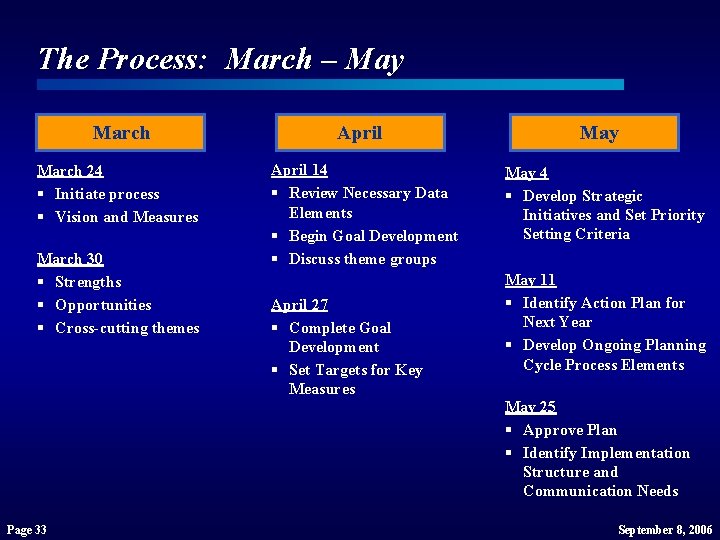
The Process: March – May March 24 § Initiate process § Vision and Measures March 30 § Strengths § Opportunities § Cross-cutting themes Page 33 April 14 § Review Necessary Data Elements § Begin Goal Development § Discuss theme groups April 27 § Complete Goal Development § Set Targets for Key Measures May 4 § Develop Strategic Initiatives and Set Priority Setting Criteria May 11 § Identify Action Plan for Next Year § Develop Ongoing Planning Cycle Process Elements May 25 § Approve Plan § Identify Implementation Structure and Communication Needs September 8, 2006
Elements of a Strategic Plan Mission & Values Mission: The organization’s fundamental reason for existence Values: The essential tenets of conduct for the organization Environment Internal assessment External environmental trends Strengths/ Weaknesses Opportunities/ Threats Gap Analysis Assessment of Constituents Page 34 Strategic Implications and Issues Vision & Goals Vision: Stated endpoint that is at least 10 years away and is an attainable stretch goal Goals: Defines the organization’s desired outcomes for a 3 to 5 -year period that are required to achieve the long-term vision Strategic Initiatives Roadmap for charting direction for the next 3 to 5 years Integrated set of choices that positions an organization to achieve its vision Initiatives grouped into programmatic and operational strategies Operating Plan A focused framework for implementing the strategic initiatives through the annual budget and operating plans Implementation planning Strategic Plan Needs to be readjusted based on the changing environment and continually assessed against defined goals and measures Creates material changes September 8, 2006
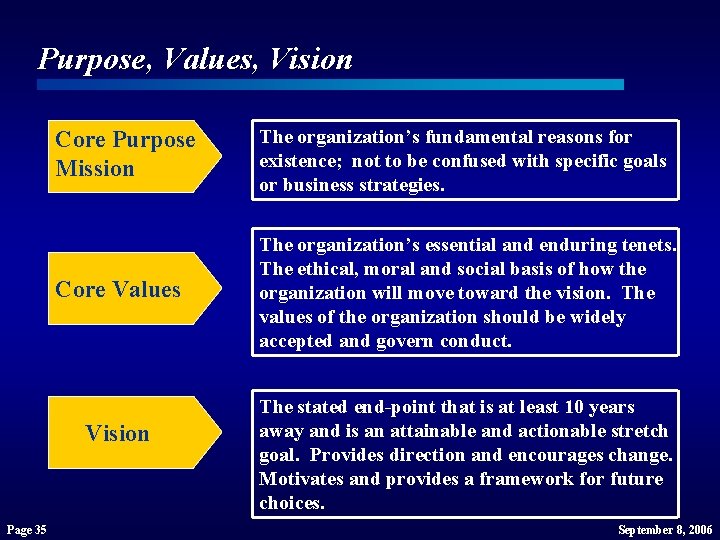
Purpose, Values, Vision Core Purpose Mission The organization’s fundamental reasons for existence; not to be confused with specific goals or business strategies. Core Values The organization’s essential and enduring tenets. The ethical, moral and social basis of how the organization will move toward the vision. The values of the organization should be widely accepted and govern conduct. Vision Page 35 The stated end-point that is at least 10 years away and is an attainable and actionable stretch goal. Provides direction and encourages change. Motivates and provides a framework for future choices. September 8, 2006
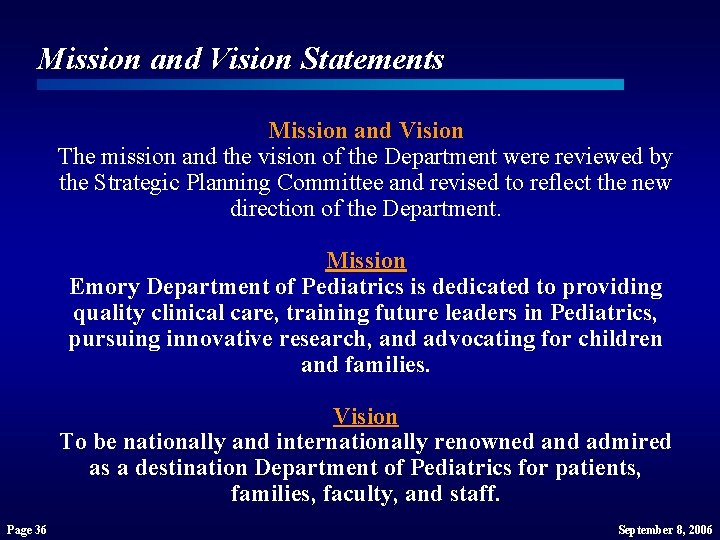
Mission and Vision Statements Mission and Vision The mission and the vision of the Department were reviewed by the Strategic Planning Committee and revised to reflect the new direction of the Department. Mission Emory Department of Pediatrics is dedicated to providing quality clinical care, training future leaders in Pediatrics, pursuing innovative research, and advocating for children and families. Vision To be nationally and internationally renowned and admired as a destination Department of Pediatrics for patients, families, faculty, and staff. Page 36 September 8, 2006
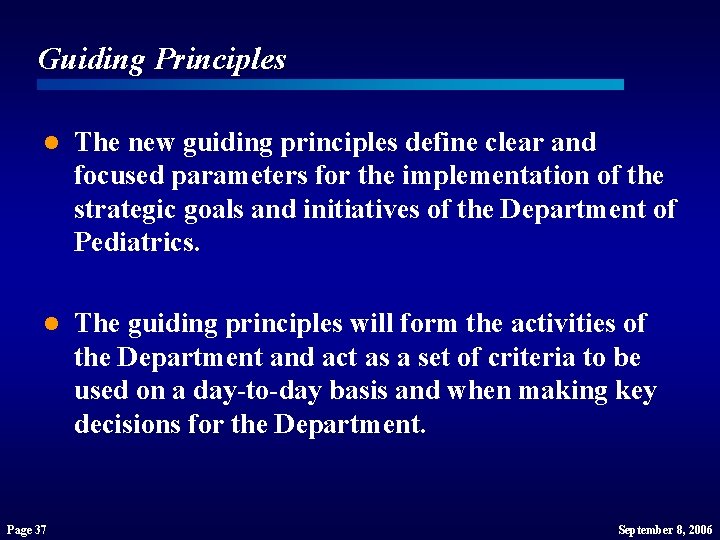
Guiding Principles l The new guiding principles define clear and focused parameters for the implementation of the strategic goals and initiatives of the Department of Pediatrics. l The guiding principles will form the activities of the Department and act as a set of criteria to be used on a day-to-day basis and when making key decisions for the Department. Page 37 September 8, 2006
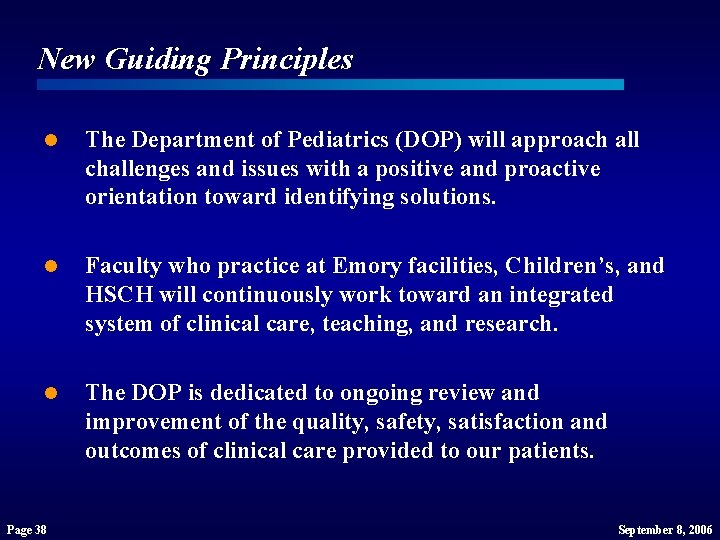
New Guiding Principles l The Department of Pediatrics (DOP) will approach all challenges and issues with a positive and proactive orientation toward identifying solutions. l Faculty who practice at Emory facilities, Children’s, and HSCH will continuously work toward an integrated system of clinical care, teaching, and research. l The DOP is dedicated to ongoing review and improvement of the quality, safety, satisfaction and outcomes of clinical care provided to our patients. Page 38 September 8, 2006
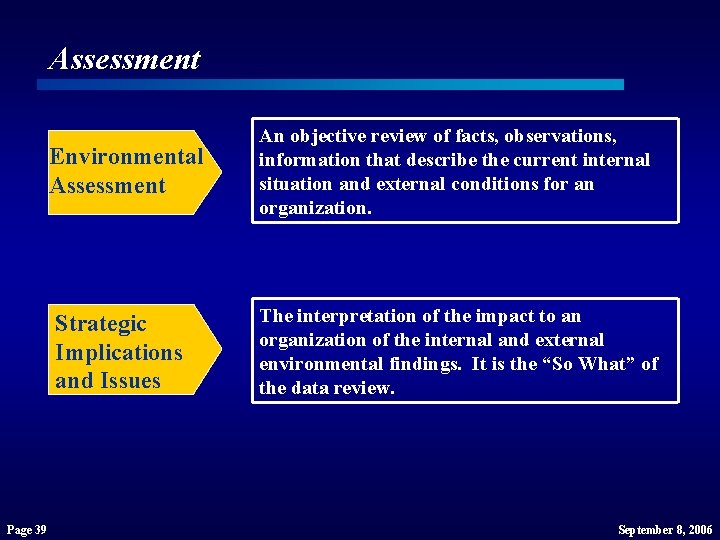
Assessment Page 39 Environmental Assessment An objective review of facts, observations, information that describe the current internal situation and external conditions for an organization. Strategic Implications and Issues The interpretation of the impact to an organization of the internal and external environmental findings. It is the “So What” of the data review. September 8, 2006
Summary of Strengths and Opportunities l Page 40 SWOT Analysis (also part of SOM Annual Report) Strengths Weaknesses Opportunities Threats September 8, 2006
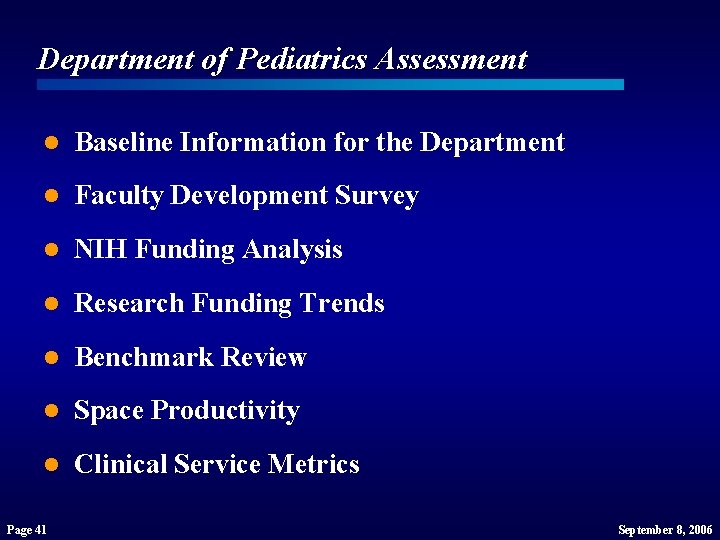
Department of Pediatrics Assessment l Baseline Information for the Department l Faculty Development Survey l NIH Funding Analysis l Research Funding Trends l Benchmark Review l Space Productivity l Clinical Service Metrics Page 41 September 8, 2006
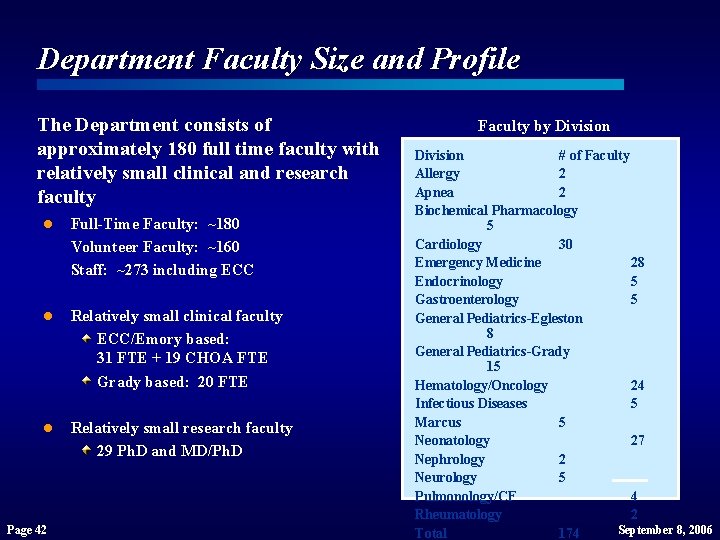
Department Faculty Size and Profile The Department consists of approximately 180 full time faculty with relatively small clinical and research faculty l Full-Time Faculty: ~180 Volunteer Faculty: ~160 Staff: ~273 including ECC l Relatively small clinical faculty ECC/Emory based: 31 FTE + 19 CHOA FTE Grady based: 20 FTE l Relatively small research faculty 29 Ph. D and MD/Ph. D Page 42 Faculty by Division # of Faculty Allergy 2 Apnea 2 Biochemical Pharmacology 5 Cardiology 30 Emergency Medicine 28 Endocrinology 5 Gastroenterology 5 General Pediatrics-Egleston 8 General Pediatrics-Grady 15 Hematology/Oncology 24 Infectious Diseases 5 Marcus 5 Neonatology 27 Nephrology 2 Neurology 5 Pulmonology/CF 4 Rheumatology 2 September 8, 2006 Total 174
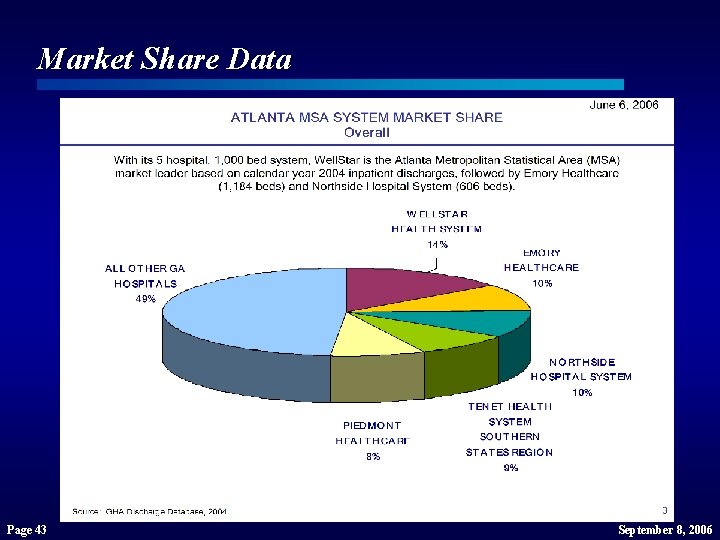
Market Share Data Page 43 September 8, 2006
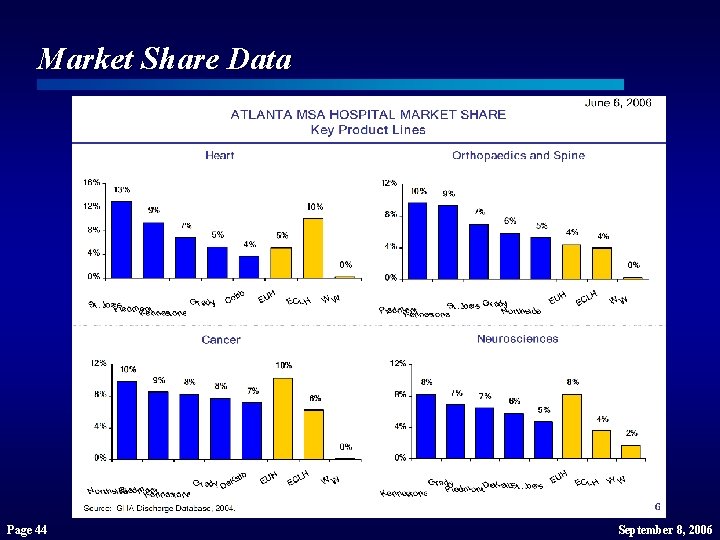
Market Share Data Page 44 September 8, 2006
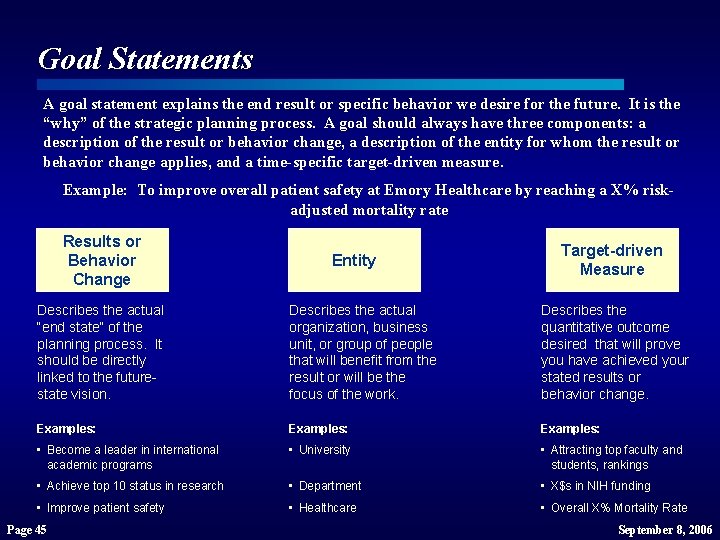
Goal Statements A goal statement explains the end result or specific behavior we desire for the future. It is the “why” of the strategic planning process. A goal should always have three components: a description of the result or behavior change, a description of the entity for whom the result or behavior change applies, and a time-specific target-driven measure. Example: To improve overall patient safety at Emory Healthcare by reaching a X% riskadjusted mortality rate Results or Behavior Change Entity Target-driven Measure Describes the actual “end state” of the planning process. It should be directly linked to the futurestate vision. Describes the actual organization, business unit, or group of people that will benefit from the result or will be the focus of the work. Describes the quantitative outcome desired that will prove you have achieved your stated results or behavior change. Examples: • Become a leader in international academic programs • University • Attracting top faculty and students, rankings • Achieve top 10 status in research • Department • X$s in NIH funding • Improve patient safety • Healthcare • Overall X% Mortality Rate Page 45 September 8, 2006
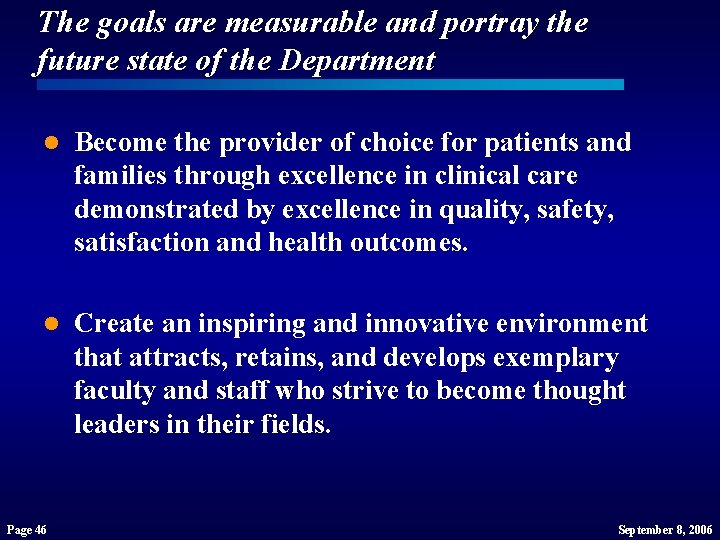
The goals are measurable and portray the future state of the Department l Become the provider of choice for patients and families through excellence in clinical care demonstrated by excellence in quality, safety, satisfaction and health outcomes. l Create an inspiring and innovative environment that attracts, retains, and develops exemplary faculty and staff who strive to become thought leaders in their fields. Page 46 September 8, 2006
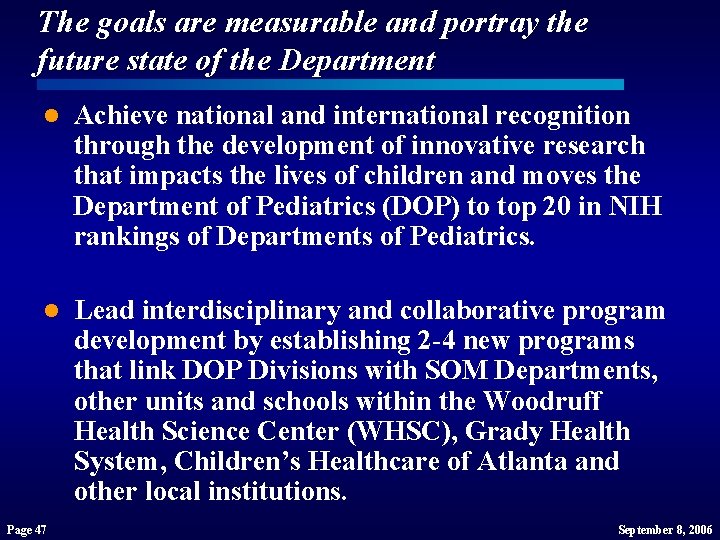
The goals are measurable and portray the future state of the Department l Achieve national and international recognition through the development of innovative research that impacts the lives of children and moves the Department of Pediatrics (DOP) to top 20 in NIH rankings of Departments of Pediatrics. l Lead interdisciplinary and collaborative program development by establishing 2 -4 new programs that link DOP Divisions with SOM Departments, other units and schools within the Woodruff Health Science Center (WHSC), Grady Health System, Children’s Healthcare of Atlanta and other local institutions. Page 47 September 8, 2006
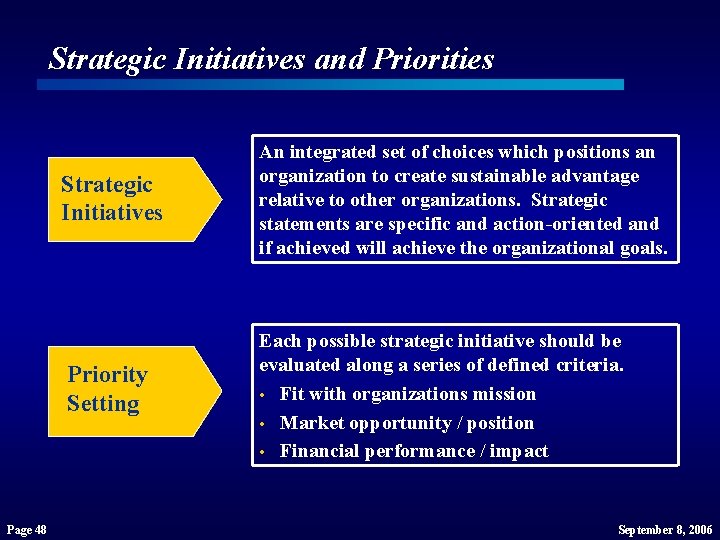
Strategic Initiatives and Priorities Page 48 Strategic Initiatives An integrated set of choices which positions an organization to create sustainable advantage relative to other organizations. Strategic statements are specific and action-oriented and if achieved will achieve the organizational goals. Priority Setting Each possible strategic initiative should be evaluated along a series of defined criteria. • Fit with organizations mission • Market opportunity / position • Financial performance / impact September 8, 2006
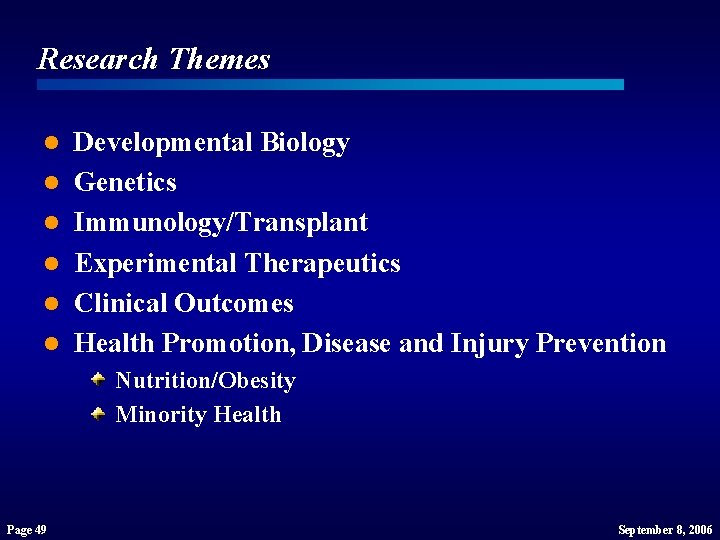
Research Themes l l l Developmental Biology Genetics Immunology/Transplant Experimental Therapeutics Clinical Outcomes Health Promotion, Disease and Injury Prevention Nutrition/Obesity Minority Health Page 49 September 8, 2006
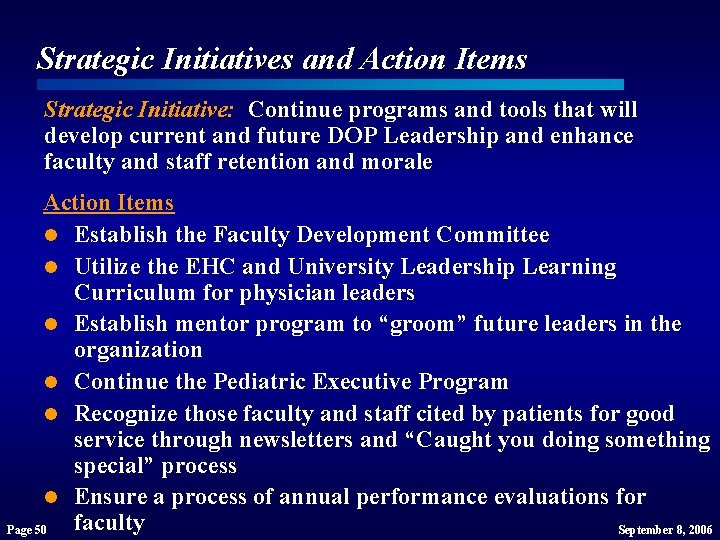
Strategic Initiatives and Action Items Strategic Initiative: Continue programs and tools that will develop current and future DOP Leadership and enhance faculty and staff retention and morale Action Items l Establish the Faculty Development Committee l Utilize the EHC and University Leadership Learning Curriculum for physician leaders l Establish mentor program to “groom” future leaders in the organization l Continue the Pediatric Executive Program l Recognize those faculty and staff cited by patients for good service through newsletters and “Caught you doing something special” process l Ensure a process of annual performance evaluations for faculty Page 50 September 8, 2006
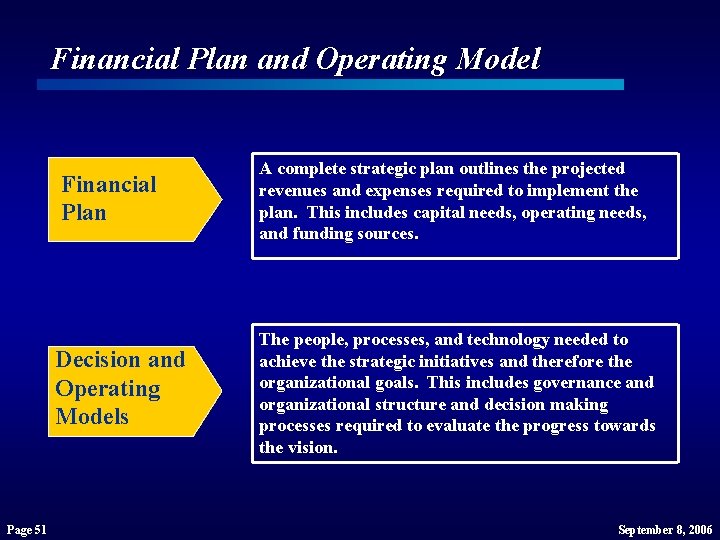
Financial Plan and Operating Model Financial Plan Decision and Operating Models Page 51 A complete strategic plan outlines the projected revenues and expenses required to implement the plan. This includes capital needs, operating needs, and funding sources. The people, processes, and technology needed to achieve the strategic initiatives and therefore the organizational goals. This includes governance and organizational structure and decision making processes required to evaluate the progress towards the vision. September 8, 2006
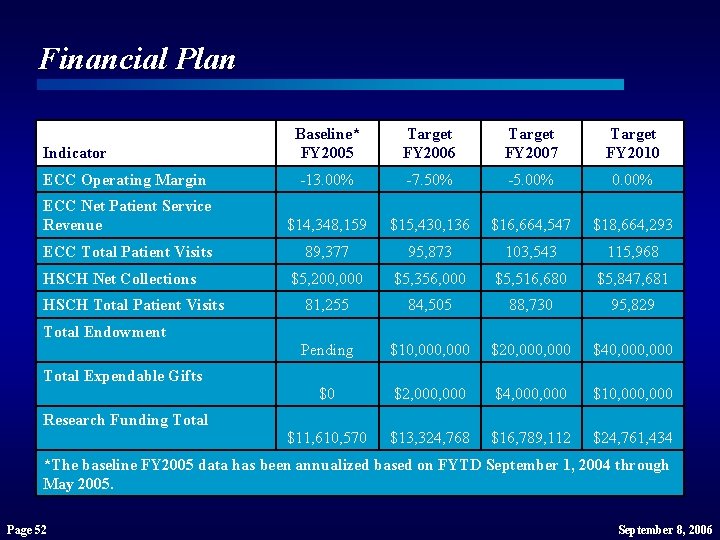
Financial Plan Baseline* FY 2005 Target FY 2006 Target FY 2007 Target FY 2010 ECC Operating Margin -13. 00% -7. 50% -5. 00% 0. 00% ECC Net Patient Service Revenue $14, 348, 159 $15, 430, 136 $16, 664, 547 $18, 664, 293 ECC Total Patient Visits 89, 377 95, 873 103, 543 115, 968 $5, 200, 000 $5, 356, 000 $5, 516, 680 $5, 847, 681 81, 255 84, 505 88, 730 95, 829 Pending $10, 000 $20, 000 $40, 000 $0 $2, 000 $4, 000 $10, 000 $11, 610, 570 $13, 324, 768 $16, 789, 112 $24, 761, 434 Indicator HSCH Net Collections HSCH Total Patient Visits Total Endowment Total Expendable Gifts Research Funding Total *The baseline FY 2005 data has been annualized based on FYTD September 1, 2004 through May 2005. Page 52 September 8, 2006
Outline Page 53 l Overview of Strategic Planning l Strategic Plans at Emory l The Planning Process – Department of Pediatrics l Getting Ready for Implementation l Strategic Planning Office Resources September 8, 2006
Page 54 September 8, 2006
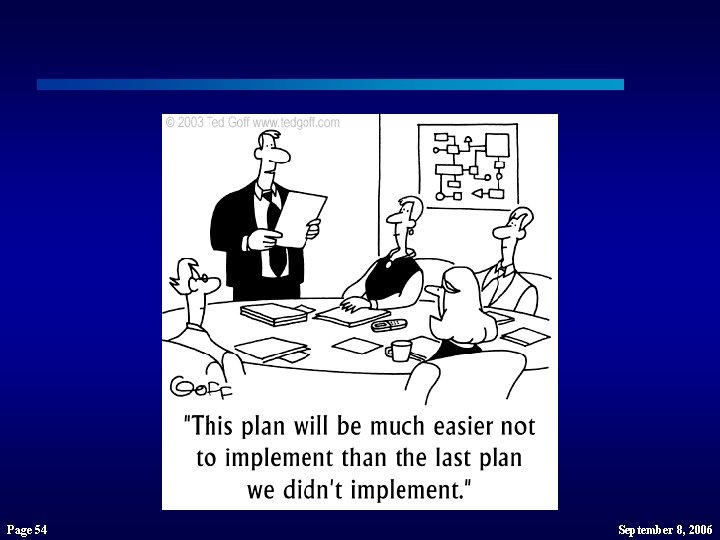
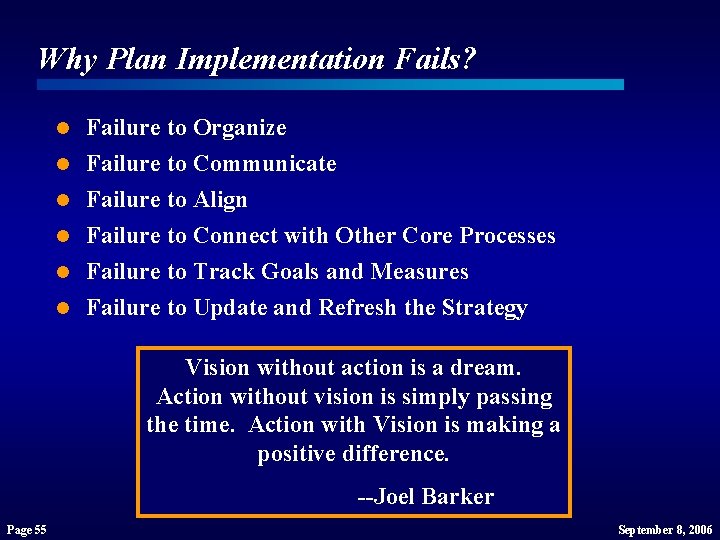
Why Plan Implementation Fails? l Failure to Organize l Failure to Communicate Failure to Align Failure to Connect with Other Core Processes Failure to Track Goals and Measures Failure to Update and Refresh the Strategy l l Vision without action is a dream. Action without vision is simply passing the time. Action with Vision is making a positive difference. --Joel Barker Page 55 September 8, 2006
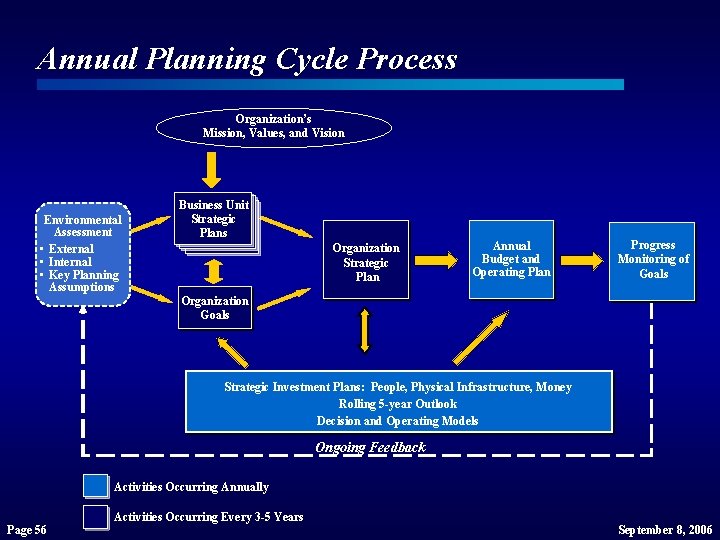
Annual Planning Cycle Process Organization’s Mission, Values, and Vision Environmental Assessment • External • Internal • Key Planning Assumptions Business Unit Strategic Plans Organization Strategic Plan Annual Budget and Operating Plan Progress Monitoring of Goals Organization Goals Strategic Investment Plans: People, Physical Infrastructure, Money Rolling 5 -year Outlook Decision and Operating Models Ongoing Feedback Activities Occurring Annually Page 56 Activities Occurring Every 3 -5 Years September 8, 2006
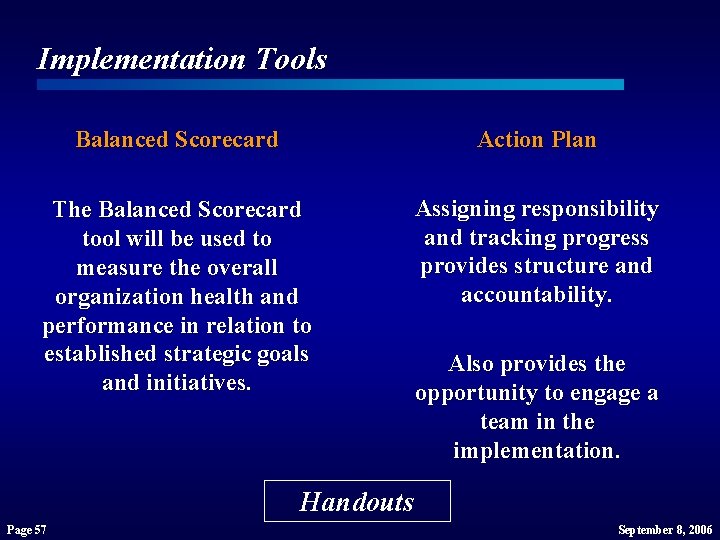
Implementation Tools Balanced Scorecard Action Plan The Balanced Scorecard tool will be used to measure the overall organization health and performance in relation to established strategic goals and initiatives. Assigning responsibility and tracking progress provides structure and accountability. Also provides the opportunity to engage a team in the implementation. Handouts Page 57 September 8, 2006
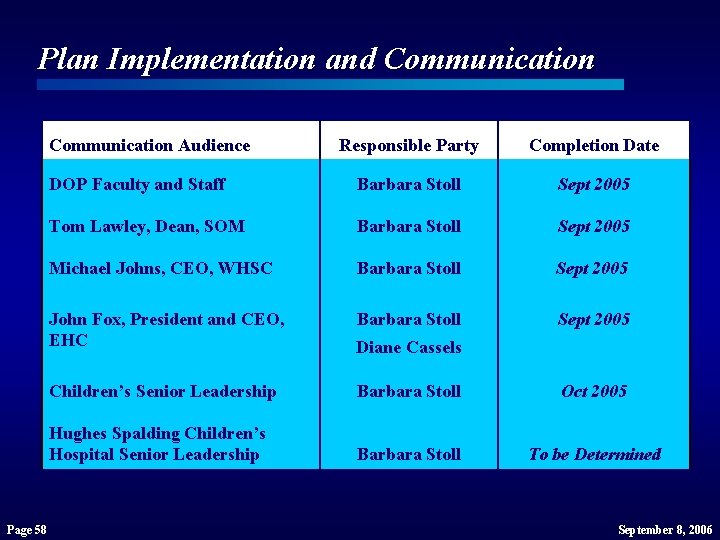
Plan Implementation and Communication Audience Page 58 Responsible Party Completion Date DOP Faculty and Staff Barbara Stoll Sept 2005 Tom Lawley, Dean, SOM Barbara Stoll Sept 2005 Michael Johns, CEO, WHSC Barbara Stoll Sept 2005 John Fox, President and CEO, EHC Barbara Stoll Sept 2005 Diane Cassels Children’s Senior Leadership Barbara Stoll Oct 2005 Hughes Spalding Children’s Hospital Senior Leadership Barbara Stoll To be Determined September 8, 2006
Outline l Overview of Strategic Planning l Strategic Plans at Emory l The Planning Process – Department of Pediatrics l Getting Ready for Implementation l Strategic Planning Resources Business Planning Data Certificate of Need Page 59 September 8, 2006
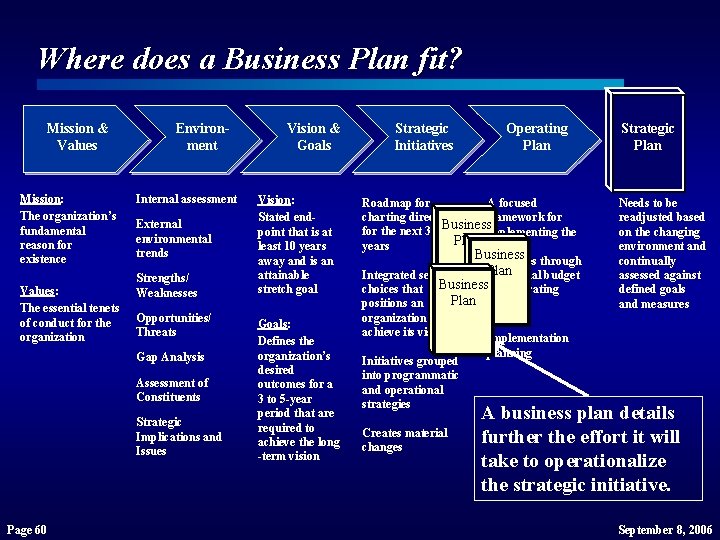
Where does a Business Plan fit? Mission & Values Mission: The organization’s fundamental reason for existence Values: The essential tenets of conduct for the organization Environment Internal assessment External environmental trends Strengths/ Weaknesses Opportunities/ Threats Gap Analysis Assessment of Constituents Strategic Implications and Issues Page 60 Vision & Goals Vision: Stated endpoint that is at least 10 years away and is an attainable stretch goal Goals: Defines the organization’s desired outcomes for a 3 to 5 -year period that are required to achieve the long -term vision Strategic Initiatives Operating Plan Roadmap for A focused charting direction framework for Business for the next 3 to 5 implementing the Plan years strategic Business initiatives through Plan Integrated set of the annual budget choices that Businessand operating Plan plans positions an organization to achieve its vision Implementation planning Initiatives grouped into programmatic and operational strategies Creates material changes Strategic Plan Needs to be readjusted based on the changing environment and continually assessed against defined goals and measures A business plan details further the effort it will take to operationalize the strategic initiative. September 8, 2006
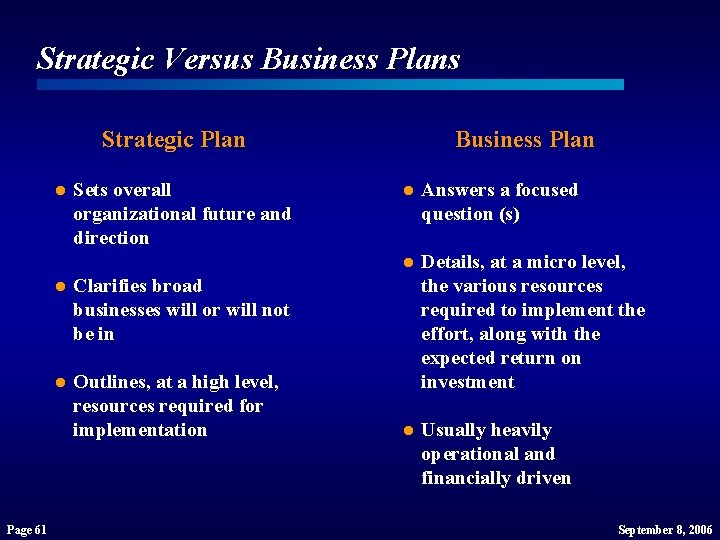
Strategic Versus Business Plans Strategic Plan l Page 61 Sets overall organizational future and direction l Clarifies broad businesses will or will not be in l Outlines, at a high level, resources required for implementation Business Plan l Answers a focused question (s) l Details, at a micro level, the various resources required to implement the effort, along with the expected return on investment l Usually heavily operational and financially driven September 8, 2006
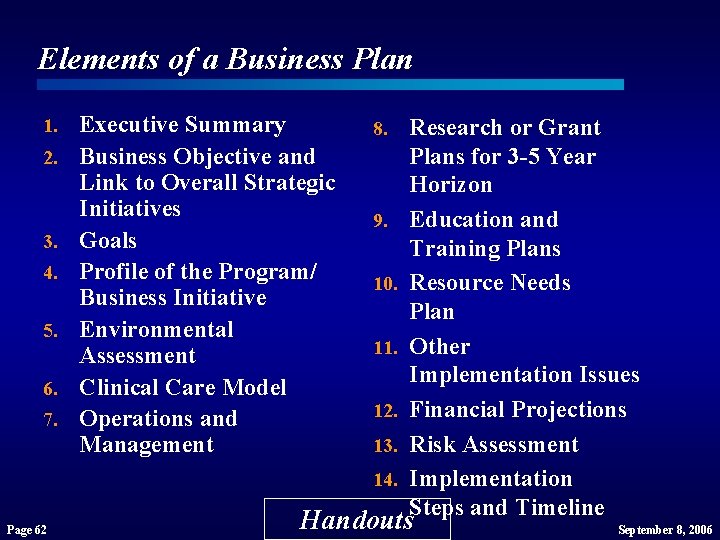
Elements of a Business Plan 1. 2. 3. 4. 5. 6. 7. Executive Summary Business Objective and Link to Overall Strategic Initiatives Goals Profile of the Program/ Business Initiative Environmental Assessment Clinical Care Model Operations and Management 8. 9. 10. 11. 12. 13. 14. Page 62 Research or Grant Plans for 3 -5 Year Horizon Education and Training Plans Resource Needs Plan Other Implementation Issues Financial Projections Risk Assessment Implementation Steps and Timeline Handouts September 8, 2006
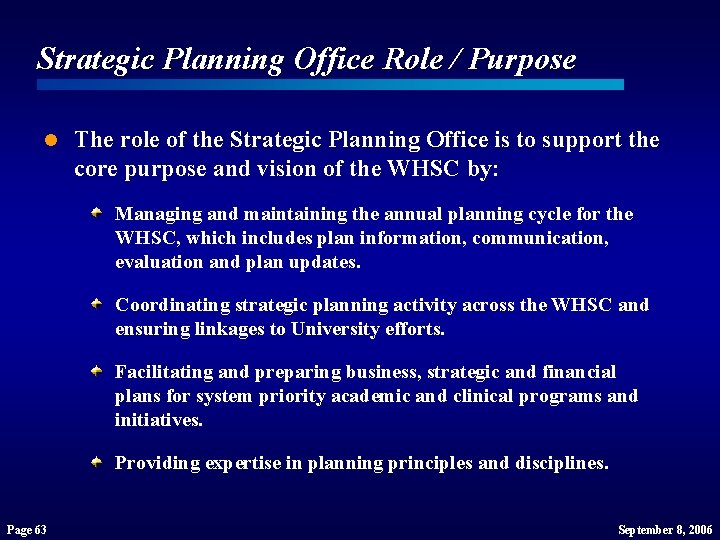
Strategic Planning Office Role / Purpose l The role of the Strategic Planning Office is to support the core purpose and vision of the WHSC by: Managing and maintaining the annual planning cycle for the WHSC, which includes plan information, communication, evaluation and plan updates. Coordinating strategic planning activity across the WHSC and ensuring linkages to University efforts. Facilitating and preparing business, strategic and financial plans for system priority academic and clinical programs and initiatives. Providing expertise in planning principles and disciplines. Page 63 September 8, 2006
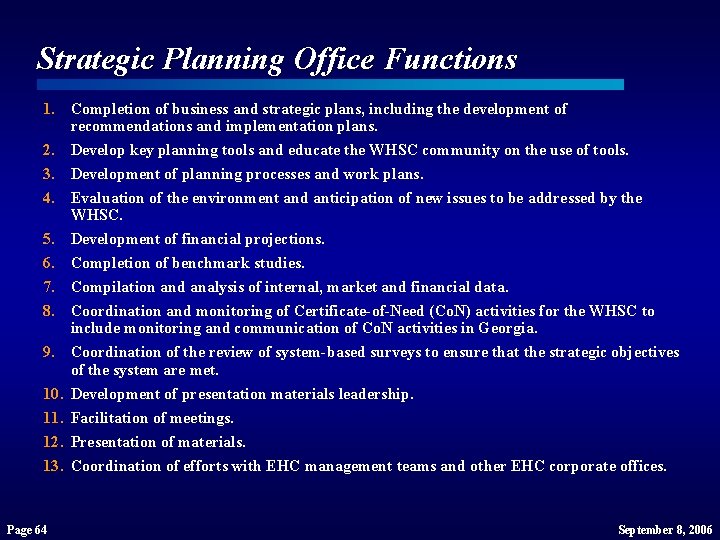
Strategic Planning Office Functions 1. Completion of business and strategic plans, including the development of recommendations and implementation plans. 2. Develop key planning tools and educate the WHSC community on the use of tools. 3. Development of planning processes and work plans. 4. Evaluation of the environment and anticipation of new issues to be addressed by the WHSC. 5. Development of financial projections. 6. Completion of benchmark studies. 7. Compilation and analysis of internal, market and financial data. 8. Coordination and monitoring of Certificate-of-Need (Co. N) activities for the WHSC to include monitoring and communication of Co. N activities in Georgia. 9. Coordination of the review of system-based surveys to ensure that the strategic objectives of the system are met. 10. Development of presentation materials leadership. 11. Facilitation of meetings. 12. Presentation of materials. 13. Coordination of efforts with EHC management teams and other EHC corporate offices. Page 64 September 8, 2006
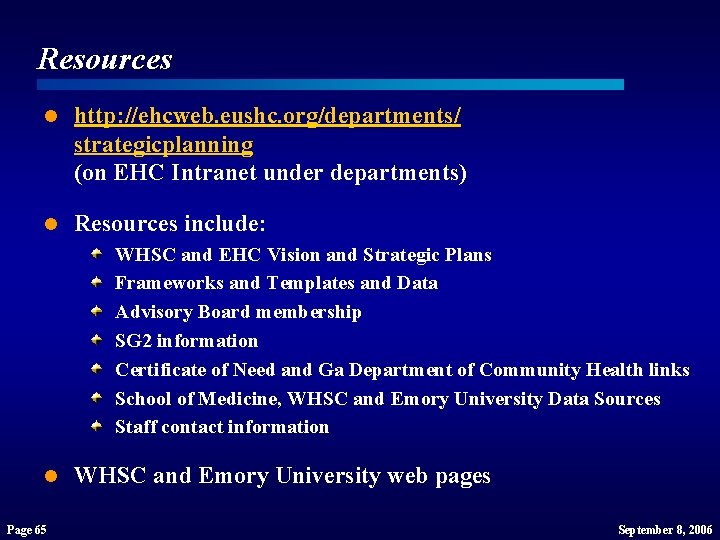
Resources l http: //ehcweb. eushc. org/departments/ strategicplanning (on EHC Intranet under departments) l Resources include: WHSC and EHC Vision and Strategic Plans Frameworks and Templates and Data Advisory Board membership SG 2 information Certificate of Need and Ga Department of Community Health links School of Medicine, WHSC and Emory University Data Sources Staff contact information l Page 65 WHSC and Emory University web pages September 8, 2006