
Strategic Planning and the Balanced Scorecard for Effective
Strategic Planning and the Balanced Scorecard for Effective Seaport Management Henry Schwarzbach, Ph. D. University of Rhode Island
Outline of Research Project and Today’s Presentation l l l This project had two major objectives First, was to describe the strategic planning processes and issues at U. S. and Korean seaports. The second objective was to examine the use of a specific strategic management tool, the balanced scorecard, in seaport strategic management. Today’s presentation will first provide a very brief overview of strategic planning and then explain the “balanced scorecard, ” developed by Harvard professor Robert Kaplan and David Norton in the early 1990’s. The balanced scorecard has been touted in several books and hundreds of articles in academic and trade journals as a major new technique that can improve an organization’s strategic management. We will look at it’s benefits and limitations and its usefulness in port strategic management. Prior to this study there was no literature specifically addressing the use of the balanced scorecard in the port industry.
What is a Port’s Strategy? Strategy describes how a port matches its own capabilities with the opportunities in the marketplace to accomplish its overall objectives. The process a port uses to develop, implement, and monitor its strategy can be either a formal strategic management process or if can be informal and “on the fly. ” Informal strategic planning is often employed when: the stakeholders cannot agree on objectives; there is a lack of planning expertise: the environment is too turbulent for long term planning; the port is not given the authority to conduct strategic planning.
Basic Strategies for any organization 1. Product differentiation/ Niche How can our port provide a better product for our customers? 2. Cost leadership How can our port provide services to our customers at a lower cost than our competitors? The essence of the strategic planning process is determining how to design and implement one these two basic strategies, given the port’s strengths and weaknesses, opportunities and threats. The Balanced Scorecard framework helps to link the strategic design, implementation, and performance evaluation.
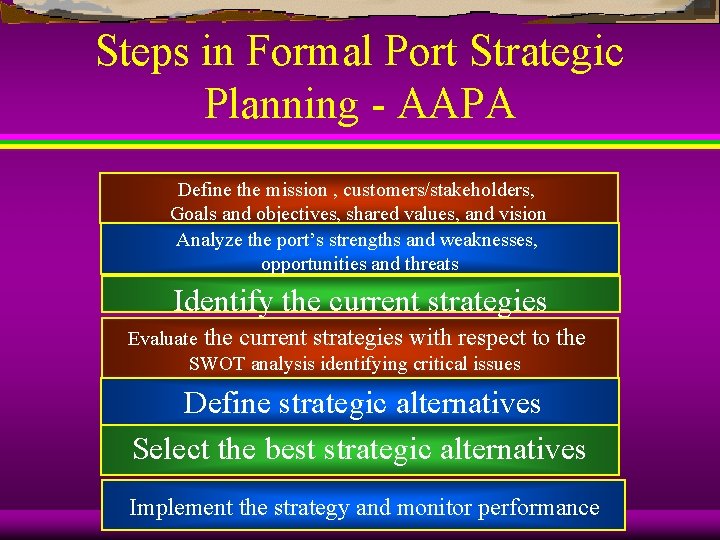
Steps in Formal Port Strategic Planning - AAPA Define the mission , customers/stakeholders, Goals and objectives, shared values, and vision Analyze the port’s strengths and weaknesses, opportunities and threats Identify the current strategies Evaluate the current strategies with respect SWOT analysis identifying critical issues to the Define strategic alternatives Select the best strategic alternatives Implement the strategy and monitor performance
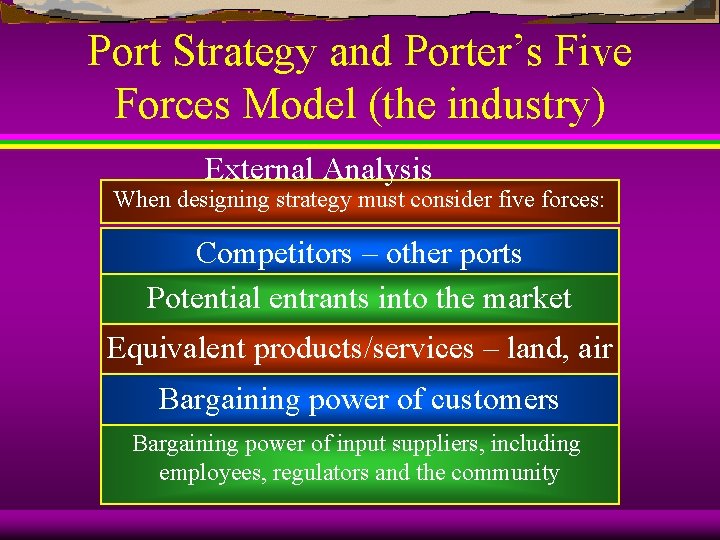
Port Strategy and Porter’s Five Forces Model (the industry) External Analysis When designing strategy must consider five forces: Competitors – other ports Potential entrants into the market Equivalent products/services – land, air Bargaining power of customers Bargaining power of input suppliers, including employees, regulators and the community
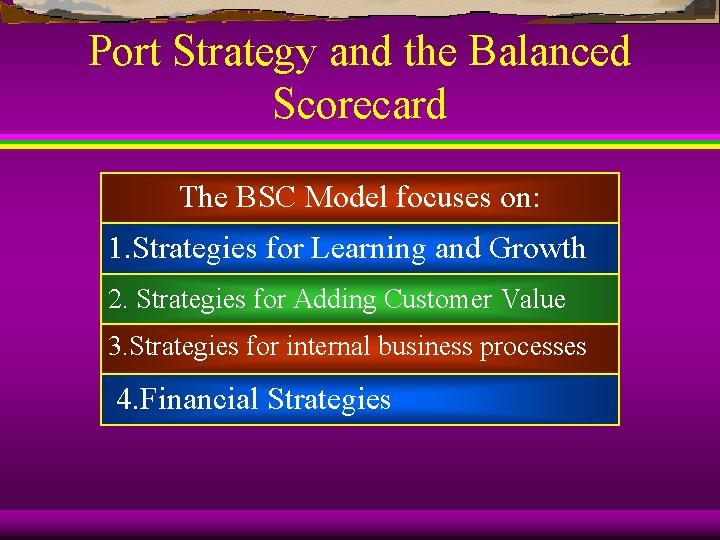
Port Strategy and the Balanced Scorecard The BSC Model focuses on: 1. Strategies for Learning and Growth 2. Strategies for Adding Customer Value 3. Strategies for internal business processes 4. Financial Strategies
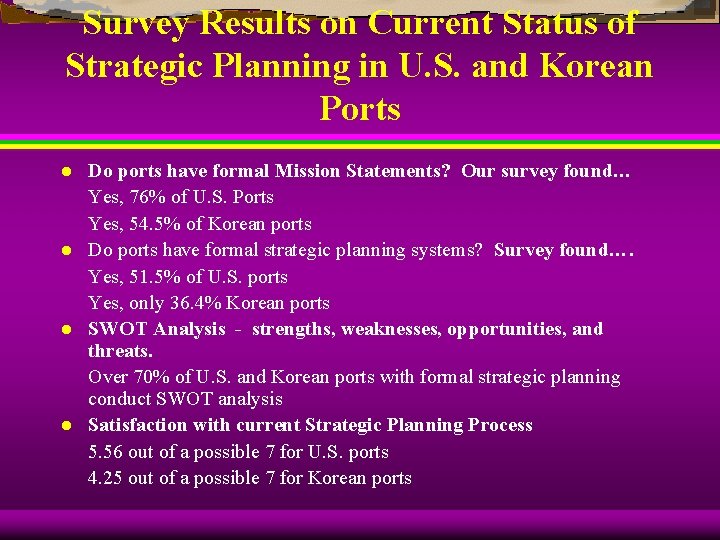
Survey Results on Current Status of Strategic Planning in U. S. and Korean Ports l l Do ports have formal Mission Statements? Our survey found… Yes, 76% of U. S. Ports Yes, 54. 5% of Korean ports Do ports have formal strategic planning systems? Survey found…. Yes, 51. 5% of U. S. ports Yes, only 36. 4% Korean ports SWOT Analysis - strengths, weaknesses, opportunities, and threats. Over 70% of U. S. and Korean ports with formal strategic planning conduct SWOT analysis Satisfaction with current Strategic Planning Process 5. 56 out of a possible 7 for U. S. ports 4. 25 out of a possible 7 for Korean ports
Status of the Balanced Scorecard In the Port Industry Our survey asked port managers about the Balanced Scorecard and we found: 1. Very few ports in the U. S. and none in Korea are using the balanced scorecard? This is not surprising since most U. S. port managers are not familiar with the balanced scorecard and neither are those in Korea. 2. The few ports in the U. S. that we found using the Balanced Scorecard were very satisfied with it so far.
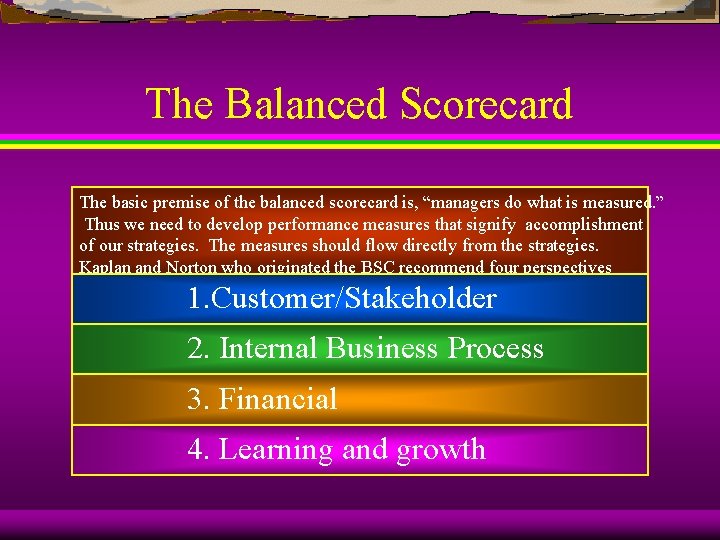
The Balanced Scorecard The basic premise of the balanced scorecard is, “managers do what is measured. ” Thus we need to develop performance measures that signify accomplishment of our strategies. The measures should flow directly from the strategies. Kaplan and Norton who originated the BSC recommend four perspectives 1. Customer/Stakeholder 2. Internal Business Process 3. Financial 4. Learning and growth
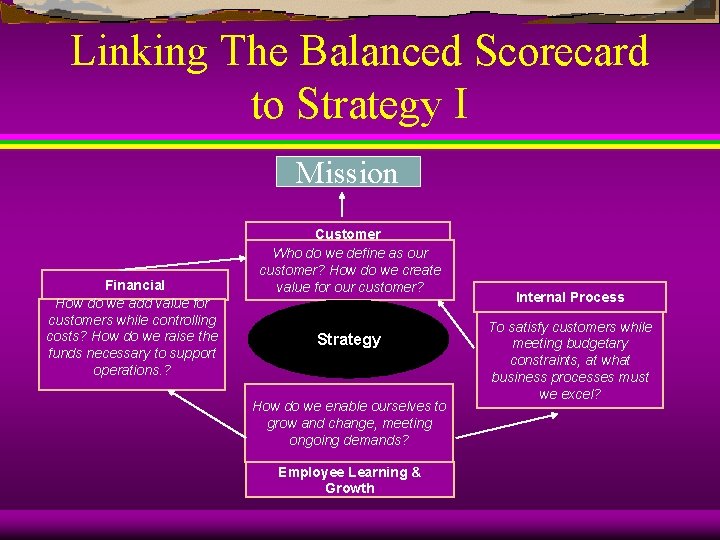
Linking The Balanced Scorecard to Strategy I Mission Financial How do we add value for customers while controlling costs? How do we raise the funds necessary to support operations. ? Customer Who do we define as our customer? How do we create value for our customer? Strategy How do we enable ourselves to grow and change, meeting ongoing demands? Employee Learning & Growth Internal Process To satisfy customers while meeting budgetary constraints, at what business processes must we excel?
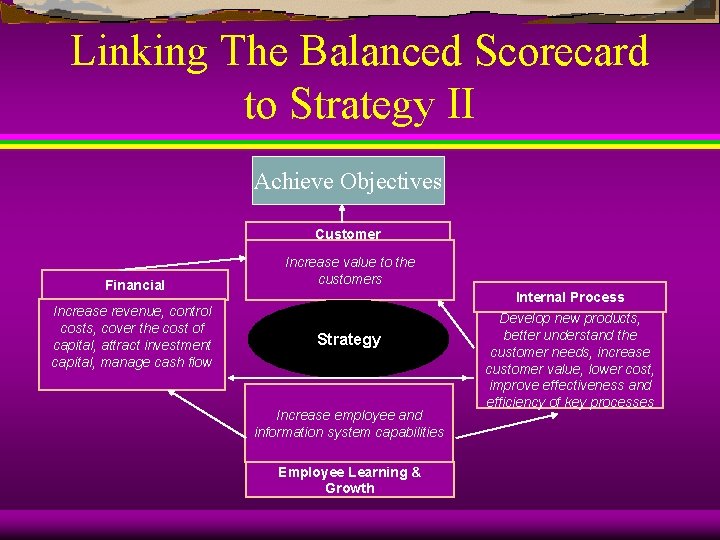
Linking The Balanced Scorecard to Strategy II Achieve Objectives Customer Financial Increase revenue, control costs, cover the cost of capital, attract investment capital, manage cash flow Increase value to the customers Internal Process Strategy Increase employee and information system capabilities Employee Learning & Growth Develop new products, better understand the customer needs, increase customer value, lower cost, improve effectiveness and efficiency of key processes
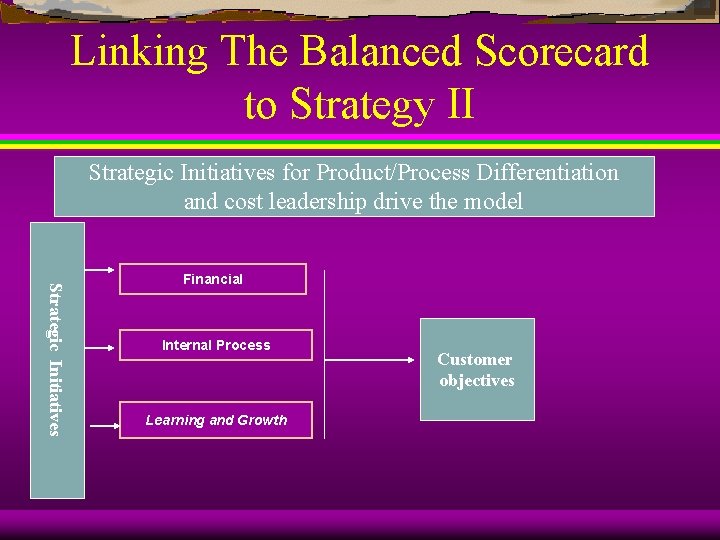
Linking The Balanced Scorecard to Strategy II Strategic Initiatives for Product/Process Differentiation and cost leadership drive the model Strategic Initiatives Financial Internal Process Learning and Growth Customer objectives
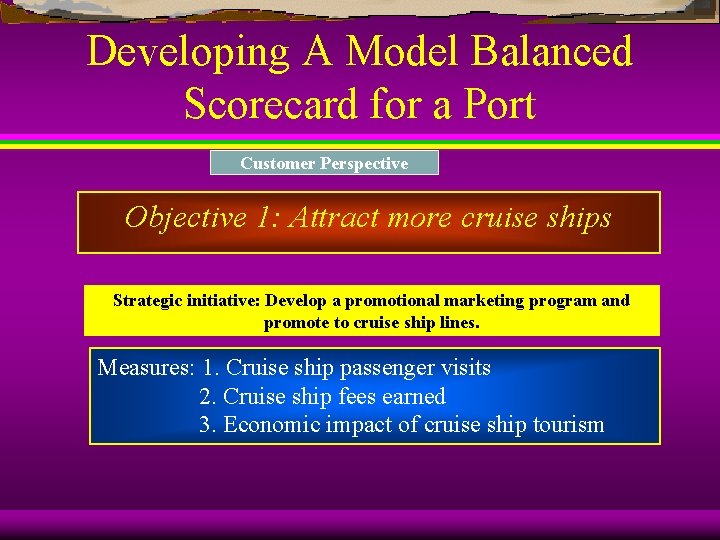
Developing A Model Balanced Scorecard for a Port Customer Perspective Objective 1: Attract more cruise ships Strategic initiative: Develop a promotional marketing program and promote to cruise ship lines. Measures: 1. Cruise ship passenger visits 2. Cruise ship fees earned 3. Economic impact of cruise ship tourism
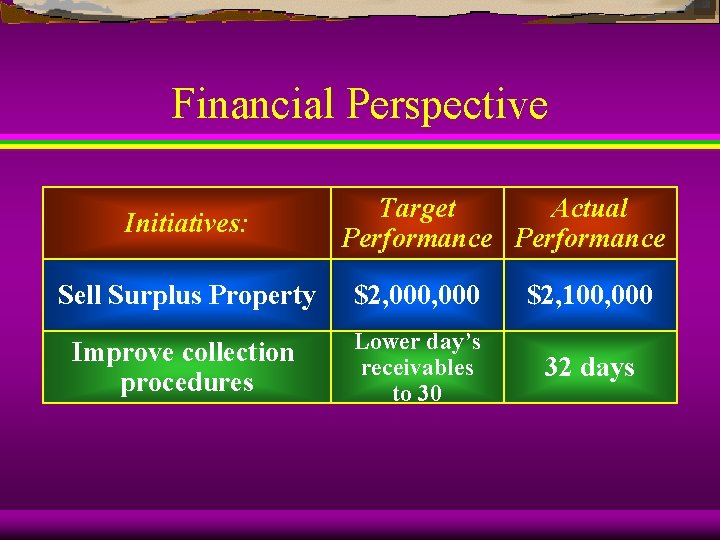
Financial Perspective Initiatives: Target Actual Performance Sell Surplus Property $2, 000 $2, 100, 000 Improve collection procedures Lower day’s receivables to 30 32 days
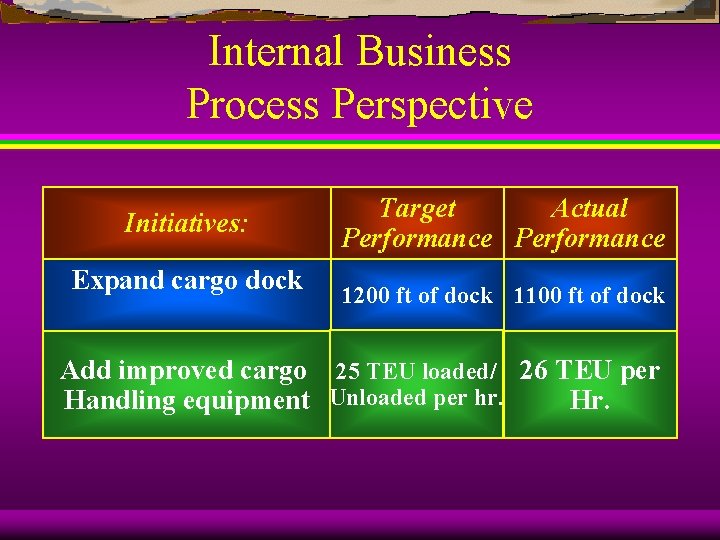
Internal Business Process Perspective Initiatives: Expand cargo dock Target Actual Performance 1200 ft of dock 1100 ft of dock Add improved cargo 25 TEU loaded/ 26 TEU per Handling equipment Unloaded per hr. Hr.

Learning and Growth Perspective Objectives: Align employee and organization goals Improve MIS cash forecasting capability Measures: Employee satisfaction survey Finance department evaluation
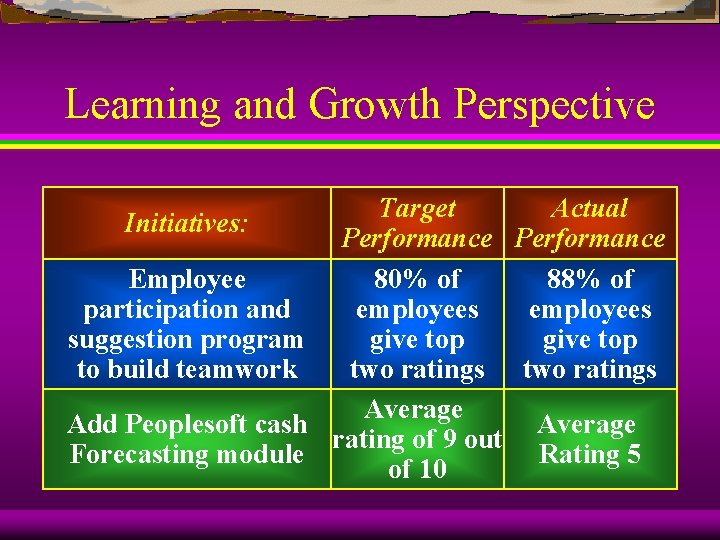
Learning and Growth Perspective Target Actual Initiatives: Performance Employee 80% of 88% of participation and employees suggestion program give top to build teamwork two ratings Average Add Peoplesoft cash Average rating of 9 out Forecasting module Rating 5 of 10
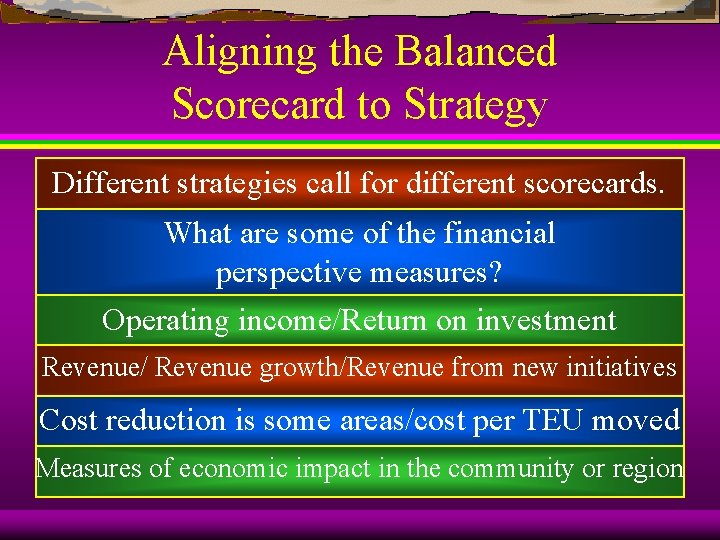
Aligning the Balanced Scorecard to Strategy Different strategies call for different scorecards. What are some of the financial perspective measures? Operating income/Return on investment Revenue/ Revenue growth/Revenue from new initiatives Cost reduction is some areas/cost per TEU moved Measures of economic impact in the community or region
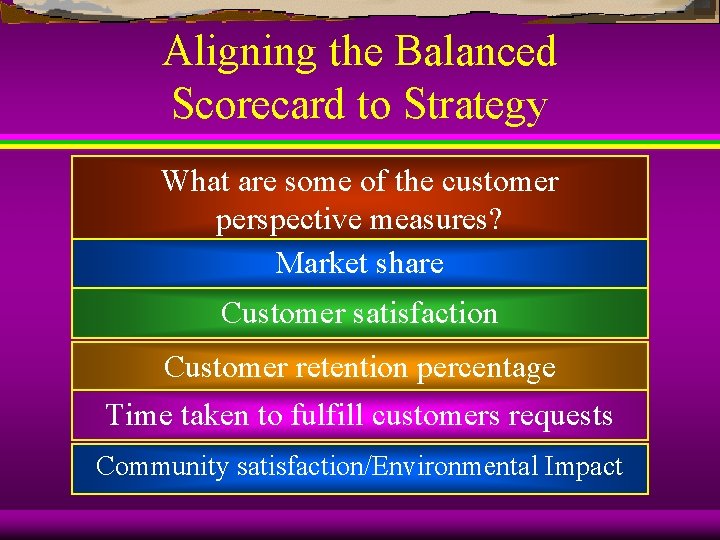
Aligning the Balanced Scorecard to Strategy What are some of the customer perspective measures? Market share Customer satisfaction Customer retention percentage Time taken to fulfill customers requests Community satisfaction/Environmental Impact
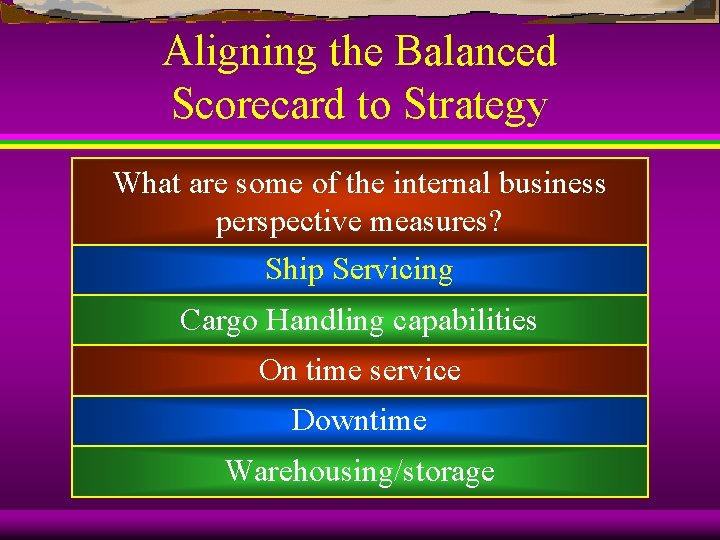
Aligning the Balanced Scorecard to Strategy What are some of the internal business perspective measures? Ship Servicing Cargo Handling capabilities On time service Downtime Warehousing/storage
Aligning the Balanced Scorecard to Strategy What are some of the learning and growth perspective measures? Employee education and skill level Employee satisfaction scores Employee turnover rates Information system availability Percentage of processes with advanced controls
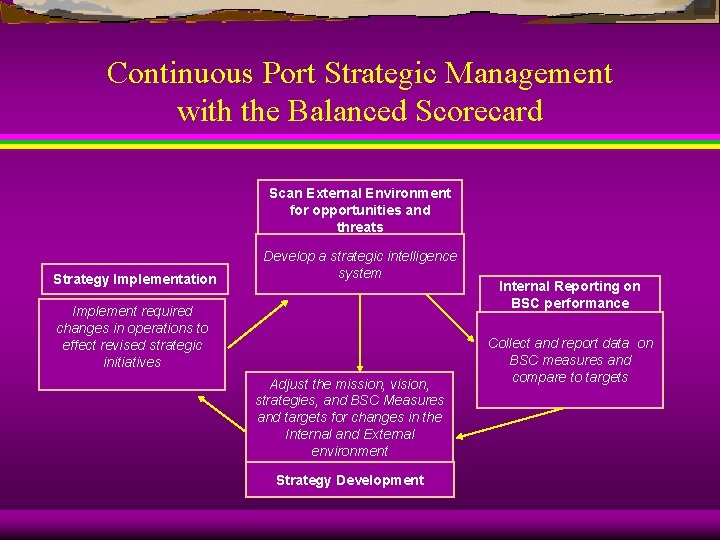
Continuous Port Strategic Management with the Balanced Scorecard Scan External Environment for opportunities and threats Strategy Implementation Develop a strategic intelligence system Implement required changes in operations to effect revised strategic initiatives Adjust the mission, vision, strategies, and BSC Measures and targets for changes in the Internal and External environment Strategy Development Internal Reporting on BSC performance Collect and report data on BSC measures and compare to targets
Strengths of the Balanced Scorecard 1. Links strategy to mission to implementation and performance 2. Allows goal alignment through the organization. 3. Provides a means to evaluate strategic planning. 3. Provides a vehicle for communicating mission, vision and strategies.
Pitfalls When Implementing a Balanced Scorecard What pitfalls should be avoided when implementing a balanced scorecard? 1. Don’t assume the cause-and-effect linkages to be precise. 2. Don’t seek improvements across all measures all the time. 3. Don’t use only objective measures on the scorecard.
Pitfalls When Implementing a Balanced Scorecard 4. Don’t fail to consider both costs and benefits of initiatives such as spending on information technology and research and development. 5. Don’t ignore nonfinancial measures when evaluating managers and employees. 6. Don’t use too many measures.
Pitfalls When Implementing a Balanced Scorecard 7. Maintain flexibility to add new measures for emergent strategies. Watch out for excessive centratization and rigidity. 8. Complexity adds cost. Keep it as simple as possible. Consider the cost versus the benefit of when selecting BSC measures. 9. Garbage in, garbage out. Insure that reliable data can be collected for all measures.
- Slides: 27