
Strategic Planning 101 Using a Guided Process to
- Slides: 53
Strategic Planning 101 Using a Guided Process to Reach Long-term Goals Supplemental Self-Study Presentation
Strategic Planning 101 Overview
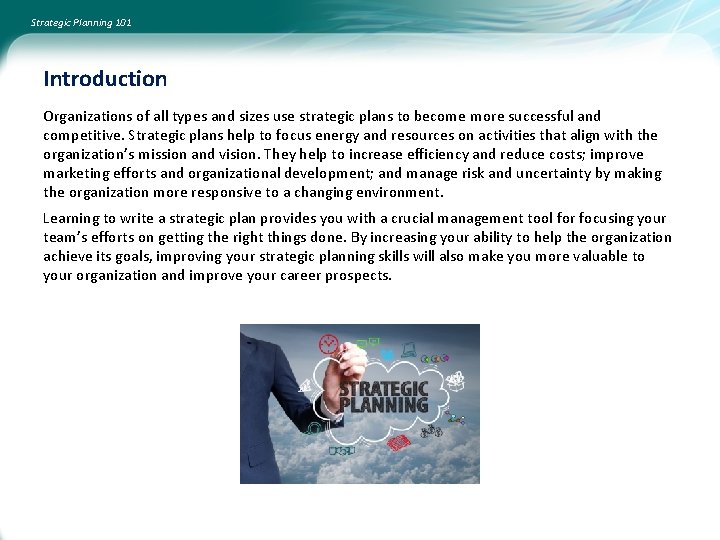
Strategic Planning 101 Introduction Organizations of all types and sizes use strategic plans to become more successful and competitive. Strategic plans help to focus energy and resources on activities that align with the organization’s mission and vision. They help to increase efficiency and reduce costs; improve marketing efforts and organizational development; and manage risk and uncertainty by making the organization more responsive to a changing environment. Learning to write a strategic plan provides you with a crucial management tool for focusing your team’s efforts on getting the right things done. By increasing your ability to help the organization achieve its goals, improving your strategic planning skills will also make you more valuable to your organization and improve your career prospects.
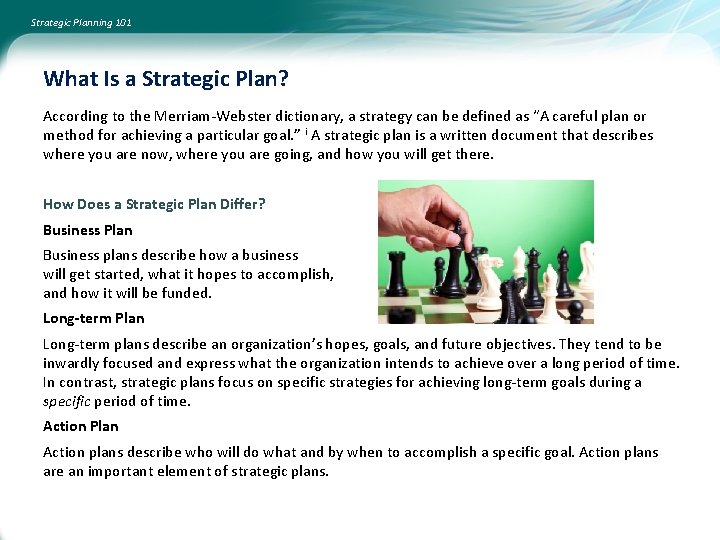
Strategic Planning 101 What Is a Strategic Plan? According to the Merriam-Webster dictionary, a strategy can be defined as “A careful plan or method for achieving a particular goal. ” i A strategic plan is a written document that describes where you are now, where you are going, and how you will get there. How Does a Strategic Plan Differ? Business Plan Business plans describe how a business will get started, what it hopes to accomplish, and how it will be funded. Long-term Plan Long-term plans describe an organization’s hopes, goals, and future objectives. They tend to be inwardly focused and express what the organization intends to achieve over a long period of time. In contrast, strategic plans focus on specific strategies for achieving long-term goals during a specific period of time. Action Plan Action plans describe who will do what and by when to accomplish a specific goal. Action plans are an important element of strategic plans.
Strategic Planning 101 How Could You Use Strategic Planning? Strategic plans can be developed at the organizational level, the department or unit level, the team level, and even at the individual level. Examples: • (Sales department) Increase our client base • (Health clinic) Expand the geographic area we serve • (Corporate publications department) Update our publications • (Technology company) Get our products to market more quickly • (Small retail business) Attract new customers; reach a new market • (Individual) Prepare for a new career; pursue a new opportunity
Strategic Planning 101 Module 1: An Introduction to Strategic Planning
Strategic Planning 101 When to Implement a Strategic Plan Although most situations benefit from some kind of planning, strategic planning is not necessary for every single goal you need to accomplish. Here are some situations in which a strategic plan is likely to increase your chances of success: When you are embarking on something new or initiating a major change in the way you do things When you are not getting the results you want or meeting your goals When there is significant change in the organization’s management and/or focus Where people seem to be spending all their time putting out fires or in nonproductive work When you are not keeping up with your competitors On a regular basis, perhaps at the beginning of each fiscal year if thing are relatively stable, and more often if they are changing rapidly
Strategic Planning 101 What to Include in a Strategic Plan Strategic plans can be complex and far-reaching. They can also be relatively simple. But just as all business plans have financial projections and all action plans have task lists, strategic plans all share essentially the same components. Whether a strategic plan is for a large organization or a small one, it should describe: • Your vision, mission, and core values – your organization’s underlying principles • An assessment of the current situation (where you are now) • Your strategic goals (where you want to go) • Your priorities – what you consider to be most important • Your objectives and action items (how you’ll get there) • A measurement and evaluation process – how you’ll know whether the strategies are successful
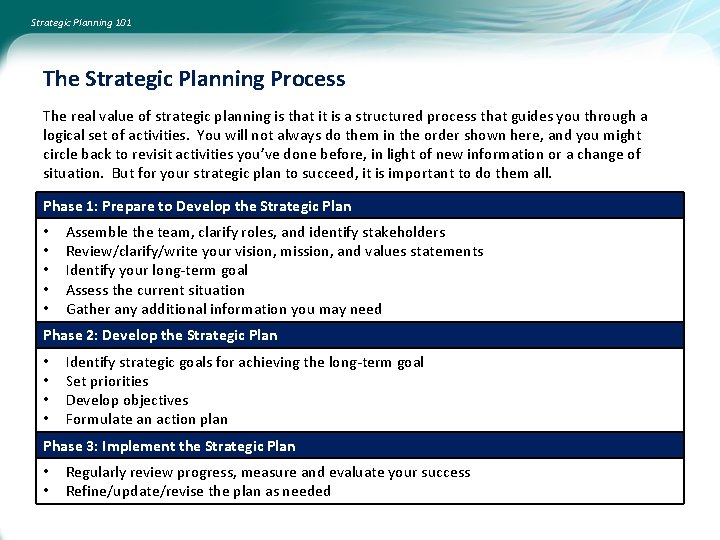
Strategic Planning 101 The Strategic Planning Process The real value of strategic planning is that it is a structured process that guides you through a logical set of activities. You will not always do them in the order shown here, and you might circle back to revisit activities you’ve done before, in light of new information or a change of situation. But for your strategic plan to succeed, it is important to do them all. Phase 1: Prepare to Develop the Strategic Plan • • • Assemble the team, clarify roles, and identify stakeholders Review/clarify/write your vision, mission, and values statements Identify your long-term goal Assess the current situation Gather any additional information you may need Phase 2: Develop the Strategic Plan • • Identify strategic goals for achieving the long-term goal Set priorities Develop objectives Formulate an action plan Phase 3: Implement the Strategic Plan • • Regularly review progress, measure and evaluate your success Refine/update/revise the plan as needed
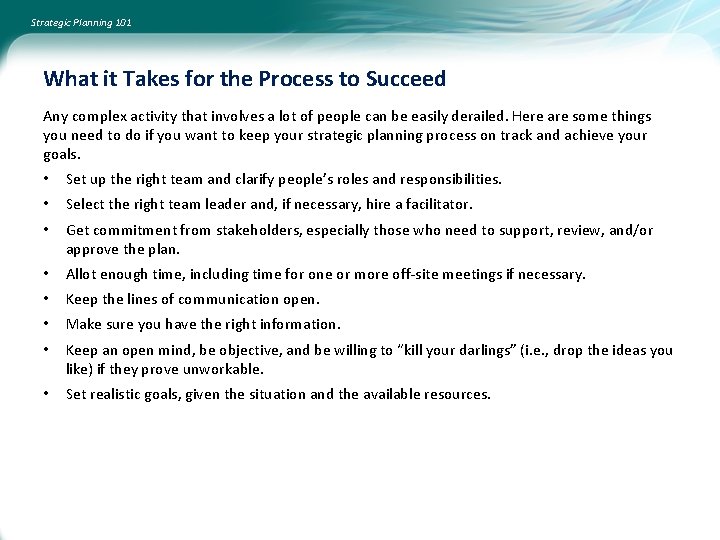
Strategic Planning 101 What it Takes for the Process to Succeed Any complex activity that involves a lot of people can be easily derailed. Here are some things you need to do if you want to keep your strategic planning process on track and achieve your goals. • Set up the right team and clarify people’s roles and responsibilities. • Select the right team leader and, if necessary, hire a facilitator. • Get commitment from stakeholders, especially those who need to support, review, and/or approve the plan. • Allot enough time, including time for one or more off-site meetings if necessary. • Keep the lines of communication open. • Make sure you have the right information. • Keep an open mind, be objective, and be willing to “kill your darlings” (i. e. , drop the ideas you like) if they prove unworkable. • Set realistic goals, given the situation and the available resources.
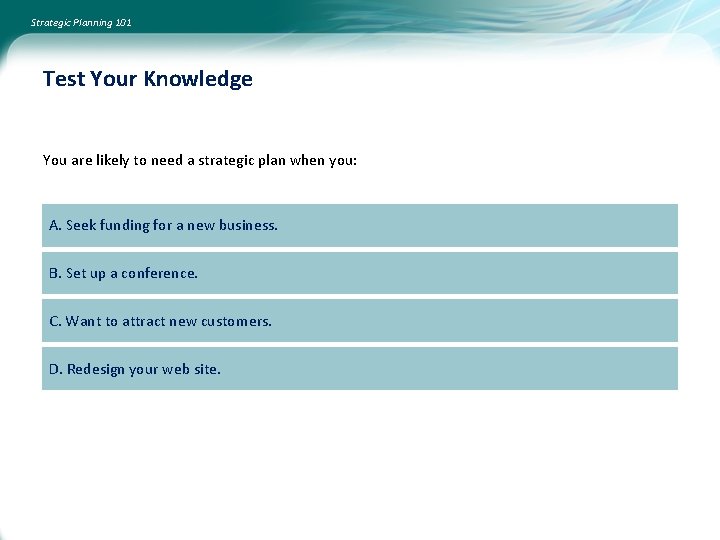
Strategic Planning 101 Test Your Knowledge You are likely to need a strategic plan when you: A. Seek funding for a new business. B. Set up a conference. C. Want to attract new customers. D. Redesign your web site.
Strategic Planning 101 Module 2: Preparing to Develop the Strategic Plan
Strategic Planning 101 Assembling the Team It’s possible for one or two people to develop a strategic plan. But the process works best when other people are involved. Taking the time to assemble the right team pays off in terms of your ability to achieve your goals. While the specific members on your team will vary depending on the situation, all teams should generally have the same characteristics. Characteristics of a Successful Strategic Planning Team Relatively small. Teams with fewer than seven or eight members may not have enough diversity or may require too much work for individuals to carry out on their own. Teams with more than 12– 15 members may be too unwieldy to get things done efficiently. Chosen with diversity in mind. Differing perspectives, skills, experience, and responsibilities lead to better ideas and more workable strategies. Committed to the process. Developing a strategic plan doesn’t happen overnight. Team members must be willing to put in the necessary time and energy.
Strategic Planning 101 Assembling the Team (cont. ) Made up of key people. In every situation, there are certain people who must be involved for the strategic planning process to work—perhaps those with essential information or skills, or those with the greatest stake in the outcome. Clear on roles and responsibilities. For the process to go smoothly, team members need to know what role each of them is to play and who is responsible for what. Guided by good leaders. The team leader is often the person with the highest level of responsibility and/or the biggest stake in the outcome. Sometimes, however, another individual is better suited by experience and temperament to lead the team toward its goals. Use a facilitator (as necessary). In some situations, strategic planning meetings are more productive when the team brings in an outside facilitator. Experienced facilitators who have no stake in the outcome may be more able to lead the group through the idea-generating and decision making process.
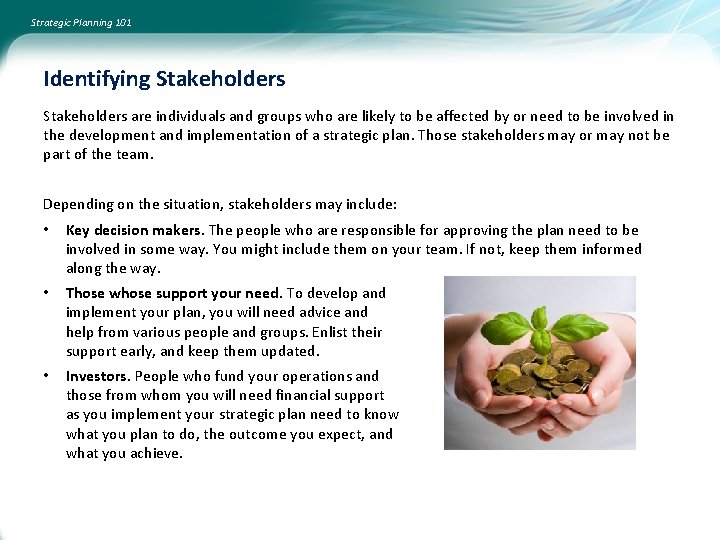
Strategic Planning 101 Identifying Stakeholders are individuals and groups who are likely to be affected by or need to be involved in the development and implementation of a strategic plan. Those stakeholders may or may not be part of the team. Depending on the situation, stakeholders may include: • Key decision makers. The people who are responsible for approving the plan need to be involved in some way. You might include them on your team. If not, keep them informed along the way. • Those whose support your need. To develop and implement your plan, you will need advice and help from various people and groups. Enlist their support early, and keep them updated. • Investors. People who fund your operations and those from whom you will need financial support as you implement your strategic plan need to know what you plan to do, the outcome you expect, and what you achieve.
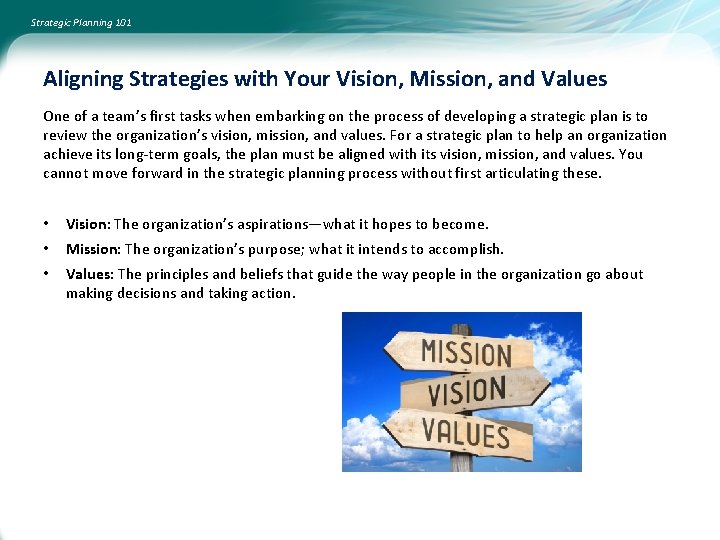
Strategic Planning 101 Aligning Strategies with Your Vision, Mission, and Values One of a team’s first tasks when embarking on the process of developing a strategic plan is to review the organization’s vision, mission, and values. For a strategic plan to help an organization achieve its long-term goals, the plan must be aligned with its vision, mission, and values. You cannot move forward in the strategic planning process without first articulating these. • Vision: The organization’s aspirations—what it hopes to become. • Mission: The organization’s purpose; what it intends to accomplish. • Values: The principles and beliefs that guide the way people in the organization go about making decisions and taking action.
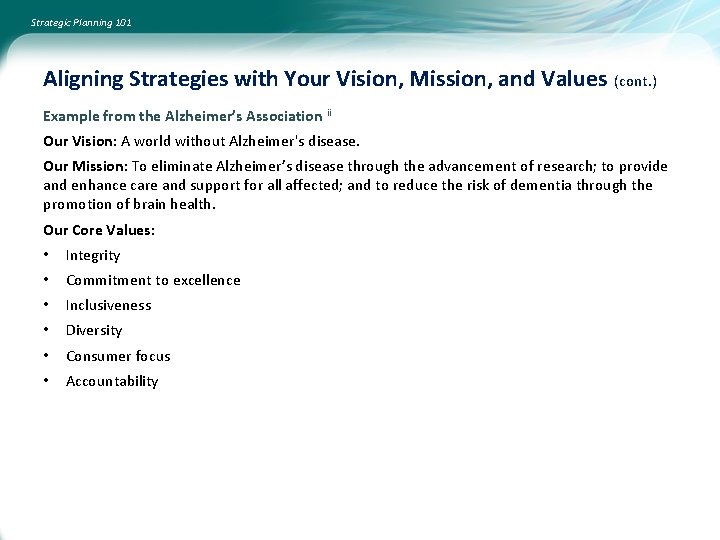
Strategic Planning 101 Aligning Strategies with Your Vision, Mission, and Values (cont. ) Example from the Alzheimer’s Association ii Our Vision: A world without Alzheimer's disease. Our Mission: To eliminate Alzheimer’s disease through the advancement of research; to provide and enhance care and support for all affected; and to reduce the risk of dementia through the promotion of brain health. Our Core Values: • Integrity • Commitment to excellence • Inclusiveness • Diversity • Consumer focus • Accountability
Strategic Planning 101 Assessing Your Current Situation Before you can identify the strategic goals that describe where you want to go, it is important to consider where you are now. There are some questions you can use to help you assess your current situation. Depending on such factors as the nature of the business and your long-term goals, explore these kinds of questions so you can make informed decisions about what strategies are most likely to help achieve your long-term goals. Be careful not to rush this process. Take enough time to explore the questions thoroughly and to gather whatever additional information you need to determine the best strategies for achieving your goals. Questions for Assessing the Current Situation What are our strengths? A successful strategic plan will focus on your strong areas. What do you do best? What sets you apart? What are our weak areas? For your strategies to succeed, you need a realistic appraisal of your weaknesses. What do you do least well? Where do you fall short?
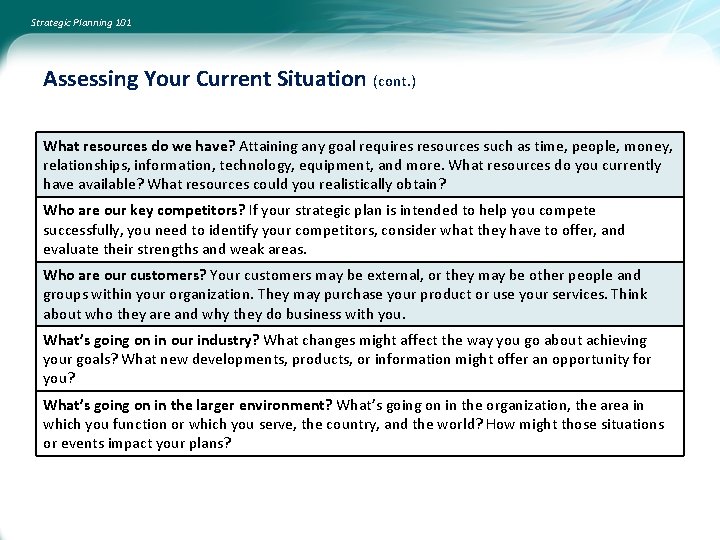
Strategic Planning 101 Assessing Your Current Situation (cont. ) What resources do we have? Attaining any goal requires resources such as time, people, money, relationships, information, technology, equipment, and more. What resources do you currently have available? What resources could you realistically obtain? Who are our key competitors? If your strategic plan is intended to help you compete successfully, you need to identify your competitors, consider what they have to offer, and evaluate their strengths and weak areas. Who are our customers? Your customers may be external, or they may be other people and groups within your organization. They may purchase your product or use your services. Think about who they are and why they do business with you. What’s going on in our industry? What changes might affect the way you go about achieving your goals? What new developments, products, or information might offer an opportunity for you? What’s going on in the larger environment? What’s going on in the organization, the area in which you function or which you serve, the country, and the world? How might those situations or events impact your plans?
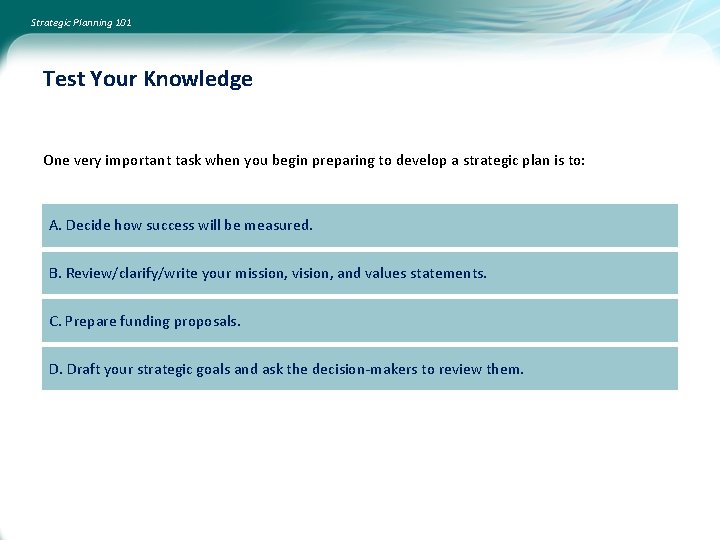
Strategic Planning 101 Test Your Knowledge One very important task when you begin preparing to develop a strategic plan is to: A. Decide how success will be measured. B. Review/clarify/write your mission, vision, and values statements. C. Prepare funding proposals. D. Draft your strategic goals and ask the decision-makers to review them.
Strategic Planning 101 Module 3: Developing the Strategic Plan
Strategic Planning 101 Identifying Your Strategic Goals So far in this process, you have focused on where you currently are. The next step in the process is to use the information and ideas you’ve explored to identify specific strategies to help you get to where you want to go. Suppose you work for a medium-sized company with a long-term goal of being recognized as a socially responsible organization within the community. Strategies for achieving that goal might include: • Provide opportunities for employees to volunteer their time. • Become more environmentally sustainable. • Offer summer intern positions to high-school students.
Strategic Planning 101 Setting Priorities Depending on the situation, you and your team may come up with a lot of possible strategies for getting to where you want to go. In most circumstances, it is impractical to try pursuing all the strategic goals you come up with. Thus, your next task is to set priorities so you can focus your efforts. These questions can help you do that. To identify priorities, consider these types of questions: What’s most important? Certain issues might have surfaced during your discussion as being more important than others; strategies for addressing those issues will probably be among your highest priorities. What strategies could we reasonably pursue right now? Consider the resources you have available or will be able to easily obtain. If you won’t have the resources to pursue a strategy, you’ll need to set it aside until you do—or develop a strategy for obtaining those necessary resources.
Strategic Planning 101 Setting Priorities (cont. ) Is the cost worth the benefit? Consider what it will cost to pursue the strategic goal in terms of resources, public perception, reputation, etc. Then evaluate whether the outcome will be worth that cost. If not, reconsider the strategy. How likely is the strategic goal to help us achieve our long-term goals? Some of the strategies are more likely to move you toward your long-term goals than others. If they are ones you can reasonably pursue, and they pass the cost-benefit test, they will most likely move to the top of your list. How well is the strategy aligned with our vision, mission, and values? It’s possible that your team will come up with a strategic goal or two that meet all the other criteria but that does not align with your vision, mission, and values. No matter how good that strategy may seem, you either have to drop it from your list or take a closer look at what your business is and the principles on which it’s based.
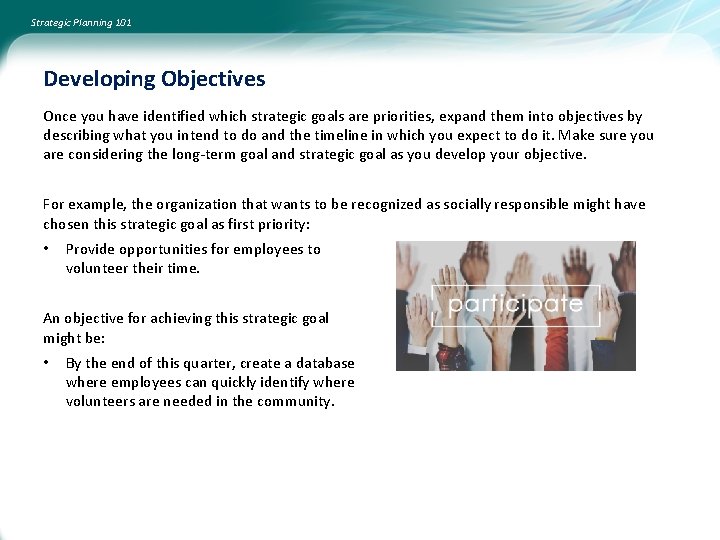
Strategic Planning 101 Developing Objectives Once you have identified which strategic goals are priorities, expand them into objectives by describing what you intend to do and the timeline in which you expect to do it. Make sure you are considering the long-term goal and strategic goal as you develop your objective. For example, the organization that wants to be recognized as socially responsible might have chosen this strategic goal as first priority: • Provide opportunities for employees to volunteer their time. An objective for achieving this strategic goal might be: • By the end of this quarter, create a database where employees can quickly identify where volunteers are needed in the community.
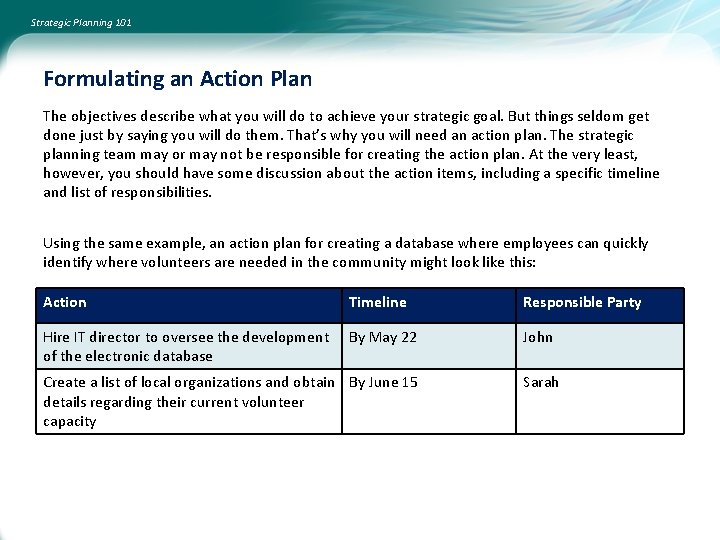
Strategic Planning 101 Formulating an Action Plan The objectives describe what you will do to achieve your strategic goal. But things seldom get done just by saying you will do them. That’s why you will need an action plan. The strategic planning team may or may not be responsible for creating the action plan. At the very least, however, you should have some discussion about the action items, including a specific timeline and list of responsibilities. Using the same example, an action plan for creating a database where employees can quickly identify where volunteers are needed in the community might look like this: Action Timeline Responsible Party Hire IT director to oversee the development of the electronic database By May 22 John Create a list of local organizations and obtain By June 15 details regarding their current volunteer capacity Sarah
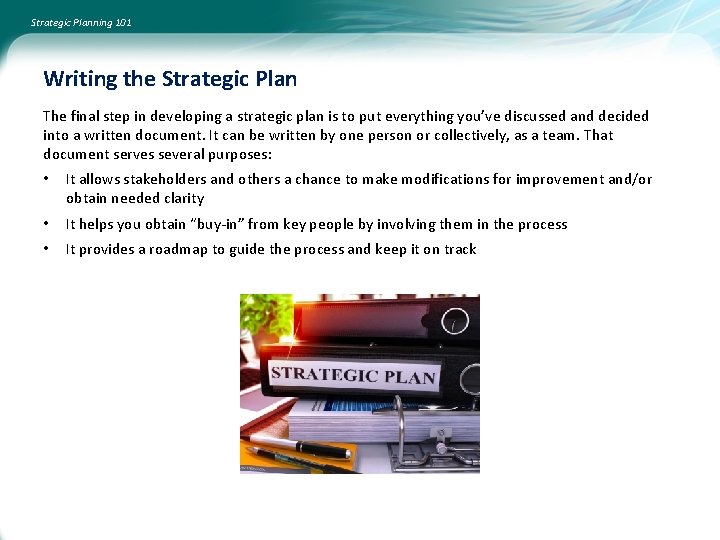
Strategic Planning 101 Writing the Strategic Plan The final step in developing a strategic plan is to put everything you’ve discussed and decided into a written document. It can be written by one person or collectively, as a team. That document serves several purposes: • It allows stakeholders and others a chance to make modifications for improvement and/or obtain needed clarity • It helps you obtain “buy-in” from key people by involving them in the process • It provides a roadmap to guide the process and keep it on track
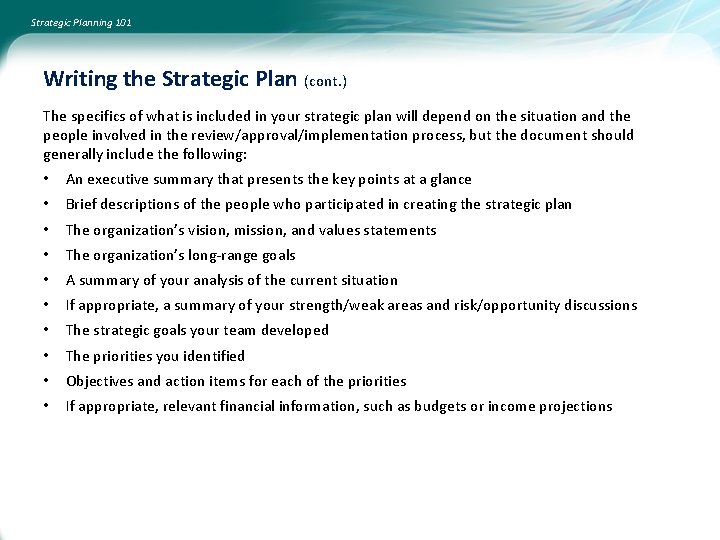
Strategic Planning 101 Writing the Strategic Plan (cont. ) The specifics of what is included in your strategic plan will depend on the situation and the people involved in the review/approval/implementation process, but the document should generally include the following: • An executive summary that presents the key points at a glance • Brief descriptions of the people who participated in creating the strategic plan • The organization’s vision, mission, and values statements • The organization’s long-range goals • A summary of your analysis of the current situation • If appropriate, a summary of your strength/weak areas and risk/opportunity discussions • The strategic goals your team developed • The priorities you identified • Objectives and action items for each of the priorities • If appropriate, relevant financial information, such as budgets or income projections
Strategic Planning 101 Distributing and Revising the Plan When all team members feel that the document clearly presents the strategic plan, you’re ready to distribute it to the necessary people, obtain their feedback, and revise the plan as needed. First, the team must decide who should receive copies of the entire strategic planning document or key sections of it. There are many factors to consider when determining who should receive copies of your strategic plan. Here are some possible recipients: • Anyone whose approval you’ll need to obtain, such as a CEO, a board of directors, a management team, or a division manager • Anyone who will be directly involved in implementing the plan • Anyone who will be directly affected by its implementation, such as selected clients, customers, or community partners • Anyone who can offer support and help in its implementation, such as key consultants and advisors • All employees, particularly if yours is a small organization or the plans will be implemented at the company level How the plan is shared can vary. You can deliver it in hard copy or online. You should also decide whether you want to distribute the plan in draft or final form. Distributing a draft to at least some of the people on your distribution list and asking for their comments can provide valuable information you can use to refine the plan and create a final document.
Strategic Planning 101 Test Your Knowledge Answer the question, then click on the answer. Which is a useful question to ask when setting priorities for your strategic goals? A. What strategies could we reasonably pursue? B. Who are our stakeholders? C. How many people do we have available for our team? D. Which strategies do we like the best?
Strategic Planning 101 Module 4: Implementing the Strategic Plan
Strategic Planning 101 Putting the Strategic Plan into Action It takes a lot of time and work to develop a strategic plan. But developing it is only the beginning. The plan has value only if you put it into action in a way that increases your chances of success. Depending on the nature of your plan, the number of people involved, and other factors, doing the following to get started can increase your chances of success. Put someone in charge. Plans of all sorts often fail because no single individual has the responsibility for making sure that everything gets done. It’s like putting on a play—the actors, musicians, set designers, and other involved parties each have their own roles and responsibilities. To keep everyone focused on the same goal, they need a director—someone who understands the big picture, knows where they are going, and can guide them in getting there. Communicate! There may be many people in many different areas involved in carrying out a strategic plan. For the plan to be successful, make sure everyone understands the goals and exactly what they are expected to do. Then keep everyone informed about progress and changes along the way.
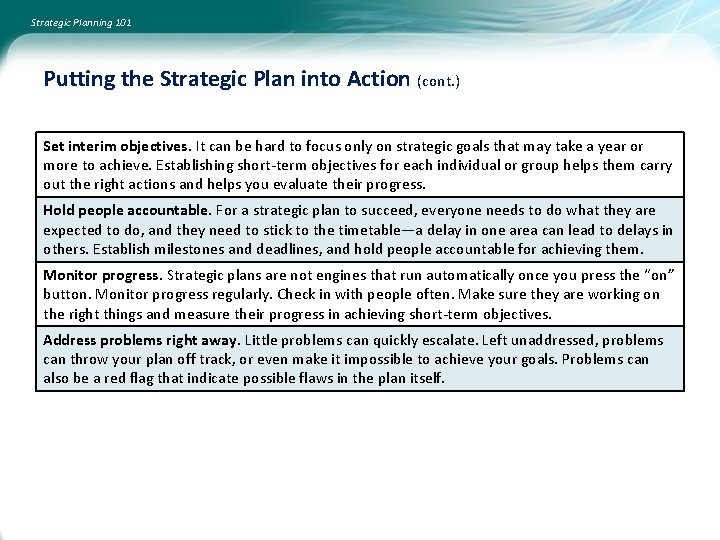
Strategic Planning 101 Putting the Strategic Plan into Action (cont. ) Set interim objectives. It can be hard to focus only on strategic goals that may take a year or more to achieve. Establishing short-term objectives for each individual or group helps them carry out the right actions and helps you evaluate their progress. Hold people accountable. For a strategic plan to succeed, everyone needs to do what they are expected to do, and they need to stick to the timetable—a delay in one area can lead to delays in others. Establish milestones and deadlines, and hold people accountable for achieving them. Monitor progress. Strategic plans are not engines that run automatically once you press the “on” button. Monitor progress regularly. Check in with people often. Make sure they are working on the right things and measure their progress in achieving short-term objectives. Address problems right away. Little problems can quickly escalate. Left unaddressed, problems can throw your plan off track, or even make it impossible to achieve your goals. Problems can also be a red flag that indicate possible flaws in the plan itself.
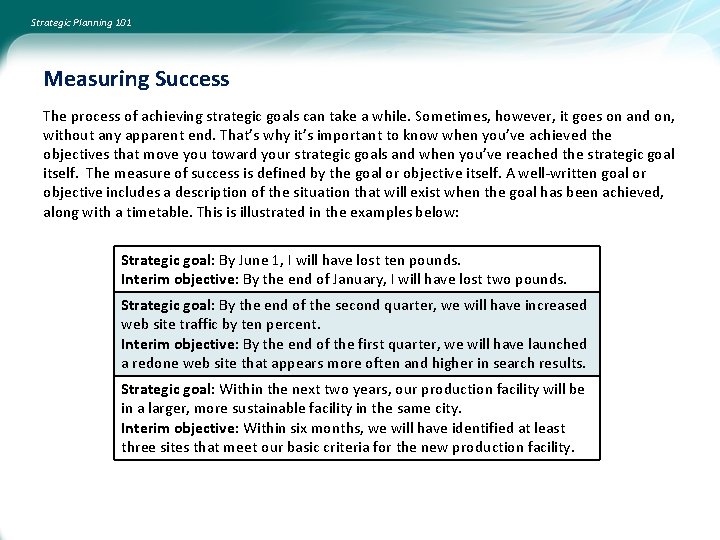
Strategic Planning 101 Measuring Success The process of achieving strategic goals can take a while. Sometimes, however, it goes on and on, without any apparent end. That’s why it’s important to know when you’ve achieved the objectives that move you toward your strategic goals and when you’ve reached the strategic goal itself. The measure of success is defined by the goal or objective itself. A well-written goal or objective includes a description of the situation that will exist when the goal has been achieved, along with a timetable. This is illustrated in the examples below: Strategic goal: By June 1, I will have lost ten pounds. Interim objective: By the end of January, I will have lost two pounds. Strategic goal: By the end of the second quarter, we will have increased web site traffic by ten percent. Interim objective: By the end of the first quarter, we will have launched a redone web site that appears more often and higher in search results. Strategic goal: Within the next two years, our production facility will be in a larger, more sustainable facility in the same city. Interim objective: Within six months, we will have identified at least three sites that meet our basic criteria for the new production facility.
Strategic Planning 101 Responding to Change Moving along a straight track toward the strategic goal would be relatively straightforward, if you could accurately predict the future. But the one thing you can always count on: things will change. One reason to monitor your strategic plan carefully is to ensure that you are able to respond to change. It’s essential to keep in mind that your strategic plan is not set in stone. You are likely to need to make many changes along the way, and you need to remain alert for signs that your strategic goal may no longer be valid.
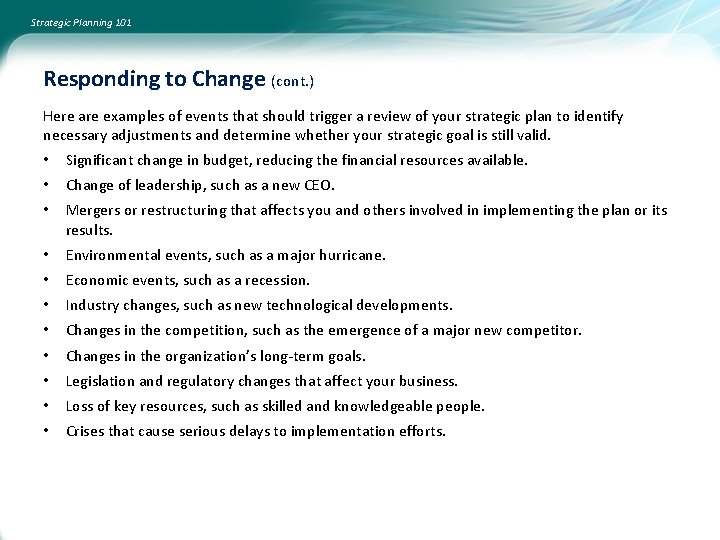
Strategic Planning 101 Responding to Change (cont. ) Here are examples of events that should trigger a review of your strategic plan to identify necessary adjustments and determine whether your strategic goal is still valid. • Significant change in budget, reducing the financial resources available. • Change of leadership, such as a new CEO. • Mergers or restructuring that affects you and others involved in implementing the plan or its results. • Environmental events, such as a major hurricane. • Economic events, such as a recession. • Industry changes, such as new technological developments. • Changes in the competition, such as the emergence of a major new competitor. • Changes in the organization’s long-term goals. • Legislation and regulatory changes that affect your business. • Loss of key resources, such as skilled and knowledgeable people. • Crises that cause serious delays to implementation efforts.
Strategic Planning 101 What to do if the Plan Isn’t Working Carrying out a strategic plan can be difficult. It takes the coordinated work of many people over a relatively long period of time. As a result, many things can go wrong. There can be many reasons why a carefully thought-out, carefully monitored strategic plan can get off track or fail to achieve the strategic goals. These questions can help you assess the situation. Then you can make an informed decision about whether to revise the plan or drop it and go back to the planning process. • Are our goals aligned with the organization’s vision, mission, and values? It’s worth revisiting the strategic plan to ensure that it is consistent with what the organization hopes to be, its reason for existence, and its fundamental principles. If not, even the most carefully crafted and implemented strategic plan is unlikely to work. • Do we have a complete, specific, workable action plan? The work you do to develop a strategic plan is of little use unless the plan is carried out. That requires an action plan that includes short-term objectives, clarifies roles and responsibilities, and includes timelines. If you have no action plan, or your action plan is vague and incomplete, you’ll need to create one or revise the one you have in order to move forward.
Strategic Planning 101 What to do if the Plan Isn’t Working (cont. ) • Do we have full commitment from the necessary people? You can’t implement a strategic plan by yourself. You need the support and assistance of a variety of people, including those who manage the budget and must approve changes to operations or policy as well as those who will do the work. Make sure that the key people understand what you are trying to do and why your strategic goal is important, and get their buy-in. • Are we communicating often enough and clearly enough? To maintain commitment and engagement in the process of achieving a strategic goal, let people know what’s going on. Keep them updated on your progress, let them know when you’ve achieved milestones, and keep them informed about changes. • Are our strategic goals achievable? It takes resources—people, time, money, technology, and more—to achieve a strategic goal. If the plan isn’t working, you might be over-reaching. Without the necessary resources, you may need to scale down, find a different way of achieving the goals, or come up with a more realistic strategic plan. • Are we adapting to change? It’s vital to keep examining your strategic goals in light of a changing internal and external environment, both to make sure they are still valid and to adapt your plan as needed along the way.
Strategic Planning 101 Strategic Planning Guidelines For a smooth, successful strategic planning process, keep the following guidelines in mind: • Distinguish between strategic planning and other forms of planning. • Recognize situations that may indicate the need for a strategic plan. • Assemble the right team: large enough but not too large; diverse enough to bring differing perspectives to the process. • Make sure everyone on the team understands his or her role. • Select the right team leader, and hire a facilitator if necessary. • Gain buy-in from stakeholders. • Align strategies with the organization’s vision, mission, values, and long-term goals. • Do a thorough assessment of the current situation and gather whatever information you need to make informed decisions.
Strategic Planning 101 Strategic Planning Guidelines (cont. ) • Consider your strengths, weak areas, and current situation when identifying possible strategies for achieving the organization’s long-term goals and setting priorities. • Make sure that goals are achievable, given the situation and that there available/obtainable resources. • Identify interim objectives and develop realistic action plans that specify responsibilities, include timelines, and state how success will be measured. • Monitor the implementation of the plan to respond to change, spot and address problems early, and make adjustments as needed. • Keep an open mind, maintain an objective viewpoint, and keep the lines of communication open throughout the process.
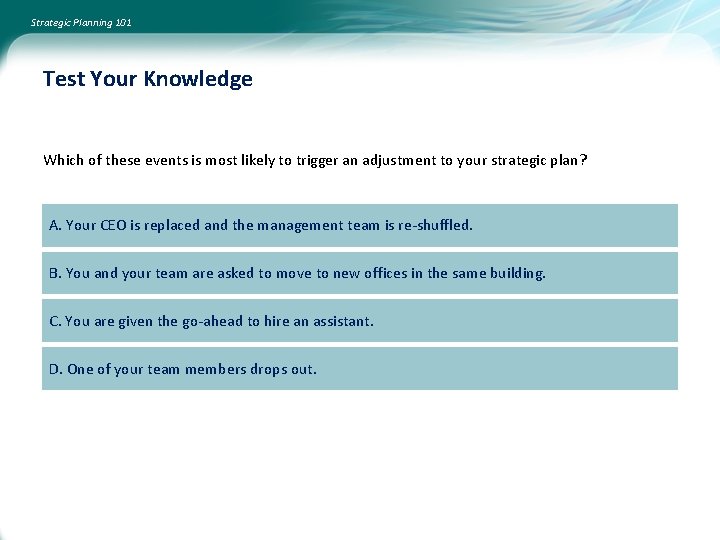
Strategic Planning 101 Test Your Knowledge Which of these events is most likely to trigger an adjustment to your strategic plan? A. Your CEO is replaced and the management team is re-shuffled. B. You and your team are asked to move to new offices in the same building. C. You are given the go-ahead to hire an assistant. D. One of your team members drops out.
Strategic Planning 101 Review
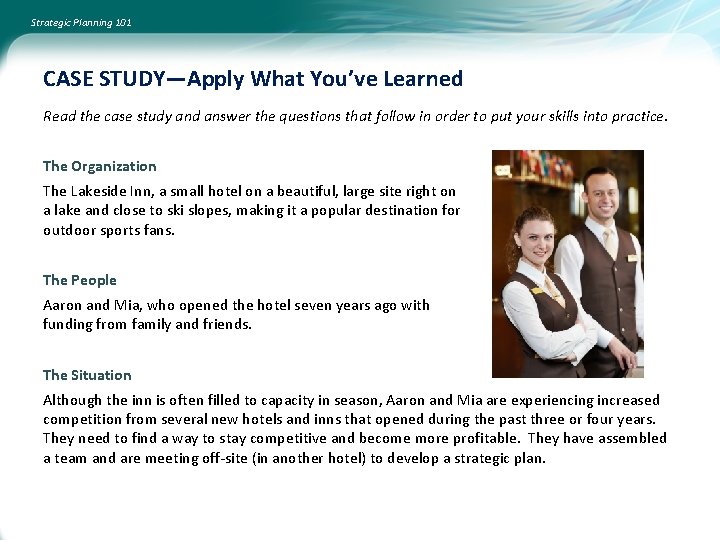
Strategic Planning 101 CASE STUDY—Apply What You’ve Learned Read the case study and answer the questions that follow in order to put your skills into practice. The Organization The Lakeside Inn, a small hotel on a beautiful, large site right on a lake and close to ski slopes, making it a popular destination for outdoor sports fans. The People Aaron and Mia, who opened the hotel seven years ago with funding from family and friends. The Situation Although the inn is often filled to capacity in season, Aaron and Mia are experiencing increased competition from several new hotels and inns that opened during the past three or four years. They need to find a way to stay competitive and become more profitable. They have assembled a team and are meeting off-site (in another hotel) to develop a strategic plan.
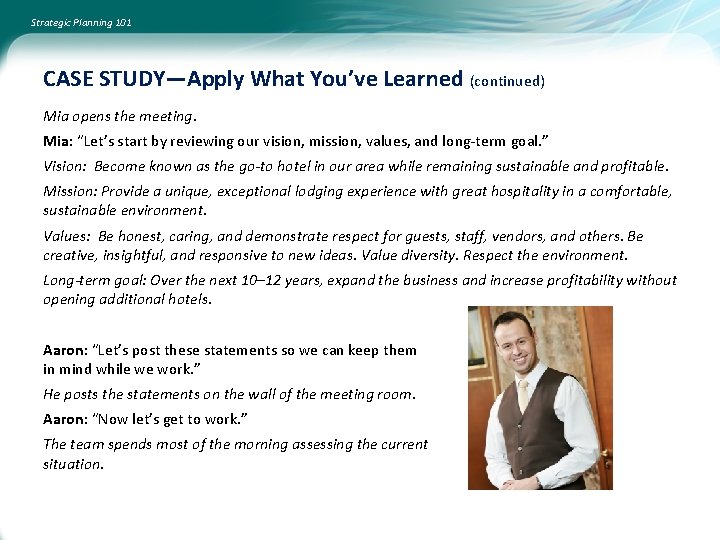
Strategic Planning 101 CASE STUDY—Apply What You’ve Learned (continued) Mia opens the meeting. Mia: “Let’s start by reviewing our vision, mission, values, and long-term goal. ” Vision: Become known as the go-to hotel in our area while remaining sustainable and profitable. Mission: Provide a unique, exceptional lodging experience with great hospitality in a comfortable, sustainable environment. Values: Be honest, caring, and demonstrate respect for guests, staff, vendors, and others. Be creative, insightful, and responsive to new ideas. Value diversity. Respect the environment. Long-term goal: Over the next 10– 12 years, expand the business and increase profitability without opening additional hotels. Aaron: “Let’s post these statements so we can keep them in mind while we work. ” He posts the statements on the wall of the meeting room. Aaron: “Now let’s get to work. ” The team spends most of the morning assessing the current situation.
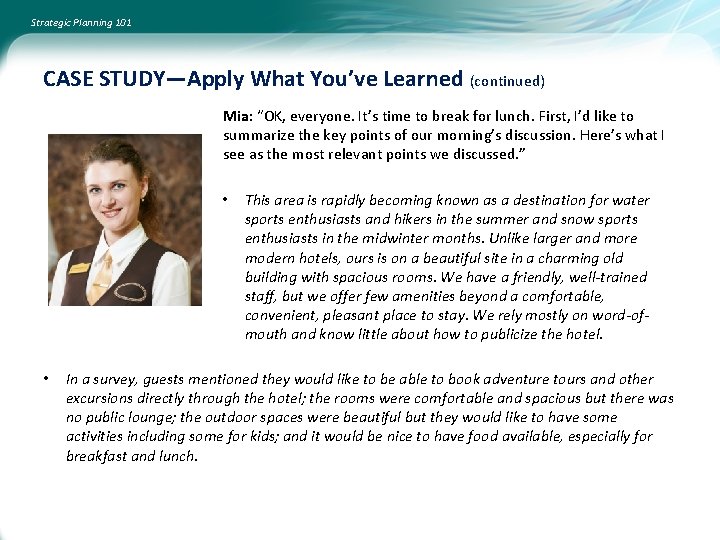
Strategic Planning 101 CASE STUDY—Apply What You’ve Learned (continued) Mia: “OK, everyone. It’s time to break for lunch. First, I’d like to summarize the key points of our morning’s discussion. Here’s what I see as the most relevant points we discussed. ” • • This area is rapidly becoming known as a destination for water sports enthusiasts and hikers in the summer and snow sports enthusiasts in the midwinter months. Unlike larger and more modern hotels, ours is on a beautiful site in a charming old building with spacious rooms. We have a friendly, well-trained staff, but we offer few amenities beyond a comfortable, convenient, pleasant place to stay. We rely mostly on word-ofmouth and know little about how to publicize the hotel. In a survey, guests mentioned they would like to be able to book adventure tours and other excursions directly through the hotel; the rooms were comfortable and spacious but there was no public lounge; the outdoor spaces were beautiful but they would like to have some activities including some for kids; and it would be nice to have food available, especially for breakfast and lunch.
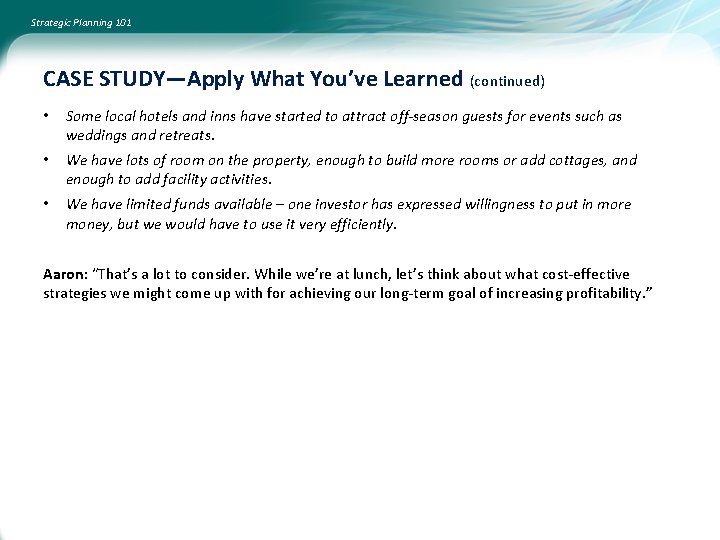
Strategic Planning 101 CASE STUDY—Apply What You’ve Learned (continued) • Some local hotels and inns have started to attract off-season guests for events such as weddings and retreats. • We have lots of room on the property, enough to build more rooms or add cottages, and enough to add facility activities. • We have limited funds available – one investor has expressed willingness to put in more money, but we would have to use it very efficiently. Aaron: “That’s a lot to consider. While we’re at lunch, let’s think about what cost-effective strategies we might come up with for achieving our long-term goal of increasing profitability. ”
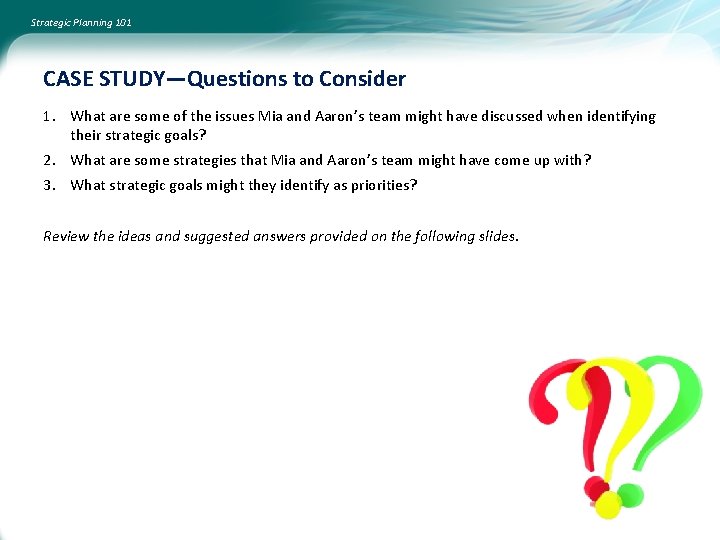
Strategic Planning 101 CASE STUDY—Questions to Consider 1. What are some of the issues Mia and Aaron’s team might have discussed when identifying their strategic goals? 2. What are some strategies that Mia and Aaron’s team might have come up with? 3. What strategic goals might they identify as priorities? Review the ideas and suggested answers provided on the following slides.
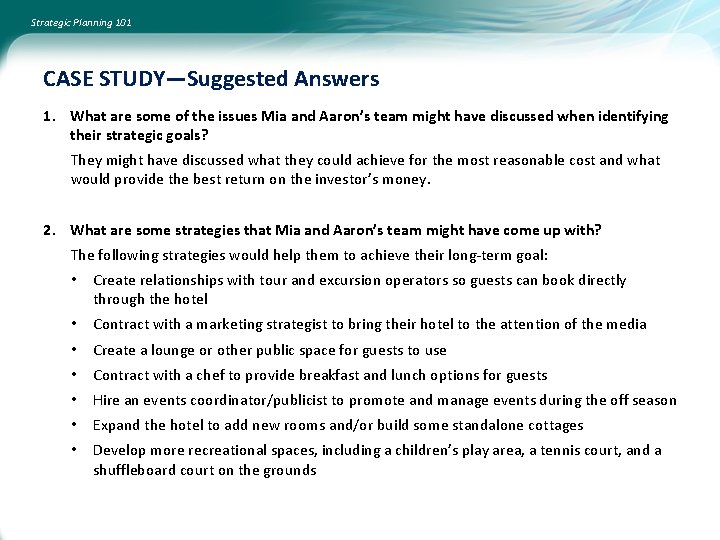
Strategic Planning 101 CASE STUDY—Suggested Answers 1. What are some of the issues Mia and Aaron’s team might have discussed when identifying their strategic goals? They might have discussed what they could achieve for the most reasonable cost and what would provide the best return on the investor’s money. 2. What are some strategies that Mia and Aaron’s team might have come up with? The following strategies would help them to achieve their long-term goal: • Create relationships with tour and excursion operators so guests can book directly through the hotel • Contract with a marketing strategist to bring their hotel to the attention of the media • Create a lounge or other public space for guests to use • Contract with a chef to provide breakfast and lunch options for guests • Hire an events coordinator/publicist to promote and manage events during the off season • Expand the hotel to add new rooms and/or build some standalone cottages • Develop more recreational spaces, including a children’s play area, a tennis court, and a shuffleboard court on the grounds
Strategic Planning 101 CASE STUDY—Suggested Answers (continued) 3. What strategic goals might they identify as priorities? They might identify the following priorities, which they could accomplish relatively quickly and at a reasonable cost: • Develop relationships with tour and excursion operators • Create a lounge or other public space • Hire an events coordinator/publicist • Develop a children’s play area • Contract with a chef to provide breakfast and lunch options for guests
Strategic Planning 101 Congratulations! By now you should be able to: • Recognize the difference between a strategic plan and other planning processes. • Identify the situations in which a strategic plan is most useful. • Understand the three phases in the strategic planning process. • Develop and implement strategies that will help you achieve long-term goals.
Strategic Planning 101 Appendix
Strategic Planning 101 References Aileron. “Five Steps to a Strategic Plan. ” Forbes. Last modified October 25, 2011. https: //www. forbes. com/sites/aileron/2011/10/25/fivesteps-to-a-strategic-plan/#5 c 5 c 3 c 745464. Conerly, Bill. “ 3 Strategic Planning Pitfalls. ” Forbes. Last modified August 15, 2013. https: //www. forbes. com/sites/billconerly/2013/08/15/3 strategic-planning-pitfalls/#339 c 76537136. Grensing-Pophal, Lin. The Complete Idiot’s Guide to Strategic Planning. New York: Penguin Group, 2011. Hill, Brian. “The Importance of Planning in an Organization. ” Chron. http: //smallbusiness. chron. com/importance-planning-organization 1137. html. “Is Strategic Planning the Same as Long-Range Planning? No. ” John Gear Law Office & Salem Consumer Law. Last modified March 1, 2012. http: //www. johngearlaw. com/law-for-real-people-blog/category/strategic%20 planning. Lavinsky, Dave. “Strategic Plan Template: What to Include in Yours. ” Forbes. Last modified October 18, 2013. https: //www. forbes. com/sites/davelavinsky/2013/10/18/strategic-plan-template-what-to-include/#72 e 98 c 2 a 47 e 1. Mintzberg, Henry. The Rise and Fall of Strategic Planning. New York: Financial Times Prentice Hall, 2000. Olsen, Erica. Strategic Planning Kit for Dummies, 2 nd ed. New Jersey: John Wiley & Sons, Inc. , 2012. “Strategic Planning Basics. ” Balanced Scorecard Institute. Last modified August 10, 2017. https: //balancedscorecard. org/Resources/Strategic. Planning. Basics. i https: //www. merriam-webster. com/dictionary/strategy ii “Alzheimer’s Association FY 15 -FY 18 Strategic Plan. ” Alzheimer’s Association. http: //www. alz. org/about_us_strategic_plan. asp.
Strategic Planning 101 © 2017 HRDQ. All rights reserved. Published by HRDQ and the HRDQ logo are registered trademarks of Organization Design and Development, Inc. This publication is distributed under the terms and conditions of the Reproducible Content End User License Agreement (EULA). For specific details, visit www. hrdq. com/legal. For more information about this publication or to order additional copies, please contact the HRDQ Customer Service Team by phone at 610279 -2002 or by email at custserv@hrdq. com. For more information about HRDQ products, visit www. hrdq. com. ISBN 978 -1 -58854 -843 -6 Title slide image: Rawpixel. com/Shutterstock. com. Images used under license from Shutterstock. com. Microsoft®, Word®, Power. Point®, and Outlook® are registered trademarks of Microsoft Corporation. 2750 E 1 STP EN-01 -DC-18