
Strategic Plan for PMR PAMR Tapio Penkkala Chairman
- Slides: 15
Strategic Plan for PMR /PAMR Tapio Penkkala – Chairman ECC / WGFM Project Team 38 28 March 2003 PMR/PAMR Workshop
Content • Introduction of the strategic plan for PMR & PAMR in Europe • Definitions of PMR and PAMR • New frequency bands for PMR & PAMR systems and ECC Decisions on spectrum harmonisation for PMR & PAMR • Decision making process in the ECC • ECC deliverables • Frequency bands for PMR & PAMR • Strategies 28 March 2003 PMR/PAMR Workshop 2
Strategic Plan for PMR & PAMR • Developed in FM PT 38 by administrations, manufacturers, ETSI and EICTA representatives, operators • objectives: üHarmonisation of frequencies for PMR/PAMR üEnsure sufficient amount of spectrum for PMR/PAMR üIdentification of frequency management issues needing to be addressed in CEPT • Consultation (as draft ECC Report 25) until 26 March, expected to be finalised at the WG FM meeting in May 2003 28 March 2003 PMR/PAMR Workshop 3
Strategic plan for PMR & PAMR • Focus on the PMR/PAMR bands between 410 -430 MHz, 450 -470 MHz and 870 -876/915 -921 MHz • Definitions and descriptions of PMR, PAMR and public land mobile networks • Frequency planning principles • Usage of the PMR/PAMR bands • Market and technology developments and trends • General strategy for PMR/PAMR in Europe for the next 10 years. 28 March 2003 PMR/PAMR Workshop 4
Definition of PMR: • Part of land mobile service, based on the use of simplex, half and possibly full duplex modes, to provide closed user group communications • PMR can be either: • traditional, self provided and self-owned by business users small area networks. Example: network in an industrial plant; or • tightly controlled set of inter-related closed user groups • Can be outsourced or owned by a dominant user who allows other related user groups to use the network. • Example: closed network of inter-related municipal organisations such as utility, public transportation, water supply and road maintenance. 28 March 2003 PMR/PAMR Workshop 5
Definition of PAMR • Operator provided, commercially open networks designed for business professional users, dedicated user groups but no limitation on the nature or type of the user groups and no need for these to be related. Not generally intended for these groups to communicate with each other • PAMR networks are operated to provide, on a commercial basis, professional communications facilities comparable to those available using dedicated PMR networks An extensive list of detailed PMR/PAMR features and services is given in the strategic plan 28 March 2003 PMR/PAMR Workshop 6
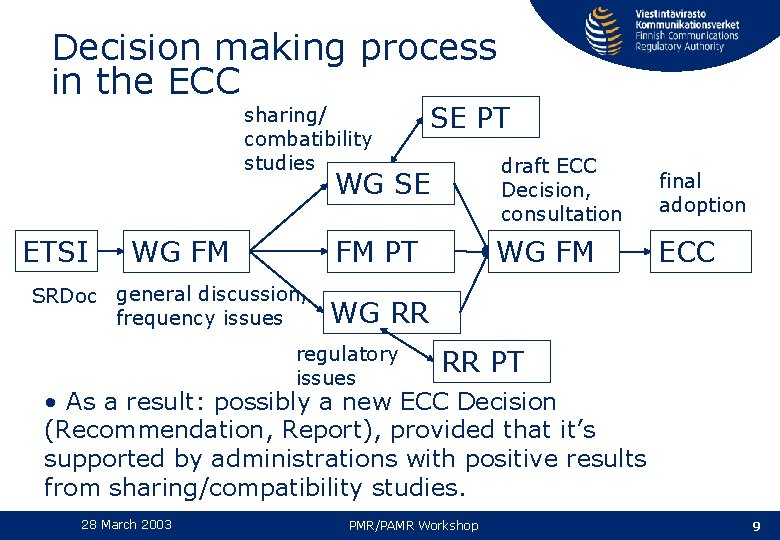
Frequency bands for new systems • Within the Mo. U between ECC and ETSI procedures are agreed to work together closely in the development of standards and in the harmonisation of frequency bands and regulatory requirements for these systems • Preferred way: System Reference Document adopted by the ETSI ERM should be forwarded officially to the WG FM for general consideration. If accepted in the general work programme, the WG FM would forward the system reference document to the relevant group (e. g. WG SE, FM PT 38) for detailed consideration. 28 March 2003 PMR/PAMR Workshop 7
Frequency bands for new systems (cont. ) • WG SE develops sharing criteria between radiocommunication services, systems or applications using the same frequency bands. WG SE also develops compatibility criteria between radiocommunication services using different frequency bands • WG RR studies the regulatory issues related to the use of radio equipment 28 March 2003 PMR/PAMR Workshop 8
Decision making process in the ECC sharing/ combatibility studies ETSI WG FM SRDoc general discussion, frequency issues SE PT WG SE draft ECC Decision, consultation final adoption FM PT WG FM ECC WG RR regulatory issues RR PT • As a result: possibly a new ECC Decision (Recommendation, Report), provided that it’s supported by administrations with positive results from sharing/compatibility studies. 28 March 2003 PMR/PAMR Workshop 9
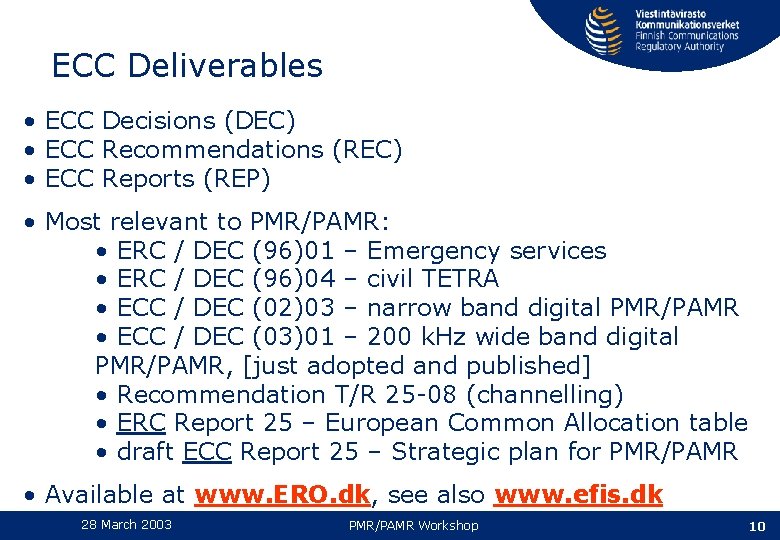
ECC Deliverables • ECC Decisions (DEC) • ECC Recommendations (REC) • ECC Reports (REP) • Most relevant to PMR/PAMR: • ERC / DEC (96)01 – Emergency services • ERC / DEC (96)04 – civil TETRA • ECC / DEC (02)03 – narrow band digital PMR/PAMR • ECC / DEC (03)01 – 200 k. Hz wide band digital PMR/PAMR, [just adopted and published] • Recommendation T/R 25 -08 (channelling) • ERC Report 25 – European Common Allocation table • draft ECC Report 25 – Strategic plan for PMR/PAMR • Available at www. ERO. dk, see also www. efis. dk 28 March 2003 PMR/PAMR Workshop 10
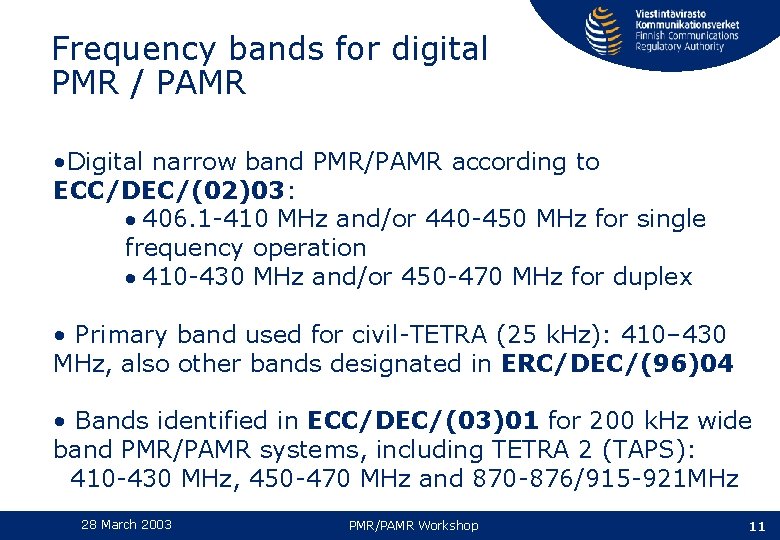
Frequency bands for digital PMR / PAMR • Digital narrow band PMR/PAMR according to ECC/DEC/(02)03: · 406. 1 -410 MHz and/or 440 -450 MHz for single frequency operation · 410 -430 MHz and/or 450 -470 MHz for duplex • Primary band used for civil-TETRA (25 k. Hz): 410– 430 MHz, also other bands designated in ERC/DEC/(96)04 • Bands identified in ECC/DEC/(03)01 for 200 k. Hz wide band PMR/PAMR systems, including TETRA 2 (TAPS): 410 -430 MHz, 450 -470 MHz and 870 -876/915 -921 MHz 28 March 2003 PMR/PAMR Workshop 11
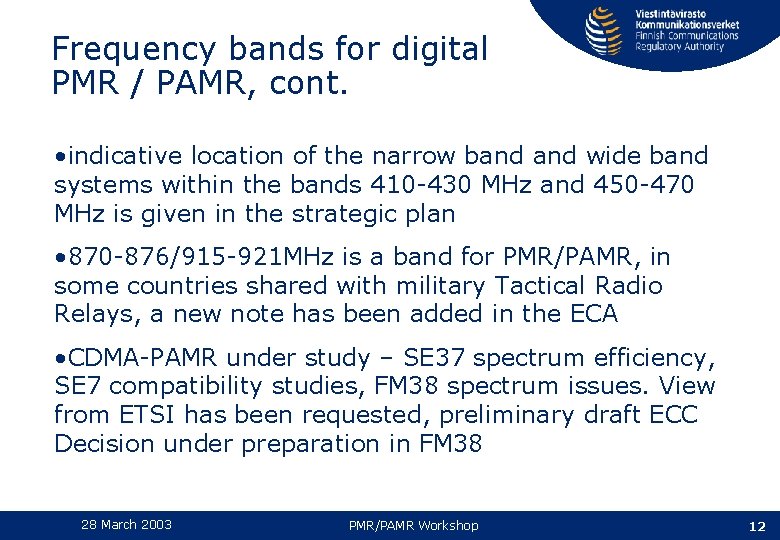
Frequency bands for digital PMR / PAMR, cont. • indicative location of the narrow band wide band systems within the bands 410 -430 MHz and 450 -470 MHz is given in the strategic plan • 870 -876/915 -921 MHz is a band for PMR/PAMR, in some countries shared with military Tactical Radio Relays, a new note has been added in the ECA • CDMA-PAMR under study – SE 37 spectrum efficiency, SE 7 compatibility studies, FM 38 spectrum issues. View from ETSI has been requested, preliminary draft ECC Decision under preparation in FM 38 28 March 2003 PMR/PAMR Workshop 12
PMR & PAMR General Strategies and Statements • Spectrum and dedicated bands needed now and in the future to meet specific requirements for PMR/PAMR, services and features • Shift from analogue to digital ongoing • Shift from narrow band to wideband providing high speed data • Equitable access has to be ensured for all the users who need PMR/PAMR spectrum • Spectrum needs to be made available according to market demands • Trends towards larger networks with better coverage and increasing number of users are expected to continue -> larger common private networks or PAMR • Spectrum needed also for small networks 28 March 2003 PMR/PAMR Workshop 13
PMR & PAMR Strategies • Migration from narrow band to wideband digital PAMR networks • From a technical point of view minimum availability of contiguous spectrum for wideband PAMR is in the order of 2*3 MHz • Gradual harmonisation of the use of these bands, according to market demands and still providing national flexibility 28 March 2003 PMR/PAMR Workshop 14
PMR & PAMR Strategies • In 450 -470 MHz narrow band analogue and digital systems should be introduced from the lower edge of the band, wideband PMR/PAMR above 453/463 MHz. Upper end of the band for existing and future PMR/PAMR allowing also new technologies to be introdued • Same concept should be used in 410 -430 MHz providing spectrum for wideband systems around the middle of the bands • 870 -876 / 915 -921 MHz for wideband PMR/PAMR. To be used from the top end. This band is also identified for military Tactical Radio Relays, shared use to be considered on a national basis. 28 March 2003 PMR/PAMR Workshop 15