
Strategic plan and budget of the Auditor General
Strategic plan and budget of the Auditor General of South Africa for 2010 - 2013 SCo. AG presentation Version 1. 0 16 October 2009 page 1
Mission The Auditor-General has a constitutional mandate and, as the Supreme Audit Institution (SAI) of South Africa, it exists to strengthen our country’s democracy by enabling oversight, accountability and governance in the public sector through auditing, thereby building public confidence. This is our reputation promise 2
Table of contents q Strategic Plan and Budget 2010 -2013 – Overview of AG Commitment – Simplicity, clarity and relevance of reports – Visibility of leadership – Strengthen human resources – Lead by Example – Funding – Detailed Budget – Conclusion q Audit tariffs q Audit directive 3
Strategic Plan and Budget Page 4
Overview of AG Commitment The AGSA remains committed to the following goals in order to impact positively on all aspects of public sector accountability: – ensuring simplicity, clarity and relevance of the messages contained in all our reports, including the quality, timeliness and deepening of stakeholders’ understanding of our reports – improving the visibility of our leadership through clear communication in championing the implementation of audit recommendations – strengthening the human resource strategy with particular emphasis on the comprehensive trainee auditor scheme – leading by example on matters of risk management, internal controls and transformation – focusing on the funding model with a view to stabilising our margins and cash flow situation 5
Simplicity, clarity and relevance of our reports Regularity Audits • Regularity audits continue to drive achievement of clean audit opinions – Root cause analysis – Ensure simplicity, clarity and relevance of messages in AGSA reports • Quality and timeliness of our reports remain pillars of our reputation – Adopt best practice methodologies (incorporating roles and responsibilities) in order to achieve timeliness and quality of AGSA reports Auditing of Performance Information • Increase Ao. PI focus and visibility in order to expedite reporting on the achievement of service delivery goals in phased-in approach – National & provincial departments, constitutional institutions & trading entities – Municipal metropolitan councils & the related municipal entities 6
Simplicity, clarity and relevance of our reports Performance Auditing • Performance auditing themes for 2010 -11 are – Poverty reduction – The oversight and governance of State-Owned Enterprises – Government departments’ use of consultants 7
Simplicity, clarity and relevance of our reports Objective: Continual improvement of the quality & timeliness of AGSA reports Performance measure % Adherence to all quality standards Excellent performance. (Regularity audits, General reports, Performance audits & special investigations; Strategic plan and budget and Annual Report) Tool Quality control assessment Target 2010 -11 Target 2011 -12 Target 2012 -13 85% 86% 87% page 8
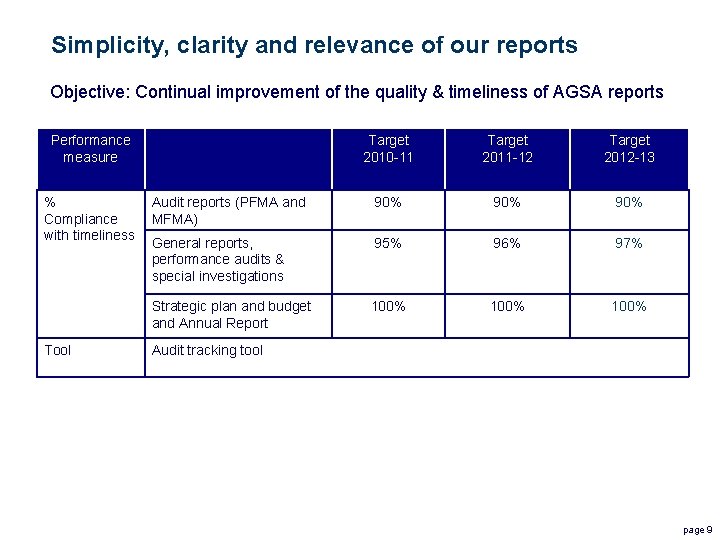
Simplicity, clarity and relevance of our reports Objective: Continual improvement of the quality & timeliness of AGSA reports Performance measure % Compliance with timeliness Tool Target 2010 -11 Target 2011 -12 Target 2012 -13 Audit reports (PFMA and MFMA) 90% 90% General reports, performance audits & special investigations 95% 96% 97% Strategic plan and budget and Annual Report 100% Audit tracking tool page 9
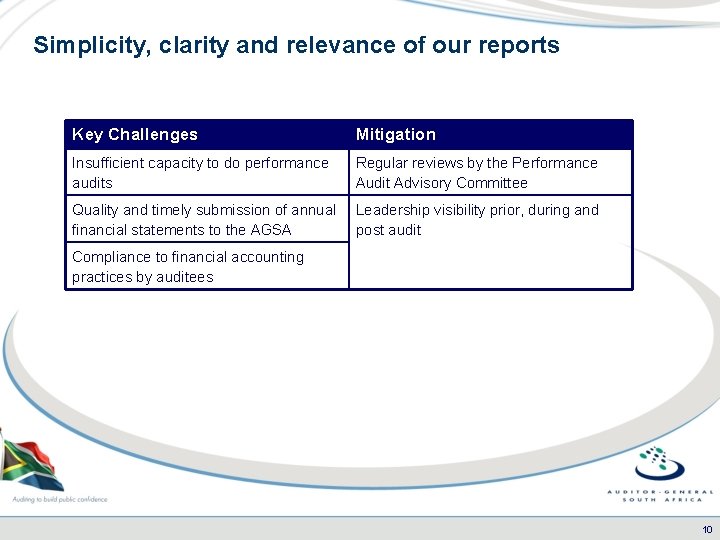
Simplicity, clarity and relevance of our reports Key Challenges Mitigation Insufficient capacity to do performance audits Regular reviews by the Performance Audit Advisory Committee Quality and timely submission of annual financial statements to the AGSA Leadership visibility prior, during and post audit Compliance to financial accounting practices by auditees 10
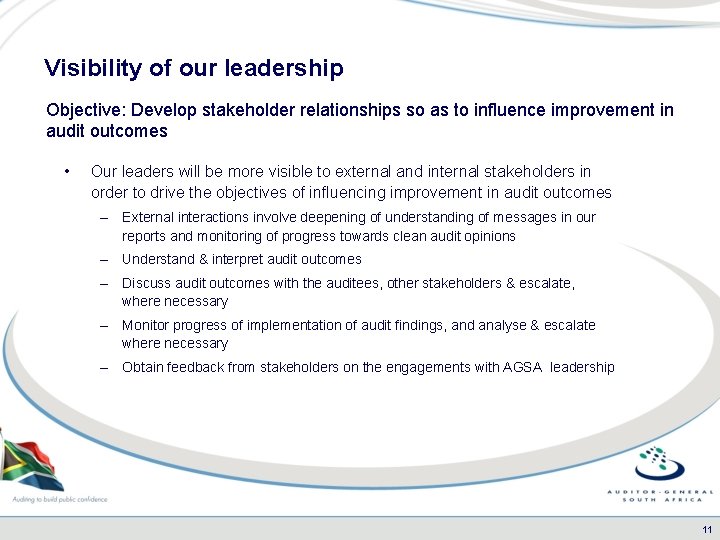
Visibility of our leadership Objective: Develop stakeholder relationships so as to influence improvement in audit outcomes • Our leaders will be more visible to external and internal stakeholders in order to drive the objectives of influencing improvement in audit outcomes – External interactions involve deepening of understanding of messages in our reports and monitoring of progress towards clean audit opinions – Understand & interpret audit outcomes – Discuss audit outcomes with the auditees, other stakeholders & escalate, where necessary – Monitor progress of implementation of audit findings, and analyse & escalate where necessary – Obtain feedback from stakeholders on the engagements with AGSA leadership 11
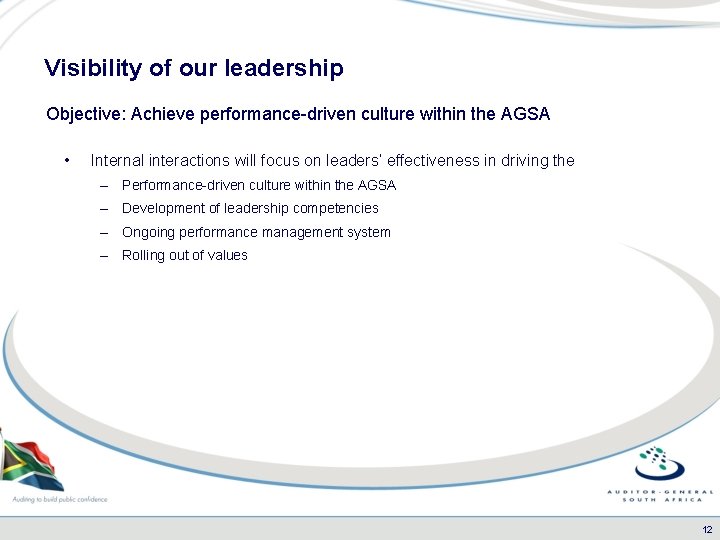
Visibility of our leadership Objective: Achieve performance-driven culture within the AGSA • Internal interactions will focus on leaders’ effectiveness in driving the – Performance-driven culture within the AGSA – Development of leadership competencies – Ongoing performance management system – Rolling out of values 12
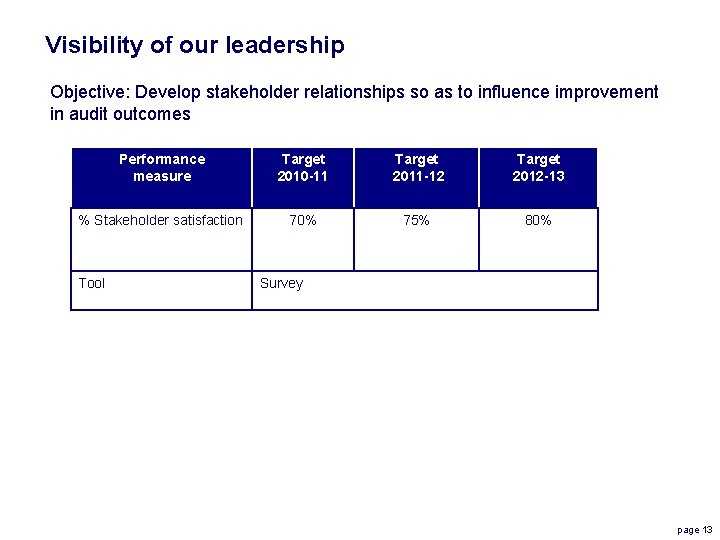
Visibility of our leadership Objective: Develop stakeholder relationships so as to influence improvement in audit outcomes Performance measure Target 2010 -11 Target 2011 -12 Target 2012 -13 % Stakeholder satisfaction 70% 75% 80% Tool Survey page 13
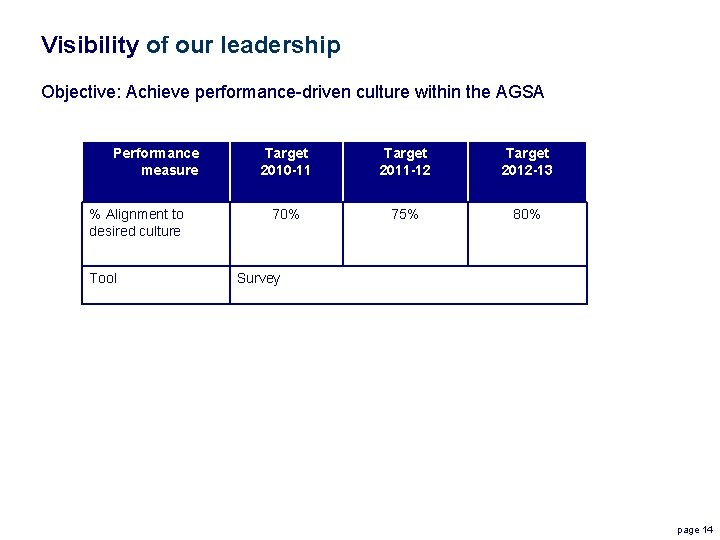
Visibility of our leadership Objective: Achieve performance-driven culture within the AGSA Performance measure % Alignment to desired culture Tool Target 2010 -11 Target 2011 -12 Target 2012 -13 70% 75% 80% Survey page 14
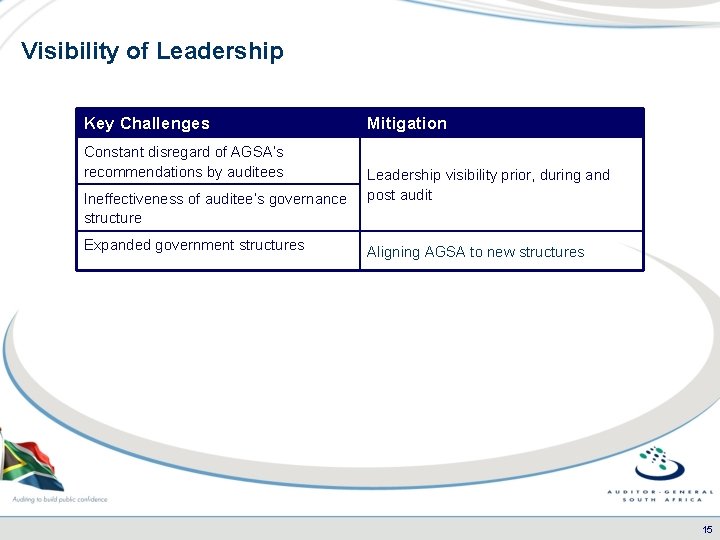
Visibility of Leadership Key Challenges Constant disregard of AGSA’s recommendations by auditees Ineffectiveness of auditee’s governance structure Expanded government structures Mitigation Leadership visibility prior, during and post audit Aligning AGSA to new structures 15
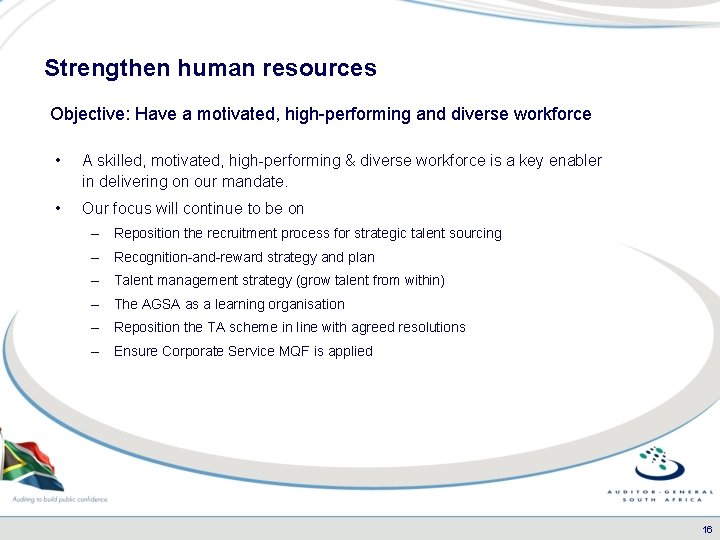
Strengthen human resources Objective: Have a motivated, high-performing and diverse workforce • A skilled, motivated, high-performing & diverse workforce is a key enabler in delivering on our mandate. • Our focus will continue to be on – Reposition the recruitment process for strategic talent sourcing – Recognition-and-reward strategy and plan – Talent management strategy (grow talent from within) – The AGSA as a learning organisation – Reposition the TA scheme in line with agreed resolutions – Ensure Corporate Service MQF is applied 16
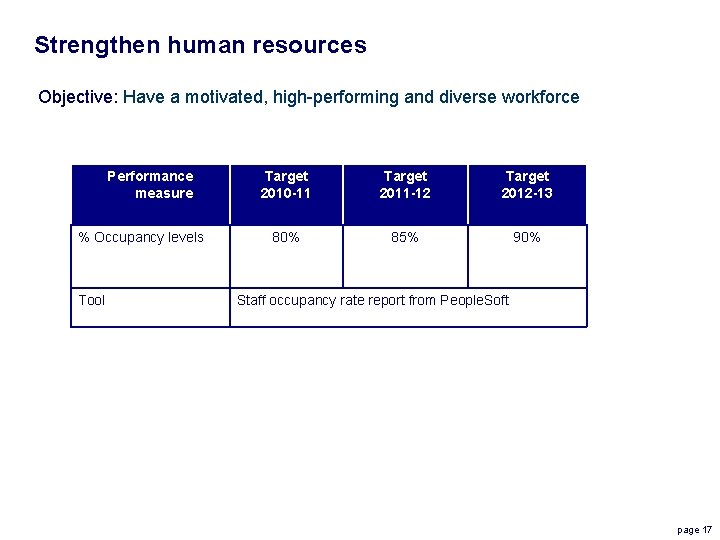
Strengthen human resources Objective: Have a motivated, high-performing and diverse workforce Performance measure % Occupancy levels Tool Target 2010 -11 Target 2011 -12 Target 2012 -13 80% 85% 90% Staff occupancy rate report from People. Soft page 17
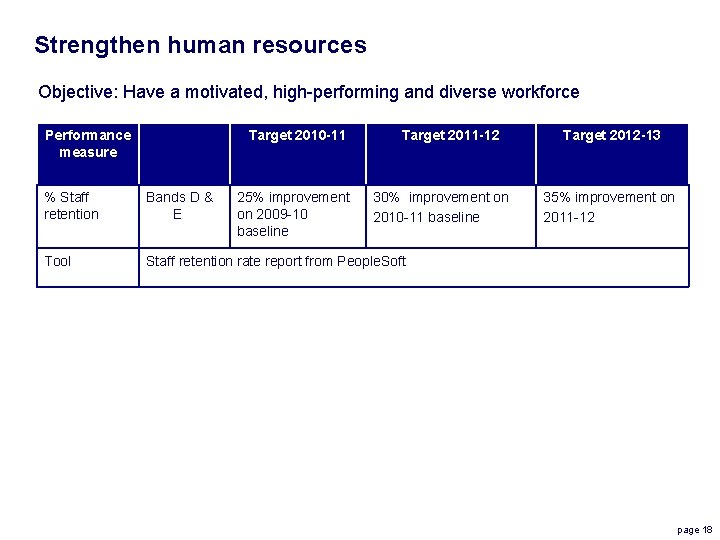
Strengthen human resources Objective: Have a motivated, high-performing and diverse workforce Performance measure Target 2010 -11 25% improvement on 2009 -10 baseline Target 2011 -12 % Staff retention Bands D & E 30% improvement on 2010 -11 baseline Tool Staff retention rate report from People. Soft Target 2012 -13 35% improvement on 2011 -12 page 18
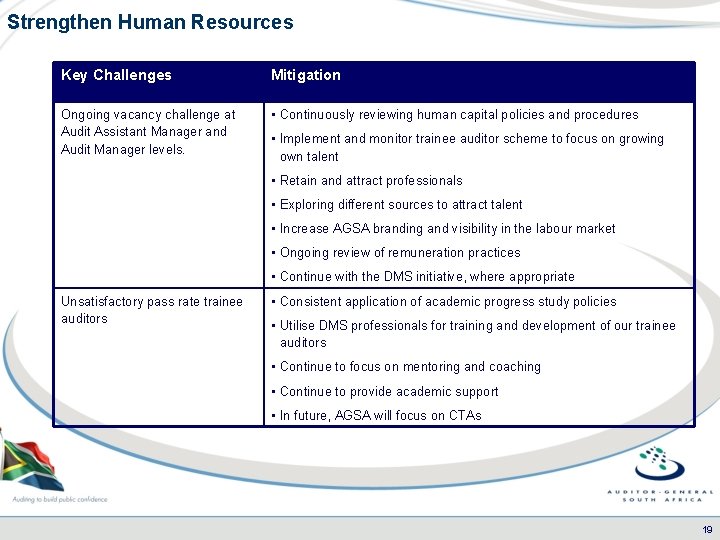
Strengthen Human Resources Key Challenges Mitigation Ongoing vacancy challenge at Audit Assistant Manager and Audit Manager levels. • Continuously reviewing human capital policies and procedures • Implement and monitor trainee auditor scheme to focus on growing own talent • Retain and attract professionals • Exploring different sources to attract talent • Increase AGSA branding and visibility in the labour market • Ongoing review of remuneration practices • Continue with the DMS initiative, where appropriate Unsatisfactory pass rate trainee auditors • Consistent application of academic progress study policies • Utilise DMS professionals for training and development of our trainee auditors • Continue to focus on mentoring and coaching • Continue to provide academic support • In future, AGSA will focus on CTAs 19
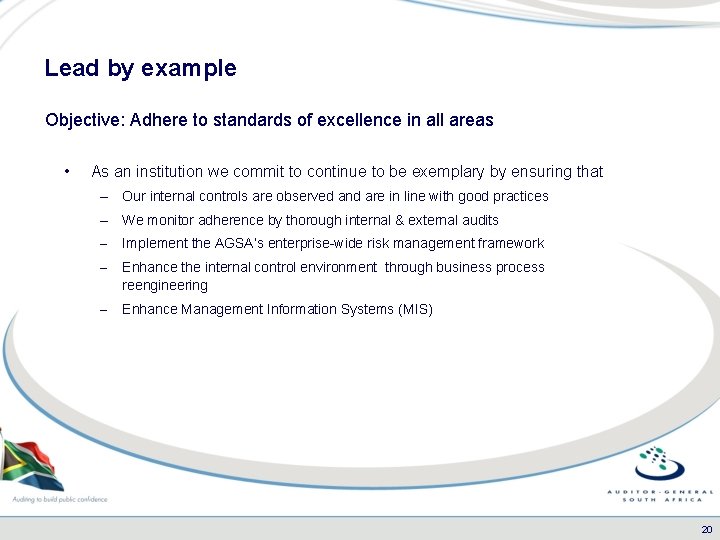
Lead by example Objective: Adhere to standards of excellence in all areas • As an institution we commit to continue to be exemplary by ensuring that – Our internal controls are observed and are in line with good practices – We monitor adherence by thorough internal & external audits – Implement the AGSA’s enterprise-wide risk management framework – Enhance the internal control environment through business process reengineering – Enhance Management Information Systems (MIS) 20
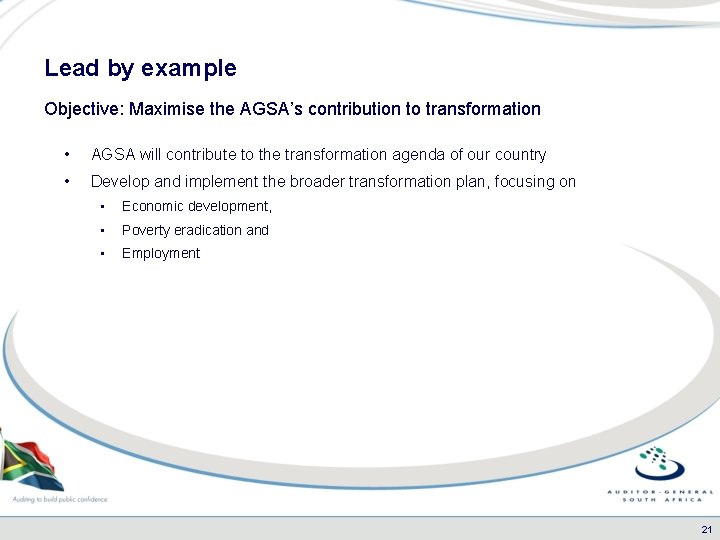
Lead by example Objective: Maximise the AGSA’s contribution to transformation • AGSA will contribute to the transformation agenda of our country • Develop and implement the broader transformation plan, focusing on • Economic development, • Poverty eradication and • Employment 21
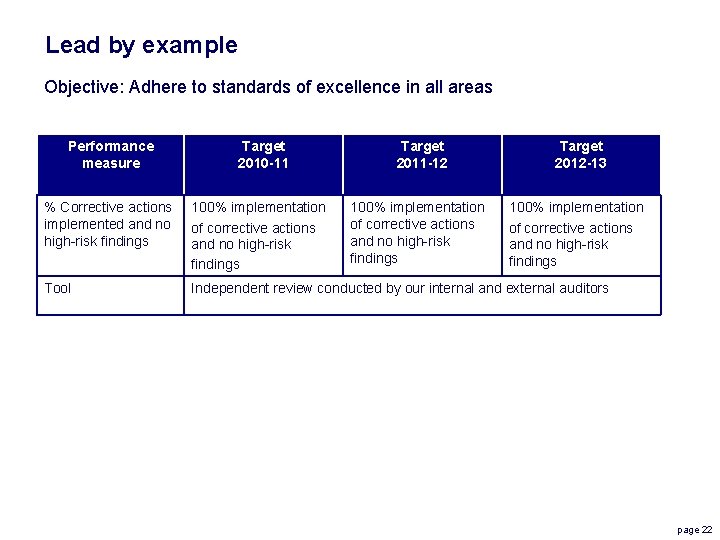
Lead by example Objective: Adhere to standards of excellence in all areas Performance measure Target 2010 -11 Target 2011 -12 100% implementation of corrective actions and no high-risk findings Target 2012 -13 % Corrective actions implemented and no high-risk findings 100% implementation of corrective actions and no high-risk findings Tool Independent review conducted by our internal and external auditors page 22
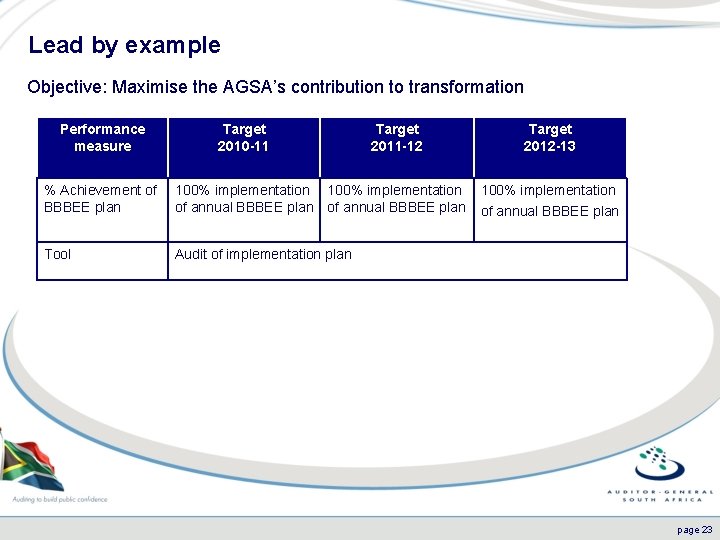
Lead by example Objective: Maximise the AGSA’s contribution to transformation Performance measure Target 2010 -11 Target 2011 -12 % Achievement of BBBEE plan 100% implementation of annual BBBEE plan Tool Audit of implementation plan Target 2012 -13 100% implementation of annual BBBEE plan page 23
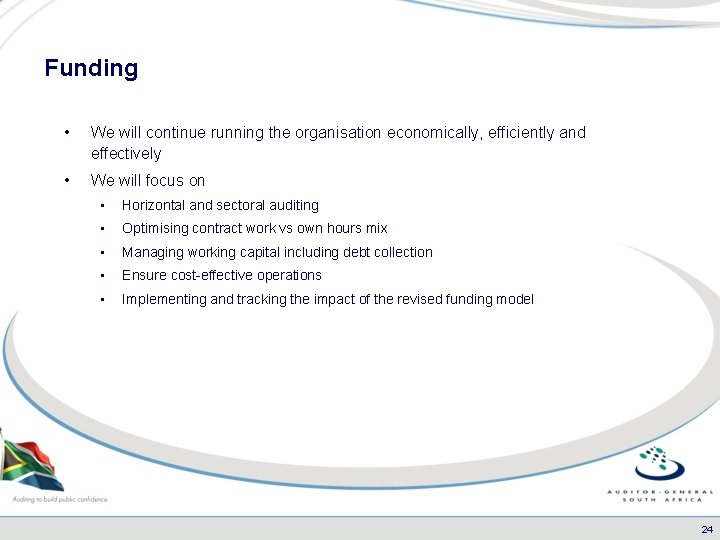
Funding • We will continue running the organisation economically, efficiently and effectively • We will focus on • Horizontal and sectoral auditing • Optimising contract work vs own hours mix • Managing working capital including debt collection • Ensure cost-effective operations • Implementing and tracking the impact of the revised funding model 24
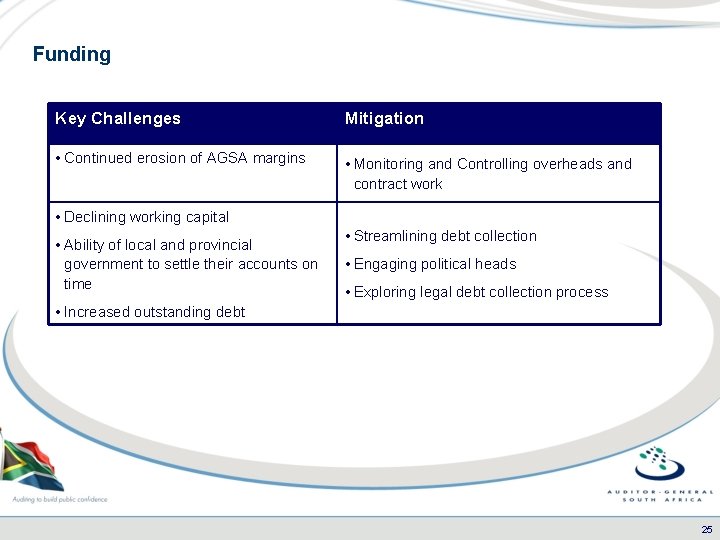
Funding Key Challenges Mitigation • Continued erosion of AGSA margins • Monitoring and Controlling overheads and contract work • Declining working capital • Ability of local and provincial government to settle their accounts on time • Streamlining debt collection • Engaging political heads • Exploring legal debt collection process • Increased outstanding debt 25
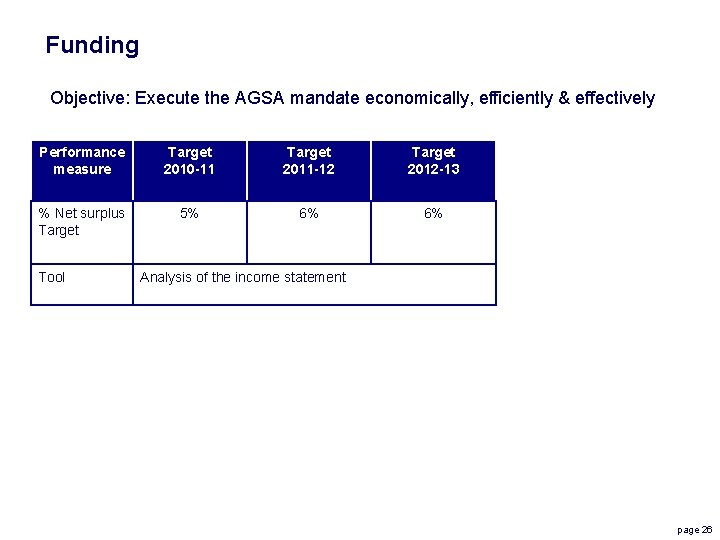
Funding Objective: Execute the AGSA mandate economically, efficiently & effectively Performance measure Target 2010 -11 Target 2011 -12 Target 2012 -13 % Net surplus Target 5% 6% 6% Tool Analysis of the income statement page 26
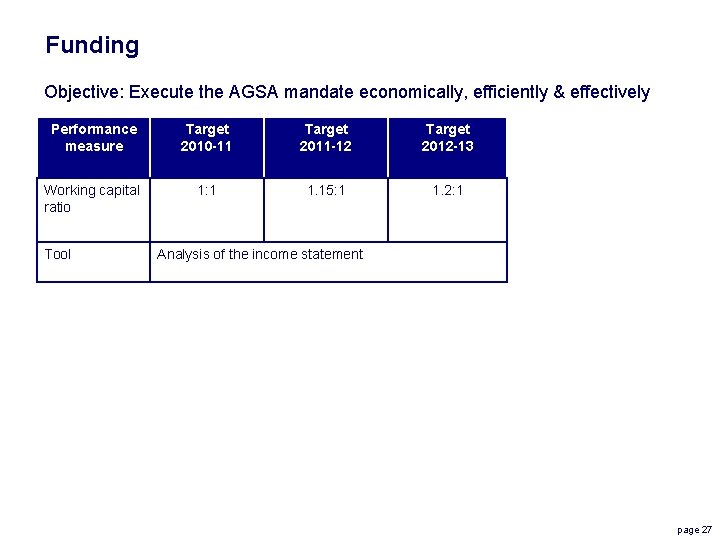
Funding Objective: Execute the AGSA mandate economically, efficiently & effectively Performance measure Target 2010 -11 Target 2011 -12 Target 2012 -13 Working capital ratio 1: 1 1. 15: 1 1. 2: 1 Tool Analysis of the income statement page 27
Detailed Budget 2010/11 Page 28
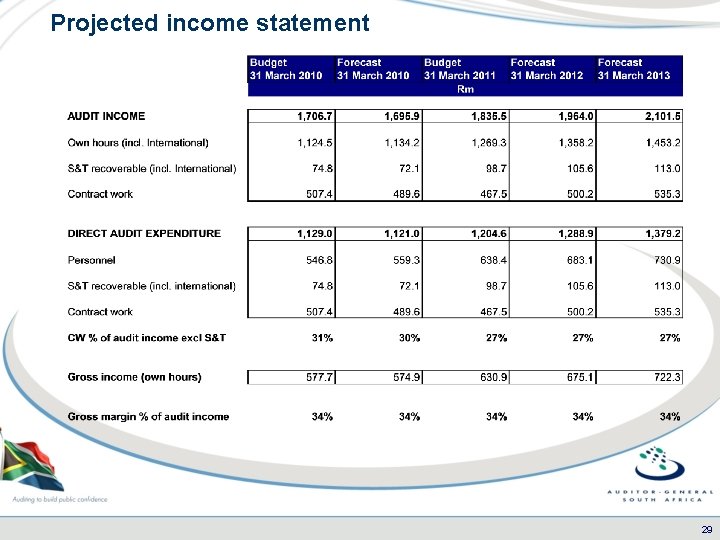
Projected income statement 29
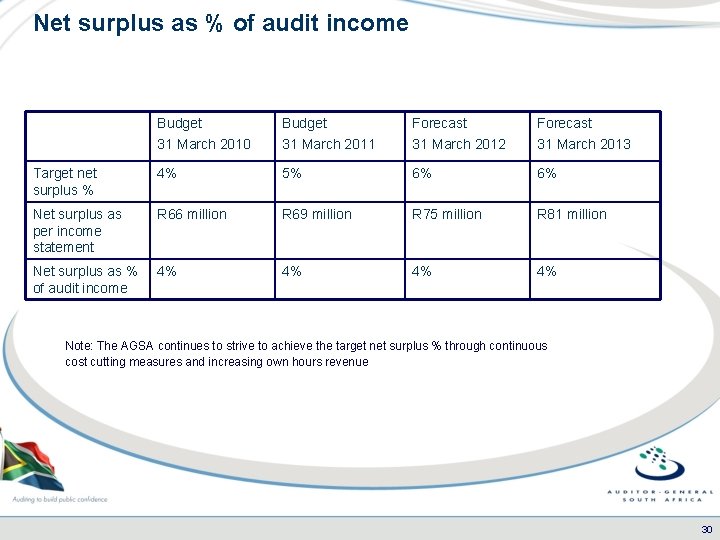
Net surplus as % of audit income Budget 31 March 2010 Budget 31 March 2011 Forecast 31 March 2012 Forecast 31 March 2013 Target net surplus % 4% 5% 6% 6% Net surplus as per income statement R 66 million R 69 million R 75 million R 81 million Net surplus as % of audit income 4% 4% Note: The AGSA continues to strive to achieve the target net surplus % through continuous cost cutting measures and increasing own hours revenue 30
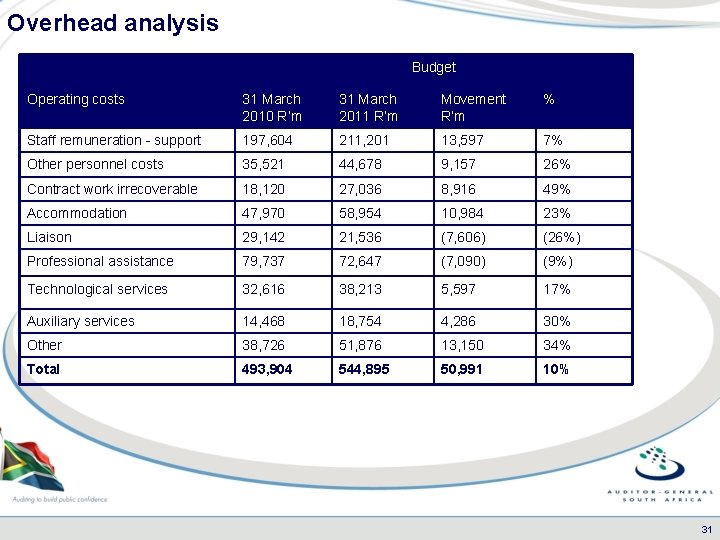
Overhead analysis Budget Operating costs 31 March 2010 R’m 31 March 2011 R’m Movement R’m % Staff remuneration - support 197, 604 211, 201 13, 597 7% Other personnel costs 35, 521 44, 678 9, 157 26% Contract work irrecoverable 18, 120 27, 036 8, 916 49% Accommodation 47, 970 58, 954 10, 984 23% Liaison 29, 142 21, 536 (7, 606) (26%) Professional assistance 79, 737 72, 647 (7, 090) (9%) Technological services 32, 616 38, 213 5, 597 17% Auxiliary services 14, 468 18, 754 4, 286 30% Other 38, 726 51, 876 13, 150 34% Total 493, 904 544, 895 50, 991 10% 31
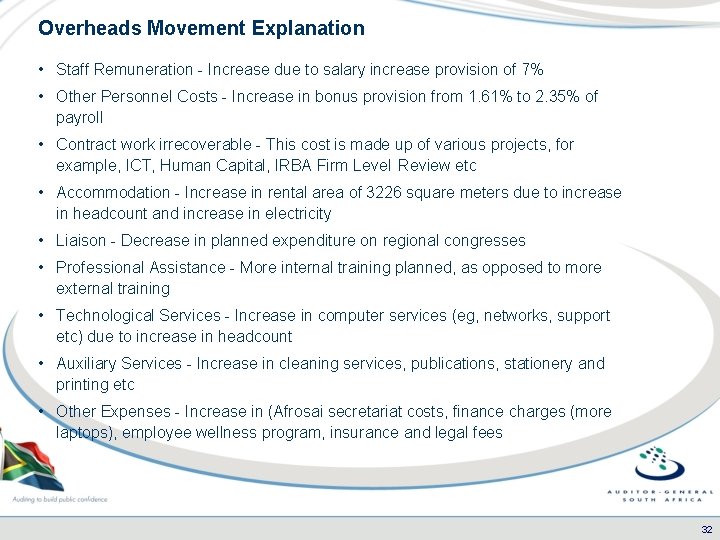
Overheads Movement Explanation • Staff Remuneration - Increase due to salary increase provision of 7% • Other Personnel Costs - Increase in bonus provision from 1. 61% to 2. 35% of payroll • Contract work irrecoverable - This cost is made up of various projects, for example, ICT, Human Capital, IRBA Firm Level Review etc • Accommodation - Increase in rental area of 3226 square meters due to increase in headcount and increase in electricity • Liaison - Decrease in planned expenditure on regional congresses • Professional Assistance - More internal training planned, as opposed to more external training • Technological Services - Increase in computer services (eg, networks, support etc) due to increase in headcount • Auxiliary Services - Increase in cleaning services, publications, stationery and printing etc • Other Expenses - Increase in (Afrosai secretariat costs, finance charges (more laptops), employee wellness program, insurance and legal fees 32
Conclusion and Proposed SCo. AG interventions Page 33
Conclusion and Proposed SCo. AG interventions q This strategic plan and budget outlines the AGSA leadership’s commitment to realising our mission and vision q We are confident that we will achieve the set targets q We request SCo. AG’s intervention in the following areas – Encouraging robust leadership monitoring and oversight at auditees to address audit findings – Regularly reviewing the appropriateness of our funding model – Engaging political stakeholders to assist us in the collection of outstanding fees 34
Audit Tariffs Page 35
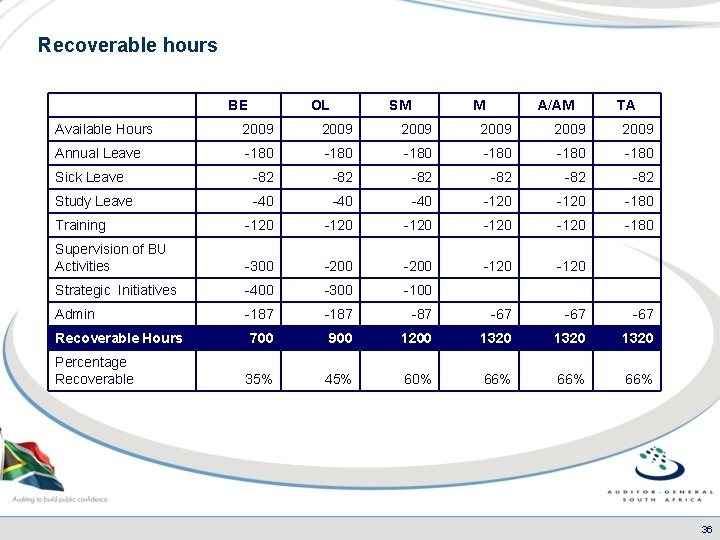
Recoverable hours BE OL SM M A/AM TA Available Hours 2009 2009 Annual Leave -180 -180 Sick Leave -82 -82 -82 Study Leave -40 -40 -120 -180 Training -120 -120 -180 Supervision of BU Activities -300 -200 -120 Strategic Initiatives -400 -300 -100 Admin -187 -87 -67 -67 700 900 1200 1320 35% 45% 60% 66% 66% Recoverable Hours Percentage Recoverable 36
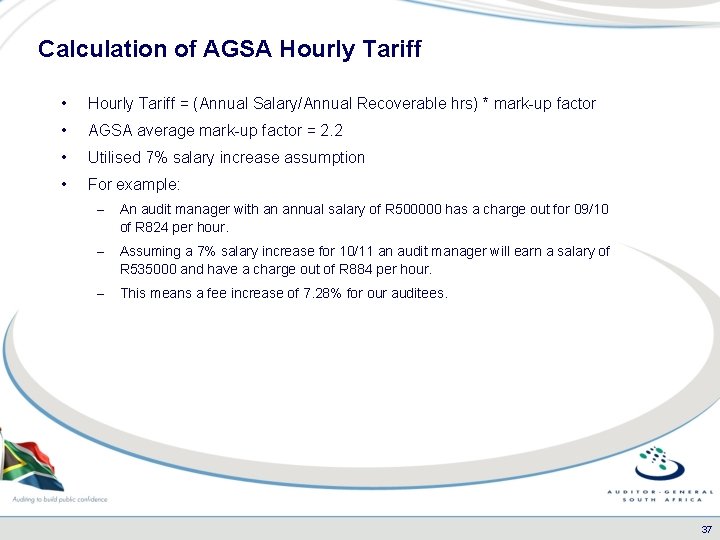
Calculation of AGSA Hourly Tariff • Hourly Tariff = (Annual Salary/Annual Recoverable hrs) * mark-up factor • AGSA average mark-up factor = 2. 2 • Utilised 7% salary increase assumption • For example: – An audit manager with an annual salary of R 500000 has a charge out for 09/10 of R 824 per hour. – Assuming a 7% salary increase for 10/11 an audit manager will earn a salary of R 535000 and have a charge out of R 884 per hour. – This means a fee increase of 7. 28% for our auditees. 37
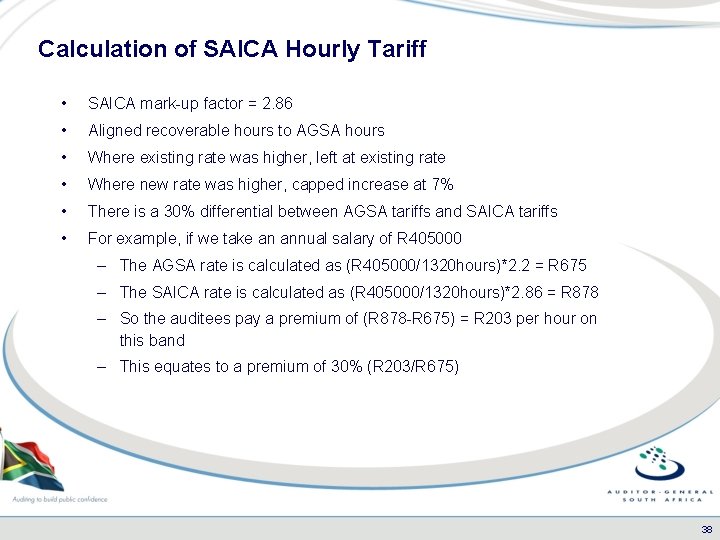
Calculation of SAICA Hourly Tariff • SAICA mark-up factor = 2. 86 • Aligned recoverable hours to AGSA hours • Where existing rate was higher, left at existing rate • Where new rate was higher, capped increase at 7% • There is a 30% differential between AGSA tariffs and SAICA tariffs • For example, if we take an annual salary of R 405000 – The AGSA rate is calculated as (R 405000/1320 hours)*2. 2 = R 675 – The SAICA rate is calculated as (R 405000/1320 hours)*2. 86 = R 878 – So the auditees pay a premium of (R 878 -R 675) = R 203 per hour on this band – This equates to a premium of 30% (R 203/R 675) 38
Audit Directive Page 39
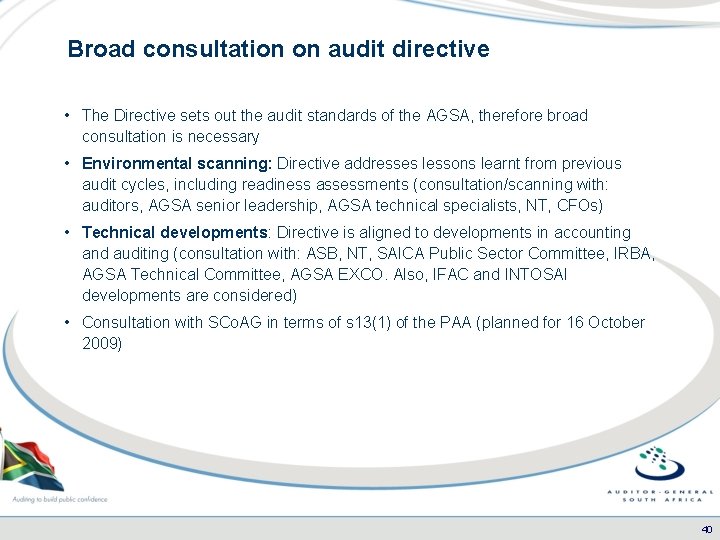
Broad consultation on audit directive • The Directive sets out the audit standards of the AGSA, therefore broad consultation is necessary • Environmental scanning: Directive addresses lessons learnt from previous audit cycles, including readiness assessments (consultation/scanning with: auditors, AGSA senior leadership, AGSA technical specialists, NT, CFOs) • Technical developments: Directive is aligned to developments in accounting and auditing (consultation with: ASB, NT, SAICA Public Sector Committee, IRBA, AGSA Technical Committee, AGSA EXCO. Also, IFAC and INTOSAI developments are considered) • Consultation with SCo. AG in terms of s 13(1) of the PAA (planned for 16 October 2009) 40
Key elements in the Directive • Applicability: all auditors of publicly funded institutions, including those that the AGSA opts not to audit itself (s 4(3) of the PAA) • Enforces consultation by Institutions on the appointment of auditors (s 25 of PAA) • Emphasises that the Audit Directive must be complied with and outlines the consequences of non-compliance • Confirms that an opinion will be issued on the financial statements in terms of international auditing standards • Elaborates on the AGSA phased approach to the audit of performance information and indicates the key areas of focus to be included in audit reports • Confirms that while no opinion is issued on non-compliance, this remains a reportable matter • Confirms that Performance Audits are undertaken in terms of INTOSAI standards • Confirms that Investigations are undertaken in terms of the AGSA’s own standards and guidelines • Specifies the standards applicable to audit related services and to reports on donor funds • Explicitly provides details of the AGSA response in terms of International Standards on Auditing to the different accounting frameworks 41
- Slides: 41