
Strategic Parts and Material Management A Proactive Lifecycle
- Slides: 36
Strategic Parts and Material Management: A Proactive Lifecycle Approach to Handle Obsolescence Robin Brown Do. D Parts Management & DMSMS Program Manager Office of the Under Secretary of Defense for Research and Engineering Policy & Systems Defense Standardization Program Office Robin. brown@dla. mil Dave Greinke Senior Consultant, Logistics Management Institute Acquisition and Lifecycle Logistics dgreinke@lmi. org Defense Acquisition University (DAU) Hot Topics July 15, 2020 Distribution Statement A: Approved for public release. Distribution is unlimited.
CHALLENGES WE FACE TODAY Rapidly changing designs and accelerated acquisition timelines Increased use of commercial part types Offshore manufacturing of parts Diminishing Manufacturing Sources and Material Shortages (DMSMS) Counterfeit parts detected in the supply chain Use of lead-free electronic parts and other environmental considerations PARTS SELECTION IS KEY! 2
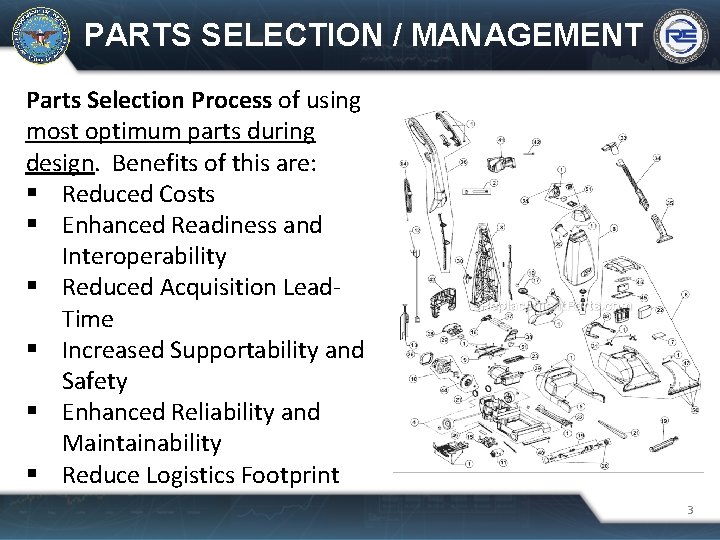
PARTS SELECTION / MANAGEMENT Parts Selection Process of using most optimum parts during design. Benefits of this are: Reduced Costs Enhanced Readiness and Interoperability Reduced Acquisition Lead. Time Increased Supportability and Safety Enhanced Reliability and Maintainability Reduce Logistics Footprint 3
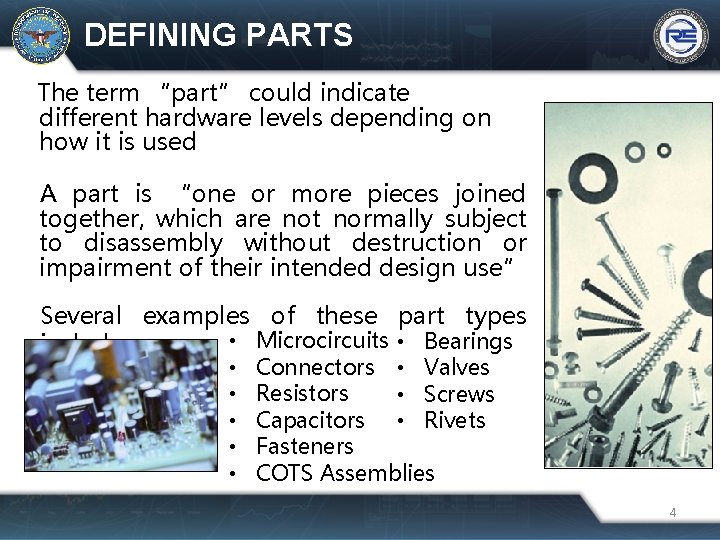
DEFINING PARTS The term “part” could indicate different hardware levels depending on how it is used A part is “one or more pieces joined together, which are not normally subject to disassembly without destruction or impairment of their intended design use” Several examples of these part types • Microcircuits • Bearings include: • • • Connectors • Valves Resistors • Screws Capacitors • Rivets Fasteners COTS Assemblies 4
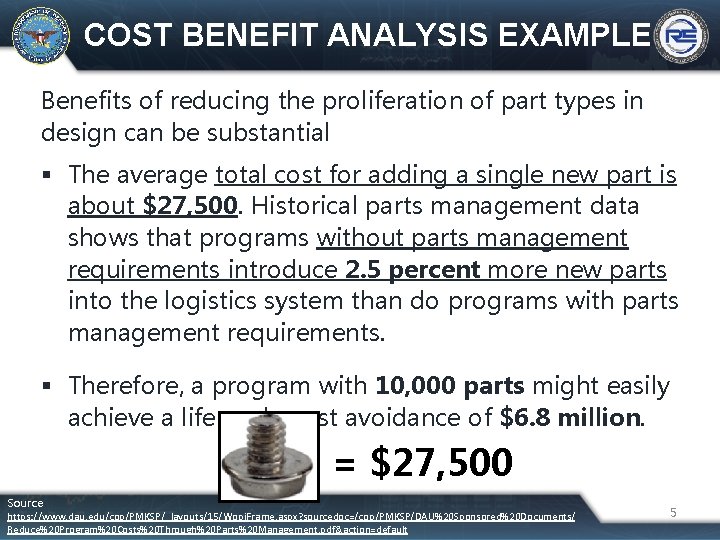
COST BENEFIT ANALYSIS EXAMPLE Benefits of reducing the proliferation of part types in design can be substantial The average total cost for adding a single new part is about $27, 500. Historical parts management data shows that programs without parts management requirements introduce 2. 5 percent more new parts into the logistics system than do programs with parts management requirements. Therefore, a program with 10, 000 parts might easily achieve a life-cycle cost avoidance of $6. 8 million. = $27, 500 Source https: //www. dau. edu/cop/PMKSP/_layouts/15/Wopi. Frame. aspx? sourcedoc=/cop/PMKSP/DAU%20 Sponsored%20 Documents/ Reduce%20 Program%20 Costs%20 Through%20 Parts%20 Management. pdf&action=default 5
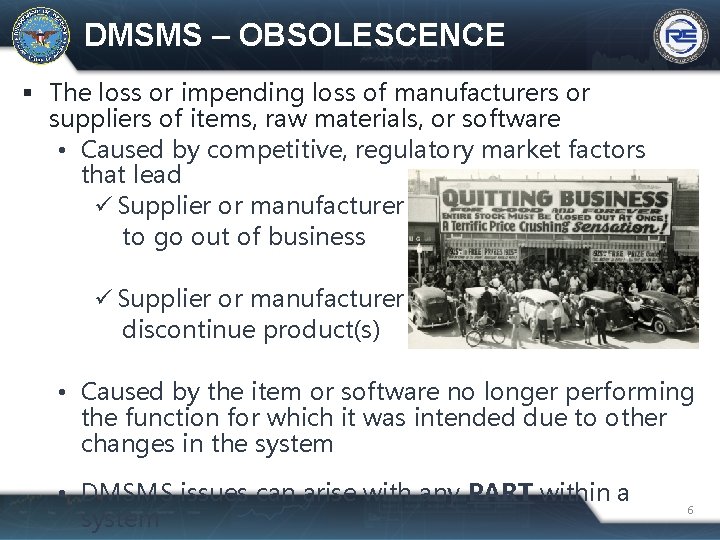
DMSMS – OBSOLESCENCE The loss or impending loss of manufacturers or suppliers of items, raw materials, or software • Caused by competitive, regulatory market factors that lead ü Supplier or manufacturer to go out of business ü Supplier or manufacturer to discontinue product(s) • Caused by the item or software no longer performing the function for which it was intended due to other changes in the system • DMSMS issues can arise with any PART within a system 6
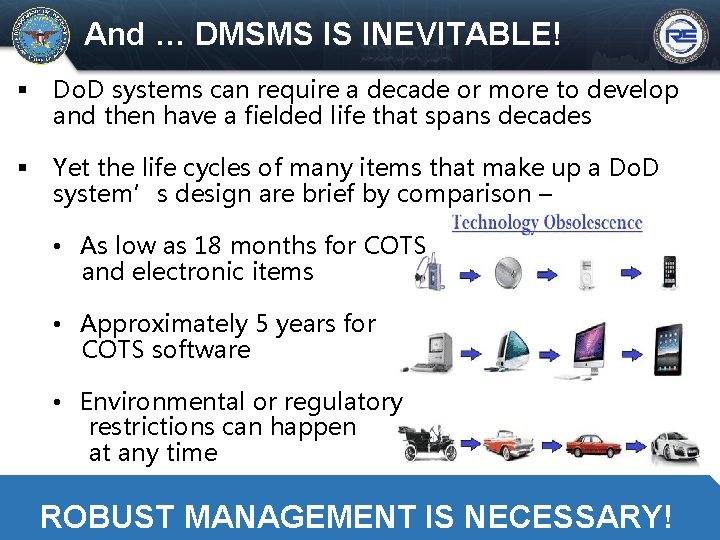
And … DMSMS IS INEVITABLE! Do. D systems can require a decade or more to develop and then have a fielded life that spans decades Yet the life cycles of many items that make up a Do. D system’s design are brief by comparison – • As low as 18 months for COTS and electronic items • Approximately 5 years for COTS software • Environmental or regulatory restrictions can happen at any time ROBUST MANAGEMENT IS NECESSARY!
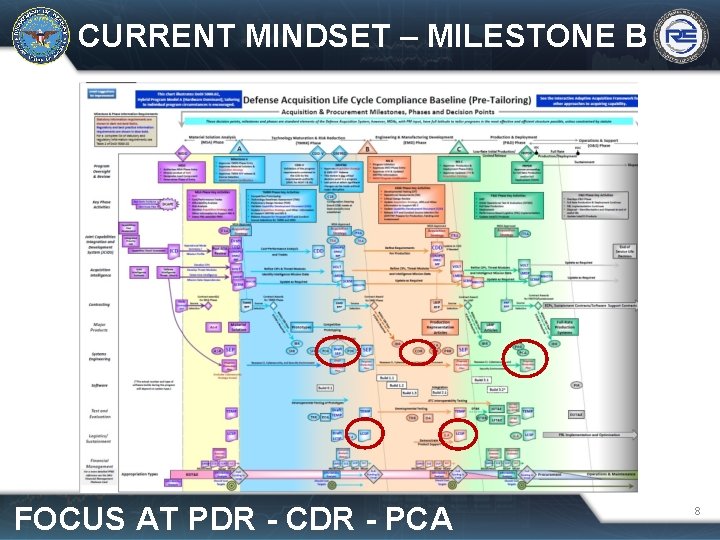
CURRENT MINDSET – MILESTONE B FOCUS AT PDR - CDR - PCA 8
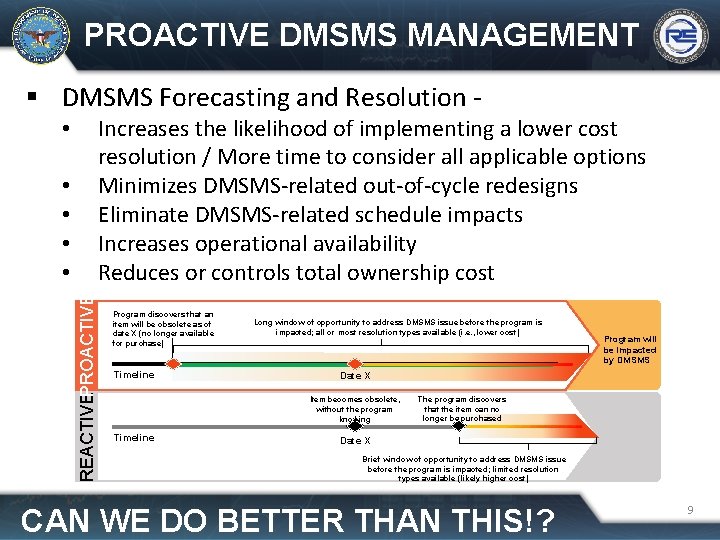
PROACTIVE DMSMS MANAGEMENT DMSMS Forecasting and Resolution - Increases the likelihood of implementing a lower cost resolution / More time to consider all applicable options Minimizes DMSMS-related out-of-cycle redesigns Eliminate DMSMS-related schedule impacts Increases operational availability Reduces or controls total ownership cost • REACTIVEPROACTIVE • • Program discovers that an item will be obsolete as of date X (no longer available for purchase) Timeline Long window of opportunity to address DMSMS issue before the program is impacted; all or most resolution types available (i. e. , lower cost) Date X Item becomes obsolete, without the program knowing Timeline Program will be impacted by DMSMS The program discovers that the item can no longer be purchased Date X Brief window of opportunity to address DMSMS issue before the program is impacted; limited resolution types available (likely higher cost) CAN WE DO BETTER THAN THIS!? 9
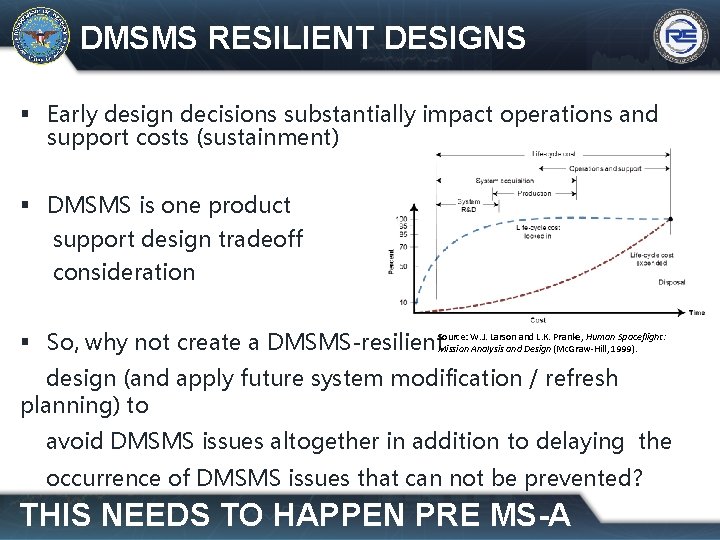
DMSMS RESILIENT DESIGNS Early design decisions substantially impact operations and support costs (sustainment) DMSMS is one product support design tradeoff consideration W. J. Larson and L. K. Pranke, Human Spaceflight: So, why not create a DMSMS-resilient. Source: Mission Analysis and Design (Mc. Graw-Hill, 1999). design (and apply future system modification / refresh planning) to avoid DMSMS issues altogether in addition to delaying the occurrence of DMSMS issues that can not be prevented? THIS NEEDS TO HAPPEN PRE MS-A
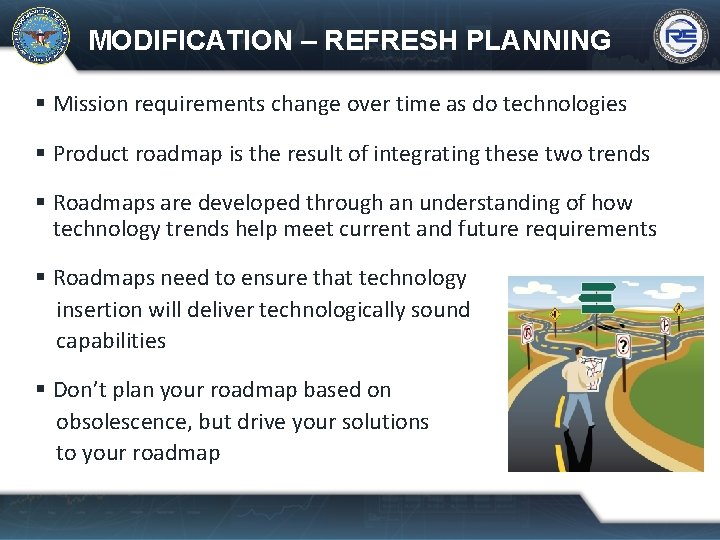
MODIFICATION – REFRESH PLANNING Mission requirements change over time as do technologies Product roadmap is the result of integrating these two trends Roadmaps are developed through an understanding of how technology trends help meet current and future requirements Roadmaps need to ensure that technology insertion will deliver technologically sound capabilities Don’t plan your roadmap based on obsolescence, but drive your solutions to your roadmap
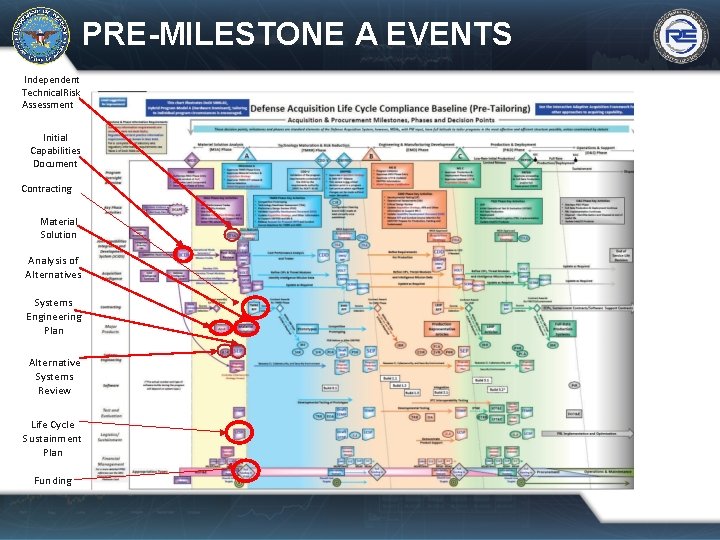
PRE-MILESTONE A EVENTS Independent Technical. Risk Assessment Initial Capabilities Document Contracting Material Solution Analysis of Alternatives Systems Engineering Plan Alternative Systems Review Life Cycle Sustainment Plan Funding
Adaptive Acquisition Framework DOD 5000 Re-Write – Re-Design • Re-write of 5000. 01 and. 02 as well as new 5000. xx policies (pathways) and functional policies currently covered by. 02 enclosures (Sustainment, engineering, cost, T/E, etc) - 5000. 02 will no longer reflect MDAP policy, but reflect the Adaptive Acquisition Framework (AAF) • Encourage critical thinking amongst our acq workforce/Tailor in vice tailor out philosophy • Multiple pathways for tailored solutions • Acq workforce will access new policies/guides via DAU hosted website (https: //aaf. dau. edu/) 13
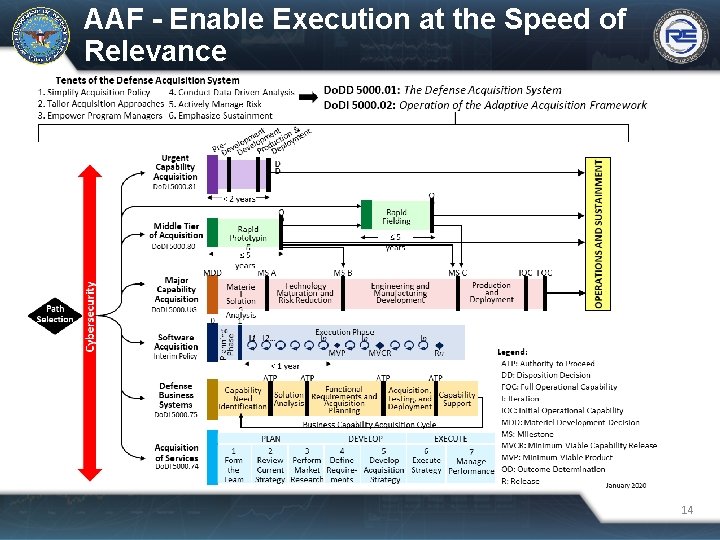
AAF - Enable Execution at the Speed of Relevance 14
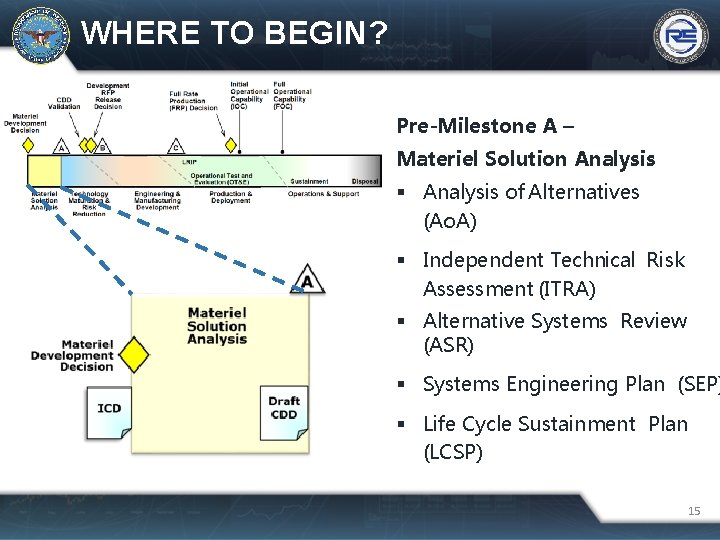
WHERE TO BEGIN? Pre-Milestone A – Materiel Solution Analysis of Alternatives (Ao. A) Independent Technical Risk Assessment (ITRA) Alternative Systems Review (ASR) Systems Engineering Plan (SEP) Life Cycle Sustainment Plan (LCSP) 15
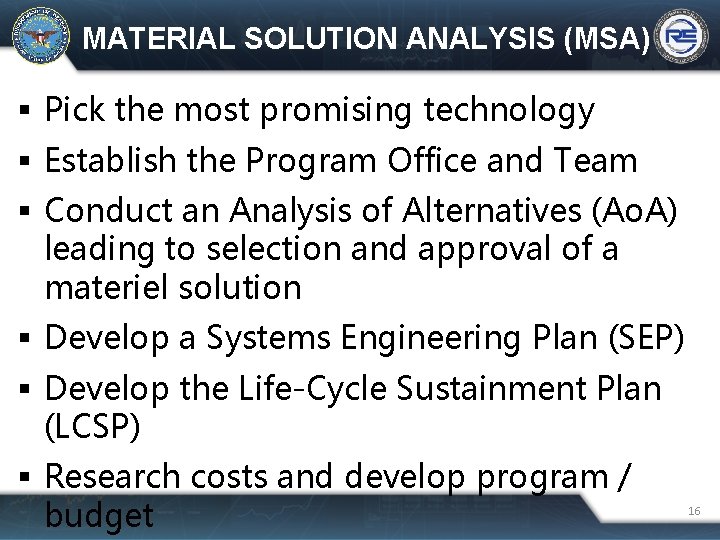
MATERIAL SOLUTION ANALYSIS (MSA) Pick the most promising technology Establish the Program Office and Team Conduct an Analysis of Alternatives (Ao. A) leading to selection and approval of a materiel solution Develop a Systems Engineering Plan (SEP) Develop the Life-Cycle Sustainment Plan (LCSP) Research costs and develop program / budget 16
ANALYSIS OF ALTERNATIVES (Ao. A) An Ao. A is an analytical comparison of the operational effectiveness, suitability, and lifecycle cost of alternatives materiel solution that satisfy an established capability need identified in an Initial Capabilities Document (ICD) An Ao. A provides input into a Alternative Systems Review (ASR) A comprehensive rationale for the proposed materiel solution(s), based upon the Ao. A that evaluated relative cost, schedule, performance (hardware, human, software), and technology risks 17
INDEPENDENT TECHNICAL RISK ASSESSMENTS (ITRA) Independent Technical Risk Assessment (ITRA) looks at the full spectrum of Technology, Engineering and Integration risk and program technical risk ITRAs are conducted on all Major Defense Acquisition Programs (MDAP) prior to Milestone A, Milestone B approval, and any decision to enter into low-rate initial production or full-rate production 18
An Example of the Problem New Acquisition Program (A Boat) Motor – Major Component Planned Motor Produced for 20 years 8 Year Production Time Line 20 -25 Year Operational Life Cycle Is This a Problem? 19
ALTERNATIVE SYSTEMS REVIEW (ASR) Looks at user requirements and the alternative solutions identified to determine which is the best approach to meeting system requirements Directly leads into the SEP which lays out the rest of the reviews through out the life cycle of the system 20
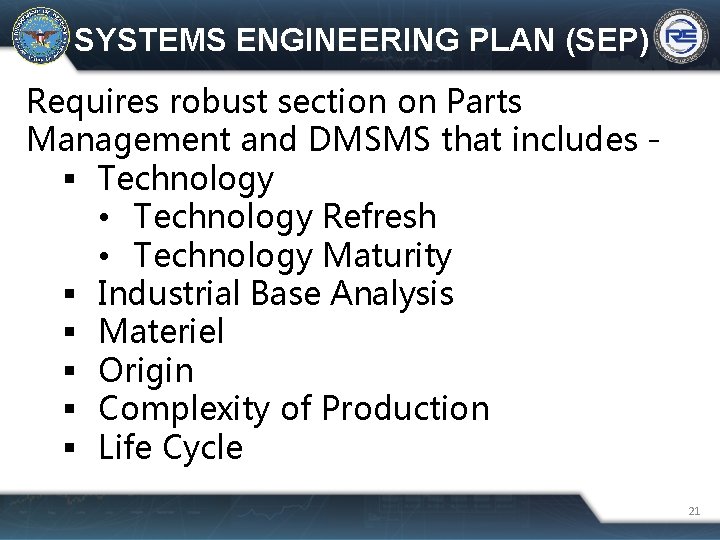
SYSTEMS ENGINEERING PLAN (SEP) Requires robust section on Parts Management and DMSMS that includes Technology • Technology Refresh • Technology Maturity Industrial Base Analysis Materiel Origin Complexity of Production Life Cycle 21
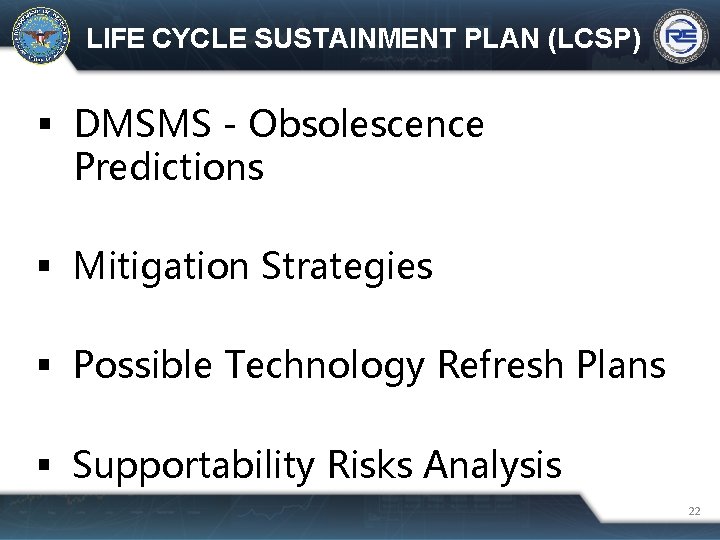
LIFE CYCLE SUSTAINMENT PLAN (LCSP) DMSMS - Obsolescence Predictions Mitigation Strategies Possible Technology Refresh Plans Supportability Risks Analysis 22
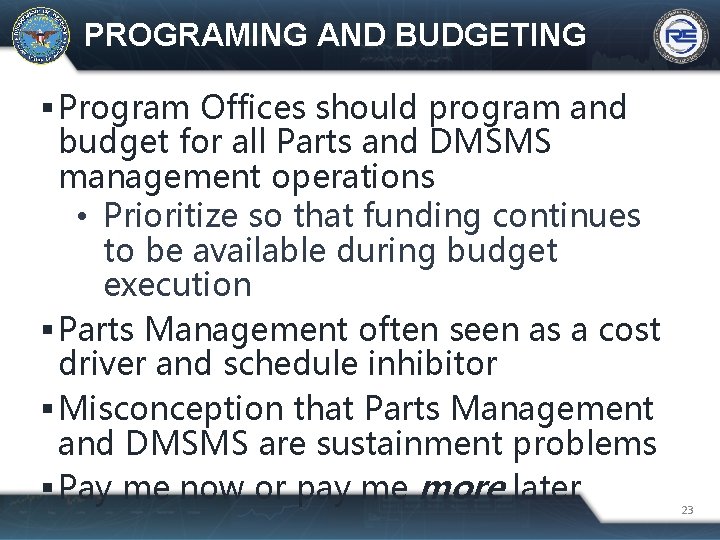
PROGRAMING AND BUDGETING Program Offices should program and budget for all Parts and DMSMS management operations • Prioritize so that funding continues to be available during budget execution Parts Management often seen as a cost driver and schedule inhibitor Misconception that Parts Management and DMSMS are sustainment problems Pay me now or pay me more later 23
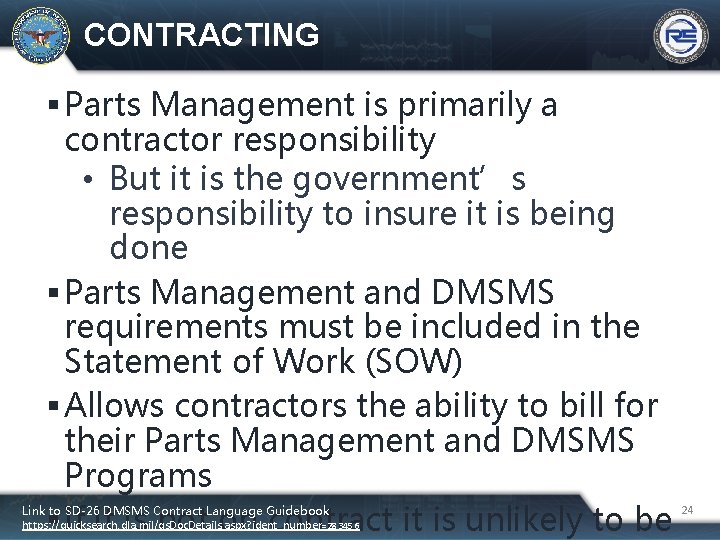
CONTRACTING Parts Management is primarily a contractor responsibility • But it is the government’s responsibility to insure it is being done Parts Management and DMSMS requirements must be included in the Statement of Work (SOW) Allows contractors the ability to bill for their Parts Management and DMSMS Programs If it is not on contract it is unlikely to be Link to SD-26 DMSMS Contract Language Guidebook https: //quicksearch. dla. mil/qs. Doc. Details. aspx? ident_number=283456 24
PARTS SELECTION SUMMARY Parts Management and DMSMS professional support prior to Milestone A is essential Research planned technology, materials, and industrial base to determine where they are in their life cycle If risks are unavoidable, it is better to find out early so plans can be made to mitigate Pay me now, or pay me more later 25
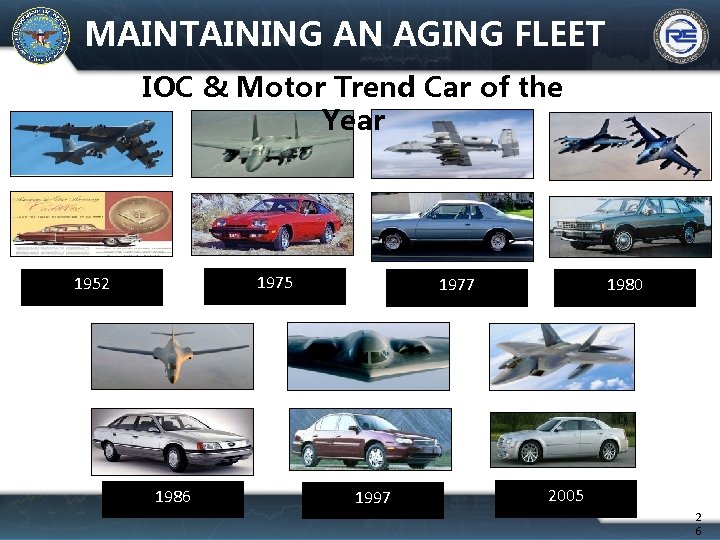
MAINTAINING AN AGING FLEET IOC & Motor Trend Car of the Year 1975 1952 1986 1977 1997 1980 2005 2 6
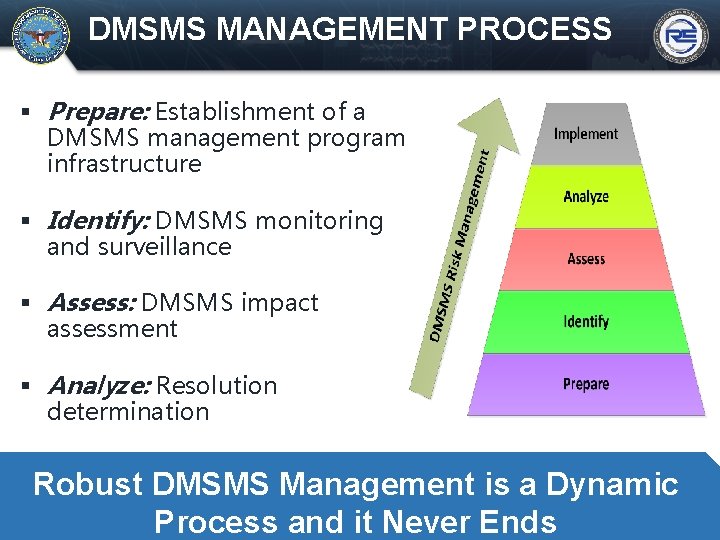
DMSMS MANAGEMENT PROCESS Prepare: Establishment of a DMSMS management program infrastructure Identify: DMSMS monitoring and surveillance Assess: DMSMS impact assessment Analyze: Resolution determination Implement: Implementation of Robust DMSMS Management DMSMS resolutions is a Dynamic Process and it Never Ends
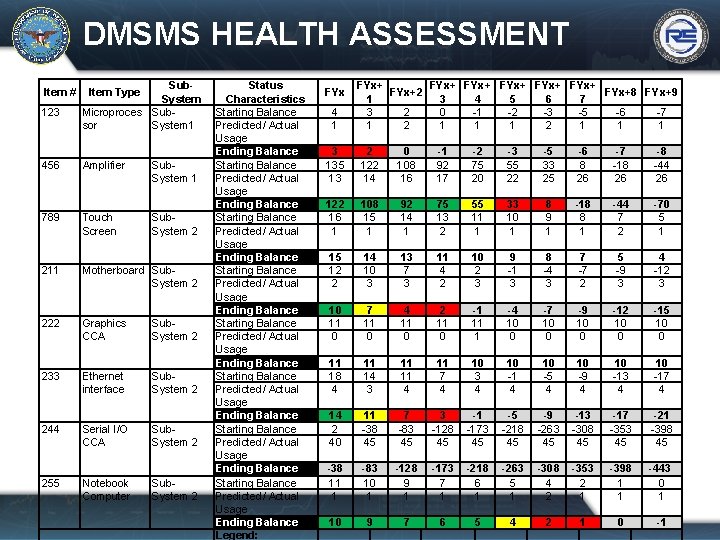
DMSMS HEALTH ASSESSMENT Item # 123 Sub. System Microproces Subsor System 1 Item Type 456 Amplifier Sub. System 1 789 Touch Screen Sub. System 2 211 Motherboard Sub. System 2 222 Graphics CCA Sub. System 2 233 Ethernet interface Sub. System 2 244 Serial I/O CCA Sub. System 2 255 Notebook Computer Sub. System 2 Status Characteristics Starting Balance Predicted/ Actual Usage Ending Balance Starting Balance Predicted/ Actual Usage Ending Balance Legend: FYx 4 1 FYx+ FYx+2 FYx+8 FYx+9 1 3 4 5 6 7 3 2 0 -1 -2 -3 -5 -6 -7 1 2 1 1 1 3 135 13 2 122 14 0 108 16 -1 92 17 -2 75 20 -3 55 22 -5 33 25 -6 8 26 -7 -18 26 -8 -44 26 122 16 1 108 15 1 92 14 1 75 13 2 55 11 1 33 10 1 8 9 1 -18 8 1 -44 7 2 -70 5 1 15 12 2 14 10 3 13 7 3 11 4 2 10 2 3 9 -1 3 8 -4 3 7 -7 2 5 -9 3 4 -12 3 10 11 0 7 11 0 4 11 0 2 11 0 -1 11 1 -4 10 0 -7 10 0 -9 10 0 -12 10 0 -15 10 0 11 18 4 11 14 3 11 11 4 11 7 4 10 3 4 10 -1 4 10 -5 4 10 -9 4 10 -13 4 10 -17 4 14 2 40 11 -38 45 7 -83 45 3 -128 45 -1 -173 45 -5 -218 45 -9 -263 45 -13 -308 45 -17 -353 45 -21 -398 45 -38 11 1 -83 10 1 -128 9 1 -173 7 1 -218 6 1 -263 5 1 -308 4 2 -353 2 1 -398 1 1 -443 0 1 10 9 7 6 5 4 2 1 0 -1
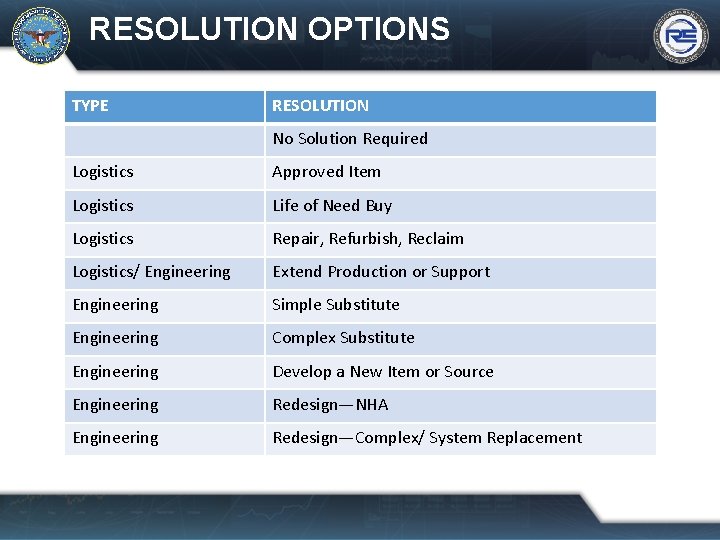
RESOLUTION OPTIONS TYPE RESOLUTION No Solution Required Logistics Approved Item Logistics Life of Need Buy Logistics Repair, Refurbish, Reclaim Logistics/ Engineering Extend Production or Support Engineering Simple Substitute Engineering Complex Substitute Engineering Develop a New Item or Source Engineering Redesign—NHA Engineering Redesign—Complex/ System Replacement
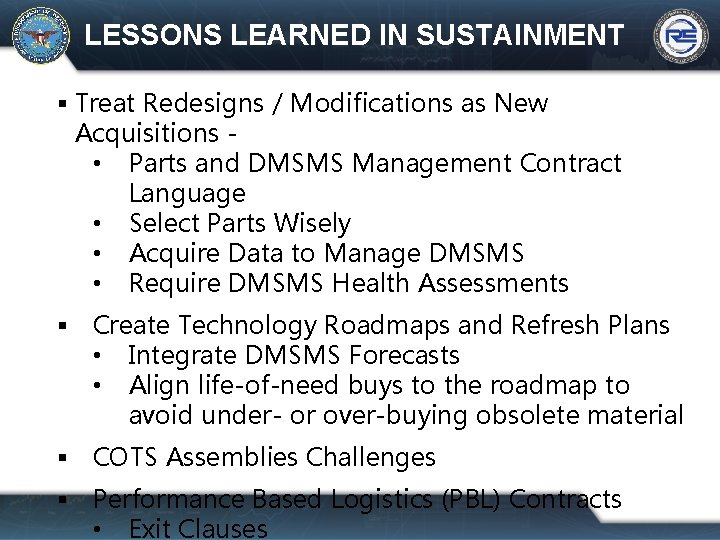
LESSONS LEARNED IN SUSTAINMENT Treat Redesigns / Modifications as New Acquisitions • Parts and DMSMS Management Contract Language • Select Parts Wisely • Acquire Data to Manage DMSMS • Require DMSMS Health Assessments Create Technology Roadmaps and Refresh Plans • Integrate DMSMS Forecasts • Align life-of-need buys to the roadmap to avoid under- or over-buying obsolete material COTS Assemblies Challenges Performance Based Logistics (PBL) Contracts • Exit Clauses
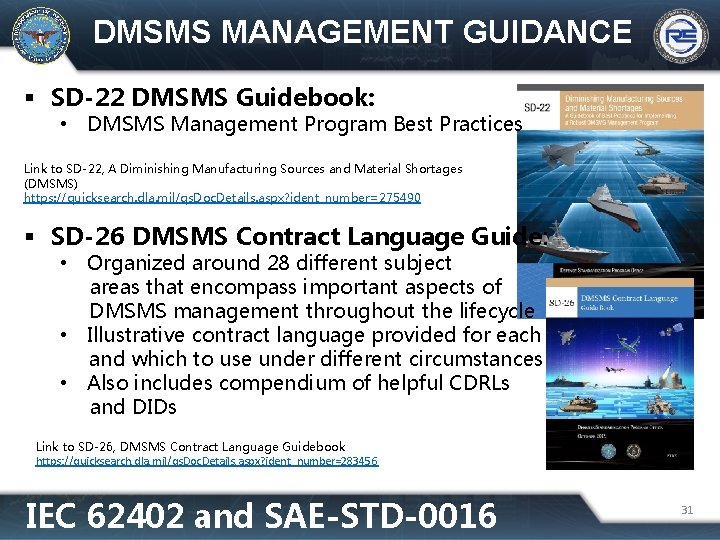
DMSMS MANAGEMENT GUIDANCE SD-22 DMSMS Guidebook: • DMSMS Management Program Best Practices Link to SD-22, A Diminishing Manufacturing Sources and Material Shortages (DMSMS) https: //quicksearch. dla. mil/qs. Doc. Details. aspx? ident_number=275490 SD-26 DMSMS Contract Language Guide: • Organized around 28 different subject areas that encompass important aspects of DMSMS management throughout the lifecycle • Illustrative contract language provided for each and which to use under different circumstances • Also includes compendium of helpful CDRLs and DIDs Link to SD-26, DMSMS Contract Language Guidebook https: //quicksearch. dla. mil/qs. Doc. Details. aspx? ident_number=283456 IEC 62402 and SAE-STD-0016 31
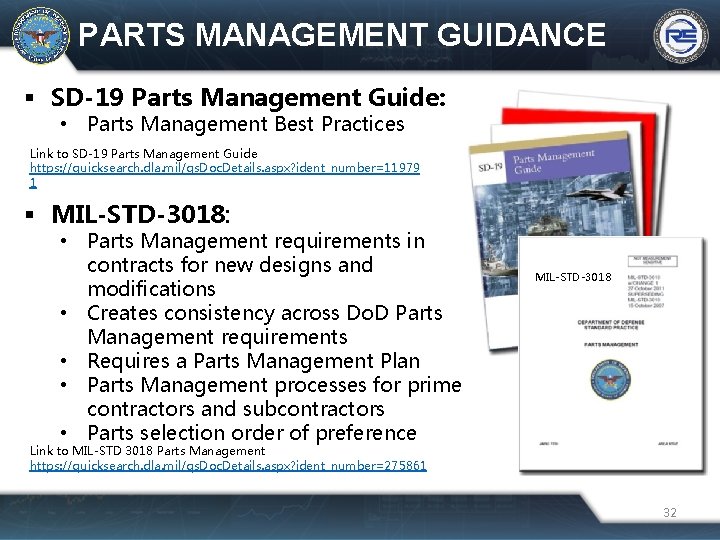
PARTS MANAGEMENT GUIDANCE SD-19 Parts Management Guide: • Parts Management Best Practices Link to SD-19 Parts Management Guide https: //quicksearch. dla. mil/qs. Doc. Details. aspx? ident_number=11979 1 MIL-STD-3018: • Parts Management requirements in contracts for new designs and modifications • Creates consistency across Do. D Parts Management requirements • Requires a Parts Management Plan • Parts Management processes for prime contractors and subcontractors • Parts selection order of preference MIL-STD-3018 Link to MIL-STD 3018 Parts Management https: //quicksearch. dla. mil/qs. Doc. Details. aspx? ident_number=275861 32
DAU PARTS & MATERIAL LIFECYCLE MANAGEMENT COURSES CLL 032 Preventing Counterfeit Parts in Do. D Supply Chains CLL 038 Provisioning & Cataloging LOG 0390 Additive Manufacturing (Future) CLL 047 Sustaining Engineering CLL 051 System Retirement, Disposition, Reclamation, Demil, Disposal CLL 200 DMSMS: What Program Manager Needs to Know CLL 201 DMSMS Fundamentals CLL 202 DMSMS Executive Overview CLL 206 Introduction to Parts Management CLL 207 DMSMS Component Research CLC 004 Market Research CLE 019 Modular Open Systems 33
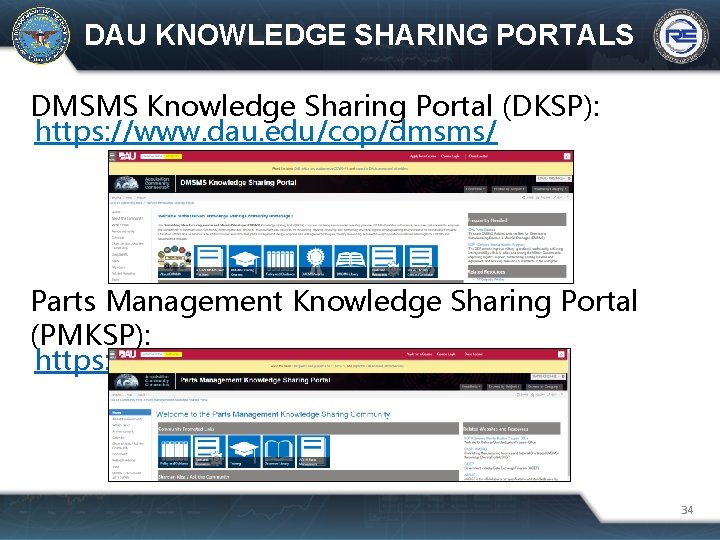
DAU KNOWLEDGE SHARING PORTALS DMSMS Knowledge Sharing Portal (DKSP): https: //www. dau. edu/cop/dmsms/ Parts Management Knowledge Sharing Portal (PMKSP): https: //www. dau. edu/cop/pmksp/ 34
CONCLUSION Good PARTS SELECTION is KEY TO SUCCESS Consider Parts Management and DMSMS prior to Milestone A or its equivalent Build DMSMS RESILIENT DESIGNS Create Technology Roadmaps and Refresh Plans If risks are unavoidable, it's better to find out early so plans can be made to mitigate 35
Q&A 36