
Strategic Measurement in the Lean Enterprise October 30
Strategic Measurement in the Lean Enterprise October 30, 2002 Professor Debbie Nightingale
Metrics Serve Multiple Purposes “Performance control systems can serve two purposes, to measure and to motivate. ” H. Mintzberg, The Structure of Organizations, (1979) Debbie Nightingale, MIT © 2001 2
Metrics Are Measurements You Can Use • Metrics are meaningful, quantified measures • To be meaningful, a metric must present data or information that allows us to take action – Helps to identify what should be done – Helps to identify who should do it • Metrics should be tied to strategy and to “core” processes - they should indicate how well organizational objectives and goals are being met through disciplined “core” processes • Metrics should foster process understanding and motivate individual, group, or team action to continually improve the way they do business. (Measurement does not necessarily result in process improvement. Good metrics always do. ) Debbie Nightingale, MIT © 2001 3
When Assessing a Metric System Ask the Following Types of Questions • Does it clearly define what constitutes business excellence? • Does it provide the information required to set aggressive yet achievable strategic objectives and stretch goals? • Does it accurately portray our progress and probability of achieving both long-term strategic objectives and near-term milestones? • Does it identify the root causes of barriers? • Does it focus the organization on the priority improvement needs? • Does it drive the behavior and actions required to achieve the objectives? • Does it align work with value? • Is it easy to use? • Does it involve everyone? Debbie Nightingale, MIT © 2001 4
What Are The Characteristics of a “Good” Metric? • Easy to get • Answers the questions • Produces the desired results Debbie Nightingale, MIT © 2001 5
A “Good” Metric Satisfies 3 Broad Criteria 1. Strategic 2. Quantitative 3. Qualitative Debbie Nightingale, MIT © 2001 6
Strategic A good metric should: • Enable strategic planning and then drive deployment of the actions required to achieve strategic objectives • Ensure alignment of behavior and initiatives with strategic objectives • Focus the organization on its priorities Example: How fast do we need to develop and market new products to grow 20 percent per year? Debbie Nightingale, MIT © 2001 7
Quantification of Metrics is Critical “When you can measure what you are speaking about, and express it in numbers, you know something about it; but when you cannot measure it, when you cannot express it in numbers, your knowledge is of a meager and unsatisfactory kind. ” - Lord Kelvin Debbie Nightingale, MIT © 2001 8
Quantitative A good metric should: • Provide a clear understanding of progress toward strategic objectives • Provide current status, rate of improvement, and probability of achievement • Identify performance gaps and improvement opportunities Example: What is the cycle time of our product development process? Where does the process need improving the most? Debbie Nightingale, MIT © 2001 9
Qualitative A good metric should: • Be perceived as valuable by your organization and the people involved with the metric Example: Is the effort and cost of collecting the data reasonable? Is the information timely and actionable? Debbie Nightingale, MIT © 2001 10
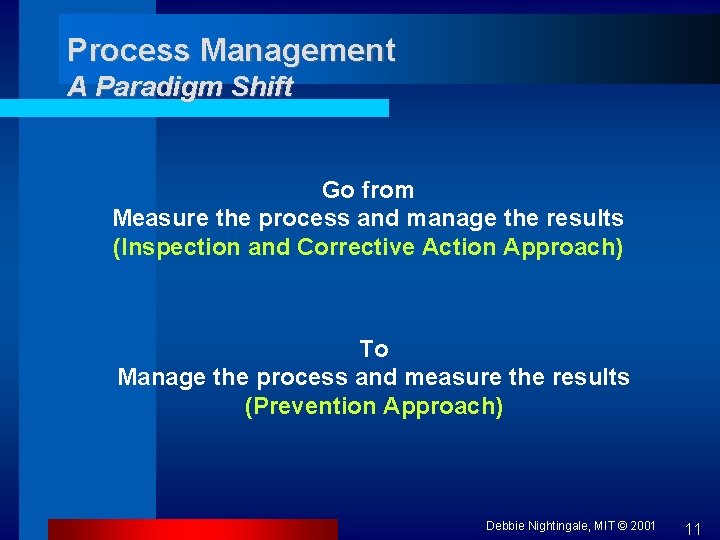
Process Management A Paradigm Shift Go from Measure the process and manage the results (Inspection and Corrective Action Approach) To Manage the process and measure the results (Prevention Approach) Debbie Nightingale, MIT © 2001 11
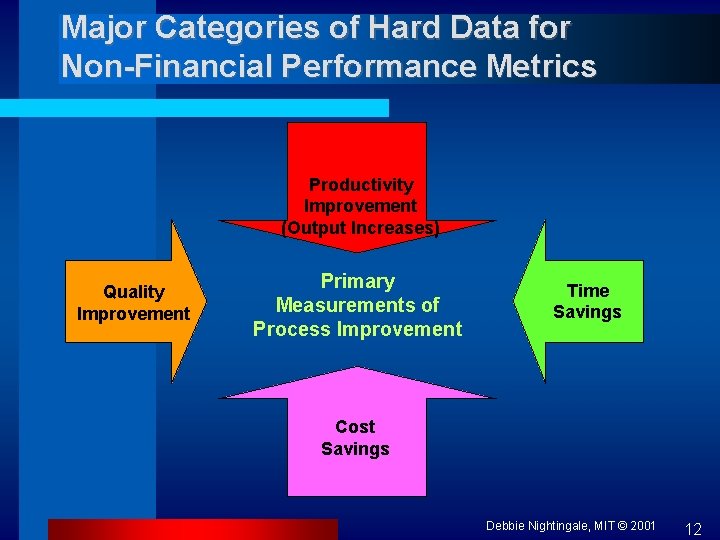
Major Categories of Hard Data for Non-Financial Performance Metrics Productivity Improvement (Output Increases) Quality Improvement Primary Measurements of Process Improvement Time Savings Cost Savings Debbie Nightingale, MIT © 2001 12

Two Edicts “Effective measurement must be an integral part of the management process. ” “What you measure is what you get” R. S. Kaplan and D. P. Norton, Harvard Business Review, January-February, 71 -79 (1992) Debbie Nightingale, MIT © 2001 13
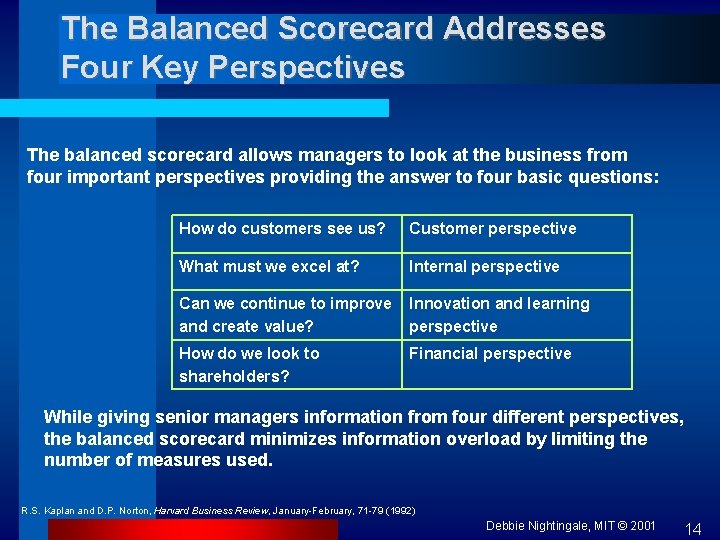
The Balanced Scorecard Addresses Four Key Perspectives The balanced scorecard allows managers to look at the business from four important perspectives providing the answer to four basic questions: How do customers see us? Customer perspective What must we excel at? Internal perspective Can we continue to improve and create value? Innovation and learning perspective How do we look to shareholders? Financial perspective While giving senior managers information from four different perspectives, the balanced scorecard minimizes information overload by limiting the number of measures used. R. S. Kaplan and D. P. Norton, Harvard Business Review, January-February, 71 -79 (1992) Debbie Nightingale, MIT © 2001 14
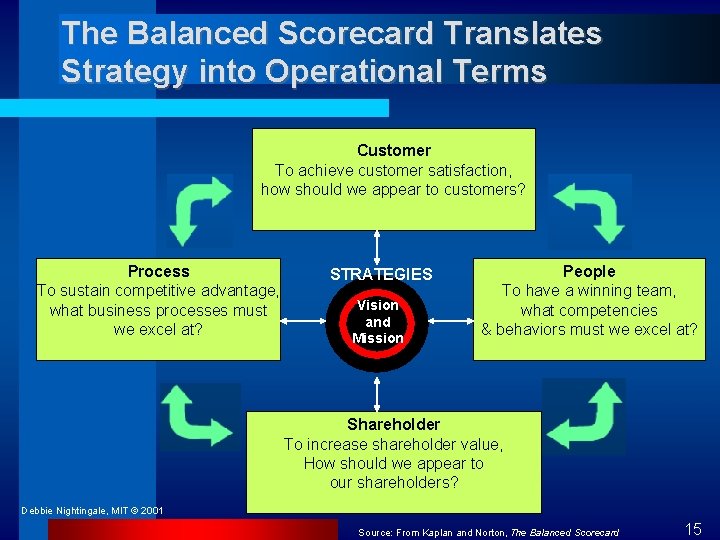
The Balanced Scorecard Translates Strategy into Operational Terms Customer To achieve customer satisfaction, how should we appear to customers? Process To sustain competitive advantage, what business processes must we excel at? STRATEGIES Vision and Mission People To have a winning team, what competencies & behaviors must we excel at? Shareholder To increase shareholder value, How should we appear to our shareholders? Debbie Nightingale, MIT © 2001 Source: From Kaplan and Norton, The Balanced Scorecard 15
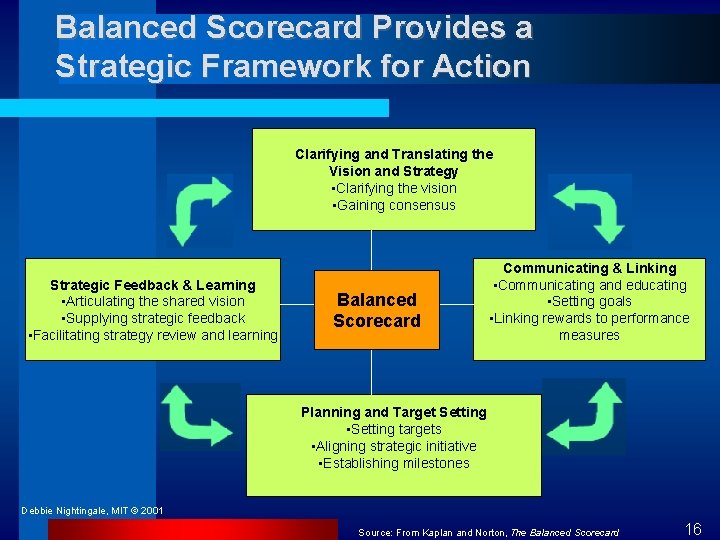
Balanced Scorecard Provides a Strategic Framework for Action Clarifying and Translating the Vision and Strategy • Clarifying the vision • Gaining consensus Strategic Feedback & Learning • Articulating the shared vision • Supplying strategic feedback • Facilitating strategy review and learning Balanced Scorecard Communicating & Linking • Communicating and educating • Setting goals • Linking rewards to performance measures Planning and Target Setting • Setting targets • Aligning strategic initiative • Establishing milestones Debbie Nightingale, MIT © 2001 Source: From Kaplan and Norton, The Balanced Scorecard 16
Balanced Scorecard Integrates Company’s Reporting Process “The scorecard brings together in a single report many of the disparate elements of the company’s competitive agenda, e. g. becoming customer oriented, shortening response time, improving quality, emphasizing team-work, reducing new product launch times and managing for the long term. ” R. S. Kaplan and D. P. Norton, Harvard Business Review, January-February, 71 -79 (1992) Debbie Nightingale, MIT © 2001 17
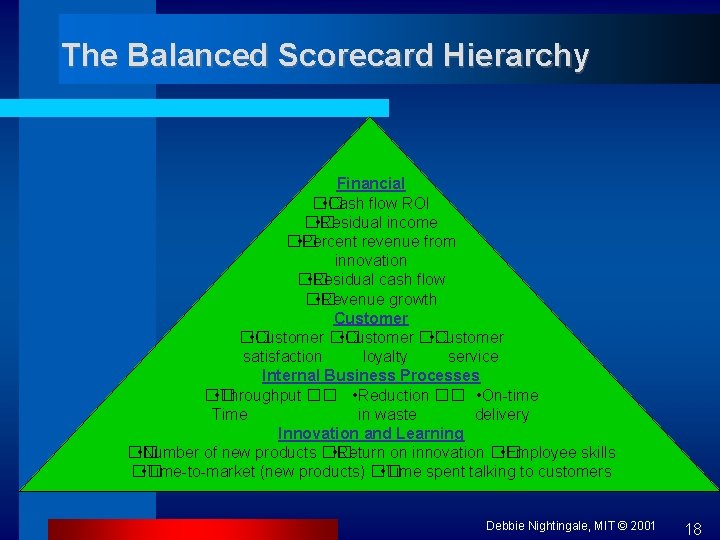
The Balanced Scorecard Hierarchy Financial �� • Cash flow ROI �� • Residual income �� • Percent revenue from innovation �� • Residual cash flow �� • Revenue growth Customer �� • Customer satisfaction loyalty service Internal Business Processes �� • Throughput �� • Reduction �� • On-time Time in waste delivery Innovation and Learning �� • Number of new products �� • Return on innovation �� • Employee skills �� • Time-to-market (new products) �� • Time spent talking to customers Debbie Nightingale, MIT © 2001 18
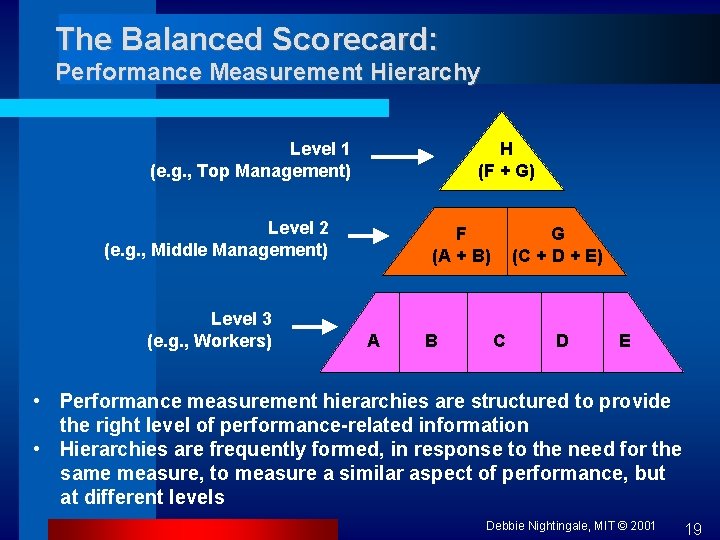
The Balanced Scorecard: Performance Measurement Hierarchy Level 1 (e. g. , Top Management) H (F + G) Level 2 (e. g. , Middle Management) Level 3 (e. g. , Workers) F (A + B) A B G (C + D + E) C D E • Performance measurement hierarchies are structured to provide the right level of performance-related information • Hierarchies are frequently formed, in response to the need for the same measure, to measure a similar aspect of performance, but at different levels Debbie Nightingale, MIT © 2001 19
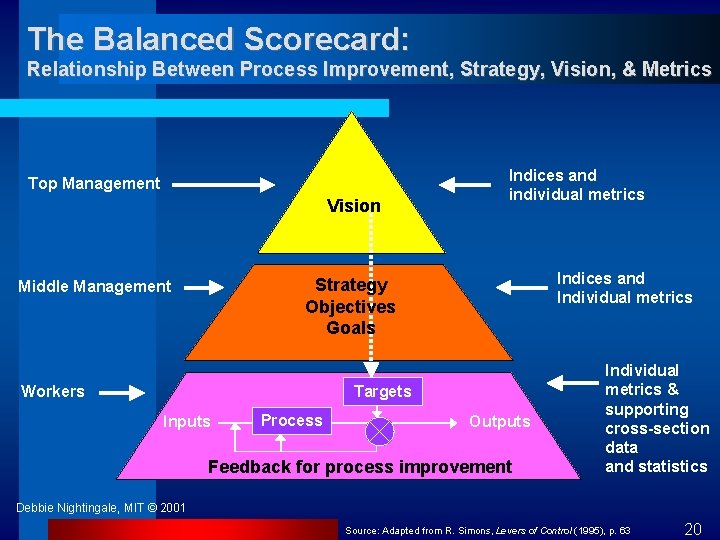
The Balanced Scorecard: Relationship Between Process Improvement, Strategy, Vision, & Metrics Top Management Vision Indices and individual metrics Indices and Individual metrics Strategy Objectives Goals Middle Management Workers Targets Inputs Process Outputs Feedback for process improvement Individual metrics & supporting cross-section data and statistics Debbie Nightingale, MIT © 2001 Source: Adapted from R. Simons, Levers of Control (1995), p. 63 20
Primary Purposes of the Balanced Performance Metrics Scorecard • Align a balanced set of performance metrics with business strategy and vision • Provide management and work teams with the information necessary and sufficient to meet their objectives and goals • Create “line-of-sight” at lower levels of the organization • Foster and support process continuous improvementinitiatives Debbie Nightingale, MIT © 2001 21
Alignment of Strategic Objectives and Metrics is a Powerful Force “When the critical success factors of a strategy are quantified and used as a measure of policy deployment, they can become a powerful force for aligning organizational priorities, actions, and behavior with strategic objectives. ” - Raytheon Systems Metrics Team Debbie Nightingale, MIT © 2001 22
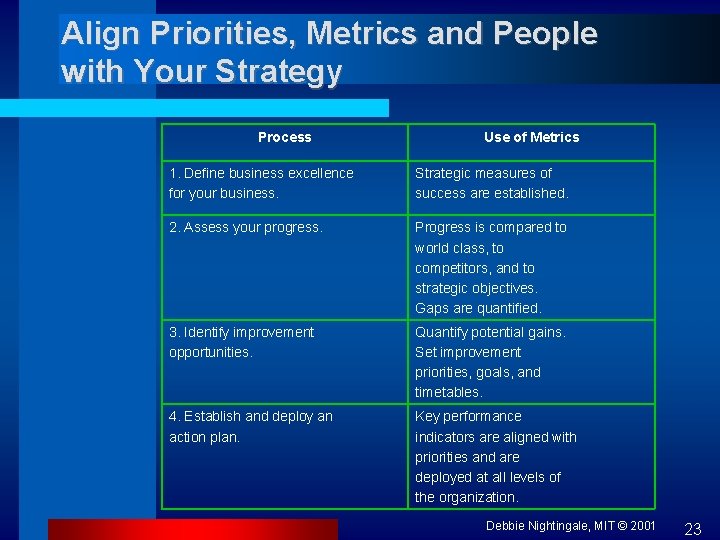
Align Priorities, Metrics and People with Your Strategy Process Use of Metrics 1. Define business excellence for your business. Strategic measures of success are established. 2. Assess your progress. Progress is compared to world class, to competitors, and to strategic objectives. Gaps are quantified. 3. Identify improvement opportunities. Quantify potential gains. Set improvement priorities, goals, and timetables. 4. Establish and deploy an action plan. Key performance indicators are aligned with priorities and are deployed at all levels of the organization. Debbie Nightingale, MIT © 2001 23
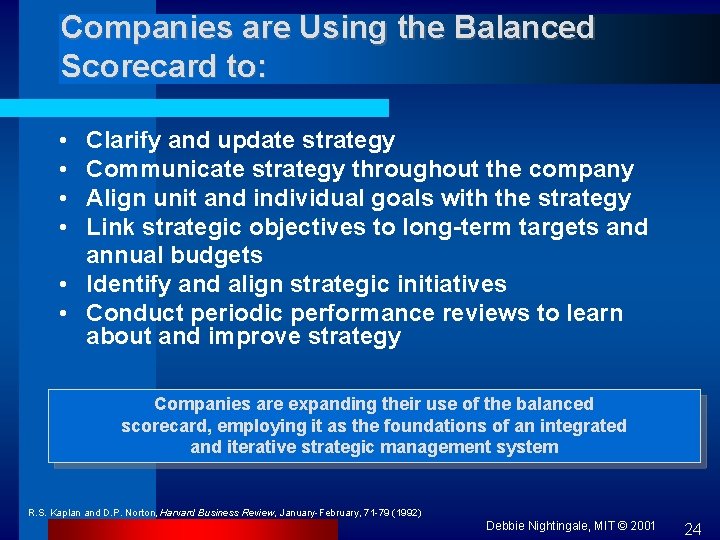
Companies are Using the Balanced Scorecard to: • • Clarify and update strategy Communicate strategy throughout the company Align unit and individual goals with the strategy Link strategic objectives to long-term targets and annual budgets • Identify and align strategic initiatives • Conduct periodic performance reviews to learn about and improve strategy Companies are expanding their use of the balanced scorecard, employing it as the foundations of an integrated and iterative strategic management system R. S. Kaplan and D. P. Norton, Harvard Business Review, January-February, 71 -79 (1992) Debbie Nightingale, MIT © 2001 24
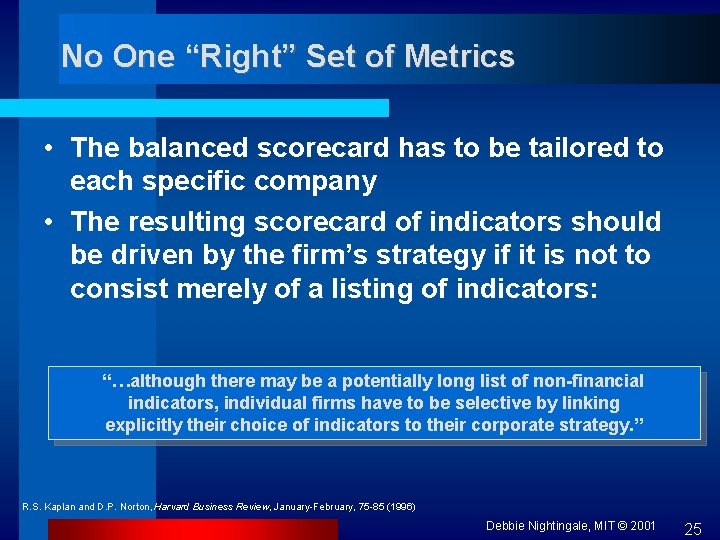
No One “Right” Set of Metrics • The balanced scorecard has to be tailored to each specific company • The resulting scorecard of indicators should be driven by the firm’s strategy if it is not to consist merely of a listing of indicators: “…although there may be a potentially long list of non-financial indicators, individual firms have to be selective by linking explicitly their choice of indicators to their corporate strategy. ” R. S. Kaplan and D. P. Norton, Harvard Business Review, January-February, 75 -85 (1996) Debbie Nightingale, MIT © 2001 25
Metrics Must Be Changed to Maintain Alignment With New Strategies Typical causes of metric misalignment are: 1. The metric is wrong and must be changed to align with the strategy 2. The right things are being measured, but the strategy is out of date and must be realigned with the changing market 3. Management perspective and policy are wrong and must change with the strategy and market 4. The process has matured and new metrics are required Debbie Nightingale, MIT © 2001 26
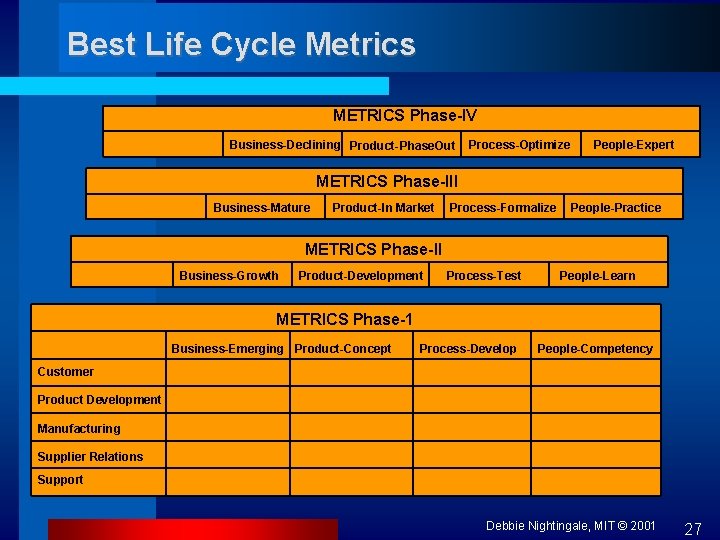
Best Life Cycle Metrics METRICS Phase-IV Business-Declining Product-Phase. Out Process-Optimize People-Expert METRICS Phase-III Business-Mature Product-In Market Process-Formalize People-Practice METRICS Phase-II Business-Growth Product-Development Process-Test People-Learn METRICS Phase-1 Business-Emerging Product-Concept Process-Develop People-Competency Customer Product Development Manufacturing Supplier Relations Support Debbie Nightingale, MIT © 2001 27
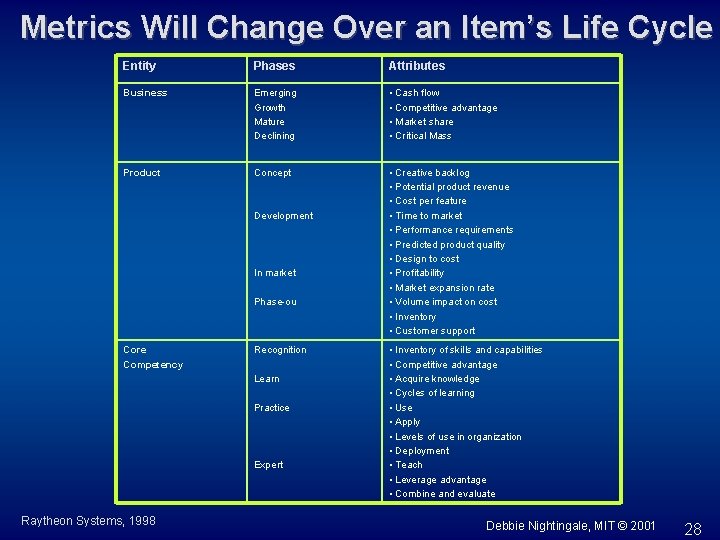
Metrics Will Change Over an Item’s Life Cycle Entity Phases Attributes Business Emerging Growth Mature Declining • Cash flow • Competitive advantage • Market share • Critical Mass Product Concept • Creative backlog • Potential product revenue • Cost per feature • Time to market • Performance requirements • Predicted product quality • Design to cost • Profitability • Market expansion rate • Volume impact on cost • Inventory • Customer support Development In market Phase-ou Core Competency Recognition Learn Practice Expert Raytheon Systems, 1998 • Inventory of skills and capabilities • Competitive advantage • Acquire knowledge • Cycles of learning • Use • Apply • Levels of use in organization • Deployment • Teach • Leverage advantage • Combine and evaluate Debbie Nightingale, MIT © 2001 28
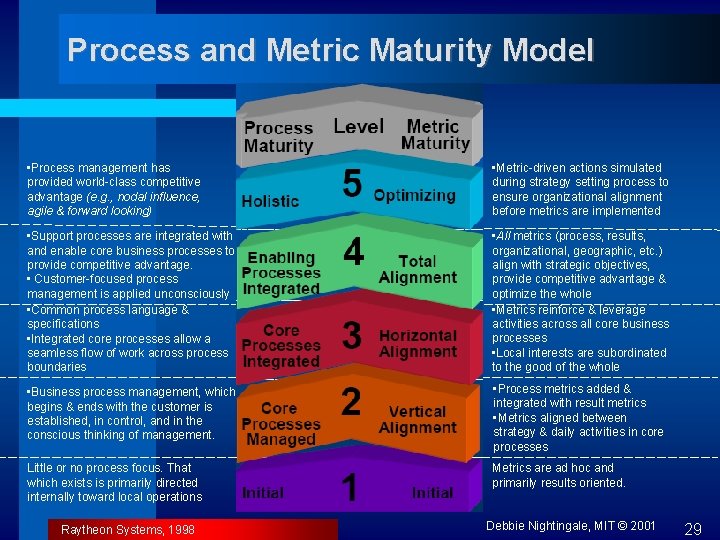
Process and Metric Maturity Model • Process management has provided world-class competitive advantage (e. g. , nodal influence, agile & forward looking) • Metric-driven actions simulated during strategy setting process to ensure organizational alignment before metrics are implemented • Support processes are integrated with and enable core business processes to provide competitive advantage. • Customer-focused process management is applied unconsciously • Common process language & specifications • Integrated core processes allow a seamless flow of work across process boundaries • All metrics (process, results, organizational, geographic, etc. ) align with strategic objectives, provide competitive advantage & optimize the whole • Metrics reinforce & leverage activities across all core business processes • Local interests are subordinated to the good of the whole • Business process management, which begins & ends with the customer is established, in control, and in the conscious thinking of management. • Process metrics added & integrated with result metrics • Metrics aligned between strategy & daily activities in core processes Little or no process focus. That which exists is primarily directed internally toward local operations Metrics are ad hoc and primarily results oriented. Raytheon Systems, 1998 Debbie Nightingale, MIT © 2001 29
Level One: Initial Enterprise does not manage its business with a process focus • Many metrics sub-optimized by local organizational interests rather than having them aligned with customer interests and with the strategic objectives of the enterprise • Organizations measure the results of past actions • Results-oriented metrics cannot provide the leading indicators needed for timely corrective action to change outcomes Debbie Nightingale, MIT © 2001 30
Level Two: Vertical Alignment Definition Vertical alignment is the alignment and reinforcement of strategic objectives with supportive goals and progress measures at all levels of the organization. • The business enterprise applies a process focus so it can measure leading indicators of the expected process output • Defective process output is viewed as a process-capability problem, not a people problem • Carefully chosen metrics ensure that all levels of the organization align with strategic objectives Debbie Nightingale, MIT © 2001 31
Level Two Example A core process related to product development activities might be documented, be in control (repeatable), be consistently deployed across the organization, and have measurable improvement gains. If so, that process is probably at or near Level 2 maturity. If the metrics indicate variations in the process results, then they are still at Level 1 because the process is not in control. Debbie Nightingale, MIT © 2001 32
Level Three: Horizontal Alignment Two phases: 1. The global optimization of work flow across all process boundaries. These boundaries become transparent to the flow of work. Metrics are customer-focused and assess the enterprise-level capability of a process to provide value from the customer’s perspective. 2. The global optimization of work flow across all organizational boundaries that support or use a particular process. Metrics are customer-focused and assess how well the infrastructure enables execution of customer-focused processes. Debbie Nightingale, MIT © 2001 33
Level Three Example The enterprise may have several core customer-related processes such as winning new business and developing new products. Also, the enterprise may have many functions that support or execute these core processes. Level 3 characteristics include: • Integrated core processes that customers see as seamless • Minimized hand-offs or delays as work moves among processes and sub-processes • Management focus primarily on early process activities in a product life cycle • Metrics insure local organizational interests (functional or business unit) are subordinated to customer needs and what is best for the entire business Debbie Nightingale, MIT © 2001 34
Level Four: Total Alignment Definition Total alignment is the synergistic interaction of metrics from all support processes with metrics from all core process to reinforce the strategy and to drive business excellence. • All employees clearly see where the business is headed and how they can make a difference. • Horizontal integration (Level 3) provides employees with “line of sight” to customer value. Dramatic performance improvements can occur at this level. • Total enterprise-level alignment (Level 4) is required to overcome the major systemic barriers to great performance and to embed the long-term gains into the fabric of the organization’s culture. Debbie Nightingale, MIT © 2001 35
Level Four Example At Level 4, the enterprise begins asking how enabling processes create competitive advantage for the core customer-related processes, rather than what they do to improve themselves. • Total enterprise alignment is required to overcome the major systemic barriers to great performance Debbie Nightingale, MIT © 2001 36
Level Five: Optimizing • From a process perspective, the enterprise will have much greater influence on the market than its size might indicate. The agile and forward-looking enterprise will be able to foresee events and respond to those events before they occur. • From a metrics perspective, the enterprise will be able not only to simulate and predict the outcome of a strategy before its deployment, but also to predict the effect of specific metrics on the outcome of that strategy before choosing metrics. Debbie Nightingale, MIT © 2001 37
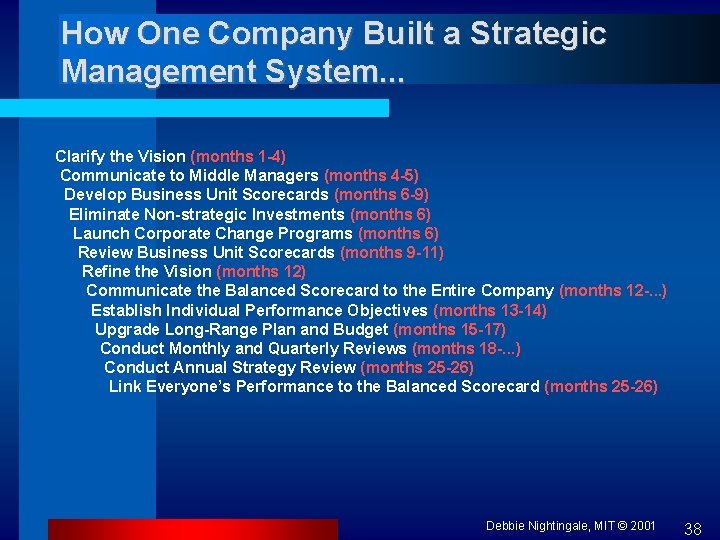
How One Company Built a Strategic Management System. . . Clarify the Vision (months 1 -4) Communicate to Middle Managers (months 4 -5) Develop Business Unit Scorecards (months 6 -9) Eliminate Non-strategic Investments (months 6) Launch Corporate Change Programs (months 6) Review Business Unit Scorecards (months 9 -11) Refine the Vision (months 12) Communicate the Balanced Scorecard to the Entire Company (months 12 -. . . ) Establish Individual Performance Objectives (months 13 -14) Upgrade Long-Range Plan and Budget (months 15 -17) Conduct Monthly and Quarterly Reviews (months 18 -. . . ) Conduct Annual Strategy Review (months 25 -26) Link Everyone’s Performance to the Balanced Scorecard (months 25 -26) Debbie Nightingale, MIT © 2001 38
- Slides: 38