
Strategic Management Strategic Planning Competitiveness Strategic Management Defined

- Slides: 50
Strategic Management Strategic Planning& Competitiveness
Strategic Management – Defined Art & science of formulating, implementing, and evaluating, cross-functional decisions that enable an organization to achieve its objectives.
Adapting to Change – Key Strategic Management Questions • What kind of business should we become? • Are we in the right fields • Are there new competitors • What strategies should we pursue? • How are our customers changing?
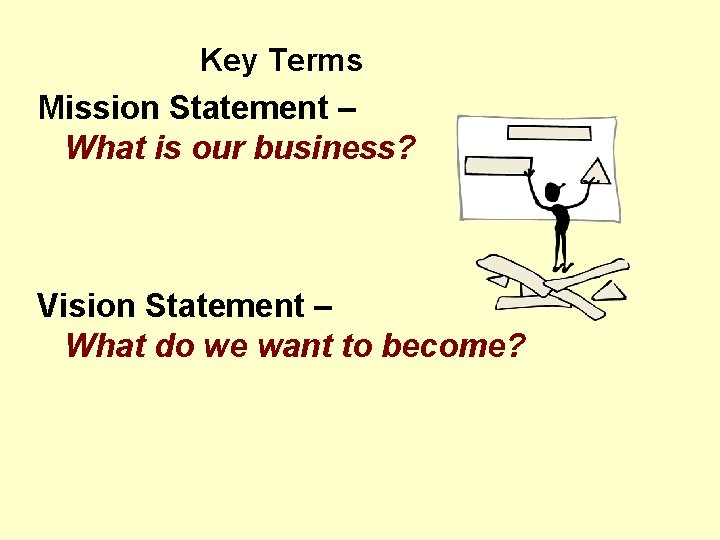
Key Terms Mission Statement – What is our business? Vision Statement – What do we want to become?
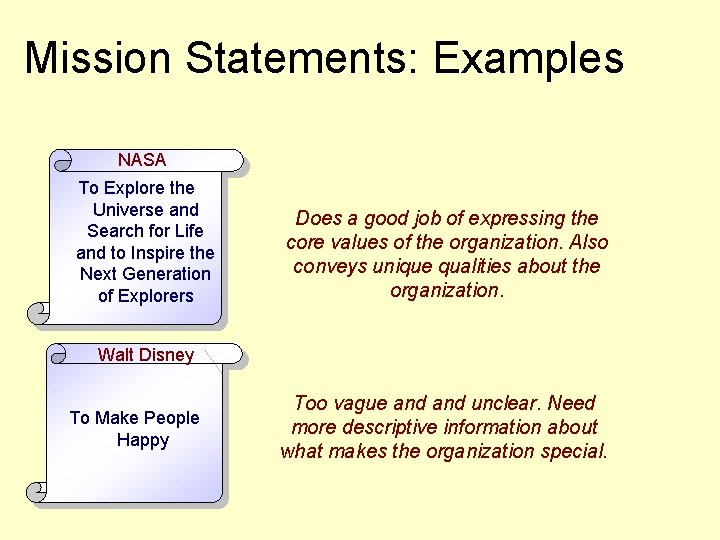
Mission Statements: Examples NASA To Explore the Universe and Search for Life and to Inspire the Next Generation of Explorers Does a good job of expressing the core values of the organization. Also conveys unique qualities about the organization. Walt Disney To Make People Happy Too vague and unclear. Need more descriptive information about what makes the organization special.
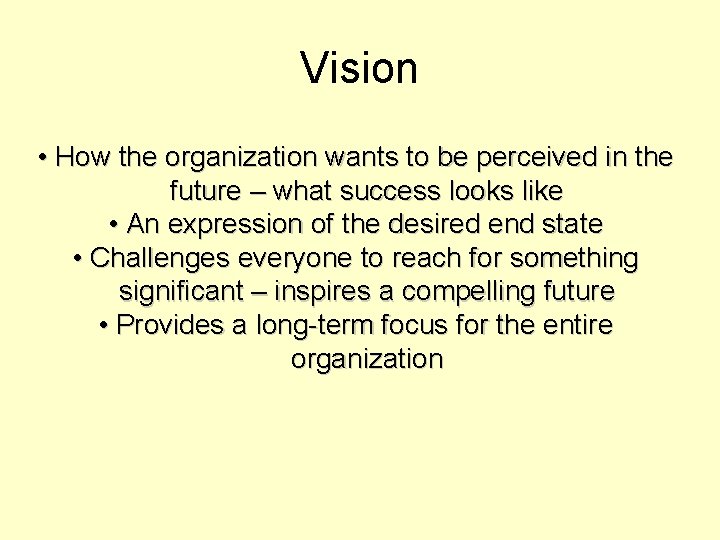
Vision • How the organization wants to be perceived in the future – what success looks like • An expression of the desired end state • Challenges everyone to reach for something significant – inspires a compelling future • Provides a long-term focus for the entire organization
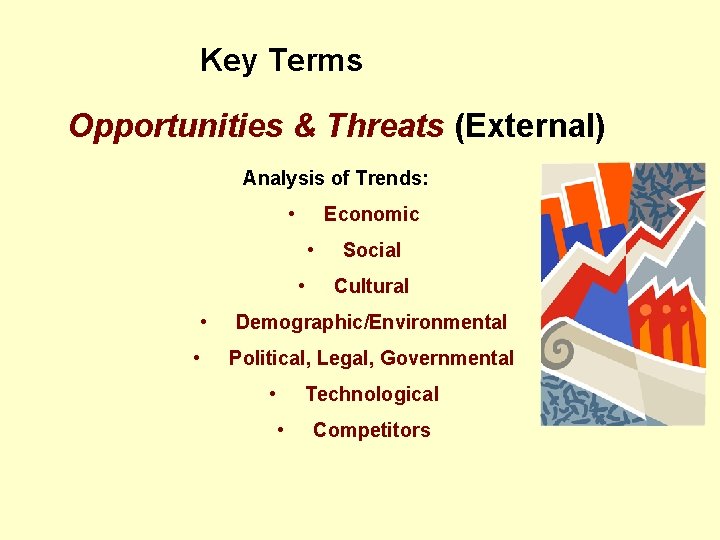
Key Terms Opportunities & Threats (External) Analysis of Trends: • Economic • • Social Cultural Demographic/Environmental Political, Legal, Governmental • Technological • Competitors
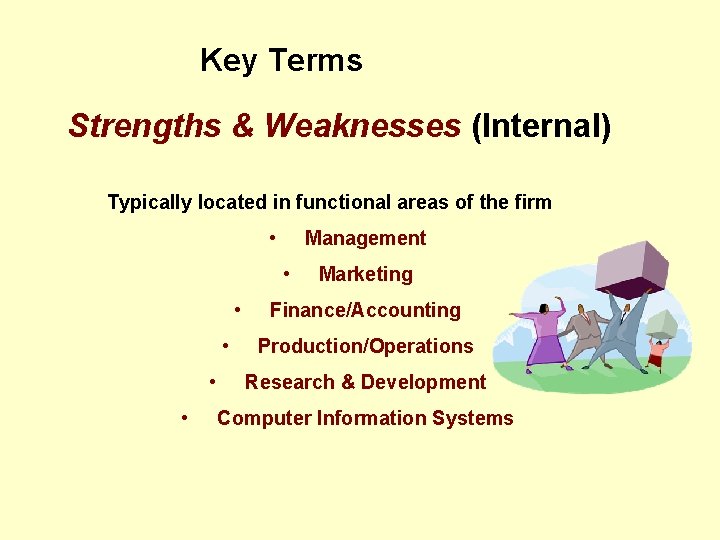
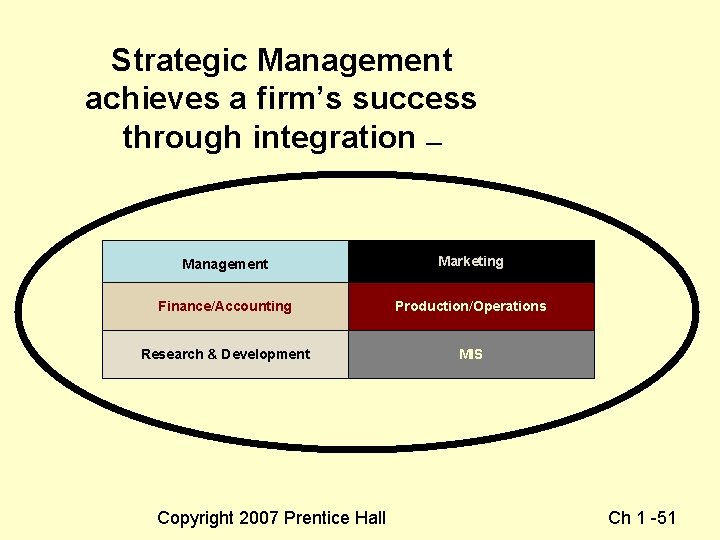
Key Terms Strengths & Weaknesses (Internal) Typically located in functional areas of the firm • Management • • • Marketing Finance/Accounting Production/Operations Research & Development Computer Information Systems
Key Terms Strategies q. Means by which long-term objectives are achieved
What is Strategy? • An integrated and coordinated set of commitments & actions designed to exploit core competencies and gain a competitive advantage. • A series of goal direceted decisions & actions • Strategies is use of engagements for the object. 1 -11
What is Strategy in different literature? “A unified, comprehensive, and integrated plan designed to ensure that the basic objectives of the enterprise are achieved. ” (Glueck, 1980: 9) “The pattern or plan that integrates an organization’s major goals, policies, and action sequences into a cohesive whole. ” (Quinn, 1980) “A pattern of resource allocation that enables firms to maintain or improve their performance. “A good strategy… neutralizes threats and exploits opportunities while capitalizing on strengths and avoiding or fixing weaknesses. ” (Barney, 1997: 17) 1 -12
• All successful strategies are based on understanding of the organization’s competitive environment. • The competitive environment is complex, and includes anything that can affect the organization’s position relative to that of its competitors. • Competitive enviroment is related with organizations’ products, services and organizational resources. 1 -13
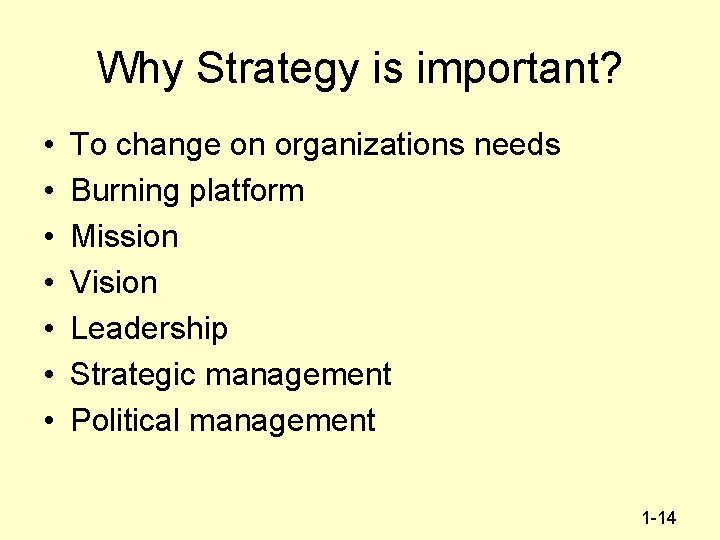
Why Strategy is important? • • To change on organizations needs Burning platform Mission Vision Leadership Strategic management Political management 1 -14
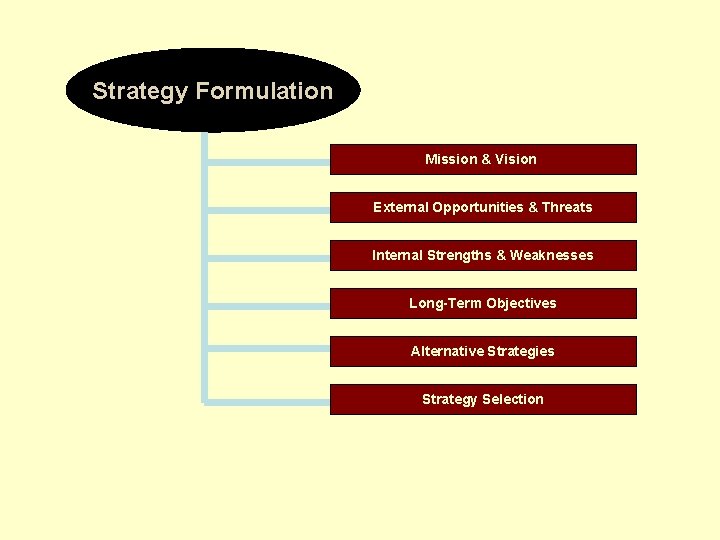
Strategy Formulation Mission & Vision External Opportunities & Threats Internal Strengths & Weaknesses Long-Term Objectives Alternative Strategies Strategy Selection
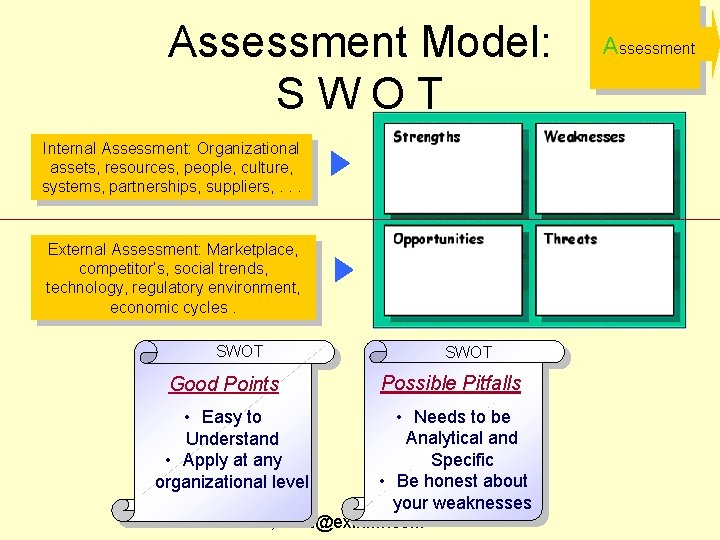
Assessment Model: SWOT Internal Assessment: Organizational assets, resources, people, culture, systems, partnerships, suppliers, . . . External Assessment: Marketplace, competitor’s, social trends, technology, regulatory environment, economic cycles. SWOT Good Points SWOT Possible Pitfalls • Needs to be Analytical and Specific • Be honest about your weaknesses Matt H. Evans, matt@exinfm. com • Easy to Understand • Apply at any organizational level Assessment
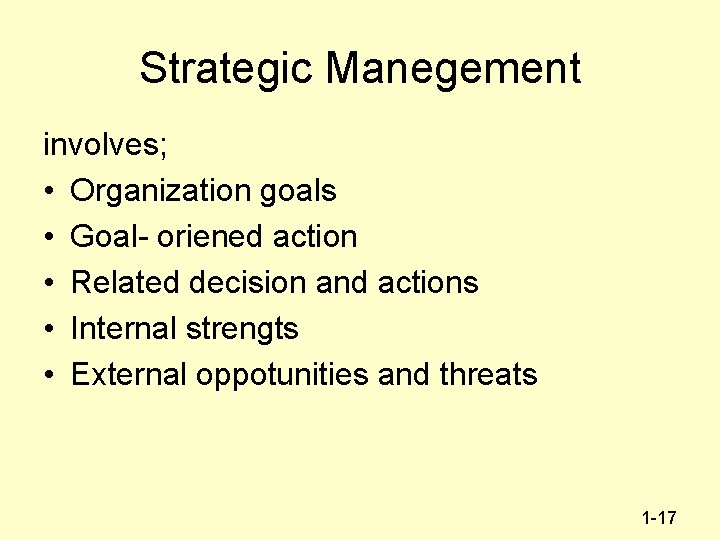
Strategic Manegement involves; • Organization goals • Goal- oriened action • Related decision and actions • Internal strengts • External oppotunities and threats 1 -17
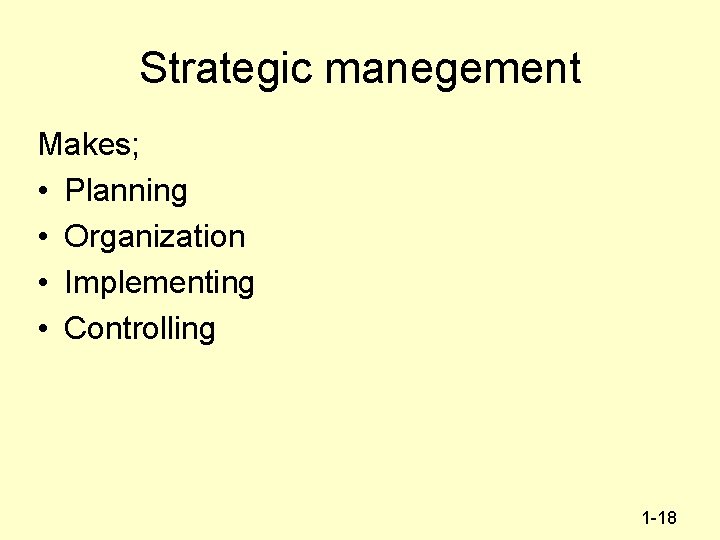
Strategic manegement Makes; • Planning • Organization • Implementing • Controlling 1 -18
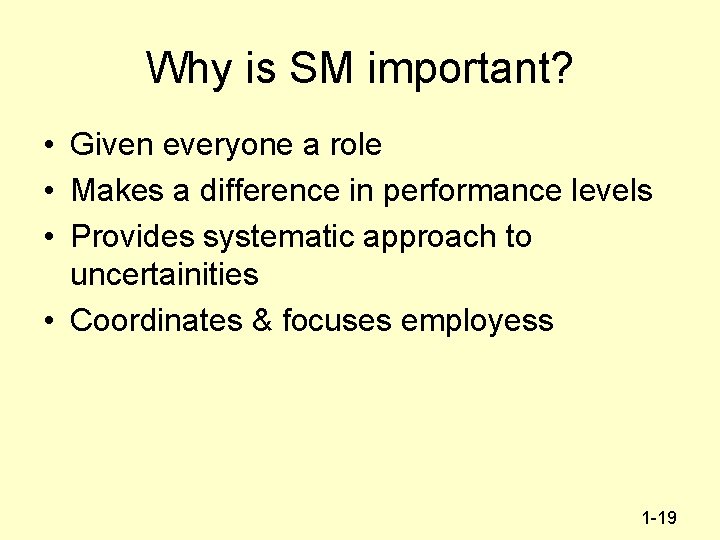
Why is SM important? • Given everyone a role • Makes a difference in performance levels • Provides systematic approach to uncertainities • Coordinates & focuses employess 1 -19
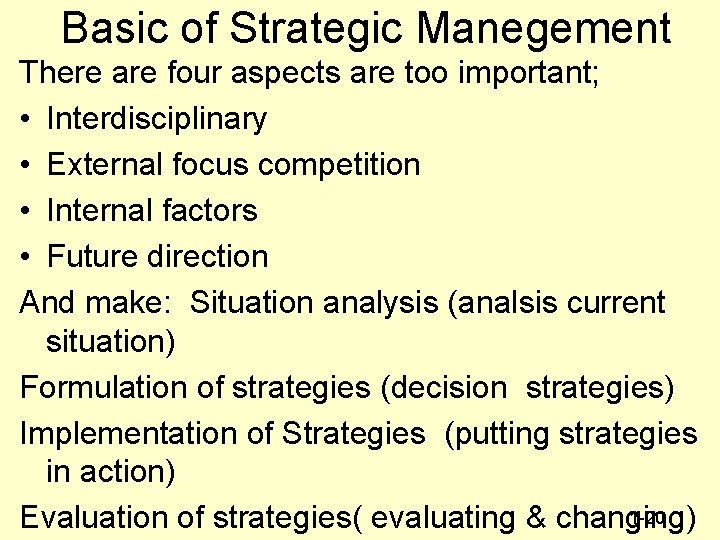
Basic of Strategic Manegement There are four aspects are too important; • Interdisciplinary • External focus competition • Internal factors • Future direction And make: Situation analysis (analsis current situation) Formulation of strategies (decision strategies) Implementation of Strategies (putting strategies in action) 1 -20 Evaluation of strategies( evaluating & changing)
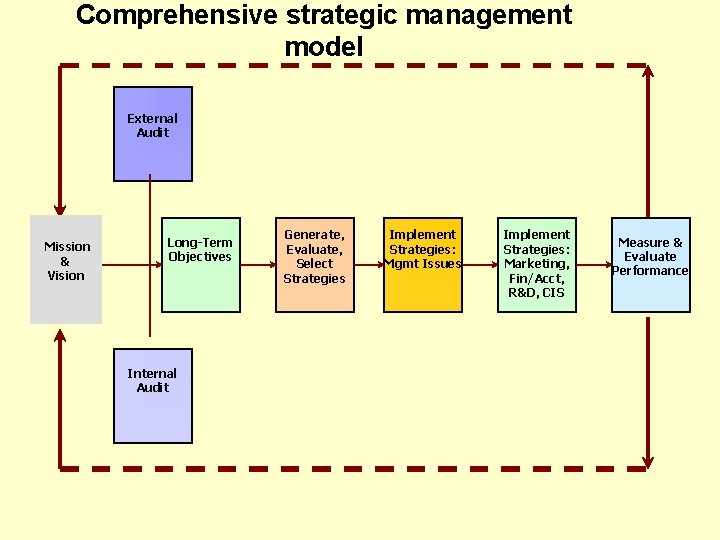
Comprehensive strategic management model External Audit Mission & Vision Long-Term Objectives Internal Audit Generate, Evaluate, Select Strategies Implement Strategies: Mgmt Issues Implement Strategies: Marketing, Fin/Acct, R&D, CIS Measure & Evaluate Performance
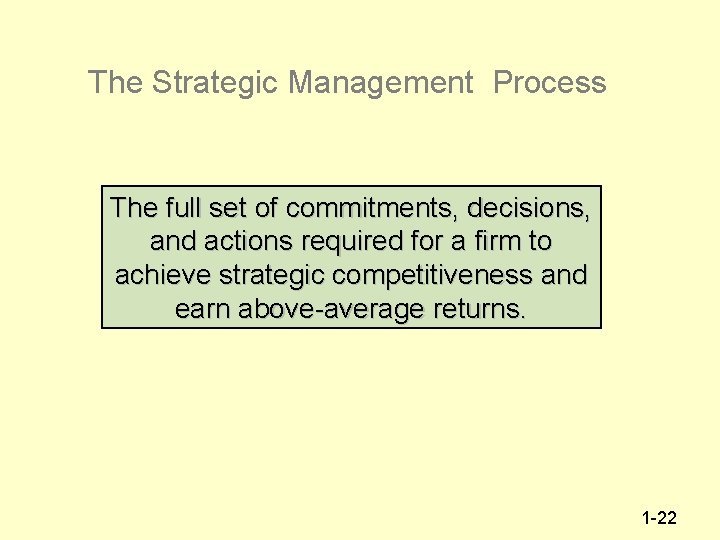
The Strategic Management Process The full set of commitments, decisions, and actions required for a firm to achieve strategic competitiveness and earn above-average returns. 1 -22
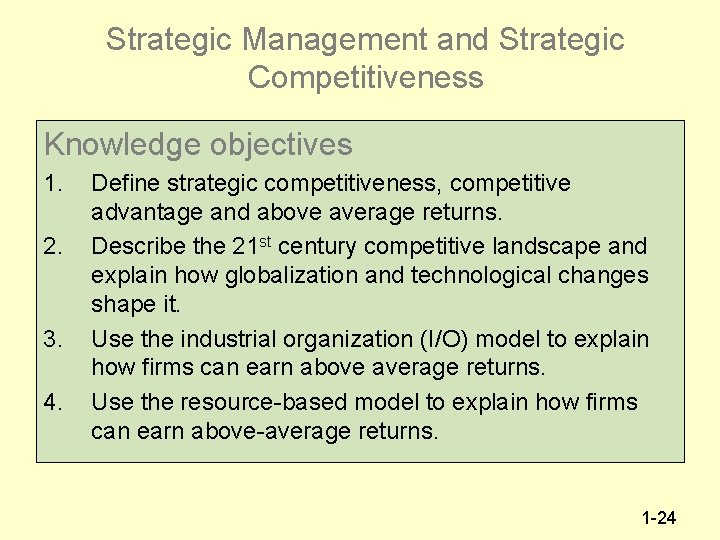
Strategic Management and Strategic Competitiveness Knowledge objectives 1. 2. 3. 4. Define strategic competitiveness, competitive advantage and above average returns. Describe the 21 st century competitive landscape and explain how globalization and technological changes shape it. Use the industrial organization (I/O) model to explain how firms can earn above average returns. Use the resource-based model to explain how firms can earn above-average returns. 1 -24
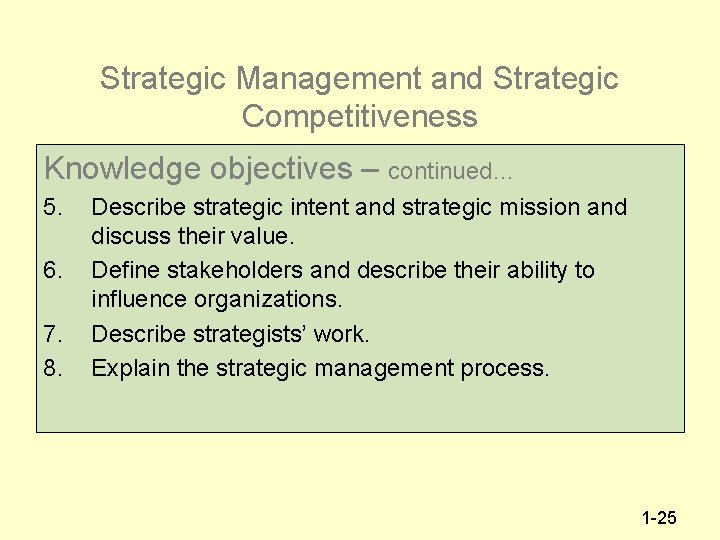
Strategic Management and Strategic Competitiveness Knowledge objectives – continued… 5. 6. 7. 8. Describe strategic intent and strategic mission and discuss their value. Define stakeholders and describe their ability to influence organizations. Describe strategists’ work. Explain the strategic management process. 1 -25
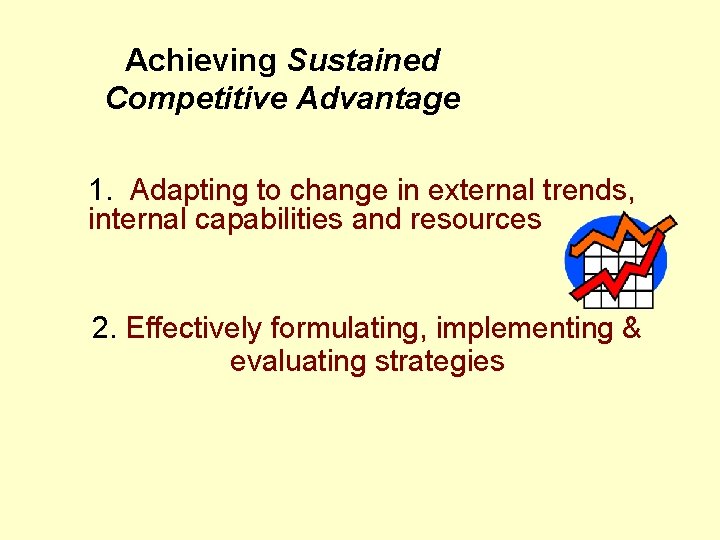
Achieving Sustained Competitive Advantage 1. Adapting to change in external trends, internal capabilities and resources 2. Effectively formulating, implementing & evaluating strategies
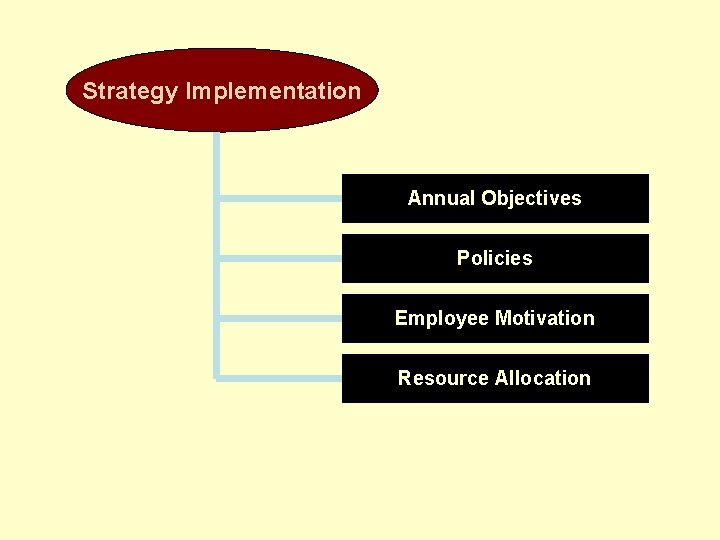
Strategy Implementation Annual Objectives Policies Employee Motivation Resource Allocation
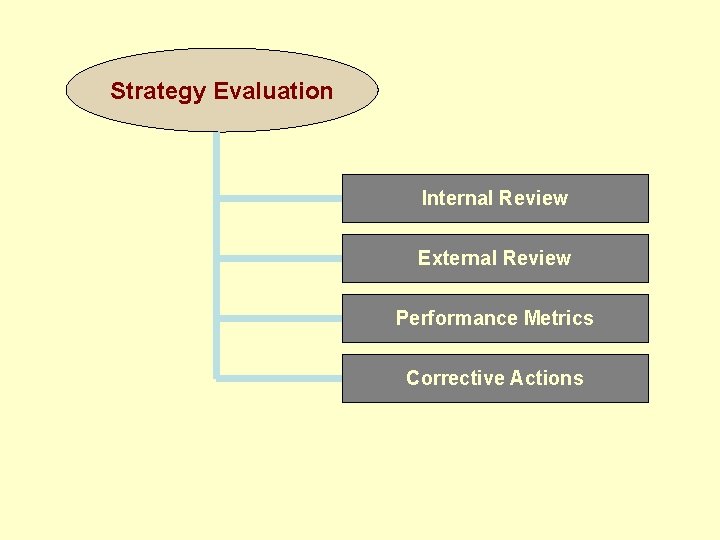
Strategy Evaluation Internal Review External Review Performance Metrics Corrective Actions
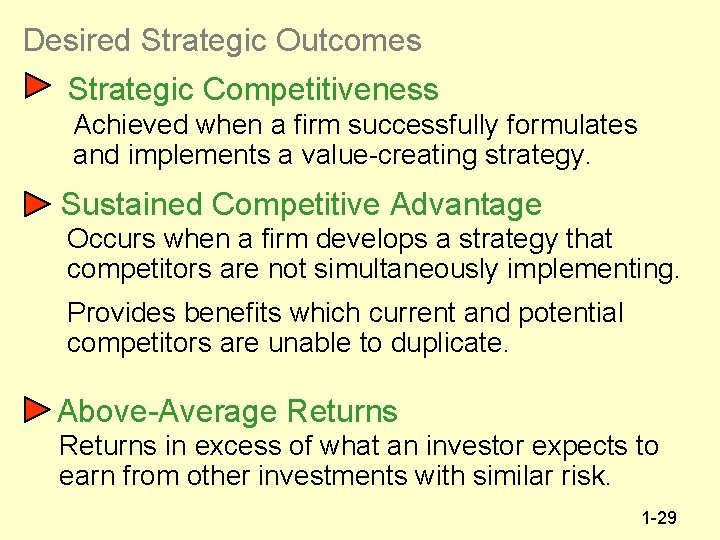
Desired Strategic Outcomes Strategic Competitiveness Achieved when a firm successfully formulates and implements a value-creating strategy. Sustained Competitive Advantage Occurs when a firm develops a strategy that competitors are not simultaneously implementing. Provides benefits which current and potential competitors are unable to duplicate. Above-Average Returns in excess of what an investor expects to earn from other investments with similar risk. 1 -29
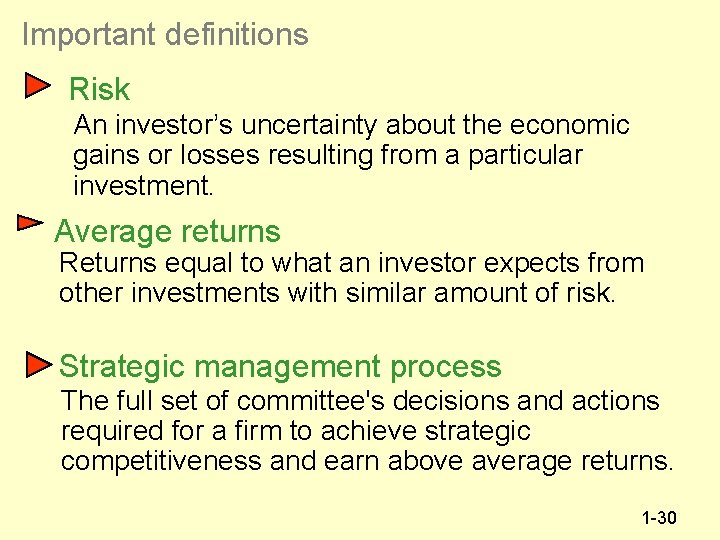
Important definitions Risk An investor’s uncertainty about the economic gains or losses resulting from a particular investment. Average returns Returns equal to what an investor expects from other investments with similar amount of risk. Strategic management process The full set of committee's decisions and actions required for a firm to achieve strategic competitiveness and earn above average returns. 1 -30
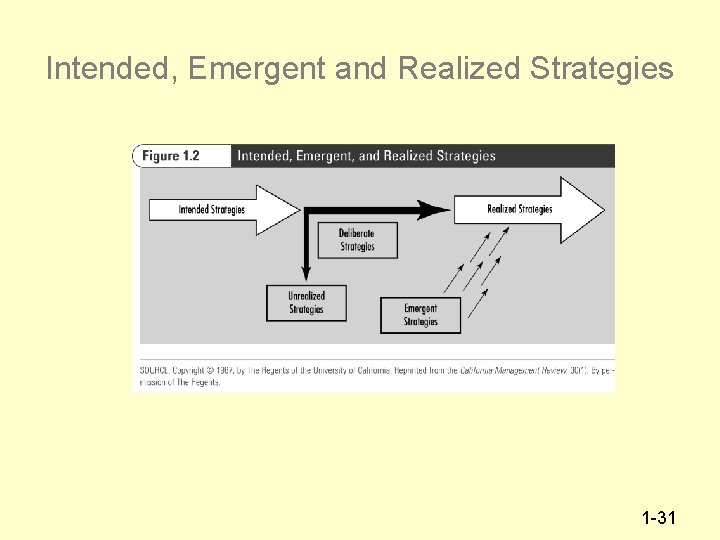
Intended, Emergent and Realized Strategies 1 -31
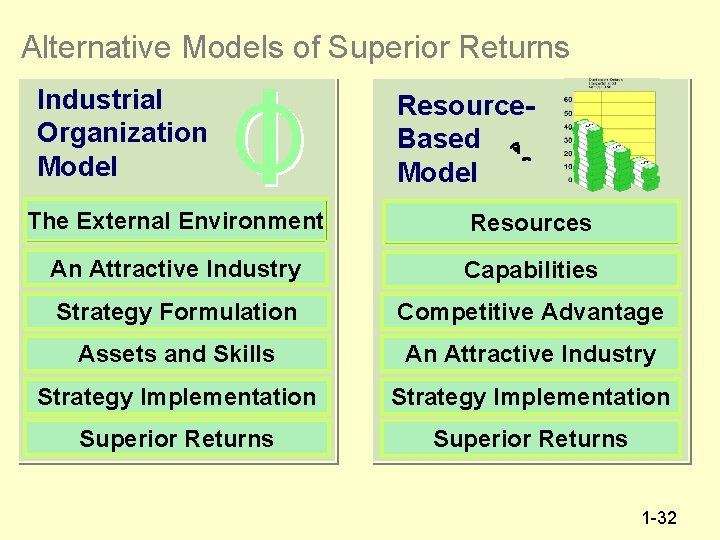
Alternative Models of Superior Returns Industrial Organization Model O I Resource. Based Model The External Environment Resources An Attractive Industry Capabilities Strategy Formulation Competitive Advantage Assets and Skills An Attractive Industry Strategy Implementation Superior Returns 1 -32
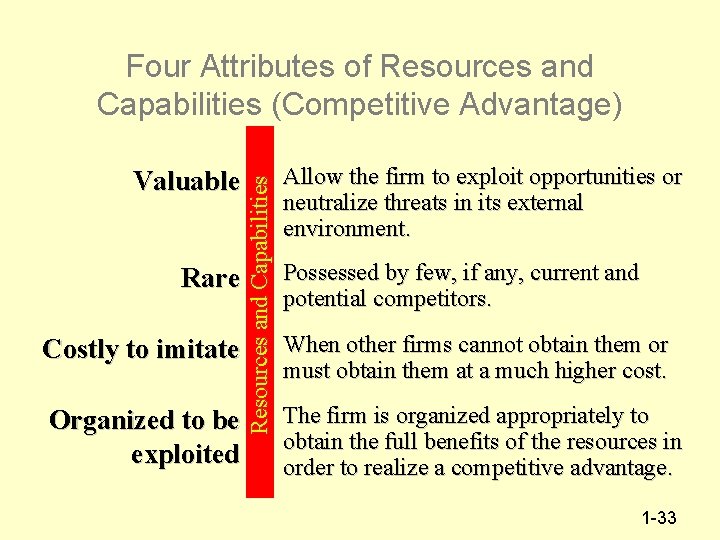
Valuable Rare Costly to imitate Organized to be exploited Resources and Capabilities Four Attributes of Resources and Capabilities (Competitive Advantage) Allow the firm to exploit opportunities or neutralize threats in its external environment. Possessed by few, if any, current and potential competitors. When other firms cannot obtain them or must obtain them at a much higher cost. The firm is organized appropriately to obtain the full benefits of the resources in order to realize a competitive advantage. 1 -33
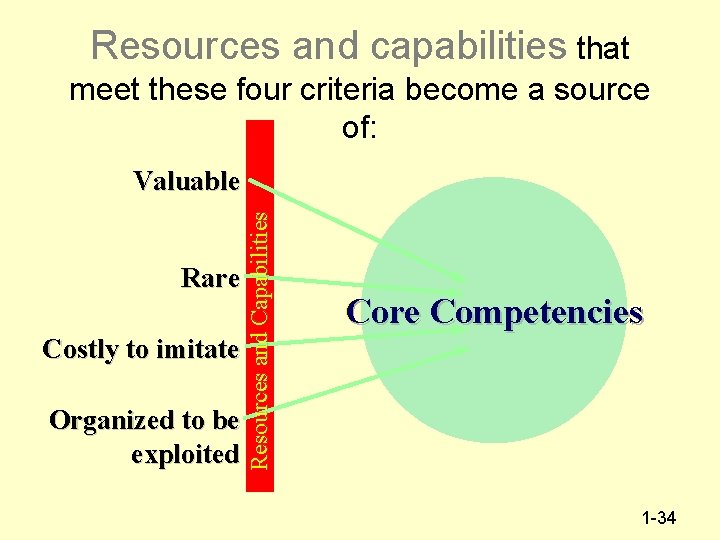
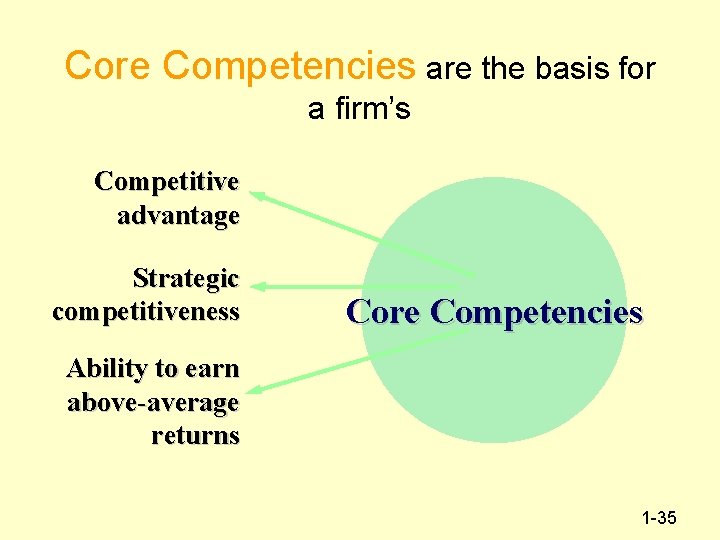
Resources and capabilities that meet these four criteria become a source of: Rare Costly to imitate Organized to be exploited Resources and Capabilities Valuable Core Competencies 1 -34
Core Competencies are the basis for a firm’s Competitive advantage Strategic competitiveness Core Competencies Ability to earn above-average returns 1 -35
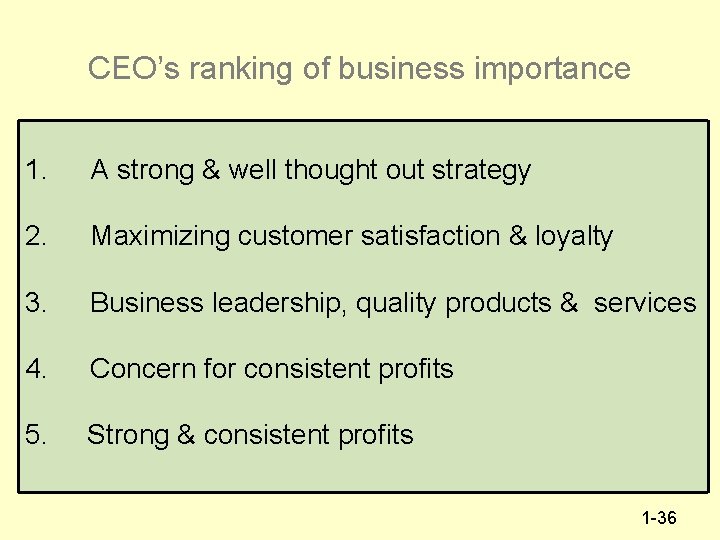
CEO’s ranking of business importance 1. A strong & well thought out strategy 2. Maximizing customer satisfaction & loyalty 3. Business leadership, quality products & services 4. Concern for consistent profits 5. Strong & consistent profits 1 -36
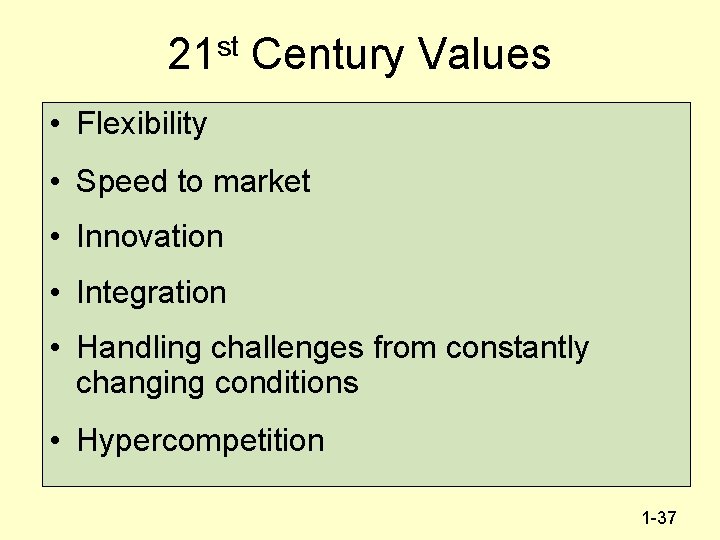
st 21 Century Values • Flexibility • Speed to market • Innovation • Integration • Handling challenges from constantly changing conditions • Hypercompetition 1 -37
The Global Economy One in which goods, services, people, skills, and ideas move freely across geographic borders 1 -38
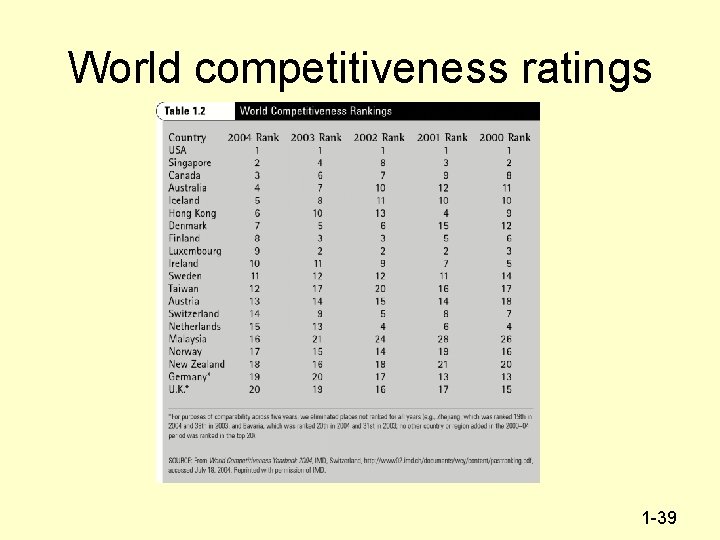
World competitiveness ratings 1 -39
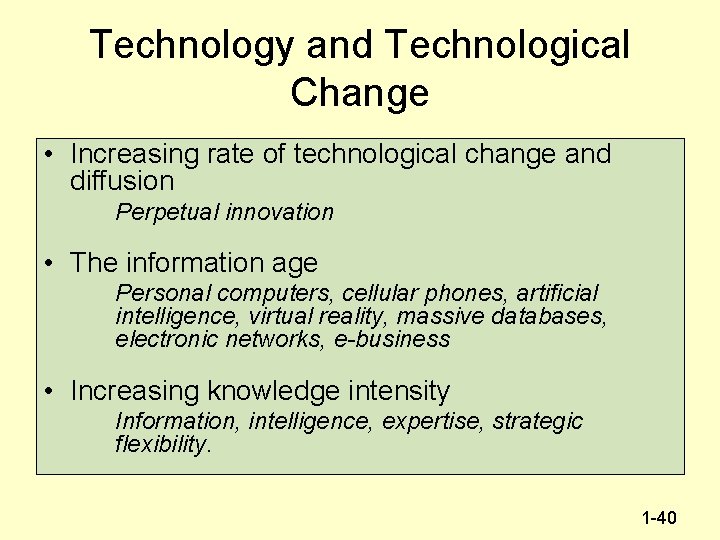
Technology and Technological Change • Increasing rate of technological change and diffusion Perpetual innovation • The information age Personal computers, cellular phones, artificial intelligence, virtual reality, massive databases, electronic networks, e-business • Increasing knowledge intensity Information, intelligence, expertise, strategic flexibility. 1 -40
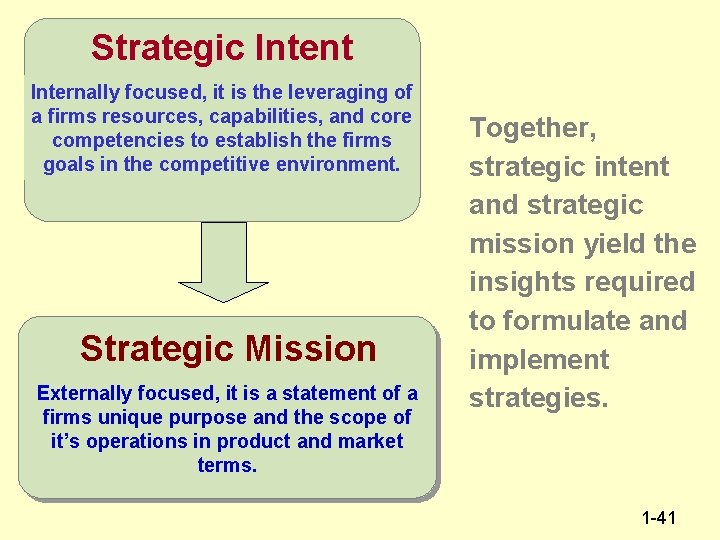
Strategic Intent Internally focused, it is the leveraging of a firms resources, capabilities, and core competencies to establish the firms goals in the competitive environment. Strategic Mission Externally focused, it is a statement of a firms unique purpose and the scope of it’s operations in product and market terms. Together, strategic intent and strategic mission yield the insights required to formulate and implement strategies. 1 -41
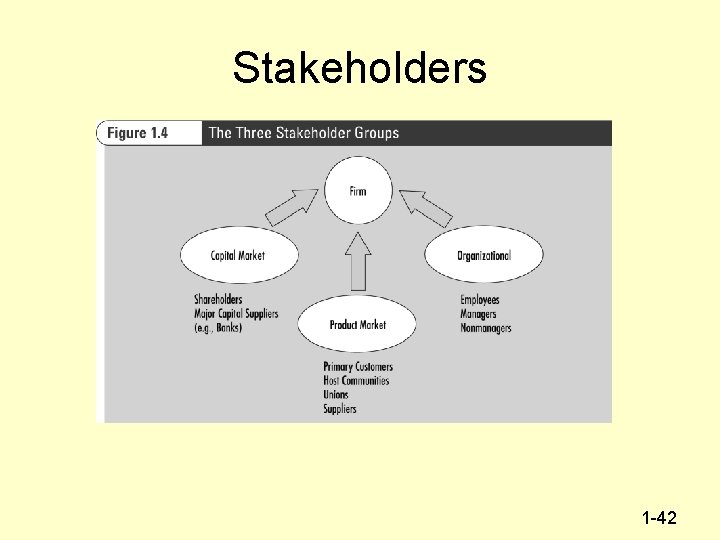
Stakeholders 1 -42
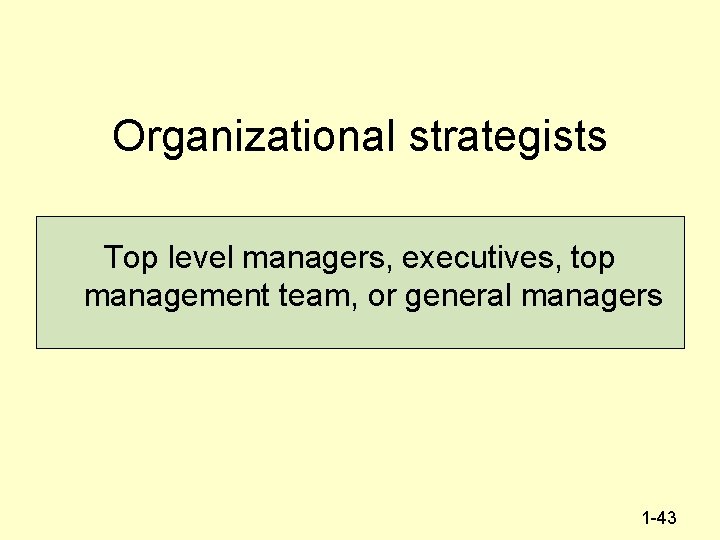
Organizational strategists Top level managers, executives, top management team, or general managers 1 -43
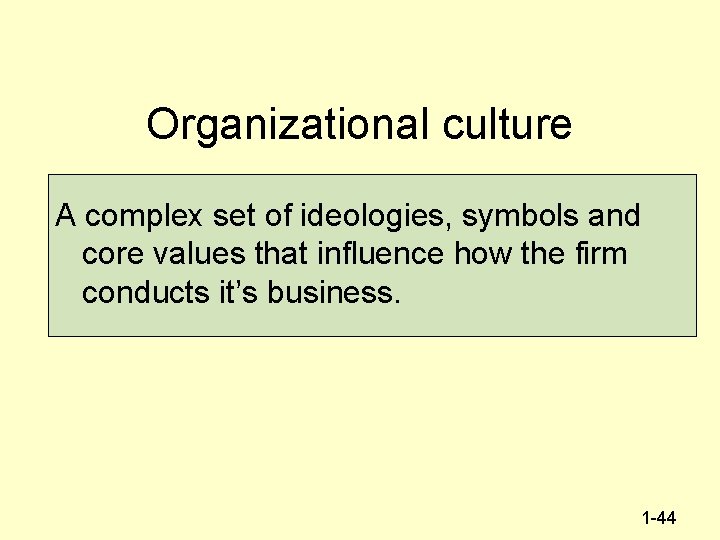
Organizational culture A complex set of ideologies, symbols and core values that influence how the firm conducts it’s business. 1 -44
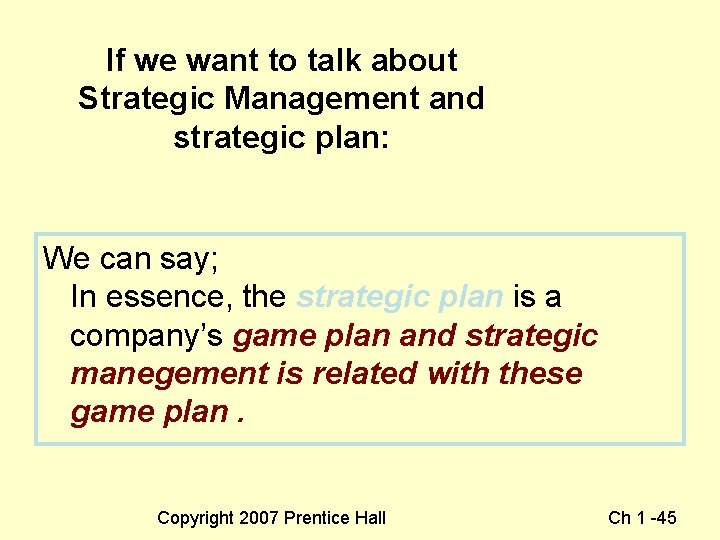
If we want to talk about Strategic Management and strategic plan: We can say; In essence, the strategic plan is a company’s game plan and strategic manegement is related with these game plan. Copyright 2007 Prentice Hall Ch 1 -45
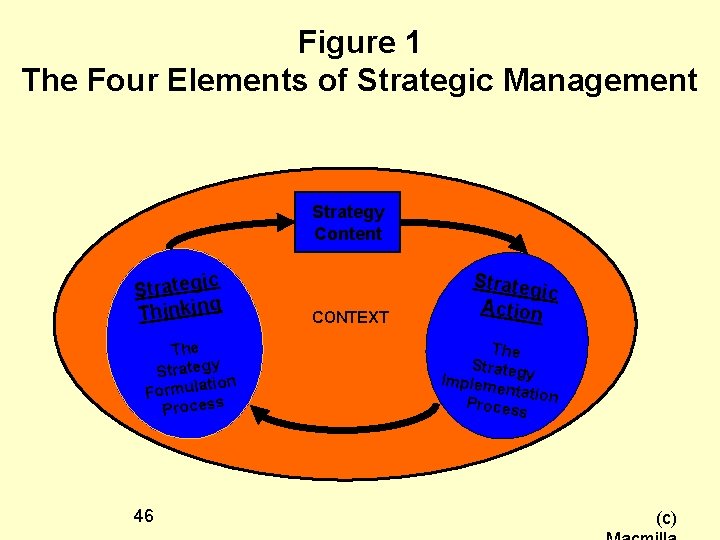
Figure 1 The Four Elements of Strategic Management Strategy Content c Strategi Thinking The Strategy tion Formula Process 46 CONTEXT Strateg ic Action The Strateg y Implem entatio n Proces s (c)
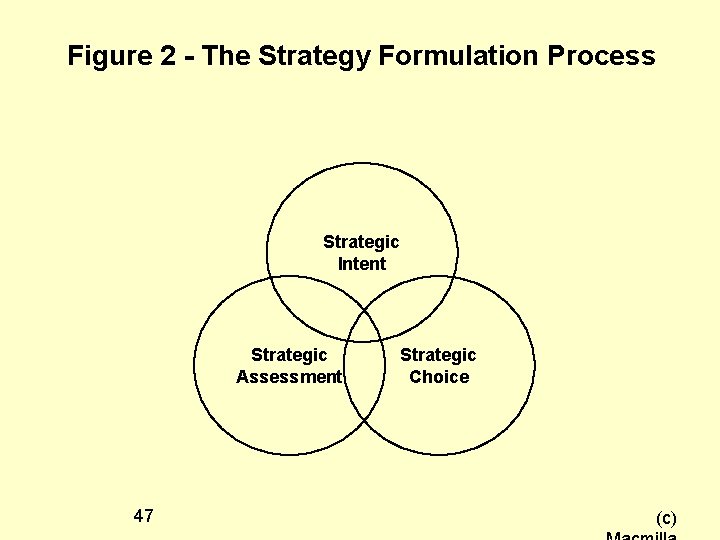
Figure 2 - The Strategy Formulation Process Strategic Intent Strategic Assessment 47 Strategic Choice (c)
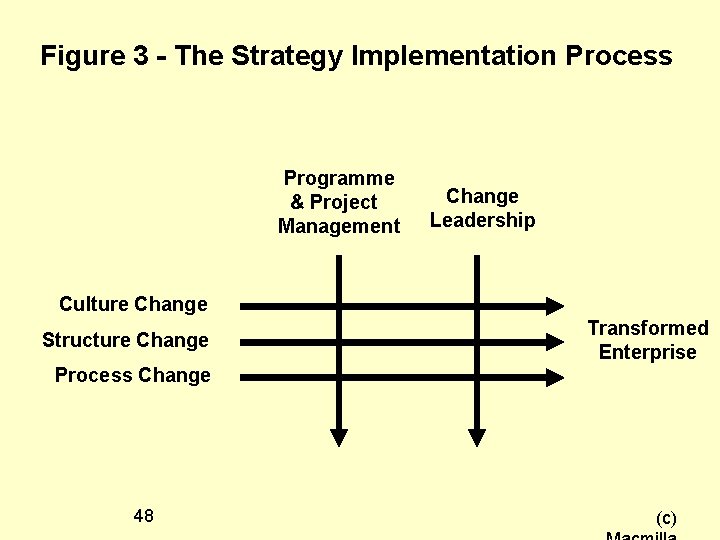
Figure 3 - The Strategy Implementation Process Programme & Project Management Change Leadership Culture Change Structure Change Transformed Enterprise Process Change 48 (c)
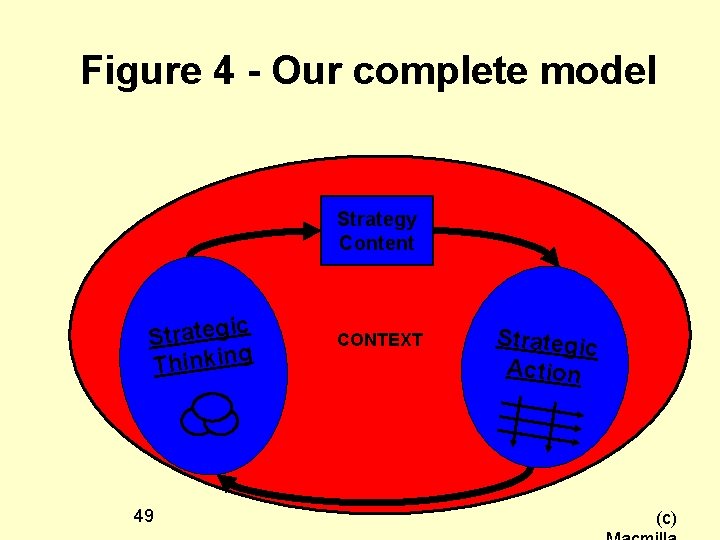
Figure 4 - Our complete model Strategy Content c Strategi Thinking 49 CONTEXT Strategic Action (c)
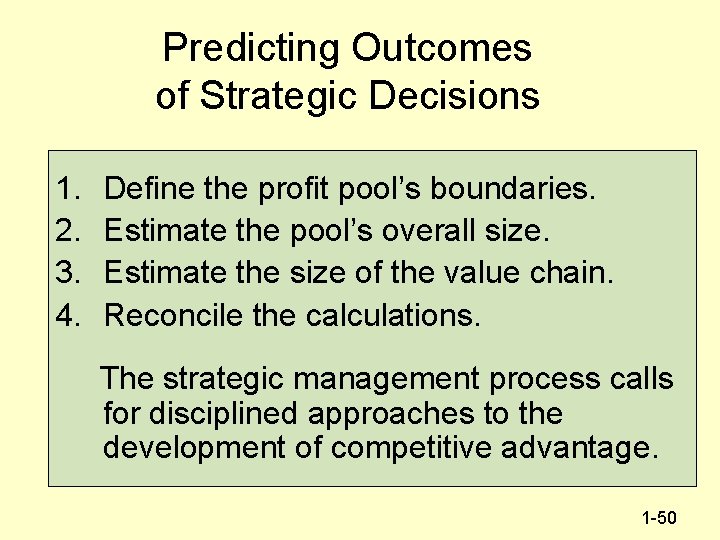
Predicting Outcomes of Strategic Decisions 1. 2. 3. 4. Define the profit pool’s boundaries. Estimate the pool’s overall size. Estimate the size of the value chain. Reconcile the calculations. The strategic management process calls for disciplined approaches to the development of competitive advantage. 1 -50
Strategic Management achieves a firm’s success through integration –– Management Marketing Finance/Accounting Production/Operations Research & Development MIS Copyright 2007 Prentice Hall Ch 1 -51
Thanks… 22. 02. 2011 1 -52