
Strategic Management Process Step 1 Identify the Organizations


- Slides: 7
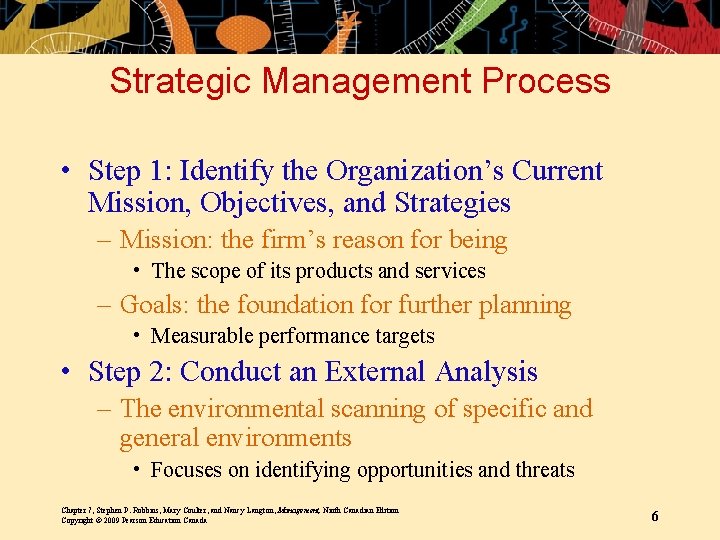
Strategic Management Process • Step 1: Identify the Organization’s Current Mission, Objectives, and Strategies – Mission: the firm’s reason for being • The scope of its products and services – Goals: the foundation for further planning • Measurable performance targets • Step 2: Conduct an External Analysis – The environmental scanning of specific and general environments • Focuses on identifying opportunities and threats Chapter 7, Stephen P. Robbins, Mary Coulter, and Nancy Langton, Management, Ninth Canadian Edition Copyright © 2009 Pearson Education Canada 6
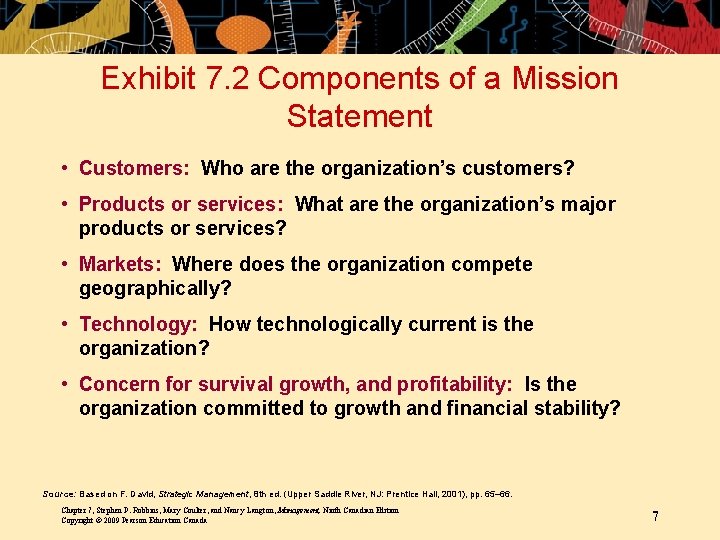
Exhibit 7. 2 Components of a Mission Statement • Customers: Who are the organization’s customers? • Products or services: What are the organization’s major products or services? • Markets: Where does the organization compete geographically? • Technology: How technologically current is the organization? • Concern for survival growth, and profitability: Is the organization committed to growth and financial stability? Source: Based on F. David, Strategic Management, 8 th ed. (Upper Saddle River, NJ: Prentice Hall, 2001), pp. 65– 66. Chapter 7, Stephen P. Robbins, Mary Coulter, and Nancy Langton, Management, Ninth Canadian Edition Copyright © 2009 Pearson Education Canada 7
Exhibit 7. 2 Components of a Mission Statement • Philosophy: What are the organization’s basic beliefs, values, aspirations, and ethical priorities? • Self-concept: What is the organization’s major competitive advantage and core competencies? • Concern for public image: How responsive is the organization to societal and environmental concerns? • Concern for employees: Does the organization consider employees a valuable asset? Source: Based on F. David, Strategic Management, 8 th ed. (Upper Saddle River, NJ: Prentice Hall, 2001), pp. 65– 66. Chapter 7, Stephen P. Robbins, Mary Coulter, and Nancy Langton, Management, Ninth Canadian Edition Copyright © 2009 Pearson Education Canada 8
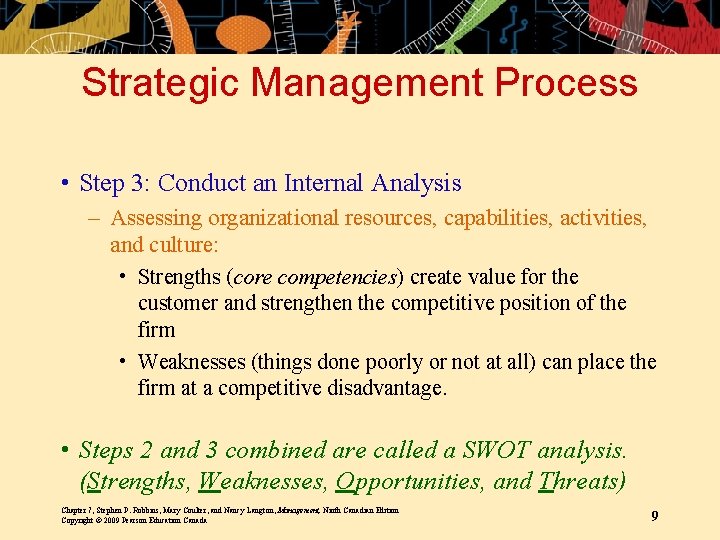
Strategic Management Process • Step 3: Conduct an Internal Analysis – Assessing organizational resources, capabilities, activities, and culture: • Strengths (core competencies) create value for the customer and strengthen the competitive position of the firm • Weaknesses (things done poorly or not at all) can place the firm at a competitive disadvantage. • Steps 2 and 3 combined are called a SWOT analysis. (Strengths, Weaknesses, Opportunities, and Threats) Chapter 7, Stephen P. Robbins, Mary Coulter, and Nancy Langton, Management, Ninth Canadian Edition Copyright © 2009 Pearson Education Canada 9
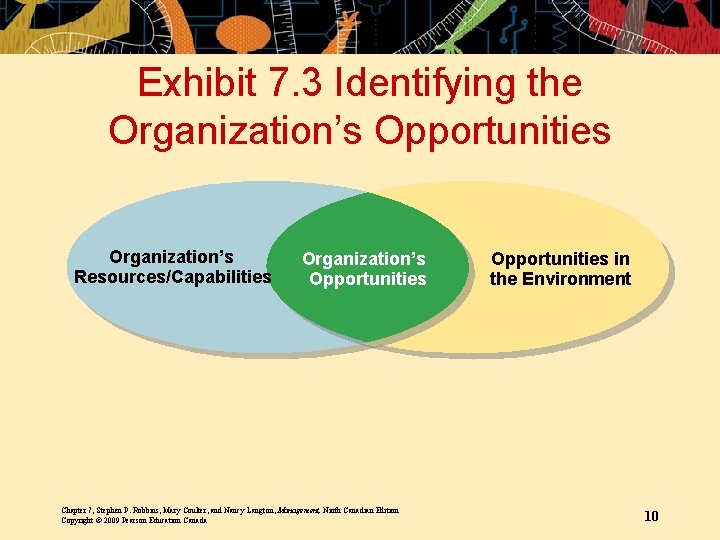
Exhibit 7. 3 Identifying the Organization’s Opportunities Organization’s Resources/Capabilities Organization’s Opportunities Chapter 7, Stephen P. Robbins, Mary Coulter, and Nancy Langton, Management, Ninth Canadian Edition Copyright © 2009 Pearson Education Canada Opportunities in the Environment 10
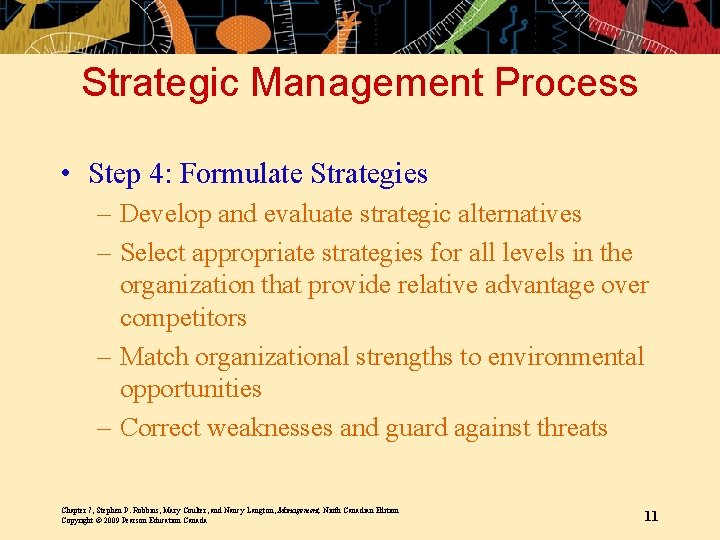
Strategic Management Process • Step 4: Formulate Strategies – Develop and evaluate strategic alternatives – Select appropriate strategies for all levels in the organization that provide relative advantage over competitors – Match organizational strengths to environmental opportunities – Correct weaknesses and guard against threats Chapter 7, Stephen P. Robbins, Mary Coulter, and Nancy Langton, Management, Ninth Canadian Edition Copyright © 2009 Pearson Education Canada 11
Strategic Management Process • Step 5: Implement Strategies – Implementation: effectively fitting organizational structure and activities to the environment – The environment dictates the chosen strategy; effective strategy implementation requires an organizational structure matched to its requirements • Step 6: Evaluate Results – How effective have strategies been? – What adjustments, if any, are necessary? Chapter 7, Stephen P. Robbins, Mary Coulter, and Nancy Langton, Management, Ninth Canadian Edition Copyright © 2009 Pearson Education Canada 12