
STRATEGIC MANAGEMENT DR HERMAN S MBA BUSINESS STRATEGY

STRATEGIC MANAGEMENT DR. HERMAN S. MBA BUSINESS STRATEGY Magister Management Program Universitas Komputer Indonesia
Referensi • T. L. Wheelen and J. W. Hunger, Strategic Management and Business Policy, 13 th Ed. , Pearson Education Ltd. , 2010. • Louis, S. , et. al. , Even Elephant Can Dance, GML Consulting, 2012.
SITUATIONAL ANALYSIS: SWOT Analysis • Mc. Kinsey Survey 2007 0 f 2700 executives • GML Survey 2010 -2011 0 f 175 executives in Indonesia
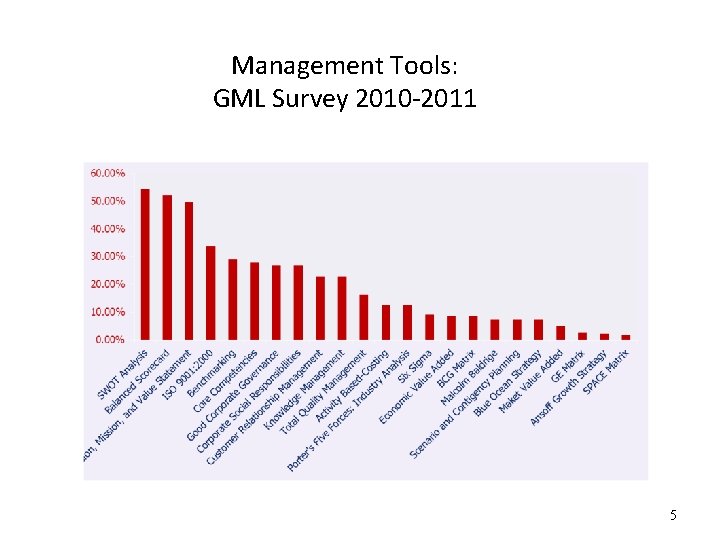
Management Tools: GML Survey 2010 -2011 5
SWOT • A widely used framework for organizing and using data and information gained from situation analysis • Encompasses both internal and external environments • One of the most effective tools in the analysis of environmental data and information
SWOT description • A SWOT analysis generates information that is helpful in matching an organization’s or a group’s goals, programs, and capacities to the social environment in which they operate • It is an instrument within strategic planning • When combined with a dialogue, it is a participatory process
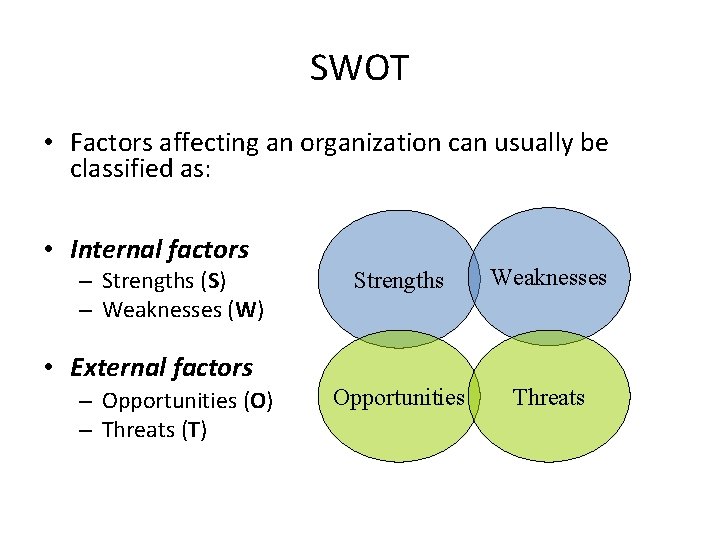
SWOT • Factors affecting an organization can usually be classified as: • Internal factors – Strengths (S) – Weaknesses (W) • External factors – Opportunities (O) – Threats (T) Strengths Weaknesses Opportunities Threats
SWOT: internal factors • Strengths – Positive tangible and intangible attributes, internal to an organization. They are within the organization’s control • Weaknesses – Factors that are within an organization’s control that detract from its ability to attain the core goal. In which areas might the organization improve?
SWOT: external factors • Opportunities – External attractive factors that represent the reason for an organization to exist and develop. What opportunities exist in the environment which will propel the organization? – Identify them by their “time frames” • Threats – External factors, beyond an organization’s control, which could place the organization’s mission or operation at risk. The organization may benefit by having contingency plans to address them should they occur – Classify them by their “seriousness” and “probability of occurrence”
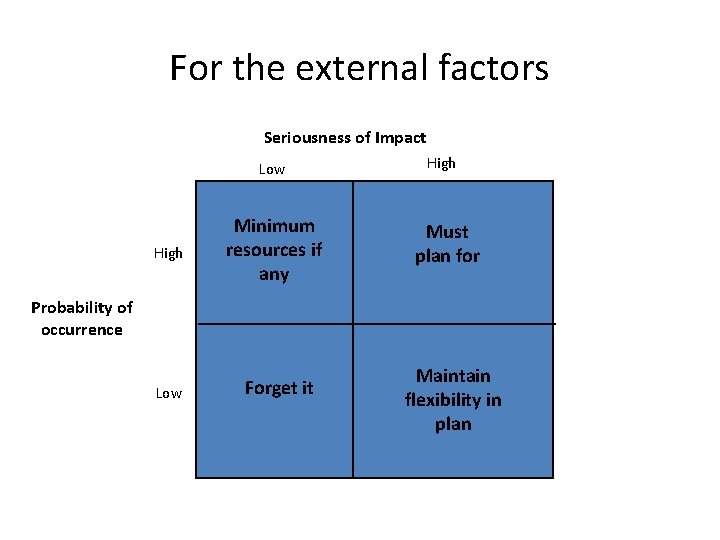
For the external factors Seriousness of Impact Low High Minimum resources if any High Must plan for Probability of occurrence Low Forget it Maintain flexibility in plan
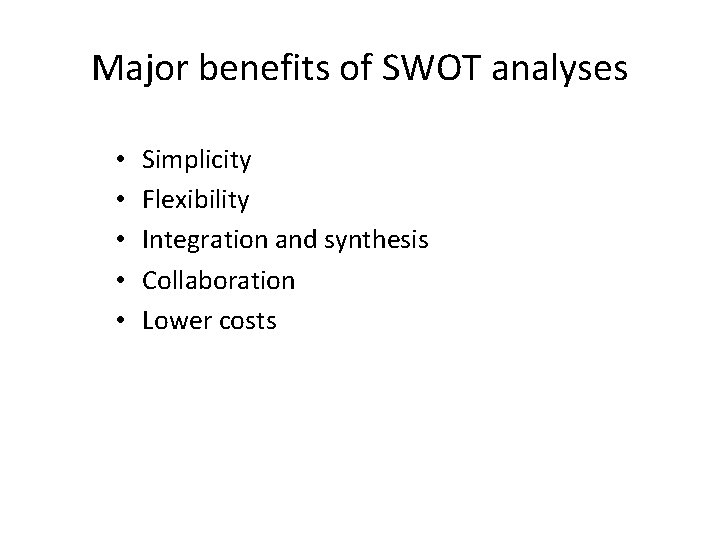
Major benefits of SWOT analyses • • • Simplicity Flexibility Integration and synthesis Collaboration Lower costs
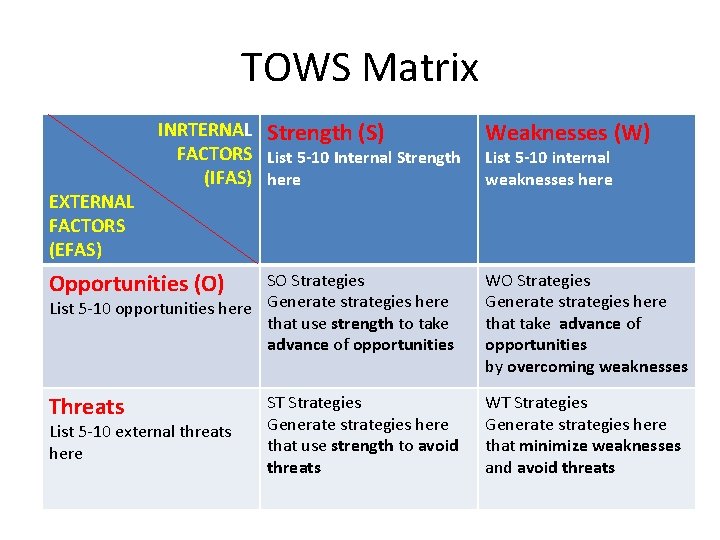
TOWS Matrix EXTERNAL FACTORS (EFAS) INRTERNAL Strength (S) FACTORS List 5 -10 Internal Strength (IFAS) here Opportunities (O) Weaknesses (W) List 5 -10 internal weaknesses here SO Strategies List 5 -10 opportunities here Generate strategies here that use strength to take advance of opportunities WO Strategies Generate strategies here that take advance of opportunities by overcoming weaknesses Threats WT Strategies Generate strategies here that minimize weaknesses and avoid threats List 5 -10 external threats here ST Strategies Generate strategies here that use strength to avoid threats
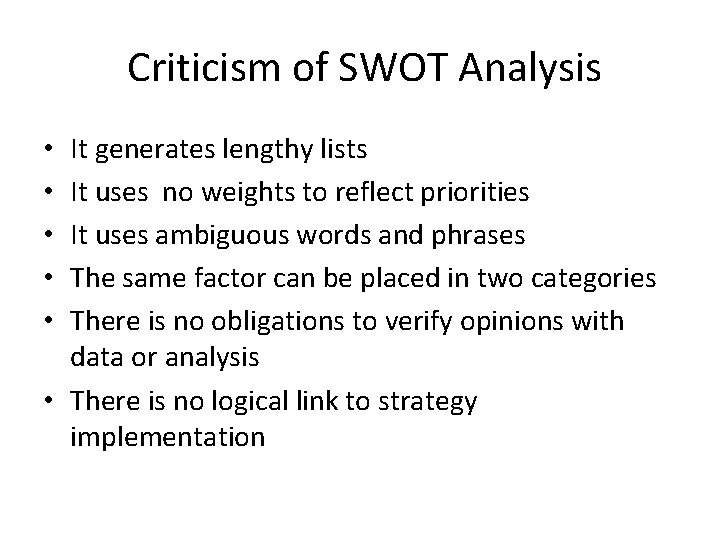
Criticism of SWOT Analysis It generates lengthy lists It uses no weights to reflect priorities It uses ambiguous words and phrases The same factor can be placed in two categories There is no obligations to verify opinions with data or analysis • There is no logical link to strategy implementation • • •
STRATEGIC FACTORS ANALISYS SUMMARY (SFAS) • SFAS matrix summarizes an organization’s strategic factors by combining the external factors from the EFAS Table with the internal factors from the IFAS Table.
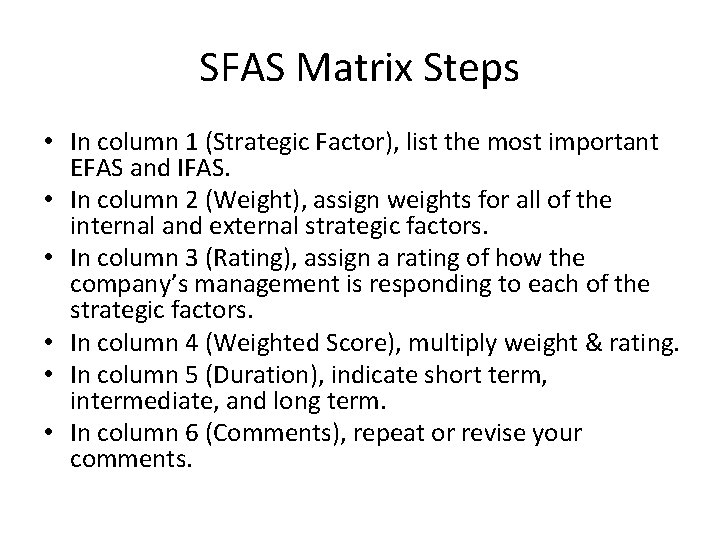
SFAS Matrix Steps • In column 1 (Strategic Factor), list the most important EFAS and IFAS. • In column 2 (Weight), assign weights for all of the internal and external strategic factors. • In column 3 (Rating), assign a rating of how the company’s management is responding to each of the strategic factors. • In column 4 (Weighted Score), multiply weight & rating. • In column 5 (Duration), indicate short term, intermediate, and long term. • In column 6 (Comments), repeat or revise your comments.
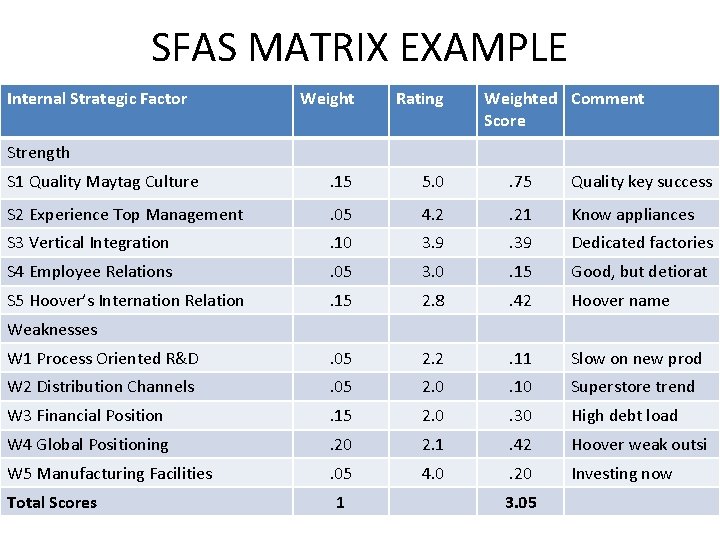
SFAS MATRIX EXAMPLE Internal Strategic Factor Weight Rating Weighted Comment Score S 1 Quality Maytag Culture . 15 5. 0 . 75 Quality key success S 2 Experience Top Management . 05 4. 2 . 21 Know appliances S 3 Vertical Integration . 10 3. 9 . 39 Dedicated factories S 4 Employee Relations . 05 3. 0 . 15 Good, but detiorat S 5 Hoover’s Internation Relation . 15 2. 8 . 42 Hoover name W 1 Process Oriented R&D . 05 2. 2 . 11 Slow on new prod W 2 Distribution Channels . 05 2. 0 . 10 Superstore trend W 3 Financial Position . 15 2. 0 . 30 High debt load W 4 Global Positioning . 20 2. 1 . 42 Hoover weak outsi W 5 Manufacturing Facilities . 05 4. 0 . 20 Investing now Strength Weaknesses Total Scores 1 3. 05
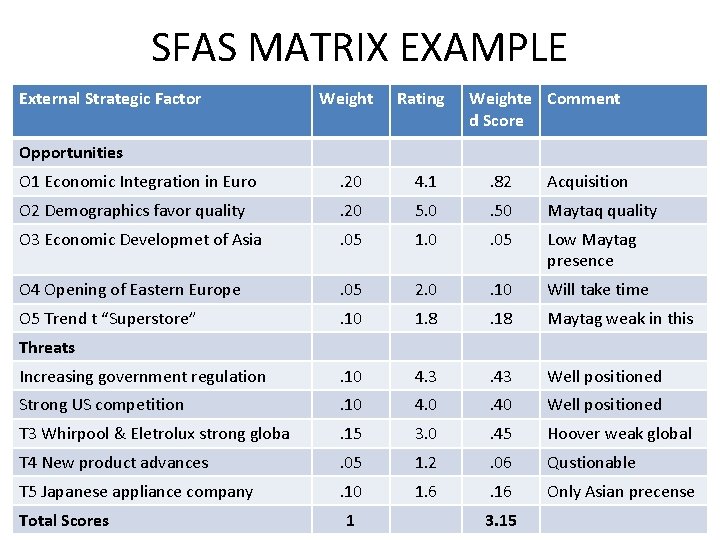
SFAS MATRIX EXAMPLE External Strategic Factor Weight Rating Weighte Comment d Score O 1 Economic Integration in Euro . 20 4. 1 . 82 Acquisition O 2 Demographics favor quality . 20 5. 0 . 50 Maytaq quality O 3 Economic Developmet of Asia . 05 1. 0 . 05 Low Maytag presence O 4 Opening of Eastern Europe . 05 2. 0 . 10 Will take time O 5 Trend t “Superstore” . 10 1. 8 . 18 Maytag weak in this Increasing government regulation . 10 4. 3 . 43 Well positioned Strong US competition . 10 4. 0 . 40 Well positioned T 3 Whirpool & Eletrolux strong globa . 15 3. 0 . 45 Hoover weak global T 4 New product advances . 05 1. 2 . 06 Qustionable T 5 Japanese appliance company . 10 1. 6 . 16 Only Asian precense Opportunities Threats Total Scores 1 3. 15
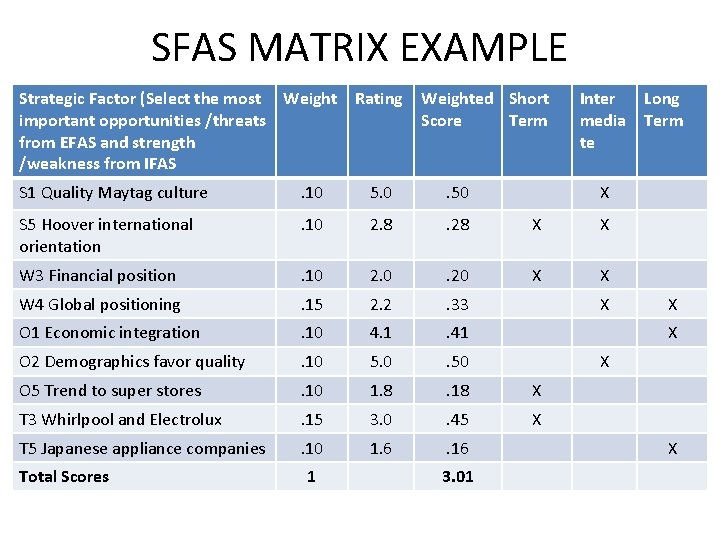
SFAS MATRIX EXAMPLE Strategic Factor (Select the most Weight Rating important opportunities /threats from EFAS and strength /weakness from IFAS Weighted Short Score Term Inter media te S 1 Quality Maytag culture . 10 5. 0 . 50 S 5 Hoover international orientation . 10 2. 8 . 28 X X W 3 Financial position . 10 2. 0 . 20 X X W 4 Global positioning . 15 2. 2 . 33 O 1 Economic integration . 10 4. 1 . 41 O 2 Demographics favor quality . 10 5. 0 . 50 O 5 Trend to super stores . 10 1. 8 . 18 X T 3 Whirlpool and Electrolux . 15 3. 0 . 45 X T 5 Japanese appliance companies . 10 1. 6 . 16 Total Scores 1 3. 01 Long Term X X X
NICHE MARKET 20
PORTER’S COMPETITIVE STRATEGY
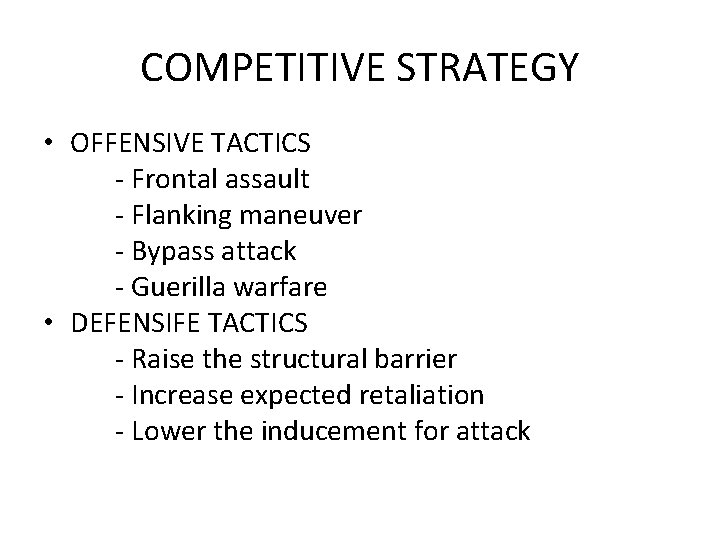
COMPETITIVE STRATEGY • OFFENSIVE TACTICS - Frontal assault - Flanking maneuver - Bypass attack - Guerilla warfare • DEFENSIFE TACTICS - Raise the structural barrier - Increase expected retaliation - Lower the inducement for attack
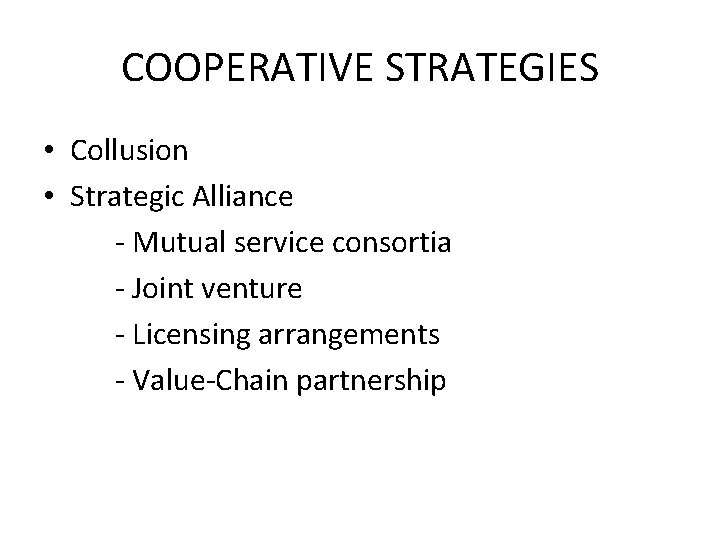
COOPERATIVE STRATEGIES • Collusion • Strategic Alliance - Mutual service consortia - Joint venture - Licensing arrangements - Value-Chain partnership

- Slides: 24