
Strategic Management Concepts Cases 13 th edition Fred
- Slides: 43
Strategic Management Concepts & Cases 13 th edition Fred R. David Chapter 1: The Nature of Strategic Management Power. Point Slides By: Ahsan Ali Ashraf Lahore LEADS University Ch. 1 -1
Organizing Themes • Global considerations impact virtually all strategic decisions. • E-commerce has become a vital strategic management tool. • The natural environment has become an important strategic issue. Ch. 1 -2
Strategic Management Defined Art and science of formulating, implementing, and evaluating crossfunctional decisions that enable an organization to achieve its objectives. Ch. 1 -3
Strategic Management Club Visit and join the club on-line: www. strategyclub. com Ch. 1 -4
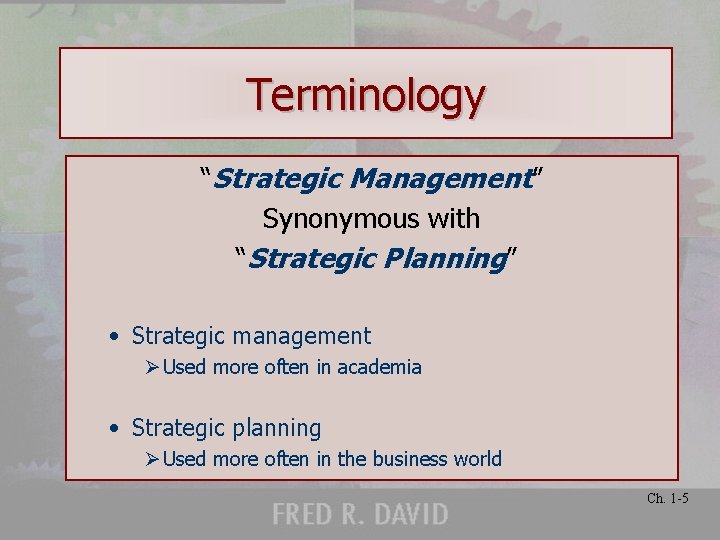
Terminology “Strategic Management” Synonymous with “Strategic Planning” • Strategic management Ø Used more often in academia • Strategic planning Ø Used more often in the business world Ch. 1 -5
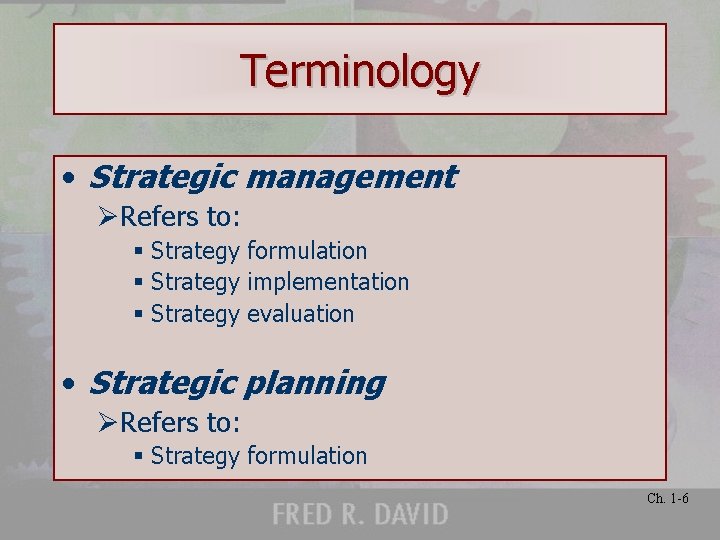
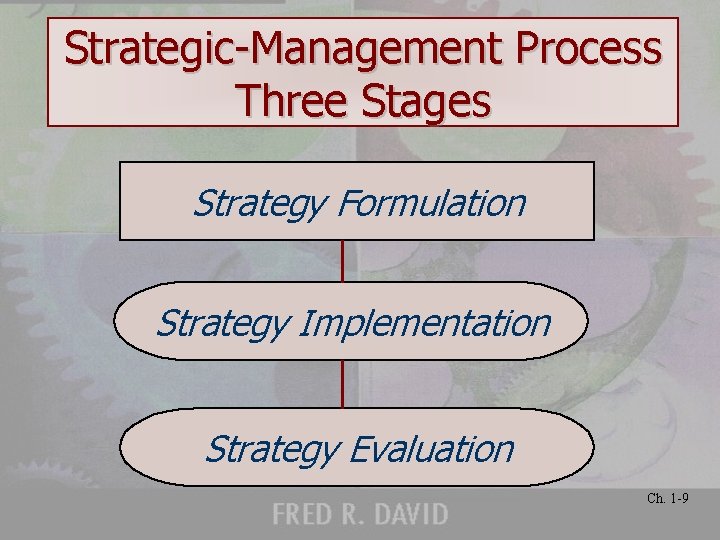
Terminology • Strategic management ØRefers to: § Strategy formulation § Strategy implementation § Strategy evaluation • Strategic planning ØRefers to: § Strategy formulation Ch. 1 -6
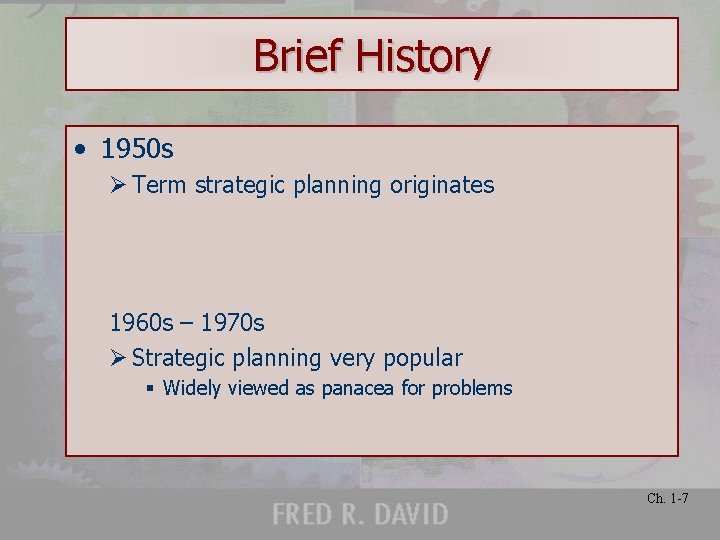
Brief History • 1950 s Ø Term strategic planning originates 1960 s – 1970 s Ø Strategic planning very popular § Widely viewed as panacea for problems Ch. 1 -7
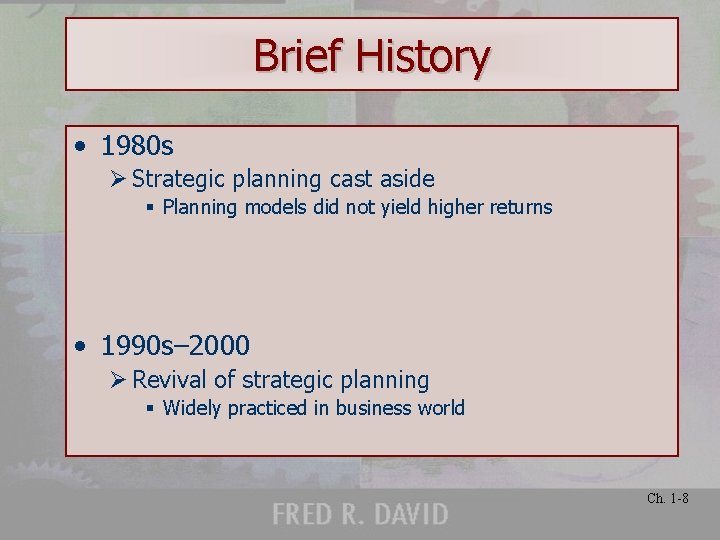
Brief History • 1980 s Ø Strategic planning cast aside § Planning models did not yield higher returns • 1990 s– 2000 Ø Revival of strategic planning § Widely practiced in business world Ch. 1 -8
Strategic-Management Process Three Stages Strategy Formulation Strategy Implementation Strategy Evaluation Ch. 1 -9
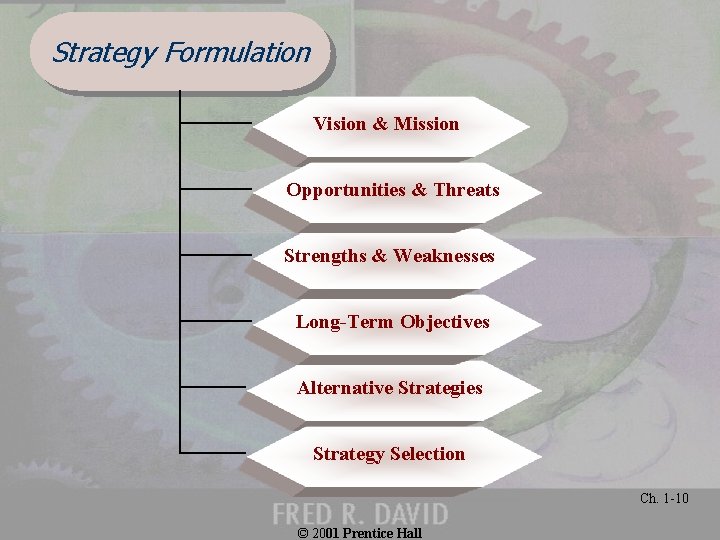
Strategy Formulation Vision & Mission Opportunities & Threats Strengths & Weaknesses Long-Term Objectives Alternative Strategies Strategy Selection Ch. 1 -10 © 2001 Prentice Hall
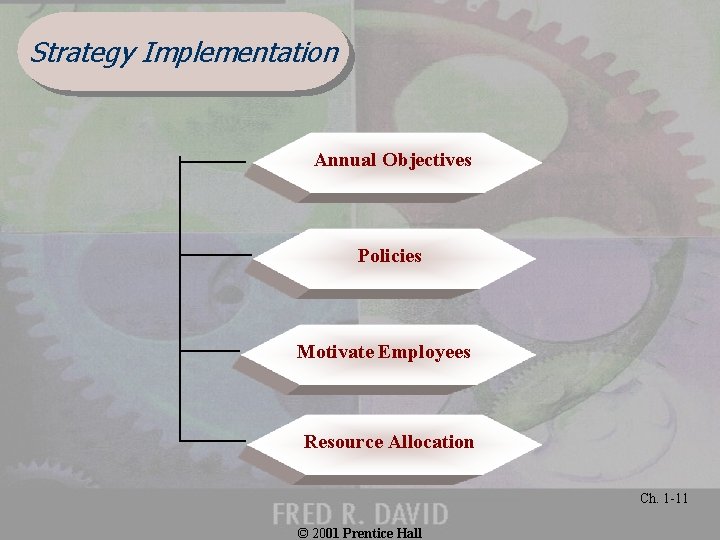
Strategy Implementation Annual Objectives Policies Motivate Employees Resource Allocation Ch. 1 -11 © 2001 Prentice Hall
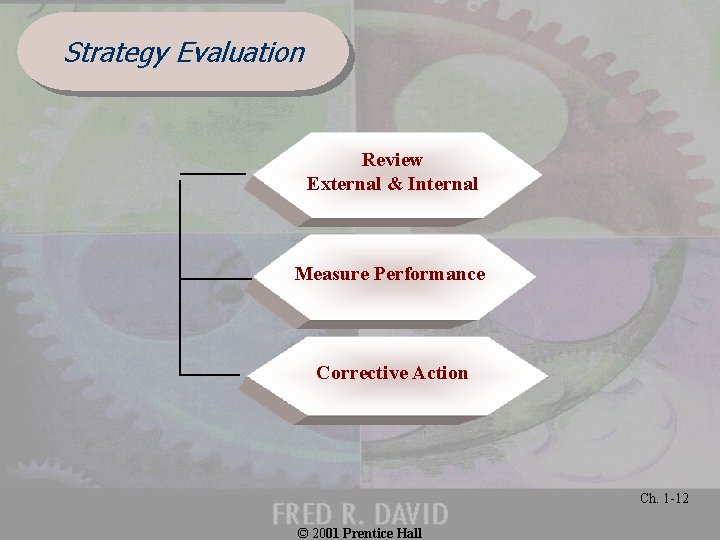
Strategy Evaluation Review External & Internal Measure Performance Corrective Action Ch. 1 -12 © 2001 Prentice Hall
Key Strategic Management Terms (Cont’d) 1. 2. 3. 4. 5. Strategists Vision statements Mission statements External opportunities and threats Internal strengths and weaknesses Ch. 1 -13 © 2001 Prentice Hall
Key Strategic Management Terms (Cont’d) 6. 7. 8. 9. Long-term objectives Strategies Annual objectives Policies Ch. 1 -14 © 2001 Prentice Hall
Strategic Management Terms (Cont’d) Strategists • Usually found in high levels of management (CEO) ØHelp organization gather, analyze, and organize information ØTrack industry and competitive trends ØDevelop forecasting model ØEvaluate corporate and divisional performance Ch. 1 -15 © 2001 Prentice Hall
Strategic Management Terms (Cont’d) Vision Statements • Answers the question: “What do we want to become? ” ØFirst step in strategic planning ØOftentimes a single sentence “Our vision is to take care of your vision. ” (Stokes Eye Clinic, Florence, South Carolina) Ch. 1 -16 © 2001 Prentice Hall
Strategic Management Terms (Cont’d) External Opportunities & Threats • Largely beyond the control of a single organization ØEconomic ØSocial ØCultural ØDemographic ØEnvironmental Ch. 1 -17 © 2001 Prentice Hall
Strategic Management Terms (Cont’d) External Opportunities & Threats (cont’d) ØPolitical ØGovernmental ØTechnological ØCompetitive trends & events Ch. 1 -18 © 2001 Prentice Hall
Strategic Management Terms (Cont’d) Internal Strengths & Weaknesses • Controllable activities that are performed well or poorly relative to competitors ØBased on functional analysis of activities in the firm’s: § Management § Marketing § Finance/accounting Ch. 1 -19 © 2001 Prentice Hall
Strategic Management Terms (Cont’d) Internal Strengths & Weaknesses (Cont’d) • Based on functional analysis of activities in the firm’s: ØProduction/operations ØResearch and development ØComputer information systems • Organizations strive to pursue strategies that capitalize on strengths and improve weaknesses Ch. 1 -20 © 2001 Prentice Hall
Strategic Management Terms (Cont’d) Long-Term Objectives • Results to be achieved in pursuing the organization’s mission. Time frame is beyond one year. ØState direction ØCreate synergy ØReveal priorities ØFocus coordination ØProvide basis for effective management Ch. 1 -21 © 2001 Prentice Hall
Strategic Management Terms (Cont’d) Strategies • Potential actions that require top management decisions and large amounts of firm’s resources Mechanisms by which long-term objectives are realized ØGeographic expansion ØDiversification ØAcquisition ØProduct development Ch. 1 -22 © 2001 Prentice Hall
Strategic Management Terms (Cont’d) Strategies (cont’d) • Mechanisms by which long-term objectives are realized ØMarket penetration ØRetrenchment ØDivestiture ØLiquidation ØJoint venture Ch. 1 -23 © 2001 Prentice Hall
Strategic Management Terms (Cont’d) Annual Objectives • Short-term milestones necessary to achieve long-term objectives. ØRepresent the basis for allocating resources ØEstablished at corporate, divisional, and functional levels Ch. 1 -24 © 2001 Prentice Hall
Strategic Management Terms (Cont’d) Annual Objectives (cont’d) • Stated in terms of accomplishments for: Ømanagement Ø marketing Ø finance/accounting Ø production/operations Ø research and development Ø information systems accomplishments Ch. 1 -25 © 2001 Prentice Hall
Strategic Management Terms (Cont’d) Policies • Important in strategy implementation as the means by which annual objectives will be achieved Ø Guide to decision making and address repetitive situations Ø Established at corporate, divisional, or functional levels Ø Allow consistency & coordination within and between organizational departments Ch. 1 -26 © 2001 Prentice Hall
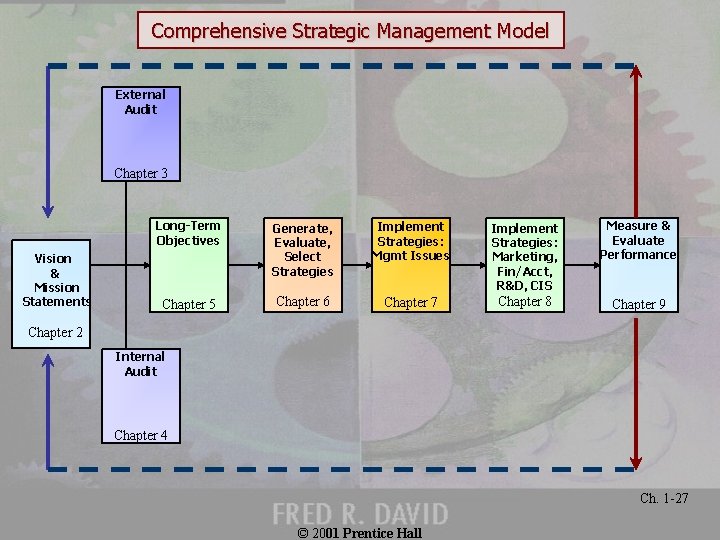
Comprehensive Strategic Management Model External Audit Chapter 3 Vision & Mission Statements Long-Term Objectives Generate, Evaluate, Select Strategies Implement Strategies: Mgmt Issues Implement Strategies: Marketing, Fin/Acct, R&D, CIS Measure & Evaluate Performance Chapter 5 Chapter 6 Chapter 7 Chapter 8 Chapter 9 Chapter 2 Internal Audit Chapter 4 Ch. 1 -27 © 2001 Prentice Hall
Benefits of Strategic Management • Proactive vs. Reactive ØInitiate and influence activities § Helps shape firm’s own future • Principal Benefit ØFormulate better strategies § Systematic, logical, and rational approach • Communication ØKey to successful strategic management Ch. 1 -28 © 2001 Prentice Hall
Benefits of Strategic Management (Cont’d) • Financial Benefits ØMore profitable and successful ØImprovements in sales, profitability, and productivity ØHigh-Performing Firms § Systematic planning v. Fluctuations in external and internal environments Ch. 1 -29 © 2001 Prentice Hall
Benefits of Strategic Management (Cont’d) • Nonfinancial Benefits ØEnhanced awareness of external threats ØUnderstanding of competitors’ strategies ØIncreased employee productivity ØReduced resistance to change ØClear performance-reward relationships ØOrder and discipline to the firm ØView change as opportunity Ch. 1 -30 © 2001 Prentice Hall
Why Some Firms Do No Strategic Planning • • • Poor reward structures Waste of time Too expensive Laziness Content with success Ch. 1 -31 © 2001 Prentice Hall
Why Some Firms Do No Strategic Planning (Cont’d) • • • Fear of failure Overconfidence Prior bad experience Self-interest Fear of the unknown Suspicion Ch. 1 -32 © 2001 Prentice Hall
Pitfalls to Avoid in Strategic Planning • Using to gain control over decisions & resources • Doing only to satisfy regulatory requirements • Moving hastily from mission to strategy formulation • Failing to communicate to employees • Intuitive decisions that conflict with formal plan • Top management not supportive of process Ch. 1 -33 © 2001 Prentice Hall
Pitfalls to Avoid in Strategic Planning (Cont’d) • Failing to use as standard for performance measurement • Delegating to a “planner” vs. involvement of managers • Failing to involve key personnel • Failing to create collaborative environment • Formality that stifles creativity and flexibility Ch. 1 -34 © 2001 Prentice Hall
Business Ethics & Strategic Planning Defined: Principles of conduct within organizations that guide decision making and behavior • Good business ethics is a prerequisite for good strategic management • Good ethics is just good business! Ch. 1 -35 © 2001 Prentice Hall
Business Ethics & Strategic Planning (Cont’d) • Strategists responsible for high ethical principles • All strategic processes have ethical ramifications (consequences) • Formal codes of ethics are in place for many businesses • Internet privacy emerging as ethical issue of immense proportions Ch. 1 -36 © 2001 Prentice Hall
Business Ethics & Strategic Planning (Cont’d) Business actions always unethical include: • • Misleading advertising Misleading labeling Environmental harm Poor product or service safety Ch. 1 -37 © 2001 Prentice Hall
Nature of Global Competition • Companies conduct business across borders ØInternational or multinational corporations § Parent company § Host country • Strategy implementation more difficult ØCultural differences § Norms, values, work ethics Ch. 1 -38 © 2001 Prentice Hall
Advantages of International Operations • • • Absorb excess capacity Reduce unit costs Low-cost production facilities Lower labor costs Competition less intense Ch. 1 -39 © 2001 Prentice Hall
Advantages of International Operations (Cont’d) • Reduced tariffs, lower taxes • Favorable political climate • Economies of scale Ch. 1 -40 © 2001 Prentice Hall
Disadvantages of International Operations Communication difficulties between parent and subsidiaries • Based on cultural, political, social, language, demographic, and competitive forces Foreign-based competitors • Strengths underestimated • Weaknesses overestimated Ch. 1 -41 © 2001 Prentice Hall
Key Terms & Concepts • • Annual objectives Business ethics Code of ethics E-commerce Empowerment Environmental scanning External opportunities External threats • • Internal strengths Internal weaknesses Intuition Long-term objectives Mission statements Policies Strategic management Strategic-management model Ch. 1 -42 © 2001 Prentice Hall
Key Terms & Concepts (Cont’d) • Strategic-management process • Strategies • Strategists • Strategy evaluation • Strategy formulation • Strategy implementation • Lobbying • • • Vision statement Vision Host country International firms Long-range planning Multinational corporation Ch. 1 -43 © 2001 Prentice Hall