
Strategic Management Accounting 22 E 10000 Professor Juhani
- Slides: 12
Strategic Management Accounting (22 E 10000) Professor Juhani Vaivio Aalto University School of Business
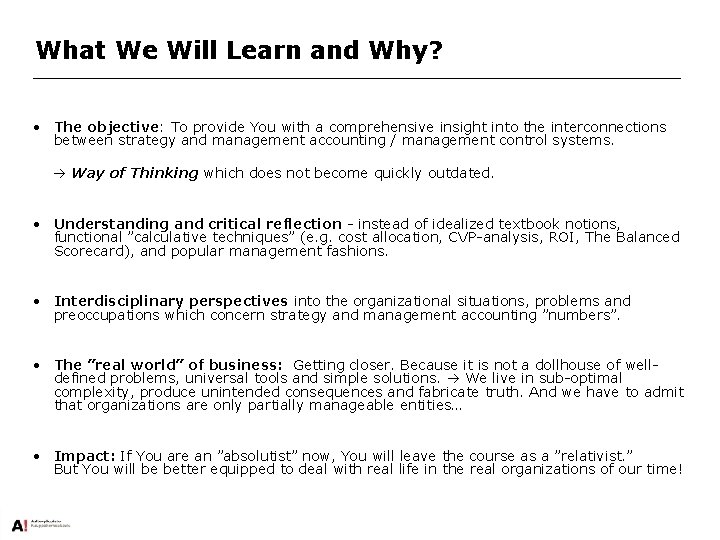
What We Will Learn and Why? • The objective: To provide You with a comprehensive insight into the interconnections between strategy and management accounting / management control systems. Way of Thinking which does not become quickly outdated. • Understanding and critical reflection - instead of idealized textbook notions, functional ”calculative techniques” (e. g. cost allocation, CVP-analysis, ROI, The Balanced Scorecard), and popular management fashions. • Interdisciplinary perspectives into the organizational situations, problems and preoccupations which concern strategy and management accounting ”numbers”. • The ”real world” of business: Getting closer. Because it is not a dollhouse of welldefined problems, universal tools and simple solutions. We live in sub-optimal complexity, produce unintended consequences and fabricate truth. And we have to admit that organizations are only partially manageable entities… • Impact: If You are an ”absolutist” now, You will leave the course as a ”relativist. ” But You will be better equipped to deal with real life in the real organizations of our time!
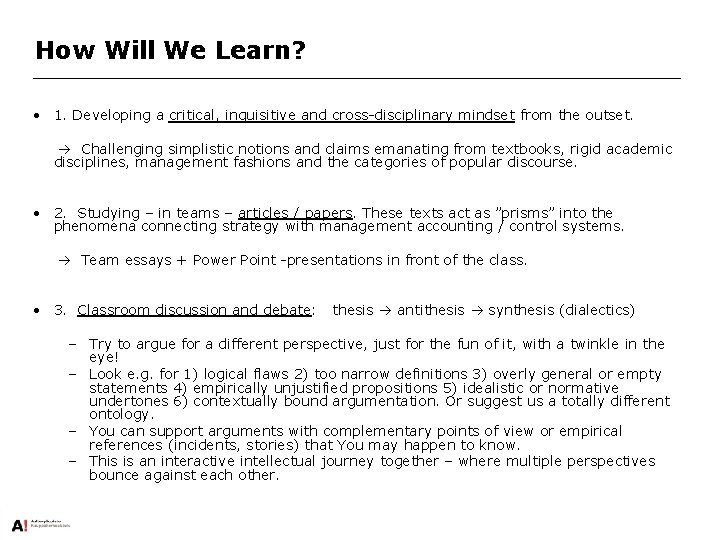
How Will We Learn? • 1. Developing a critical, inquisitive and cross-disciplinary mindset from the outset. Challenging simplistic notions and claims emanating from textbooks, rigid academic disciplines, management fashions and the categories of popular discourse. • 2. Studying – in teams – articles / papers. These texts act as ”prisms” into the phenomena connecting strategy with management accounting / control systems. Team essays + Power Point -presentations in front of the class. • 3. Classroom discussion and debate: thesis antithesis synthesis (dialectics) – Try to argue for a different perspective, just for the fun of it, with a twinkle in the eye! – Look e. g. for 1) logical flaws 2) too narrow definitions 3) overly general or empty statements 4) empirically unjustified propositions 5) idealistic or normative undertones 6) contextually bound argumentation. Or suggest us a totally different ontology. – You can support arguments with complementary points of view or empirical references (incidents, stories) that You may happen to know. – This is an interactive intellectual journey together – where multiple perspectives bounce against each other.
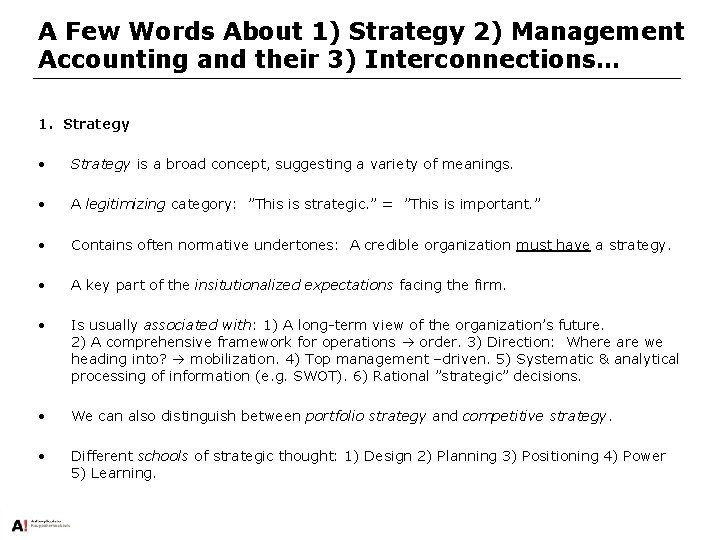
A Few Words About 1) Strategy 2) Management Accounting and their 3) Interconnections… 1. Strategy • Strategy is a broad concept, suggesting a variety of meanings. • A legitimizing category: ”This is strategic. ” = ”This is important. ” • Contains often normative undertones: A credible organization must have a strategy. • A key part of the insitutionalized expectations facing the firm. • Is usually associated with: 1) A long-term view of the organization’s future. 2) A comprehensive framework for operations order. 3) Direction: Where are we heading into? mobilization. 4) Top management –driven. 5) Systematic & analytical processing of information (e. g. SWOT). 6) Rational ”strategic” decisions. • We can also distinguish between portfolio strategy and competitive strategy. • Different schools of strategic thought: 1) Design 2) Planning 3) Positioning 4) Power 5) Learning.
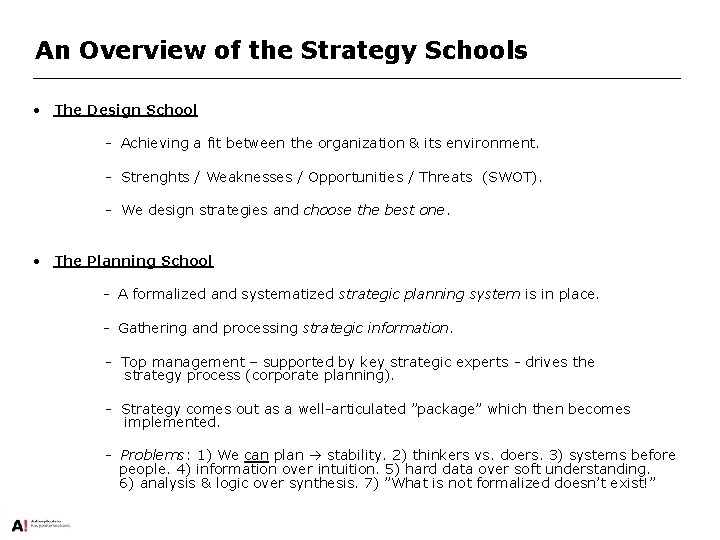
An Overview of the Strategy Schools • The Design School - Achieving a fit between the organization & its environment. - Strenghts / Weaknesses / Opportunities / Threats (SWOT). - We design strategies and choose the best one. • The Planning School - A formalized and systematized strategic planning system is in place. - Gathering and processing strategic information. - Top management – supported by key strategic experts - drives the strategy process (corporate planning). - Strategy comes out as a well-articulated ”package” which then becomes implemented. - Problems: 1) We can plan stability. 2) thinkers vs. doers. 3) systems before people. 4) information over intuition. 5) hard data over soft understanding. 6) analysis & logic over synthesis. 7) ”What is not formalized doesn’t exist!”
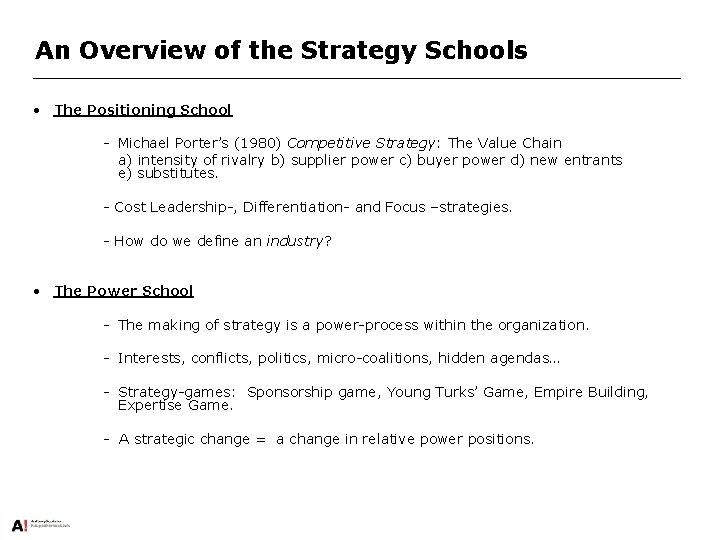
An Overview of the Strategy Schools • The Positioning School - Michael Porter’s (1980) Competitive Strategy: The Value Chain a) intensity of rivalry b) supplier power c) buyer power d) new entrants e) substitutes. - Cost Leadership-, Differentiation- and Focus –strategies. - How do we define an industry? • The Power School - The making of strategy is a power-process within the organization. - Interests, conflicts, politics, micro-coalitions, hidden agendas… - Strategy-games: Sponsorship game, Young Turks’ Game, Empire Building, Expertise Game. - A strategic change = a change in relative power positions.
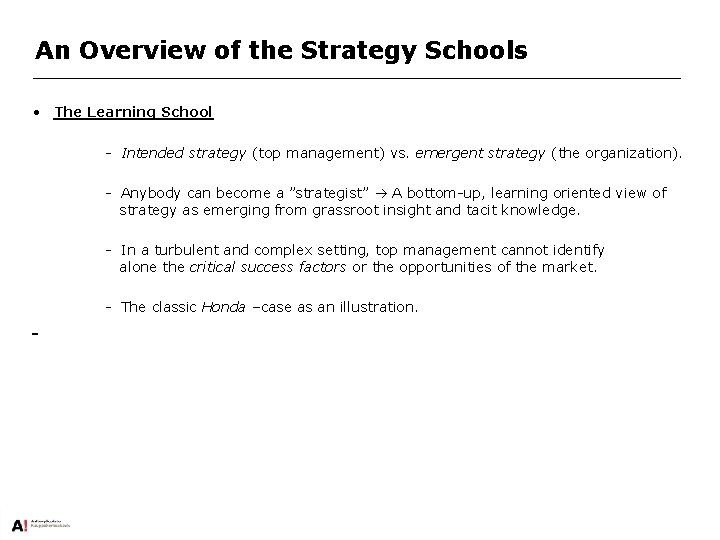
An Overview of the Strategy Schools • The Learning School - Intended strategy (top management) vs. emergent strategy (the organization). - Anybody can become a ”strategist” A bottom-up, learning oriented view of strategy as emerging from grassroot insight and tacit knowledge. - In a turbulent and complex setting, top management cannot identify alone the critical success factors or the opportunities of the market. - The classic Honda –case as an illustration.
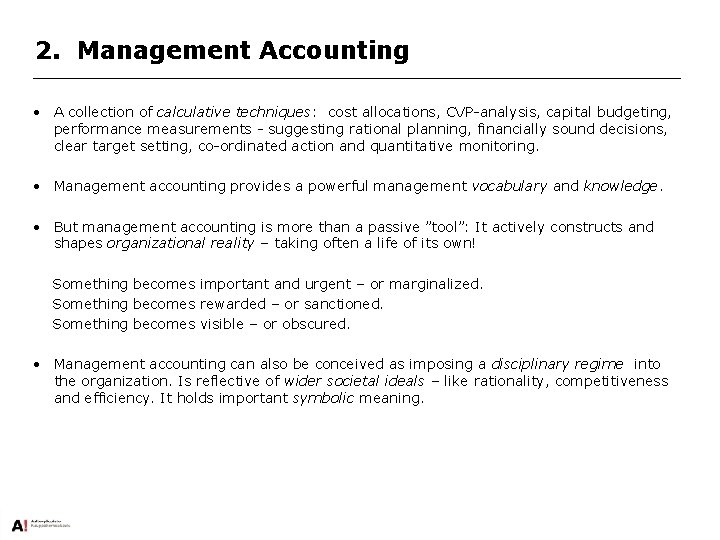
2. Management Accounting • A collection of calculative techniques: cost allocations, CVP-analysis, capital budgeting, performance measurements - suggesting rational planning, financially sound decisions, clear target setting, co-ordinated action and quantitative monitoring. • Management accounting provides a powerful management vocabulary and knowledge. • But management accounting is more than a passive ”tool”: It actively constructs and shapes organizational reality – taking often a life of its own! Something becomes important and urgent – or marginalized. Something becomes rewarded – or sanctioned. Something becomes visible – or obscured. • Management accounting can also be conceived as imposing a disciplinary regime into the organization. Is reflective of wider societal ideals – like rationality, competitiveness and efficiency. It holds important symbolic meaning.
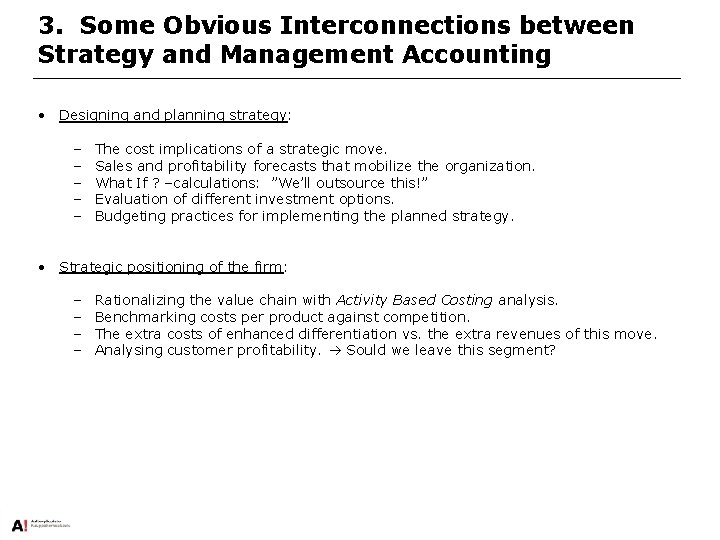
3. Some Obvious Interconnections between Strategy and Management Accounting • Designing and planning strategy: – – – The cost implications of a strategic move. Sales and profitability forecasts that mobilize the organization. What If ? –calculations: ”We’ll outsource this!” Evaluation of different investment options. Budgeting practices for implementing the planned strategy. • Strategic positioning of the firm: – – Rationalizing the value chain with Activity Based Costing analysis. Benchmarking costs per product against competition. The extra costs of enhanced differentiation vs. the extra revenues of this move. Analysing customer profitability. Sould we leave this segment?
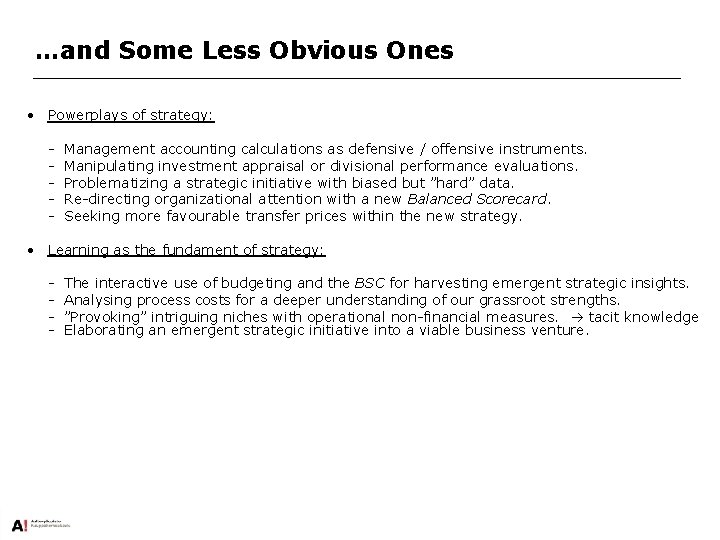
…and Some Less Obvious Ones • Powerplays of strategy: - Management accounting calculations as defensive / offensive instruments. Manipulating investment appraisal or divisional performance evaluations. Problematizing a strategic initiative with biased but ”hard” data. Re-directing organizational attention with a new Balanced Scorecard. Seeking more favourable transfer prices within the new strategy. • Learning as the fundament of strategy: - The interactive use of budgeting and the BSC for harvesting emergent strategic insights. Analysing process costs for a deeper understanding of our grassroot strengths. ”Provoking” intriguing niches with operational non-financial measures. tacit knowledge Elaborating an emergent strategic initiative into a viable business venture.
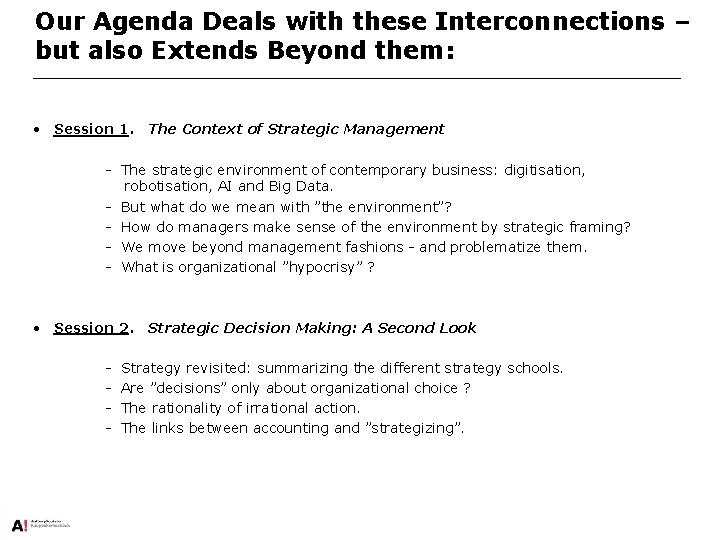
Our Agenda Deals with these Interconnections – but also Extends Beyond them: • Session 1. The Context of Strategic Management - The strategic environment of contemporary business: digitisation, robotisation, AI and Big Data. - But what do we mean with ”the environment”? - How do managers make sense of the environment by strategic framing? - We move beyond management fashions - and problematize them. - What is organizational ”hypocrisy” ? • Session 2. - Strategic Decision Making: A Second Look Strategy revisited: summarizing the different strategy schools. Are ”decisions” only about organizational choice ? The rationality of irrational action. The links between accounting and ”strategizing”.
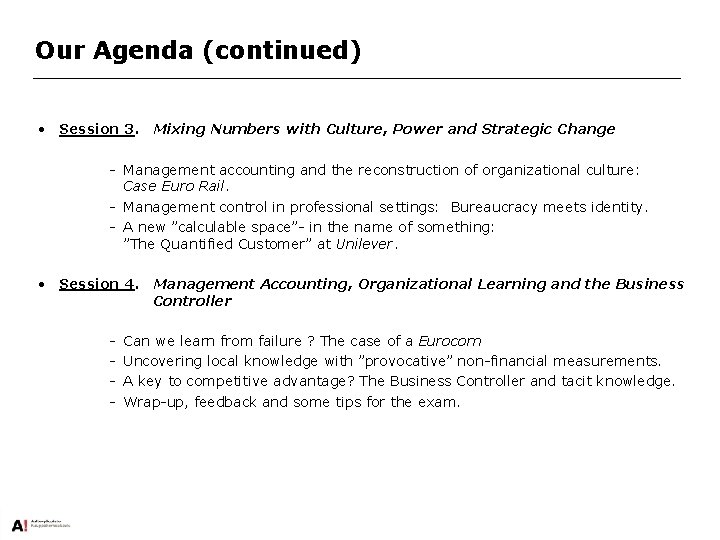
Our Agenda (continued) • Session 3. Mixing Numbers with Culture, Power and Strategic Change - Management accounting and the reconstruction of organizational culture: Case Euro Rail. - Management control in professional settings: Bureaucracy meets identity. - A new ”calculable space”- in the name of something: ”The Quantified Customer” at Unilever. • Session 4. - Management Accounting, Organizational Learning and the Business Controller Can we learn from failure ? The case of a Eurocom Uncovering local knowledge with ”provocative” non-financial measurements. A key to competitive advantage? The Business Controller and tacit knowledge. Wrap-up, feedback and some tips for the exam.