
Strategic Health IT Advanced Research Projects SHARP ORGANIZATION
- Slides: 1
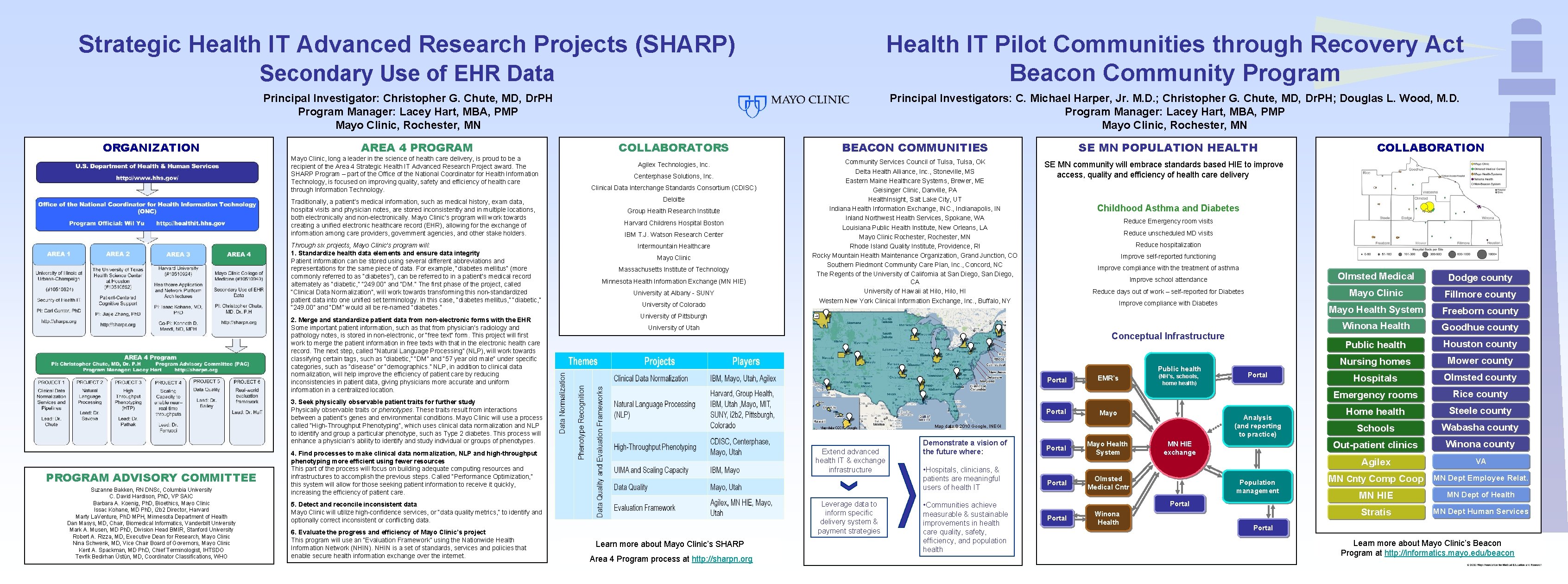
Strategic Health IT Advanced Research Projects (SHARP) ORGANIZATION Secondary Use of EHR Data Health IT Pilot Communities through Recovery Act Beacon Community Program Principal Investigator: Christopher G. Chute, MD, Dr. PH Program Manager: Lacey Hart, MBA, PMP Mayo Clinic, Rochester, MN Principal Investigators: C. Michael Harper, Jr. M. D. ; Christopher G. Chute, MD, Dr. PH; Douglas L. Wood, M. D. Program Manager: Lacey Hart, MBA, PMP Mayo Clinic, Rochester, MN AREA 4 PROGRAM Mayo Clinic, long a leader in the science of health care delivery, is proud to be a recipient of the Area 4 Strategic Health IT Advanced Research Project award. The SHARP Program – part of the Office of the National Coordinator for Health Information Technology, is focused on improving quality, safety and efficiency of health care through Information Technology. Traditionally, a patient’s medical information, such as medical history, exam data, hospital visits and physician notes, are stored inconsistently and in multiple locations, both electronically and non-electronically. Mayo Clinic’s program will work towards creating a unified electronic healthcare record (EHR), allowing for the exchange of information among care providers, government agencies, and other stake holders. Through six projects, Mayo Clinic’s program will: 1. Standardize health data elements and ensure data integrity Patient information can be stored using several different abbreviations and representations for the same piece of data. For example, “diabetes mellitus” (more commonly referred to as “diabetes”), can be referred to in a patient’s medical record alternately as “diabetic, ” “ 249. 00” and “DM. ” The first phase of the project, called “Clinical Data Normalization”, will work towards transforming this non-standardized patient data into one unified set terminology. In this case, “diabetes mellitus, ” “diabetic, ” “ 249. 00” and “DM” would all be re-named “diabetes. ” 2. Merge and standardize patient data from non-electronic forms with the EHR Some important patient information, such as that from physician’s radiology and pathology notes, is stored in non-electronic, or “free text” form. This project will first work to merge the patient information in free texts with that in the electronic health care record. The next step, called “Natural Language Processing” (NLP), will work towards classifying certain tags, such as “diabetic, ” “DM” and “ 57 year old male” under specific categories, such as “disease” or “demographics. ” NLP, in addition to clinical data normalization, will help improve the efficiency of patient care by reducing inconsistencies in patient data, giving physicians more accurate and uniform information in a centralized location. COLLABORATORS BEACON COMMUNITIES Agilex Technologies, Inc. Community Services Council of Tulsa, OK Delta Health Alliance, Inc. , Stoneville, MS Eastern Maine Healthcare Systems, Brewer, ME Geisinger Clinic, Danville, PA Health. Insight, Salt Lake City, UT Indiana Health Information Exchange, INC. , Indianapolis, IN Inland Northwest Health Services, Spokane, WA Louisiana Public Health Institute, New Orleans, LA Mayo Clinic Rochester, MN Rhode Island Quality Institute, Providence, RI Rocky Mountain Health Maintenance Organization, Grand Junction, CO Southern Piedmont Community Care Plan, Inc. , Concord, NC The Regents of the University of California at San Diego, CA University of Hawaii at Hilo, HI Western New York Clinical Information Exchange, Inc. , Buffalo, NY Centerphase Solutions, Inc. Clinical Data Interchange Standards Consortium (CDISC) Deloitte Group Health Research Institute Harvard Childrens Hospital Boston IBM T. J. Watson Research Center Intermountain Healthcare Mayo Clinic Massachusetts Institute of Technology Minnesota Health Information Exchange (MN HIE) University at Albany - SUNY University of Colorado Suzanne Bakken, RN DNSc, Columbia University C. David Hardison, Ph. D, VP SAIC Barbara A. Koenig, Ph. D, Bioethics, Mayo Clinic Issac Kohane, MD Ph. D, i 2 b 2 Director, Harvard Marty La. Venture, Ph. D MPH, Minnesota Department of Health Dan Masys, MD, Chair, Biomedical Informatics, Vanderbilt University Mark A. Musen, MD Ph. D, Division Head BMIR, Stanford University Robert A. Rizza, MD, Executive Dean for Research, Mayo Clinic Nina Schwenk, MD, Vice Chair Board of Governors, Mayo Clinic Kent A. Spackman, MD Ph. D, Chief Terminologist, IHTSDO Tevfik Bedirhan Üstün, MD, Coordinator Classifications, WHO Reduce Emergency room visits Reduce unscheduled MD visits Reduce hospitalization Improve self-reported functioning Improve compliance with the treatment of asthma Improve school attendance Reduce days out of work – self-reported for Diabetes Improve compliance with Diabetes Conceptual Infrastructure Public health Portal EMR’s (NH’s, schools, home health) Mayo Extend advanced health IT & exchange infrastructure Leverage data to inform specific delivery system & payment strategies 5. Detect and reconcile inconsistent data Mayo Clinic will utilize high-confidence services, or “data quality metrics, ” to identify and optionally correct inconsistent or conflicting data. Learn more about Mayo Clinic’s SHARP Area 4 Program process at http: //sharpn. org • Hospitals, clinicians, & patients are meaningful users of health IT • Communities achieve measurable & sustainable improvements in health care quality, safety, efficiency, and population health Portal Mayo Health System Portal Analysis (and reporting to practice) Map data © 2010 Google, INEGI 4. Find processes to make clinical data normalization, NLP and high-throughput phenotyping more efficient using fewer resources This part of the process will focus on building adequate computing resources and infrastructures to accomplish the previous steps. Called “Performance Optimization, ” this system will allow for those seeking patient information to receive it quickly, increasing the efficiency of patient care. 6. Evaluate the progress and efficiency of Mayo Clinic’s project This program will use an “Evaluation Framework” using the Nationwide Health Information Network (NHIN). NHIN is a set of standards, services and policies that enable secure health information exchange over the internet. Childhood Asthma and Diabetes University of Utah Demonstrate a vision of the future where: COLLABORATION SE MN community will embrace standards based HIE to improve access, quality and efficiency of health care delivery University of Pittsburgh 3. Seek physically observable patient traits for further study Physically observable traits or phenotypes. These traits result from interactions between a patient’s genes and environmental conditions. Mayo Clinic will use a process called “High-Throughput Phenotyping”, which uses clinical data normalization and NLP to identify and group a particular phenotype, such as Type 2 diabetes. This process will enhance a physician’s ability to identify and study individual or groups of phenotypes. PROGRAM ADVISORY COMMITTEE SE MN POPULATION HEALTH MN HIE exchange Olmsted Medical Cntr Population management Portal Winona Health Olmsted Medical Dodge county Mayo Clinic Fillmore county Mayo Health System Freeborn county Winona Health Goodhue county Public health Houston county Nursing homes Mower county Hospitals Olmsted county Emergency rooms Rice county Home health Steele county Schools Wabasha county Out-patient clinics Winona county Agilex VA MN Cnty Comp Coop MN Dept Employee Relat. MN HIE MN Dept of Health Stratis MN Dept Human Services Portal Learn more about Mayo Clinic’s Beacon Program at http: //informatics. mayo. edu/beacon