
STRATEGIC GOAL SETTING Features of IEP Goals Observable
STRATEGIC GOAL SETTING
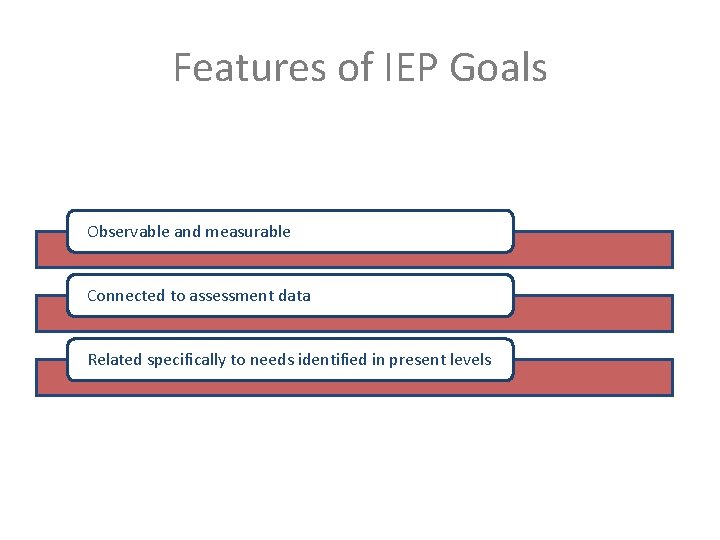
Features of IEP Goals Observable and measurable Connected to assessment data Related specifically to needs identified in present levels
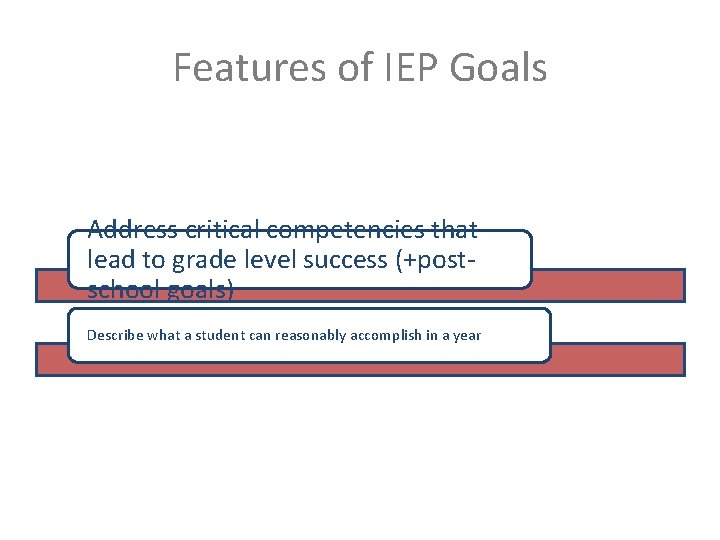
Features of IEP Goals Address critical competencies that lead to grade level success (+postschool goals) Describe what a student can reasonably accomplish in a year
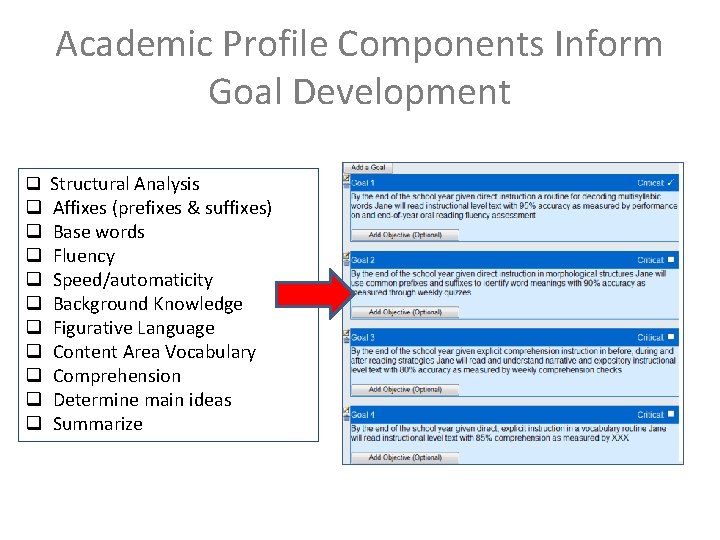
Academic Profile Components Inform Goal Development q Structural Analysis q q q q q Affixes (prefixes & suffixes) Base words Fluency Speed/automaticity Background Knowledge Figurative Language Content Area Vocabulary Comprehension Determine main ideas Summarize
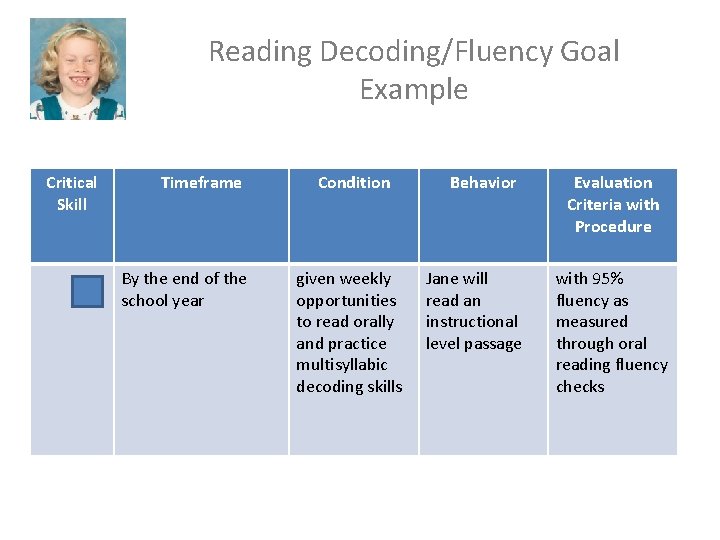
Reading Decoding/Fluency Goal Example Critical Skill Timeframe By the end of the school year Condition given weekly opportunities to read orally and practice multisyllabic decoding skills Behavior Jane will read an instructional level passage Evaluation Criteria with Procedure with 95% fluency as measured through oral reading fluency checks
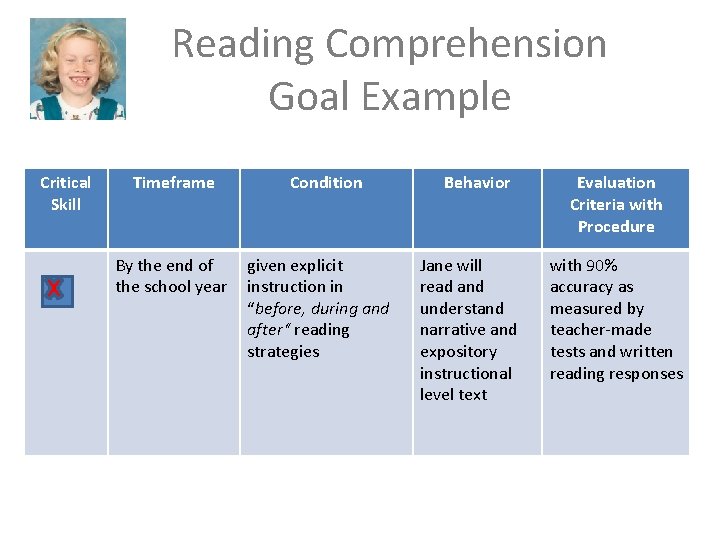
Reading Comprehension Goal Example Critical Skill Timeframe By the end of the school year Condition given explicit instruction in “before, during and after“ reading strategies Behavior Jane will read and understand narrative and expository instructional level text Evaluation Criteria with Procedure with 90% accuracy as measured by teacher-made tests and written reading responses

Vocabulary Goal Example Critical Skill Timeframe Condition Behavior Evaluation Criteria with Procedure By the end of the school year Using a vocabulary routine designed to increase use of academic vocabulary across all content areas Jane will read and define academic vocabulary With 80% accuracy as measured by monthly pre/post testing
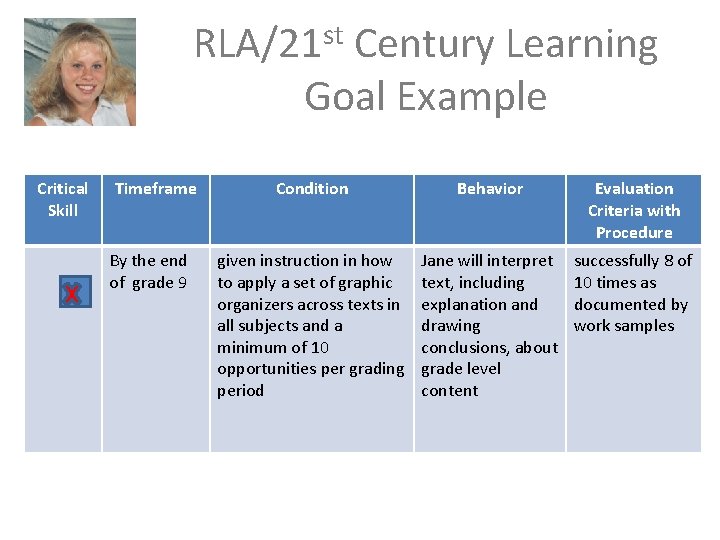
RLA/21 st Century Learning Goal Example Critical Skill Timeframe By the end of grade 9 Condition Behavior Evaluation Criteria with Procedure given instruction in how to apply a set of graphic organizers across texts in all subjects and a minimum of 10 opportunities per grading period Jane will interpret text, including explanation and drawing conclusions, about grade level content successfully 8 of 10 times as documented by work samples
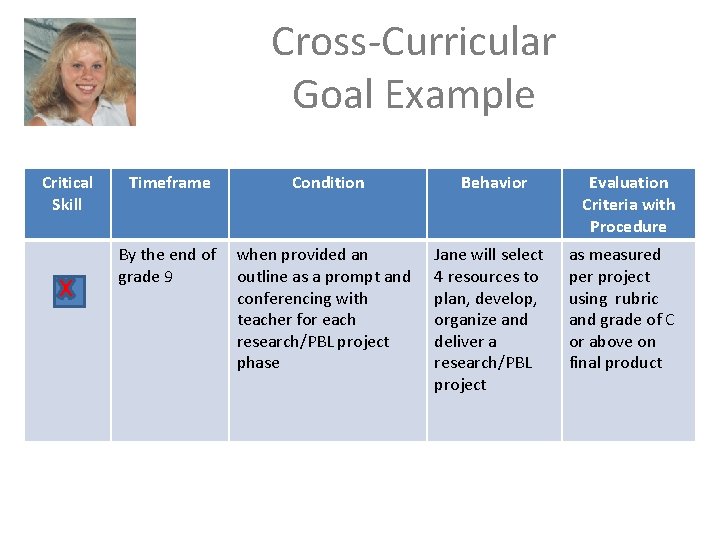
Cross-Curricular Goal Example Critical Skill Timeframe Condition By the end of grade 9 when provided an outline as a prompt and conferencing with teacher for each research/PBL project phase Behavior Jane will select 4 resources to plan, develop, organize and deliver a research/PBL project Evaluation Criteria with Procedure as measured per project using rubric and grade of C or above on final product
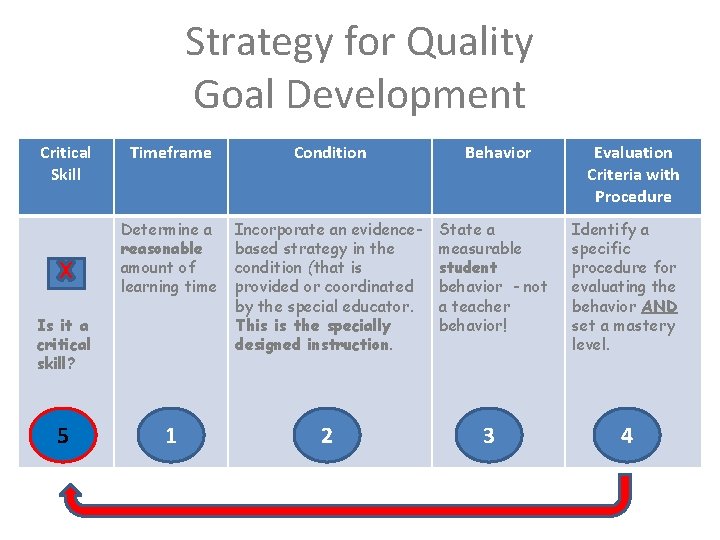
Strategy for Quality Goal Development Critical Skill Timeframe Condition Behavior Determine a reasonable amount of learning time Incorporate an evidencebased strategy in the condition (that is provided or coordinated by the special educator. This is the specially designed instruction. State a measurable student behavior - not a teacher behavior! 1 2 Is it a critical skill? 5 3 Evaluation Criteria with Procedure Identify a specific procedure for evaluating the behavior AND set a mastery level. 4
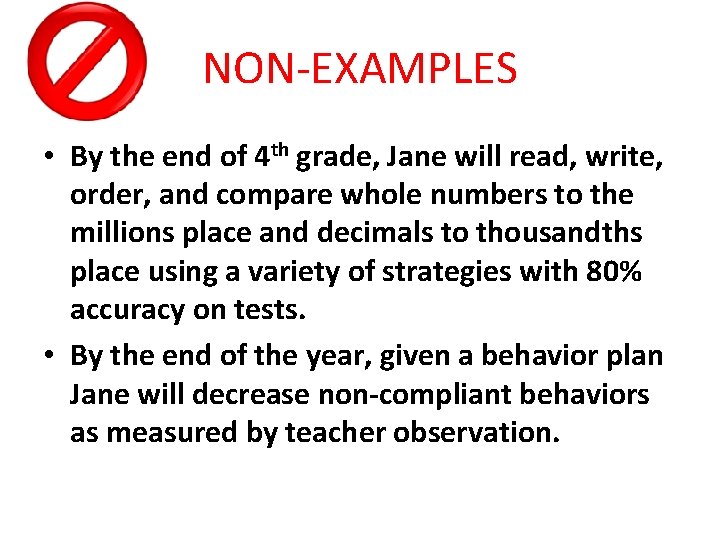
NON-EXAMPLES • By the end of 4 th grade, Jane will read, write, order, and compare whole numbers to the millions place and decimals to thousandths place using a variety of strategies with 80% accuracy on tests. • By the end of the year, given a behavior plan Jane will decrease non-compliant behaviors as measured by teacher observation.
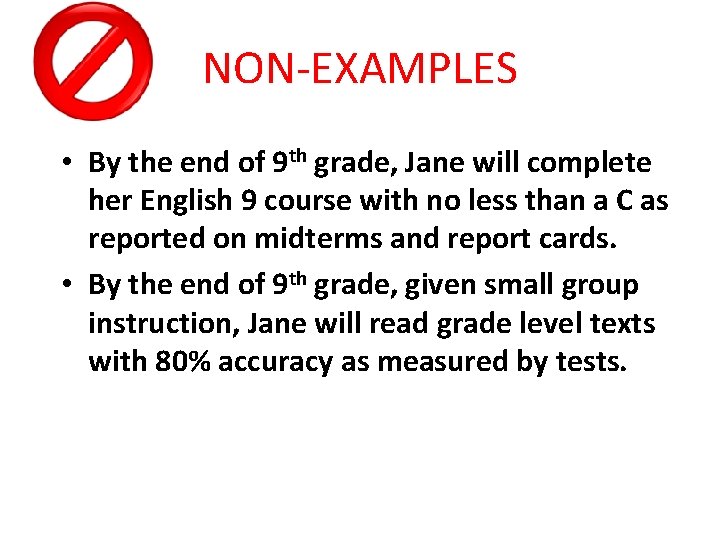
NON-EXAMPLES • By the end of 9 th grade, Jane will complete her English 9 course with no less than a C as reported on midterms and report cards. • By the end of 9 th grade, given small group instruction, Jane will read grade level texts with 80% accuracy as measured by tests.
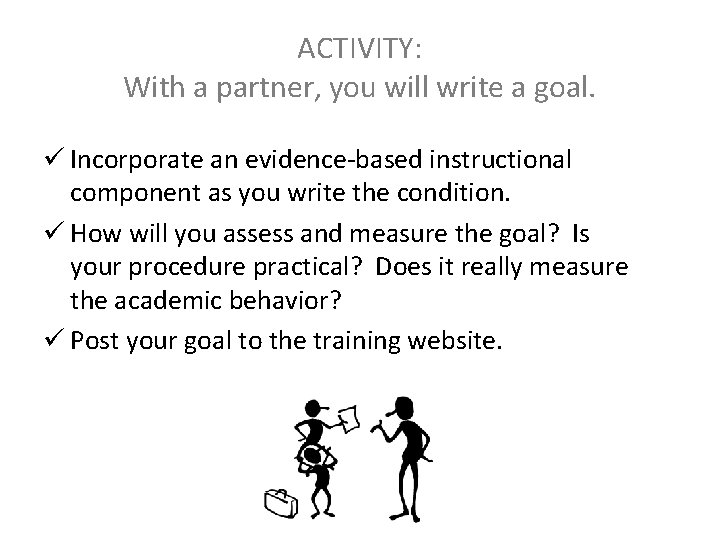
ACTIVITY: With a partner, you will write a goal. ü Incorporate an evidence-based instructional component as you write the condition. ü How will you assess and measure the goal? Is your procedure practical? Does it really measure the academic behavior? ü Post your goal to the training website.
Choose a CSO or Extended Standard 2 nd GRADE MATHEMATICS • M. O. 2. 1. 8 Model and justify the relationship between addition and subtraction (e. g. , identity element of addition, associative property, commutative property, inverse operations, fact families). 8 th GRADE WRITING • RLA. O. 8. 2. 05 From a prompt use the five-step writing process to develop a focused composition that contains specific, relevant details, and vivid, precise words.
Choose a CSO or Extended Standard Alternate Academic Achievement Standards (AAAS) M. S. 7. 5. ES. 1 organize given data by category, frequency, and range. Technology Tools 21 C. O. PK-2. 1. TT. 7 Student, working in a teacher-led whole group project, uses presentation software to illustrate concepts and communicate ideas. Or, address an impeding behavior…
- Slides: 15