
STRATEGIC FIT MATCHING STRATEGY TO STRUCTURE AND THE
- Slides: 26
STRATEGIC FIT: MATCHING STRATEGY TO STRUCTURE AND THE SITUATION Payne (7) 1
Two Primary Types of Fit 1. FIT WITH INDUSTRY OR MARKET CONDITIONS – external fit 1. 2. 3. 4. 5. 2. Strategies for Emerging Industries Strategies for High Velocity Markets Strategies for Maturing Industries Strategies for Declining Industries Strategies for Fragmented Industries FIT WITH ORGANOZATIONAL STRUCTURE – internal fit 2
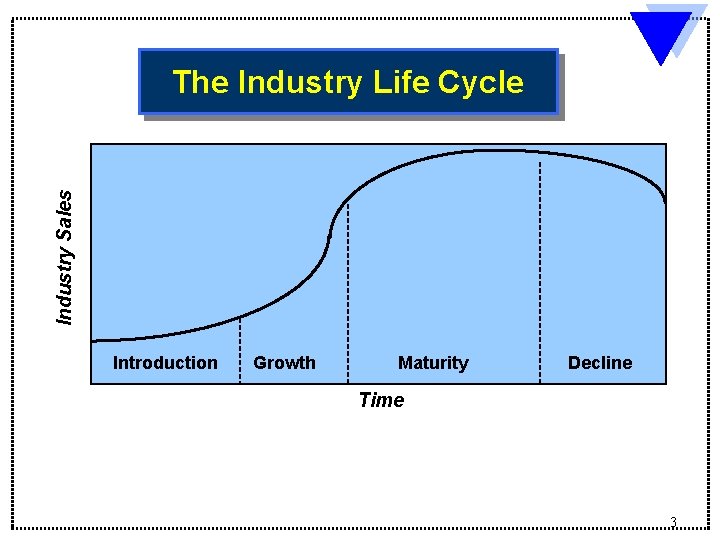
Industry Sales The Industry Life Cycle Introduction Growth Maturity Decline Time 3
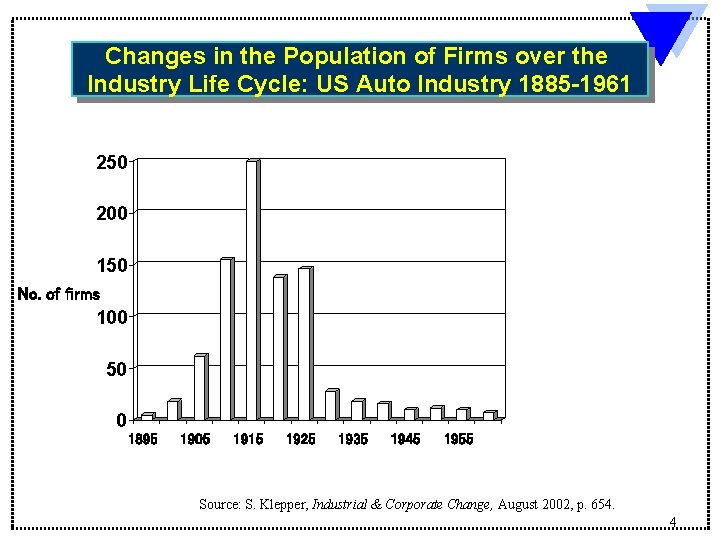
Changes in the Population of Firms over the Industry Life Cycle: US Auto Industry 1885 -1961 250 200 150 No. of firms 100 50 0 1895 1905 1915 1925 1935 1945 1955 Source: S. Klepper, Industrial & Corporate Change, August 2002, p. 654. 4
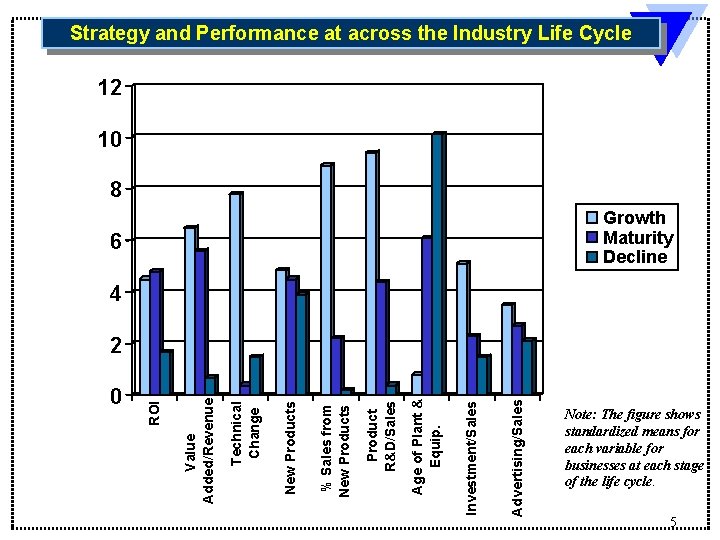
Strategy and Performance at across the Industry Life Cycle 12 10 8 Growth Maturity Decline 6 4 Advertising/Sales Investment/Sales Age of Plant & Equip. Product R&D/Sales % Sales from New Products Technical Change Value Added/Revenue 0 ROI 2 Note: The figure shows standardized means for each variable for businesses at each stage of the life cycle. 5
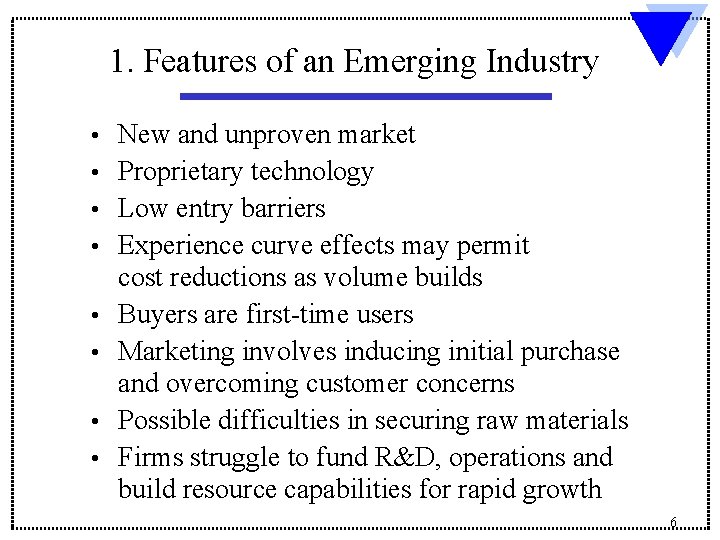
1. Features of an Emerging Industry • • New and unproven market Proprietary technology Low entry barriers Experience curve effects may permit cost reductions as volume builds Buyers are first-time users Marketing involves inducing initial purchase and overcoming customer concerns Possible difficulties in securing raw materials Firms struggle to fund R&D, operations and build resource capabilities for rapid growth 6
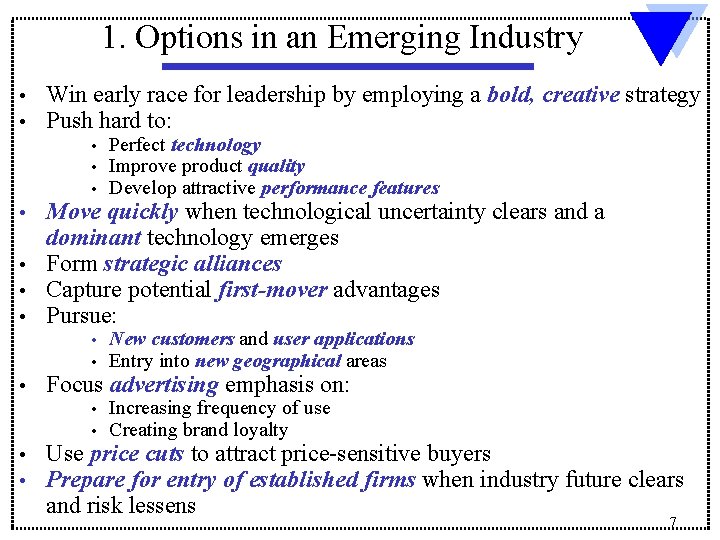
1. Options in an Emerging Industry • • Win early race for leadership by employing a bold, creative strategy Push hard to: • • • Perfect technology Improve product quality Develop attractive performance features Move quickly when technological uncertainty clears and a dominant technology emerges • Form strategic alliances • Capture potential first-mover advantages • Pursue: • • Focus advertising emphasis on: • • New customers and user applications Entry into new geographical areas Increasing frequency of use Creating brand loyalty Use price cuts to attract price-sensitive buyers Prepare for entry of established firms when industry future clears and risk lessens 7
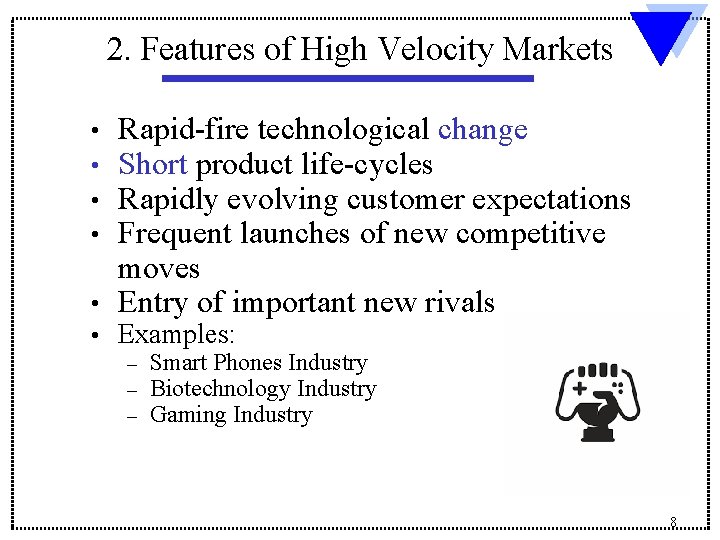
2. Features of High Velocity Markets Rapid-fire technological change Short product life-cycles Rapidly evolving customer expectations Frequent launches of new competitive moves • Entry of important new rivals • • • Examples: – – – Smart Phones Industry Biotechnology Industry Gaming Industry 8
2. Options in the High Velocity Markets • • Invest aggressively in R&D Develop quick response capabilities • • • Match rivals Shift resources Adapt competencies Create new competitive capabilities Speed new products to market • Use strategic partnerships to develop specialized expertise and capabilities • Keys to success: • • Cutting-edge expertise Speed in responding to new developments Collaboration with others Agility Innovativeness Opportunism Resource flexibility First-to-market capabilities 9
3. Characteristics of Industry Maturity • • Slowing demand generates stiff competition More sophisticated buyers demand bargains Greater emphasis on cost and service “Topping out” problem in adding production capacity Product innovation and new end uses harder to come by International competition increases Industry profitability falls Mergers and acquisitions reduce the number of industry rivals 10
3. Strategy Options for Competing in a Mature Industry • • Prune product line Emphasize process innovation Strong focus on cost reduction Increase sales to present customers Purchase rivals at bargain prices Expand internationally Build new, more flexible competitive capabilities 11
4. Characteristics of Stagnant or Declining Industries • Demand grows more slowly than economy as whole (or even declines) • Competitive pressures intensify--rivals battle for market share • To grow and prosper, firm must take market share from rivals • Industry consolidates to a smaller number of key players via mergers and acquisitions 12
4. Options for Competing in a Stagnant or Declining Industry Pursue focus strategy aimed at fastest growing market segments • Stress differentiation based on quality improvement or product innovation • Work diligently to drive costs down by • – – – Outsourcing Redesign internal processes Consolidate under-utilized production facilities Close low-volume, high-cost distribution outlets Cut marginal activities from value chain 13
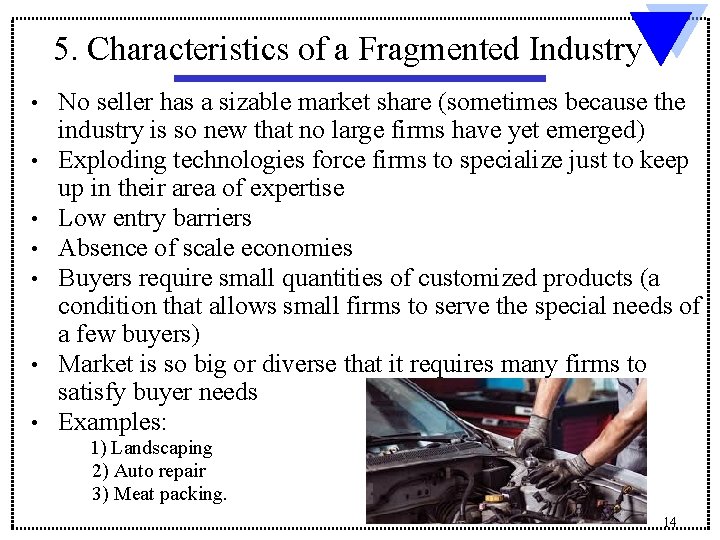
5. Characteristics of a Fragmented Industry • • No seller has a sizable market share (sometimes because the industry is so new that no large firms have yet emerged) Exploding technologies force firms to specialize just to keep up in their area of expertise Low entry barriers Absence of scale economies Buyers require small quantities of customized products (a condition that allows small firms to serve the special needs of a few buyers) Market is so big or diverse that it requires many firms to satisfy buyer needs Examples: 1) Landscaping 2) Auto repair 3) Meat packing. 14
5. Options for a Fragmented Industry Construct and operate “formula” facilities Become a low-cost operator Increase customer value via backward or forward integration • Specialize by product type • Specialize by customer type • Focus on limited geographic area • • • 15
Strategy & Structure Fit Concepts: Strategy and Structure Relationship Structure Characteristics Dealing with Size Issues 16
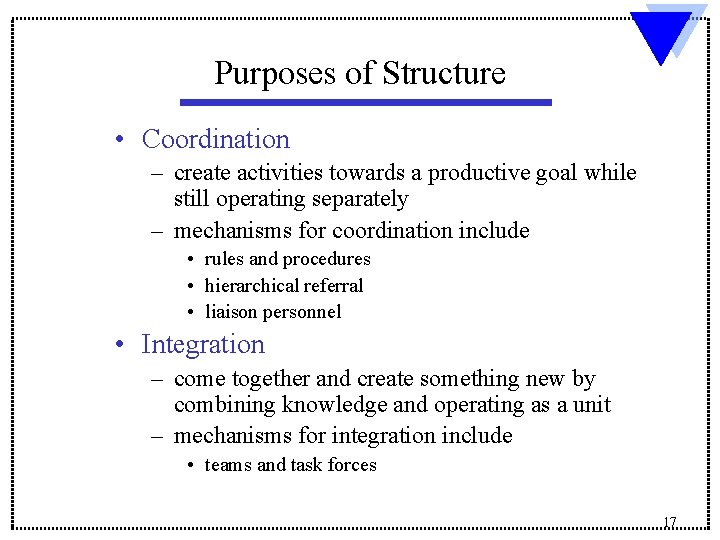
Purposes of Structure • Coordination – create activities towards a productive goal while still operating separately – mechanisms for coordination include • rules and procedures • hierarchical referral • liaison personnel • Integration – come together and create something new by combining knowledge and operating as a unit – mechanisms for integration include • teams and task forces 17
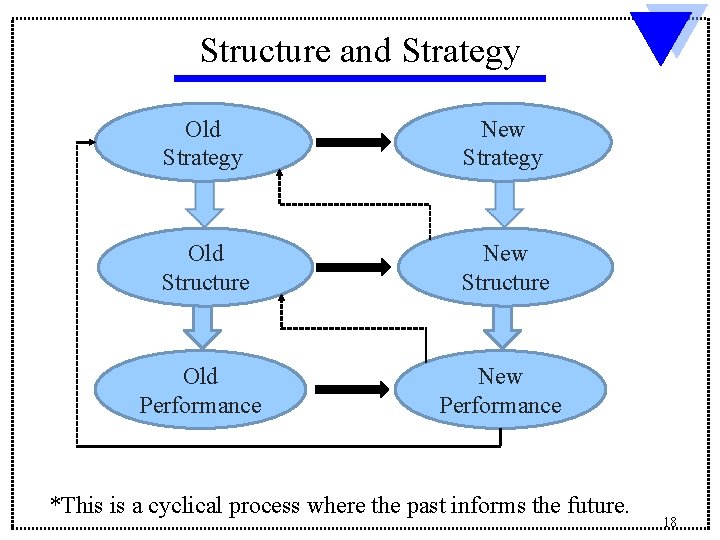
Structure and Strategy Old Strategy New Strategy Old Structure New Structure Old Performance New Performance *This is a cyclical process where the past informs the future. 18
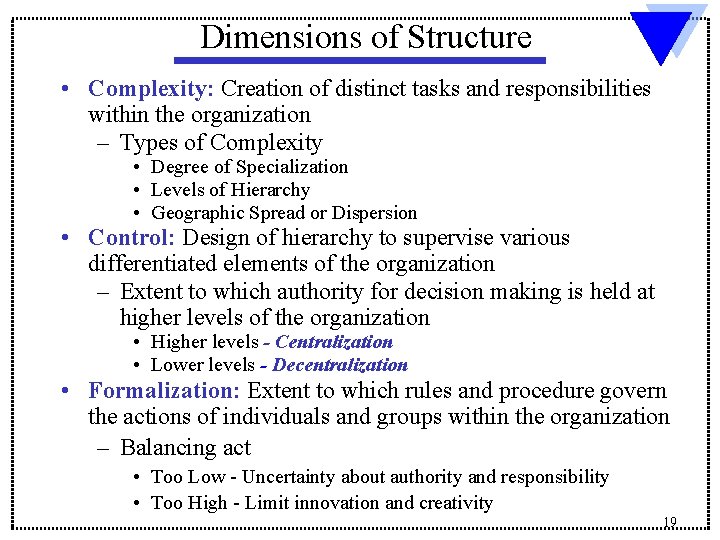
Dimensions of Structure • Complexity: Creation of distinct tasks and responsibilities within the organization – Types of Complexity • Degree of Specialization • Levels of Hierarchy • Geographic Spread or Dispersion • Control: Design of hierarchy to supervise various differentiated elements of the organization – Extent to which authority for decision making is held at higher levels of the organization • Higher levels - Centralization • Lower levels - Decentralization • Formalization: Extent to which rules and procedure govern the actions of individuals and groups within the organization – Balancing act • Too Low - Uncertainty about authority and responsibility • Too High - Limit innovation and creativity 19
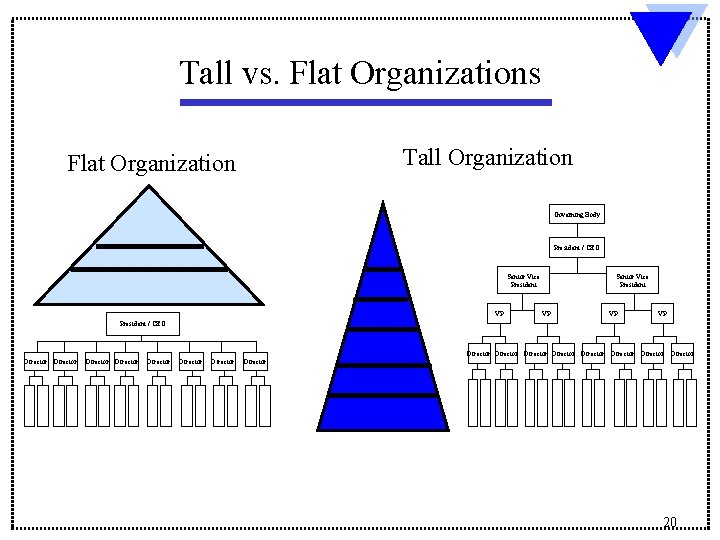
Tall vs. Flat Organizations Tall Organization Flat Organization Governing Body President / CEO Senior Vice President VP VP VP President / CEO Director Director Director Director 20
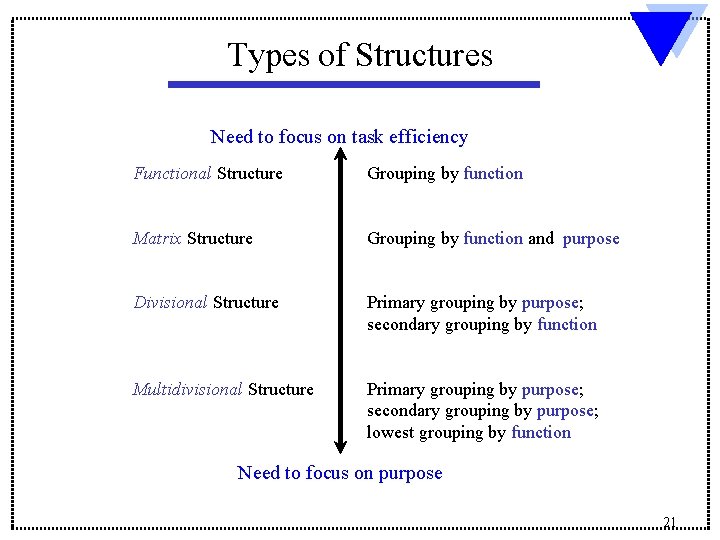
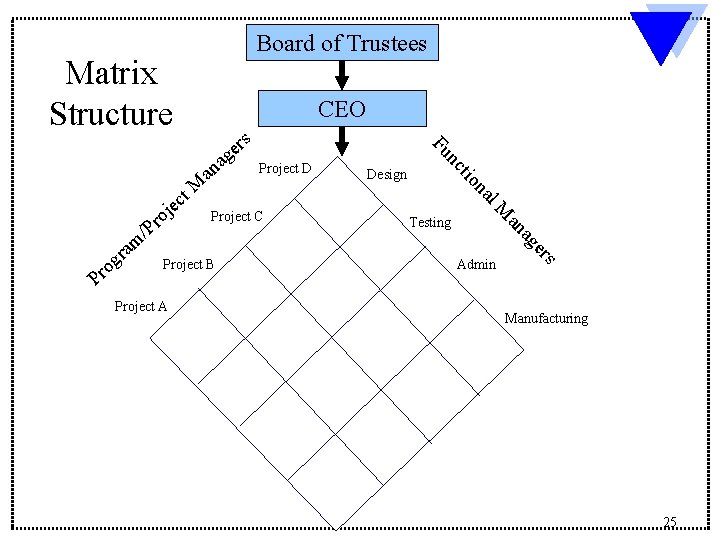
Types of Structures Need to focus on task efficiency Functional Structure Grouping by function Matrix Structure Grouping by function and purpose Divisional Structure Primary grouping by purpose; secondary grouping by function Multidivisional Structure Primary grouping by purpose; secondary grouping by purpose; lowest grouping by function Need to focus on purpose 21
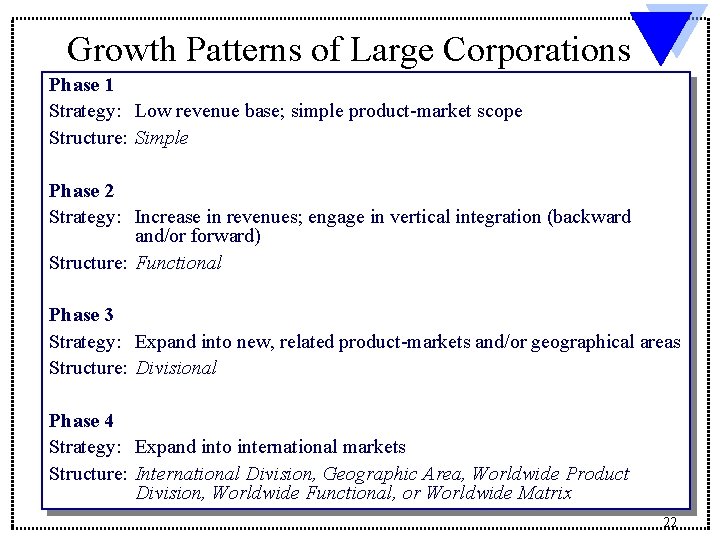
Growth Patterns of Large Corporations Phase 1 Strategy: Low revenue base; simple product-market scope Structure: Simple Phase 2 Strategy: Increase in revenues; engage in vertical integration (backward and/or forward) Structure: Functional Phase 3 Strategy: Expand into new, related product-markets and/or geographical areas Structure: Divisional Phase 4 Strategy: Expand into international markets Structure: International Division, Geographic Area, Worldwide Product Division, Worldwide Functional, or Worldwide Matrix 22
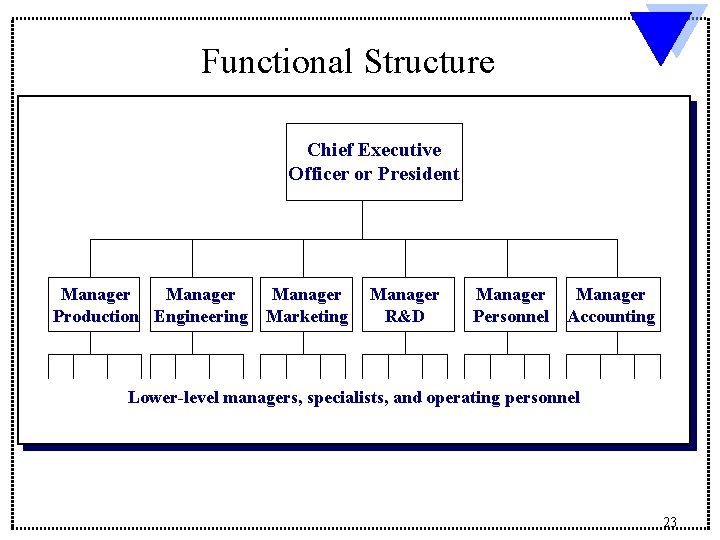
Functional Structure Chief Executive Officer or President Manager Production Engineering Manager Marketing Manager R&D Manager Personnel Accounting Lower-level managers, specialists, and operating personnel 23
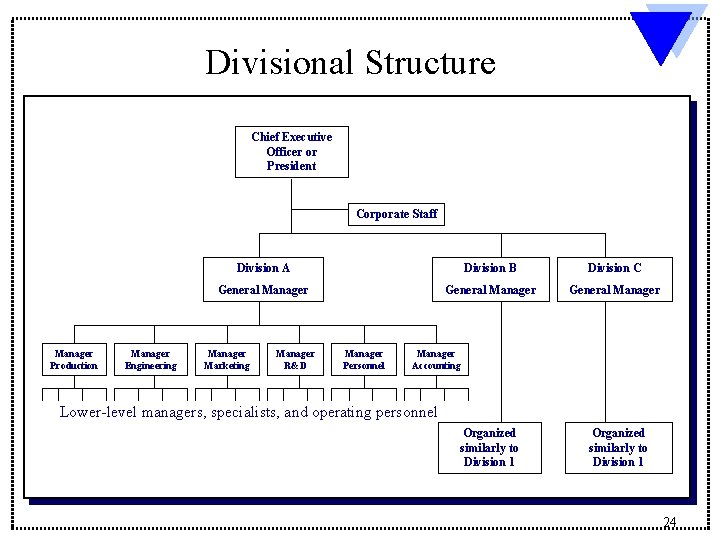
Divisional Structure Chief Executive Officer or President Corporate Staff Manager Production Manager Engineering Division A Division B Division C General Manager Marketing Manager R&D Manager Personnel Manager Accounting Lower-level managers, specialists, and operating personnel Organized similarly to Division 1 24
Board of Trustees Matrix Structure CEO Project A Admin s er Project B Testing ag an o Pr Project C Design l. M na tio / m a gr ec j o Pr Project D nc a an t. M Fu s r ge Manufacturing 25
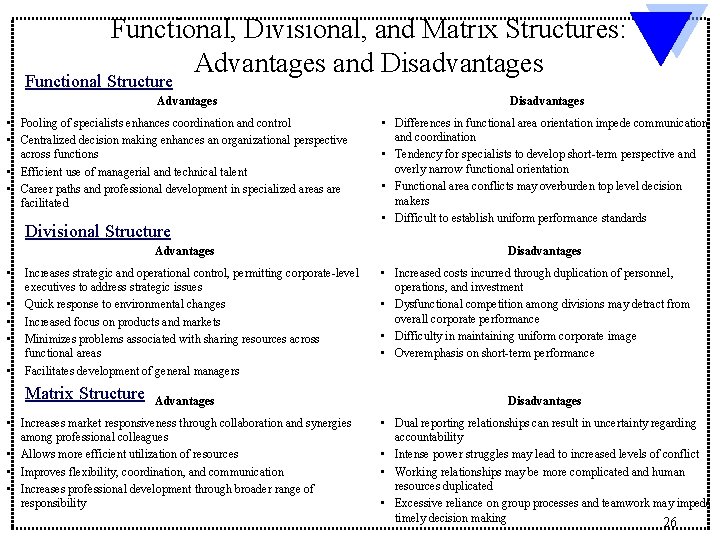
Functional, Divisional, and Matrix Structures: Advantages and Disadvantages Functional Structure Advantages • Pooling of specialists enhances coordination and control • Centralized decision making enhances an organizational perspective across functions • Efficient use of managerial and technical talent • Career paths and professional development in specialized areas are facilitated Divisional Structure Advantages • • • Increases strategic and operational control, permitting corporate-level executives to address strategic issues Quick response to environmental changes Increased focus on products and markets Minimizes problems associated with sharing resources across functional areas Facilitates development of general managers Matrix Structure Advantages • Increases market responsiveness through collaboration and synergies among professional colleagues • Allows more efficient utilization of resources • Improves flexibility, coordination, and communication • Increases professional development through broader range of responsibility Disadvantages • Differences in functional area orientation impede communication and coordination • Tendency for specialists to develop short-term perspective and overly narrow functional orientation • Functional area conflicts may overburden top level decision makers • Difficult to establish uniform performance standards Disadvantages • Increased costs incurred through duplication of personnel, operations, and investment • Dysfunctional competition among divisions may detract from overall corporate performance • Difficulty in maintaining uniform corporate image • Overemphasis on short-term performance Disadvantages • Dual reporting relationships can result in uncertainty regarding accountability • Intense power struggles may lead to increased levels of conflict • Working relationships may be more complicated and human resources duplicated • Excessive reliance on group processes and teamwork may impede timely decision making 26