
Strategic Environmental Assessment in Land Use Planning Lesson
- Slides: 23
Strategic Environmental Assessment in Land Use Planning: Lesson from Tanzania Growth, Conservation and Responsibility 27 th Annual General Meeting IAIA’ 07 3 - 9 June 2007 Alexander Chambi, Raphael Mwalyosi CEARM Dar es Salaam – Tanzania
Paper outline w General introduction to Land Use Planning n n Definition Influence w Land Use Planning in Tanzania n n Historical perspective Land use practice w SEA and Para-SEA in Tanzania n Practice, Expertise, Institutions & Legislation w Conclusion and Recommendations
Land use planning w Programme of state intervention in land use and environmental change n n Mediate conflict of interest over how land should be used and developed Coordinate individual activities on land w Land use programme is realized through n Planning system constituted by l l l Institutional arrangement Instruments and Tools
Land use planning w Influenced by: n n n Land policy Interest extant in a locality Land administrators
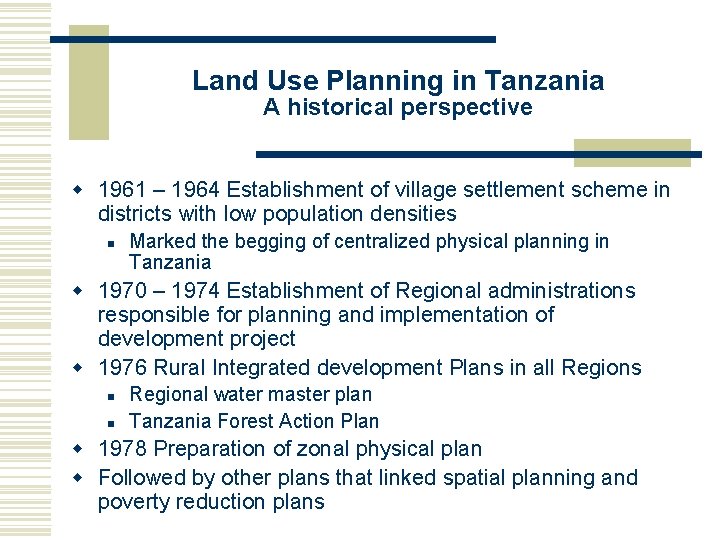
Land Use Planning in Tanzania A historical perspective w 1961 – 1964 Establishment of village settlement scheme in districts with low population densities n Marked the begging of centralized physical planning in Tanzania w 1970 – 1974 Establishment of Regional administrations responsible for planning and implementation of development project w 1976 Rural Integrated development Plans in all Regions n n Regional water master plan Tanzania Forest Action Plan w 1978 Preparation of zonal physical plan w Followed by other plans that linked spatial planning and poverty reduction plans
Land Use Planning in Tanzania w The government attempted to regulate and organize which land for which purpose by: w Enacting the National Land Use Planning Commission Act of 1984 w The act created the National Land Use Planning Commission (NLUPC) w Main functions n n Prepare regional physical land use plan Formulate land use policies and legislation
Constrains and effects w Constrains of land use planning in Tanzania n n Low capacity in terms of manpower and financial support Traditional practice in land use l Culture, experience, customs, beliefs, traditional laws and local knowledge w Effects of land use planning in Tanzania n Conflict among resource uses e. g. Land use in Usangu basin
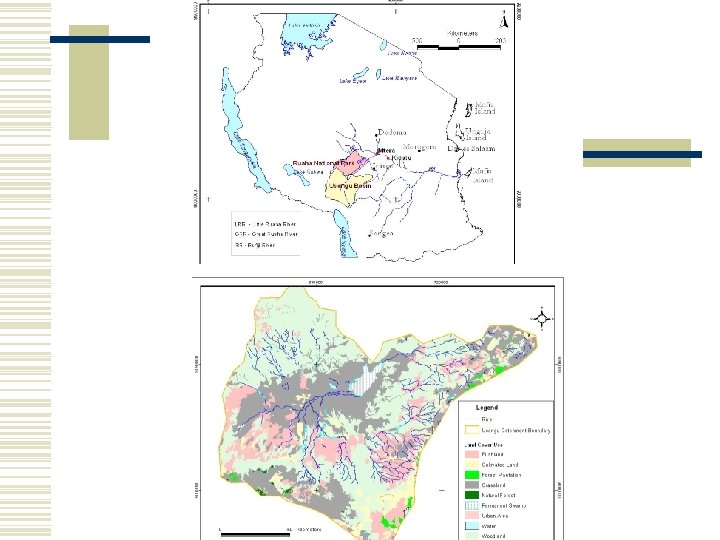
Land Use in Usangu Basin w Usangu Basin is economically important in Tanzania n n It is important regulator for the hydroelectric schemes downstream of Mtera and Kidatu Irrigation scheme l l n n n about 208, 000 ha irrigable Support over 30, 000 farming household Key for the Ruaha National Park Livestock within the basin and along Great Ruaha River Source of firewood, timber and other related construction materials
Land Use in Usangu basin w Competition between resource users resulted in over utilization of resources due to n n n Poor coordination Lack of monitoring Lack of participation of key stakeholders w Effect n n From 1994, drying of Great Ruaha River during dry season The zero flows implied no water from Usangu basin to Ruaha National Park and to Mtera hydropower
Effort to Restore w 2006 Relocating livestock, livestock keepers and villages from wetland within basin w 2006/2007 Gazette of Usangu Game Reserve and attach in Ruaha National Park making Ruaha National Park the biggest national park in Tanzania
Results w Positively: w Increased water flow in Great Ruaha River w Raised water level of Mtera dam to over maximum capacity of 698. 50 m. a. s. l for hydropower generation within 2 months w Improved industrial development w Improved wildlife in Ruaha National Park w Negatively: w Reduced agricultural land
Effect - based planning and SEA w The appraisal process for policy and plan formulation do not by itself provide for full assessment of their overall impact on sustainability w Restoration of the basin overlooks issues such as drought and evaporation effect w Cost Benefit Analysis on land use changes in Usangu basin for growth and conservation w SEA in LUP for Growth, Conservation and Responsibility? Case study below illustrate
SEA in Land Use Planning in Tanzania – Case Studies w SEA for Roads Improvements in Tanzania national Parks 2001 n n n The planning involved: Assessment of impacts, threats and constrains of current and future land use Projection/prediction of future potentials and opportunities Strategies for impact mitigation and opportunity enhancement Involvement of all key stakeholders including surrounding local communities
Case study cont… w Benefits n n increased number of visitors interring national parks from 576, 000 in 2003 to 582, 807 in 2004. In 2005 Tanzania visited by 624, 020 increased Tanzania’s economy from tourist sector from US$ 731. 00 Mil in 2003 to 746. 1 Mil in 2004 while in 2005 Tanzania earned US$1, 083. 50 Mil Improved conservation in national parks Every National Park has detained GMP w Another good example of SEA applied to University of Dar es Salaam Physical Master Plan and Land Use Policy
Effectiveness of strategic planning w Most of strategic plans up to 1990 s incorporate sustainability and SEA principles w Shortcomings n n n Top-down participatory and exclude key stakeholders Most plans depends on donors supports for both planning and implementation casting doubt on sustainability Lack of cross-sector policies to avoid contradictions and sector conflicts and overlap w 2004 SEA mandatory requirement for PPPs under the EMA No. 20 of 2004
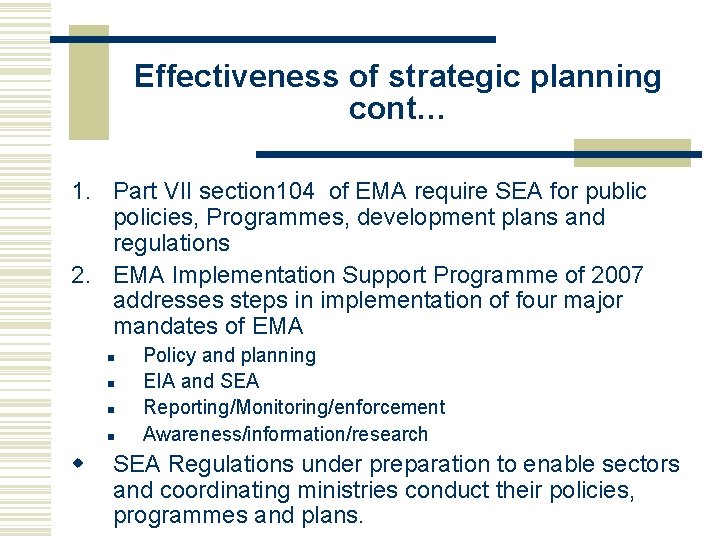
Effectiveness of strategic planning cont… 1. Part VII section 104 of EMA require SEA for public policies, Programmes, development plans and regulations 2. EMA Implementation Support Programme of 2007 addresses steps in implementation of four major mandates of EMA n n w Policy and planning EIA and SEA Reporting/Monitoring/enforcement Awareness/information/research SEA Regulations under preparation to enable sectors and coordinating ministries conduct their policies, programmes and plans.
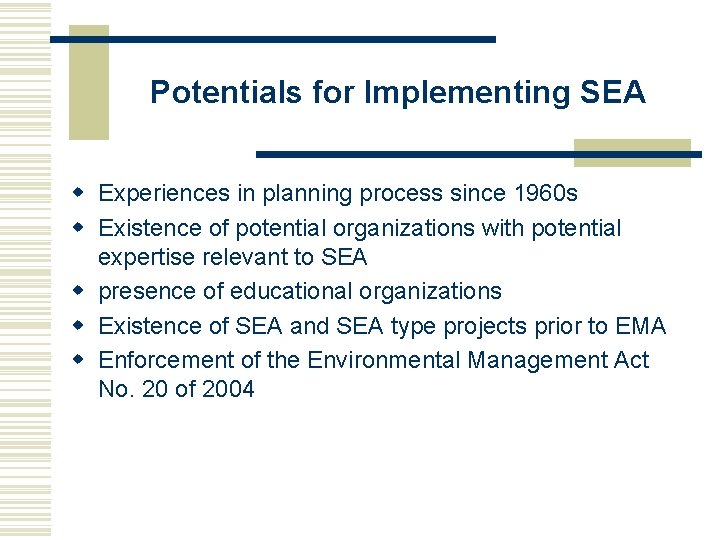
Potentials for Implementing SEA w Experiences in planning process since 1960 s w Existence of potential organizations with potential expertise relevant to SEA w presence of educational organizations w Existence of SEA and SEA type projects prior to EMA w Enforcement of the Environmental Management Act No. 20 of 2004
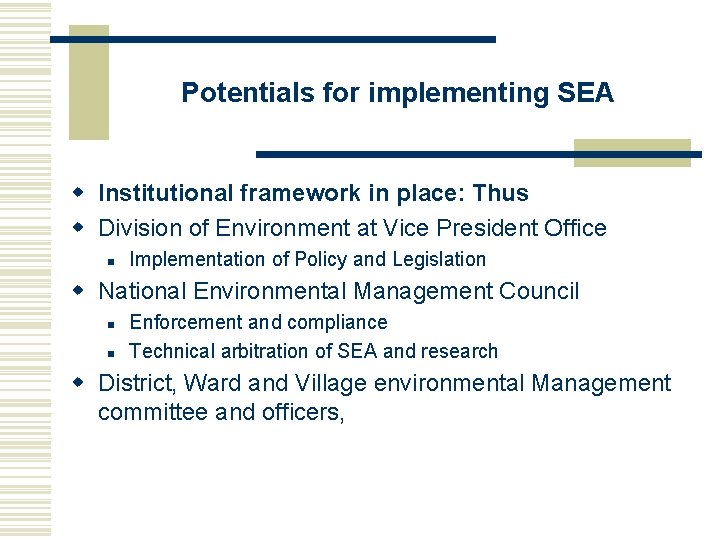
Potentials for implementing SEA w Institutional framework in place: Thus w Division of Environment at Vice President Office n Implementation of Policy and Legislation w National Environmental Management Council n n Enforcement and compliance Technical arbitration of SEA and research w District, Ward and Village environmental Management committee and officers,
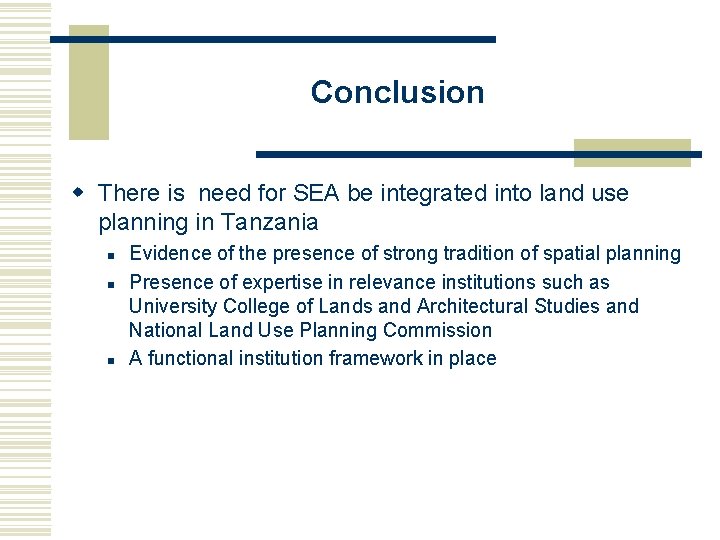
Conclusion w There is need for SEA be integrated into land use planning in Tanzania n n n Evidence of the presence of strong tradition of spatial planning Presence of expertise in relevance institutions such as University College of Lands and Architectural Studies and National Land Use Planning Commission A functional institution framework in place
Recommendations w Tanzania need to adopt a ‘bottom-up’ approach to SEA w Existing planning policy documents should be reviewed/audited to integrate SEA/sustainability principles w SEA should inform land use planners, decision-makers and affected public on the sustainability of strategic decisions, facilitate the search for the best alternative and ensure a democratic decision-making process.
Recommendations w Four levels and type of SEA are recommended for Tanzania: n n Policy-based SEA: Sector-based SEA: Plan/Programme-based SEA Geographic area-based SEA
Recommendations w SEA is fairly new in Tanzania and hence capacity building in form of training and skills enhancement is needed to enable sector and coordinating ministries to conduct SEA of their policy, planning and legislation.