
Strategic Directions of the National Science Foundation and

- Slides: 46
Strategic Directions of the National Science Foundation and the CISE Directorate Peter A. Freeman Assistant Director U. S. National Science Foundation for Computer and Information Science and Engineering (CISE) August 2004
Agenda • • NSF context The CISE Directorate Focus for Computing Research in 2004 Long-term Challenges for Computing Research 2
The U. S. National Science Foundation (NSF)
NSF Mission National Science Foundation Act of 1950 (Public Law 810507): • To promote the progress of science; • to advance the national health, prosperity, and welfare; • to secure the national defense; • and for other purposes. 4
NSF Organization Administrative Offices 5
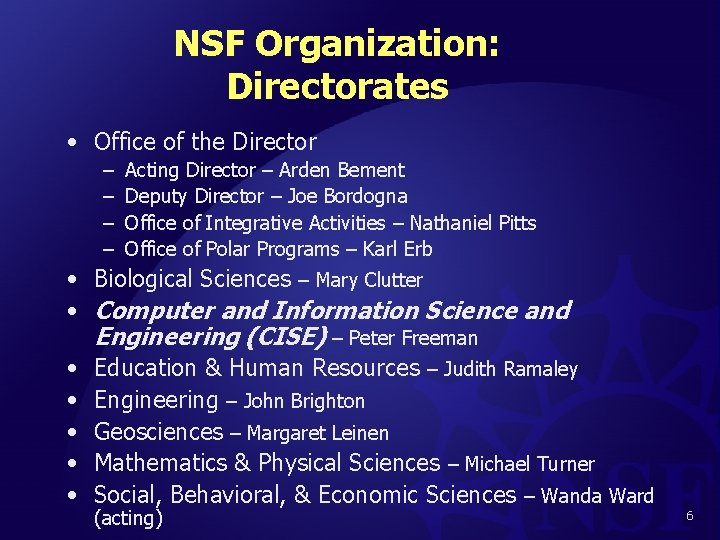
NSF Organization: Directorates • Office of the Director – – Acting Director – Arden Bement Deputy Director – Joe Bordogna Office of Integrative Activities – Nathaniel Pitts Office of Polar Programs – Karl Erb • Biological Sciences – Mary Clutter • Computer and Information Science and Engineering (CISE) – Peter Freeman • Education & Human Resources – Judith Ramaley • Engineering – John Brighton • Geosciences – Margaret Leinen • Mathematics & Physical Sciences – Michael Turner • Social, Behavioral, & Economic Sciences – Wanda Ward (acting) 6
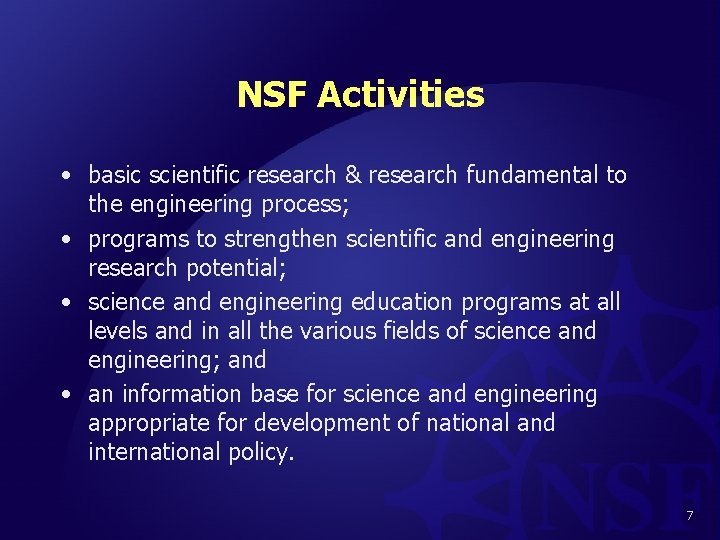
NSF Activities • basic scientific research & research fundamental to the engineering process; • programs to strengthen scientific and engineering research potential; • science and engineering education programs at all levels and in all the various fields of science and engineering; and • an information base for science and engineering appropriate for development of national and international policy. 7
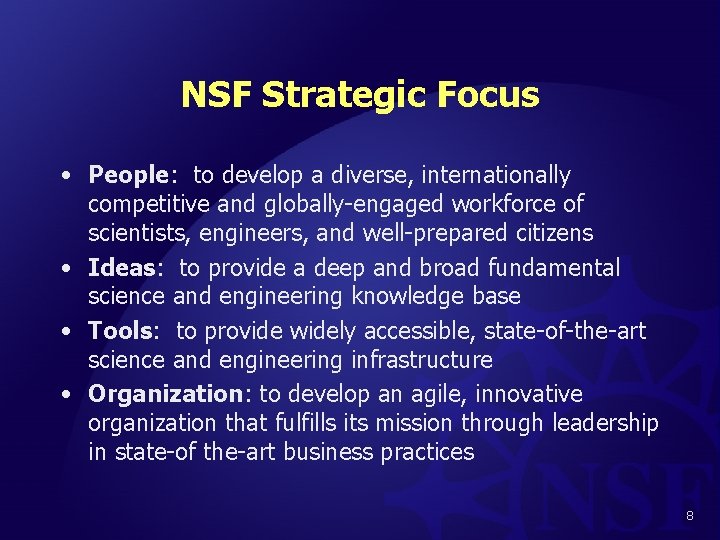
NSF Strategic Focus • People: to develop a diverse, internationally competitive and globally-engaged workforce of scientists, engineers, and well-prepared citizens • Ideas: to provide a deep and broad fundamental science and engineering knowledge base • Tools: to provide widely accessible, state-of-the-art science and engineering infrastructure • Organization: to develop an agile, innovative organization that fulfills its mission through leadership in state-of the-art business practices 8
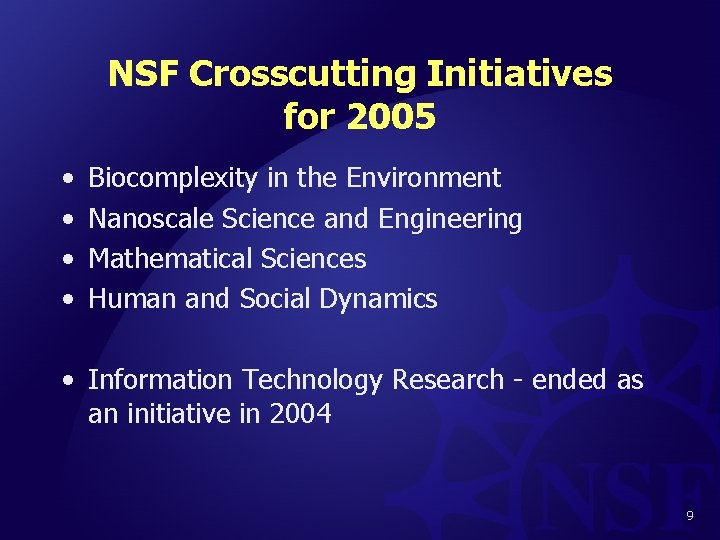
NSF Crosscutting Initiatives for 2005 • • Biocomplexity in the Environment Nanoscale Science and Engineering Mathematical Sciences Human and Social Dynamics • Information Technology Research - ended as an initiative in 2004 9
The NSF Directorate for Computer & Information Science & Engineering (CISE)
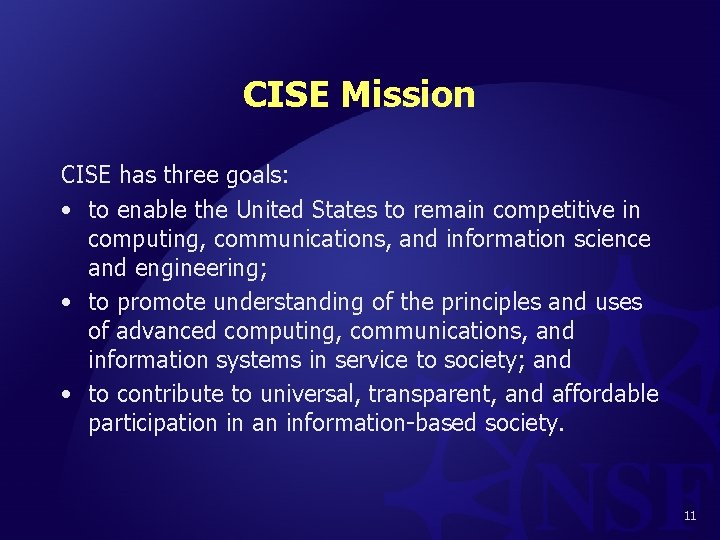
CISE Mission CISE has three goals: • to enable the United States to remain competitive in computing, communications, and information science and engineering; • to promote understanding of the principles and uses of advanced computing, communications, and information systems in service to society; and • to contribute to universal, transparent, and affordable participation in an information-based society. 11
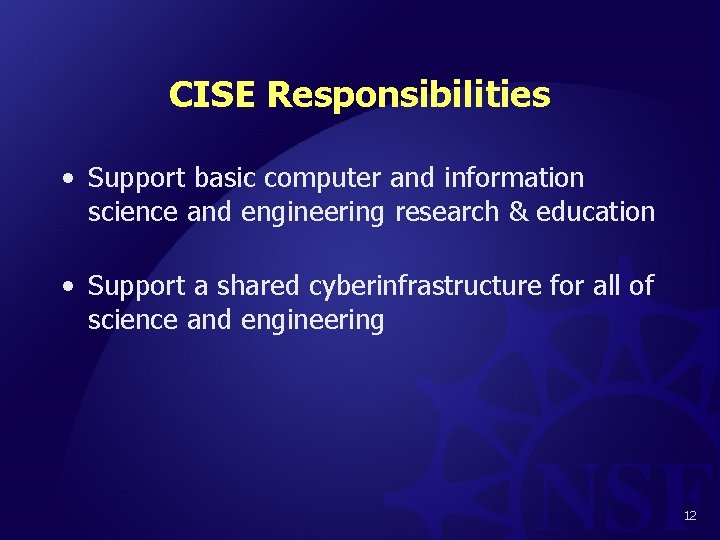
CISE Responsibilities • Support basic computer and information science and engineering research & education • Support a shared cyberinfrastructure for all of science and engineering 12
The New CISE
New CISE Organization 14
Key Concept: Clusters • Comprehensive activity in a coherent area of research and education • Teams of Program Officers and Staff working closely with the community • Initially: groups of existing programs • Eventually: one program per cluster 15
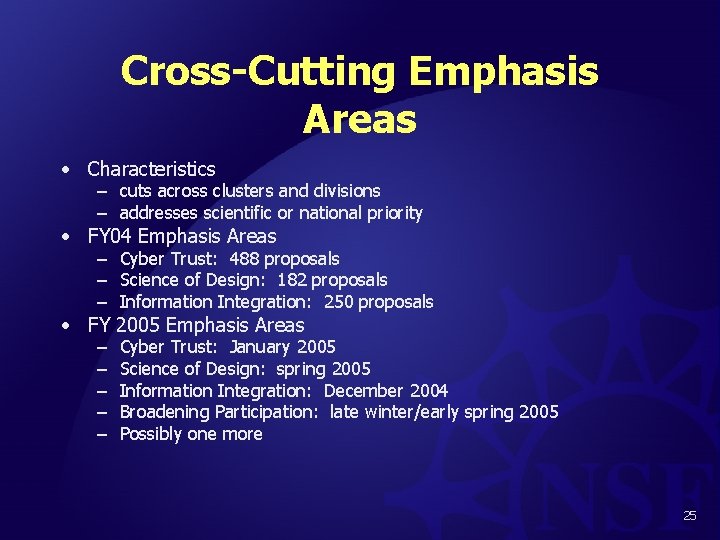
Key Concept: Emphasis Areas • Focused areas of research that cut across clusters and divisions • Address scientific and national priorities • Have program announcements and funds • Examples: – – Cybertrust Education and workforce Information Integration Science of design 16
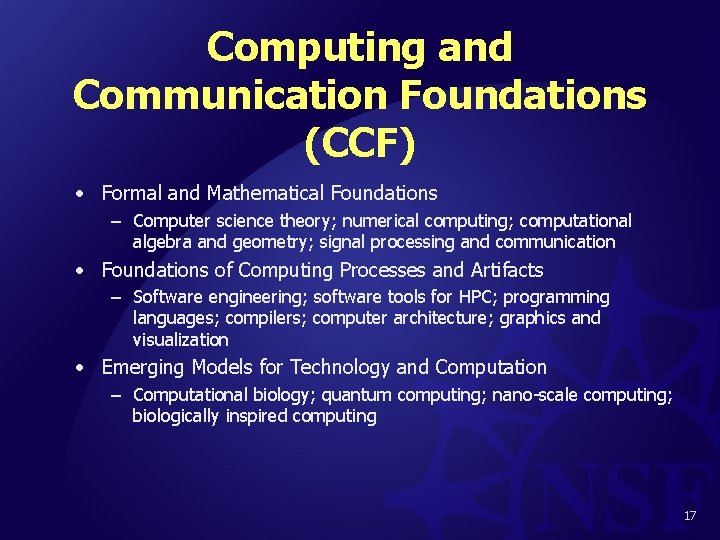
Computing and Communication Foundations (CCF) • Formal and Mathematical Foundations – Computer science theory; numerical computing; computational algebra and geometry; signal processing and communication • Foundations of Computing Processes and Artifacts – Software engineering; software tools for HPC; programming languages; compilers; computer architecture; graphics and visualization • Emerging Models for Technology and Computation – Computational biology; quantum computing; nano-scale computing; biologically inspired computing 17
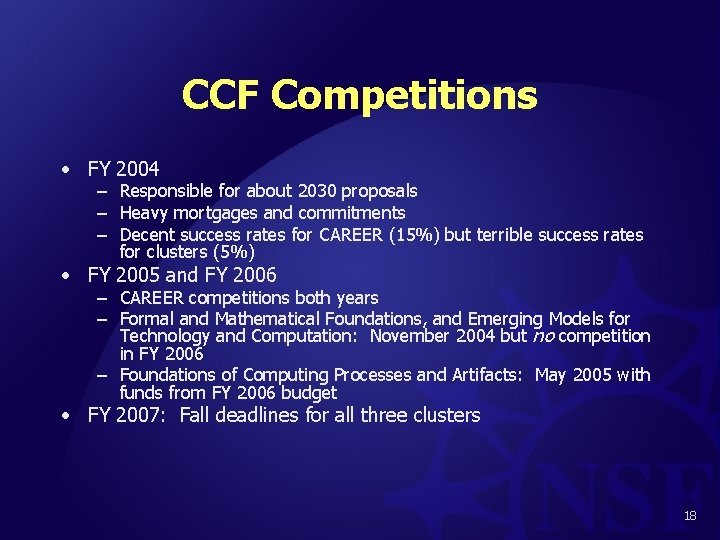
CCF Competitions • FY 2004 – Responsible for about 2030 proposals – Heavy mortgages and commitments – Decent success rates for CAREER (15%) but terrible success rates for clusters (5%) • FY 2005 and FY 2006 – CAREER competitions both years – Formal and Mathematical Foundations, and Emerging Models for Technology and Computation: November 2004 but no competition in FY 2006 – Foundations of Computing Processes and Artifacts: May 2005 with funds from FY 2006 budget • FY 2007: Fall deadlines for all three clusters 18
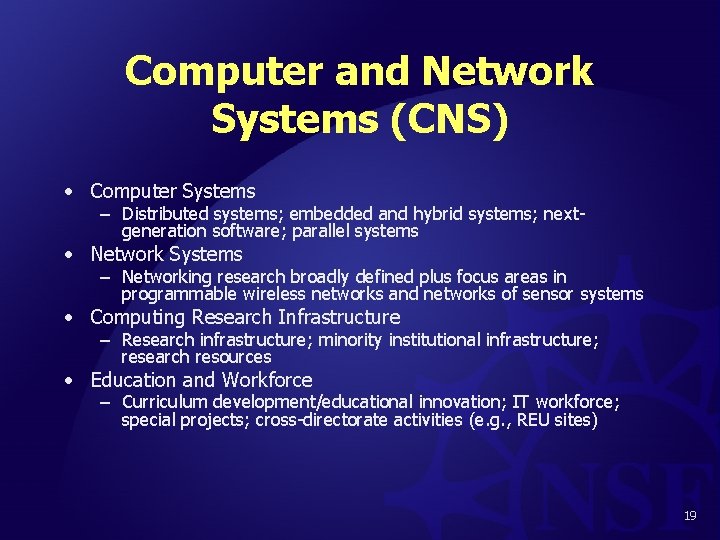
Computer and Network Systems (CNS) • Computer Systems – Distributed systems; embedded and hybrid systems; nextgeneration software; parallel systems • Network Systems – Networking research broadly defined plus focus areas in programmable wireless networks and networks of sensor systems • Computing Research Infrastructure – Research infrastructure; minority institutional infrastructure; research resources • Education and Workforce – Curriculum development/educational innovation; IT workforce; special projects; cross-directorate activities (e. g. , REU sites) 19
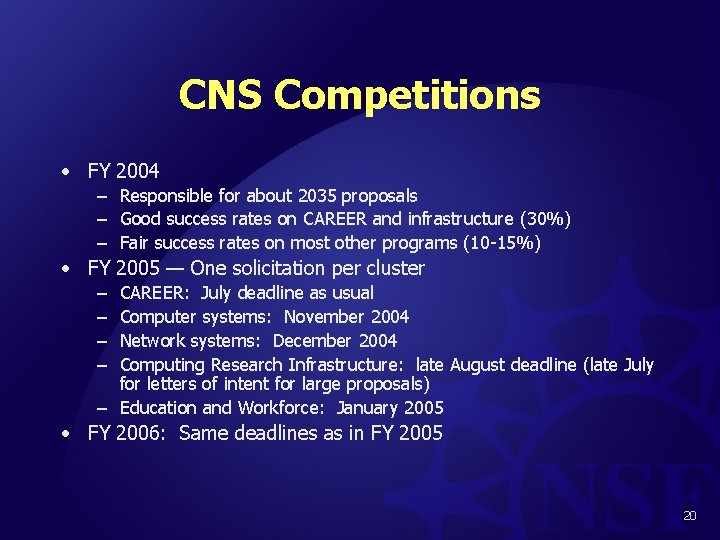
CNS Competitions • FY 2004 – Responsible for about 2035 proposals – Good success rates on CAREER and infrastructure (30%) – Fair success rates on most other programs (10 -15%) • FY 2005 — One solicitation per cluster – – CAREER: July deadline as usual Computer systems: November 2004 Network systems: December 2004 Computing Research Infrastructure: late August deadline (late July for letters of intent for large proposals) – Education and Workforce: January 2005 • FY 2006: Same deadlines as in FY 2005 20
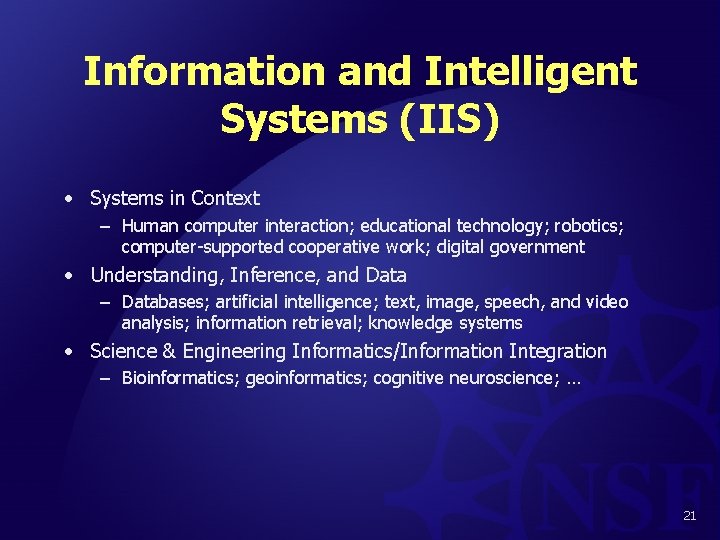
Information and Intelligent Systems (IIS) • Systems in Context – Human computer interaction; educational technology; robotics; computer-supported cooperative work; digital government • Understanding, Inference, and Data – Databases; artificial intelligence; text, image, speech, and video analysis; information retrieval; knowledge systems • Science & Engineering Informatics/Information Integration – Bioinformatics; geoinformatics; cognitive neuroscience; … 21
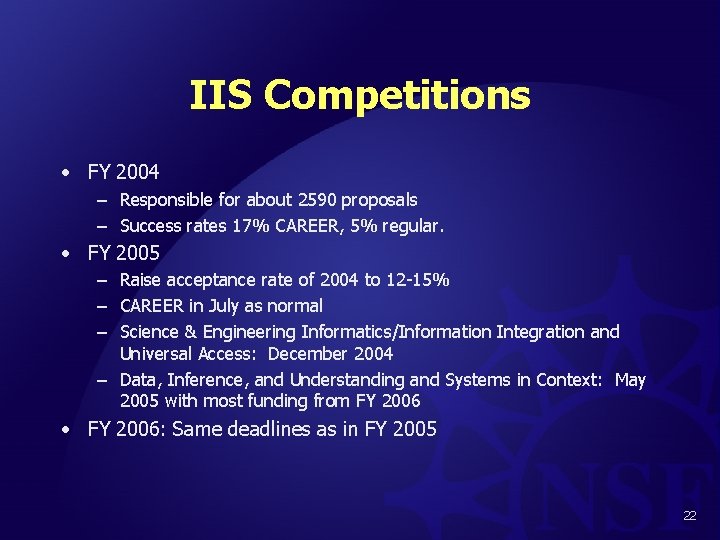
IIS Competitions • FY 2004 – Responsible for about 2590 proposals – Success rates 17% CAREER, 5% regular. • FY 2005 – Raise acceptance rate of 2004 to 12 -15% – CAREER in July as normal – Science & Engineering Informatics/Information Integration and Universal Access: December 2004 – Data, Inference, and Understanding and Systems in Context: May 2005 with most funding from FY 2006 • FY 2006: Same deadlines as in FY 2005 22
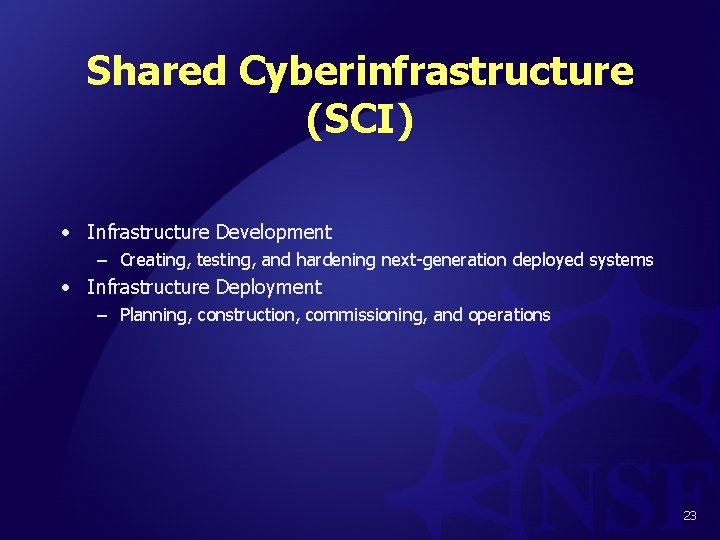
Shared Cyberinfrastructure (SCI) • Infrastructure Development – Creating, testing, and hardening next-generation deployed systems • Infrastructure Deployment – Planning, construction, commissioning, and operations 23
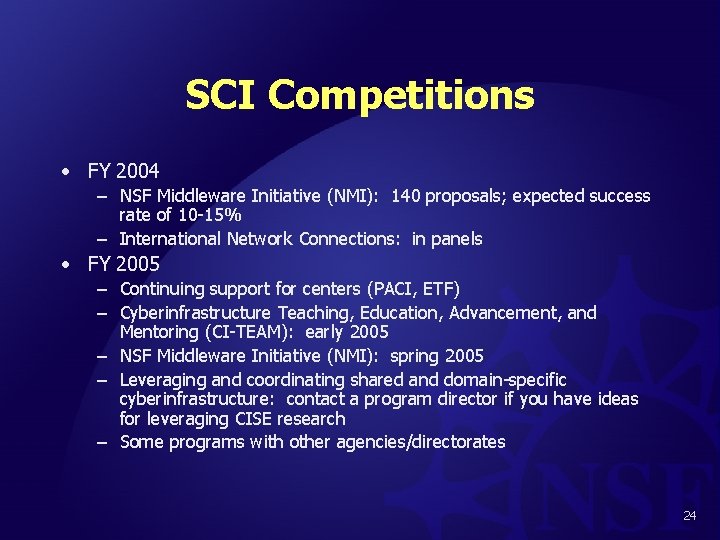
SCI Competitions • FY 2004 – NSF Middleware Initiative (NMI): 140 proposals; expected success rate of 10 -15% – International Network Connections: in panels • FY 2005 – Continuing support for centers (PACI, ETF) – Cyberinfrastructure Teaching, Education, Advancement, and Mentoring (CI-TEAM): early 2005 – NSF Middleware Initiative (NMI): spring 2005 – Leveraging and coordinating shared and domain-specific cyberinfrastructure: contact a program director if you have ideas for leveraging CISE research – Some programs with other agencies/directorates 24
Cross-Cutting Emphasis Areas • Characteristics – cuts across clusters and divisions – addresses scientific or national priority • FY 04 Emphasis Areas – Cyber Trust: 488 proposals – Science of Design: 182 proposals – Information Integration: 250 proposals • FY 2005 Emphasis Areas – – – Cyber Trust: January 2005 Science of Design: spring 2005 Information Integration: December 2004 Broadening Participation: late winter/early spring 2005 Possibly one more 25
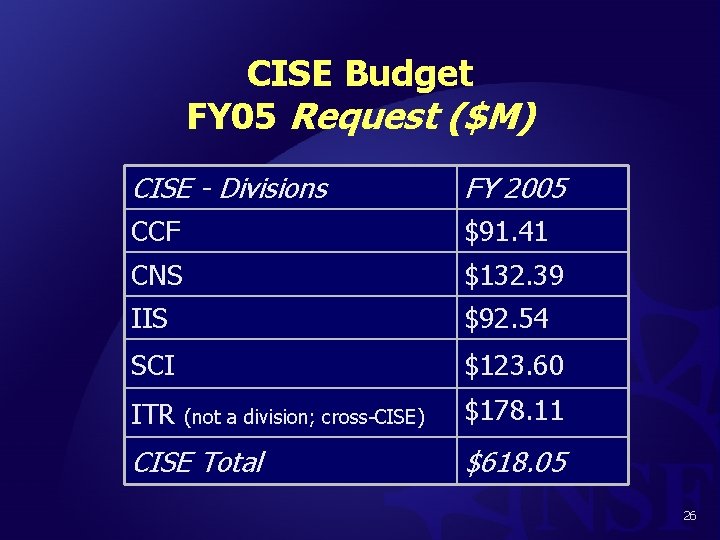
CISE Budget FY 05 Request ($M) CISE - Divisions FY 2005 CCF $91. 41 CNS $132. 39 IIS $92. 54 SCI $123. 60 ITR (not a division; cross-CISE) CISE Total $178. 11 $618. 05 26
Cyber Trust
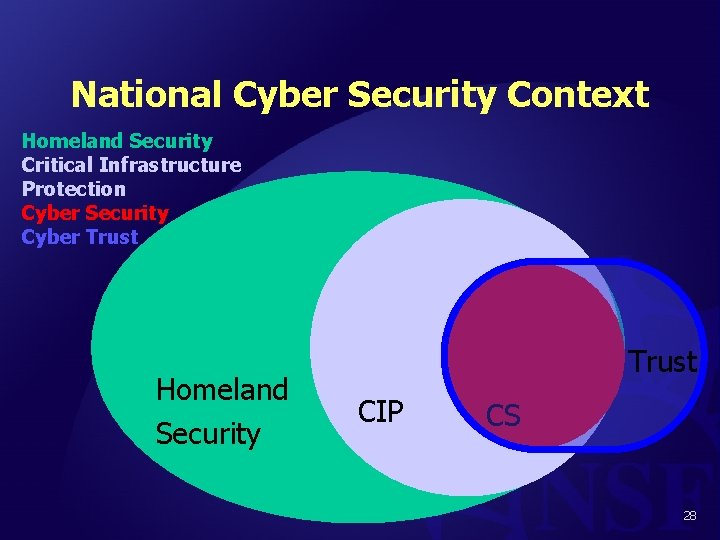
National Cyber Security Context Homeland Security Critical Infrastructure Protection Cyber Security Cyber Trust Homeland Security Trust CIP CS 28
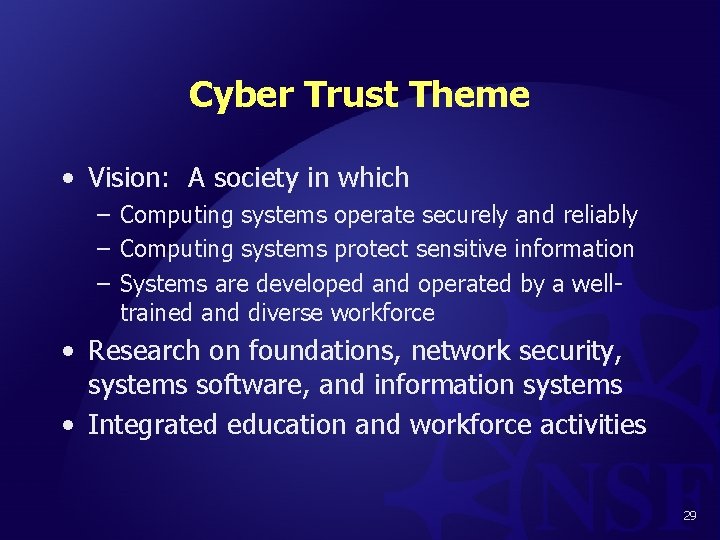
Cyber Trust Theme • Vision: A society in which – Computing systems operate securely and reliably – Computing systems protect sensitive information – Systems are developed and operated by a welltrained and diverse workforce • Research on foundations, network security, systems software, and information systems • Integrated education and workforce activities 29
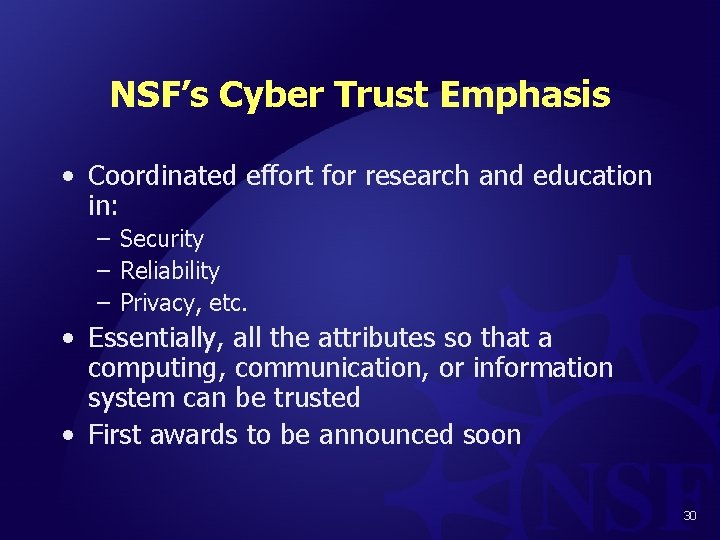
NSF’s Cyber Trust Emphasis • Coordinated effort for research and education in: – Security – Reliability – Privacy, etc. • Essentially, all the attributes so that a computing, communication, or information system can be trusted • First awards to be announced soon 30
Cyberinfrastructure
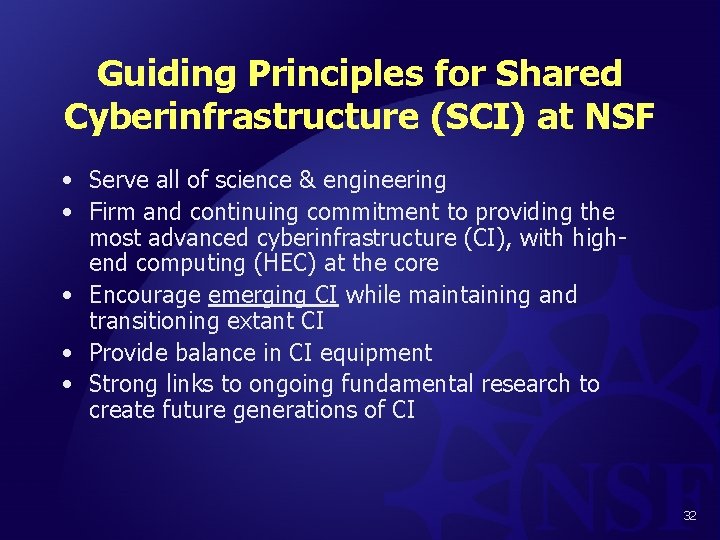
Guiding Principles for Shared Cyberinfrastructure (SCI) at NSF • Serve all of science & engineering • Firm and continuing commitment to providing the most advanced cyberinfrastructure (CI), with highend computing (HEC) at the core • Encourage emerging CI while maintaining and transitioning extant CI • Provide balance in CI equipment • Strong links to ongoing fundamental research to create future generations of CI 32
History of NSF CI Investments 33
Looking to the Future • Science frontiers as the drivers • Balance capability and capacity: – the Extensible Terascale Facility (ETF) • Emerging importance of data-intensive paradigms 34
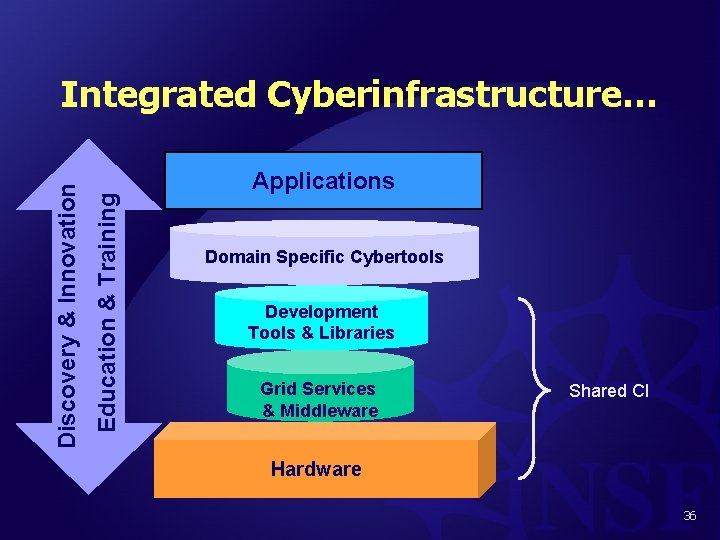
Cyberinfrastructure consists of: • Computational engines (supercomputers, clusters, workstations – capability and capacity) • Mass storage (disk drives, tapes, …) and persistence • Networking (including optical, wireless, ubiquitous) • Digital libraries/data bases • Sensors/effectors • Software (operating systems, middleware, domain specific tools/platforms for building applications) • Services (education, training, consulting, user assistance) All working together in an integrated fashion. 35
Education & Training Discovery & Innovation Integrated Cyberinfrastructure… Applications Domain Specific Cybertools Development Tools & Libraries Grid Services & Middleware Shared CI Hardware 36
Broadening Participation
Vision • A discipline in which – Graduates are well-prepared relative to a well-defined core of knowledge and are prepared for life-long learning – There are no under-represented groups – There is a strong and productive mix of domestic and foreign students – There is balance between demand supply • Educational institutions, government organizations, and private industry work together to achieve the vision • NSF’s role is seed efforts, model programs, dissemination, and research into success factors 38
Moving Forward • Increased staff and dollars in CISE focused on EWF action • Build on research results and encourage action • Help successful efforts mature • Focus new efforts on selected areas sequentially • Encourage computing community to participate in NSF-wide programs (ADVANCE, LS-AMP, etc. ) 39
Conclusion • NSF’s role is fundamental to all areas of our society the most basic future investment • Computer science and related disciplines are hugely important in their own right and essential to advancement in all areas of S&E • NSF and our field are facing unprecedented pressures that can only be overcome by concerted, cooperative action 40
41
Contact Information Dr. Peter A. Freeman NSF Assistant Director for CISE Phone: 703 -292 -8900 Email: pfreeman@nsf. gov Visit the NSF Web site at: www. nsf. gov 42
Former CISE Organization 43
CISE Reorganization: Drivers • Scientific: changes to the field – Current organization is essentially the same as in 1985 • Administrative: proposal pressure – Up 125% since 1997 (vs. 16% for NSF) • Financial: end of ITR – How to invest those funds 44
CISE Reorganization: Strategic Objectives • Realign divisions for coherence and to mirror the field • Cluster similar programs • Support cross-cutting themes • Build on success of ITR to invigorate the CISE core 45
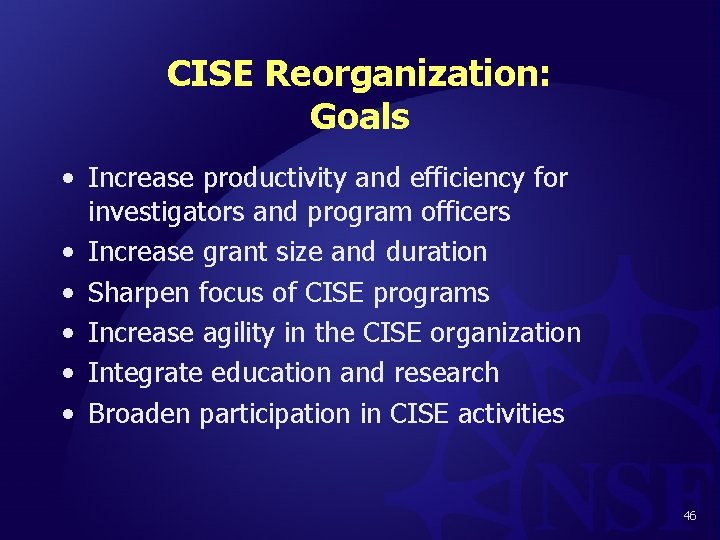
CISE Reorganization: Goals • Increase productivity and efficiency for investigators and program officers • Increase grant size and duration • Sharpen focus of CISE programs • Increase agility in the CISE organization • Integrate education and research • Broaden participation in CISE activities 46