
Strategic Computing and Communications Technolgy Course web page
Strategic Computing and Communications Technolgy • Course web page – http: //www. ischool. berkeley. edu/~hal/Courses/Strat. Tech 09 • Syllabus, schedule, lectures, readings – will be updated • Requirements – Individuals • Submit 4 relevant news items + 2 or 3 paragraph analysis of each over semester • Participate in class discussions – Group projects • I appoint mixed groups • Technology assessment presentations at end
Strategy Overview Hal R. Varian
What is strategy? • Definitions – “A course of action to achieve targets” – “A plan or method employed in order to achieve a goal or objective – In practice: often a checklist of things to pay attention to and watch out for • External and internal • Planning v strategic interaction
3 approaches to business strategy • Education – Michael Porter, Competitive Strategy • Executive – Jack Welch, Winning • Economics – Shapiro and Varian, Information Rules – Brandenberger and Nalebuff, Co-opetition – Dixit and Nalebuff, The Art of Strategy
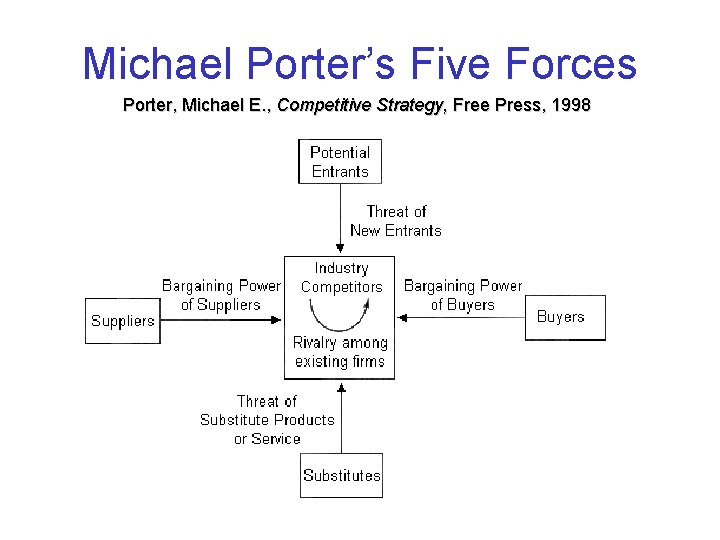
Michael Porter’s Five Forces Porter, Michael E. , Competitive Strategy, Free Press, 1998
Supplier power • Importance of costs – Impact of inputs on your product cost or design • Competitive environment – Supplier concentration, bargaining power – Presence of substitute inputs – Importance of volume to supplier – Switching costs of suppliers – Threat of forward integration
Barriers to entry • Costs – Absolute cost advantages – Economies of scale – Capital requirements • Scarcity – Access to distribution – Proprietary learning curve – Access to inputs (IP) – Proprietary products – Brand identity • Other – Customer switching costs – Expected retaliation (I. e. , capacity threat) – Government policy
Buyer power • Competitive environment – – – – – Buyer concentration Bargaining power Substitutes available Product differentiation Price sensitivity Buyers' switching costs Brand identity Buyer volume Threat of backward integration
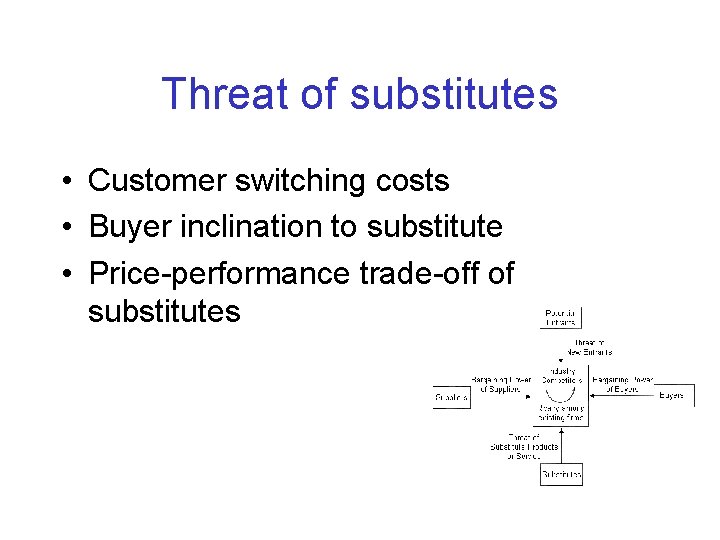
Threat of substitutes • Customer switching costs • Buyer inclination to substitute • Price-performance trade-off of substitutes
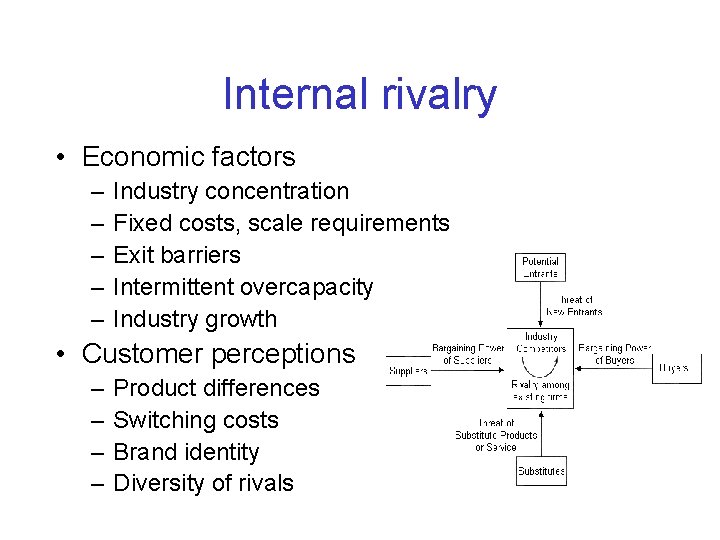
Internal rivalry • Economic factors – – – Industry concentration Fixed costs, scale requirements Exit barriers Intermittent overcapacity Industry growth • Customer perceptions – – Product differences Switching costs Brand identity Diversity of rivals
Critique of Porter • Product of its times (1980 s) – Relatively stable environment – Manufacturing model • Not a very clear taxonomy – Competitors: actual and potential? – Substitutes: internal or external? • Not much emphasis on technology and innovation
Jack Welch (ex-CEO of GE) • Winning, Harper Business 2005 • Three steps – Find a smart, realistic, fast way to gain substantial competitive advantage – Put the right people in the right place to drive this forward – Seek out best practices, adapt them, and continue to improve them • GE initiative: “Be No 1 or No 2 in each market and fix, sell, or close deal to be there. ” • 5 Slides
1. What playing field looks like • Who are your competitors? • What has what share globally and in each market? • Is your business a commodity or high value, long cycle or short, where on growth curve? What are drivers of profitability? • What are strengths and weaknesses of each competitor? How good are its products? How much does each one spend on R&D? How big is its sales force? • Who are your customers and how do they buy?
2. What the competition is doing? • What has each competitor done in past year to change the playing field? • Has anyone introduced game-changing new products, technologies, or new channel? • Are there new entrants, and what have they been doing?
3. What have you been doing? • What have you done to change the playing field? • Have you bought a company, introduced a new product, taken a competitor’s salesperson, licensed a new technology? • Have you lost competitive advantages you once had: a salesperson, special product, proprietary technology?
4. What’s around the corner? • What scares you the most in the year ahead? What could a competitor do to nail you? • What new products or technologies could your competitor launch that might change the game? • What mergers/acquisitions would knock you off your feet?
5. What is your winning move? • What can you do now to change the playing field? New acquisition, new product, new market? • What can you do to make customers stick to you?
Critique of Welch • Very action oriented, not so analytic – Good for CEO, not for industry analyst – Strategy and tactics intermingled – Doesn’t emphasize specific industry forces – Good meeting agenda, may not lead to deepest insights. . .
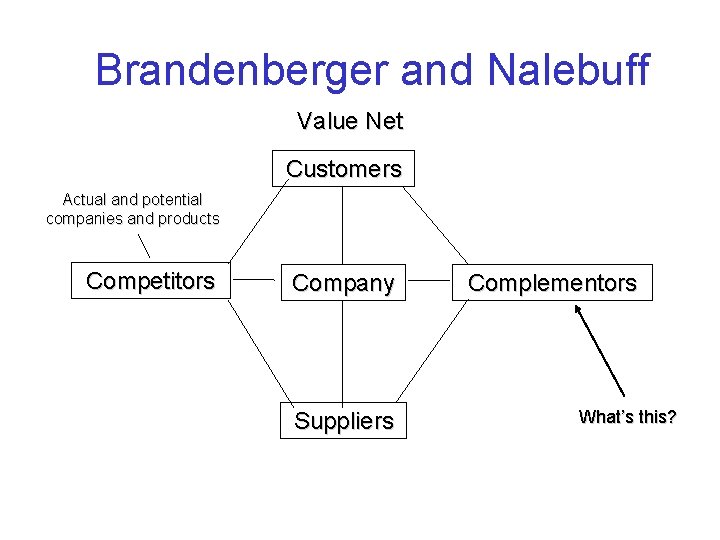
Brandenberger and Nalebuff Value Net Customers Actual and potential companies and products Competitors Company Suppliers Complementors What’s this?
Co-opetition and complements • Customers value entire system – Hardware+software, DVD player+disks • Sometimes you compete, sometimes you cooperate – Think of Intel and Microsoft, IBM and Oracle – Not a zero sum game! • Complementors can be critical to your business, particularly in technology
Google • • • Customers Competitors Complementors Suppliers [Users? ]
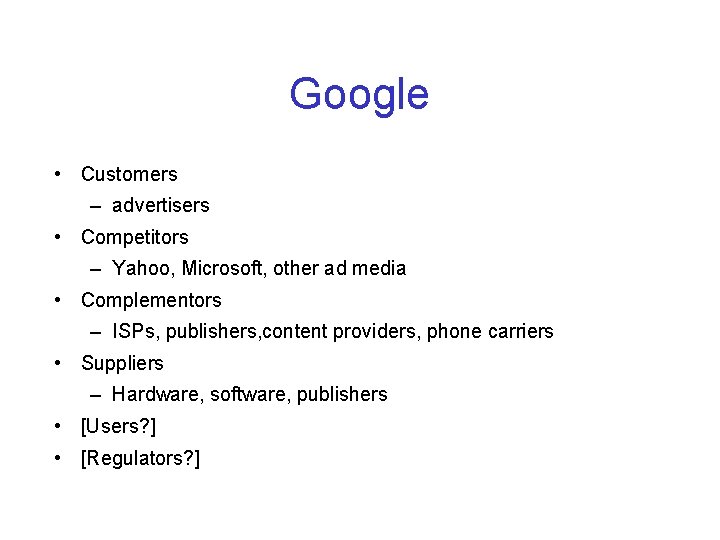
Google • Customers – advertisers • Competitors – Yahoo, Microsoft, other ad media • Complementors – ISPs, publishers, content providers, phone carriers • Suppliers – Hardware, software, publishers • [Users? ] • [Regulators? ]
Shapiro and Varian • Forces important for info tech industries – Differentiation of products and prices – Intellectual property (copyright + patents) – Switching costs and lock-in – Network effects – Standards and interconnection – Systems effects and complementors
Example: Apple Ipod story • • Price of songs (differentiation of prices) Competition (free songs, other players) Government policy (copyright) Complementors (players + content) Channel conflict (online + offline) Standardization (interoperability, DRM) New entrants (mobile phones)
- Slides: 24