
STRATEGIC COMPENSATION A Human Resource Management Approach Chapter

- Slides: 46
STRATEGIC COMPENSATION A Human Resource Management Approach Chapter 4: Incentive Pay Copyright © 2015 Pearson Education, Inc. 4 -1
Learning Objectives 1. Explain two reasons why companies use incentive pay. 2. Concisely provide a contrast between incentive pay methods and traditional pay methods. 3. List three categories of incentive pay plans. 4. Define individual incentive plans and give one example. Copyright © 2015 Pearson Education, Inc. 4 -2
Learning Objectives (cont’d) 5. Provide the definition group incentives and summarize two examples of group incentive plans. 6. Discuss the advantages and disadvantages of group incentive plans. 7. Offer a definition of company-wide incentive plans with an example. 8. List and summarize five factors in the design of incentive pay programs. Copyright © 2015 Pearson Education, Inc. 4 -3
Learning Objective 1 Explain two reasons why companies use incentive pay. Copyright © 2015 Pearson Education, Inc. 4 -4
Incentive Pay • Compensation fluctuates according to: – A preestablished formula – Individual or group goals – Company earnings • Adds to base pay • Controls costs • Motivates employees Copyright © 2015 Pearson Education, Inc. 4 -5
Incentive Pay Assumptions • Effective incentive pay systems are based on three assumptions: 1. Individual employees and work teams differ in how much they contribute to the company, both in what they do as well as in how well they do it. 2. The company’s overall performance depends to a large degree on the performance of individuals and groups within the company. Copyright © 2015 Pearson Education, Inc. 4 -6
Incentive Pay Assumptions (cont’d) 3. To attract, retain, and motivate high performers and to be fair to all employees, a company needs to reward employees on the basis of their relative performance. Copyright © 2015 Pearson Education, Inc. 4 -7
Learning Objective 2 Concisely provide a contrast between incentive pay methods and traditional pay methods. Copyright © 2015 Pearson Education, Inc. 4 -8
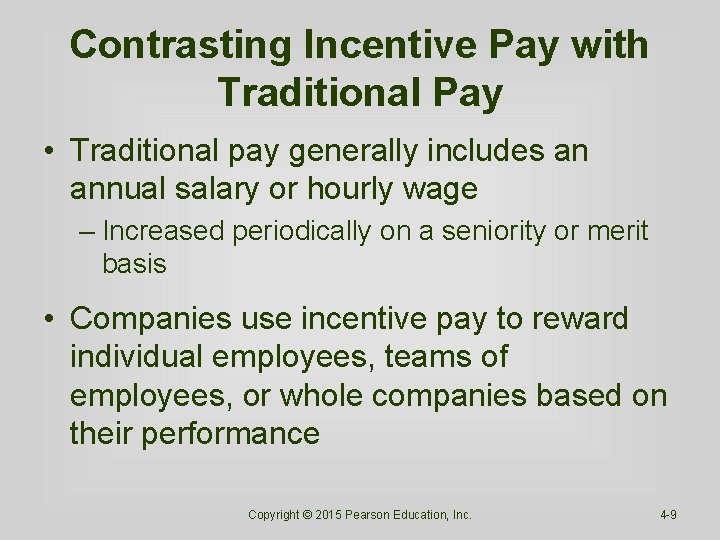
Contrasting Incentive Pay with Traditional Pay • Traditional pay generally includes an annual salary or hourly wage – Increased periodically on a seniority or merit basis • Companies use incentive pay to reward individual employees, teams of employees, or whole companies based on their performance Copyright © 2015 Pearson Education, Inc. 4 -9
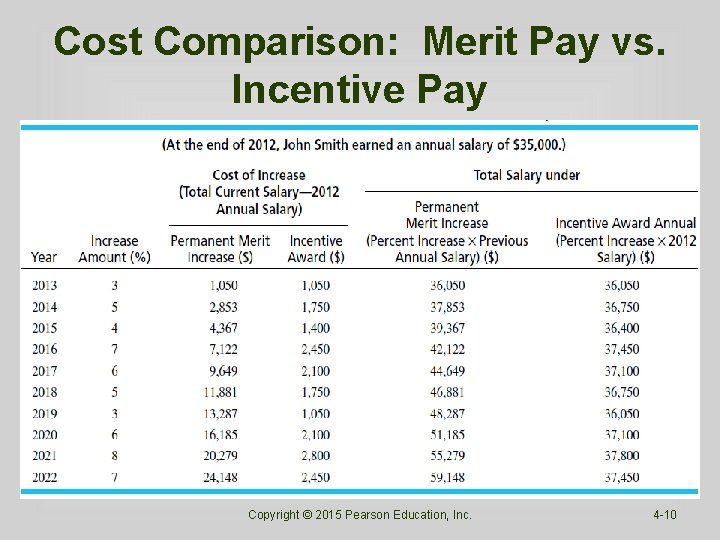
Cost Comparison: Merit Pay vs. Incentive Pay Copyright © 2015 Pearson Education, Inc. 4 -10
Learning Objective 3 List three categories of incentive pay plans. Copyright © 2015 Pearson Education, Inc. 4 -11
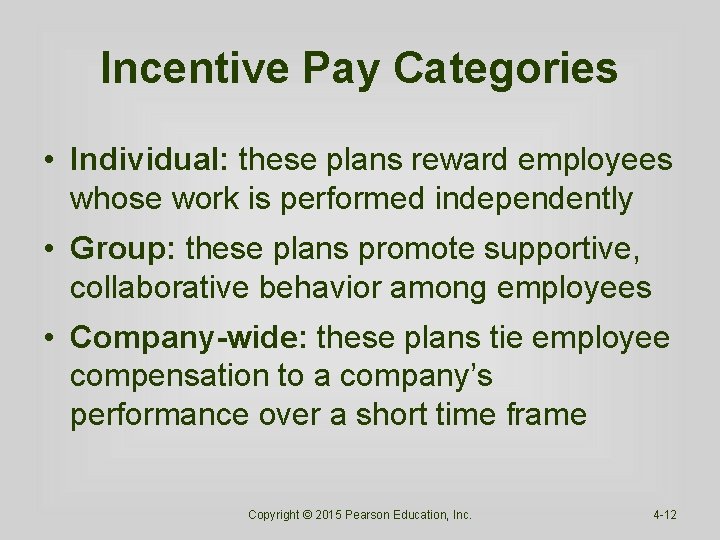
Incentive Pay Categories • Individual: these plans reward employees whose work is performed independently • Group: these plans promote supportive, collaborative behavior among employees • Company-wide: these plans tie employee compensation to a company’s performance over a short time frame Copyright © 2015 Pearson Education, Inc. 4 -12
Learning Objective 4 Define individual incentive plans and give one example. Copyright © 2015 Pearson Education, Inc. 4 -13
Individual Incentive Performance Measures • Quantity of work output • Quality of work output • Monthly sales • Work safety record • Work attendance Copyright © 2015 Pearson Education, Inc. 4 -14
Types of Individual Incentive Plans • Piecework plans: reward workers for every item produced over a designated production standard • Management incentive plans: award bonuses to managers when they meet or exceed objectives based on sales, profit, production, or other measures for their division Copyright © 2015 Pearson Education, Inc. 4 -15
Types of Individual Incentive Plans (cont’d) • Behavior encouragement plans: employees receive payments for specific behavioral accomplishments • Referral plans: employees receive bonuses for recruitment of highly qualified employees Copyright © 2015 Pearson Education, Inc. 4 -16
Piecework Plans • Awards based on individual production vs. objective standards • Awards based on individual performance standards using objective and subjective criteria • Quantity and/or quality goals Copyright © 2015 Pearson Education, Inc. 4 -17
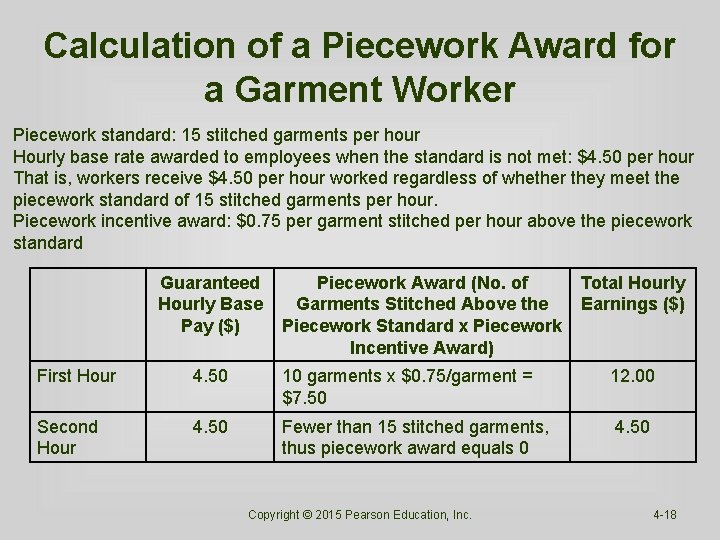
Calculation of a Piecework Award for a Garment Worker Piecework standard: 15 stitched garments per hour Hourly base rate awarded to employees when the standard is not met: $4. 50 per hour That is, workers receive $4. 50 per hour worked regardless of whether they meet the piecework standard of 15 stitched garments per hour. Piecework incentive award: $0. 75 per garment stitched per hour above the piecework standard Guaranteed Hourly Base Pay ($) Piecework Award (No. of Garments Stitched Above the Piecework Standard x Piecework Incentive Award) Total Hourly Earnings ($) First Hour 4. 50 10 garments x $0. 75/garment = $7. 50 12. 00 Second Hour 4. 50 Fewer than 15 stitched garments, thus piecework award equals 0 4. 50 Copyright © 2015 Pearson Education, Inc. 4 -18
Individual Incentive Plan Advantages • Helps relate pay to performance • Promotes equitable distribution of compensation • Helps retain best performers • Compatible with America’s individualistic culture Copyright © 2015 Pearson Education, Inc. 4 -19
Individual Incentive Plan Disadvantages • May promote inflexibility • Unrealistic standards may hamper employee motivation • Setting performance standards is time consuming • Factors beyond employee’s control may affect outcomes • May promote undesirable behaviors Copyright © 2015 Pearson Education, Inc. 4 -20
Learning Objective 5 Provide the definition group incentives and summarize two examples of group incentive plans. Copyright © 2015 Pearson Education, Inc. 4 -21
Group Incentive Plans • Reward employees for their collective performance • Use has increased in industry • Two types: – Team based or small group – Gain sharing Copyright © 2015 Pearson Education, Inc. 4 -22
Group Incentive Performance Measures • Customer satisfaction • Labor cost savings • Materials cost savings • Reduction in accidents • Services cost savings Copyright © 2015 Pearson Education, Inc. 4 -23
Types of Teams for Team Incentive Plans • Work (process) teams: refer to organizational units that perform the work of the organization on an ongoing basis – Ex: customer service teams, assembly teams on production lines • Project teams: consist of a group of people assigned to complete a one-time project – Ex: a team of engineers working on the construction of a bridge • Parallel teams (task forces): include employees assigned to work on a specific task in addition to normal work duties Copyright © 2015 Pearson Education, Inc. 4 -24
Rewards Allocation Methods • Equal incentive payments • Differential payments based on contribution to goals • Differential payments according to base pay Copyright © 2015 Pearson Education, Inc. 4 -25
Gain Sharing • Incentives based on company performance in – Increased productivity – Increased customer satisfaction – Lower costs – Better safety records • Based on open leadership • Involves employee participation • Includes bonuses Copyright © 2015 Pearson Education, Inc. 4 -26
Gain Sharing Programs • Most gain sharing programs have three components 1. Leadership philosophy 2. Employee involvement systems 3. Bonuses Copyright © 2015 Pearson Education, Inc. 4 -27
Gain Sharing Plans Three common forms • Scanlon plan • Rucker plan • Improshare Copyright © 2015 Pearson Education, Inc. 4 -28
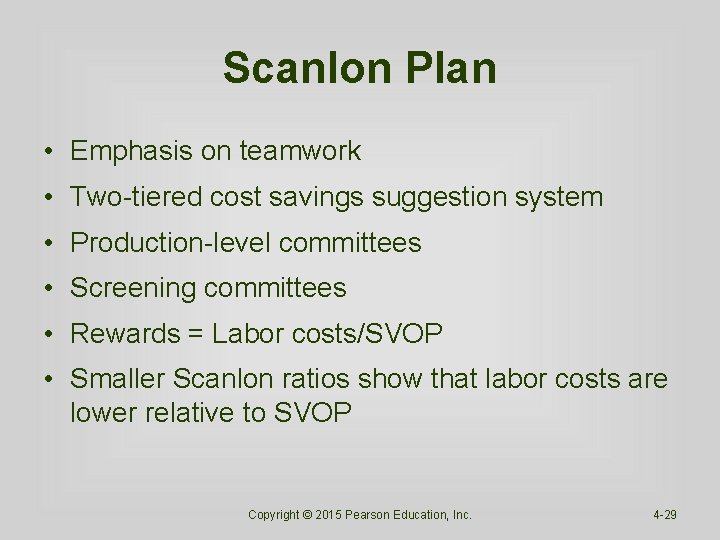
Scanlon Plan • Emphasis on teamwork • Two-tiered cost savings suggestion system • Production-level committees • Screening committees • Rewards = Labor costs/SVOP • Smaller Scanlon ratios show that labor costs are lower relative to SVOP Copyright © 2015 Pearson Education, Inc. 4 -29
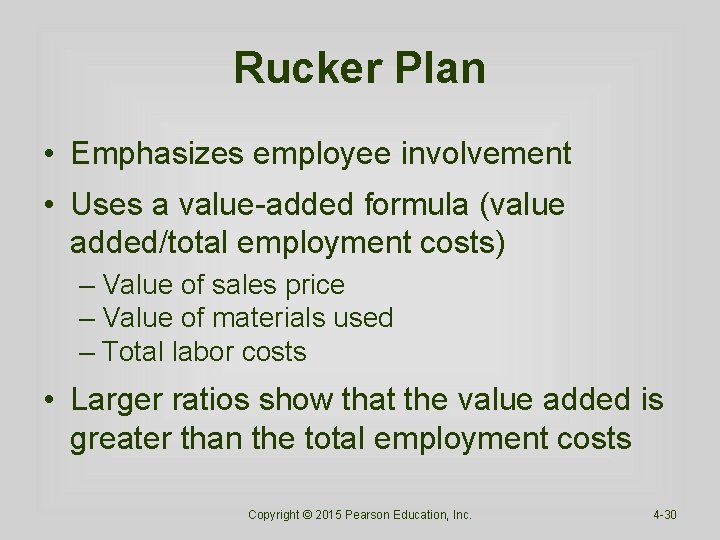
Rucker Plan • Emphasizes employee involvement • Uses a value-added formula (value added/total employment costs) – Value of sales price – Value of materials used – Total labor costs • Larger ratios show that the value added is greater than the total employment costs Copyright © 2015 Pearson Education, Inc. 4 -30
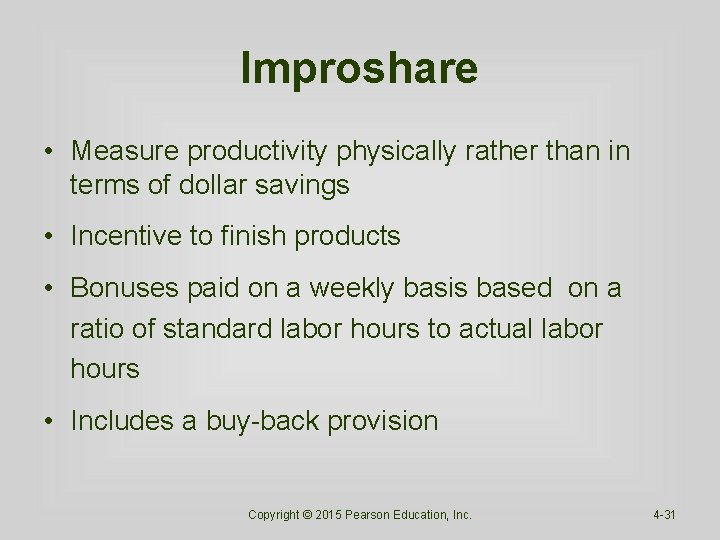
Improshare • Measure productivity physically rather than in terms of dollar savings • Incentive to finish products • Bonuses paid on a weekly basis based on a ratio of standard labor hours to actual labor hours • Includes a buy-back provision Copyright © 2015 Pearson Education, Inc. 4 -31
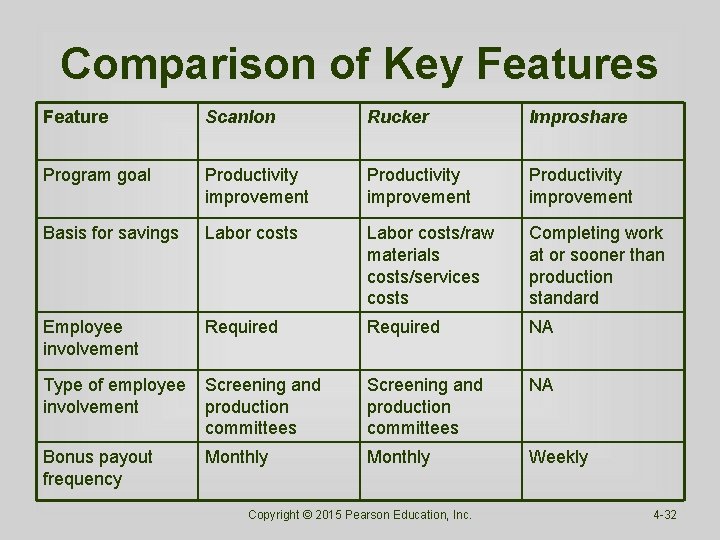
Comparison of Key Features Feature Scanlon Rucker Improshare Program goal Productivity improvement Basis for savings Labor costs/raw materials costs/services costs Completing work at or sooner than production standard Employee involvement Required NA Type of employee involvement Screening and production committees NA Bonus payout frequency Monthly Weekly Copyright © 2015 Pearson Education, Inc. 4 -32
Learning Objective 6 Discuss the advantages and disadvantages of group incentive plans. Copyright © 2015 Pearson Education, Inc. 4 -33
Advantages of Group Incentives • Companies can more easily develop performance measures for group plans than individual plans • Greater group cohesion Copyright © 2015 Pearson Education, Inc. 4 -34
Disadvantages of Group Incentives • May lead to higher employee turnover because of the free-rider effect • Members may feel uncomfortable with the fact that other members’ performance influences their compensation level Copyright © 2015 Pearson Education, Inc. 4 -35
Learning Objective 7 Offer a definition of company-wide incentive plans with an example. Copyright © 2015 Pearson Education, Inc. 4 -36
Company-Wide Incentive Plans • Rewards employees when company meets performance standards • Two types – Profit sharing plans – Employee stock options Copyright © 2015 Pearson Education, Inc. 4 -37
Company-Wide Performance Measures • Company profits • Cost attainment • Market share • Sales revenue Copyright © 2015 Pearson Education, Inc. 4 -38
Profit-Sharing Plans • Current profit-sharing plans – Award cash to employees typically on a quarterly or annual basis • Deferred profit-sharing plans – Place cash awards in trust accounts for employees Copyright © 2015 Pearson Education, Inc. 4 -39
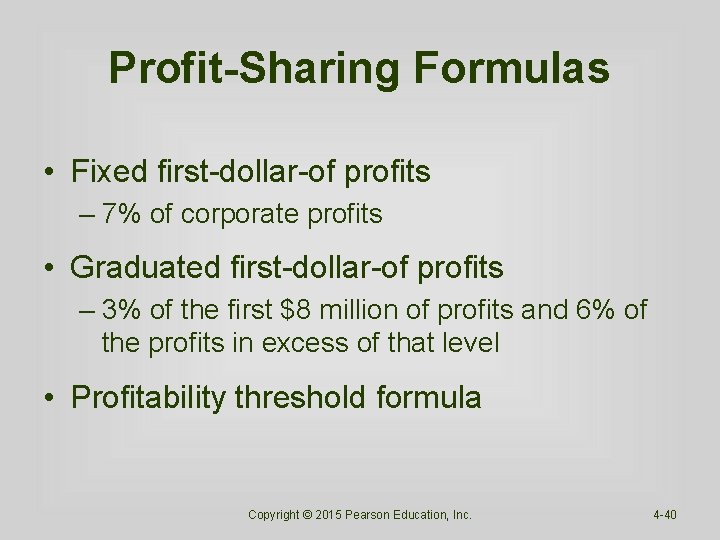
Profit-Sharing Formulas • Fixed first-dollar-of profits – 7% of corporate profits • Graduated first-dollar-of profits – 3% of the first $8 million of profits and 6% of the profits in excess of that level • Profitability threshold formula Copyright © 2015 Pearson Education, Inc. 4 -40
Distribution Methods • Equal payments • Proportional payments based on annual salary • Proportional payments based on contribution to profits Copyright © 2015 Pearson Education, Inc. 4 -41
Advantages and Disadvantages of Profit-Sharing Plans Advantages • Enable employees to share in companies’ profits • Allow companies greater financial flexibility Disadvantages • Can undermine the economic security of employees • May fail to motivate employees if they do not see a direct link between their efforts and corporate profits Copyright © 2015 Pearson Education, Inc. 4 -42
Employee Stock Option Plans Companies grant employees right to purchase share of company • Company stock shares • Stock options Copyright © 2015 Pearson Education, Inc. 4 -43
Learning Objective 8 List and summarize five factors in the design of incentive pay program. Copyright © 2015 Pearson Education, Inc. 4 -44
Incentive Pay Considerations • Based on individual or group performance? • Acceptable level of risk? • Replace traditional pay? • Performance criteria evaluated? • Appropriate time horizon? Copyright © 2015 Pearson Education, Inc. 4 -45
All rights reserved. No part of this publication may be reproduced, stored in a retrieval system, or transmitted, in any form or by any means, electronic, mechanical, photocopying, recording, or otherwise, without the prior written permission of the publisher. Printed in the United States of America. Copyright © 2015 Pearson Education, Inc. 4 -46