
Strategic Commitment and Competition Strategic Moves A strategic

- Slides: 25
Strategic Commitment and Competition
Strategic Moves A strategic move is designed to alter the beliefs and actions of others in a direction favorable to yourself. 2
Classification of strategic Moves • Strategic commitments – decisions that have long-term impacts and are difficult to reverse • Threats • Promises 3
Strategic Commitments In 1982 … Should Philips build a disk-pressing plant to supply CDs to the American market, or should it delay its decision a year or so, until the commercial appeal of the CD market became more certain? 4
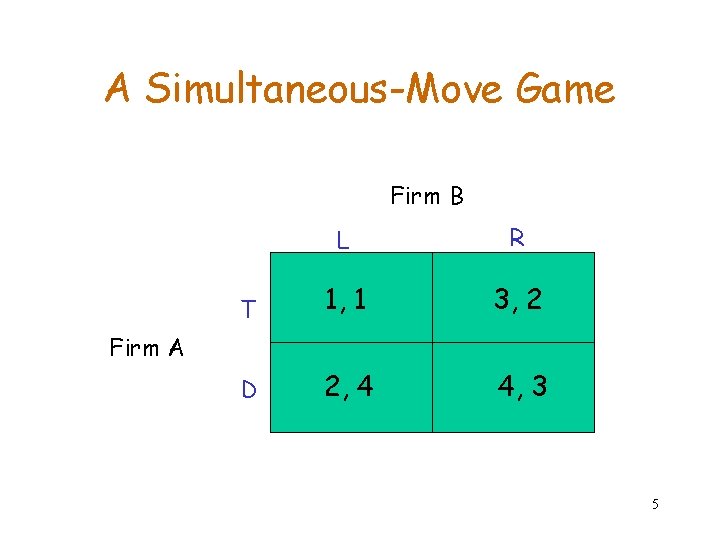
A Simultaneous-Move Game Firm B L R T 1, 1 3, 2 D 2, 4 4, 3 Firm A 5
A Sequential-Move Game B A L T R D L B R (1, 1) (3, 2) (2, 4) (4, 3) 6
Credible Commitments must be • observable and understandable • irreversible (i. e. credible) 7
Threats and Promises Threats and promises are response rules: your actual future action is conditioned on what the other players do, but your freedom of future action is constrained to following the stated rule. 8
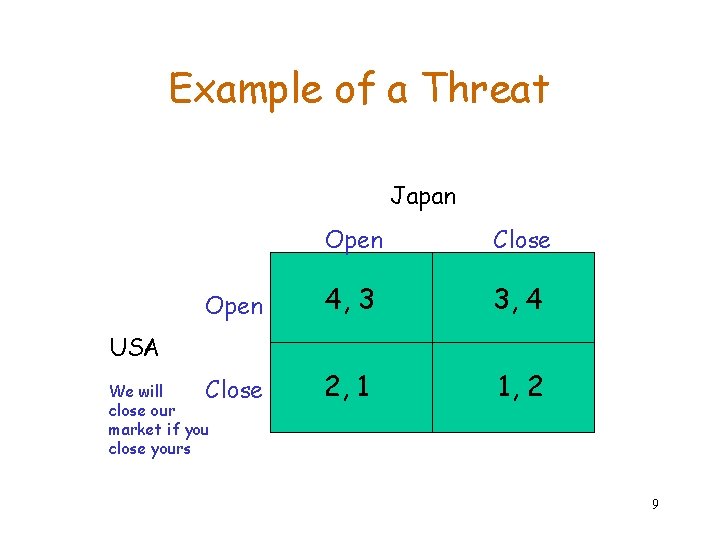
Example of a Threat Japan Open Close 4, 3 3, 4 2, 1 1, 2 USA We will Close close our market if you close yours 9
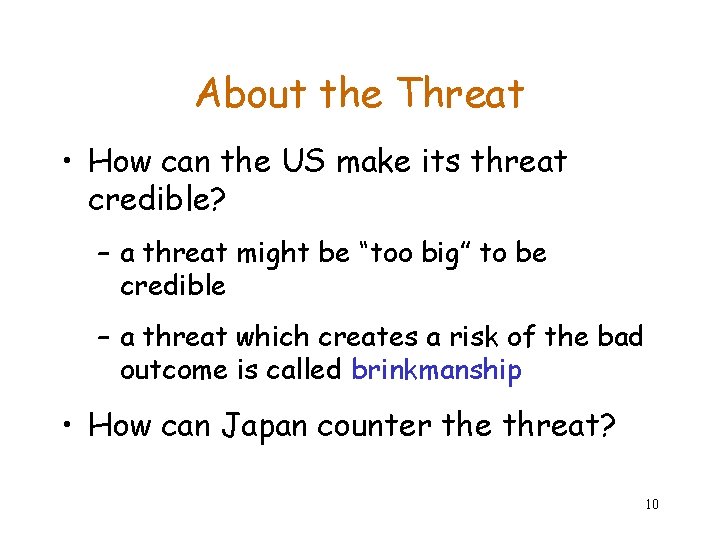
About the Threat • How can the US make its threat credible? – a threat might be “too big” to be credible – a threat which creates a risk of the bad outcome is called brinkmanship • How can Japan counter the threat? 10
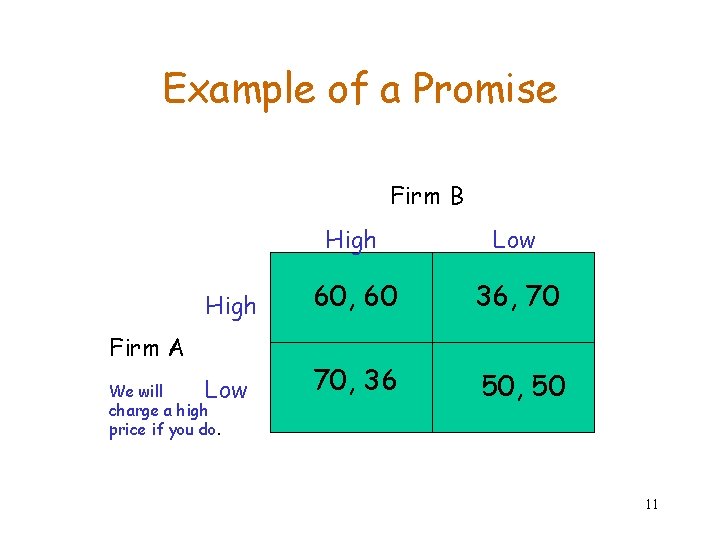
Example of a Promise Firm B High Firm A We will Low charge a high price if you do. High Low 60, 60 36, 70 70, 36 50, 50 11
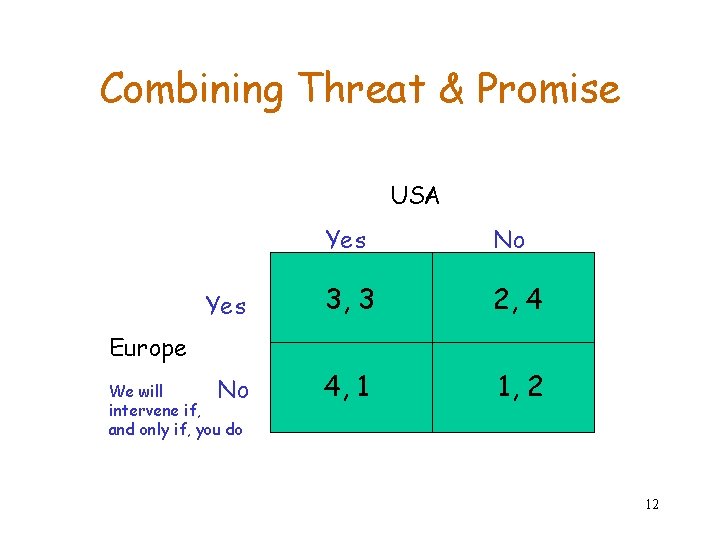
Combining Threat & Promise USA Yes No 3, 3 2, 4 4, 1 1, 2 Europe We will No intervene if, and only if, you do 12
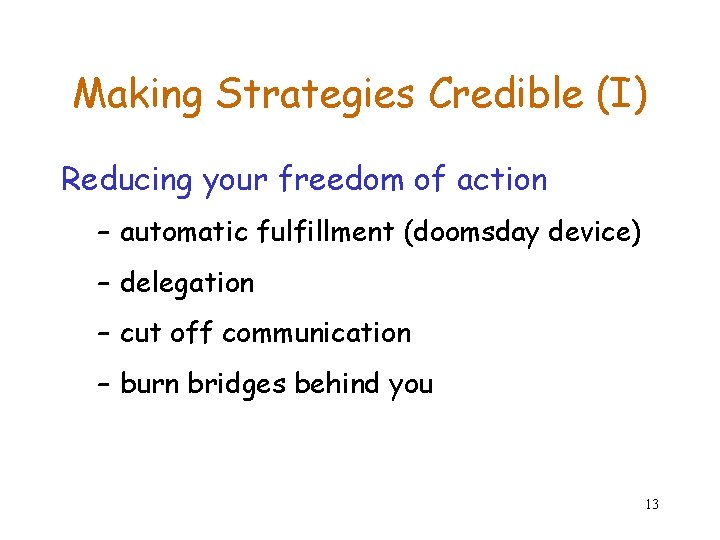
Making Strategies Credible (I) Reducing your freedom of action – automatic fulfillment (doomsday device) – delegation – cut off communication – burn bridges behind you 13
Making Strategies Credible (II) Changing your payoffs – – – establish and use a reputation divide the game into small steps contracts teamwork irrationality brinkmanship 14
Countering the opponent’s Strategic Movies • • Irrationality Cutting off communication Leave escape routes open Undermining your opponent’s motive to uphold his reputation • Salami Tactics 15
Case of Thin-Slab Casting Background. . . • Continuous casting for producing sheet steel is not very efficient because of the need to reheat the slabs before rolling them into thin sheets. • Thin-slab casting could save costs 16
Nucor and USX In 1987, Nucor became the first U. S. adopter of thin-slab casting. At that time, Nucor was looking for a way to enter the flat-rolled sheet segment of the steel business, which had been unavailable to the so called minimills such as Nucor. 17
Nucor and USX (cont. ) USX, the largest U. S. integrated steel producer and a company 60 times as large as Nucor, eventually decided not to adopt thin-slab casting. 18
Who adopts first? Decision-theoretic analysis predicts earlier adoption by an entrants – cannibalization or replacement effect – the innovation reduces capital costs more than operating costs 19
Incumbent Adopt First? Game-theoretic analysis predicts that an incumbent may adopt process innovations more quickly – the business-stealing effect may outweigh the cannibalization or replacement effect. 20
Adoption of Thin-slab Casting • The decision-theoretic analysis predicts “correctly” what actually happened in thin-slab casting. • However, the decision-theoretic approach ignores interactive considerations. 21
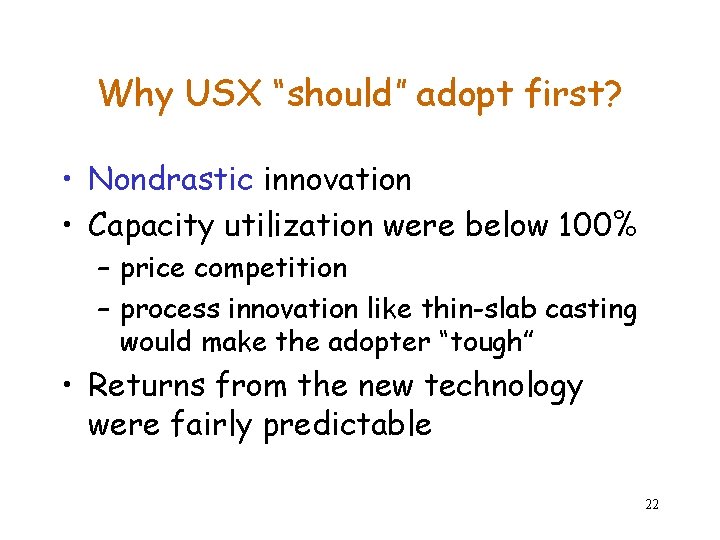
Why USX “should” adopt first? • Nondrastic innovation • Capacity utilization were below 100% – price competition – process innovation like thin-slab casting would make the adopter “tough” • Returns from the new technology were fairly predictable 22
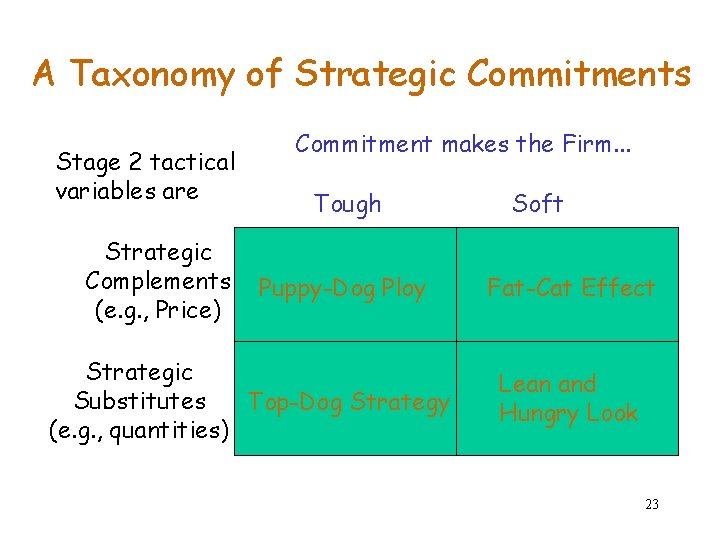
A Taxonomy of Strategic Commitments Stage 2 tactical variables are Strategic Complements (e. g. , Price) Commitment makes the Firm. . . Tough Puppy-Dog Ploy Strategic Substitutes Top-Dog Strategy (e. g. , quantities) Soft Fat-Cat Effect Lean and Hungry Look 23
Why didn’t USX adopt? The decision, argues Ghemawat, stemmed from prior organizational and strategic commitments that constrained USX’s opportunity to profit from thin-slab casting. 24
Comment In forecasting the likely reactions of competitors to major strategic commitments, a firm should recognize that prior commitments made by its competitors can constrain their potential responses. 25