
Strategic challenges in Indias water management Presented to

- Slides: 34
Strategic challenges in India’s water management Presented to Green Business Council, Federation of Indian Chambers of Commerce and Industry, Hyderabad, 17 June 2004.
Strategic Challenges in India’s Water Management Christopher Scott International Water Management Institute www. iwmi. org
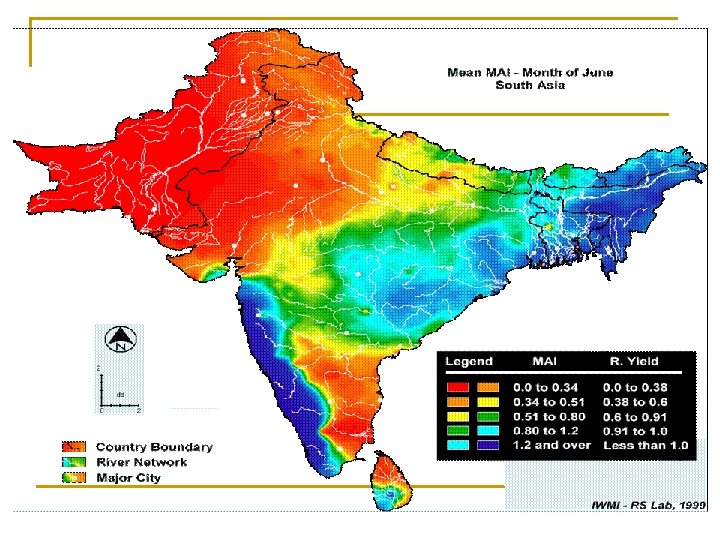
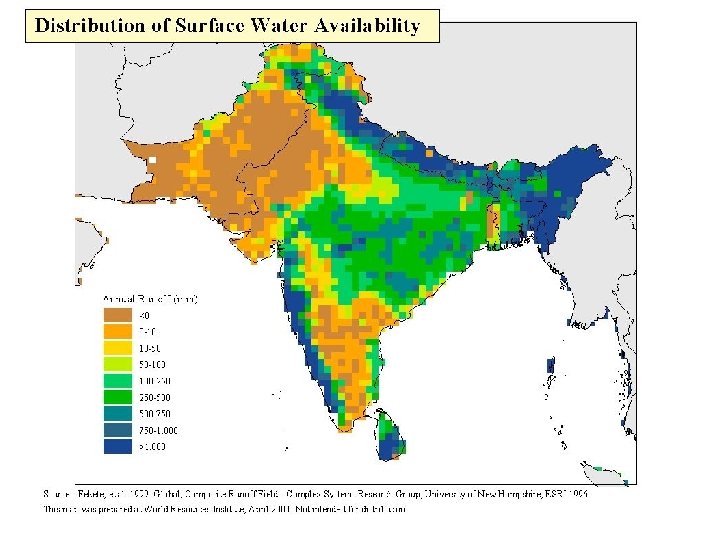
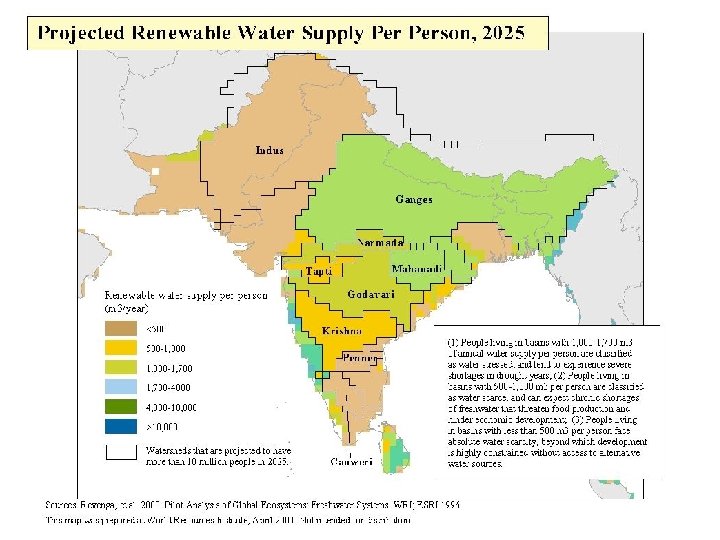
Absolute Water Scarcity: India’s Upcoming Challenge 3/4 th of India, Pakistan, West Asia, North Africa and North China will be in the throes of absolute water scarcity over the coming 25 years Low rainfall/capita is the crux; 80% of it falls in less than 100 hours; storing it for 8 months in a climate of high mean temperatures, high windspeeds and low stream density is the challenge.
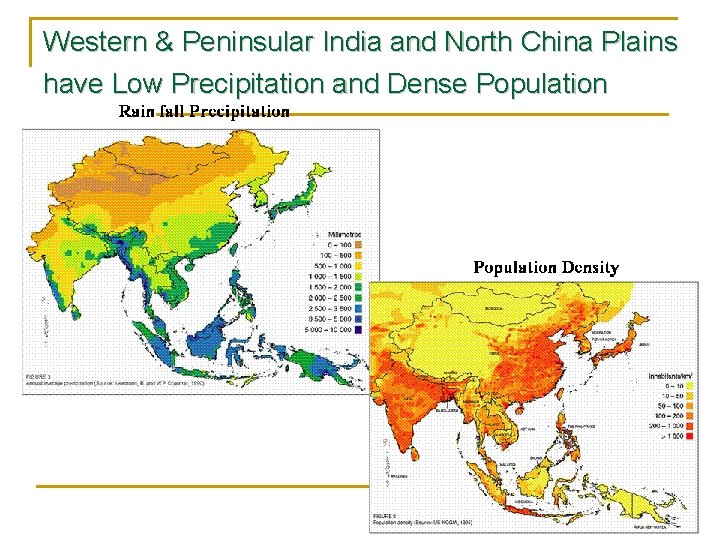
Western & Peninsular India and North China Plains have Low Precipitation and Dense Population
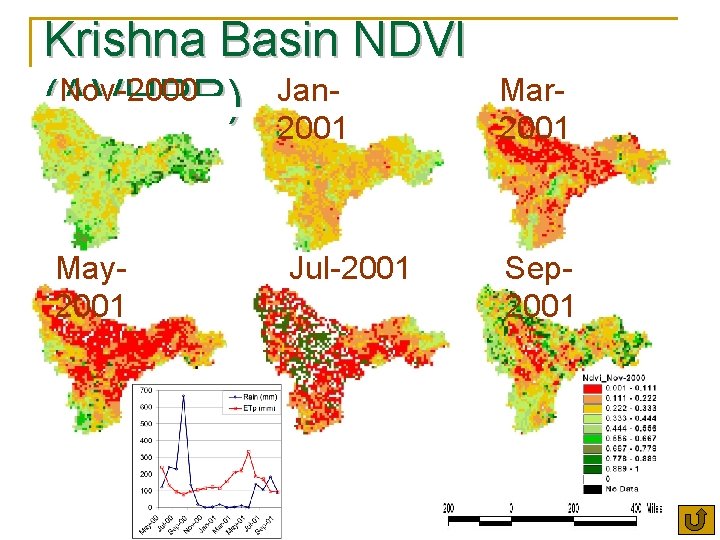
Krishna Basin NDVI Nov-2000 Jan(AVHRR) 2001 May 2001 Jul-2001 Mar 2001 Sep 2001
Drivers of India’s Water Future 2025 Population Growth n Urbanization n Economic Growth n Agrarian growth and food production n Technology-trade factors Plus. . New approaches, mindsets, Institutions and policies n
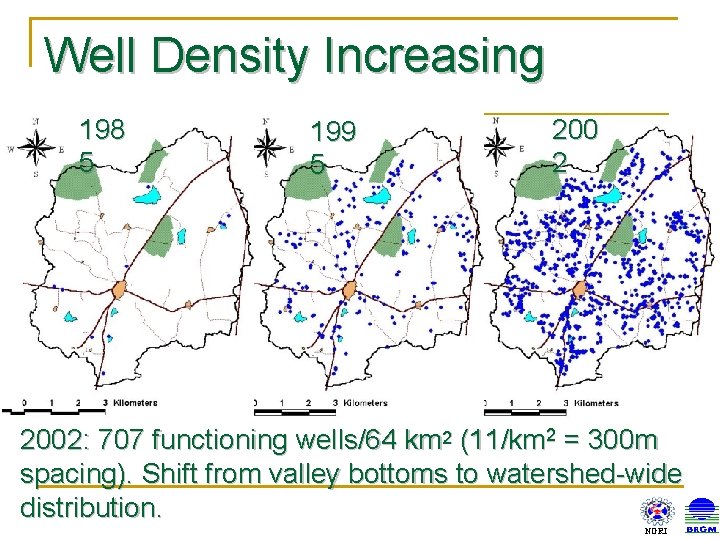
Well Density Increasing 198 5 199 5 200 2 2002: 707 functioning wells/64 km 2 (11/km 2 = 300 m spacing). Shift from valley bottoms to watershed-wide distribution. NGRI
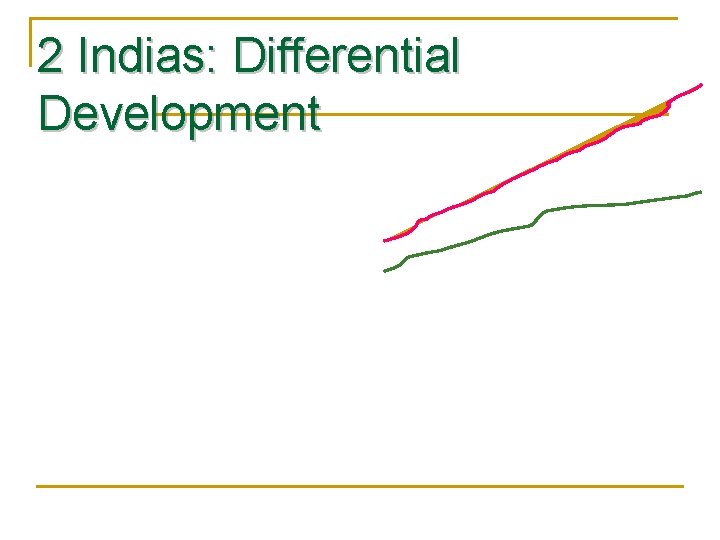
2 Indias: Differential Development
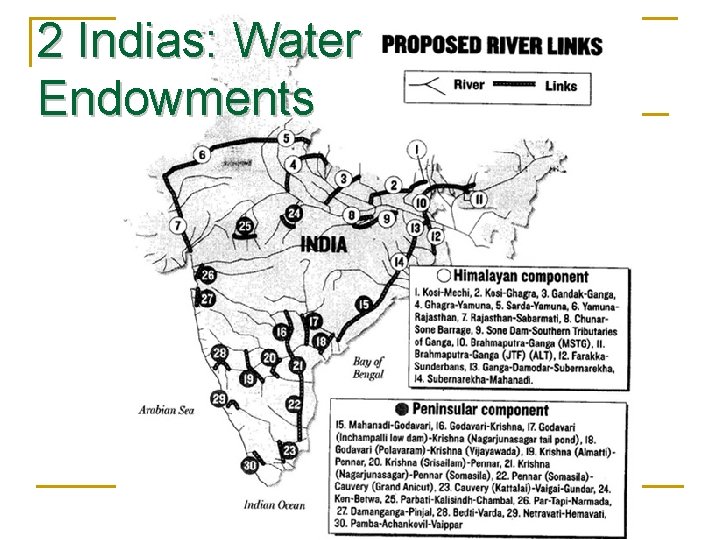
2 Indias: Water Endowments
Repast of the Water Sector n India has been a ‘hydraulic society’ for millennia Indus civilization q Tank-based empires q British era q Modern India, since Independence: q n n Over Rs. 1, 000 crore invested in dams and canals Rs. 24, 000 crore per annum in power supply to agriculture
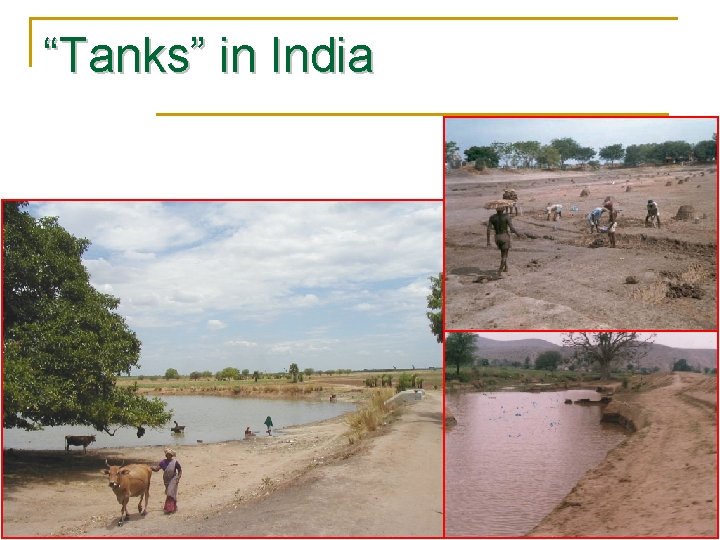
“Tanks” in India
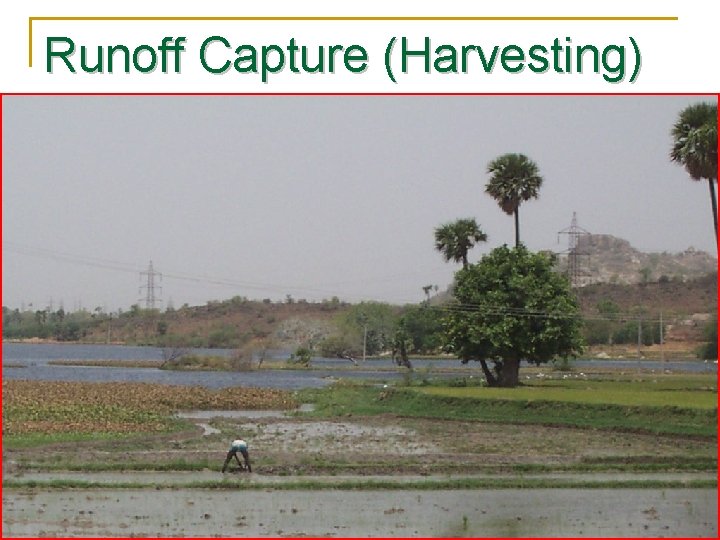
Runoff Capture (Harvesting)
Lower Krishna River Gauge Flow
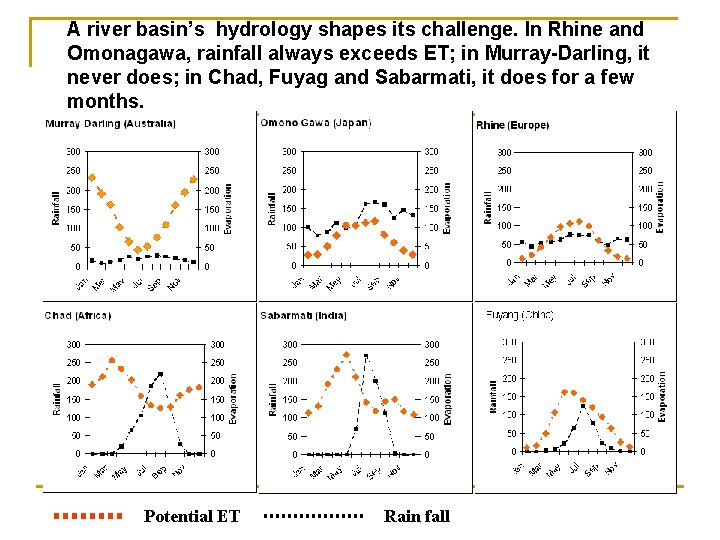
A river basin’s hydrology shapes its challenge. In Rhine and Omonagawa, rainfall always exceeds ET; in Murray-Darling, it never does; in Chad, Fuyag and Sabarmati, it does for a few months. Potential ET Rain fall
Global Groundwater Use
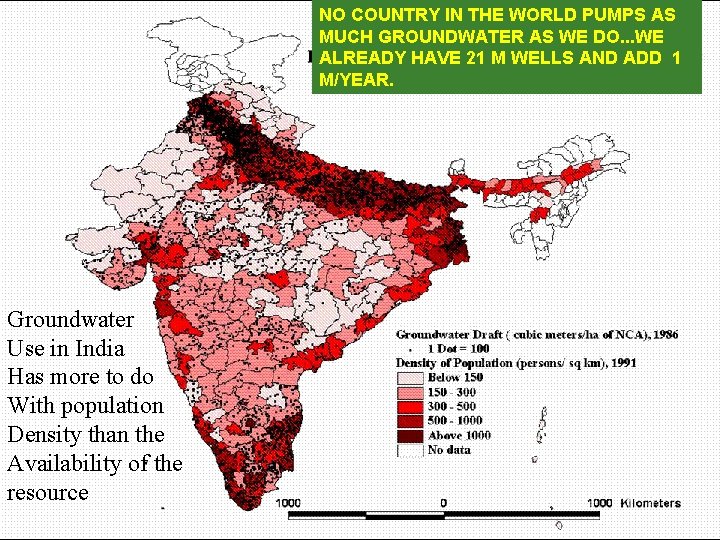
NO COUNTRY IN THE WORLD PUMPS AS MUCH GROUNDWATER AS WE DO. . . WE ALREADY HAVE 21 M WELLS AND ADD 1 M/YEAR. Groundwater Use in India Has more to do With population Density than the Availability of the resource
At current rate, Groundwater use will Ease out all other Sources of water. . This indicates the Failure of public Systems. . It will also redefine India’s water challenge
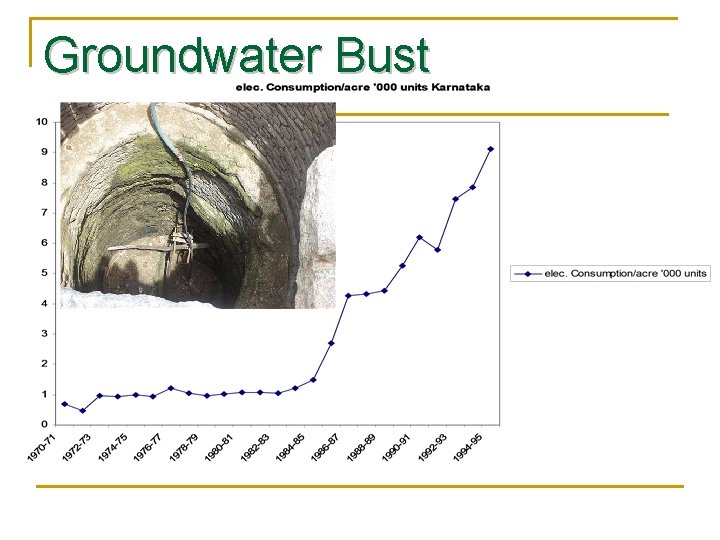
Groundwater Bust
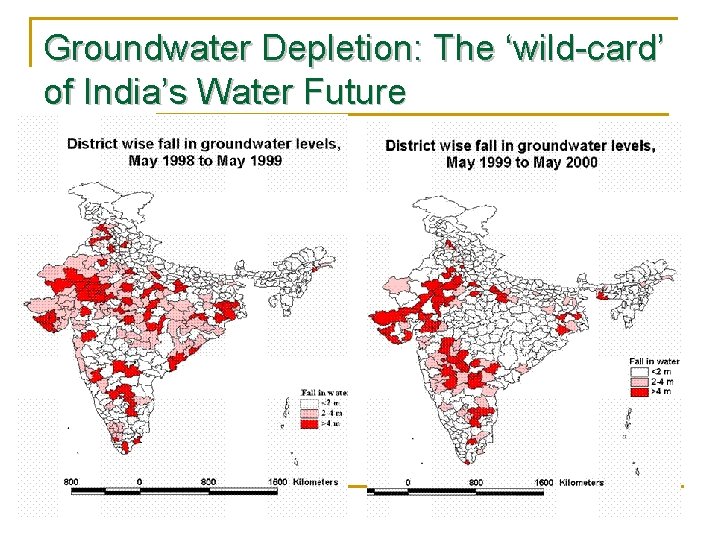
Groundwater Depletion: The ‘wild-card’ of India’s Water Future
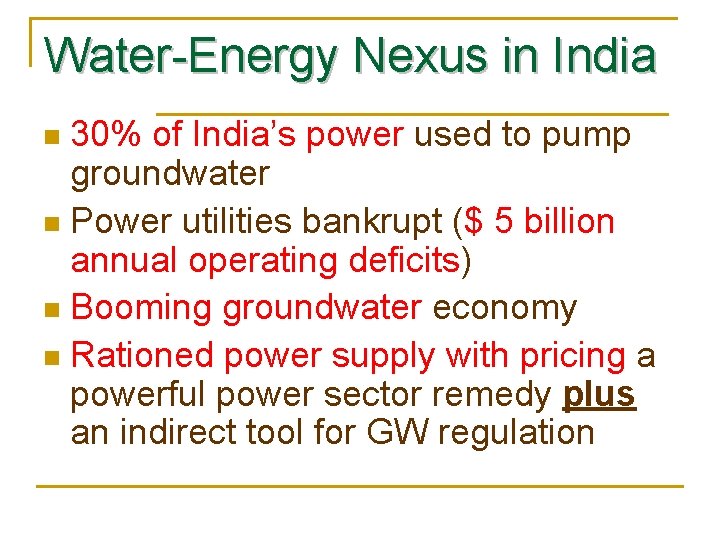
Water-Energy Nexus in India 30% of India’s power used to pump groundwater n Power utilities bankrupt ($ 5 billion annual operating deficits) n Booming groundwater economy n Rationed power supply with pricing a powerful power sector remedy plus an indirect tool for GW regulation n
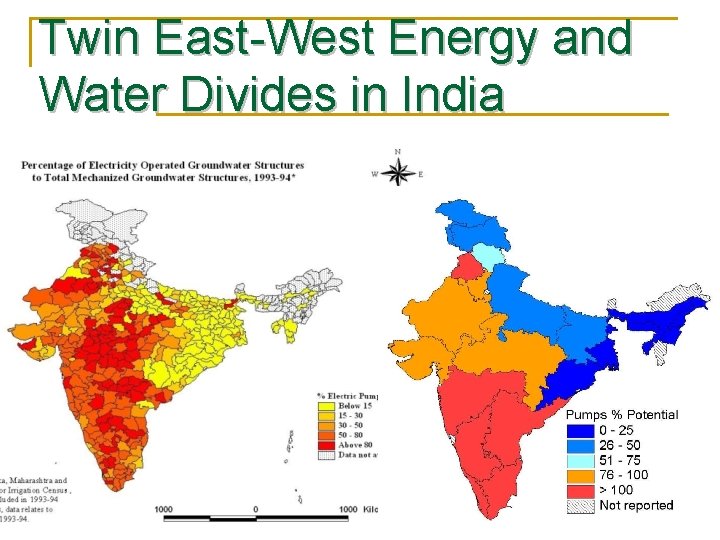
Twin East-West Energy and Water Divides in India
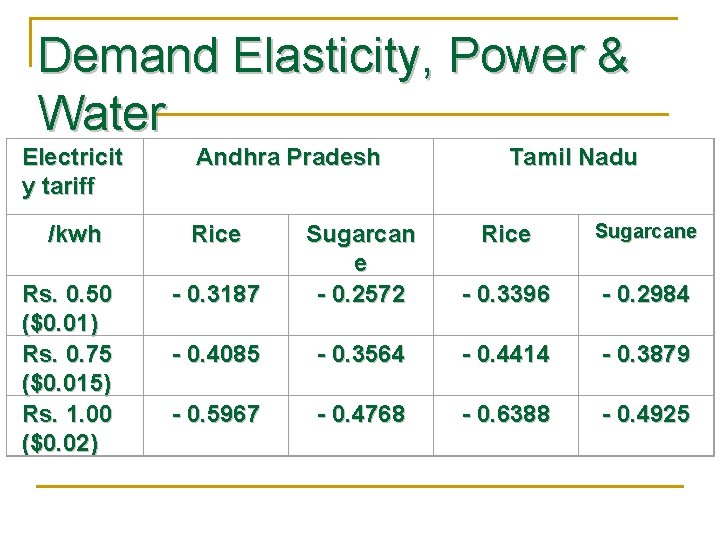
Demand Elasticity, Power & Water Electricit y tariff /kwh Rs. 0. 50 ($0. 01) Rs. 0. 75 ($0. 015) Rs. 1. 00 ($0. 02) Andhra Pradesh Tamil Nadu Rice Sugarcane - 0. 3187 Sugarcan e - 0. 2572 - 0. 3396 - 0. 2984 - 0. 4085 - 0. 3564 - 0. 4414 - 0. 3879 - 0. 5967 - 0. 4768 - 0. 6388 - 0. 4925 Rice
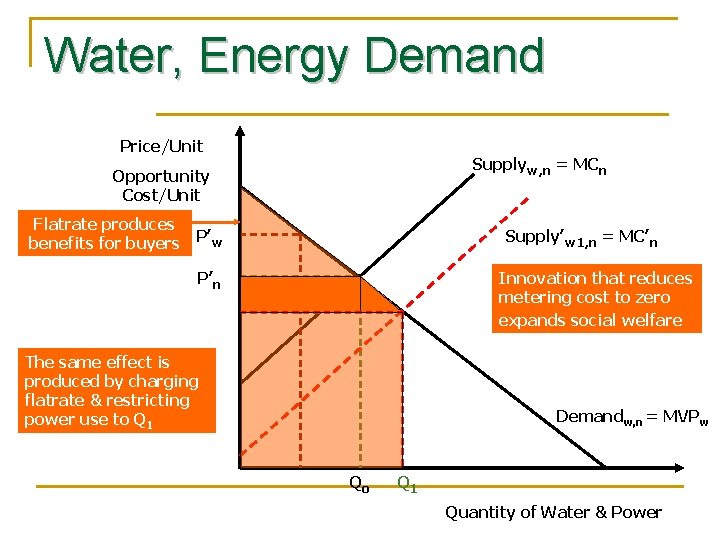
Water, Energy Demand Price/Unit Supplyw, n = MCn Opportunity Cost/Unit Flatrate produces benefits for buyers P’w Supply’w 1, n = MC’n P’n Innovation that reduces metering cost to zero expands social welfare The same effect is produced by charging flatrate & restricting power use to Q 1 Demandw, n = MVPw Qo Q 1 Quantity of Water & Power
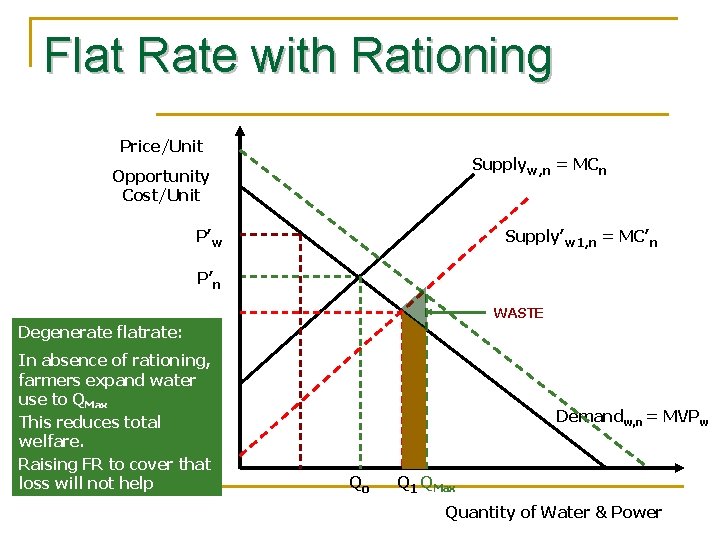
Flat Rate with Rationing Price/Unit Supplyw, n = MCn Opportunity Cost/Unit Supply’w 1, n = MC’n P’w P’n WASTE Degenerate flatrate: In absence of rationing, farmers expand water use to QMax This reduces total welfare. Raising FR to cover that loss will not help Demandw, n = MVPw Qo Q 1 QMax Quantity of Water & Power
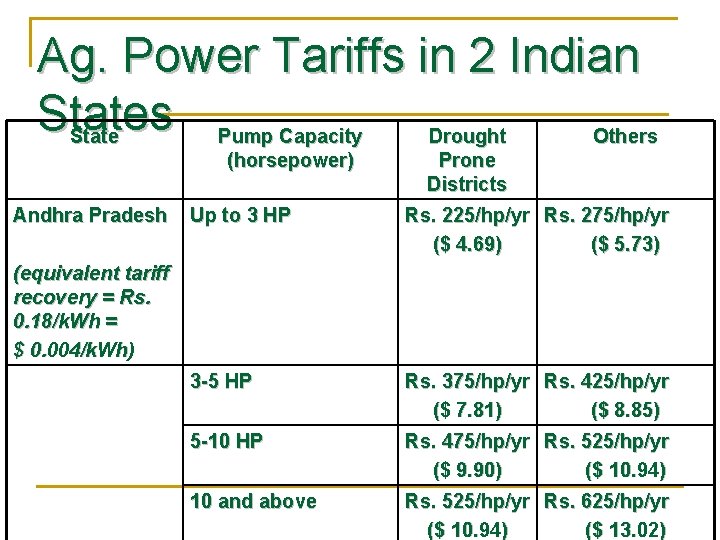
Ag. Power Tariffs in 2 Indian States State Pump Capacity Drought Others (horsepower) Andhra Pradesh Prone Districts Up to 3 HP Rs. 225/hp/yr Rs. 275/hp/yr ($ 4. 69) ($ 5. 73) 3 -5 HP Rs. 375/hp/yr Rs. 425/hp/yr ($ 7. 81) ($ 8. 85) 5 -10 HP Rs. 475/hp/yr Rs. 525/hp/yr ($ 9. 90) ($ 10. 94) 10 and above Rs. 525/hp/yr Rs. 625/hp/yr ($ 10. 94) ($ 13. 02) (equivalent tariff recovery = Rs. 0. 18/k. Wh = $ 0. 004/k. Wh)
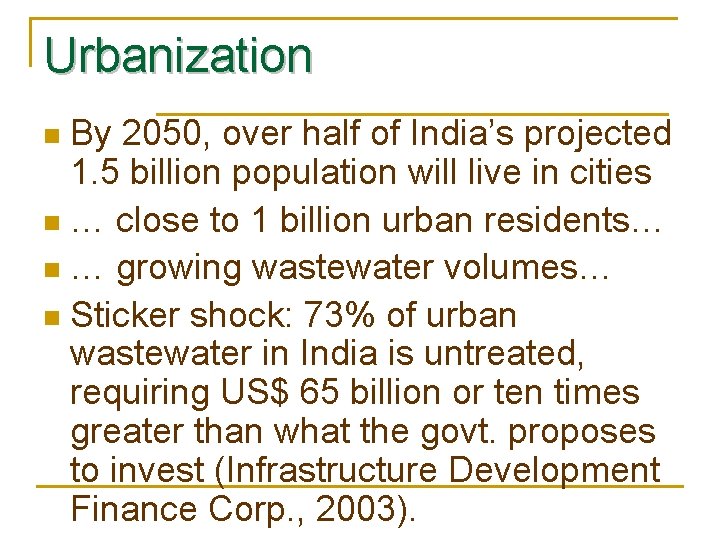
Urbanization By 2050, over half of India’s projected 1. 5 billion population will live in cities n … close to 1 billion urban residents… n … growing wastewater volumes… n Sticker shock: 73% of urban wastewater in India is untreated, requiring US$ 65 billion or ten times greater than what the govt. proposes to invest (Infrastructure Development Finance Corp. , 2003). n
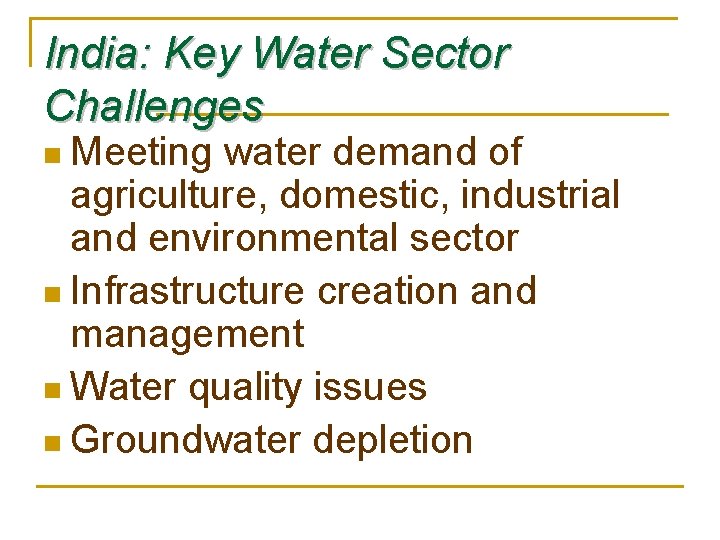
India: Key Water Sector Challenges n Meeting water demand of agriculture, domestic, industrial and environmental sector n Infrastructure creation and management n Water quality issues n Groundwater depletion
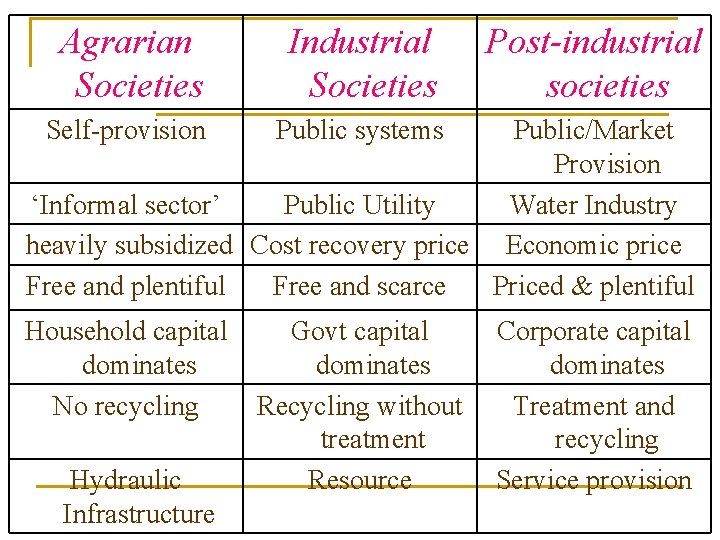
Agrarian Societies Industrial Societies Self-provision Public systems Household capital dominates No recycling Govt capital dominates Recycling without treatment Resource Post-industrial societies Public/Market Provision ‘Informal sector’ Public Utility Water Industry heavily subsidized Cost recovery price Economic price Free and plentiful Free and scarce Priced & plentiful Hydraulic Infrastructure Corporate capital dominates Treatment and recycling Service provision
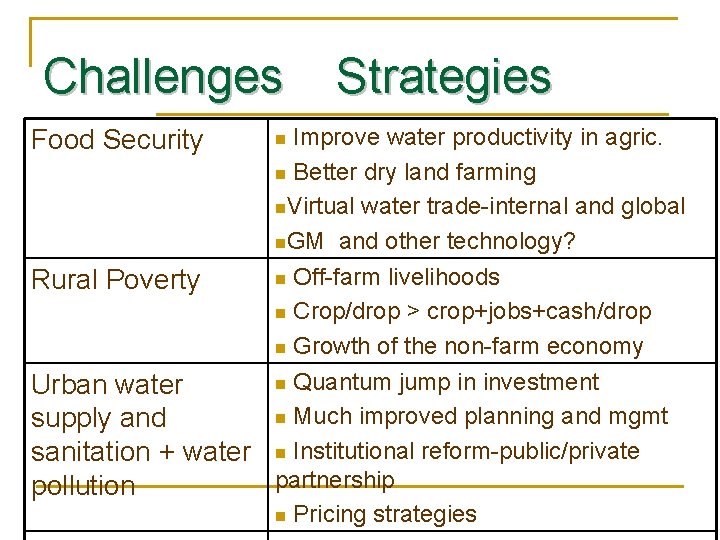
Challenges Food Security Rural Poverty Strategies Improve water productivity in agric. n Better dry land farming n. Virtual water trade-internal and global n. GM and other technology? n Off-farm livelihoods n Crop/drop > crop+jobs+cash/drop n Growth of the non-farm economy n n Quantum jump in investment Urban water n Much improved planning and mgmt supply and sanitation + water n Institutional reform-public/private partnership pollution n Pricing strategies
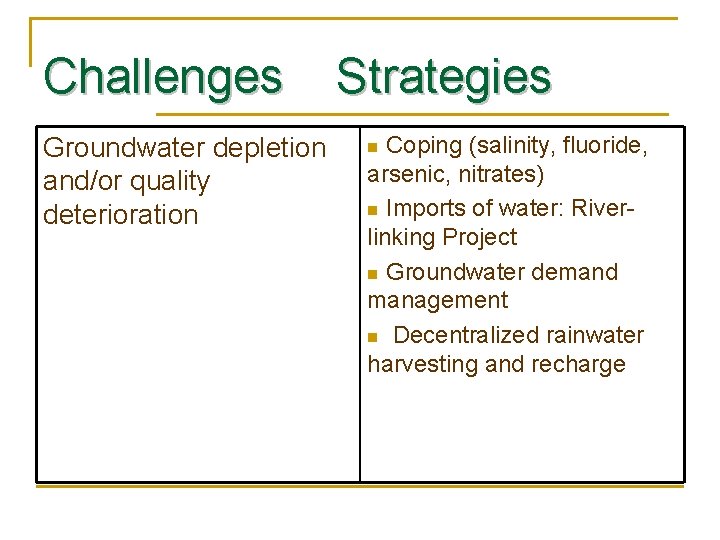
Challenges Groundwater depletion and/or quality deterioration Strategies Coping (salinity, fluoride, arsenic, nitrates) n Imports of water: Riverlinking Project n Groundwater demand management n Decentralized rainwater harvesting and recharge n
Thank you.