
Strangeness in the nucleon M V Polyakov Bochum
Strangeness in the nucleon. M. V. Polyakov Bochum University • What is known about strangeness in the nucleon ? • What is strange in the strange quark matrix elements? • Heavy quark limit. Heavy-light duality for strangeness? • Exclusive production as effective tool to excite sea
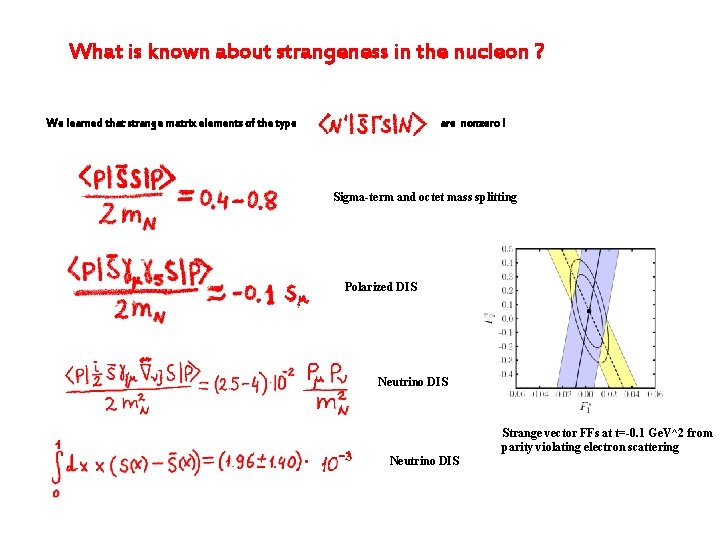
What is known about strangeness in the nucleon ? We learned that strange matrix elements of the type are nonzero ! Sigma-term and octet mass splitting Polarized DIS Neutrino DIS Strange vector FFs at t=-0. 1 Ge. V^2 from parity violating electron scattering Neutrino DIS
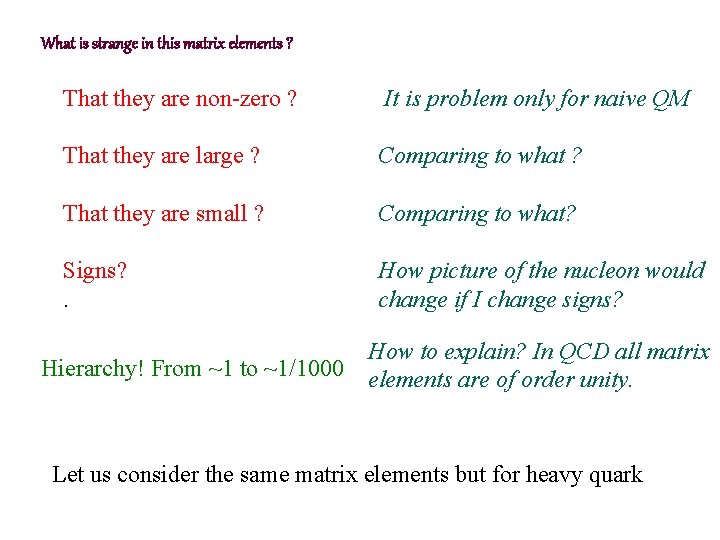
What is strange in this matrix elements ? That they are non-zero ? It is problem only for naive QM That they are large ? Comparing to what ? That they are small ? Comparing to what? Signs? . How picture of the nucleon would change if I change signs? Hierarchy! From ~1 to ~1/1000 How to explain? In QCD all matrix elements are of order unity. Let us consider the same matrix elements but for heavy quark
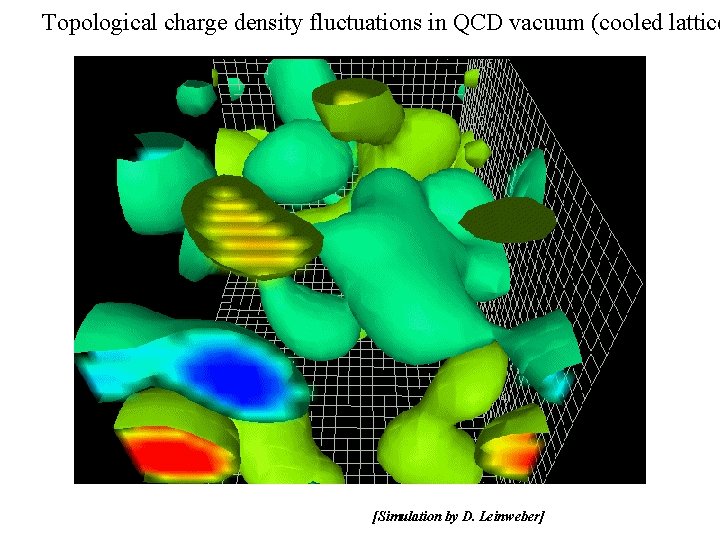
Topological charge density fluctuations in QCD vacuum (cooled lattice [Simulation by D. Leinweber]
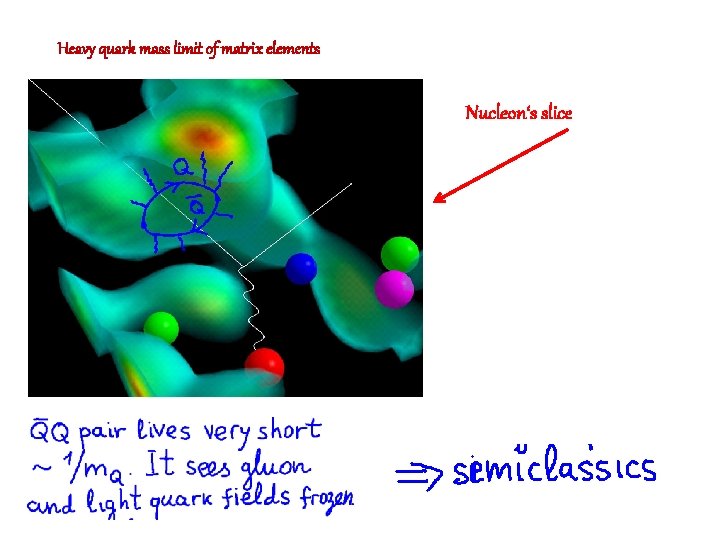
Heavy quark mass limit of matrix elements Nucleon‘s slice
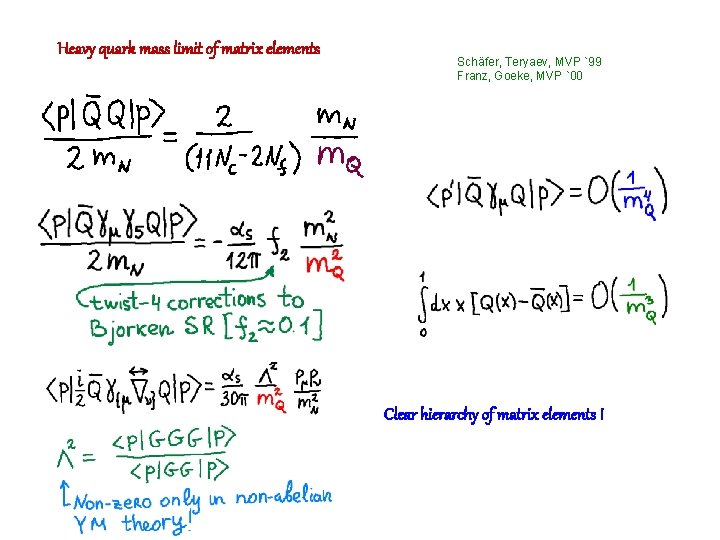
Heavy quark mass limit of matrix elements Schäfer, Teryaev, MVP `99 Franz, Goeke, MVP `00 Clear hierarchy of matrix elements !
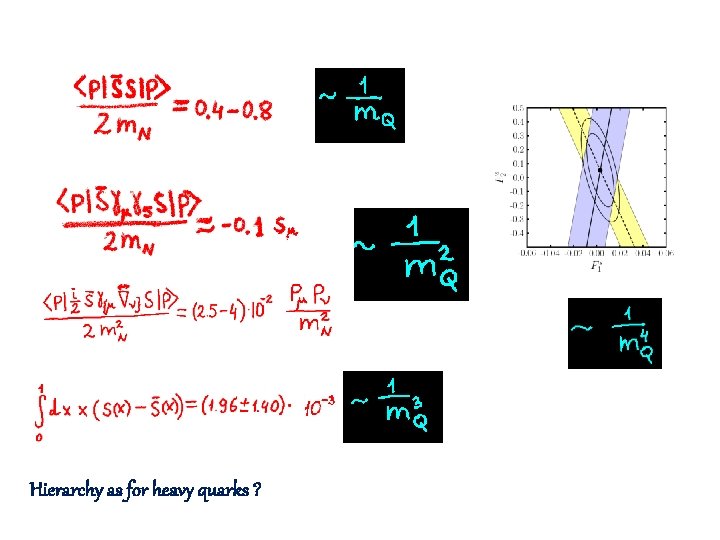
Hierarchy as for heavy quarks ?
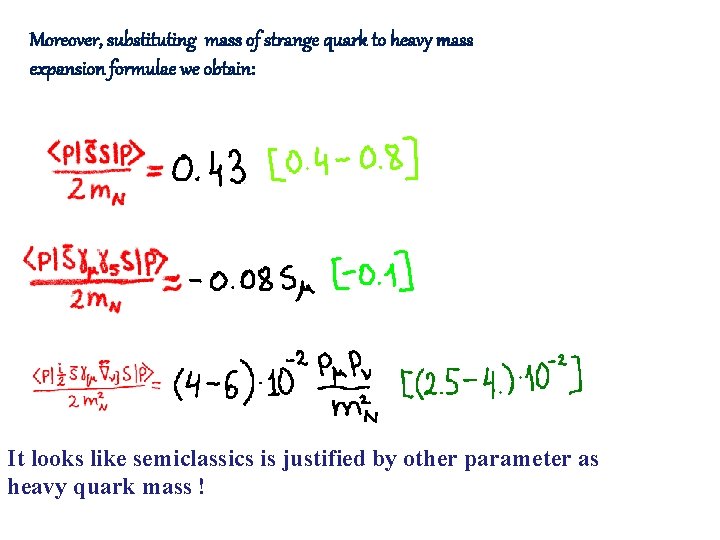
Moreover, substituting mass of strange quark to heavy mass expansion formulae we obtain: It looks like semiclassics is justified by other parameter as heavy quark mass !
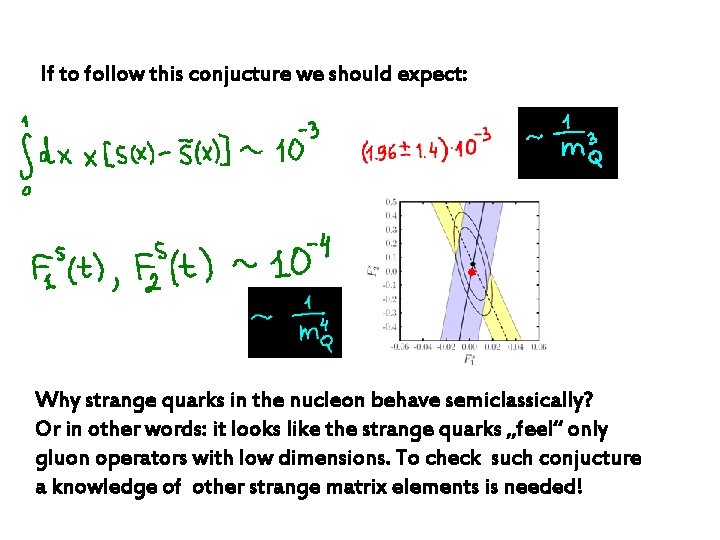
If to follow this conjucture we should expect: Why strange quarks in the nucleon behave semiclassically? Or in other words: it looks like the strange quarks „feel“ only gluon operators with low dimensions. To check such conjucture a knowledge of other strange matrix elements is needed!
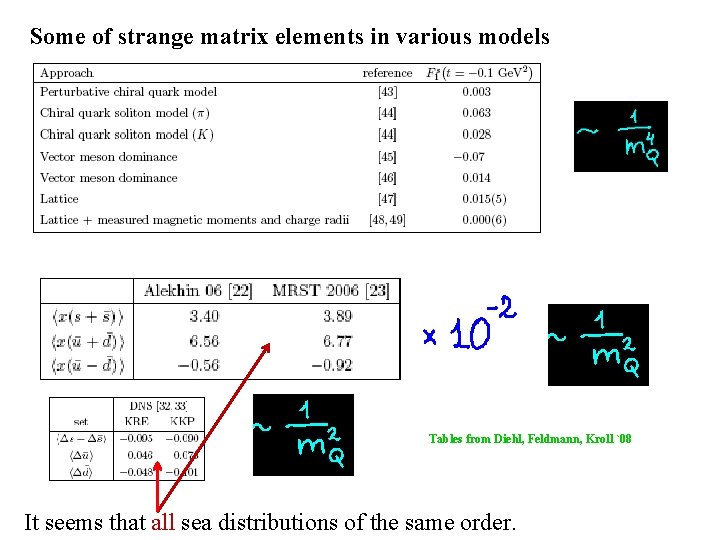
Some of strange matrix elements in various models Tables from Diehl, Feldmann, Kroll `08 It seems that all sea distributions of the same order.
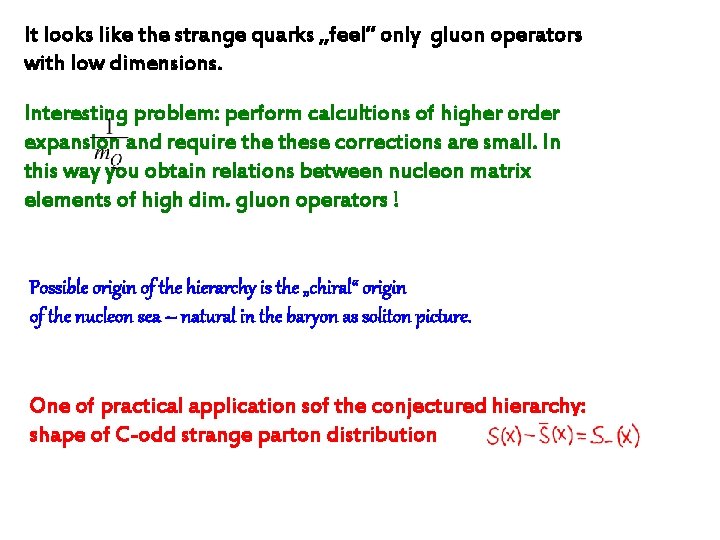
It looks like the strange quarks „feel“ only gluon operators with low dimensions. Interesting problem: perform calcultions of higher order expansion and require these corrections are small. In this way you obtain relations between nucleon matrix elements of high dim. gluon operators ! Possible origin of the hierarchy is the „chiral“ origin of the nucleon sea – natural in the baryon as soliton picture. One of practical application sof the conjectured hierarchy: shape of C-odd strange parton distribution
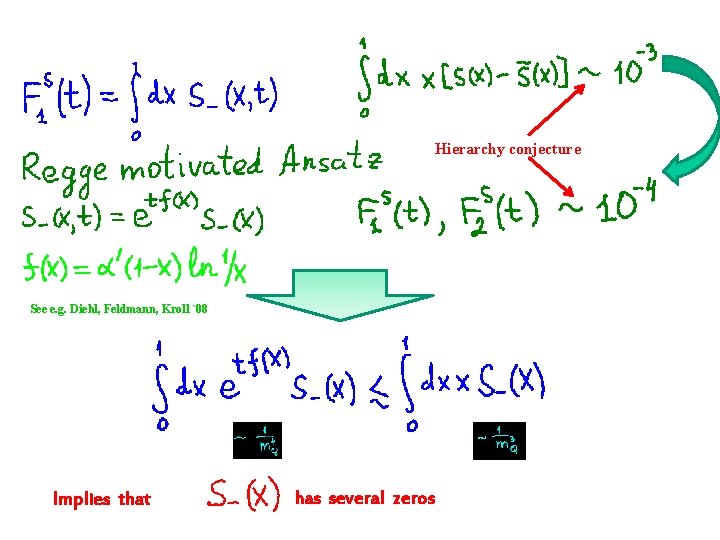
Hierarchy conjecture See e. g. Diehl, Feldmann, Kroll `08 Implies that has several zeros
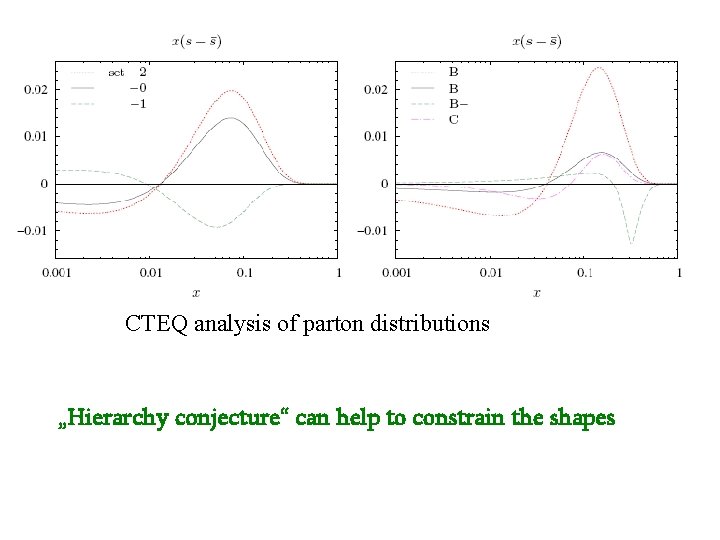
CTEQ analysis of parton distributions „Hierarchy conjecture“ can help to constrain the shapes
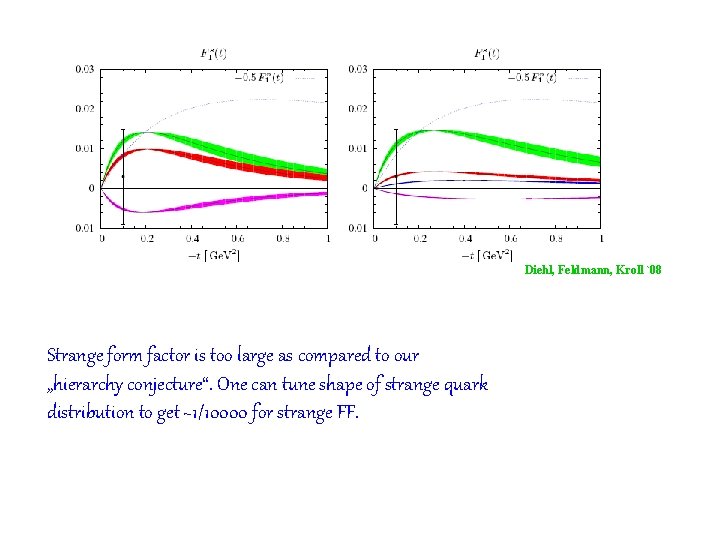
Diehl, Feldmann, Kroll `08 Strange form factor is too large as compared to our „hierarchy conjecture“. One can tune shape of strange quark distribution to get ~1/10000 for strange FF.
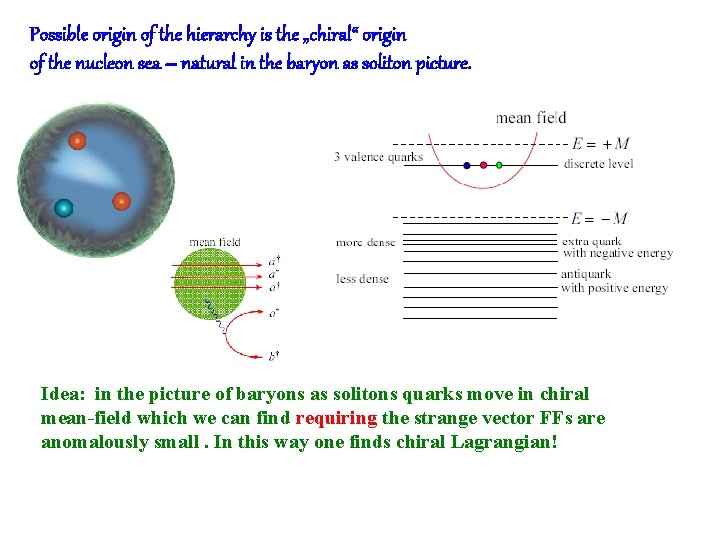
Possible origin of the hierarchy is the „chiral“ origin of the nucleon sea – natural in the baryon as soliton picture. Idea: in the picture of baryons as solitons quarks move in chiral mean-field which we can find requiring the strange vector FFs are anomalously small. In this way one finds chiral Lagrangian!
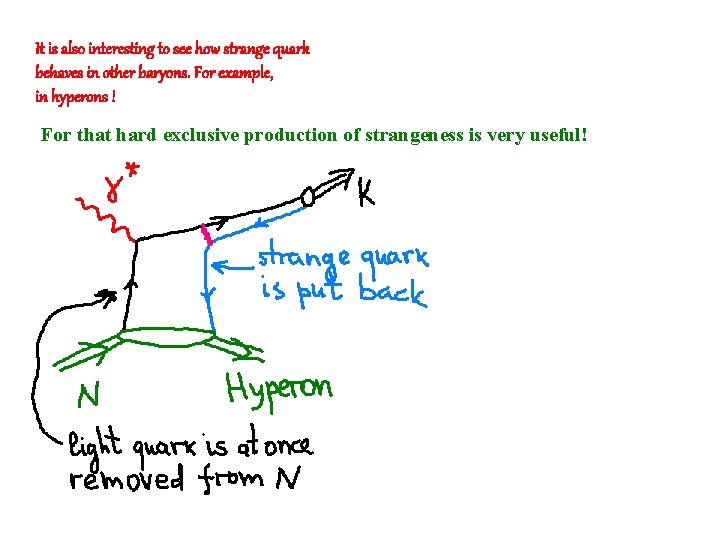
It is also interesting to see how strange quark behaves in other baryons. For example, in hyperons ! For that hard exclusive production of strangeness is very useful!
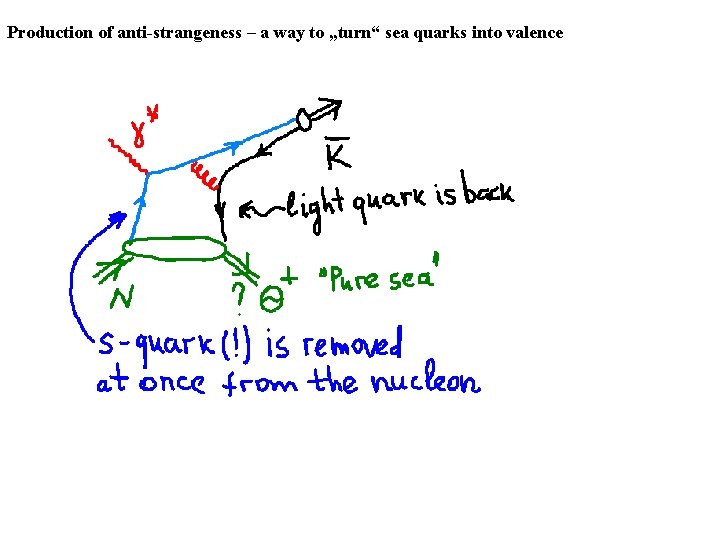
Production of anti-strangeness – a way to „turn“ sea quarks into valence
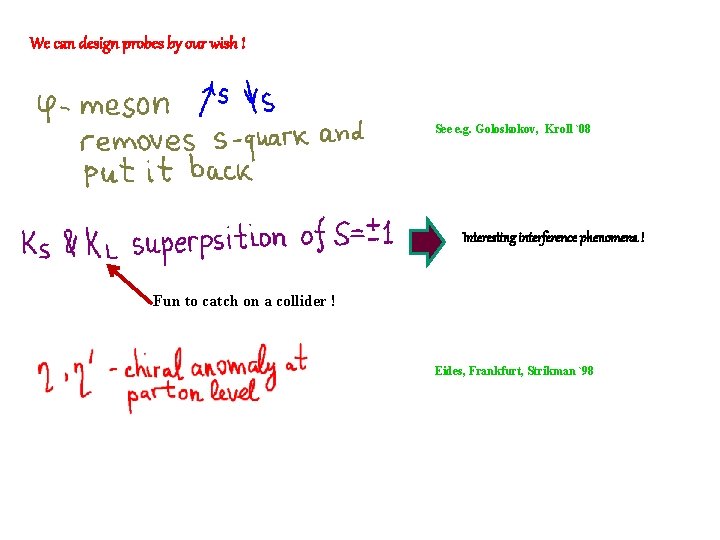
We can design probes by our wish ! See e. g. Goloskokov, Kroll `08 Interesting interference phenomena ! Fun to catch on a collider ! Eides, Frankfurt, Strikman `98
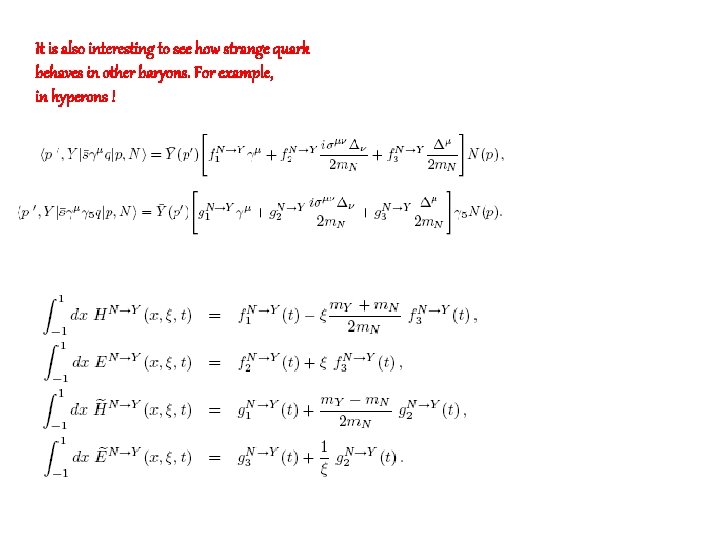
It is also interesting to see how strange quark behaves in other baryons. For example, in hyperons !
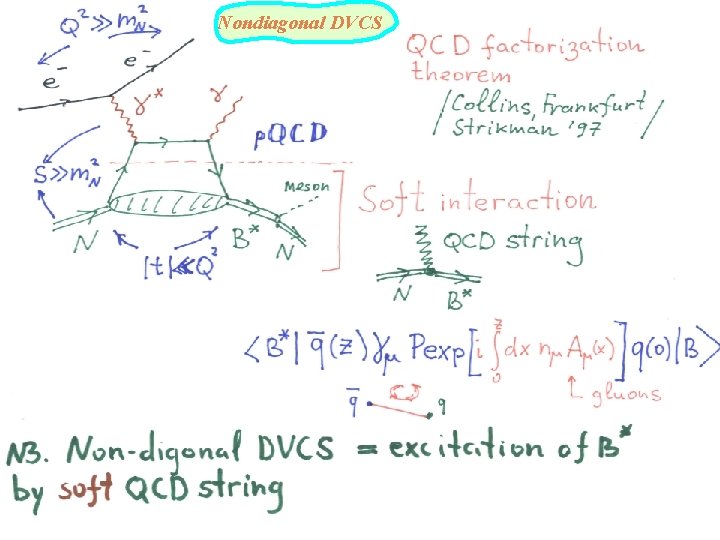
Nondiagonal DVCS
a b
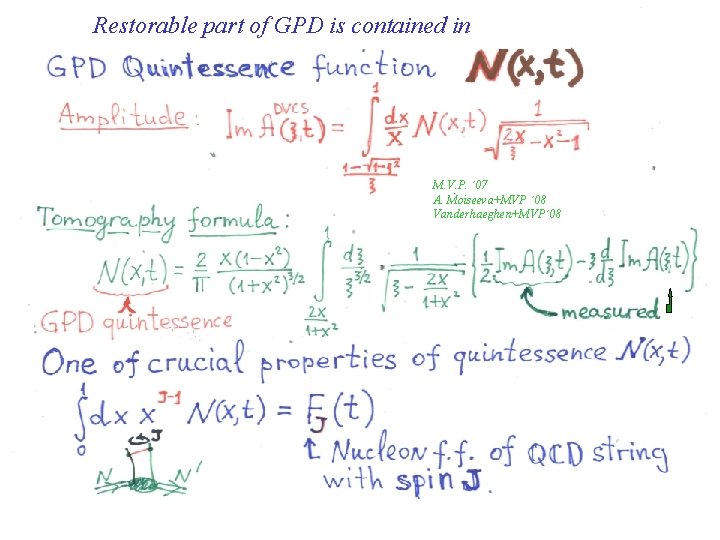
Restorable part of GPD is contained in M. V. P. ´ 07 A. Moiseeva+MVP ´ 08 Vanderhaeghen+MVP´ 08
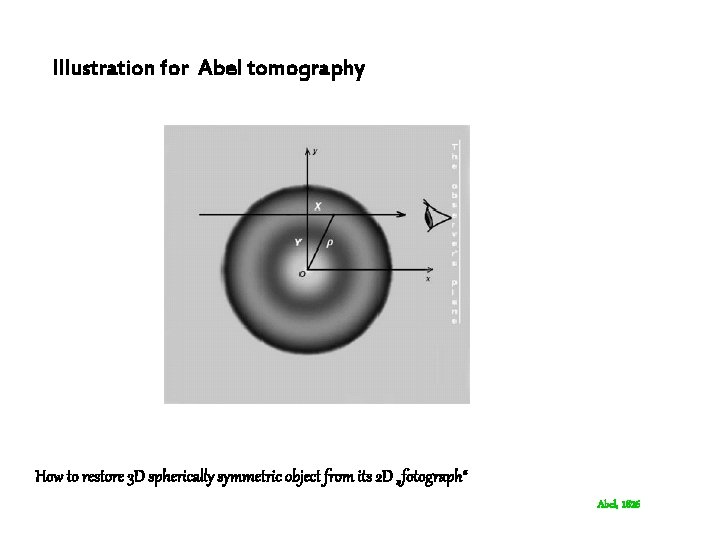
Illustration for Abel tomography How to restore 3 D spherically symmetric object from its 2 D „fotograph“ Abel, 1826
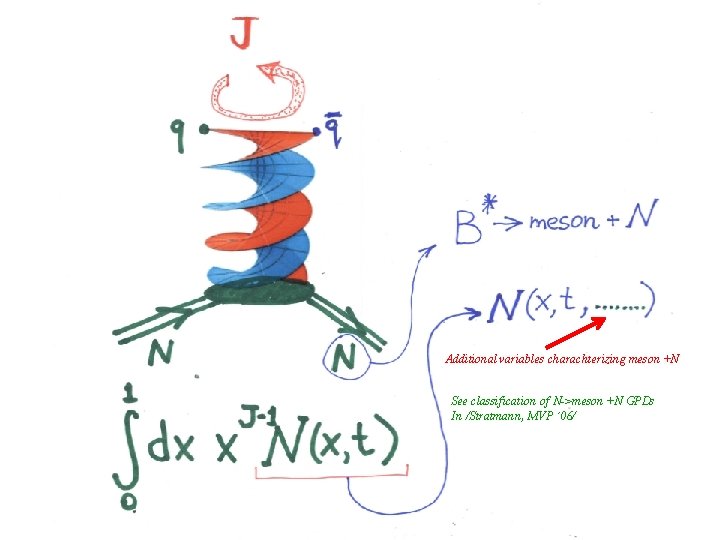
Additional variables charachterizing meson +N See classification of N->meson +N GPDs In /Stratmann, MVP ´ 06/
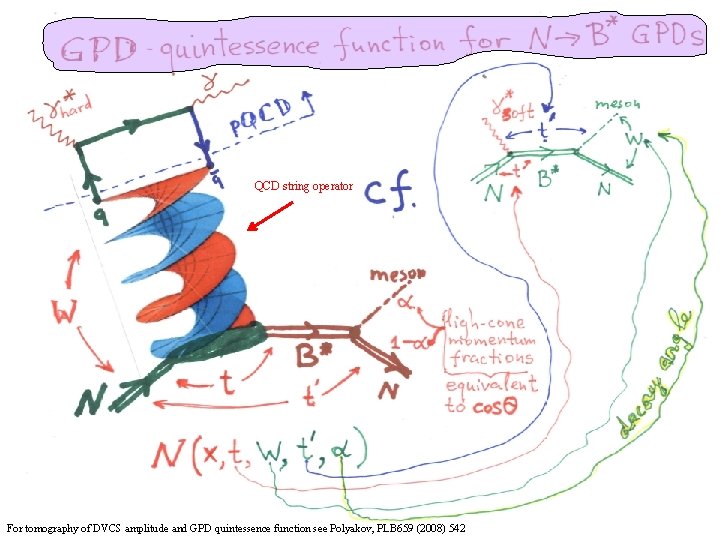
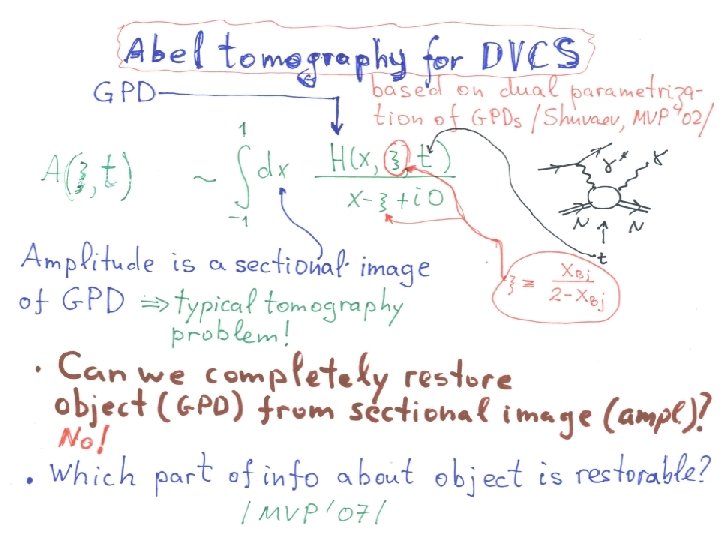
QCD string operator For tomography of DVCS amplitude and GPD quintessence function see Polyakov, PLB 659 (2008) 542
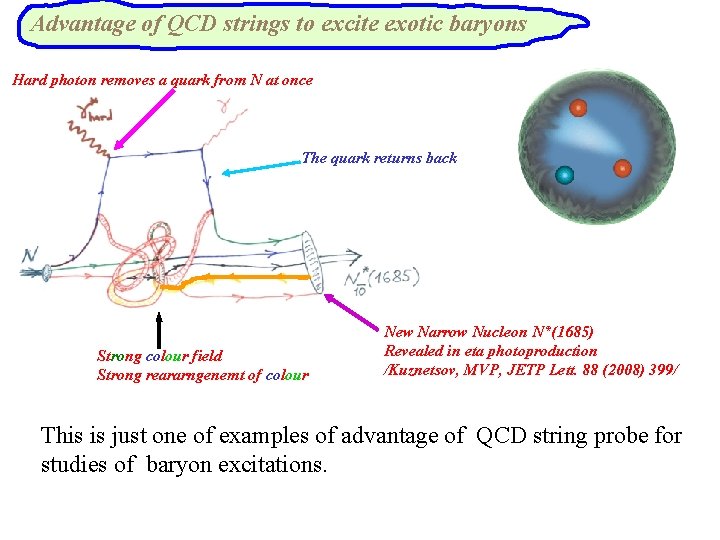
Advantage of QCD strings to excite exotic baryons Hard photon removes a quark from N at once The quark returns back Strong colour field Strong reararngenemt of colour New Narrow Nucleon N*(1685) Revealed in eta photoproduction /Kuznetsov, MVP, JETP Lett. 88 (2008) 399/ This is just one of examples of advantage of QCD string probe for studies of baryon excitations.
- Slides: 27