
Strands of Effective STEM Instruction Inquiry Learning ThematicBig
Strands of Effective STEM Instruction
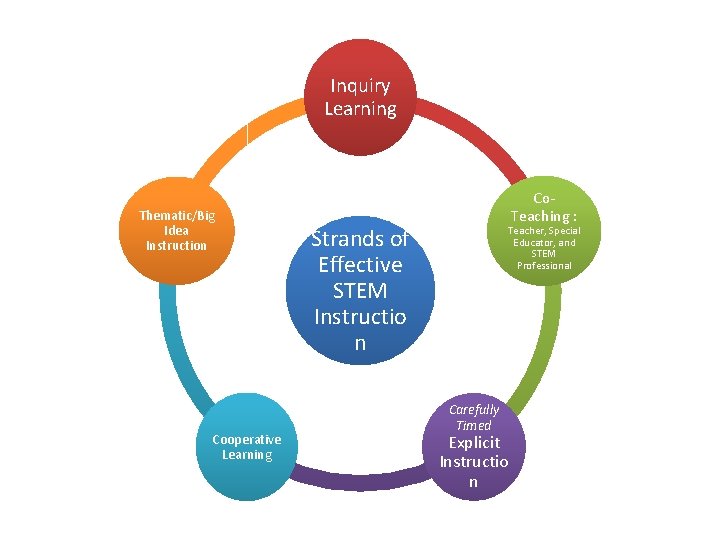
Inquiry Learning Thematic/Big Idea Instruction Cooperative Learning Co. Teaching : Strands of Effective STEM Instructio n Teacher, Special Educator, and STEM Professional Carefully Timed Explicit Instructio n
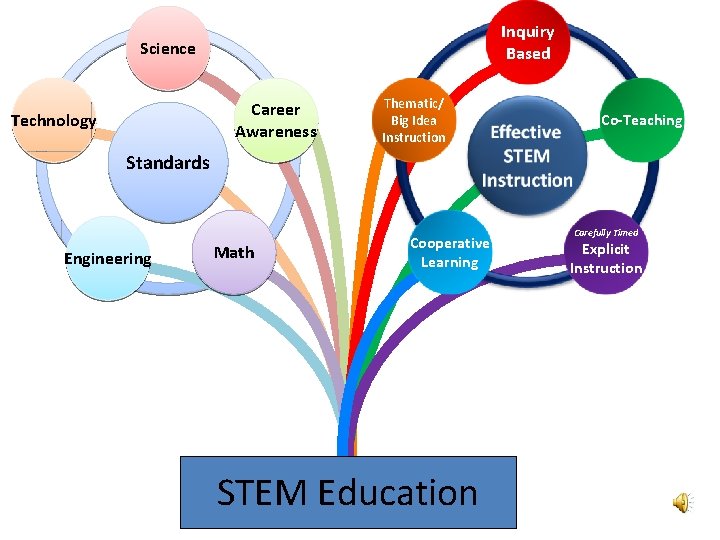
Inquiry Based Science Career Awareness Technology Thematic/ Big Idea Instruction Co-Teaching Standards Engineering Math Cooperative Learning STEM Education Carefully Timed Explicit Instruction
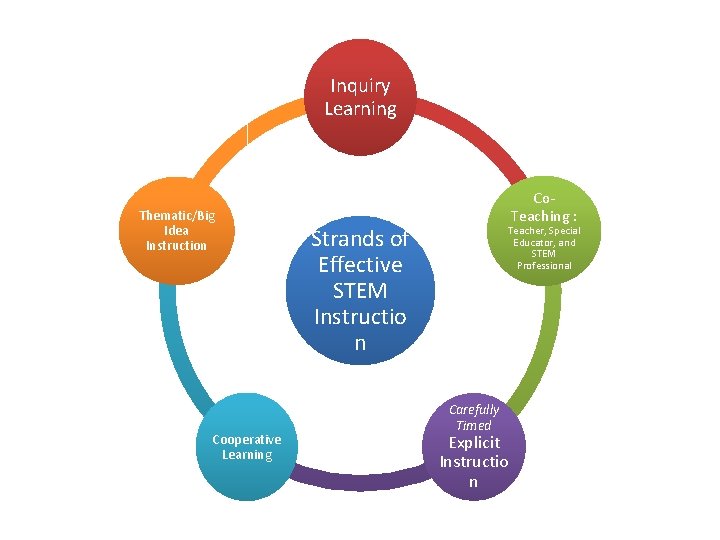
Inquiry Learning Thematic/Big Idea Instruction Cooperative Learning Co. Teaching : Strands of Effective STEM Instructio n Teacher, Special Educator, and STEM Professional Carefully Timed Explicit Instructio n
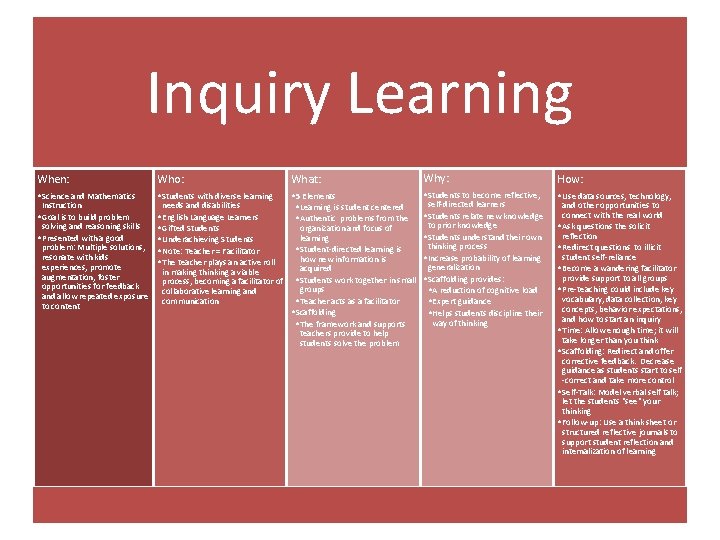
Inquiry Learning When: Who: What: Why: How: • Science and Mathematics • Students with diverse learning • 5 Elements • Learning is student centered • Authentic problems from the • Students to become reflective, • Use data sources, technology, Instruction • Goal is to build problem solving and reasoning skills • Presented with a good problem: Multiple solutions, resonate with kids experiences, promote augmentation, foster opportunities for feedback and allow repeated exposure to content needs and disabilities • English Language Learners • Gifted Students • Underachieving Students • Note: Teacher = Facilitator • The teacher plays an active roll in making thinking a viable process, becoming a facilitator of collaborative learning and communication self-directed learners • Students relate new knowledge to prior knowledge organization and focus of • Students understand their own learning thinking process • Student-directed learning is • Increase probability of learning how new information is generalization acquired • Students work together in small • Scaffolding provides: groups • A reduction of cognitive load • Teacher acts as a facilitator • Expert guidance • Scaffolding • Helps students discipline their way of thinking • The framework and supports teachers provide to help students solve the problem and other opportunities to connect with the real world • Ask questions the solicit reflection • Redirect questions to illicit student self-reliance • Become a wandering facilitator provide support to all groups • Pre-teaching could include key vocabulary, data collection, key concepts, behavior expectations, and how to start an inquiry • Time: Allow enough time; it will take longer than you think • Scaffolding: Redirect and offer corrective feedback. Decrease guidance as students start to self -correct and take more control • Self-Talk: Model verbal self talk; let the students "see" your thinking • Follow-up: Use a think sheet or structured reflective journals to support student reflection and internalization of learning
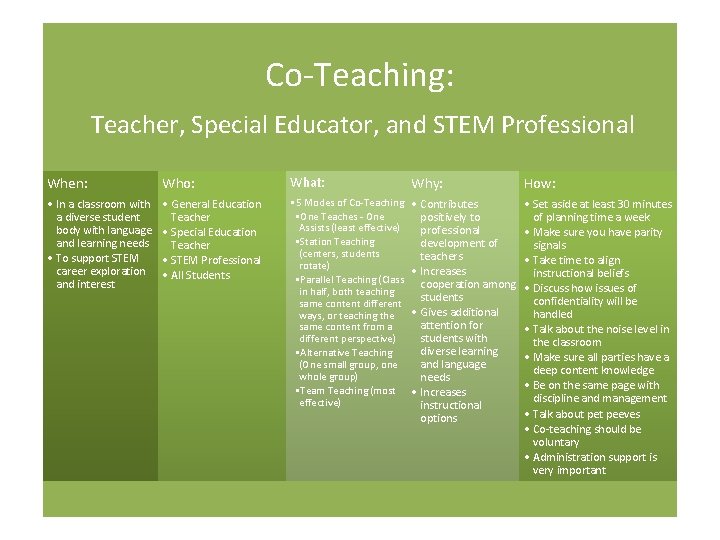
Co-Teaching: Teacher, Special Educator, and STEM Professional When: Who: What: Why: How: • In a classroom with a diverse student body with language and learning needs • To support STEM career exploration and interest • General Education Teacher • Special Education Teacher • STEM Professional • All Students • 5 Modes of Co-Teaching • One Teaches - One Assists (least effective) • Station Teaching (centers, students rotate) • Parallel Teaching (Class in half, both teaching same content different ways, or teaching the same content from a different perspective) • Alternative Teaching (One small group, one whole group) • Team Teaching (most effective) • Contributes positively to professional development of teachers • Increases cooperation among students • Gives additional attention for students with diverse learning and language needs • Increases instructional options • Set aside at least 30 minutes of planning time a week • Make sure you have parity signals • Take time to align instructional beliefs • Discuss how issues of confidentiality will be handled • Talk about the noise level in the classroom • Make sure all parties have a deep content knowledge • Be on the same page with discipline and management • Talk about peeves • Co-teaching should be voluntary • Administration support is very important
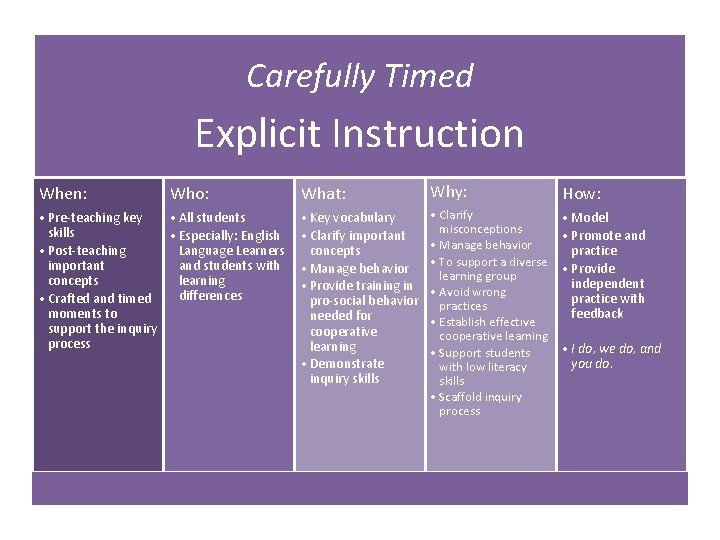
Carefully Timed Explicit Instruction When: Who: • Pre-teaching key • All students skills • Especially: English • Post-teaching Language Learners important and students with concepts learning differences • Crafted and timed moments to support the inquiry process What: Why: How: • Key vocabulary • Clarify important concepts • Manage behavior • Provide training in pro-social behavior needed for cooperative learning • Demonstrate inquiry skills • Clarify misconceptions • Manage behavior • To support a diverse learning group • Avoid wrong practices • Establish effective cooperative learning • Support students with low literacy skills • Scaffold inquiry process • Model • Promote and practice • Provide independent practice with feedback • I do, we do, and you do.

Cooperative Learning When: Who: What: Any content Why: How: • During inquiry learning • To learn subject matter and • All students • Highly effective for English • Structuring Cooperative • Peer mentoring and peer • Essential Elements of teamwork, communication, lifelong learning, and problem solving Language Learners and students with learning differences Learning : • Clear group task • Teach interpersonal skills and small group skills like communication, managing conflict, allocation of resources, and democratic decision making • Learning Roles: • Meaningful • Rotate • Teacher supported • Age appropriate • Non-hierarchical mediation supports English Language Learners and students with learning differences • Supports vocabulary development • Student become effective explainers of their thinking • Students listen more to peer explanations • Students feel like they can make a difference in their environment • Increased achievement and productivity • More frequent use of higher level reasoning strategies Cooperation (Structuring tasks to support learning) • Positive Interdependence (Resources, role, and task interdependence) • Individual Accountability and Personal Responsibility (Assessment of individual performance; facilitated by groups four or less in number) • Promotive Interaction (Individuals promoting and facilitating each other’s efforts to achieve the group’s goal, active engagement) • Appropriate Use of Social Skills (Students must be taught interpersonal and small groups skills needed for quality cooperation; model and explicitly teach these skills) • Group Processing (Reflection, decision making and change; promote positive helping)
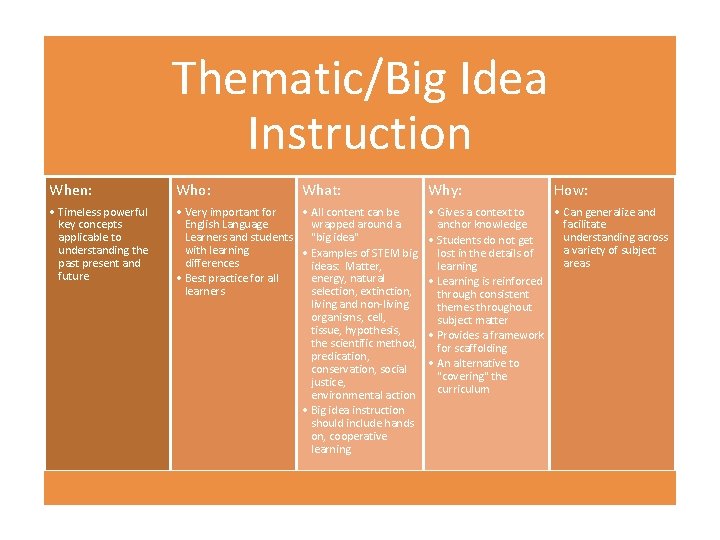
Thematic/Big Idea Instruction When: Who: What: • Timeless powerful key concepts applicable to understanding the past present and future • Very important for • All content can be English Language wrapped around a Learners and students "big idea" with learning • Examples of STEM big differences ideas: Matter, • Best practice for all energy, natural learners selection, extinction, living and non-living organisms, cell, tissue, hypothesis, the scientific method, predication, conservation, social justice, environmental action • Big idea instruction should include hands on, cooperative learning Why: How: • Gives a context to • Can generalize and anchor knowledge facilitate understanding across • Students do not get a variety of subject lost in the details of areas learning • Learning is reinforced through consistent themes throughout subject matter • Provides a framework for scaffolding • An alternative to "covering" the curriculum
References Inquiry Learning Amaral, O. M. , Garrison, L. , & Klentschy, M. (2002). Helping english learners increase achievement through inquiry-based science instruction. Bilingual Research Journal, 26(2), 213. Barrows, H. S. (1996). Problem-based learning in medicine and beyond: A brief overview; accession number: 9703301040; authors: Barrows, howard S. ; subject: CURRICULUM change; subject: PROBLEM-based learning; subject: MCMASTER university (hamilton, ont. ); subject: ONTARIO; subject: HAMILTON (ont. ); subject: CANADA; number of pages: 9 p. New Directions for Teaching & Learning, (68), 3. Cote, D. , & Cote, D. (2007). Problem-based learning software for students with disabilities Dalton, B. , Morocco, C. C. , & Dalton, B. (1997). Supported inquiry science: Teaching for conceptual change in urban and suburban science classrooms Fradd, S. H. , & Lee, O. (1999). Teachers' roles in promoting science inquiry with students from diverse language backgrounds. Educational Researcher, 28(6), 14 -42. Harmer, A. J. , Cates, W. M. , & Harmer, A. J. (2007). Designing for learner engagement in middle school science: Technology, inquiry, and the hierarchies of engagement Hmelo-Silver, C. , Duncan, R. G. , & Chinn, C. A. (2007). Scaffolding and achievement in problem-based and inquiry learning: A response to kirschner, sweller, and clark (2006). Educational Psychologist, 42(2), 99 -107. Hmelo-Silver, C. , & Hmelo-Silver, C. (2004). Problem-based learning: What and how do students learn? Mastropieri, M. A. , Scruggs, T. E. , Mantzicopoulos, P. , Sturgeon, A. , Goodwin, L. , Chung, S. , et al. (1998). `A place where living things affect and depend on each other': Qualitative and quantitative. . Mastropieri, M. A. , Scruggs, T. E. , Norland, J. J. , Berkeley, S. , Mc. Duffie, K. , Tornquist, E. H. , et al. (2006). Differentiated curriculum enhancement in inclusive middle school science: Effects on classroom and high-stakes tests. Journal of Special Education, 40(3), 130 -137. Mc. Carthy, C. B. , & Mc. Carthy, C. B. (2005). Effects of thematic-based, hands-on science teaching versus a textbook approach for students with disabilities Scruggs, T. E. , & Mastropieri, M. A. (1993). Reading versus doing: The relative effects of textbook-based and inquiry-oriented approaches to. . Journal of Special Education, 27(1), 1. Simons, K. D. (2007). The impact of scaffolding and student achievement levels in a problem-based learning environment Woodward, J. , Carnine, D. , & Gersten, R. (1988). Teaching problem solving through computer simulations. American Educational Research Journal, 25(1), 7286.
References Explicit Instruction Fradd, S. H. , & Lee, O. (1999). Teachers' roles in promoting science inquiry with students from diverse language backgrounds. Educational Researcher, 28(6), 14 -42. Fradd, S. H. , Lee, O. , Sutman, F. X. , & Saxton, M. K. (2001). Promoting science literacy with english language learners through instructional materials development: A case study. Bilingual Research Journal, 25(4), 479. Scruggs, T. E. , & Mastropieri, M. A. (1993). Reading versus doing: The relative effects of textbook-based and inquiry-oriented approaches to. . Journal of Special Education, 27(1), 1. Scruggs, T. E. , Mastropieri, M. A. , & Scruggs, T. E. (2000). The effectiveness of mnemonic instruction for students with learning and behavior problems: An update and research synthesis Steele, M. (2007). TEACHING SCIENCE to STUDENTS with LEARNING DIFFERENCES. Science Teacher, 74(3), 24 -27. Steele, M. M. , & Steele, M. M. (2008 a). HELPING STUDENTS with LEARNING DISABILITIES SUCCEED Steele, M. M. , & Steele, M. M. (2008 b). Section 3: Science success for students with special needs Trundle, K. C. , & Trundle, K. C. (2007). Chapter 7: Inquiry-based science instruction for students with disabilities Co-Teaching Bouck, E. C. (2007). Co-Teaching…Not just a textbook term: Implications for practice. Preventing School Failure, 51(2), 46 -51. Cook, L. , & Friend, M. (1995). Co-teaching: Guidelines for creating effective practices. (cover story). Focus on Exceptional Children, 28(3), 1. Dieker, L. A. , & Murawski, W. W. (2003). Co-teaching at the secondary level: Unique issues, current trends, and suggestions for success. High School Journal, 86(4), 1. Gately, S. E. , Gately Jr. , F. J. , & Gately, S. E. (2001). Understanding coteaching components Magiera, K. , Smith, C. , Zigmond, N. , & Gebauer, K. (2005). Benefits of co-teaching in secondary mathematics classes. Teaching Exceptional Children, 37(3), 20 -24. Mastropieri, M. A. , Scruggs, T. E. , Graetz, J. , Norland, J. , Gardizi, W. , & Mc. Duffie, K. (2005). Case studies in co-teaching in the content areas: Successes, failures, and challenges. Intervention in School & Clinic, 40(5), 260 -270. Murawski, W. W. (2005). Introduction to special issue. Intervention in School & Clinic, 40(5), 259 -259. Murawski, W. W. (2006). Student outcomes in co-taught secondary english classes: How can we improve? Murawski, W. W. , & Hughes, C. E. (2009). Response to intervention, collaboration, and co-teaching: A logical combination for successful systemic change. Preventing School Failure, 53(4), 267 -277. Rice, D. , & Zigmond, N. (2000). Co-teaching in secondary schools: Teacher reports of developments in australian and american classrooms Scruggs, T. E. , Mastropieri, M. A. , & Mc. Duffie, K. A. (2007). Co-teaching in inclusive classrooms: A metasynthesis of qualitative research. Exceptional Children, 73(4), 392 -416. Spraker, J. Teacher teaming in relation to student performance: Findings from the literature
References Cooperative Learning Abrami, P. C. , Poulsen, C. , & Chambers, B. (2004). Teacher motivation to implement an educational innovation: Factors differentiating users and non-users of cooperative learning. Educational Psychology, 24(2), 201 -216. Amaral, O. M. , Garrison, L. , & Klentschy, M. (2002). Helping english learners increase achievement through inquiry-based science instruction. Bilingual Research Journal, 26(2), 213. de Romero, N. Y. , Slater, P. , & De. Cristofano, C. (2006). Design challenges are "ELL-ementary". Science & Children, 43(4), 34 -37. Devine-Wright, P. , Devine-Wright, H. , & Fleming, P. (2004). Situational influences upon children's beliefs about global warming and energy. Environmental Education Research, 10(4), 493 -506. Dinan, F. J. (2006). Opening day: Getting started in a cooperative classroom. Journal of College Science Teaching, 35(4), 12 -14. Gillies, R. M. (2008). The effects of cooperative learning on junior high school students' behaviours, discourse and learning during a science-based learning activity. School Psychology International, 29(3), 328 -347. Johnson, D. W. , & Johnson, F. P. (2003). Joining together: Group theory and group skills (8 th ed. ). Boston, MA: Allyn and Bacon. Johnson, D. W. , & Johnson, R. (1990). Cooperative learning and achievement. In S. Sharan (Ed. ), Cooperative learning, theory and research (pp. 23 -37). New York: Praeger. Johnson, D. W. , & R. T. Johnson. (2009). An educational psychology success story: Social interdependence theory and cooperative learning. Educational Researcher, 38(5), 365. doi: DOI: 10. 3102/0013189 X 09339057 Mastropieri, M. A. , Scruggs, T. E. , Mantzicopoulos, P. , Sturgeon, A. , Goodwin, L. , Chung, S. , et al. (1998). `A place where living things affect and depend on each other': Qualitative and quantitative. . Ross, J. A. (2007). Explanation giving and recieving in cooperative learning groups. In R. M. Gillies, A. F. Ashman & J. Terwel (Eds. ), The teacher's role in implementing cooperative learning in the classroom (pp. 222 -237) Springer US. Souvignier, E. , & Kronenberger, J. (2007). Cooperative learning in third graders' jigsaw groups for mathematics and science with and without questioning training. British Journal of Educational Psychology, 77(4), 755 -771. Sutman, F. X. (1993). Teaching science effectively to limited english proficient students. ERIC Clearinghouse on Urban Education, 87 Trundle, K. C. , & Trundle, K. C. (2007). Chapter 7: Inquiry-based science instruction for students with disabilities Webb, N. M. , Farivar, S. H. , & Mastergeorge, A. M. (2002). Productive helping in cooperative groups. Theory into Practice, 41(1), 13. Webb, N. M. , Nemer, K. M. , & Ing, M. (2006). Small-group reflections: Parallels between teacher discourse and student behavior in peer-directed groups. Journal of the Learning Sciences, 15(1), 63 -119. Big Idea Instruction Carnine, D. (1994). Introduction to the mini-series: Diverse learners and prevailing, emerging, and research-based. . School Psychology Review, 23(3), 341. Freund, L. , & Rich, R. (2005). Teaching students with learning problems in the inclusive classroom. New Jersey: Pearson Education Inc. Steele, M. (2007). TEACHING SCIENCE to STUDENTS with LEARNING DIFFERENCES. Science Teacher, 74(3), 24 -27. Steele, M. M. , & Steele, M. M. (2008 a). HELPING STUDENTS with LEARNING DISABILITIES SUCCEED Steele, M. M. , & Steele, M. M. (2008 b). Section 3: Science success for students with special needs Sutman, F. X. (1993). Teaching science effectively to limited english proficient students. ERIC Clearinghouse on Urban Education, 87
- Slides: 12