
Story telling Dialogic Reading Why is reading important
- Slides: 11
Story telling: Dialogic Reading
Why is reading important? Benefits of reading: careers, study, pleasure, language acquisition (writing, vocabulary, grammar, punctuation, construct sentences, paragraphs, and whole texts)
• What is Dialogic reading? Developed by Whitehurst and his colleagues from the Stony Brook Reading and Language Project in 1988 (cf. Whitehurst, 1992; Zevenbergen & Whitehurst, 2003). Story telling • Adult: storyteller • Child: listener, audience Dialogic reading • Adult: listener, questioner, audience • Child: storyteller. 3
1. key techniques and strategies PEER and CROWD
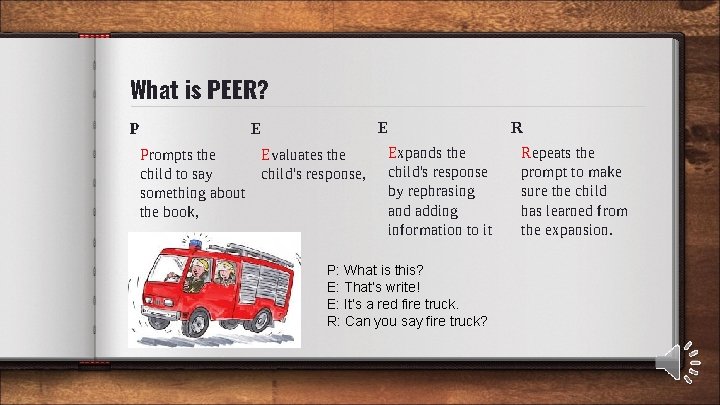
What is PEER? P E E Prompts the Evaluates the child to say child's response, something about the book, Expands the child's response by rephrasing and adding information to it P: What is this? E: That’s write! E: It’s a red fire truck. R: Can you say fire truck? R Repeats the prompt to make sure the child has learned from the expansion.
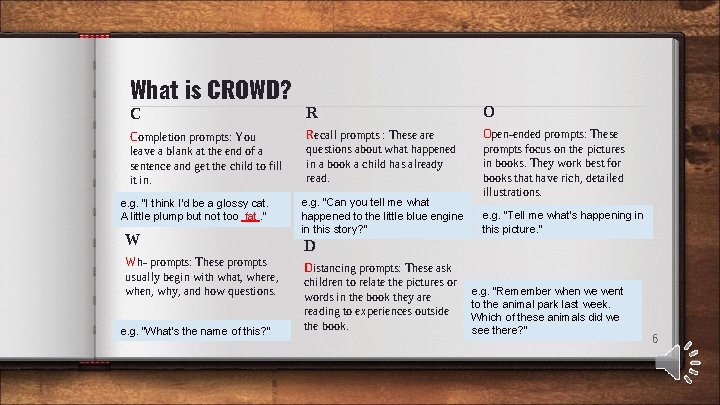
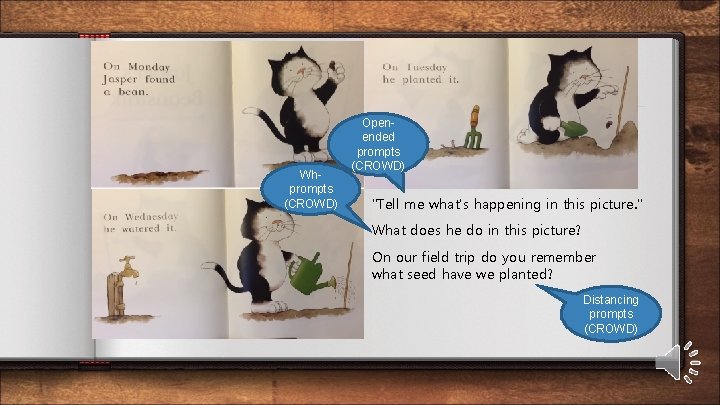
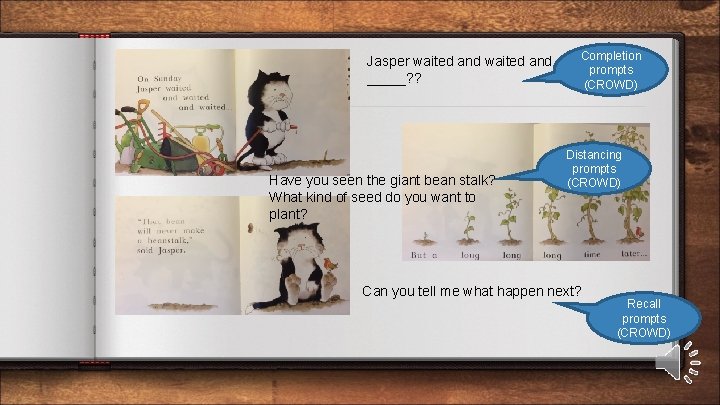
What is CROWD? C R O Completion prompts: You leave a blank at the end of a sentence and get the child to fill it in. Recall prompts : These are questions about what happened in a book a child has already read. Open-ended prompts: These prompts focus on the pictures in books. They work best for books that have rich, detailed illustrations. e. g. "I think I'd be a glossy cat. A little plump but not too fat. " W Wh- prompts: These prompts usually begin with what, where, when, why, and how questions. e. g. "What's the name of this? " e. g. "Can you tell me what happened to the little blue engine in this story? " e. g. "Tell me what's happening in this picture. " D Distancing prompts: These ask children to relate the pictures or words in the book they are reading to experiences outside the book. e. g. "Remember when we went to the animal park last week. Which of these animals did we see there? " 6
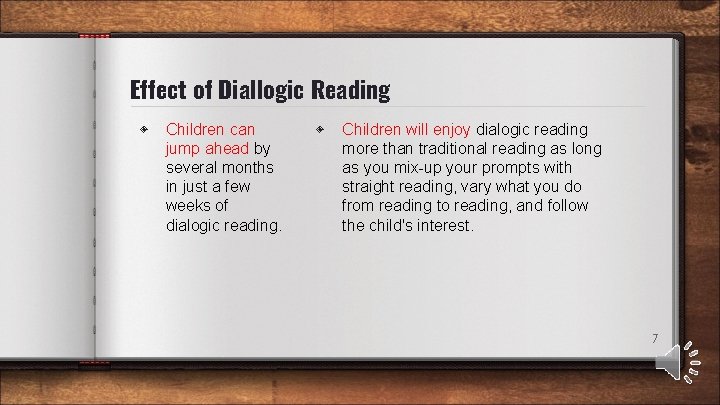
Effect of Diallogic Reading ◈ Children can jump ahead by several months in just a few weeks of dialogic reading. ◈ Children will enjoy dialogic reading more than traditional reading as long as you mix-up your prompts with straight reading, vary what you do from reading to reading, and follow the child's interest. 7
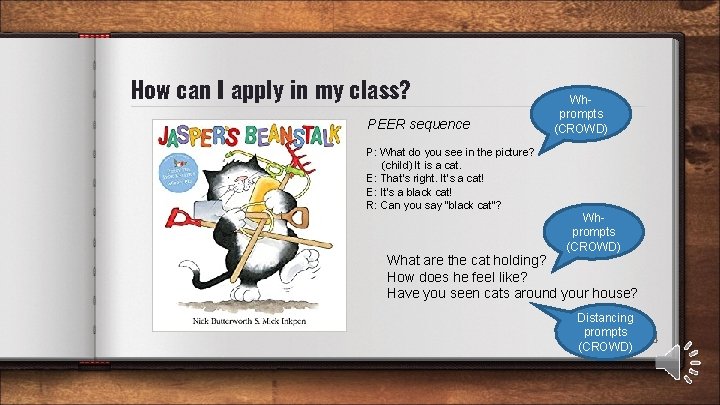
How can I apply in my class? PEER sequence P: What do you see in the picture? (child) It is a cat. E: That’s right. It’s a cat! E: It’s a black cat! R: Can you say “black cat”? Whprompts (CROWD) What are the cat holding? How does he feel like? Have you seen cats around your house? Distancing prompts (CROWD) 8
Whprompts (CROWD) Openended prompts (CROWD) "Tell me what's happening in this picture. " What does he do in this picture? On our field trip do you remember what seed have we planted? Distancing prompts (CROWD)
Jasper waited and _____? ? Have you seen the giant bean stalk? What kind of seed do you want to plant? Completion prompts (CROWD) Distancing prompts (CROWD) Can you tell me what happen next? Recall prompts (CROWD)
THANKS! What I learned from this presentation is… 11