
Story Game Directions Mineral Hunter Game Preparation Game
- Slides: 15
Story Game Directions Mineral Hunter Game Preparation Game Pieces Play the game Objectives Credits Copyright Notice A Homemade Power. Point Game By James Martin The University of Memphis
The Story of the “Mineral Hunter” It’s 1848 in the hills of Coloma, California, and you just learned about the possibility of a hidden mine overflowing with precious and semiprecious minerals. The problem is it’s surrounded by clever traps and puzzle that only the best miners can navigate with success. Are you willing to try for the untold fortunes or do you want to continue working as a clerk at the local General Store for the rest of your life? Have you got the skills and knowledge to overcome the challenges and become a MINERAL HUNTER!!!! Home Page
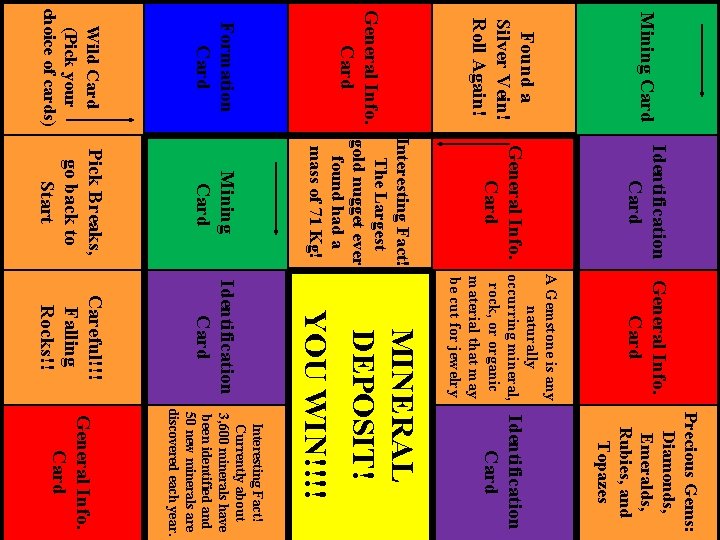
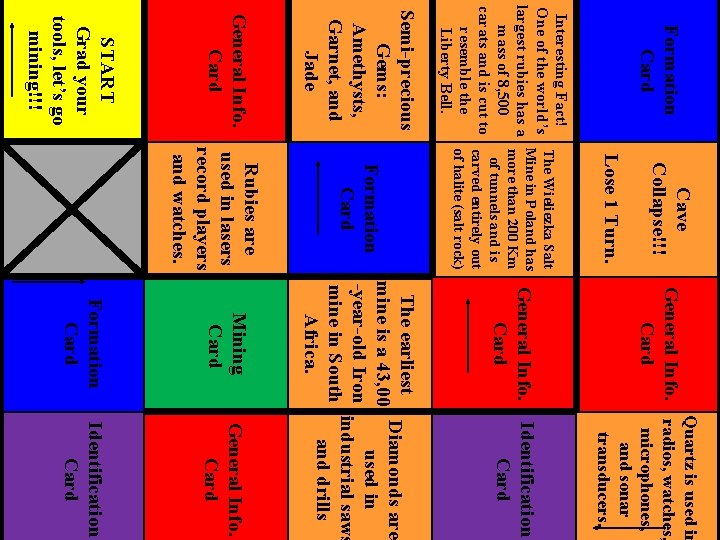
Game Directions • To determine play order, each person or team will roll a die. Highest person goes first and play moves to the left. • To play the game each player or team will roll one die to determine the number of spaces to move. If the player lands on a space with a General Info Card, Identification Card, Formation Card, or a Mining Card another player needs to read the card question to the player who landed on the space. If the answer is incorrect, then the player must move back two spaces (they do not choose another card is they land on a Card space). If the answer is correct, the player stays on the space and their turn ends. • To win the game you have to be the first person or team to successfully navigate the map and reach the Mineral Deposit. Return
Game Preparation • • • Game Board: Print out slides 10 -11, cut off the edges, then tape together. Die Game Pieces: Print out slide 5, and cut into squares for game pieces. The game cards are designed to be customized by the teacher or students, depending upon state standards and grade level. An example question has been provided for each card type. • • Formation Cards: Print out Slide 12 and cut in cards (15 total). Mining Cards: Print out Slide 13 and cut in cards (15 total). Identification Cards: Print out Slide 14 and cut in cards (15 total). General Info. Cards: Print out Slide 15 and cut in cards (15 total). Home Page
Game Pieces Return
Credits All teachers and students at non-profit schools can use, revise, or adapt this game at will at no cost on the condition that all prior designers are cited. • Originally designed by James Martin, The University of Memphis, July 22, 2013, Mineral Hunter Home Page
Educational Objectives • Audience – Middle School (5 -8) Science Students • Subject Area Objectives – Students will be able to describe the physical properties of minerals. – Students will be able to organize and explain information about the properties of minerals and their uses. – Students will be able to use physical properties to classify minerals. • Curriculum Standards: http: //www. tn. gov/education/ci/sci/doc/SCI_Grade_7. pdf – GLE 0707. 7. 1 – CFU 0707. 7. 1 – SPI 0707. 7. 1 Home Page
Copyright • • • Copyright 2013 James Martin Permission to copy this game at no cost is granted to all teachers and students of non-profit schools. Permission is also granted to all teachers and students of non-profit schools to make revisions to this game for their own purposes, on the condition that this copyright page and the credits page remain part of the game. Teachers and students who adapt the game should add their names and affiliations to the credits page without deleting any names already there. Home Page
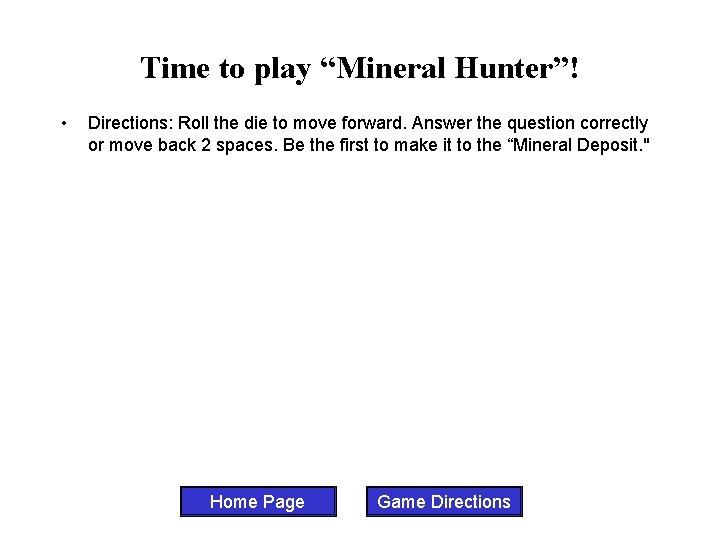
Time to play “Mineral Hunter”! • Directions: Roll the die to move forward. Answer the question correctly or move back 2 spaces. Be the first to make it to the “Mineral Deposit. " Home Page Game Directions
Mining Card Found a Silver Vein! Roll Again! Identification Card Precious Gems: Diamonds, General Info. Emeralds, Card Rubies, and Topazes Careful!!! Falling Rocks!! Identification Card General Info. Card Interesting Fact! Currently about 3, 600 minerals have been identified and 50 new minerals are discovered each year. YOU WIN!!!! MINERAL DEPOSIT! Identification Card General Info. Card A Gemstone is any naturally occurring mineral, rock, or organic material that may be cut for jewelry Pick Breaks, go back to Start Mining Card Interesting Fact! The Largest General Info. gold nugget ever Card found had a mass of 71 Kg! Formation Card Wild Card (Pick your choice of cards)
Cave Collapse!!! The Wieliezka Salt Mine in Poland has more than 200 Km of tunnels and is carved entirely out of halite (salt rock) Formation Card Interesting Fact! One of the world’s largest rubies has a mass of 8, 500 carats and is cut to resemble the Liberty Bell. Formation Card Lose 1 Turn. Semi-precious Gems: Amethysts, Garnet, and Jade Rubies are General Info. used in lasers Card record players and watches. START Grad your tools, let’s go mining!!! Identification Card Quartz is used in General Info. radios, watches, microphones, Card and sonar transducers. General Info. Card Mining Card Identification Card General Info. Card The earliest Diamonds are mine is a 43, 00 used in -year-old Iron industrial saws mine in South and drills Africa. Formation Card
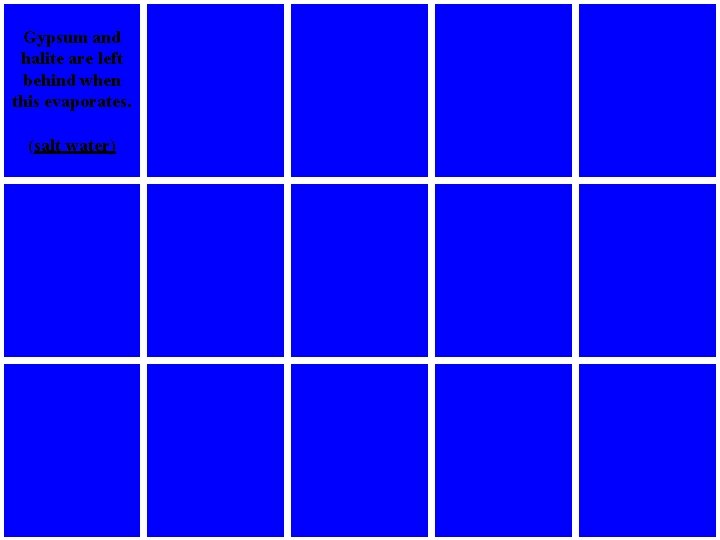
Gypsum and halite are left behind when this evaporates. (salt water)
This is the process of returning land that was mined back to its original state after the mining is completed. (Reclamation)
The tendency to break unevenly along curved or irregular surfaces is called _____. (Fracture)
Name a mineral that is made up of only one element. (Silver or Gold)