
STORY ELEMENTS Protagonist The main character of a




- Slides: 40
STORY ELEMENTS
Protagonist The main character of a novel, play, or story.
Antagonist A major character who opposes the protagonist in a story or play.
Plot The events that make up a story – aka the storyline.
Setting The “somewhere” of the story. The setting may include the historical time period, season, time of day, weather, landscape, objects, and so on.
Conflict The problem that extends throughout the story.
Types of Conflict � Person vs. person � Person vs. self � Person vs. nature � Person vs. society
Exposition The characters, setting, and conflict are introduced.
Rising Action The main character tries to solve the conflict, which becomes more and more complicated. Events that lead up to the climax.
Climax The main character succeeds or fails once and for all; the excitement is usually greatest at this point.
Falling Action The characters feel the effects of the events that are related to the climax. This is where the loose ends of the story start to tie up.
Resolution The story comes to an interesting conclusion; the main character may learn a life lesson.
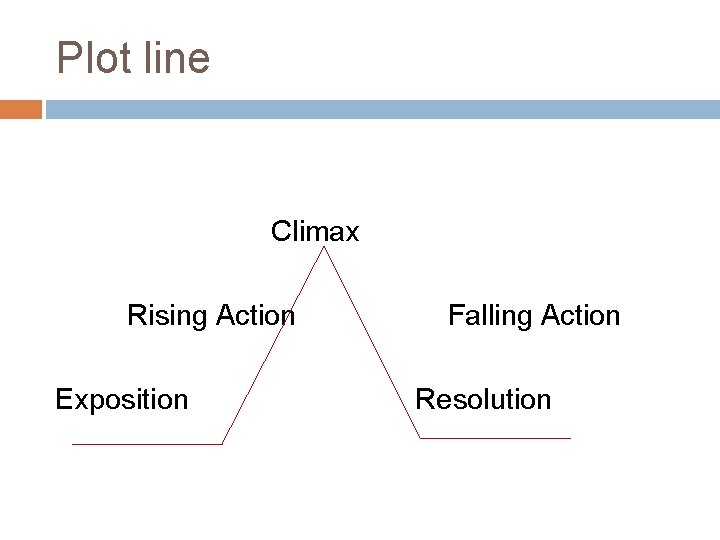
Plot line Climax Rising Action Exposition Falling Action Resolution
Foreshadowing Gives clues to hint at events that will happen later in a story.
LITERARY DEVICES
Literary Devices The tools an author can use to affect the way you, as a reader, learn about the plot, characters, and setting and the way you feel about the story.
Point of View The vantage point from which a narrative is told � 1 st person- the narrator participates in the action; uses “I” and “me” � 3 rd person omniscient- the narrator knows everything about all characters � 3 rd person limited- the narrator knows everything about one character
Narrator The person (or animal or object or fantastical being) that tells the story.
Flashback A scene that shows events that happened before the present action of the story.
Style The way an author uses words. An author’s style can be simple, direct, flowery, fast-paced, straightforward, and so on.
Tone The overall “feeling” of the author’s words. The tone can be humorous, sad, cautious, loving, etc. The tone of the author’s words affects the story’s mood.
Mood The mood is the general atmosphere of the story. Feelings the text arouses in a reader.
Literal Language Words that are true to fact, no exaggeration or metaphor. �Ex: He is tall.
Figurative Language Used to create a vivid picture and/or idea. It is language that compares, exaggerates, or means something other than what it first appears to mean.
Simile A comparison of two unlike things that uses “like” or “as”. For example, “I’m as hungry as a wolf, ” or “My love is like a rose. ”
Metaphor A comparison of two unlike things that doesn’t use “like” or “as”—such as “He’s a rock” or “I am an island. ”
Personification Giving inanimate object human characteristics. For example, “The flames reached for the child hovering in the corner. ”
Hyperbole An extreme exaggeration. For example, “Dan’s the funniest guy on the planet!” or “That baseball card is worth a zillion dollars!”
Idioms Expression in which the words have a figurative vs. literal meaning � Example: They were two peas in a pod. He let the cat out of the bag. It was raining cats and dogs.
Alliteration Alliteration: similar beginning sounds in neighboring words. (Like a tongue twister in the extreme form) �Ex. Her stunning smile was like sunshine.
Rhyme Recurring final sounds in words at the end of lines.
Clarifying To answer a question or confirm an inquiry.
Connecting When a reader finds familiarity with the story.
Predicting To guess what will happen next.
Questioning To ask or make an inquiry regarding the story.
Evaluation Making judgments or opinions of a story.
Parable A story illustrating a moral or religious lesson.
Connotative An association that a word calls to mind; beyond literal. Ex: There is no place like home.
Denotative Literal or standard dictionary meaning of a word. Ex: House
Onomatopoeia Sound words (when you say them, you’ve made the sound) Examples: sizzle, crack, pop, zip, bang