
Stormwater Management and Pollution Control California Water Environment


- Slides: 74
Stormwater Management and Pollution Control California Water Environment Association Pretreatment, Pollution Prevention, and Stormwater (P 3 S) Committee P 3 S Toolbelt Training Los Angeles County Sanitation Districts Whittier, CA October 30, 2019 Joseph C. Reichenberger PE, BCEE, F. ASCE Professor of Civil Engineering & Environmental Science Loyola Marymount University Los Angeles, CA 90045 Jreichenberger@LMU. edu
Presentation Overview • Impacts of Wet Weather Flows on Water Resource Recovery Facilities and Management Options • Stormwater Control Strategies • Probability and Percentiles • Stormwater Pollution Control Measures • Simple Economics of Stormwater Capture
Learning Objectives • Understand the Impacts of Stormwater Infiltration and Inflow on WRRF • Know the terminology of percentiles and recurrence interval • Become familiar with stormwater runoff and pollution prevention measures • Understand “simple payback” for stormwater capture
Stormwater Impacts to WRRF • Higher than normal inflows • Often increased Total Suspended Solids (TSS) loading – From high flows scouring solids deposited during normal flow • Generally reduced concentrations of BOD, N, and P • Possible increased concentrations of oil and grease, heavy metals, pesticides, etc.
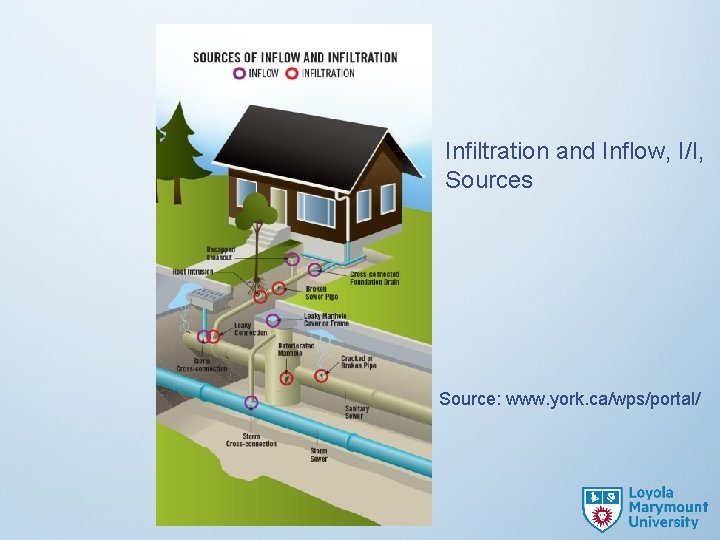
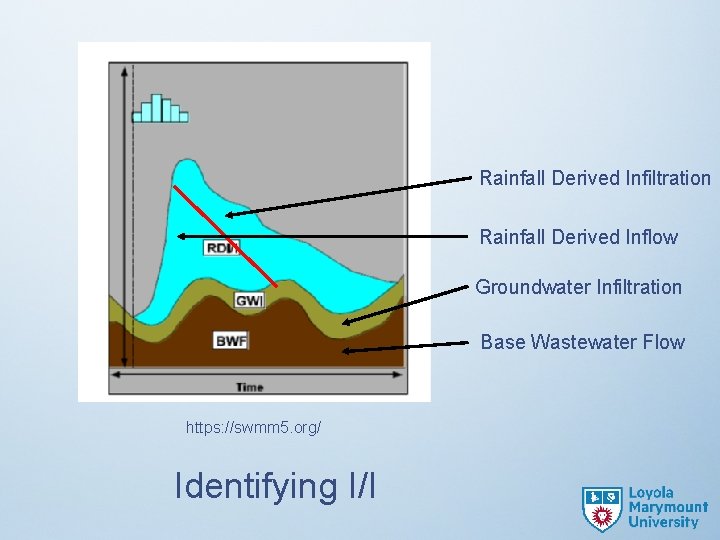
Terminology • Infiltration – Dry Weather Groundwater Infiltration – Sewers below the groundwater table – Controllable by lining pipe interior or replace pipe – Rainfall Derived Infiltration – Rainfall that percolates downward and flows subsurface to sewer pipe trench • Inflow – Direct connection to sewer system – Typically illegal yard or site drains
The Committee, P 3 S • Pretreatment • Pollution Prevention • Stormwater • All addressed in presentation today – Infiltration/Inflow to prevent pollution – Stormwater Best Management Practices (BMPs) and General Industrial Stormwater Permit provide treatment, runoff control, and pollution reduction
Let’s start with the sewer system and the Water Resource Recovery Facility (WRRF)
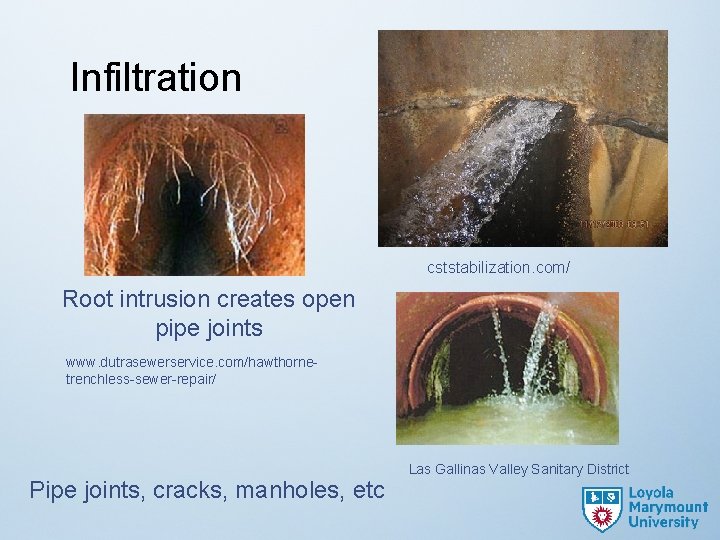
Infiltration cststabilization. com/ Root intrusion creates open pipe joints www. dutrasewerservice. com/hawthornetrenchless-sewer-repair/ Pipe joints, cracks, manholes, etc Las Gallinas Valley Sanitary District
Infiltration and Inflow, I/I, Sources Source: www. york. ca/wps/portal/
Rainfall Derived Infiltration Rainfall Derived Inflow Groundwater Infiltration Base Wastewater Flow https: //swmm 5. org/ Identifying I/I
Quantifying Groundwater Infiltration • Need Dry Weather Period and flow metering of sewersheds below the groundwater table • For residential area, the wastewater flow during the middle of the night is normally very low – Any significant flow during night is likely GWI • Industrial flows “muddy the waters” • Not easy to quantify • May be able to estimate the fraction of flow if groundwater TDS is significantly different from normal WW TDS through a mass balance
Quantifying I/I • Detailed analysis of problematic “sewersheds” – Old pipes – Below the groundwater table – Older areas of the community and industrial areas where lot drains may be connected to the sewer • Flow metering and rain gaging – Develop “R-value” = Fraction of Rainfall that appears as RDI/I – R-value = Volume of RDI/I/(Sewershed Area)* Rainfall Depth – Watch the “units”
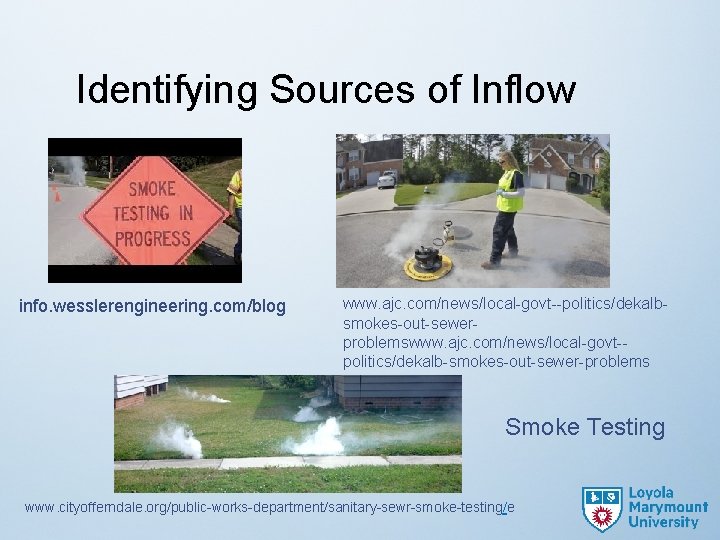
Identifying Sources of Inflow info. wesslerengineering. com/blog www. ajc. com/news/local-govt--politics/dekalbsmokes-out-sewerproblemswww. ajc. com/news/local-govt-politics/dekalb-smokes-out-sewer-problems Smoke Testing www. cityofferndale. org/public-works-department/sanitary-sewr-smoke-testing/e
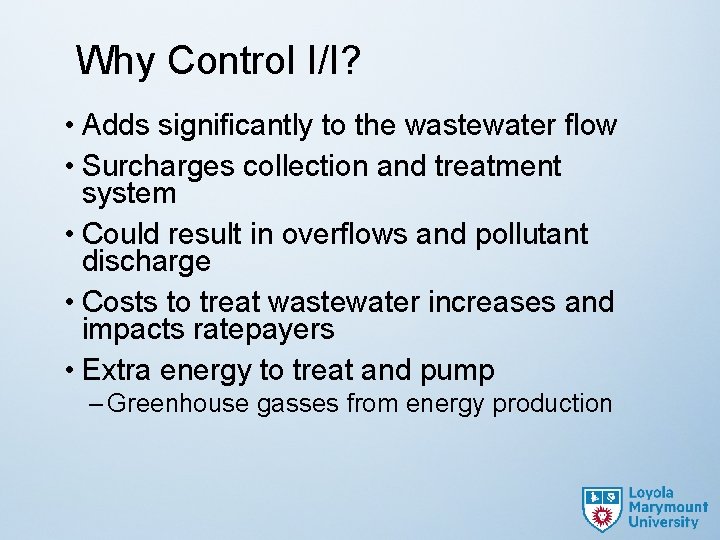
Why Control I/I? • Adds significantly to the wastewater flow • Surcharges collection and treatment system • Could result in overflows and pollutant discharge • Costs to treat wastewater increases and impacts ratepayers • Extra energy to treat and pump – Greenhouse gasses from energy production
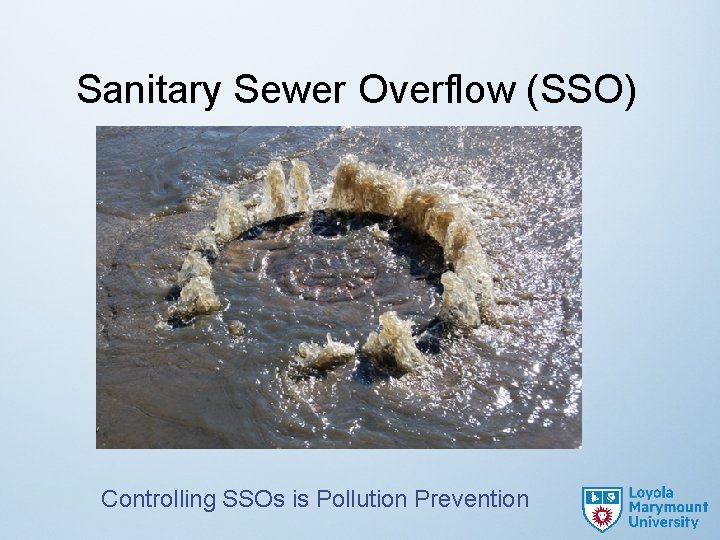
Sanitary Sewer Overflow (SSO) Controlling SSOs is Pollution Prevention
Mitigating the Impacts of I/I • Normal dry weather wastewater flows have declined in most service areas – water conservation – more efficient appliances, ultra low-flow toilets etc. • Improved rainfall prediction and live data availability • Utilize storage volume in collection system and available treatment capacity to better manage wet weather flows
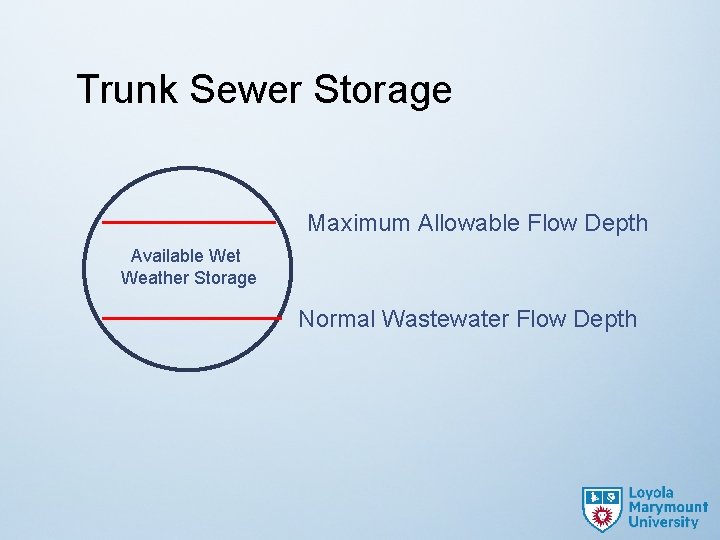
Management Options to Consider • Large collection system like City of LA, County Sanitation Districts, OCSD, etc. have large pipelines on relatively flat slopes • Depth of flow can be managed to provide interim storage of wet weather flows
Trunk Sewer Storage Maximum Allowable Flow Depth Available Wet Weather Storage Normal Wastewater Flow Depth
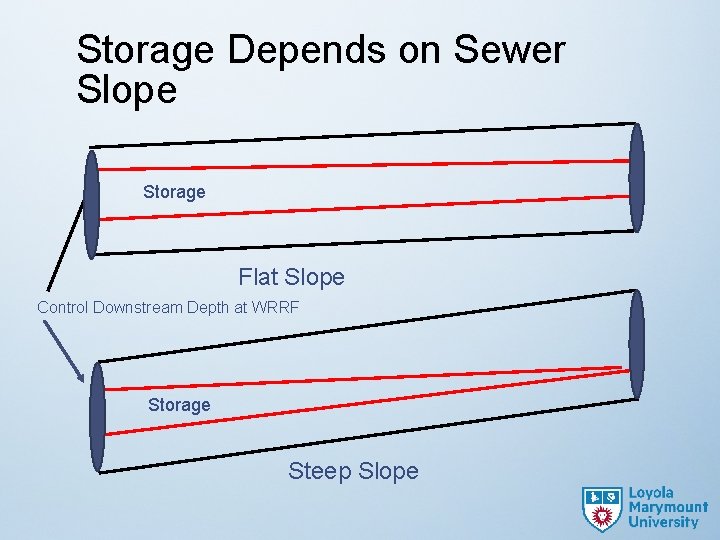
Storage Depends on Sewer Slope Storage Flat Slope Control Downstream Depth at WRRF Storage Steep Slope
Management Options to Consider • Requires real time monitoring of trunk sewer flow depths and upstream rainfall amounts • Real time monitoring of depth of flow at major upstream junctions and confluences • Installation of gates to restrict flow and depth upstream to acceptable levels • Always some risk that the unexpected can happen, e. g. , microbursts near the treatment plant • Must monitor rainfall patterns continuously
Smart Sewer System, South Bend, IN – An Example • In 2008 City installed a “smart sewer system” with depth and flow sensors, rain gauges, and automatic gates throughout the sewer trunk system • Result of work between Notre Dame, Purdue, the City and Em. Net, a private company • The technology has been generally successful but is still evolving Note: there may be other locations employing smart sewers
Dry Weather Pollution Prevention • A number of agencies are using the excess capacity in collection and treatment systems to treat “urban slobber” – summer dry weather runoff • Decreasing wastewater flows mean lower amounts of recycled water at a time when it is most needed – Reduces pollutant discharge to streams and the ocean – Makes more water available to meet recycled water needs and indirect potable reuse
Stormwater Best Management Practices (BMPs) to control flow and reduce pollution
Stormwater Control Strategies • Best if controlled at the source through Best Management Practices (BMPs) – Storage and reuse or infiltration – Detention, treatment, and release – Design guidelines are available • Often termed Low Impact Development (LID) standards – Counties and Cities have developed design guidelines for these
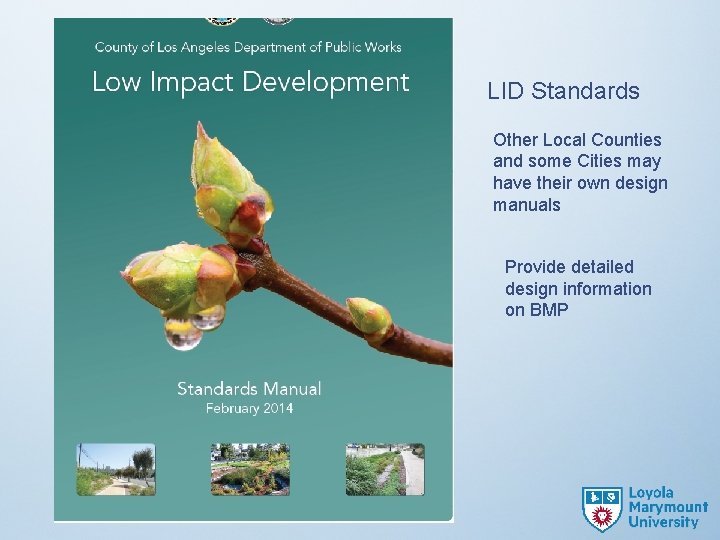
LID Standards Other Local Counties and some Cities may have their own design manuals Provide detailed design information on BMP
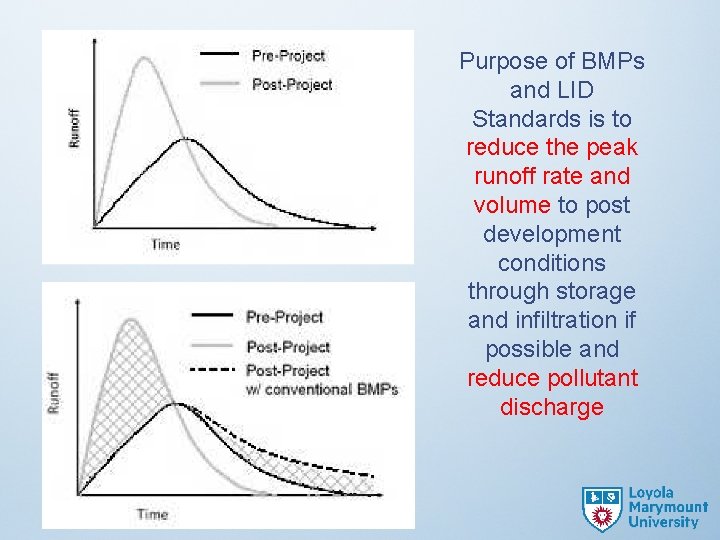
Purpose of BMPs and LID Standards is to reduce the peak runoff rate and volume to post development conditions through storage and infiltration if possible and reduce pollutant discharge
Stormwater BMPs • Bioretention Basins • Detention/Retention Ponds • Infiltration Trenches • Dry Wells • Rain Barrels and Cisterns • Hydro-mechanical Separators
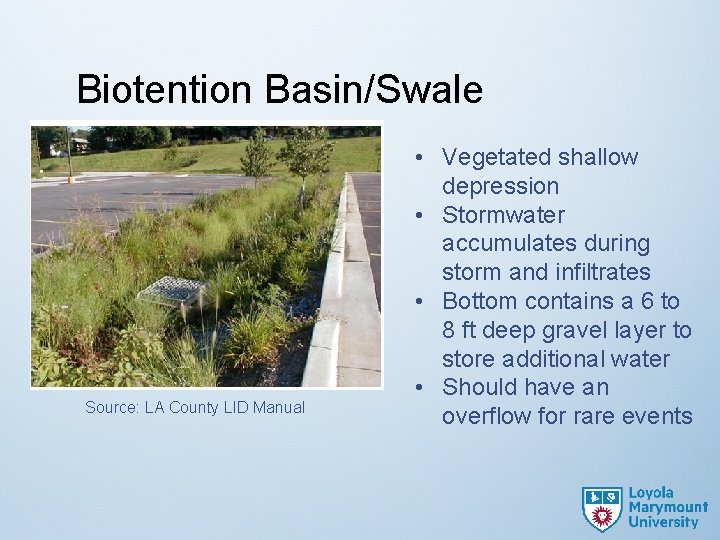
Biotention Basin/Swale Source: LA County LID Manual • Vegetated shallow depression • Stormwater accumulates during storm and infiltrates • Bottom contains a 6 to 8 ft deep gravel layer to store additional water • Should have an overflow for rare events
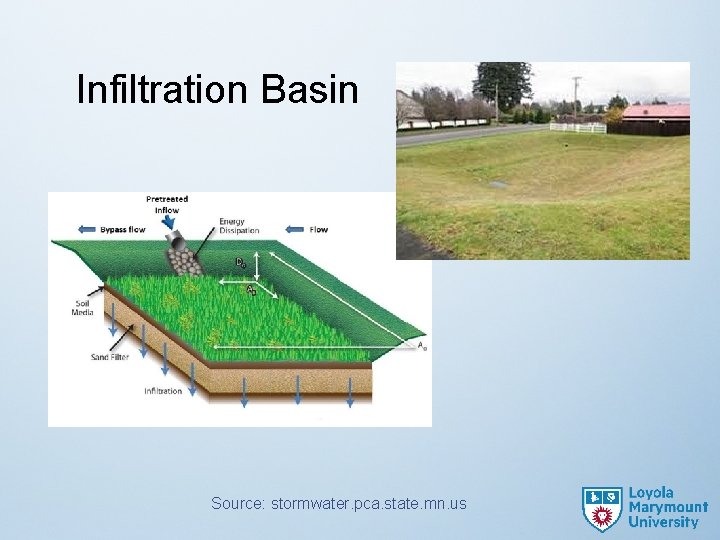
Infiltration Basin Source: stormwater. pca. state. mn. us
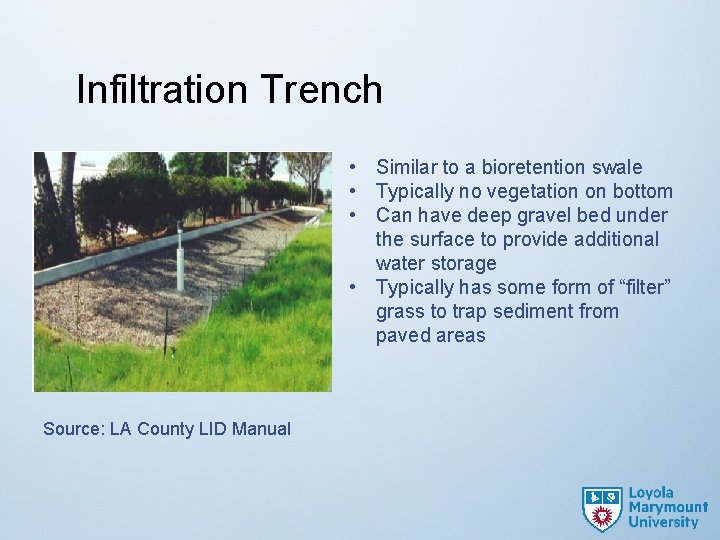
Infiltration Trench • Similar to a bioretention swale • Typically no vegetation on bottom • Can have deep gravel bed under the surface to provide additional water storage • Typically has some form of “filter” grass to trap sediment from paved areas Source: LA County LID Manual
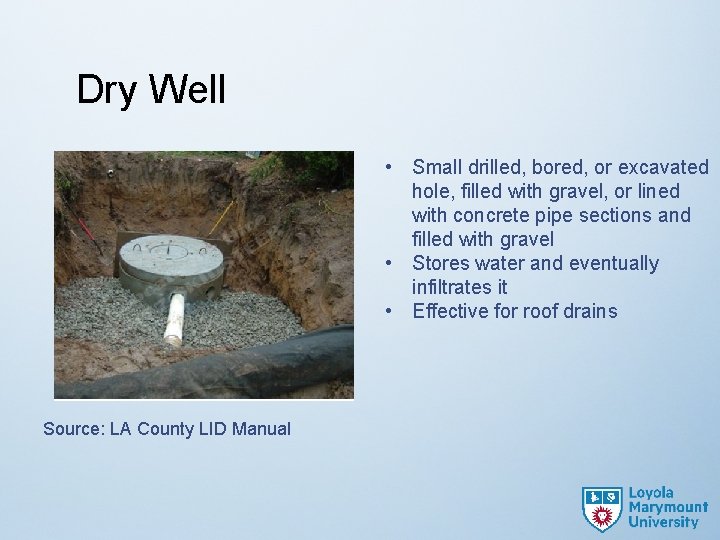
Dry Well • Small drilled, bored, or excavated hole, filled with gravel, or lined with concrete pipe sections and filled with gravel • Stores water and eventually infiltrates it • Effective for roof drains Source: LA County LID Manual
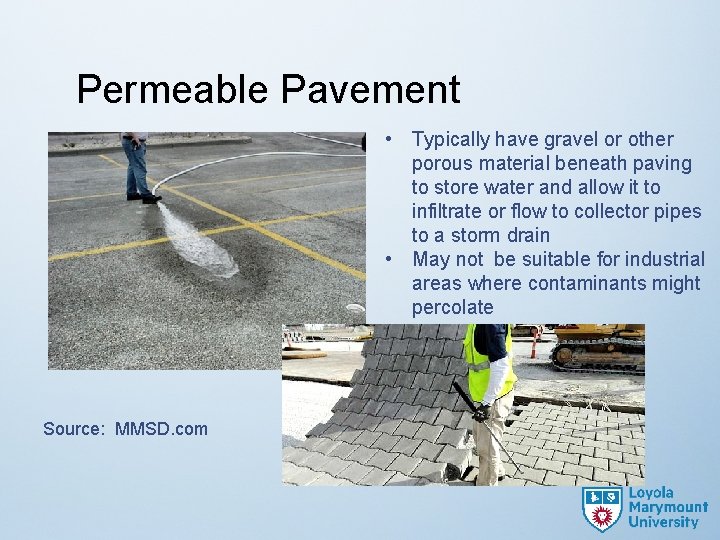
Permeable Pavement • Typically have gravel or other porous material beneath paving to store water and allow it to infiltrate or flow to collector pipes to a storm drain • May not be suitable for industrial areas where contaminants might percolate Source: MMSD. com
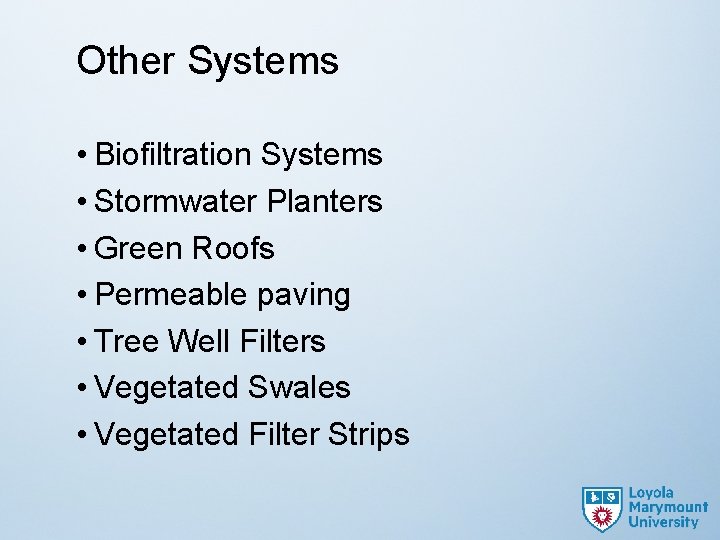
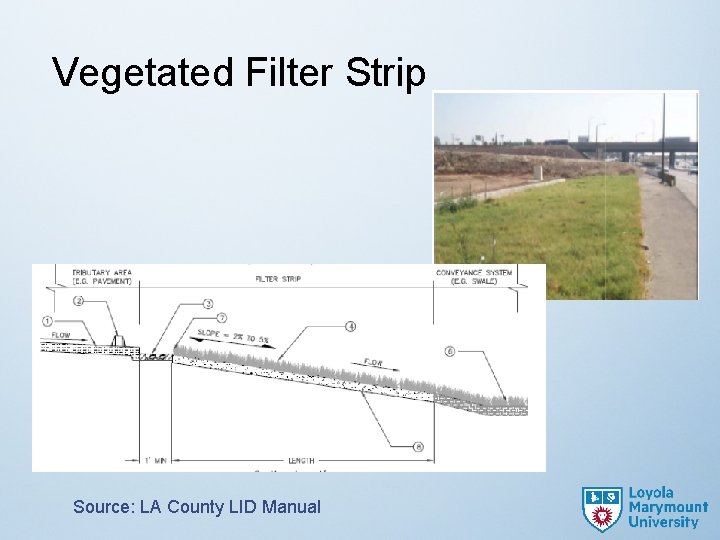
Other Systems • Biofiltration Systems • Stormwater Planters • Green Roofs • Permeable paving • Tree Well Filters • Vegetated Swales • Vegetated Filter Strips
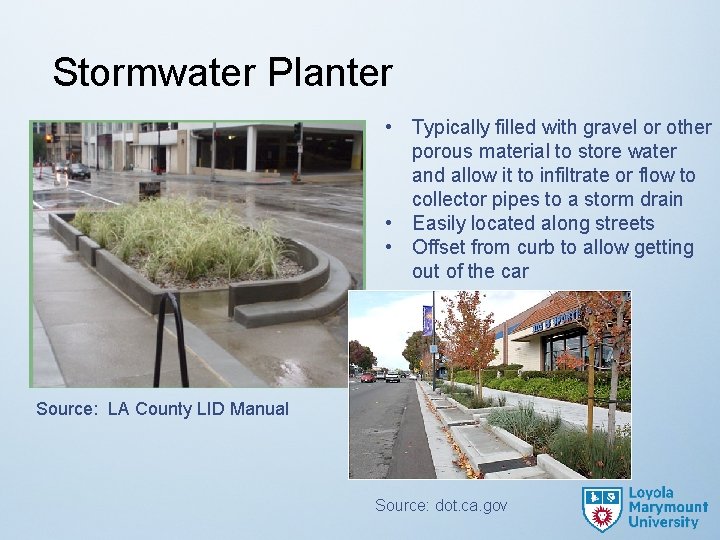
Stormwater Planter • Typically filled with gravel or other porous material to store water and allow it to infiltrate or flow to collector pipes to a storm drain • Easily located along streets • Offset from curb to allow getting out of the car Source: LA County LID Manual Source: dot. ca. gov
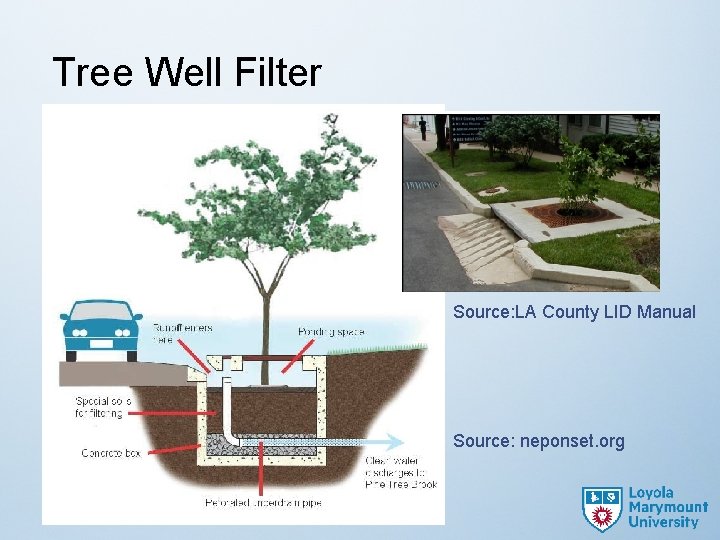
Tree Well Filter Source: LA County LID Manual Source: neponset. org
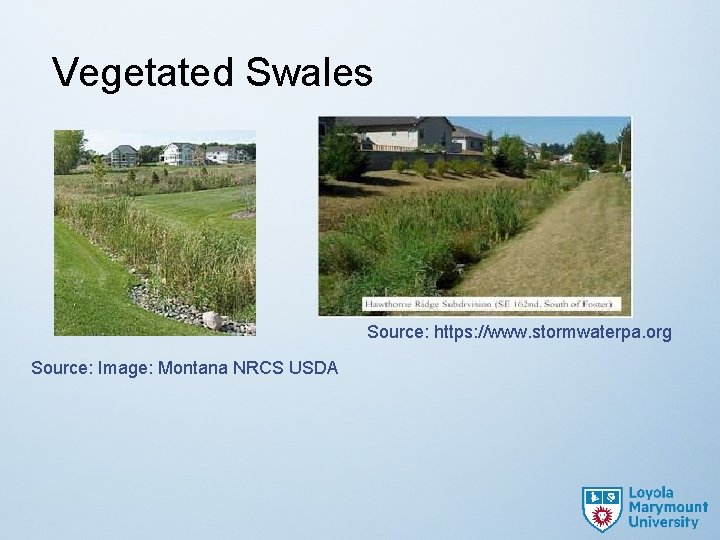
Vegetated Swales Source: https: //www. stormwaterpa. org Source: Image: Montana NRCS USDA
Vegetated Filter Strip Source: LA County LID Manual
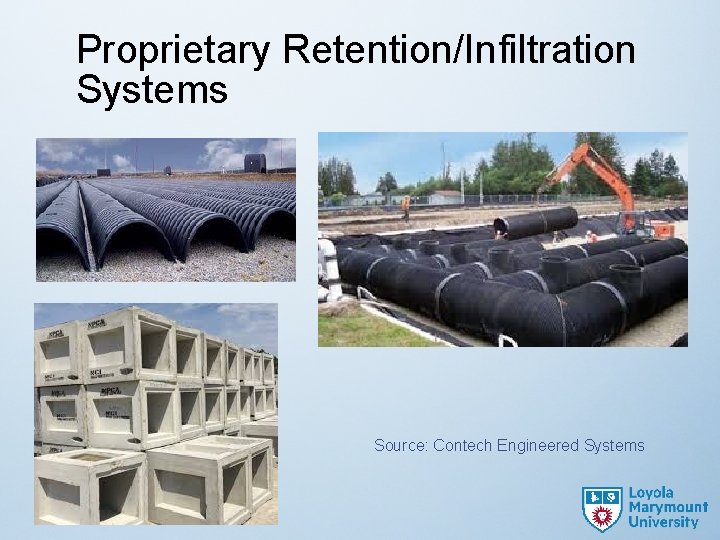
Proprietary Retention/Infiltration Systems Source: Contech Engineered Systems
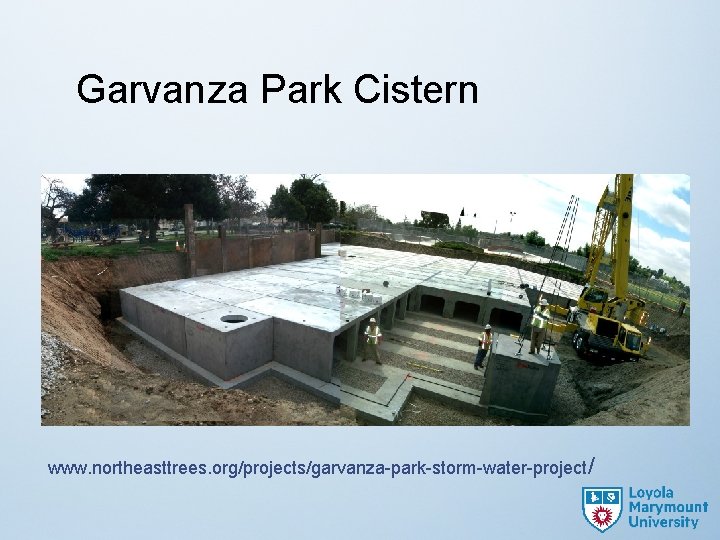
Garvanza Park Cistern www. northeasttrees. org/projects/garvanza-park-storm-water-project/
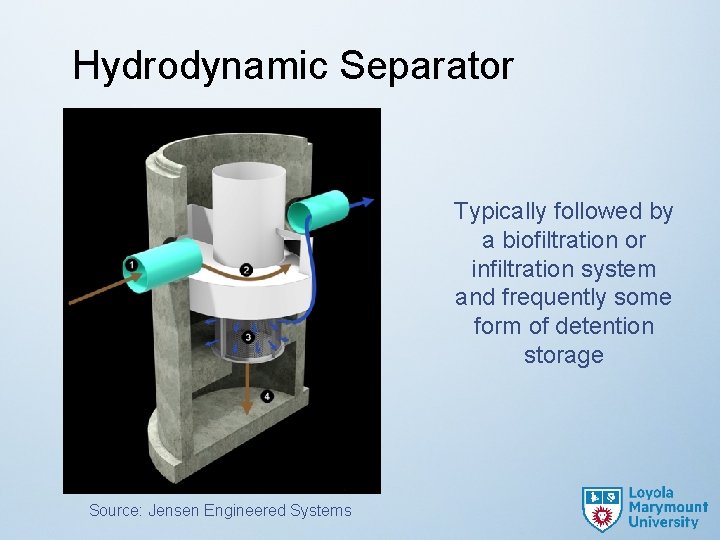
Hydrodynamic Separator Typically followed by a biofiltration or infiltration system and frequently some form of detention storage Source: Jensen Engineered Systems
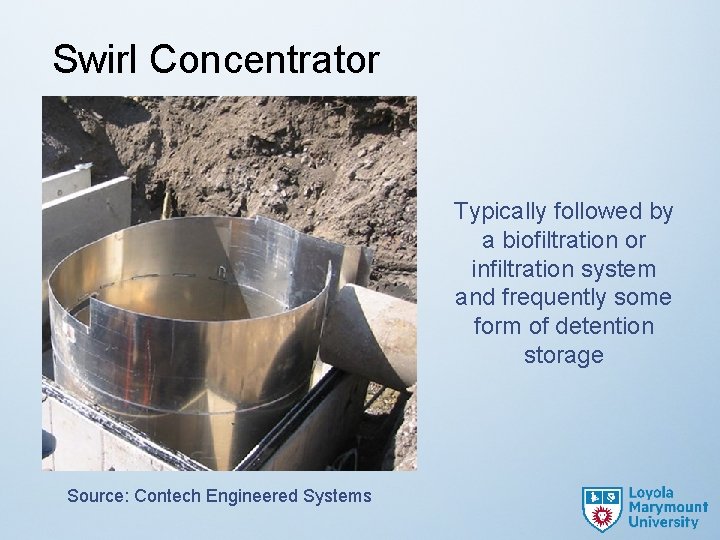
Swirl Concentrator Typically followed by a biofiltration or infiltration system and frequently some form of detention storage Source: Contech Engineered Systems
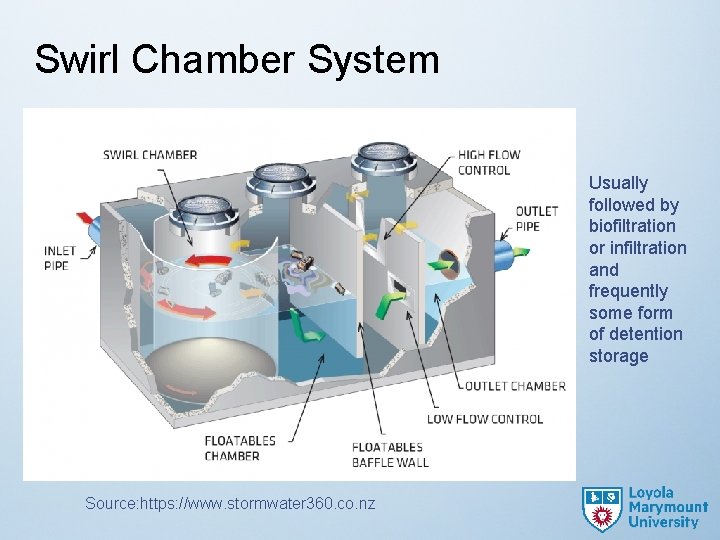
Swirl Chamber System Usually followed by biofiltration or infiltration and frequently some form of detention storage Source: https: //www. stormwater 360. co. nz
Design Parameters for BMPs • Design Rainfall: – 0. 75 in rainfall over 24 -hr period (minimum) – 85 th percentile, 24 -hour rainfall • Infiltrate any stored runoff in 96 hours • Others are particular to the BMP; refer to LID and BMP design manuals
What does 85 th percentile 24 hour rainfall mean? • Considering all of the rainstorms that dropped rain in the area over a 24 -hour period (say Los Angeles County), since record keeping began, only 15% of all of those storms dropped more than the 85 th percentile amount
Recurrence Interval • Another way of expressing rainfall or runoff amounts • “ 50 -year rainfall”, “ 10 -year storm”, “ 100 -year flood”, etc. • Over a long period of time, say 1, 000 years, we could expect 20 storms with a rainfall equal to or greater than the 50 -year rainfall to occur; or 100 storms with a rainfall equal to or greater than the 10 -year rainfall, etc. • They could occur two years in a row • Not intended to describe the time period between events • The 85 th percentile would be roughly equivalent to the 15 -year rainfall
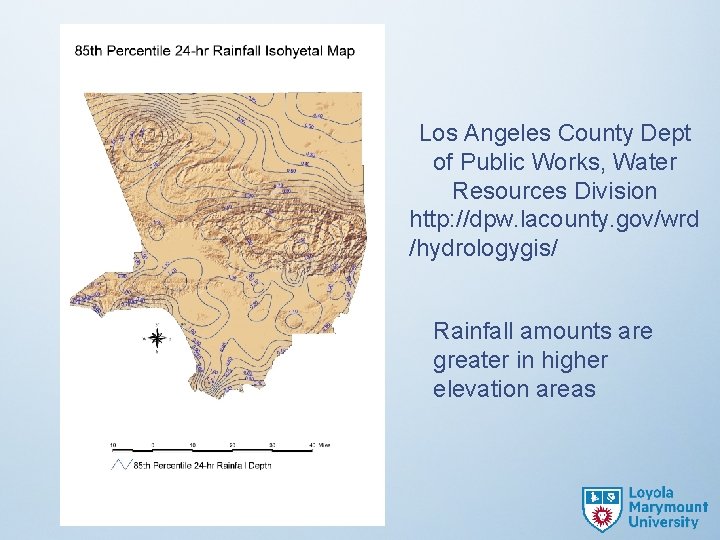
Los Angeles County Dept of Public Works, Water Resources Division http: //dpw. lacounty. gov/wrd /hydrologygis/ Rainfall amounts are greater in higher elevation areas
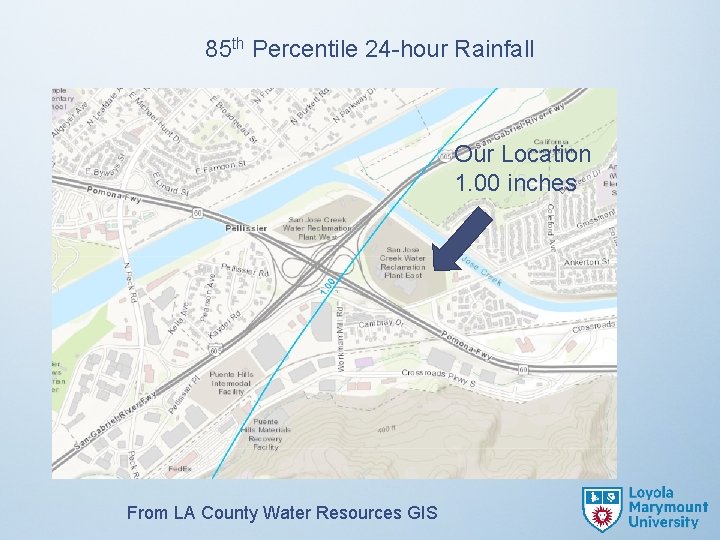
85 th Percentile 24 -hour Rainfall Our Location 1. 00 inches From LA County Water Resources GIS
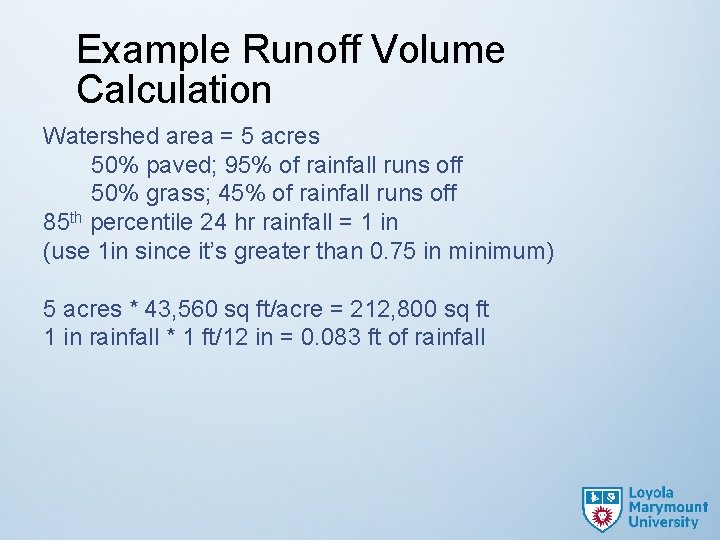
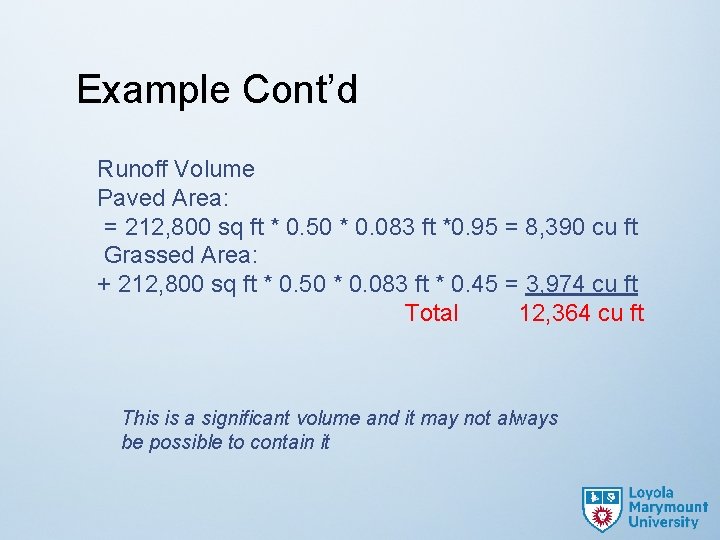
Example Runoff Volume Calculation Watershed area = 5 acres 50% paved; 95% of rainfall runs off 50% grass; 45% of rainfall runs off 85 th percentile 24 hr rainfall = 1 in (use 1 in since it’s greater than 0. 75 in minimum) 5 acres * 43, 560 sq ft/acre = 212, 800 sq ft 1 in rainfall * 1 ft/12 in = 0. 083 ft of rainfall
Example Cont’d Runoff Volume Paved Area: = 212, 800 sq ft * 0. 50 * 0. 083 ft *0. 95 = 8, 390 cu ft Grassed Area: + 212, 800 sq ft * 0. 50 * 0. 083 ft * 0. 45 = 3, 974 cu ft Total 12, 364 cu ft This is a significant volume and it may not always be possible to contain it
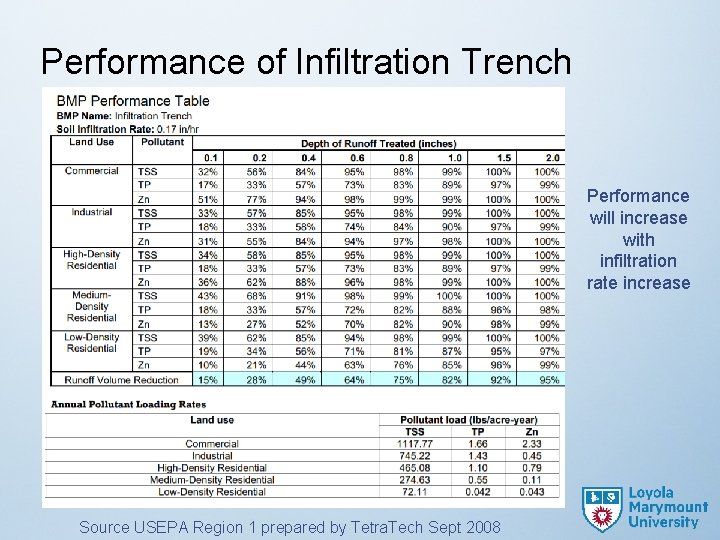
Performance of Infiltration Trench Performance will increase with infiltration rate increase Source USEPA Region 1 prepared by Tetra. Tech Sept 2008
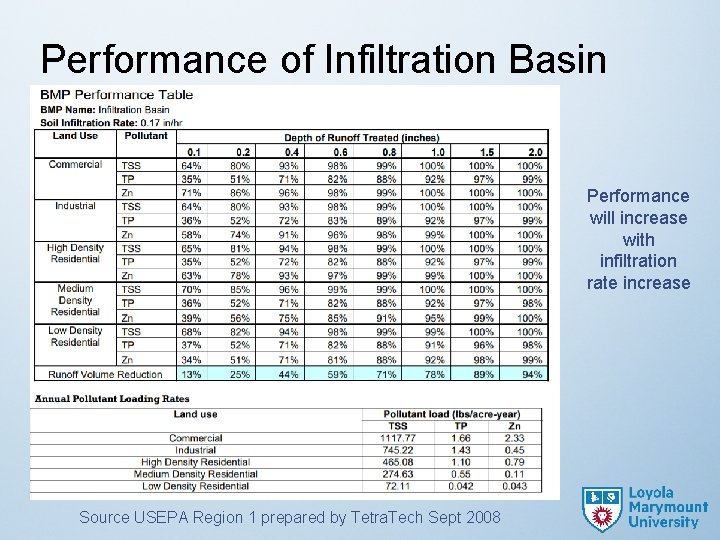
Performance of Infiltration Basin Performance will increase with infiltration rate increase Source USEPA Region 1 prepared by Tetra. Tech Sept 2008
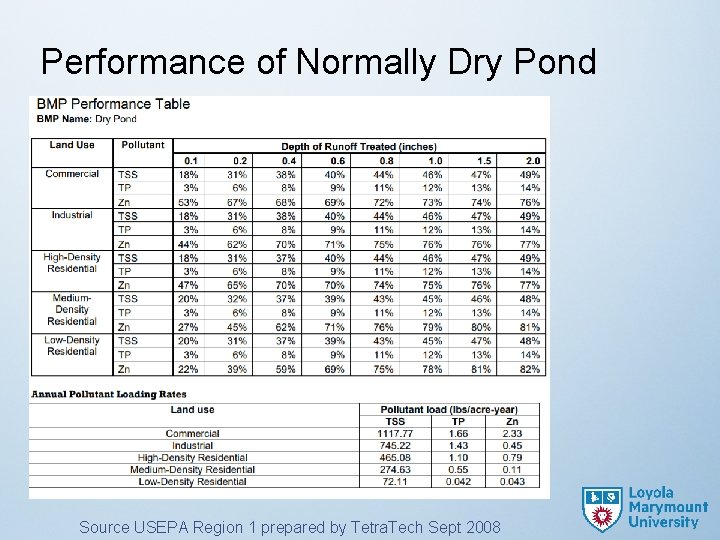
Performance of Normally Dry Pond Source USEPA Region 1 prepared by Tetra. Tech Sept 2008
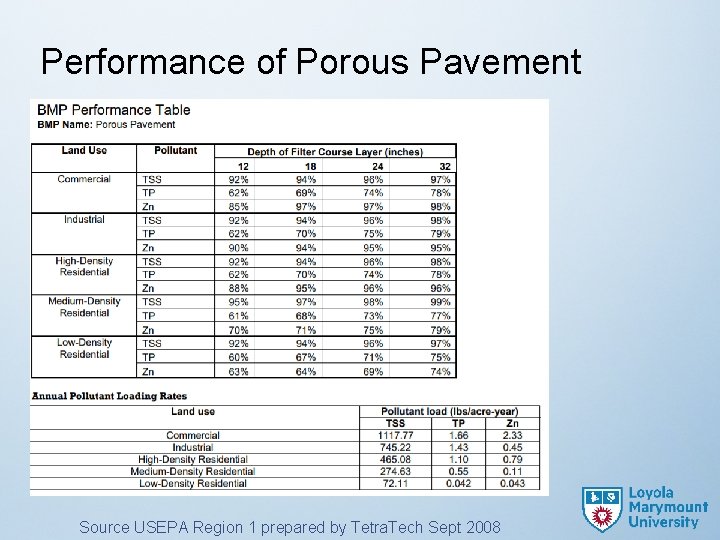
Performance of Porous Pavement Source USEPA Region 1 prepared by Tetra. Tech Sept 2008
General Industrial Stormwater Permit to control pollution from industrial sites NPDES CAS 000001
General Industrial Stormwater Permit • Mandated for certain industries under Federal Clean Water Act for certain SIC Codes that discharge stormwater to a storm drain system or surface waters obtain an NPDES permit • Industries comply by applying for coverage under CA’s General Permit for Stormwater Discharges Associated with Industrial Activities (or by a separate individual permit) with Regional Board • Requires regular monitoring and reporting and implementation of Best Management Practices to minimize pollutant discharge
General Industrial Stormwater Permit Cont’d • Requires preparation and filing of a Stormwater Pollution Prevention Plan (SWPPP) with Regional Board – Elimination of any unauthorized nonstormwater discharges • Designation by Owner/Applicant of a Qualified Industrial Stormwater Practitioner (QISP) who has been trained
Industrial General Permit Cont’d • BMP Design Rainfall or Runoff – Volume Based: – Must treat the 85 th Percentile 24 -hour rainfall volume – Make sure there is adequate storage volume or treatment capacity – Flow-rate Based: – Based on a rainfall intensity of 0. 2 in/hr – Based on the 85 th percentile hourly rainfall intensity multiplied by a factor of 2 – Make sure the treatment system has adequate flow capacity
General Facilities Covered • Cement manufacturing, refineries, mining etc. • Certain manufacturing facilities • Oil and gas facilities • Landfills receiving industrial wastes • Hazardous waste TSD facilities • Recycling facilities • Steam electric power generating facilities • Vehicle maintenance shops, airport deicing • WRRFs* * May be covered in WRRF NDPES or discharge permit
Now that we’ve looked at some systems and methods, how do we determine the economics of these systems
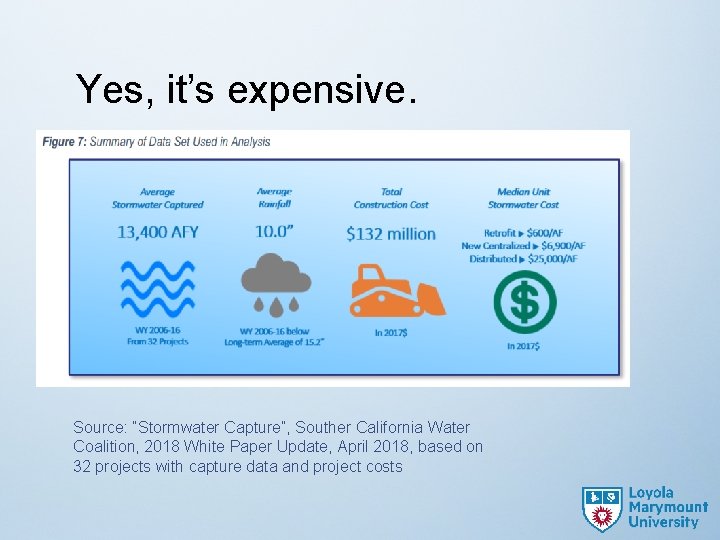
Some Disclaimers • Most stormwater capture and reuse systems do not “pay for themselves”, i. e. , not economically viable – Water is to “cheap” – Monterey Park = $3. 50/100 cu ft or $0. 005/gal – LADWP = $7. 30/100 cu ft or $0. 01/gal – Sea Water Desalting = $2, 500 or so/acre-ft = $0. 008/gal – Advanced Treated Recycled Water $1, 800 to $2, 500/acre-ft or $0. 006 to $0. 008/gal – Arrowhead Bottled Water 16 oz bottles (Target) = $1. 10/gal
Some Disclaimers Cont’d • There are other financial benefits in addition to water saved which are not quantified, but must be considered: – Financial impacts of pollution on streams and ocean – Potential flood savings benefits from reduced peak flow – These and other factors should be given a “dollar” value and included • You just might want to do the project anyway since it is the “right thing to do”
Let’s take an example of a Rain Barrel • Cost for 50 -gal plastic rain barrel at Home Depot = $158; say another $40 for parts to modify raingutter downspout etc. = $200 total • Water savings/barrel at LADWP prices = 50 gal* 0. 01/gal = $0. 50 • Say barrel lasts 10 years; annual cost = $200/10 years = $20/year
Rain Barrel Cont’d • At $0. 50 savings in water/barrel of water, each year we would need to capture $20/year/$0. 50/barrel of water saved = 40 barrels full of rain water each year to make it “pencil out” • The problem is there are not 40 rainstorms* per year in So. Calif, and when it does rain, we don’t need to water the lawns • This doesn’t mean we don’t recommend rain barrels, it is only that they don’t make economic sense; but we just might want to do it. * Los Angeles averages about 36 rainy days/yr; actual rainstorms would be much less
How much rainwater could be captured in normal wet season • Typically get about 15 in of rain/year • Assume a roof area = 2, 000 sq ft • We could capture 2, 000 sq ft * 15 in/12 in/ft *7. 48 gal/cu ft = 18, 700 gal/year • Cost for 20, 000 gal plastic tank = $1. 00 to $1. 50/gallon plus installation and possibly permitting costs • Assume a useful life of 15 years, cost for 20, 000 gal tank installed = $1. 60/gal or $32, 000
Value of Annual Rainfall • At LADWP water rates = $0. 01/gal, water savings is $187/year • Simple Payback Period – The time required for the savings we realize to offset the initial cost of doing the project • Simple payback time = Costs to Implement/Annual savings • Simple payback time = ($32, 000)/ ($187/year savings) = 176 years* * Does not include the time value of money or water rate increases over time
Value of Annual Rainfall (Cont’d) • What if water rates increased 1. 5%/year? – After 15 years $0. 01/gal * (1+0. 015)15 = $0. 0125/gal; say an average of $0. 015/gal over the 15 years – 20, 000 gal/year * $0. 015/gal = $300/year savings • Simple payback time = ($32, 000)/ ($300/year savings) = 100 years
Value of Annual Rainfall (Cont’d) • Express the cost in terms of $/acre-ft – Acre-ft = 1 acre flooded 1 ft deep – Acre = 43, 560 sq ft, so acre-ft = 43, 560 cu ft = 325, 800 gallons • In 15 years we would collect 20, 000 gal/year * 15 years = 300, 000 gal water = 0. 92 acre-ft • Initial cost = $32, 000, so cost per acre-ft = $32, 000/0. 92 acre-ft = $34, 700/acre-ft at least 12 - 15 times the cost to desalt sea water • Should we do it? Yes, but not for economic reasons
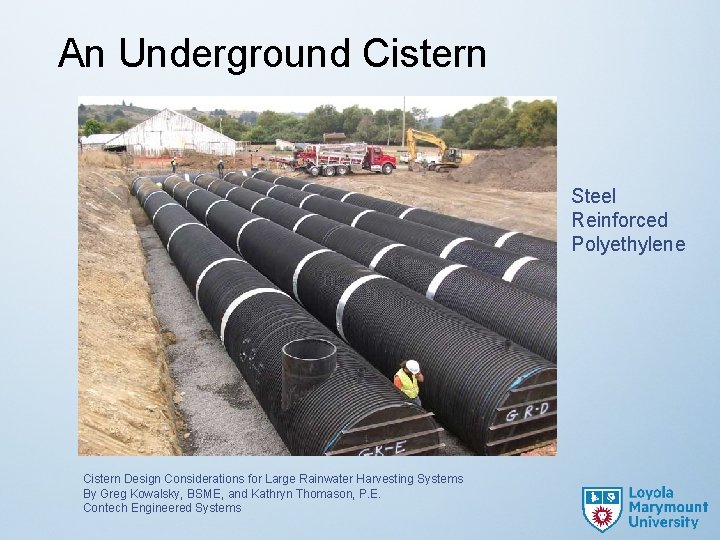
Large Cistern Systems • Buried under parking lots and park recreation surfaces • Cost/acre-ft would be reduced due to economics of scale
An Underground Cistern Steel Reinforced Polyethylene Cistern Design Considerations for Large Rainwater Harvesting Systems By Greg Kowalsky, BSME, and Kathryn Thomason, P. E. Contech Engineered Systems
Yes, it’s expensive. Source: “Stormwater Capture”, Souther California Water Coalition, 2018 White Paper Update, April 2018, based on 32 projects with capture data and project costs
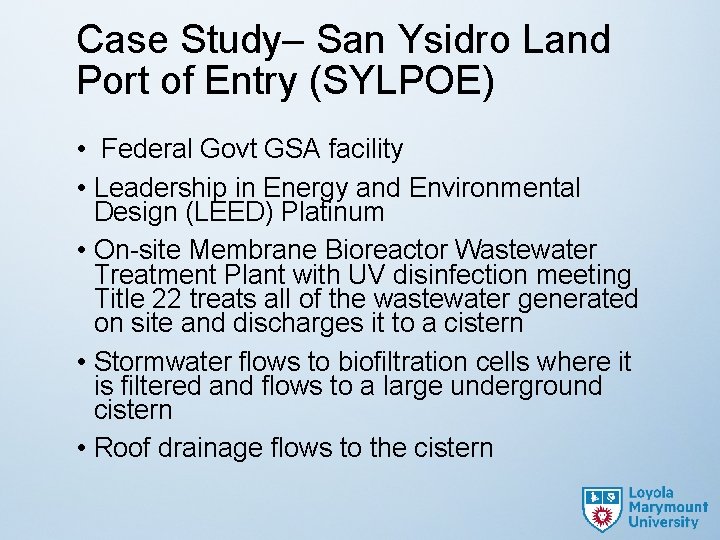
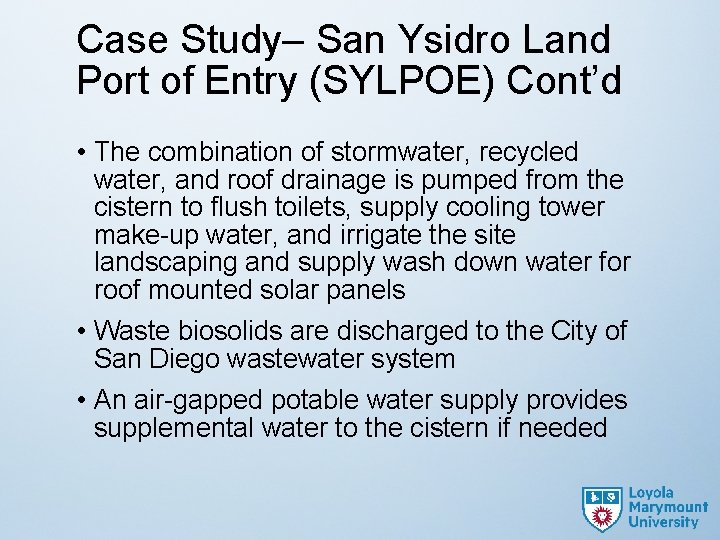
Case Study– San Ysidro Land Port of Entry (SYLPOE) • Federal Govt GSA facility • Leadership in Energy and Environmental Design (LEED) Platinum • On-site Membrane Bioreactor Wastewater Treatment Plant with UV disinfection meeting Title 22 treats all of the wastewater generated on site and discharges it to a cistern • Stormwater flows to biofiltration cells where it is filtered and flows to a large underground cistern • Roof drainage flows to the cistern
Case Study– San Ysidro Land Port of Entry (SYLPOE) Cont’d • The combination of stormwater, recycled water, and roof drainage is pumped from the cistern to flush toilets, supply cooling tower make-up water, and irrigate the site landscaping and supply wash down water for roof mounted solar panels • Waste biosolids are discharged to the City of San Diego wastewater system • An air-gapped potable water supply provides supplemental water to the cistern if needed
The Fine Print • Pictures and descriptions of various proprietary systems have been included in this presentation. This is for illustrative purposes only and is not an endorsement of the system or product.
Thank You