
Stormwater Infiltration on Contaminated Sites Rebecca Higgins Mike
Stormwater Infiltration on Contaminated Sites Rebecca Higgins Mike Trojan Minnesota Pollution Control Agency ASCE MN October Section Meeting October 19, 2017
Presentation Outline • Infiltration overview • Regulatory framework • Guidance • Scenarios, examples, case study • Q&A

Stormwater infiltration is desired when conditions are appropriate – water quality • About 90% of TP and TSS is removed for an infiltration practice that meets a 1. 1 inch (MIDS) performance goal (B soils) • Generally, impacts to groundwater are insignificant. Exceptions: • Chloride • Soils with excessive infiltration rates and poor attenuation properties • Locations that pose higher pollution risk (hot spots and contaminated sites)
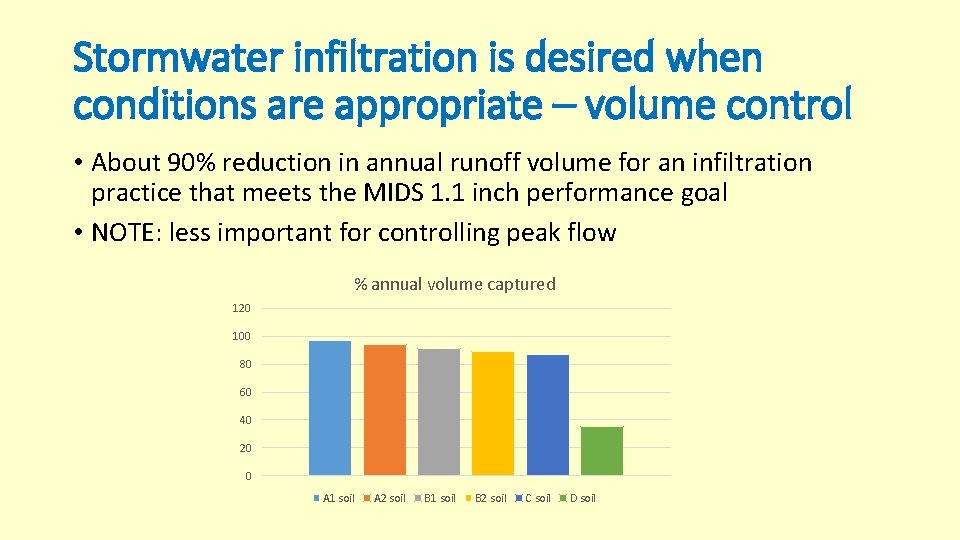
Stormwater infiltration is desired when conditions are appropriate – volume control • About 90% reduction in annual runoff volume for an infiltration practice that meets the MIDS 1. 1 inch performance goal • NOTE: less important for controlling peak flow % annual volume captured 120 100 80 60 40 20 0 A 1 soil A 2 soil B 1 soil B 2 soil C soil D soil

There are many situations where infiltration is not appropriate • Shallow bedrock • High water table • Karst • Inadequate separation distance • Contaminated soils or groundwater – infiltrated stormwater can mobilize contaminants
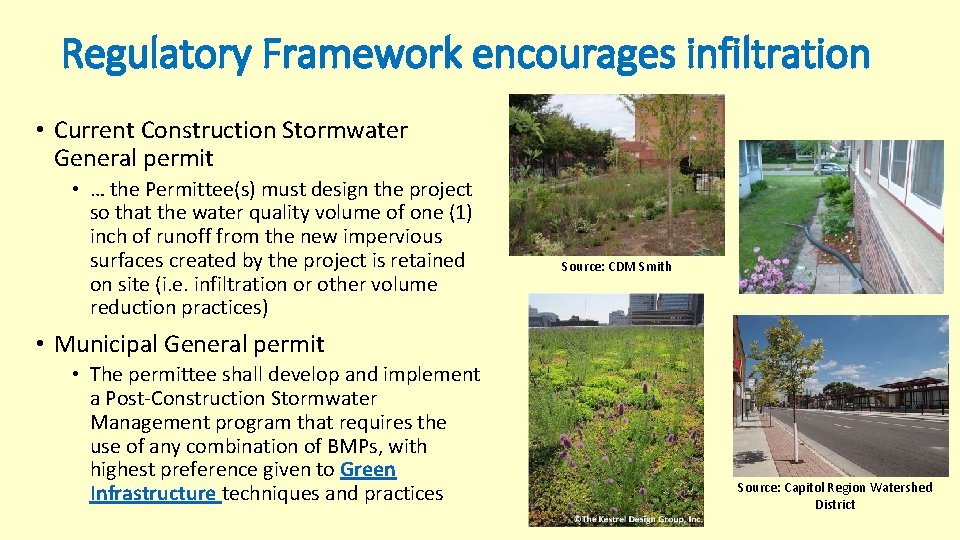
Regulatory Framework encourages infiltration • Current Construction Stormwater General permit • … the Permittee(s) must design the project so that the water quality volume of one (1) inch of runoff from the new impervious surfaces created by the project is retained on site (i. e. infiltration or other volume reduction practices) Source: CDM Smith • Municipal General permit • The permittee shall develop and implement a Post-Construction Stormwater Management program that requires the use of any combination of BMPs, with highest preference given to Green Infrastructure techniques and practices Source: Capitol Region Watershed District
Regulatory Framework has restrictions • Current Construction Stormwater General permit • Infiltration is prohibited when the infiltration system will be constructed in … Areas where high levels of contaminants in soil or groundwater will be mobilized by the infiltrating stormwater. • Draft proposed language for next permit issuance • Infiltration is prohibited in areas where infiltrated stormwater could enter contaminated groundwater with contaminant levels over Health Risk Limits (HRLs), Health based Values (HBVs), or Maximum Contaminant Levels (MCLs), unless an appropriate environmental assessment is performed to demonstrate that infiltration will not have a negative impact on groundwater. • Infiltration is prohibited in areas where infiltrated stormwater could come into contact with contaminated soils with levels above Soil Leaching Values (SLVs), unless an appropriate environmental assessment is performed to demonstrate that infiltration will not have a negative impact on groundwater.
Potential Contamination Liability MERLA (115 B) Persons Not Protected from Liability Water Pollution Control Act and Petroleum Tank Release Cleanup Act (115, 115 C) Responses to Releases and Duty to Notify and Avoid Water Pollution MN Rule (7060) Prohibition Against Discharge into Saturated or Unsaturated Zones
Regulatory Framework – Contaminated Sites Review Remediation Programs review sites individually in context Do not have legal authority to approve stormwater designs Work with consultants and stormwater staff to be aware of infiltration risks May comment on potential risks posed by infiltration A development’s stormwater management system can affect the soil leaching pathway. The location and design of the stormwater management system should take into account the nature and distribution of contamination at or nearby the site.
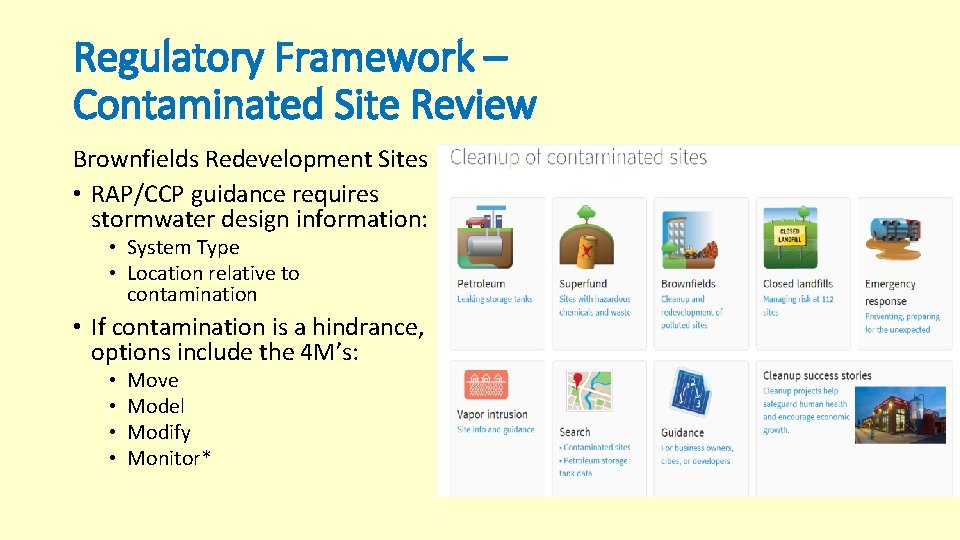
Regulatory Framework – Contaminated Site Review Brownfields Redevelopment Sites • RAP/CCP guidance requires stormwater design information: • System Type • Location relative to contamination • If contamination is a hindrance, options include the 4 M’s: • • Move Model Modify Monitor*
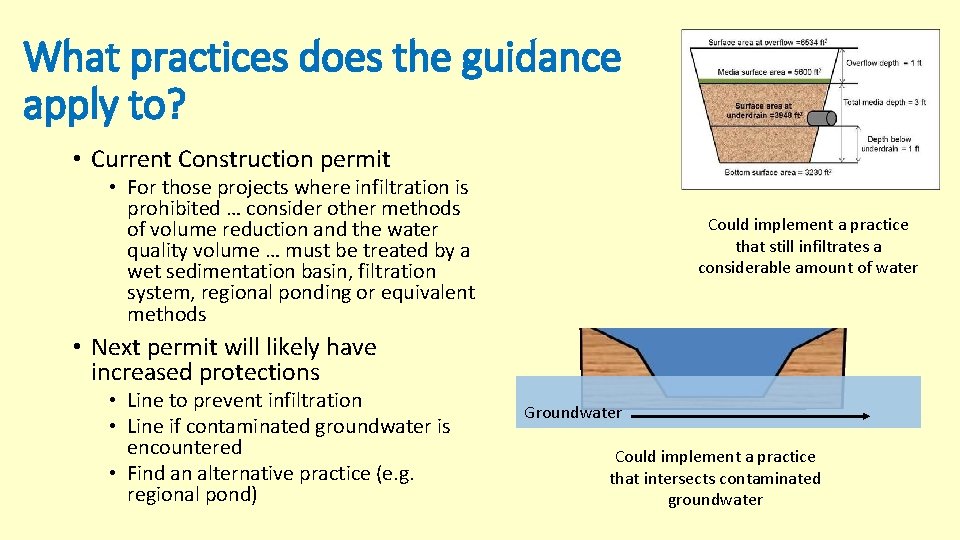
What practices does the guidance apply to? • Current Construction permit • For those projects where infiltration is prohibited … consider other methods of volume reduction and the water quality volume … must be treated by a wet sedimentation basin, filtration system, regional ponding or equivalent methods Could implement a practice that still infiltrates a considerable amount of water • Next permit will likely have increased protections • Line to prevent infiltration • Line if contaminated groundwater is encountered • Find an alternative practice (e. g. regional pond) Groundwater Could implement a practice that intersects contaminated groundwater
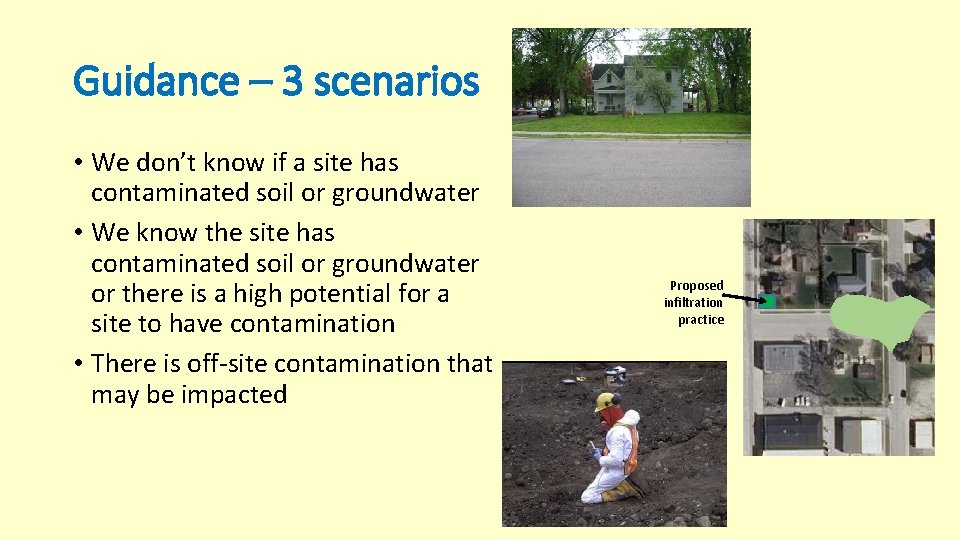
Guidance – 3 scenarios • We don’t know if a site has contaminated soil or groundwater • We know the site has contaminated soil or groundwater or there is a high potential for a site to have contamination • There is off-site contamination that may be impacted Proposed infiltration practice
Scenario 1 - We don’t know if a site has contaminated soil or groundwater • Current guidance is in the Minnesota Stormwater Manual: Screening assessment for contamination at potential stormwater infiltration sites • We recommend a screening level assessment of the site • The screening utilizes simple methods to assess the likely presence of contamination – doesn’t burden the developer with sampling and analysis • The method is conservative in that infiltration is not recommended if there is potential contamination at the site • The method utilizes a checklist contained in an Excel spreadsheet
Checklist items 1. 2. 3. 4. Is or was the site contaminated and not remediated? Are there on-site “indicators” that contamination may exist? Are there off-site “indicators” that contamination may exist? If “indicators” exist, can they be isolated or eliminated to allow for infiltration?
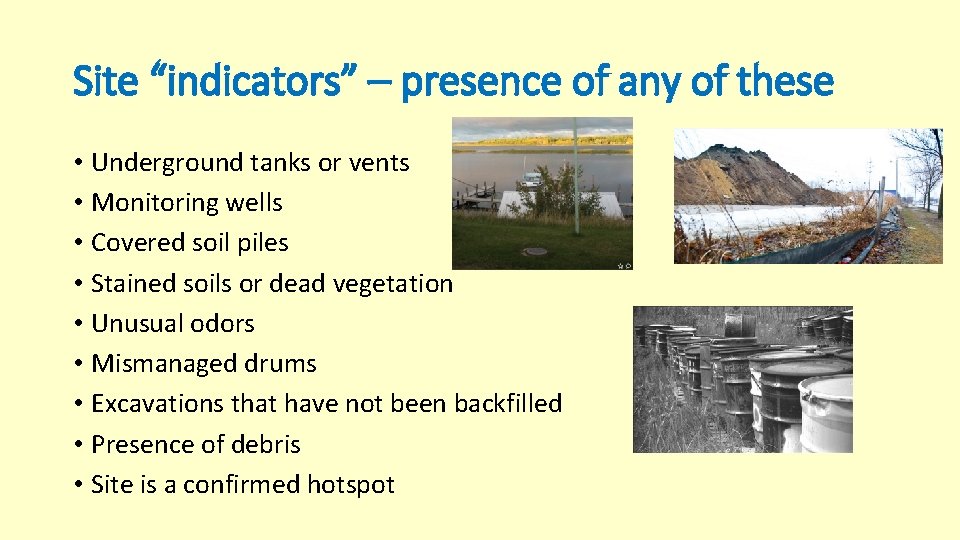
Site “indicators” – presence of any of these • Underground tanks or vents • Monitoring wells • Covered soil piles • Stained soils or dead vegetation • Unusual odors • Mismanaged drums • Excavations that have not been backfilled • Presence of debris • Site is a confirmed hotspot
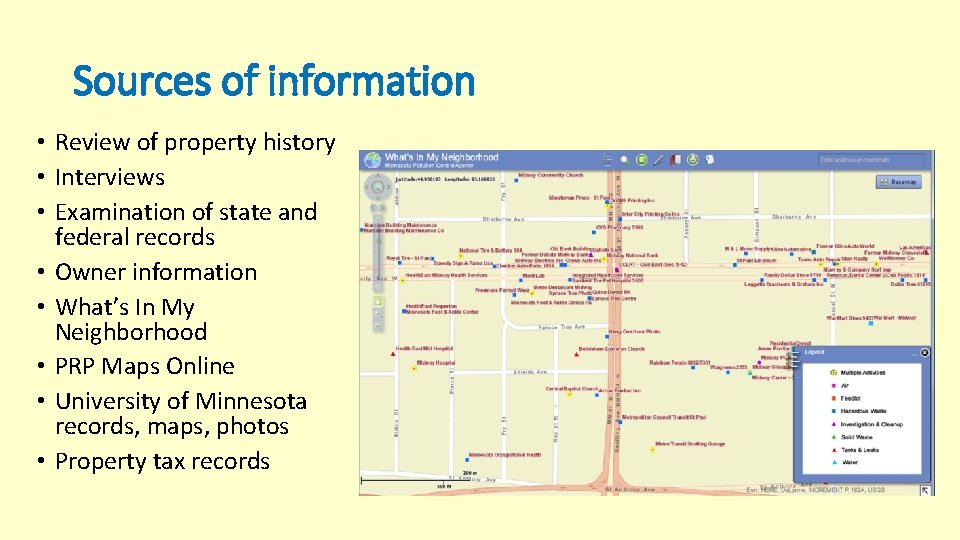
Sources of information • Review of property history • Interviews • Examination of state and federal records • Owner information • What’s In My Neighborhood • PRP Maps Online • University of Minnesota records, maps, photos • Property tax records
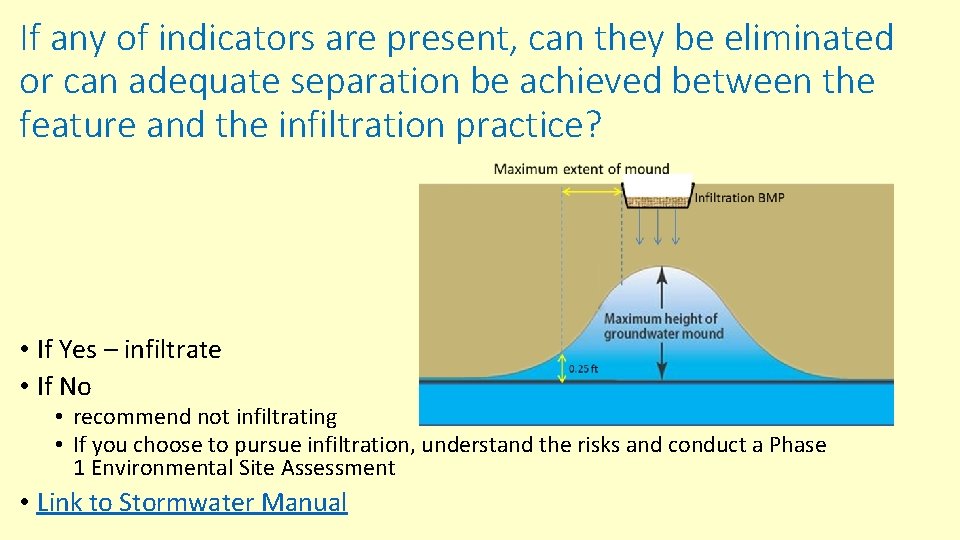
If any of indicators are present, can they be eliminated or can adequate separation be achieved between the feature and the infiltration practice? • If Yes – infiltrate • If No • recommend not infiltrating • If you choose to pursue infiltration, understand the risks and conduct a Phase 1 Environmental Site Assessment • Link to Stormwater Manual
Scenario 2: We know the site has contaminated soil or groundwater or there is a high potential for a site to have contamination • Could be based on sampling • Could be based on failure to pass the screening assessment • In either case, a site investigation, including sampling, is necessary
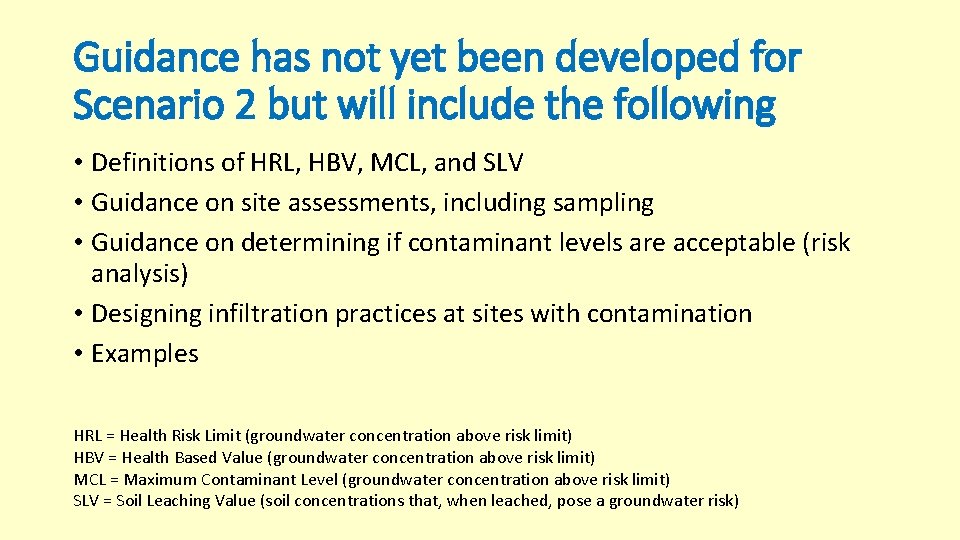
Guidance has not yet been developed for Scenario 2 but will include the following • Definitions of HRL, HBV, MCL, and SLV • Guidance on site assessments, including sampling • Guidance on determining if contaminant levels are acceptable (risk analysis) • Designing infiltration practices at sites with contamination • Examples HRL = Health Risk Limit (groundwater concentration above risk limit) HBV = Health Based Value (groundwater concentration above risk limit) MCL = Maximum Contaminant Level (groundwater concentration above risk limit) SLV = Soil Leaching Value (soil concentrations that, when leached, pose a groundwater risk)
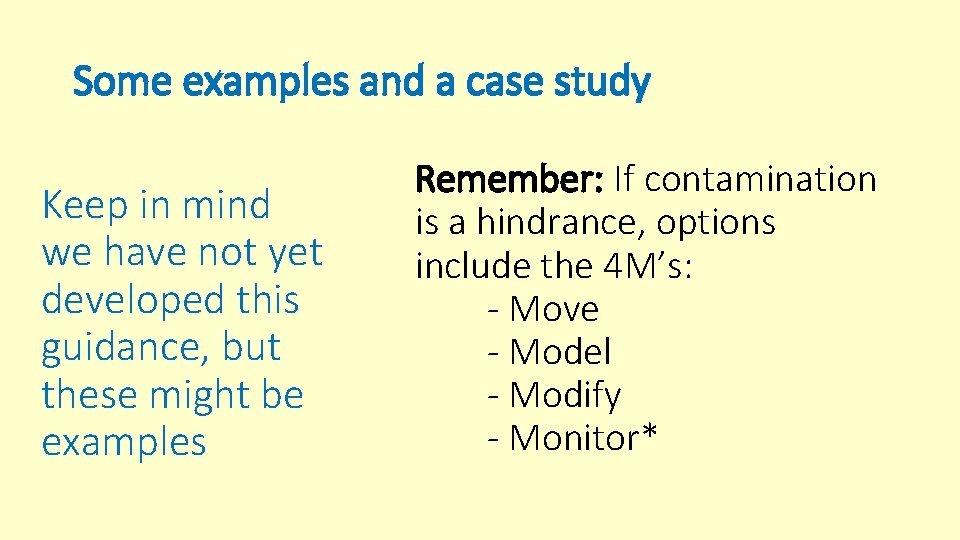
Some examples and a case study Keep in mind we have not yet developed this guidance, but these might be examples Remember: If contamination is a hindrance, options include the 4 M’s: - Move - Model - Modify - Monitor*
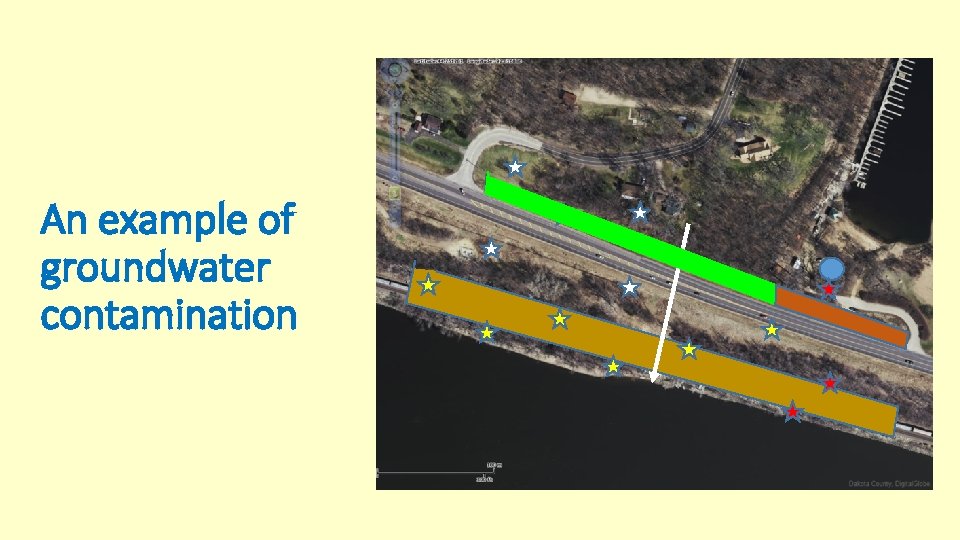
An example of groundwater contamination
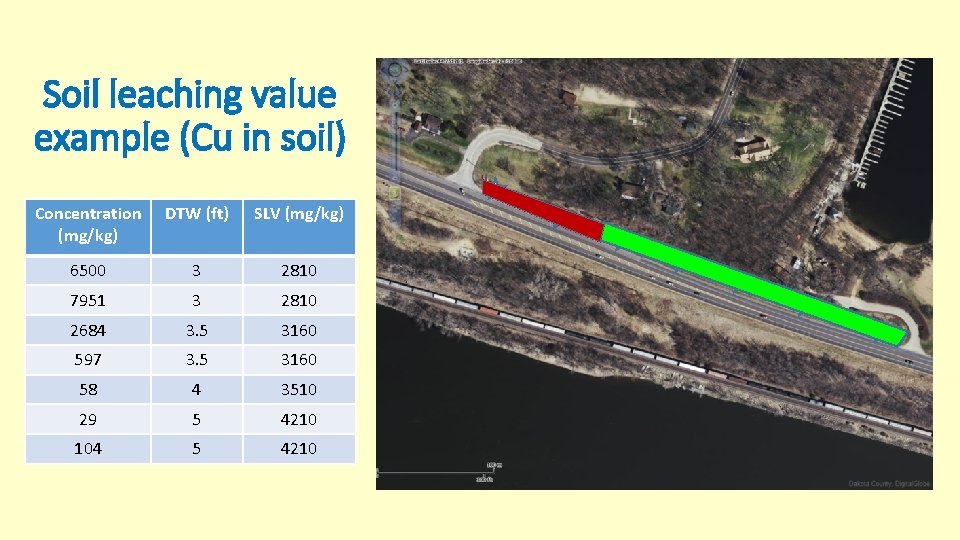
Soil leaching value example (Cu in soil) Concentration (mg/kg) DTW (ft) SLV (mg/kg) 6500 3 2810 7951 3 2810 2684 3. 5 3160 597 3. 5 3160 58 4 3510 29 5 4210 104 5 4210
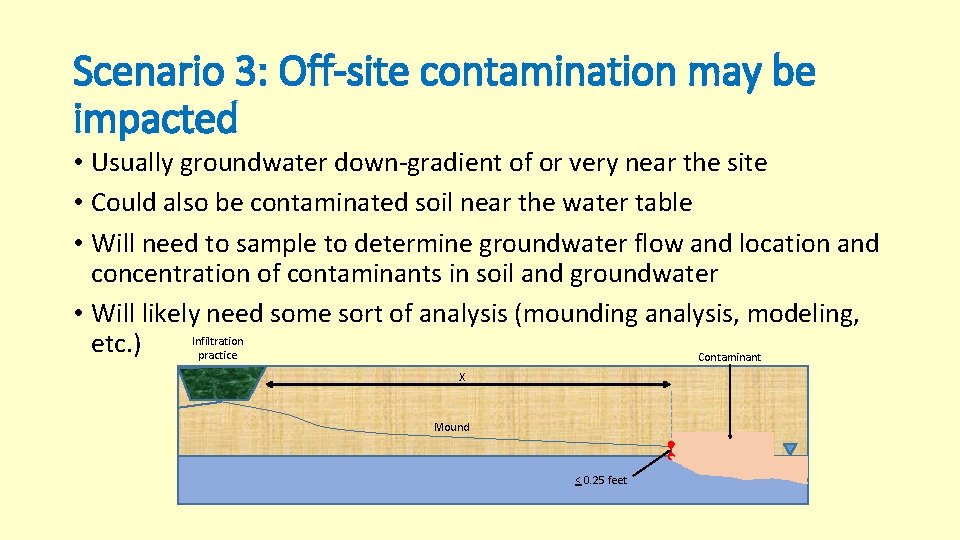
Scenario 3: Off-site contamination may be impacted • Usually groundwater down-gradient of or very near the site • Could also be contaminated soil near the water table • Will need to sample to determine groundwater flow and location and concentration of contaminants in soil and groundwater • Will likely need some sort of analysis (mounding analysis, modeling, Infiltration etc. ) practice Contaminant X Mound < 0. 25 feet
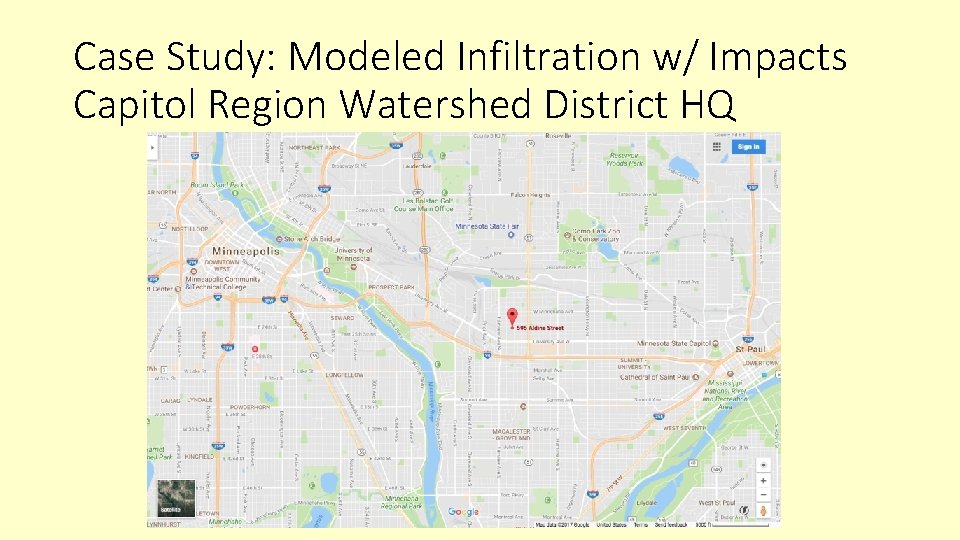
Case Study: Modeled Infiltration w/ Impacts Capitol Region Watershed District HQ
Case Study: Modeled Infiltration w/ Impacts Capitol Region Watershed District HQ Site Redevelopment • Petroleum and Non-Petroleum Impacts in soil and groundwater • Headquarters for the CRWD • Maximizing BMPs onsite for demonstration purposes Modeling Infiltration • Located in known area of groundwater impacts • Installed monitoring network • Model demonstrates low-risk to receptors from infiltrating stormwater • Model demonstrates potential for “Beneficial Infiltration” affect on impacted groundwater Innovative Report, Collaboration with MPCA Project Teams • Continuous communications • Demonstrates 4 th “M” option
Guidance • We expect to have guidance completed at the time the next Construction permit is issued. • The guidance will cover the scenarios discussed in this presentation, including examples • The guidance will clarify permit language, which has been ambiguous • The guidance should provide clarification which in turn should make the permitting process simpler • Will be housed in the MN Stormwater Manual, which can be updated as needed • Brownfields Guidance: https: //www. pca. state. mn. us/waste/cleanup-guidance
- Slides: 26