
Storm surge modelling in the North Sea Baltic
Storm surge modelling in the North Sea - Baltic sea transition zone: model inter-comparison of static wind simulations Elin Andrée 1, 3, Asger Bendix Hansen 2, Morten Andreas Dahl Larsen 3, Jian Su 1, Kristine Skovgaard Madsen 1, and Martin Drews 3, (1) Danish Meteorological Institute, Denmark (2) DHI, Denmark (3) Technical University of Denmark, Denmark EGU 2020: Sharing Gesocience Online 7 May 2020 Elin Andrée eliand@dmi. dk, elina@dtu. dk Contact: elina@dtu. dk 1
Abstract Extreme water levels in the micro-tidal transition zone between the North Sea and the semi-enclosed Baltic sea are predominantly determined by wind forcing associated with synoptic-scale weather systems. This connection between the two seas is partly blocked by low-lying islands, and the bathymetry comprises a complex mixture of narrow, deep channels and shallow sills. Coastlines in the Southern Kattegat and the Western Baltic Sea are therefore exposed to wind forcing from a large range of directions, and the extent of water build-up varies strongly between locations. IThe simulations are conducted with two different regional 3 D ocean models to enable model inter-comparison. The DMIHBM model implements a structured grid with fully dynamic 2 -way nesting, while the MIKE 3 FM invokes an unstructured mesh. Both models have grid resolutions of ~0. 5– 1 km within the Danish Straits and 4– 6 km in the offshore Baltic Sea. The models are forced by synthetic wind fields, where both wind speed and wind direction are maintained at fixed levels over the entire model domains. Pairs of model simulations are then obtained by varying the angle from which the wind is blowing. From the model outputs, we describe the temporal evolution of the water level by the site-specific peak water level, and the time required for the response to reach its peak value. Our results show a steady rise of the water level up until the peak value. The peak water level significantly overshoots the final equilibrium water level, which develops further into the simulations. Our study facilitates a better understanding of the sea level's response to extreme and persistent winds in a region with highly complex geometry. EGU 2020: Sharing Gesocience Online 7 May 2020 Contact: elina@dtu. dk 2
Motivation ● Denmark is a low-lying country comprised by a mainland peninsula and over 400 islands. ● Denmark is exposed to extreme sea levels (ESL) that can cause coastal flooding. ● Since Denmark’s coastlines are facing many different directions and several water bodies, ESLs due to strong or persistent winds can be generated by wind from a large range of directions. Objective To assess the simulated maximum water level for Danish coastlines using synthetic wind fields that maintain a fixed wind speed and direction for the entire model domain. EGU 2020: Sharing Gesocience Online 7 May 2020 Contact: elina@dtu. dk 3
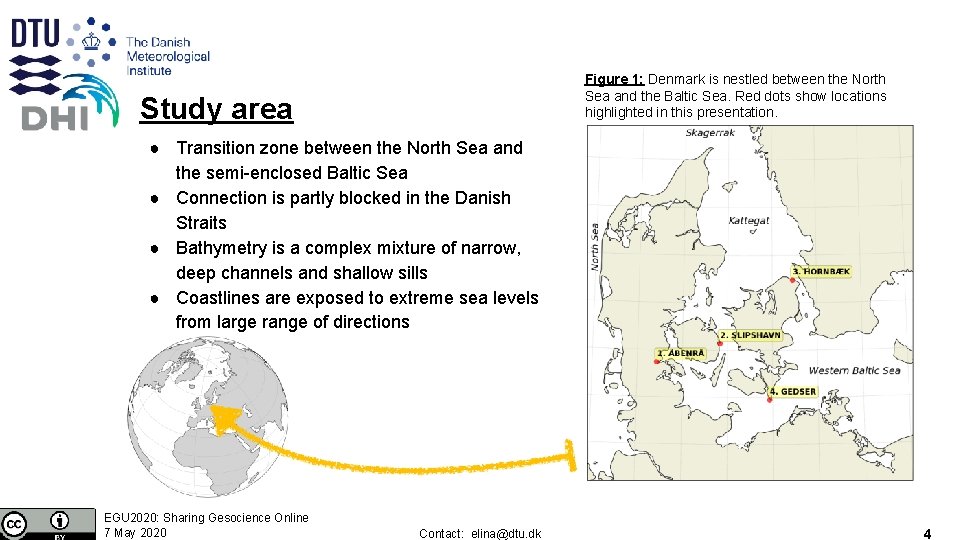
Figure 1: Denmark is nestled between the North Sea and the Baltic Sea. Red dots show locations highlighted in this presentation. Study area ● Transition zone between the North Sea and the semi-enclosed Baltic Sea ● Connection is partly blocked in the Danish Straits ● Bathymetry is a complex mixture of narrow, deep channels and shallow sills ● Coastlines are exposed to extreme sea levels from large range of directions EGU 2020: Sharing Gesocience Online 7 May 2020 Contact: elina@dtu. dk 4
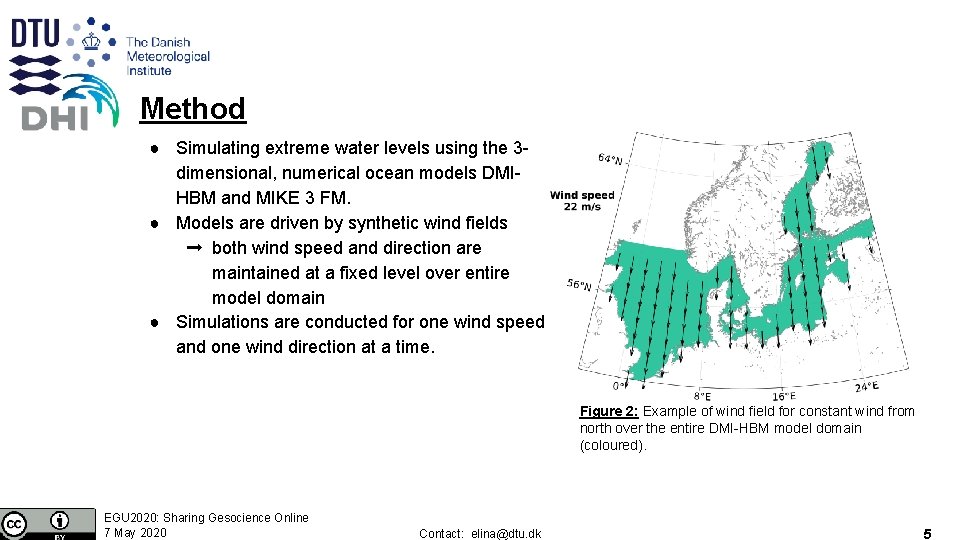
Method ● Simulating extreme water levels using the 3 dimensional, numerical ocean models DMIHBM and MIKE 3 FM. ● Models are driven by synthetic wind fields ➞ both wind speed and direction are maintained at a fixed level over entire model domain ● Simulations are conducted for one wind speed and one wind direction at a time. Figure 2: Example of wind field for constant wind from north over the entire DMI-HBM model domain (coloured). EGU 2020: Sharing Gesocience Online 7 May 2020 Contact: elina@dtu. dk 5
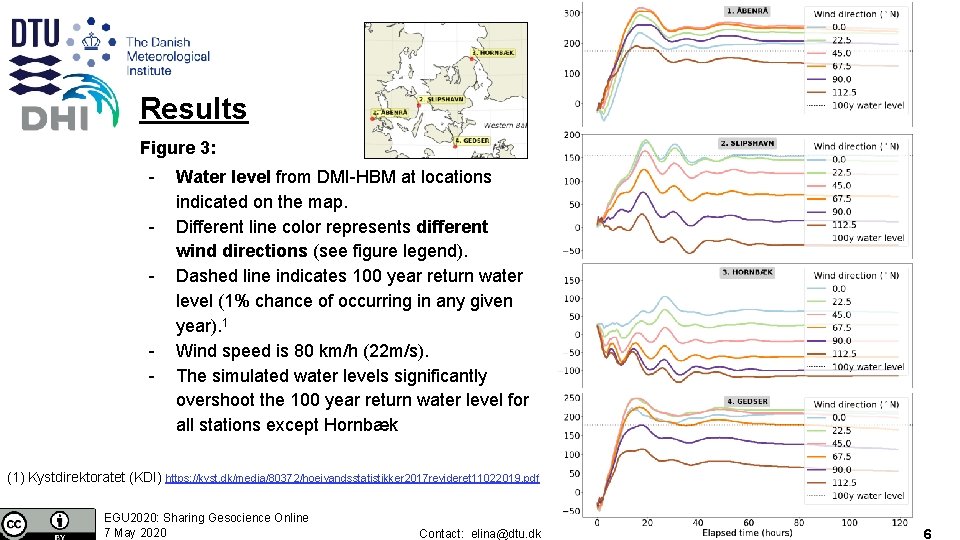
Results Figure 3: - - Water level from DMI-HBM at locations indicated on the map. Different line color represents different wind directions (see figure legend). Dashed line indicates 100 year return water level (1% chance of occurring in any given year). 1 Wind speed is 80 km/h (22 m/s). The simulated water levels significantly overshoot the 100 year return water level for all stations except Hornbæk (1) Kystdirektoratet (KDI) https: //kyst. dk/media/80372/hoejvandsstatistikker 2017 revideret 11022019. pdf EGU 2020: Sharing Gesocience Online 7 May 2020 Contact: elina@dtu. dk 6
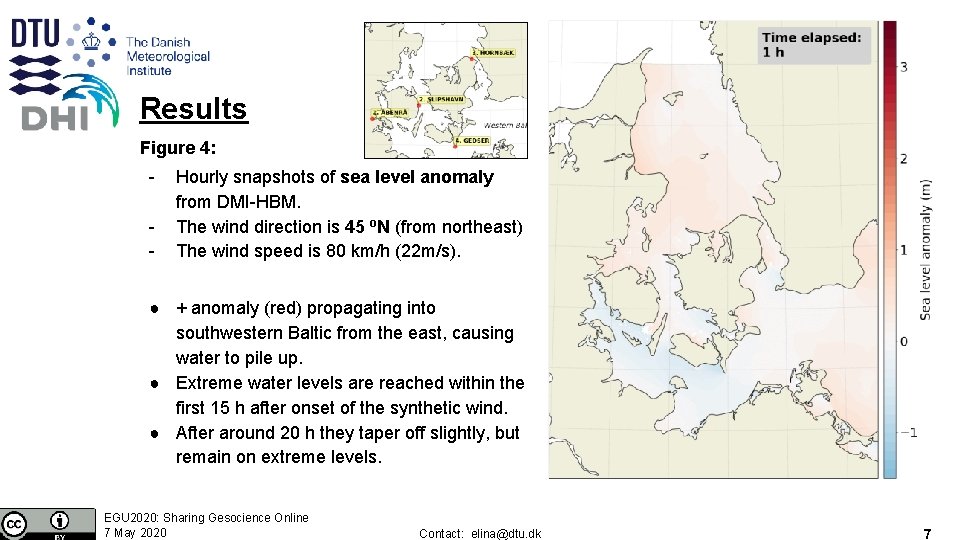
Results Figure 4: - Hourly snapshots of sea level anomaly from DMI-HBM. The wind direction is 45 o. N (from northeast) The wind speed is 80 km/h (22 m/s). ● + anomaly (red) propagating into southwestern Baltic from the east, causing water to pile up. ● Extreme water levels are reached within the first 15 h after onset of the synthetic wind. ● After around 20 h they taper off slightly, but remain on extreme levels. EGU 2020: Sharing Gesocience Online 7 May 2020 Contact: elina@dtu. dk 7
Next steps ● Expanding ensemble to assess water level response for all coastlines using ➞ more wind directions Thanks for reading! ➞ higher wind speed Questions, comments, suggestions? Please reach out to us: elina@dtu. dk Summary ● We simulate extreme water levels driven by wind from single directions in the transition zone between the North Sea and the Baltic Sea ● We show results for wind speeds of 80 km/h and N to ESE wind directions. ● Extreme water levels were reached within the first day after onset of the synthetic wind. ● The water level responds very differently north (Hornbæk, needs westerly wind component), middle (Slipshavn) and south (Åbenrå, Gedser) of the straits. EGU 2020: Sharing Gesocience Online 7 May 2020 Contact: elina@dtu. dk 8
- Slides: 8