
Storm on the Island 2 Try to answer
- Slides: 7
Storm on the Island (2) Try to answer all of these. Blue = 3 points Green = 2 points Yellow = 1 point 1. Complete the following quotation: ‘Our brains _____ in the ______ iced east winds that _______ us. ’ 2. What is the name of the character that hears a knocking at the gate of Macbeth’s castle? T__ P_____ 3. What is the definition of the word, ‘narcissistic’ and which poem does this link to? 4. What is the final thing Scrooge sees before he begs the Ghost of Christmas Yet to Come to let him have another chance? 5. What is the definition of asinine and which Birling family member does this link to? 6. Complete the following quotation: 7. What is the definition of ‘blunder’ and which poem does this link to? 8. Complete the following quotation: 9. What is a pre positional phrase? Give an example. ______ is much ______ than he used to be, that home’s like ______! – Fan ‘__ are all ______ of one ____’ – Inspector Goole
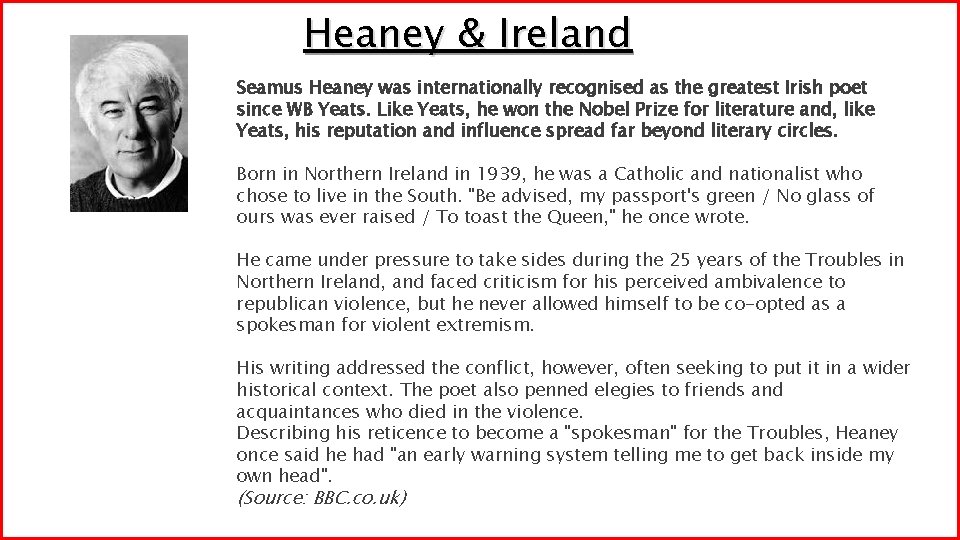
Heaney & Ireland Seamus Heaney was internationally recognised as the greatest Irish poet since WB Yeats. Like Yeats, he won the Nobel Prize for literature and, like Yeats, his reputation and influence spread far beyond literary circles. Born in Northern Ireland in 1939, he was a Catholic and nationalist who chose to live in the South. "Be advised, my passport's green / No glass of ours was ever raised / To toast the Queen, " he once wrote. He came under pressure to take sides during the 25 years of the Troubles in Northern Ireland, and faced criticism for his perceived ambivalence to republican violence, but he never allowed himself to be co-opted as a spokesman for violent extremism. His writing addressed the conflict, however, often seeking to put it in a wider historical context. The poet also penned elegies to friends and acquaintances who died in the violence. Describing his reticence to become a "spokesman" for the Troubles, Heaney once said he had "an early warning system telling me to get back inside my own head". (Source: BBC. co. uk)
Ireland & The Troubles • In 1921 Ireland was divided into two parts. Northern Ireland remained part of the United Kingdom and the rest became known as the Republic of Ireland. • Northern Ireland's history is a little complicated! About 800 years ago, the Kings of England gained control of Ireland, but years later, the Irish managed to get rid of most of the English! But in the mid-1600 s, the famous English military leader, Oliver Cromwell, took over all of Ireland. Since England was Protestant while Ireland was Catholic, there was a lot of hostility between both sides. • By the 19 th century, many people living in Northern Ireland were Protestant and had English roots. And this is where problems arose as most people in Northern Ireland didn't want independence like the rest of Ireland did. • The people who wanted an independent Ireland became known as republicans or nationalists because they wanted Ireland to become a republic, a government where people come together to make laws. The people who didn't want independence for Ireland were referred to as unionists because they wanted to retain their union with the UK. The unionists lived mostly in Northern Ireland. • By 1921, the UK agreed to recognise Ireland as an independent nation, but kept Northern Ireland under the Government of Ireland Act. • But this didn't stop the problems, unfortunately. The reason why? Republicans were willing to continue to fight to make Northern Ireland part of the rest of Ireland while Irish unionists were willing to fight to prevent it. There were lots of protests and riots. The crisis escalated in 1969 when British troops were sent in to prevent religious violence between the Protestants and the Catholics. The clashes between the two sides were known as the Troubles. Bloody Sunday was one of the most significant events of the Troubles. It took place on the 30 January 1972, when British soldiers shot 28 civilian citizens and 14 people died. •
Storm on the Island (2) We are prepared: we build our houses squat, Sink walls in rock and roof them with good slate. This wizened earth has never troubled us With hay, so, as you see, there are no stacks Or stooks that can be lost. Nor are there trees Which might prove company when it blows full Blast: you know what I mean - leaves and branches Can raise a tragic chorus in a gale So that you listen to the thing you fear Forgetting that it pummels your house too. But there are no trees, no natural shelter. You might think that the sea is company, Exploding comfortably down on the cliffs But no: when it begins, the flung spray hits The very windows, spits like a tame cat Turned savage. We just sit tight while wind dives And strafes invisibly. Space is a salvo, We are bombarded with the empty air. Strange, it is a huge nothing that we fear. Analysis tasks – complete the following 1) Find the following devices in the poem and explain why they are used: - Simile - Metaphor - Personification - Juxtaposition 2) There is a semantic field of violence within the poem – which words make this semantic field and what does this highlight or emphasise? 3) Look at how Heaney describes the residents on the Island acting and how this compares to the behaviour of the storm – why might he have done this? Pick two quotations to support your ideas. 4) Look at the structure of the poem, what do you notice? Why might Heaney have done this? What could it reflect?
Storm on the Island (2) Analysis tasks – please do your work here
Choice – choose one of these to complete Create a newspaper article that reports on the storm that is described in the poem, include: q q q q a headline a summary of the events an interview with a local resident an image of the storm use two of the three words from the vocab box use prepositional time phrases 200 words This poem is an extended metaphor for the ‘Troubles’ a period of conflict in Northern Ireland during the 20 th Century. The first 8 letters of the poem spell Stormont – the name of the government buildings of Northern Ireland in Belfast. Look at the poem again and find evidence of that this poem has a political message. Why might Heaney have written this? Explain in a what-how-why paragraph. Compare Storm on the Island to one other poem: put the similarities in the middle and the differences on the left/right. Storm on the Island poem of your choice
Storm on the Island (2) Choice task– please do your work here