
Stories from the Home Front The Civil War

- Slides: 58
Stories from the Home Front The Civil War in Trimble, Shelby, Henry, Carroll, Gallatin, Owen, Counties in Kentucky
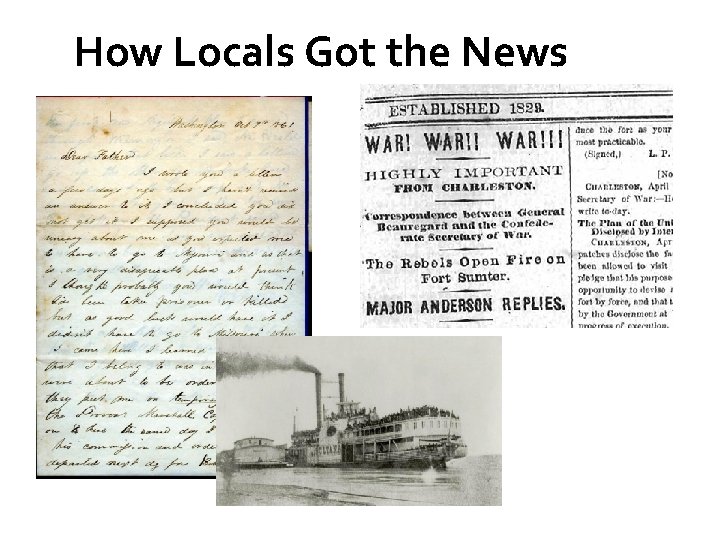
How Locals Got the News
Events Leading to War The 1850 s, Nationally 1850 Compromise - Slavery into Western Territories 1850 Fugitive Slave Act and Abolitionists 1850 s Cotton Gin and Cotton Economics 1852 “Uncle Tom’s Cabin" 1856 Bleeding Kansas 1857 Dred Scott decision - U. S. Supreme Court 1858 – Lincoln-Douglas Debates 1859 – Raid on Harpers Ferry 1860 – Lincoln wins the Presidency
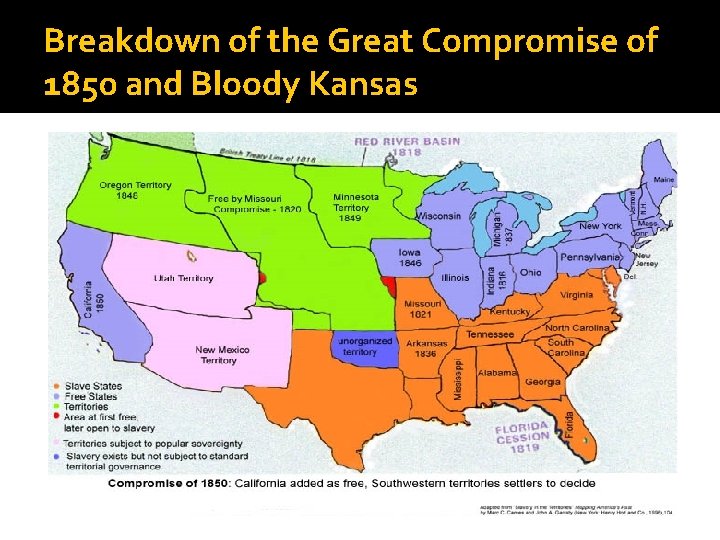
Breakdown of the Great Compromise of 1850 and Bloody Kansas
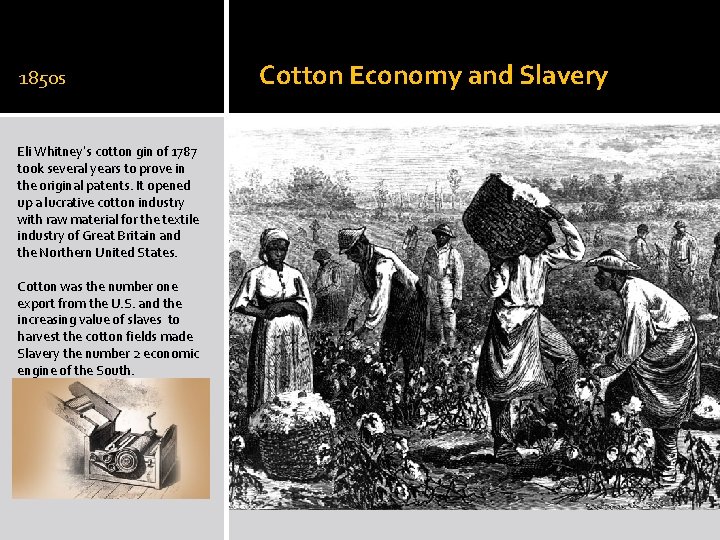
1850 s Eli Whitney’s cotton gin of 1787 took several years to prove in the original patents. It opened up a lucrative cotton industry with raw material for the textile industry of Great Britain and the Northern United States. Cotton was the number one export from the U. S. and the increasing value of slaves to harvest the cotton fields made Slavery the number 2 economic engine of the South. Cotton Economy and Slavery
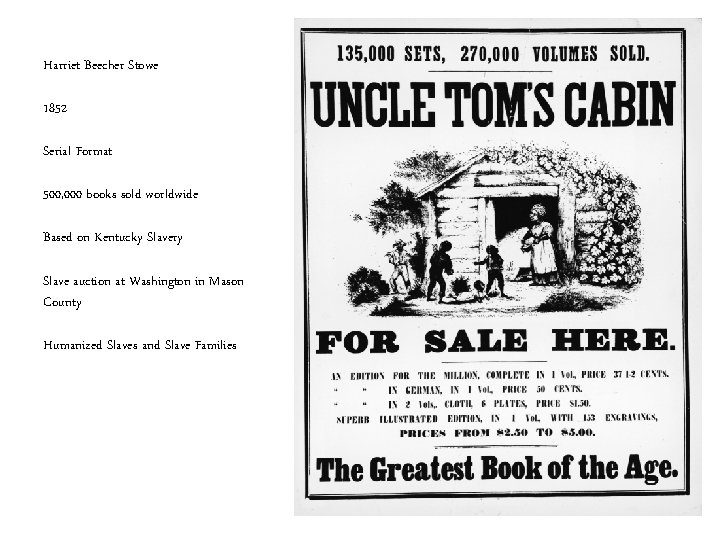
Harriet Beecher Stowe 1852 Serial Format 500, 000 books sold worldwide Based on Kentucky Slavery Slave auction at Washington in Mason County Humanized Slaves and Slave Families
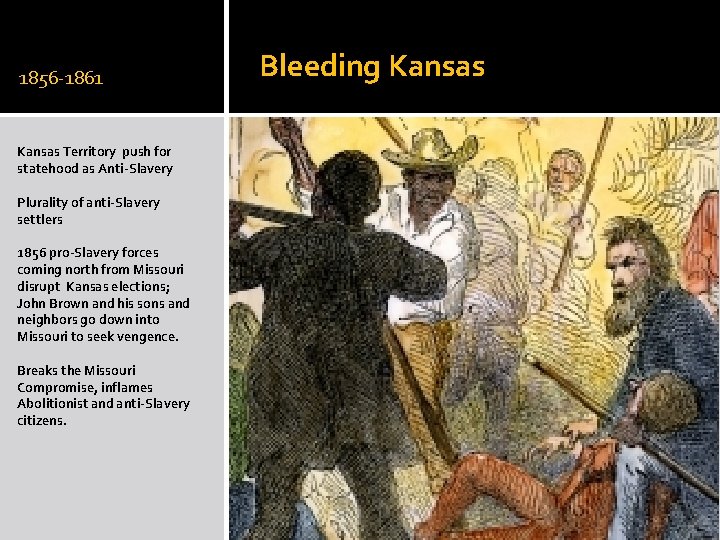
1856 -1861 Kansas Territory push for statehood as Anti-Slavery Plurality of anti-Slavery settlers 1856 pro-Slavery forces coming north from Missouri disrupt Kansas elections; John Brown and his sons and neighbors go down into Missouri to seek vengence. Breaks the Missouri Compromise, inflames Abolitionist and anti-Slavery citizens. Bleeding Kansas
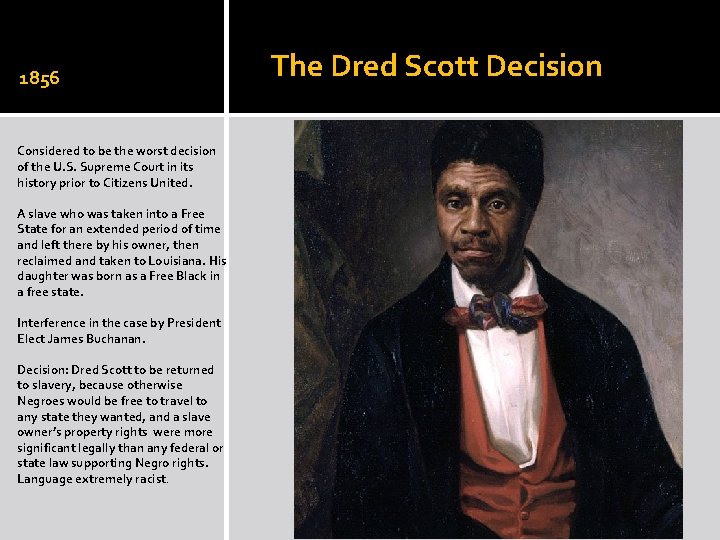
1856 Considered to be the worst decision of the U. S. Supreme Court in its history prior to Citizens United. A slave who was taken into a Free State for an extended period of time and left there by his owner, then reclaimed and taken to Louisiana. His daughter was born as a Free Black in a free state. Interference in the case by President Elect James Buchanan. Decision: Dred Scott to be returned to slavery, because otherwise Negroes would be free to travel to any state they wanted, and a slave owner’s property rights were more significant legally than any federal or state law supporting Negro rights. Language extremely racist. The Dred Scott Decision
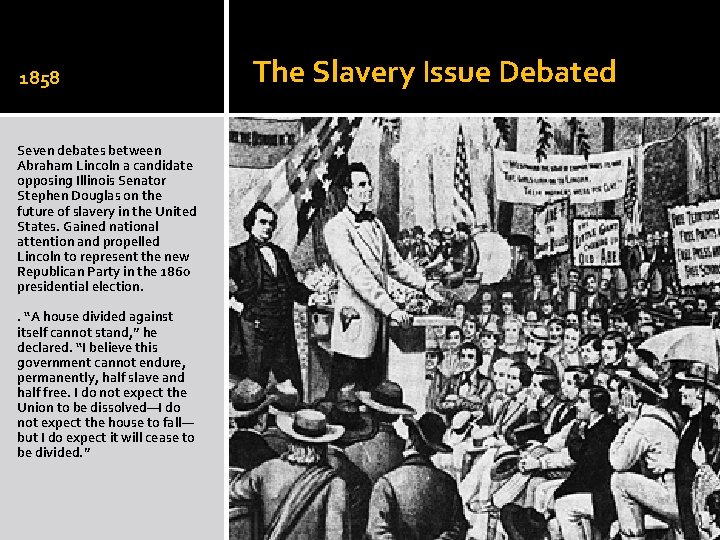
1858 Seven debates between Abraham Lincoln a candidate opposing Illinois Senator Stephen Douglas on the future of slavery in the United States. Gained national attention and propelled Lincoln to represent the new Republican Party in the 1860 presidential election. . “A house divided against itself cannot stand, ” he declared. “I believe this government cannot endure, permanently, half slave and half free. I do not expect the Union to be dissolved—I do not expect the house to fall— but I do expect it will cease to be divided. ” The Slavery Issue Debated
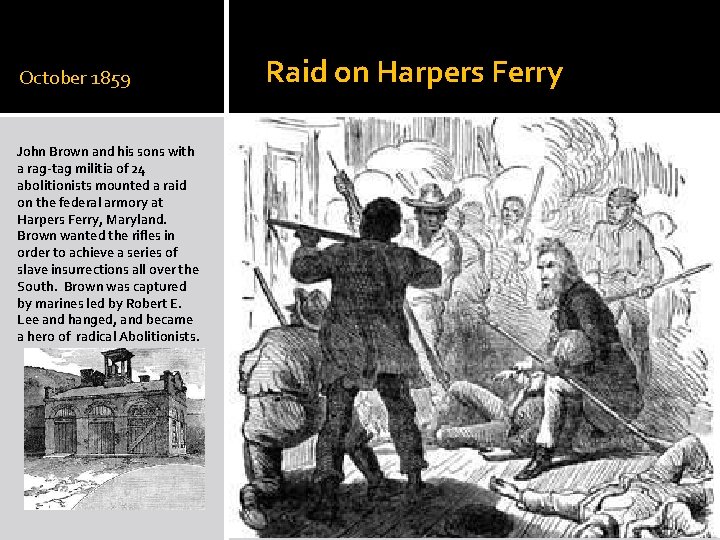
October 1859 John Brown and his sons with a rag-tag militia of 24 abolitionists mounted a raid on the federal armory at Harpers Ferry, Maryland. Brown wanted the rifles in order to achieve a series of slave insurrections all over the South. Brown was captured by marines led by Robert E. Lee and hanged, and became a hero of radical Abolitionists. Raid on Harpers Ferry
1850 s Locally �Madison UGRR impacting slave owners; losses mount along the river bottoms � 1852 Delia Webster buys Mt. Orison � 1854 Delia Webster jailed at Bedford � 1856 Richard Daly escapes with family � 1856 Elijah Anderson trial at Bedford
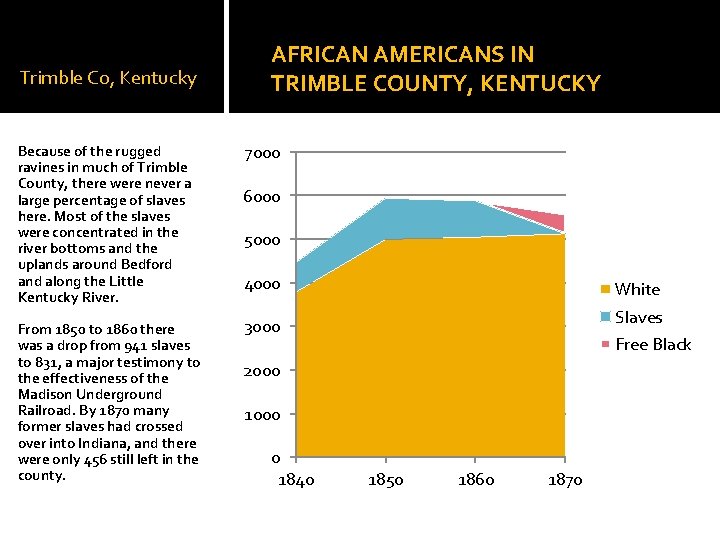
Trimble Co, Kentucky Because of the rugged ravines in much of Trimble County, there were never a large percentage of slaves here. Most of the slaves were concentrated in the river bottoms and the uplands around Bedford and along the Little Kentucky River. From 1850 to 1860 there was a drop from 941 slaves to 831, a major testimony to the effectiveness of the Madison Underground Railroad. By 1870 many former slaves had crossed over into Indiana, and there were only 456 still left in the county. AFRICAN AMERICANS IN TRIMBLE COUNTY, KENTUCKY 7000 6000 5000 4000 White Slaves 3000 Free Black 2000 1000 0 1840 1850 1860 1870
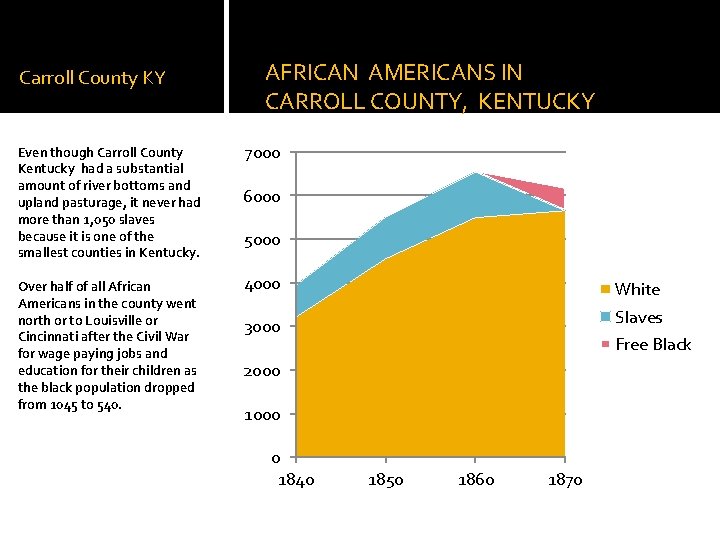
Carroll County KY Even though Carroll County Kentucky had a substantial amount of river bottoms and upland pasturage, it never had more than 1, 050 slaves because it is one of the smallest counties in Kentucky. Over half of all African Americans in the county went north or to Louisville or Cincinnati after the Civil War for wage paying jobs and education for their children as the black population dropped from 1045 to 540. AFRICAN AMERICANS IN CARROLL COUNTY, KENTUCKY 7000 6000 5000 4000 White Slaves 3000 Free Black 2000 1000 0 1840 1850 1860 1870
Late 1860 the Winds of War �Abraham Lincoln elected, Kentucky backs Seward by large margin �Kentucky legislature debates secession; wants neutrality for economic reasons �Defensive measures sought
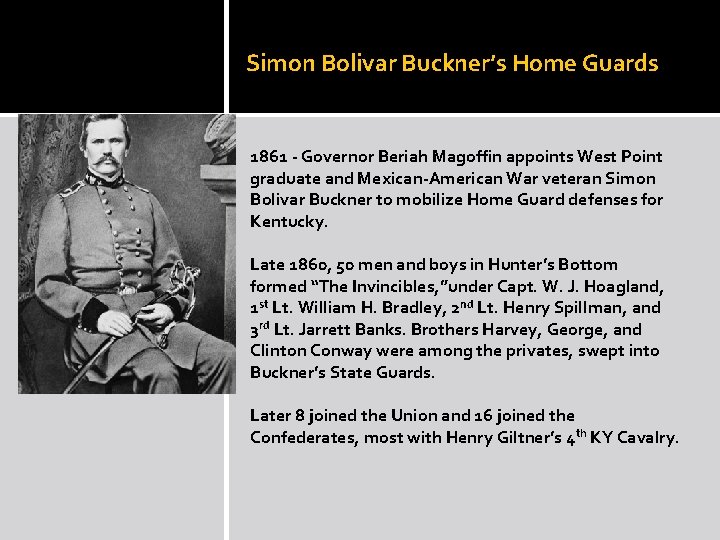
Simon Bolivar Buckner’s Home Guards 1861 - Governor Beriah Magoffin appoints West Point graduate and Mexican-American War veteran Simon Bolivar Buckner to mobilize Home Guard defenses for Kentucky. Late 1860, 50 men and boys in Hunter’s Bottom formed “The Invincibles, ”under Capt. W. J. Hoagland, 1 st Lt. William H. Bradley, 2 nd Lt. Henry Spillman, and 3 rd Lt. Jarrett Banks. Brothers Harvey, George, and Clinton Conway were among the privates, swept into Buckner’s State Guards. Later 8 joined the Union and 16 joined the Confederates, most with Henry Giltner’s 4 th KY Cavalry.
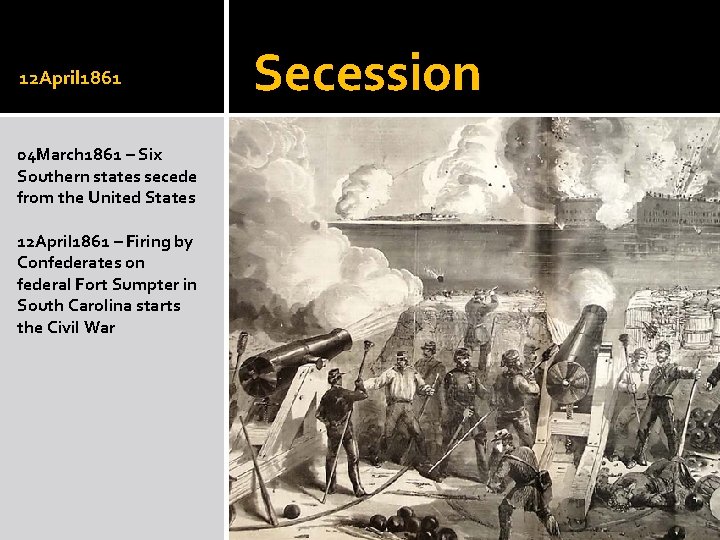
12 April 1861 04 March 1861 – Six Southern states secede from the United States 12 April 1861 – Firing by Confederates on federal Fort Sumpter in South Carolina starts the Civil War Secession
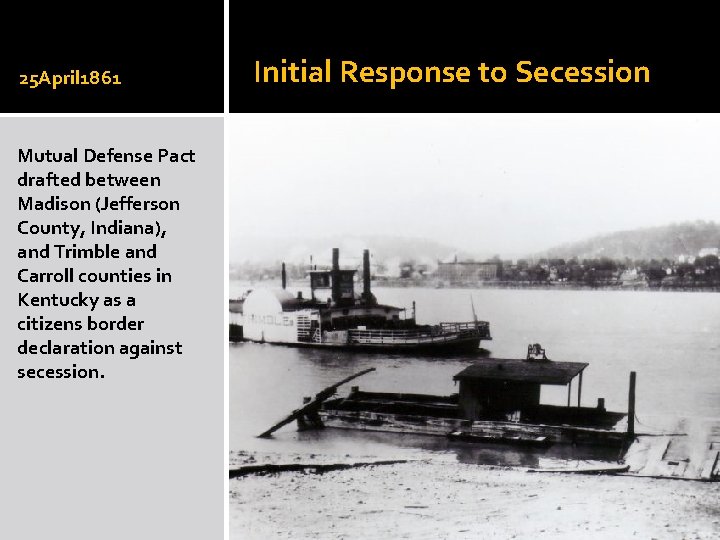
25 April 1861 Mutual Defense Pact drafted between Madison (Jefferson County, Indiana), and Trimble and Carroll counties in Kentucky as a citizens border declaration against secession. Initial Response to Secession
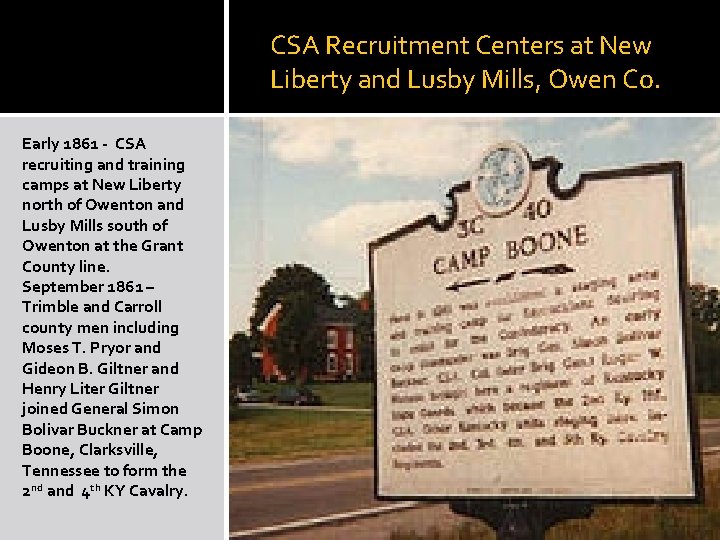
CSA Recruitment Centers at New Liberty and Lusby Mills, Owen Co. Early 1861 - CSA recruiting and training camps at New Liberty north of Owenton and Lusby Mills south of Owenton at the Grant County line. September 1861 – Trimble and Carroll county men including Moses T. Pryor and Gideon B. Giltner and Henry Liter Giltner joined General Simon Bolivar Buckner at Camp Boone, Clarksville, Tennessee to form the 2 nd and 4 th KY Cavalry.
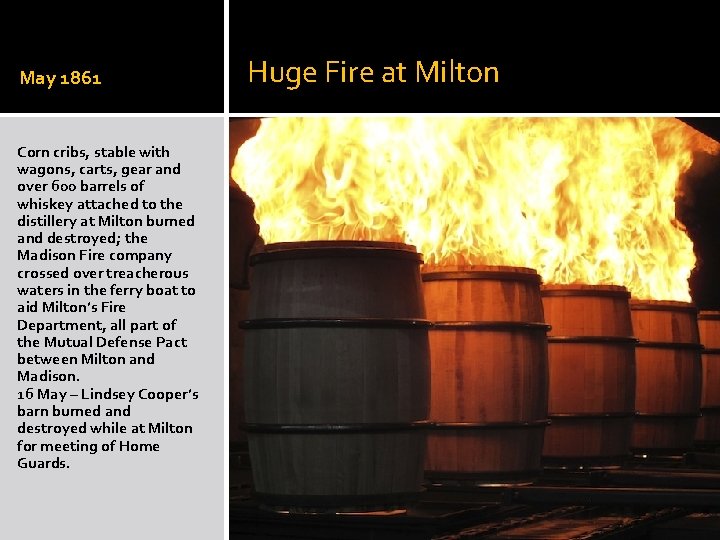
May 1861 Corn cribs, stable with wagons, carts, gear and over 600 barrels of whiskey attached to the distillery at Milton burned and destroyed; the Madison Fire company crossed over treacherous waters in the ferry boat to aid Milton’s Fire Department, all part of the Mutual Defense Pact between Milton and Madison. 16 May – Lindsey Cooper’s barn burned and destroyed while at Milton for meeting of Home Guards. Huge Fire at Milton
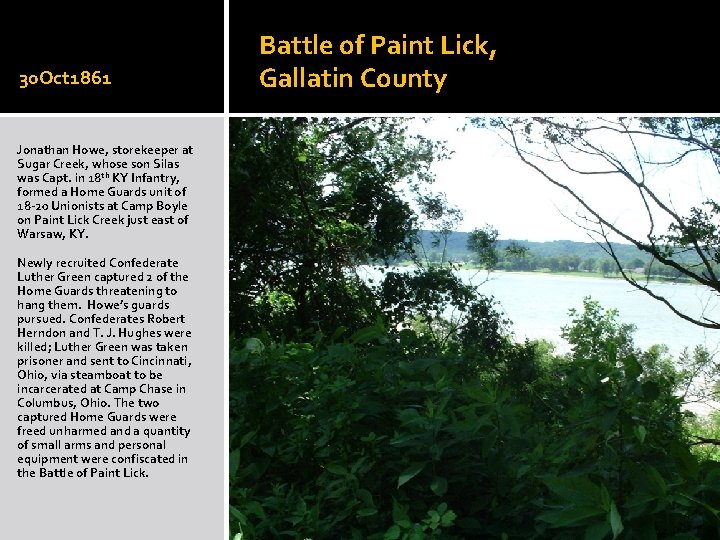
30 Oct 1861 Jonathan Howe, storekeeper at Sugar Creek, whose son Silas was Capt. in 18 th KY Infantry, formed a Home Guards unit of 18 -20 Unionists at Camp Boyle on Paint Lick Creek just east of Warsaw, KY. Newly recruited Confederate Luther Green captured 2 of the Home Guards threatening to hang them. Howe’s guards pursued. Confederates Robert Herndon and T. J. Hughes were killed; Luther Green was taken prisoner and sent to Cincinnati, Ohio, via steamboat to be incarcerated at Camp Chase in Columbus, Ohio. The two captured Home Guards were freed unharmed and a quantity of small arms and personal equipment were confiscated in the Battle of Paint Lick, Gallatin County
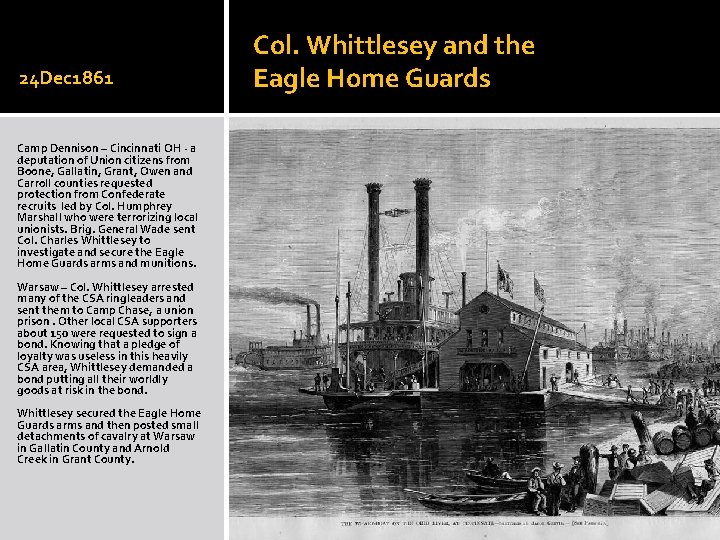
24 Dec 1861 Camp Dennison – Cincinnati OH - a deputation of Union citizens from Boone, Gallatin, Grant, Owen and Carroll counties requested protection from Confederate recruits led by Col. Humphrey Marshall who were terrorizing local unionists. Brig. General Wade sent Col. Charles Whittlesey to investigate and secure the Eagle Home Guards arms and munitions. Warsaw – Col. Whittlesey arrested many of the CSA ringleaders and sent them to Camp Chase, a union prison. Other local CSA supporters about 150 were requested to sign a bond. Knowing that a pledge of loyalty was useless in this heavily CSA area, Whittlesey demanded a bond putting all their worldly goods at risk in the bond. Whittlesey secured the Eagle Home Guards arms and then posted small detachments of cavalry at Warsaw in Gallatin County and Arnold Creek in Grant County. Col. Whittlesey and the Eagle Home Guards
Ohio River Valley The Western Front
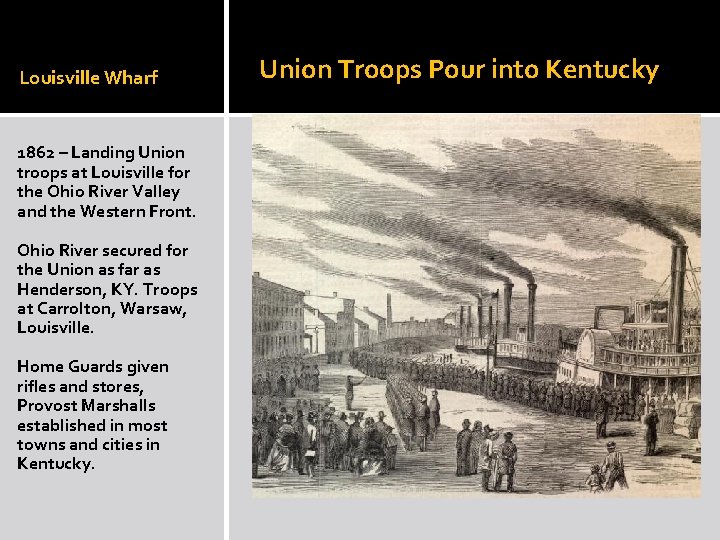
Louisville Wharf 1862 – Landing Union troops at Louisville for the Ohio River Valley and the Western Front. Ohio River secured for the Union as far as Henderson, KY. Troops at Carrolton, Warsaw, Louisville. Home Guards given rifles and stores, Provost Marshalls established in most towns and cities in Kentucky. Union Troops Pour into Kentucky
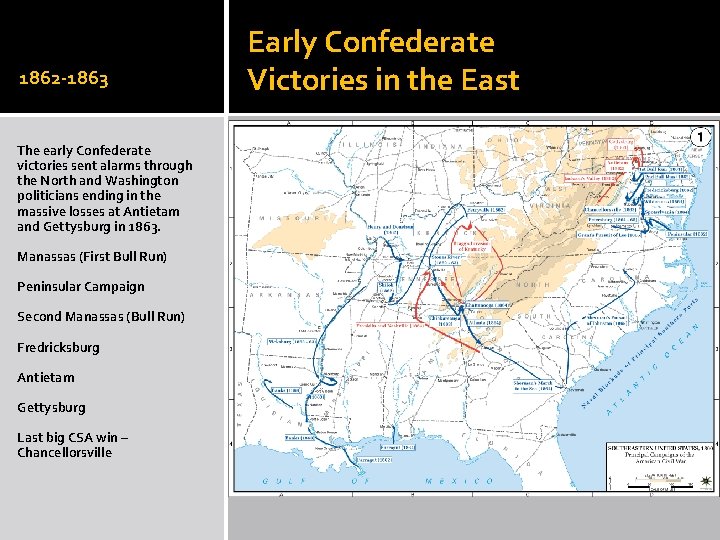
1862 -1863 The early Confederate victories sent alarms through the North and Washington politicians ending in the massive losses at Antietam and Gettysburg in 1863. Manassas (First Bull Run) Peninsular Campaign Second Manassas (Bull Run) Fredricksburg Antietam Gettysburg Last big CSA win – Chancellorsville Early Confederate Victories in the East
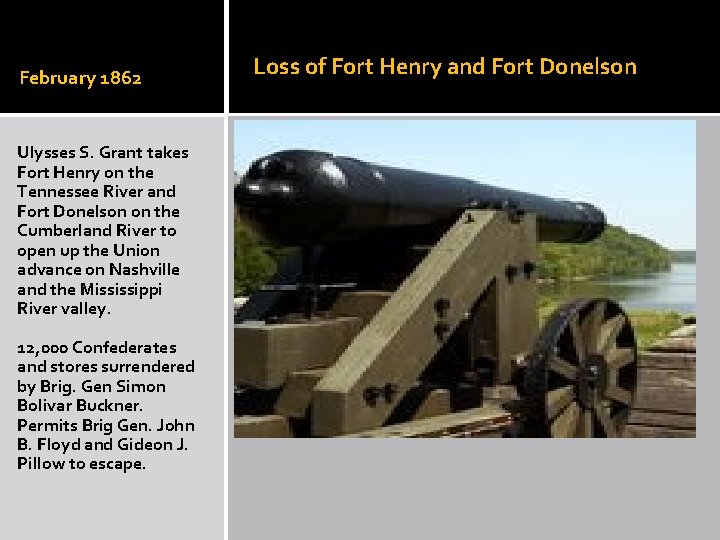
February 1862 Ulysses S. Grant takes Fort Henry on the Tennessee River and Fort Donelson on the Cumberland River to open up the Union advance on Nashville and the Mississippi River valley. 12, 000 Confederates and stores surrendered by Brig. Gen Simon Bolivar Buckner. Permits Brig Gen. John B. Floyd and Gideon J. Pillow to escape. Loss of Fort Henry and Fort Donelson
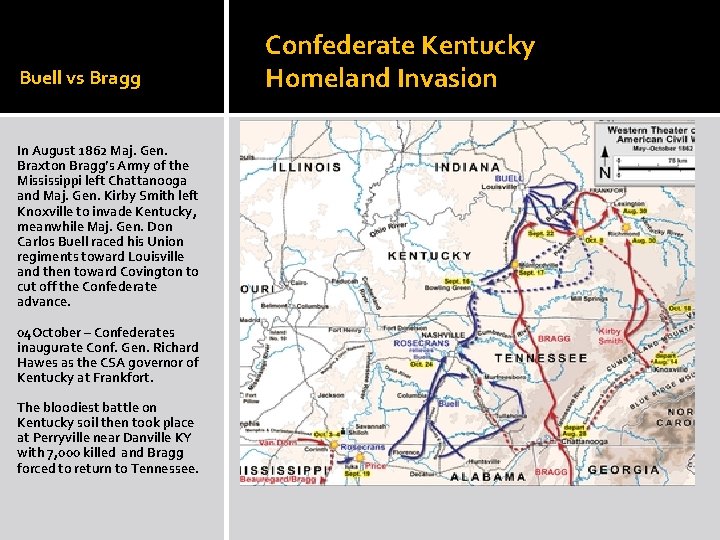
Buell vs Bragg In August 1862 Maj. Gen. Braxton Bragg’s Army of the Mississippi left Chattanooga and Maj. Gen. Kirby Smith left Knoxville to invade Kentucky, meanwhile Maj. Gen. Don Carlos Buell raced his Union regiments toward Louisville and then toward Covington to cut off the Confederate advance. 04 October – Confederates inaugurate Conf. Gen. Richard Hawes as the CSA governor of Kentucky at Frankfort. The bloodiest battle on Kentucky soil then took place at Perryville near Danville KY with 7, 000 killed and Bragg forced to return to Tennessee. Confederate Kentucky Homeland Invasion
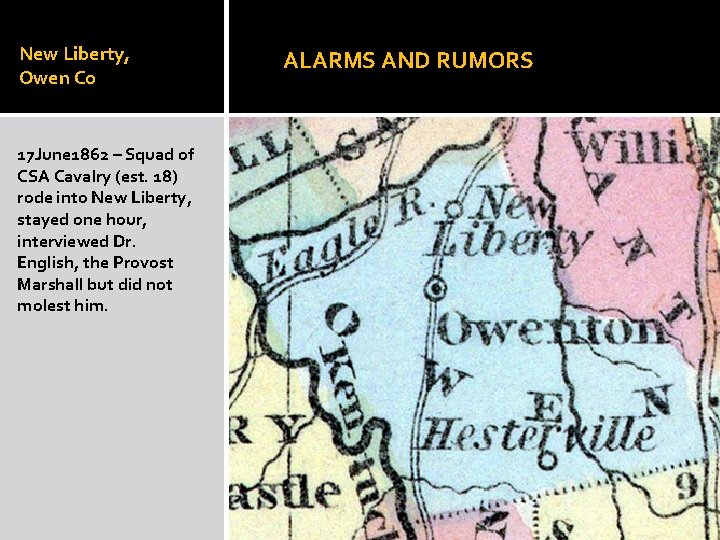
New Liberty, Owen Co 17 June 1862 – Squad of CSA Cavalry (est. 18) rode into New Liberty, stayed one hour, interviewed Dr. English, the Provost Marshall but did not molest him. ALARMS AND RUMORS
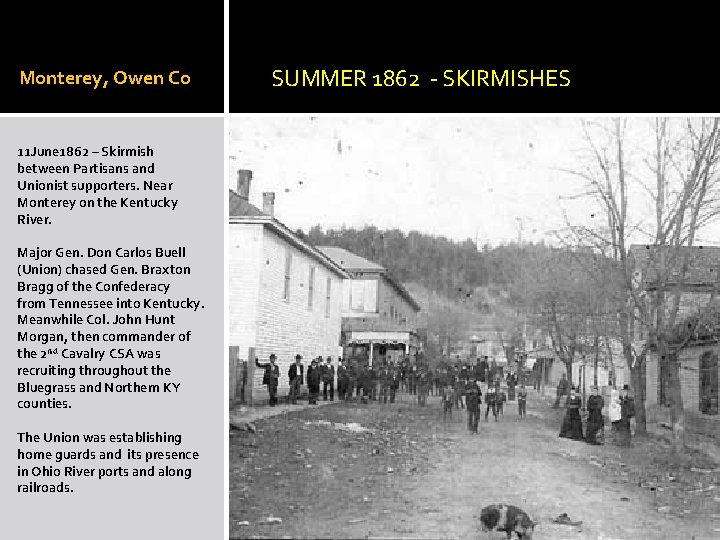
Monterey, Owen Co 11 June 1862 – Skirmish between Partisans and Unionist supporters. Near Monterey on the Kentucky River. Major Gen. Don Carlos Buell (Union) chased Gen. Braxton Bragg of the Confederacy from Tennessee into Kentucky. Meanwhile Col. John Hunt Morgan, then commander of the 2 nd Cavalry CSA was recruiting throughout the Bluegrass and Northern KY counties. The Union was establishing home guards and its presence in Ohio River ports and along railroads. SUMMER 1862 - SKIRMISHES
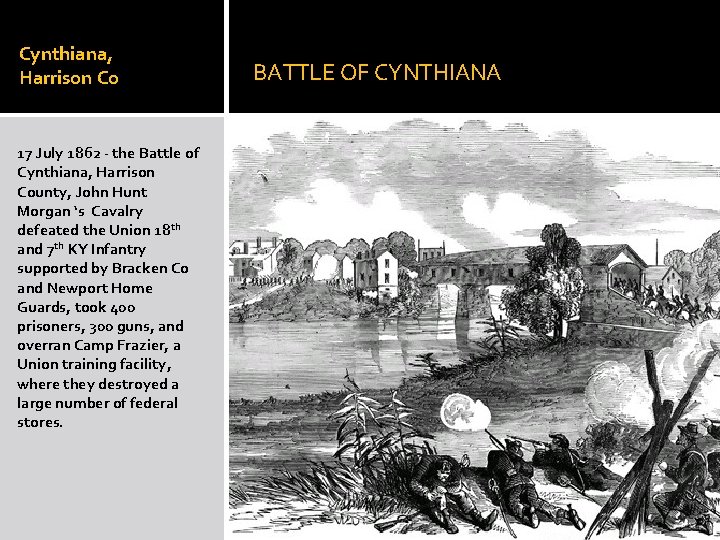
Cynthiana, Harrison Co 17 July 1862 - the Battle of Cynthiana, Harrison County, John Hunt Morgan ‘s Cavalry defeated the Union 18 th and 7 th KY Infantry supported by Bracken Co and Newport Home Guards, took 400 prisoners, 300 guns, and overran Camp Frazier, a Union training facility, where they destroyed a large number of federal stores. BATTLE OF CYNTHIANA
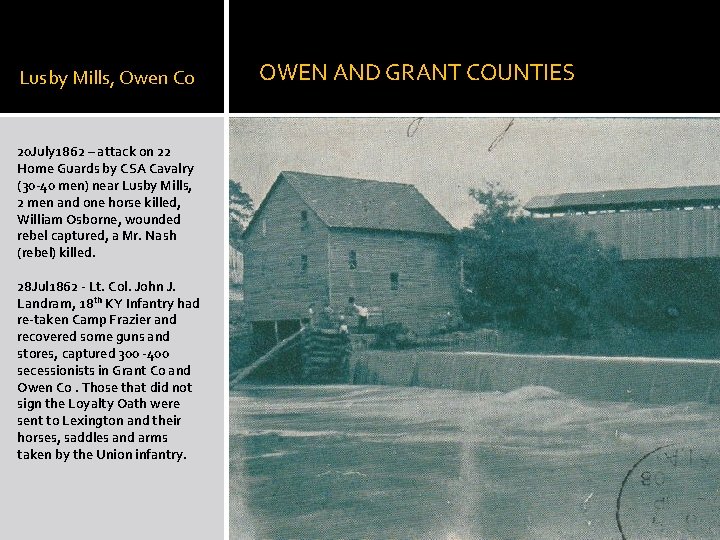
Lusby Mills, Owen Co 20 July 1862 – attack on 22 Home Guards by CSA Cavalry (30 -40 men) near Lusby Mills, 2 men and one horse killed, William Osborne, wounded rebel captured, a Mr. Nash (rebel) killed. 28 Jul 1862 - Lt. Col. John J. Landram, 18 th KY Infantry had re-taken Camp Frazier and recovered some guns and stores, captured 300 -400 secessionists in Grant Co and Owen Co. Those that did not sign the Loyalty Oath were sent to Lexington and their horses, saddles and arms taken by the Union infantry. OWEN AND GRANT COUNTIES
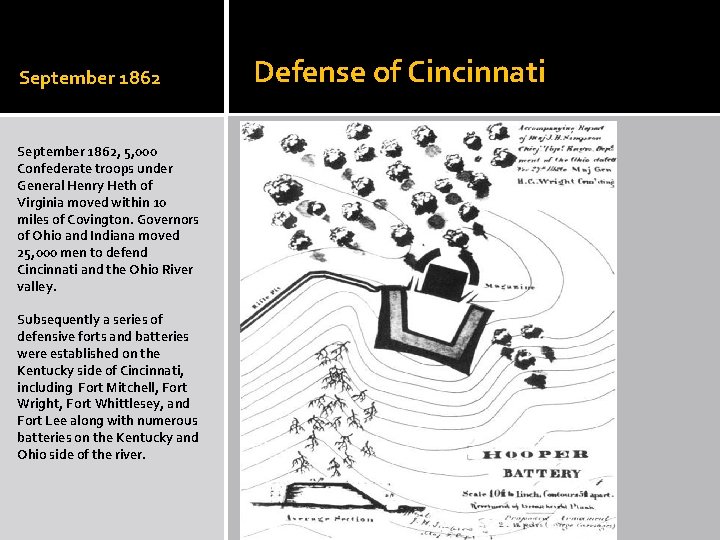
September 1862, 5, 000 Confederate troops under General Henry Heth of Virginia moved within 10 miles of Covington. Governors of Ohio and Indiana moved 25, 000 men to defend Cincinnati and the Ohio River valley. Subsequently a series of defensive forts and batteries were established on the Kentucky side of Cincinnati, including Fort Mitchell, Fort Wright, Fort Whittlesey, and Fort Lee along with numerous batteries on the Kentucky and Ohio side of the river. Defense of Cincinnati
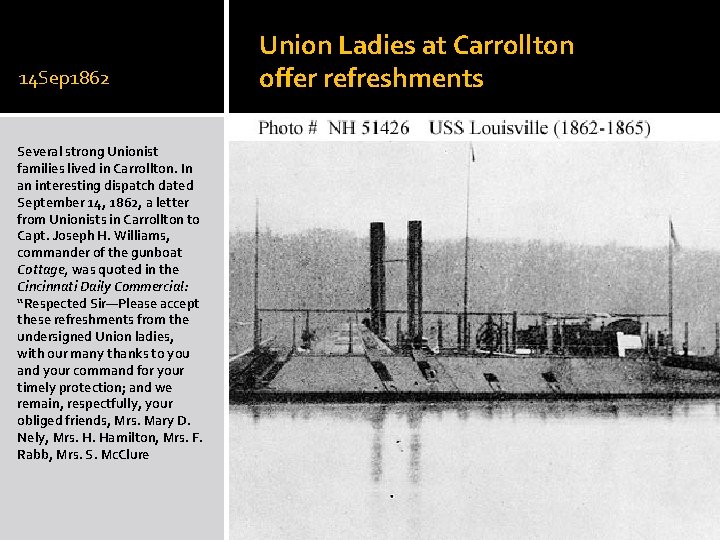
14 Sep 1862 Several strong Unionist families lived in Carrollton. In an interesting dispatch dated September 14, 1862, a letter from Unionists in Carrollton to Capt. Joseph H. Williams, commander of the gunboat Cottage, was quoted in the Cincinnati Daily Commercial: “Respected Sir—Please accept these refreshments from the undersigned Union ladies, with our many thanks to you and your command for your timely protection; and we remain, respectfully, your obliged friends, Mrs. Mary D. Nely, Mrs. H. Hamilton, Mrs. F. Rabb, Mrs. S. Mc. Clure Union Ladies at Carrollton offer refreshments
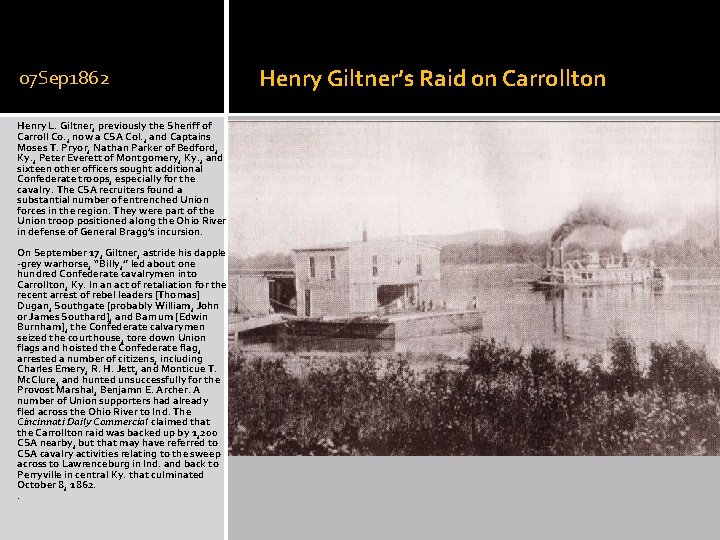
07 Sep 1862 Henry L. Giltner, previously the Sheriff of Carroll Co. , now a CSA Col. , and Captains Moses T. Pryor, Nathan Parker of Bedford, Ky. , Peter Everett of Montgomery, Ky. , and sixteen other officers sought additional Confederate troops, especially for the cavalry. The CSA recruiters found a substantial number of entrenched Union forces in the region. They were part of the Union troop positioned along the Ohio River in defense of General Bragg’s incursion. On September 17, Giltner, astride his dapple -grey warhorse, “Billy, ” led about one hundred Confederate cavalrymen into Carrollton, Ky. In an act of retaliation for the recent arrest of rebel leaders [Thomas] Dugan, Southgate [probably William, John or James Southard], and Barnum [Edwin Burnham], the Confederate calvarymen seized the courthouse, tore down Union flags and hoisted the Confederate flag, arrested a number of citizens, including Charles Emery, R. H. Jett, and Monticue T. Mc. Clure, and hunted unsuccessfully for the Provost Marshal, Benjamn E. Archer. A number of Union supporters had already fled across the Ohio River to Ind. The Cincinnati Daily Commercial claimed that the Carrollton raid was backed up by 1, 200 CSA nearby, but that may have referred to CSA cavalry activities relating to the sweep across to Lawrenceburg in Ind. and back to Perryville in central Ky. that culminated October 8, 1862. . Henry Giltner’s Raid on Carrollton
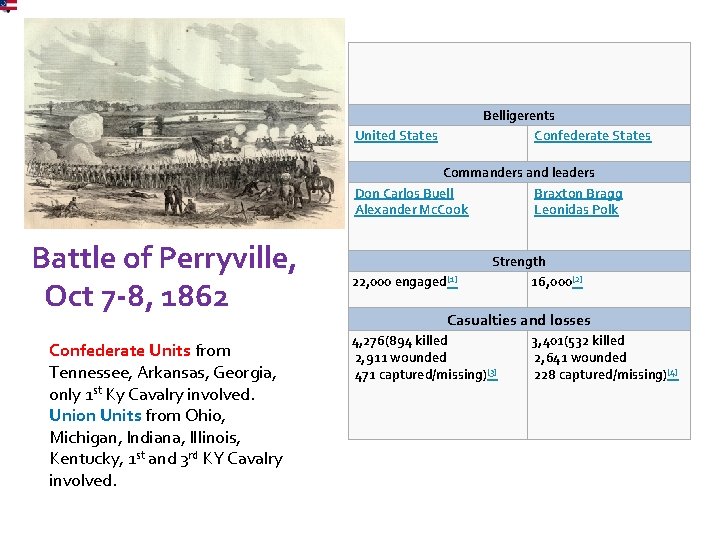
Belligerents Confederate States United States Commanders and leaders Don Carlos Buell Braxton Bragg Alexander Mc. Cook Leonidas Polk Battle of Perryville, Oct 7 -8, 1862 Confederate Units from Tennessee, Arkansas, Georgia, only 1 st Ky Cavalry involved. Union Units from Ohio, Michigan, Indiana, Illinois, Kentucky, 1 st and 3 rd KY Cavalry involved. 22, 000 engaged[1] Strength 16, 000[2] Casualties and losses 4, 276(894 killed 2, 911 wounded 471 captured/missing)[3] 3, 401(532 killed 2, 641 wounded 228 captured/missing)[4]
Local Soldiers Confederates and Union Units
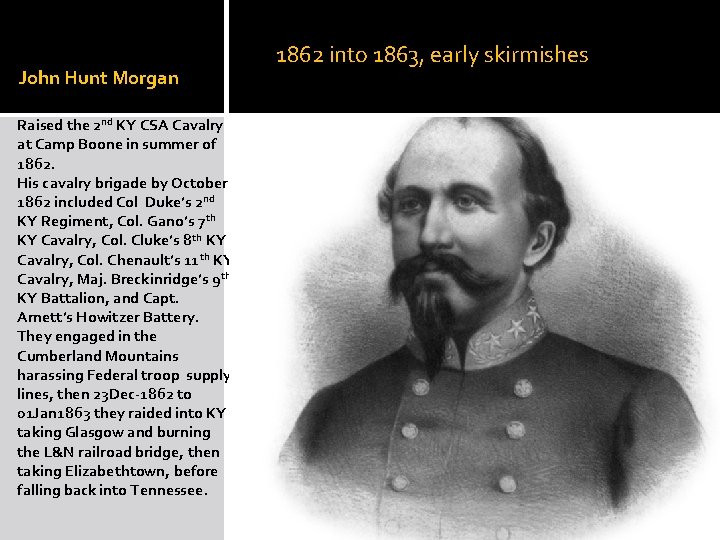
John Hunt Morgan Raised the 2 nd KY CSA Cavalry at Camp Boone in summer of 1862. His cavalry brigade by October 1862 included Col Duke’s 2 nd KY Regiment, Col. Gano’s 7 th KY Cavalry, Col. Cluke’s 8 th KY Cavalry, Col. Chenault’s 11 th KY Cavalry, Maj. Breckinridge’s 9 th KY Battalion, and Capt. Arnett’s Howitzer Battery. They engaged in the Cumberland Mountains harassing Federal troop supply lines, then 23 Dec-1862 to 01 Jan 1863 they raided into KY taking Glasgow and burning the L&N railroad bridge, then taking Elizabethtown, before falling back into Tennessee. 11862 into 1863, early skirmishes
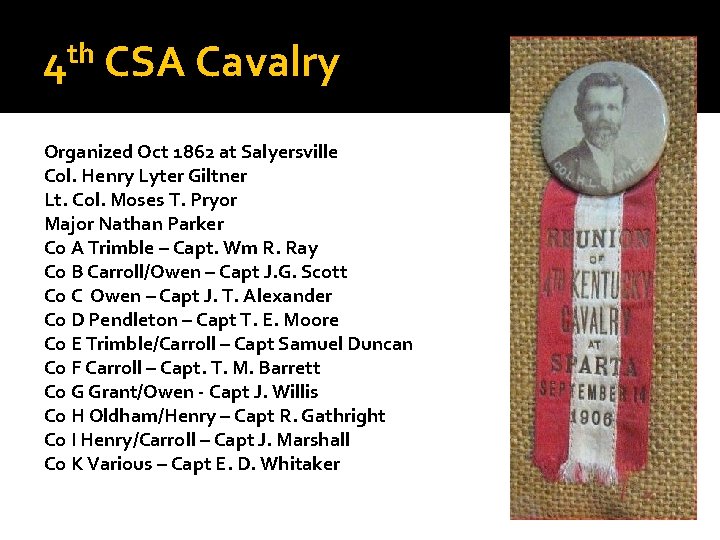
th 4 CSA Cavalry Organized Oct 1862 at Salyersville Col. Henry Lyter Giltner Lt. Col. Moses T. Pryor Major Nathan Parker Co A Trimble – Capt. Wm R. Ray Co B Carroll/Owen – Capt J. G. Scott Co C Owen – Capt J. T. Alexander Co D Pendleton – Capt T. E. Moore Co E Trimble/Carroll – Capt Samuel Duncan Co F Carroll – Capt. T. M. Barrett Co G Grant/Owen - Capt J. Willis Co H Oldham/Henry – Capt R. Gathright Co I Henry/Carroll – Capt J. Marshall Co K Various – Capt E. D. Whitaker
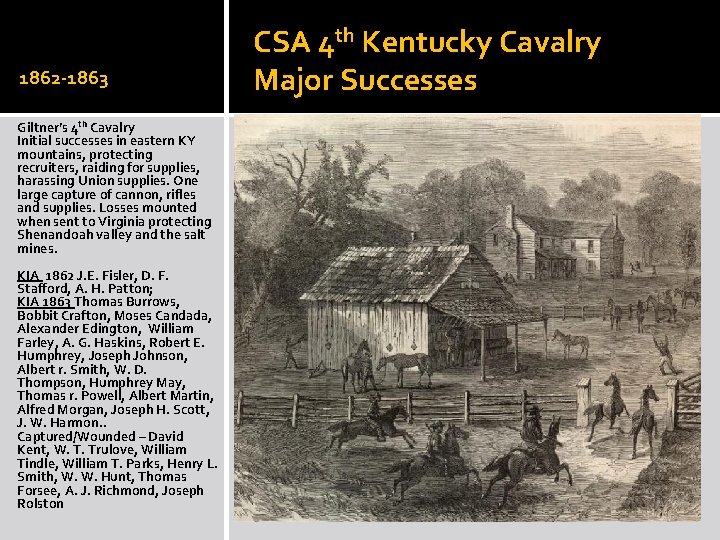
1862 -1863 Giltner’s 4 th Cavalry Initial successes in eastern KY mountains, protecting recruiters, raiding for supplies, harassing Union supplies. One large capture of cannon, rifles and supplies. Losses mounted when sent to Virginia protecting Shenandoah valley and the salt mines. KIA 1862 J. E. Fisler, D. F. Stafford, A. H. Patton; KIA 1863 Thomas Burrows, Bobbit Crafton, Moses Candada, Alexander Edington, William Farley, A. G. Haskins, Robert E. Humphrey, Joseph Johnson, Albert r. Smith, W. D. Thompson, Humphrey May, Thomas r. Powell, Albert Martin, Alfred Morgan, Joseph H. Scott, J. W. Harmon. . Captured/Wounded – David Kent, W. T. Trulove, William Tindle, William T. Parks, Henry L. Smith, W. W. Hunt, Thomas Forsee, A. J. Richmond, Joseph Rolston CSA 4 th Kentucky Cavalry Major Successes
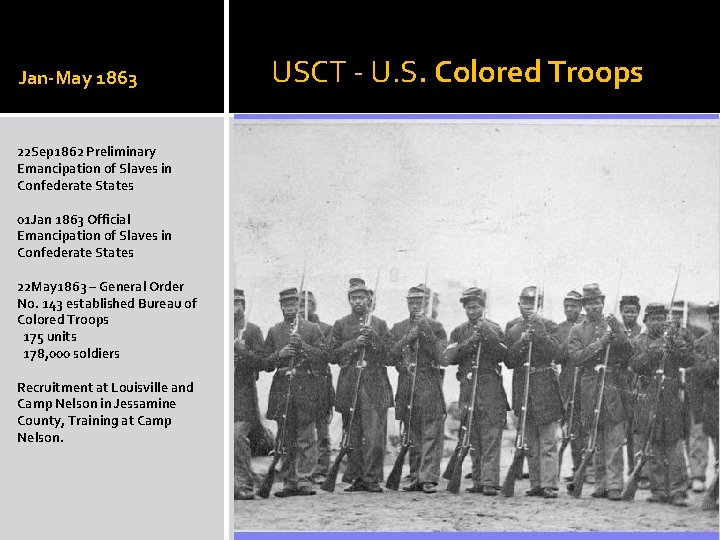
Jan-May 1863 22 Sep 1862 Preliminary Emancipation of Slaves in Confederate States 01 Jan 1863 Official Emancipation of Slaves in Confederate States 22 May 1863 – General Order No. 143 established Bureau of Colored Troops 175 units 178, 000 soldiers Recruitment at Louisville and Camp Nelson in Jessamine County, Training at Camp Nelson. USCT - U. S. Colored Troops
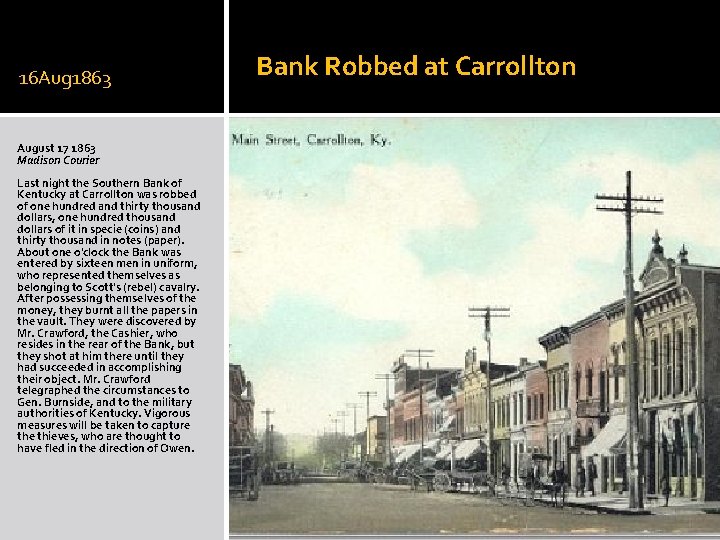
16 Aug 1863 August 17 1863 Madison Courier Last night the Southern Bank of Kentucky at Carrollton was robbed of one hundred and thirty thousand dollars, one hundred thousand dollars of it in specie (coins) and thirty thousand in notes (paper). About one o'clock the Bank was entered by sixteen men in uniform, who represented themselves as belonging to Scott's (rebel) cavalry. After possessing themselves of the money, they burnt all the papers in the vault. They were discovered by Mr. Crawford, the Cashier, who resides in the rear of the Bank, but they shot at him there until they had succeeded in accomplishing their object. Mr. Crawford telegraphed the circumstances to Gen. Burnside, and to the military authorities of Kentucky. Vigorous measures will be taken to capture thieves, who are thought to have fled in the direction of Owen. Bank Robbed at Carrollton
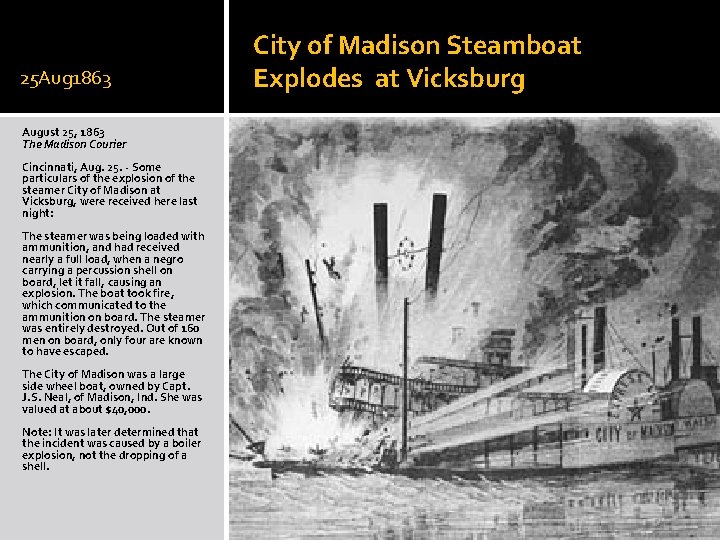
25 Aug 1863 August 25, 1863 The Madison Courier Cincinnati, Aug. 25. - Some particulars of the explosion of the steamer City of Madison at Vicksburg, were received here last night: The steamer was being loaded with ammunition, and had received nearly a full load, when a negro carrying a percussion shell on board, let it fall, causing an explosion. The boat took fire, which communicated to the ammunition on board. The steamer was entirely destroyed. Out of 160 men on board, only four are known to have escaped. The City of Madison was a large side wheel boat, owned by Capt. J. S. Neal, of Madison, Ind. She was valued at about $40, 000. Note: It was later determined that the incident was caused by a boiler explosion, not the dropping of a shell. City of Madison Steamboat Explodes at Vicksburg
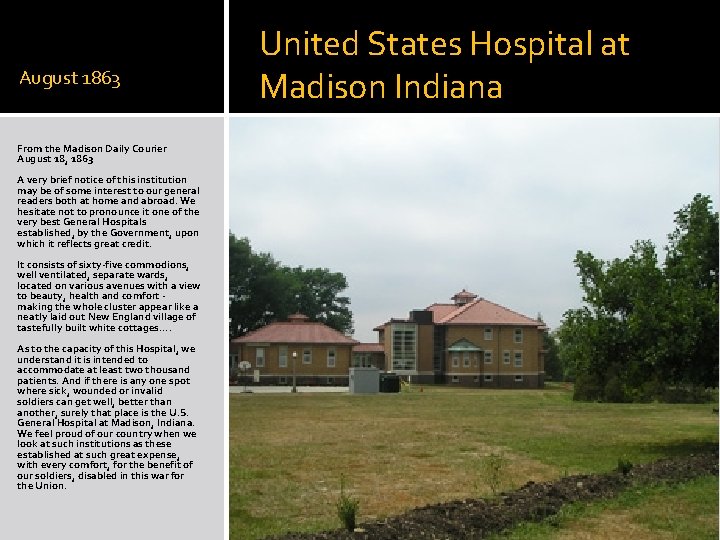
August 1863 From the Madison Daily Courier August 18, 1863 A very brief notice of this institution may be of some interest to our general readers both at home and abroad. We hesitate not to pronounce it one of the very best General Hospitals established, by the Government, upon which it reflects great credit. It consists of sixty-five commodions, well ventilated, separate wards, located on various avenues with a view to beauty, health and comfort - making the whole cluster appear like a neatly laid out New England village of tastefully built white cottages. . As to the capacity of this Hospital, we understand it is intended to accommodate at least two thousand patients. And if there is any one spot where sick, wounded or invalid soldiers can get well, better than another, surely that place is the U. S. General Hospital at Madison, Indiana. We feel proud of our country when we look at such institutions as these established at such great expense, with every comfort, for the benefit of our soldiers, disabled in this war for the Union. United States Hospital at Madison Indiana
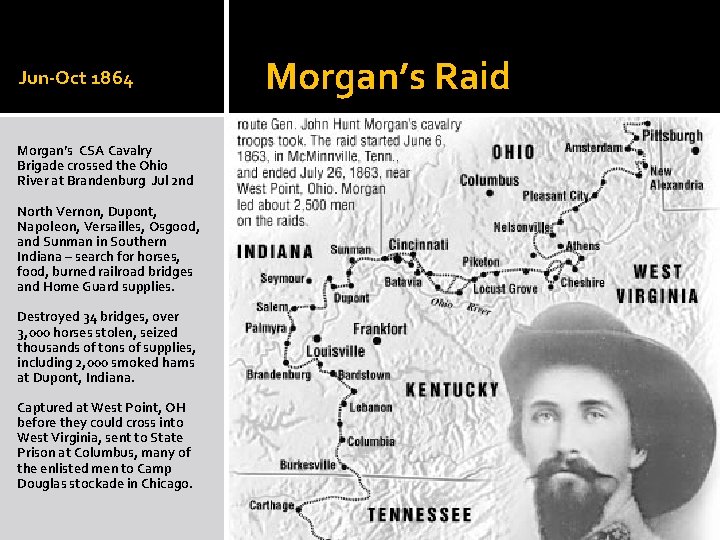
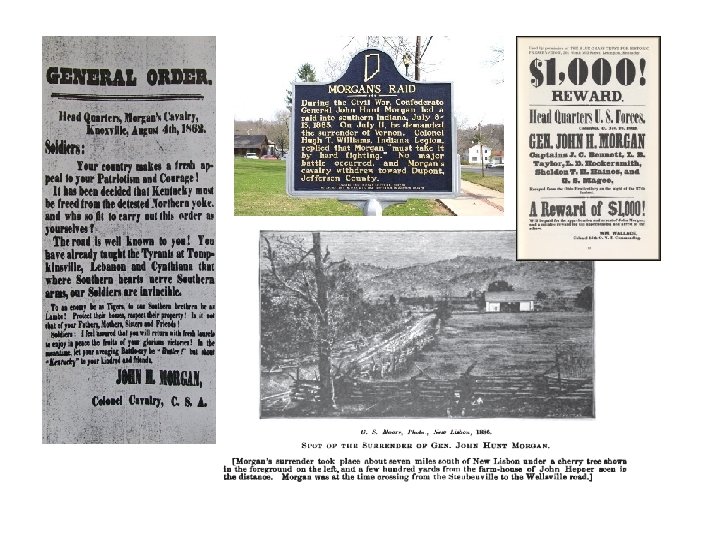
Jun-Oct 1864 Morgan’s CSA Cavalry Brigade crossed the Ohio River at Brandenburg Jul 2 nd North Vernon, Dupont, Napoleon, Versailles, Osgood, and Sunman in Southern Indiana – search for horses, food, burned railroad bridges and Home Guard supplies. Destroyed 34 bridges, over 3, 000 horses stolen, seized thousands of tons of supplies, including 2, 000 smoked hams at Dupont, Indiana. Captured at West Point, OH before they could cross into West Virginia, sent to State Prison at Columbus, many of the enlisted men to Camp Douglas stockade in Chicago. Morgan’s Raid
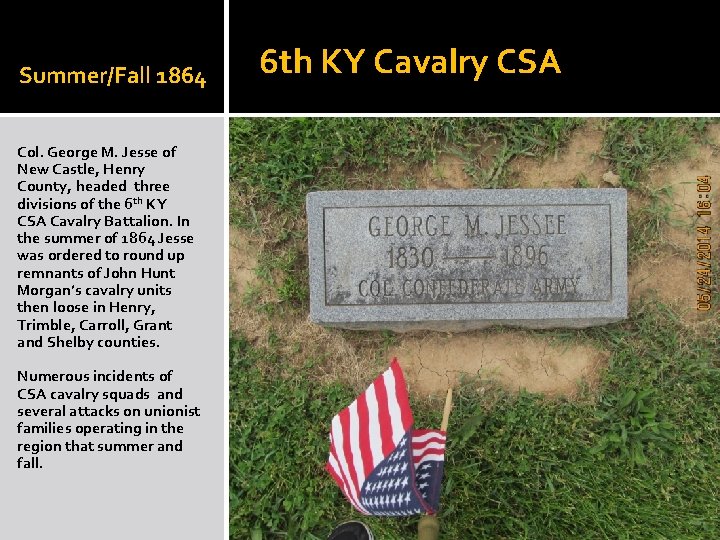
Summer/Fall 1864 Col. George M. Jesse of New Castle, Henry County, headed three divisions of the 6 th KY CSA Cavalry Battalion. In the summer of 1864 Jesse was ordered to round up remnants of John Hunt Morgan’s cavalry units then loose in Henry, Trimble, Carroll, Grant and Shelby counties. Numerous incidents of CSA cavalry squads and several attacks on unionist families operating in the region that summer and fall. 6 th KY Cavalry CSA
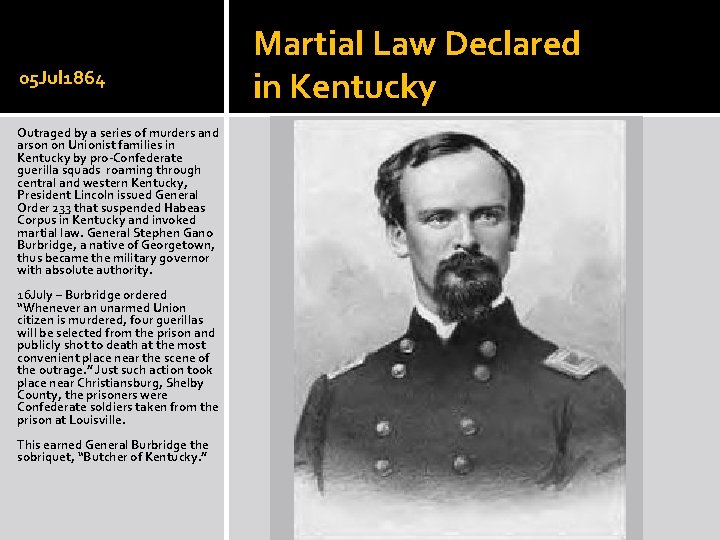
05 Jul 1864 Outraged by a series of murders and arson on Unionist families in Kentucky by pro-Confederate guerilla squads roaming through central and western Kentucky, President Lincoln issued General Order 233 that suspended Habeas Corpus in Kentucky and invoked martial law. General Stephen Gano Burbridge, a native of Georgetown, thus became the military governor with absolute authority. 16 July – Burbridge ordered “Whenever an unarmed Union citizen is murdered, four guerillas will be selected from the prison and publicly shot to death at the most convenient place near the scene of the outrage. ” Just such action took place near Christiansburg, Shelby County, the prisoners were Confederate soldiers taken from the prison at Louisville. This earned General Burbridge the sobriquet, “Butcher of Kentucky. ” Martial Law Declared in Kentucky
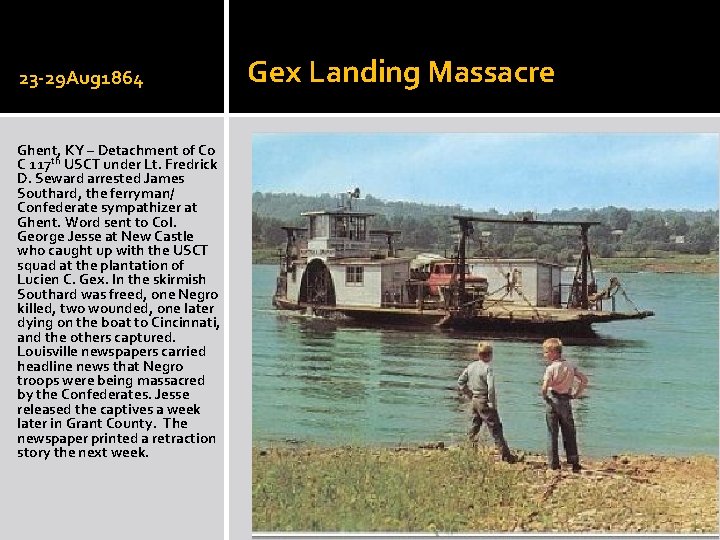
23 -29 Aug 1864 Ghent, KY – Detachment of Co C 117 th USCT under Lt. Fredrick D. Seward arrested James Southard, the ferryman/ Confederate sympathizer at Ghent. Word sent to Col. George Jesse at New Castle who caught up with the USCT squad at the plantation of Lucien C. Gex. In the skirmish Southard was freed, one Negro killed, two wounded, one later dying on the boat to Cincinnati, and the others captured. Louisville newspapers carried headline news that Negro troops were being massacred by the Confederates. Jesse released the captives a week later in Grant County. The newspaper printed a retraction story the next week. Gex Landing Massacre
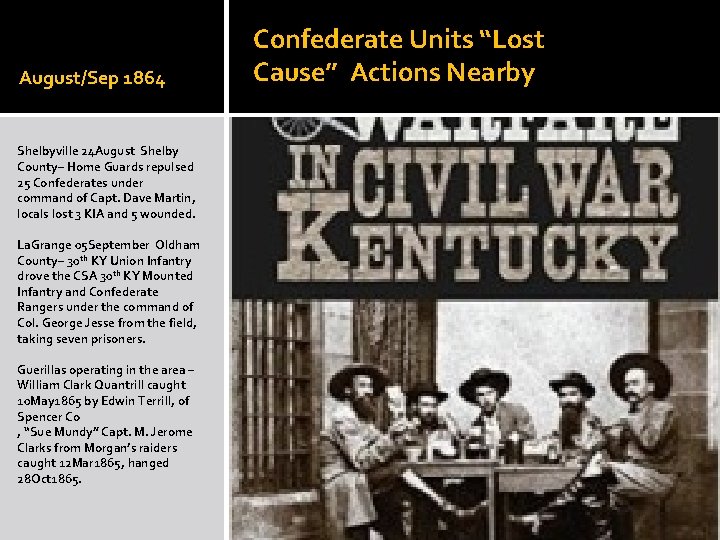
August/Sep 1864 Shelbyville 24 August Shelby County– Home Guards repulsed 25 Confederates under command of Capt. Dave Martin, locals lost 3 KIA and 5 wounded. La. Grange 05 September Oldham County– 30 th KY Union Infantry drove the CSA 30 th KY Mounted Infantry and Confederate Rangers under the command of Col. George Jesse from the field, taking seven prisoners. Guerillas operating in the area – William Clark Quantrill caught 10 May 1865 by Edwin Terrill, of Spencer Co , “Sue Mundy” Capt. M. Jerome Clarks from Morgan’s raiders caught 12 Mar 1865, hanged 28 Oct 1865. Confederate Units “Lost Cause” Actions Nearby
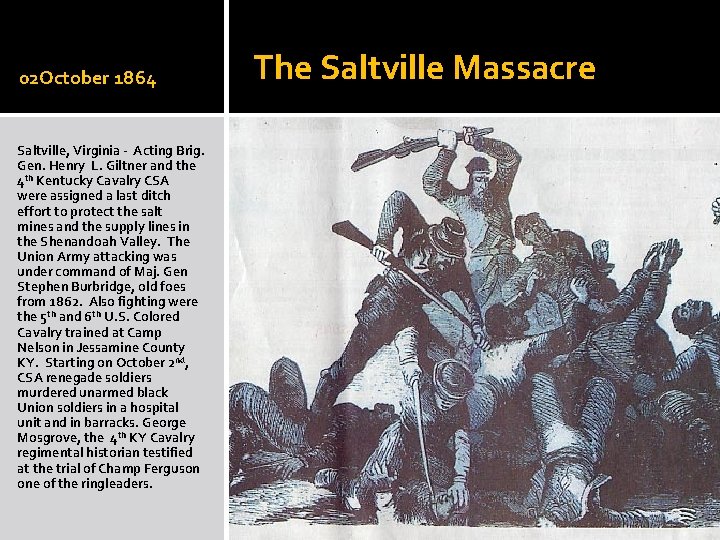
02 October 1864 Saltville, Virginia - Acting Brig. Gen. Henry L. Giltner and the 4 th Kentucky Cavalry CSA were assigned a last ditch effort to protect the salt mines and the supply lines in the Shenandoah Valley. The Union Army attacking was under command of Maj. Gen Stephen Burbridge, old foes from 1862. Also fighting were the 5 th and 6 th U. S. Colored Cavalry trained at Camp Nelson in Jessamine County KY. Starting on October 2 nd, CSA renegade soldiers murdered unarmed black Union soldiers in a hospital unit and in barracks. George Mosgrove, the 4 th KY Cavalry regimental historian testified at the trial of Champ Ferguson one of the ringleaders. The Saltville Massacre
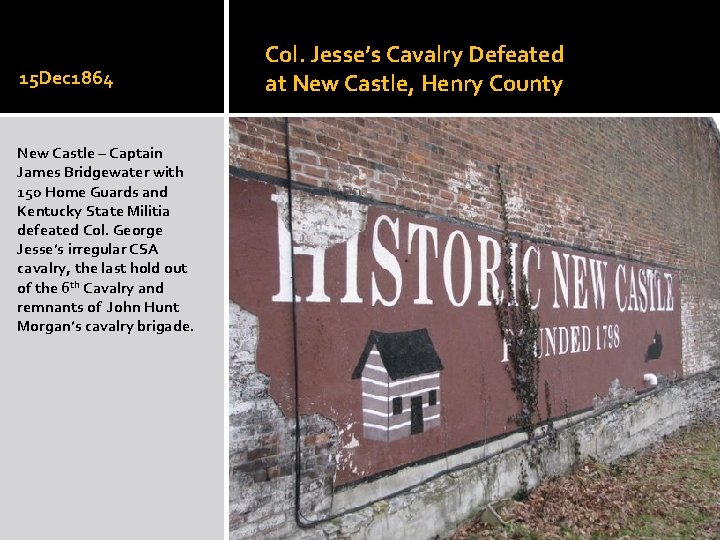
15 Dec 1864 New Castle – Captain James Bridgewater with 150 Home Guards and Kentucky State Militia defeated Col. George Jesse’s irregular CSA cavalry, the last hold out of the 6 th Cavalry and remnants of John Hunt Morgan’s cavalry brigade. Col. Jesse’s Cavalry Defeated at New Castle, Henry County
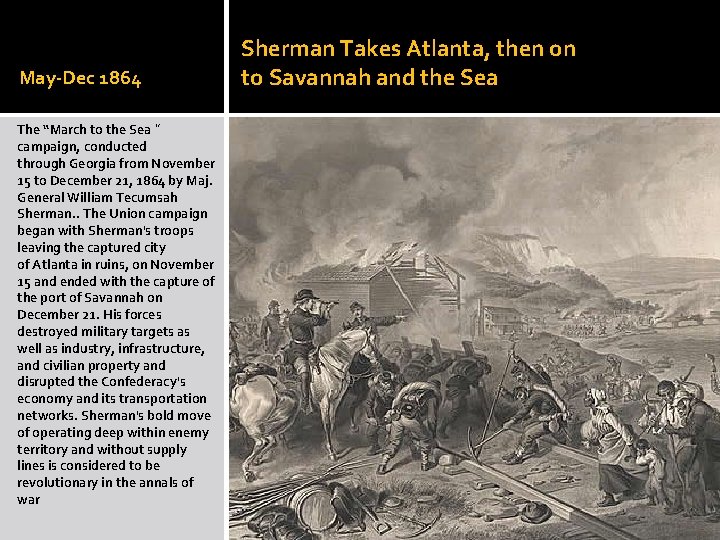
May-Dec 1864 The “March to the Sea ” campaign, conducted through Georgia from November 15 to December 21, 1864 by Maj. General William Tecumsah Sherman. . The Union campaign began with Sherman's troops leaving the captured city of Atlanta in ruins, on November 15 and ended with the capture of the port of Savannah on December 21. His forces destroyed military targets as well as industry, infrastructure, and civilian property and disrupted the Confederacy's economy and its transportation networks. Sherman's bold move of operating deep within enemy territory and without supply lines is considered to be revolutionary in the annals of war Sherman Takes Atlanta, then on to Savannah and the Sea
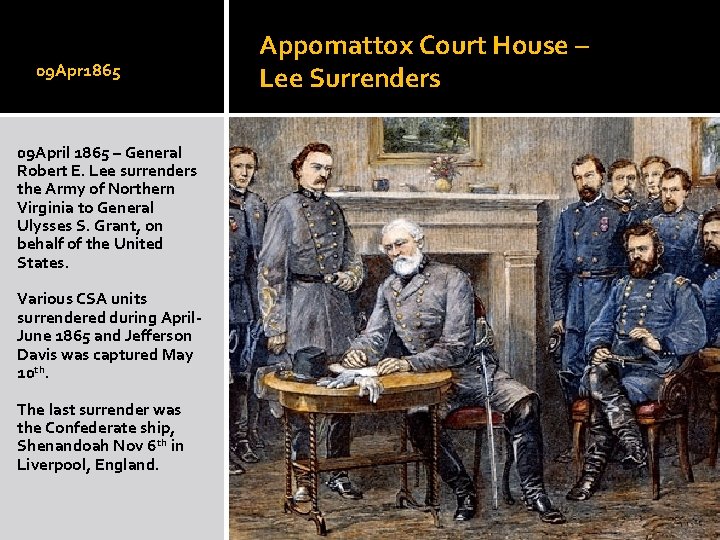
09 Apr 1865 09 April 1865 – General Robert E. Lee surrenders the Army of Northern Virginia to General Ulysses S. Grant, on behalf of the United States. Various CSA units surrendered during April. June 1865 and Jefferson Davis was captured May 10 th. The last surrender was the Confederate ship, Shenandoah Nov 6 th in Liverpool, England. Appomattox Court House – Lee Surrenders
Reconstruction Period Confederates Take Political Power in Kentucky
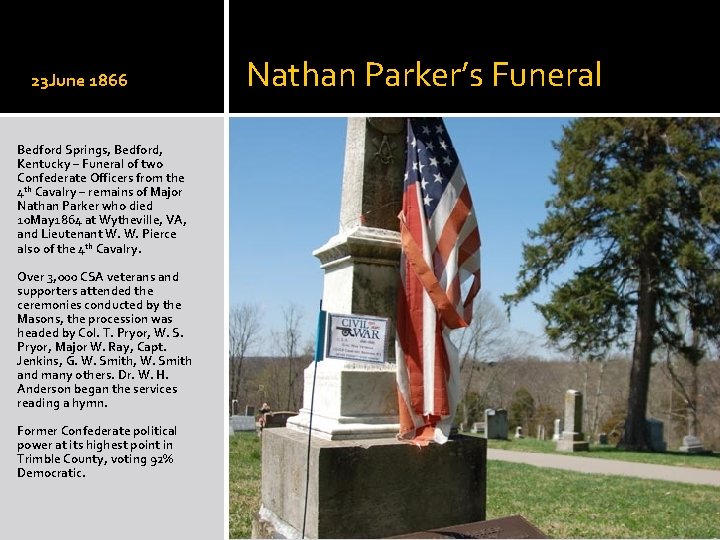
23 June 1866 Bedford Springs, Bedford, Kentucky – Funeral of two Confederate Officers from the 4 th Cavalry – remains of Major Nathan Parker who died 10 May 1864 at Wytheville, VA, and Lieutenant W. W. Pierce also of the 4 th Cavalry. Over 3, 000 CSA veterans and supporters attended the ceremonies conducted by the Masons, the procession was headed by Col. T. Pryor, W. S. Pryor, Major W. Ray, Capt. Jenkins, G. W. Smith, W. Smith and many others. Dr. W. H. Anderson began the services reading a hymn. Former Confederate political power at its highest point in Trimble County, voting 92% Democratic. Nathan Parker’s Funeral
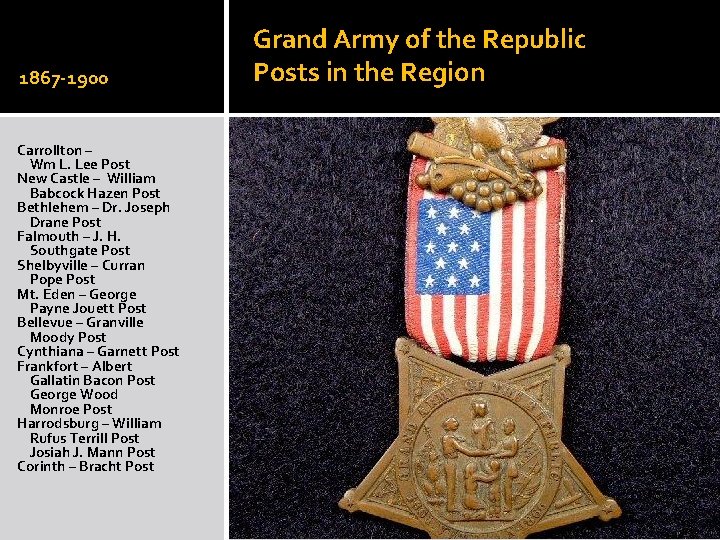
1867 -1900 Carrollton – Wm L. Lee Post New Castle – William Babcock Hazen Post Bethlehem – Dr. Joseph Drane Post Falmouth – J. H. Southgate Post Shelbyville – Curran Pope Post Mt. Eden – George Payne Jouett Post Bellevue – Granville Moody Post Cynthiana – Garnett Post Frankfort – Albert Gallatin Bacon Post George Wood Monroe Post Harrodsburg – William Rufus Terrill Post Josiah J. Mann Post Corinth – Bracht Post Grand Army of the Republic Posts in the Region
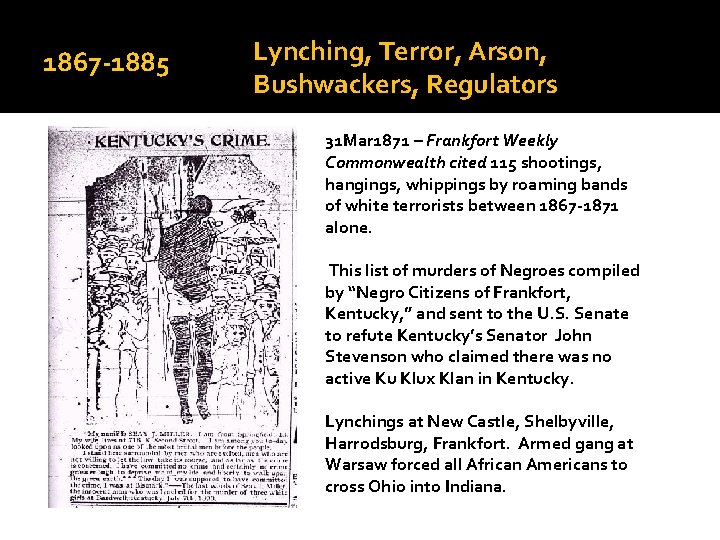
1867 -1885 Lynching, Terror, Arson, Bushwackers, Regulators 31 Mar 1871 – Frankfort Weekly Commonwealth cited 115 shootings, hangings, whippings by roaming bands of white terrorists between 1867 -1871 alone. This list of murders of Negroes compiled by “Negro Citizens of Frankfort, Kentucky, ” and sent to the U. S. Senate to refute Kentucky’s Senator John Stevenson who claimed there was no active Ku Klux Klan in Kentucky. Lynchings at New Castle, Shelbyville, Harrodsburg, Frankfort. Armed gang at Warsaw forced all African Americans to cross Ohio into Indiana.
The Civil War Legacy Here �Extremely cohesive socially, politically �African American’s fled to Indiana and Louisville and Cincinnati by 1950 only a handful left in the county �Many Unionists went West to Open Lands �Pro-South sentiment and “Lost Cause” sympathy most pronounced; family legends �Men’s Clubs – Masons, Elks, Red Men �Perhaps 90% belonged to churches �As steamboats gave way to railroads, remained agricultural - tobacco and orchards, gradual decline in local economy
Thanks for Your Interest Diane Perrine Coon April 2015 � Sources: � Trimble County Historical Society – Heritage Books and Cemetery Books � New History of Kentucky – Harrison & Klotter � The Guerilla War in Kentucky – G. W. Fischer � Racial Violence in Kentucky, 1865 --1940: Lynchings, Mob Rule, and "Legal Lynchings“ George C. Wright � Mills Springs and Perryville – K. A. Hafendorfer � Civil War Collection – The Filson Historical Society, Kentucky Historical Society, Kentucky Archives and Libraries