
STORIA GLOBALE Guido Abbattista Laurea Magistrale Interateneo in

STORIA GLOBALE Guido Abbattista Laurea Magistrale Interateneo in Studi Storici dal Medioevo all’età contemporanea Moodle enrolment key: GLOBHIST
Lezione 2: Gunpowder empires 08/03/2021 2
Impero ottomano 08/03/2021 3
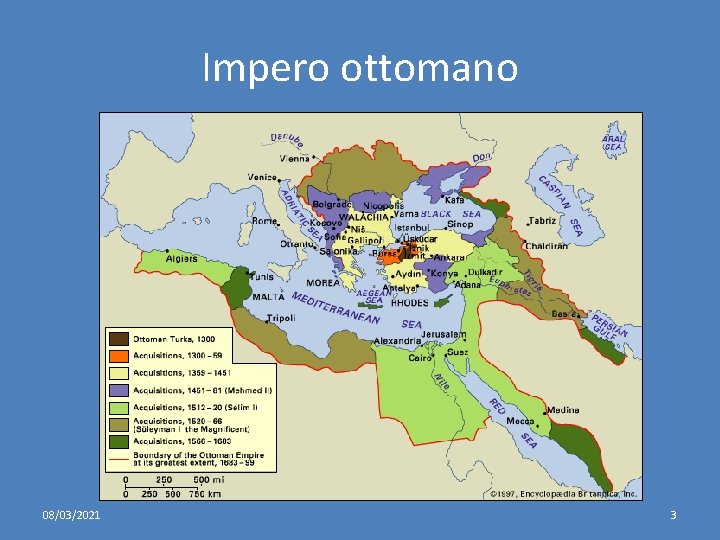
Impero ottomano • Ottoman Empire, empire created by Turkish tribes in Anatolia. One of the most powerful states in the world during the 15 th and 16 th centuries, it spanned more than 600 years and came to an end only in 1922, when it was replaced by the Turkish Republic and various successor states in southeastern Europe and the Middle East. At its height the empire included most of southeastern Europe to the gates of Vienna, including modern Hungary, Serbia, Bosnia, Romania, Greece, and Ukraine; Iraq, Syria, Israel, and Egypt; North Africa as far west as Algeria; and most of the Arabian Peninsula. The term Ottoman is a dynastic appellation derived from Osman (Arabic: ʿUthmān), the nomadic Turkmen chief who founded both the dynasty and the empire. 08/03/2021 4
The Ottoman state to 1481: the age of expansion The first period of Ottoman history was characterized by almost continuous territorial expansion, during which Ottoman dominion spread out from a small northwestern Anatolian principality to cover most of southeastern Europe and Anatolia. The political, economic, and social institutions of the classical Islāmic empires were amalgamated with those inherited from Byzantium and the great Turkish empires of Central Asia and were reestablished in new forms that were to characterize the area into modern times. 08/03/2021 5
By the time the Ottoman rulers became sultans [Sultan Mehmed (Muḥammad) I (ruled 1413– 20)], they already had far more extensive power and authority than had been the case a half century earlier. The simple tribal organization of the Ottoman bey could suffice only while the state was small enough for the individual tribal leaders to remain on their lands to collect their revenues and fight the nearby enemy at the same time. As the principality expanded and the frontiers and enemies became further removed from previously conquered territory, the financial and administrative functions at home had to be separated from the military. Taxes had to be collected to exploit the conquered territories and support the officers and soldiers while they were away. The treasury of the sultan had to be separated from that of the state so that each would have an independent income and organization. 08/03/2021 6
The peak of Ottoman power, 1481– 1566 • Bayezid II (1481– 1512) • Selim I (1512– 20) (first siege of Vienna, 1529) • Süleyman I (1520– 66), called “the Magnificent” • Selim II (ruled 1566– 74), known as “the Sot” or “the Blonde, ” • Murad III (1574– 95) 08/03/2021 7
The decline of the Ottoman Empire, 1566– 1807 The Ottoman reforms introduced during the 17 th century were undertaken by sultans Osman II (ruled 1618– 22) and Murad IV (1623– 40) and by the famous dynasty of Köprülü grand viziers who served under Mehmed IV (1648 – 87)—Köprülü Mehmed Paşa (served 1656– 61) and Köprülü Fazıl Ahmed Paşa (served 1661– 76). Each of these early reformers rose as the result of crises and military defeats that threatened the very existence of the empire. Each was given the power needed to introduce reforms because of the fears of the ruling class that the empire, on which the privileges of the ruling class depended, was in mortal danger. In a war between the Ottomans and the Habsburgs that began in 1593, the Austrians were able to take much of central Hungary and Romania, and only an accidental Ottoman triumph in 1596 enabled the sultan to recoup. The Habsburgs then agreed to the Treaty of Zsitvatorok (1606), by which Ottoman rule of Hungary and Romania was restored. The treaty itself, however, like the events that led up to it, for the first time demonstrated to Europe the extent of Ottoman weakness and thus exposed the Ottomans to new dangers in subsequent years. 08/03/2021 8
The second siege of Vienna (1683) marks the high point of Muslim expansion in Europe. Its failure highlights the incipient weakness of Muslim armies in technology, tactics and discipline in comparison to those of the Europeans. The Ottoman retreat began about the same time as the Moghul reverses at the hands of the Marathas in India, and the Safavid losses in northern Persia to the Russians. After Vienna, the Ottomans ceased to be a threat to Europe, although the resilient Turks made recurrent efforts to reform and revitalize their institutions. A sustained counter thrust from Europe began, which was aimed initially at the Balkans and the Caucasus, but expanded over the years to North Africa and Egypt, and resulted ultimately in the destruction of the Ottoman Empire in the Great War of 1914 -1918. Muslim power had passed its zenith. The hour of Europe had arrived 08/03/2021 9
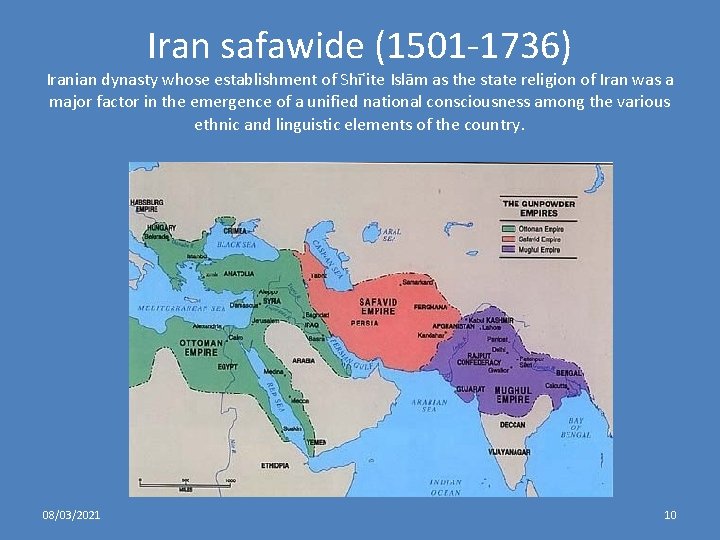
Iran safawide (1501 -1736) Iranian dynasty whose establishment of Shīʿite Islām as the state religion of Iran was a major factor in the emergence of a unified national consciousness among the various ethnic and linguistic elements of the country. 08/03/2021 10
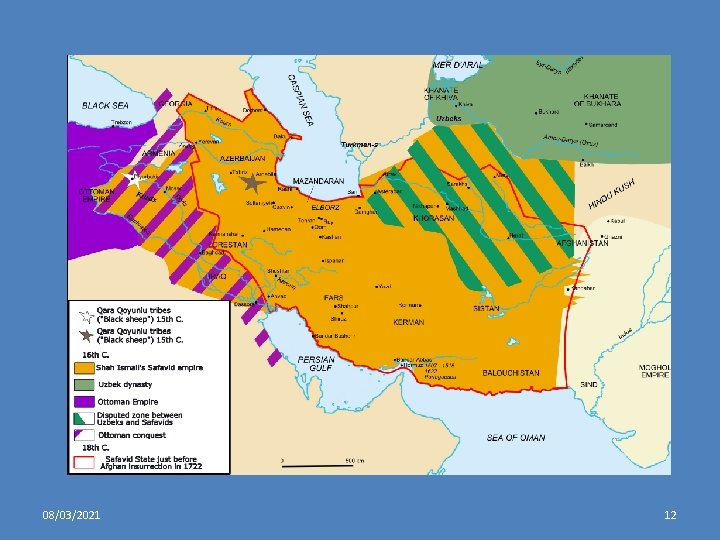
Shah ʿAbbās’ remarkable reign (1588 -1629), with its striking military successes and efficient administrative system, raised Iran to the status of a great power. Trade with the West and industry expanded, communications improved; the capital, Eṣfahān, became the centre of Ṣafavid architectural achievement, manifest in the mosques Masjid-i Shāh and the Masjid-i Sheykh Loṭfollāh; and other monuments including the ʿAlī Qāpū, the Chehel Sotūn, and the Meydān-i Shāh. Despite the Ṣafavid Shīʿite zeal, Christians were tolerated and several missions and churches were built. 08/03/2021 11
08/03/2021 12
Storia dell’India • • • Magadha, Shishunaga, Nanda (684 -321 a. C. ) Achemenidi, Greci (520 -325 a. C. ) Maurya (321 -185 a. C. ) Regno indo-scita Regno Gupta (secc. IV-V) Regno Harsha (VI-VII sec. ) Invasioni islamiche: Mahmud di Ghazna (979 -1030) Mahmud di Ghur e il sultanato di Delhi (secc. XII-XIV) Impero indù Vijayanagar (1336 -1646) Moghul (1526 -1857) Maratha (1627 -1817) 08/03/2021 13
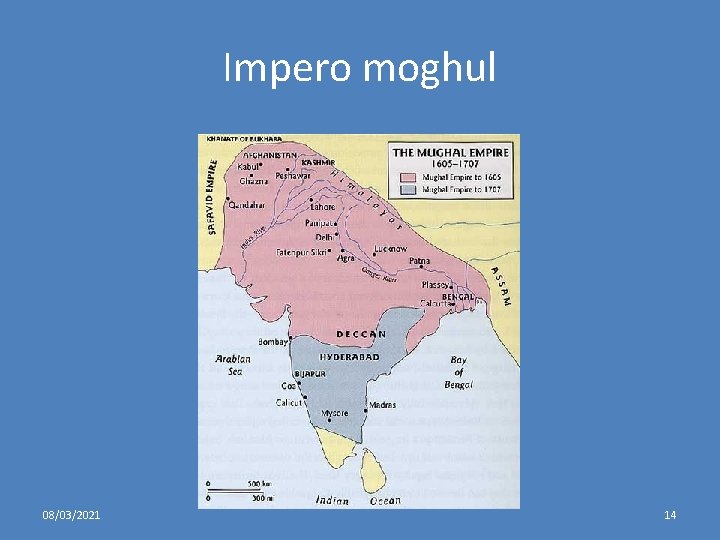
Impero moghul 08/03/2021 14
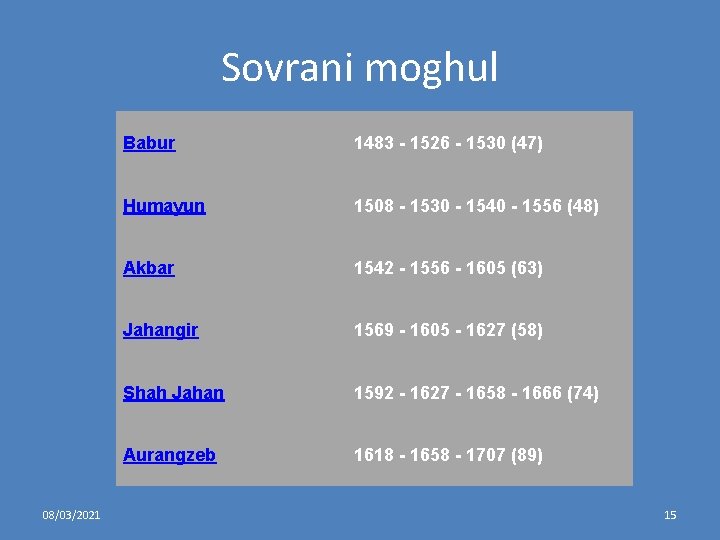
Sovrani moghul Babur 1483 - 1526 - 1530 (47) 08/03/2021 Humayun 1508 - 1530 - 1540 - 1556 (48) Akbar 1542 - 1556 - 1605 (63) Jahangir 1569 - 1605 - 1627 (58) Shah Jahan 1592 - 1627 - 1658 - 1666 (74) Aurangzeb 1618 - 1658 - 1707 (89) 15
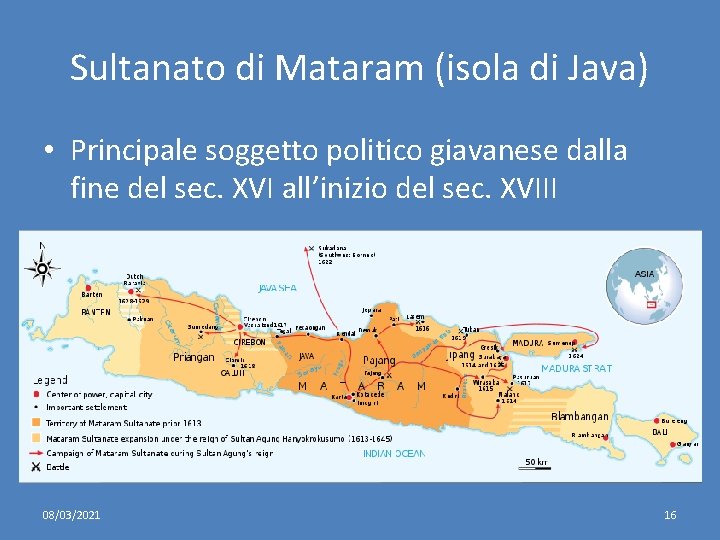
Sultanato di Mataram (isola di Java) • Principale soggetto politico giavanese dalla fine del sec. XVI all’inizio del sec. XVIII 08/03/2021 16
Mataram all’epoca dell’arrivo degli Europei • Sultan Agung (1613 -1646): capitale Karta • supremazia politico-militare nell’isola di Giava (sconfitta degli avversari di Surabaya e Madura, est Giava); fallito tentativo di espellere gli Olandesi da Batavia (1628 -1629) • Amangkurat I e Amangkurat II (1677 - 08/03/2021 17
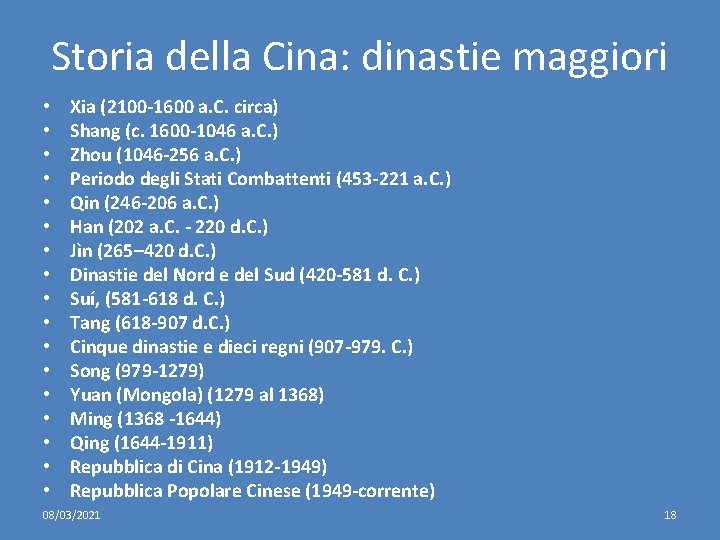
Storia della Cina: dinastie maggiori • • • • • Xia (2100 -1600 a. C. circa) Shang (c. 1600 -1046 a. C. ) Zhou (1046 -256 a. C. ) Periodo degli Stati Combattenti (453 -221 a. C. ) Qin (246 -206 a. C. ) Han (202 a. C. - 220 d. C. ) Jìn (265– 420 d. C. ) Dinastie del Nord e del Sud (420 -581 d. C. ) Suí, (581 -618 d. C. ) Tang (618 -907 d. C. ) Cinque dinastie e dieci regni (907 -979. C. ) Song (979 -1279) Yuan (Mongola) (1279 al 1368) Ming (1368 -1644) Qing (1644 -1911) Repubblica di Cina (1912 -1949) Repubblica Popolare Cinese (1949 -corrente) 08/03/2021 18
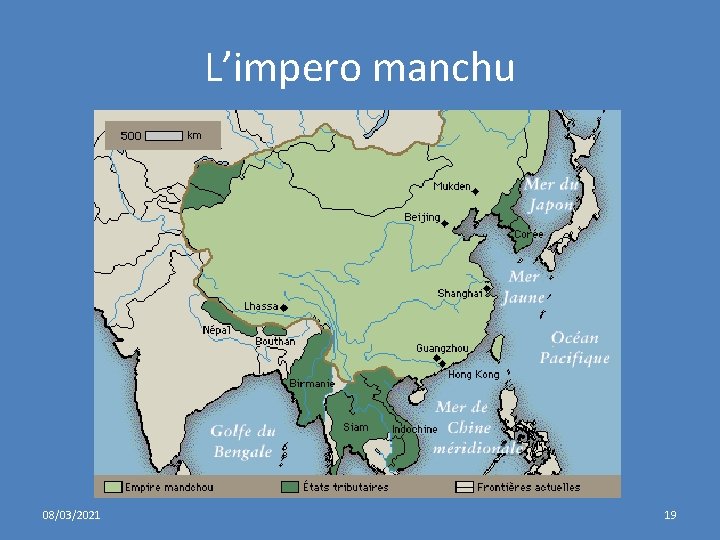
L’impero manchu 08/03/2021 19
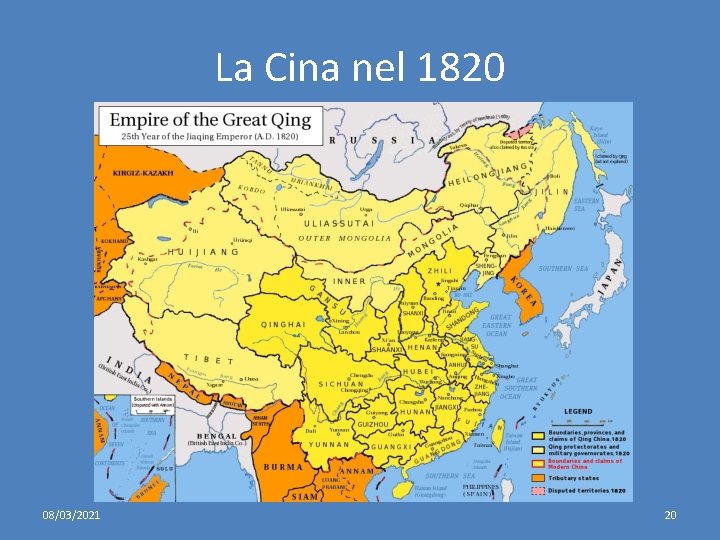
La Cina nel 1820 08/03/2021 20
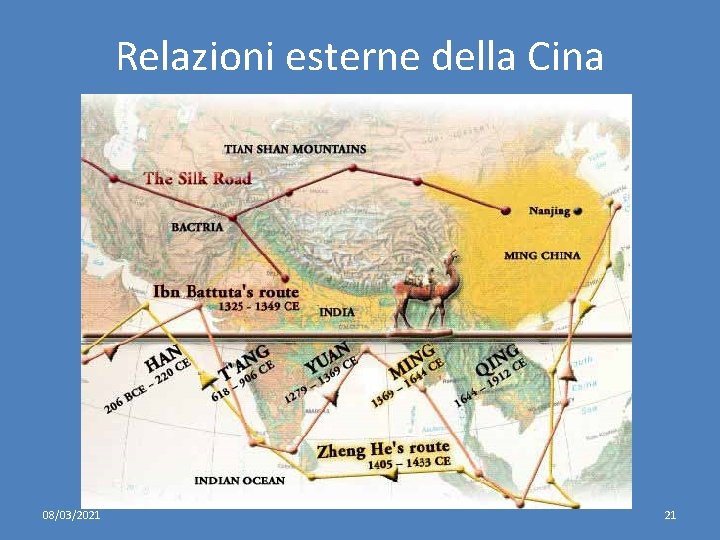
Relazioni esterne della Cina 08/03/2021 21
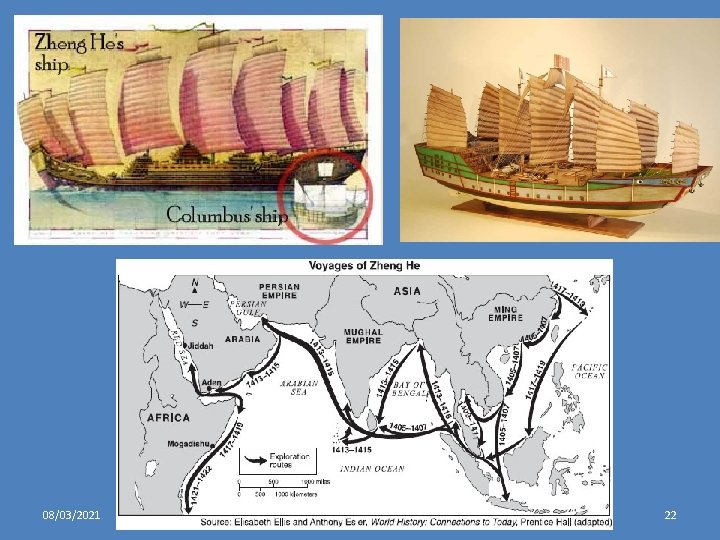
08/03/2021 22
Storia del Giappone Periodo Yayoi (300 a. C. -250 d. C. ) periodo Kofun (250 -700 d. C. ) Periodo Nara (710 - 784) Periodo Heian (784 - 1185) Periodo Ashikaga o Muromachi (1333 - 1573) Periodo Azuchi-Momoyama (1573 - 1600) (Tokugawa Ieyasu) • Periodo Edo o Tokugawa (1600 - 1868) (shōgunato ereditario) • Takamori Saigō (Satsuma) e Kido Kōin (Chōshū): alleanza del 1866 e rinnovamento Meiji • Impero giapponese (1868 - 1945) • • • Ø guerra sino-giapponese (1894 -95 e russo-giapponese (1904 -1905) 08/03/2021 23
Storia dell’Africa • Africa occidentale prima degli Europei: • ” There were many forms of government in Africa before Europeans knew it, ranging from powerful empires to decentralised groups of pastoralists and hunters. In West Africa, archaeological excavations at Old Jenne (modern Djenné, in Mali) have uncovered a sophisticated urban settlement dating from the 3 rd century BC. The ancient kingdom of Ghana was based on the gold trade and flourished from at least as early as the 8 th century AD. In the Middle Ages much of modern Senegal and Mali was governed by a confederation of states known as the Mali empire“ • Spartizione e dominazione coloniale 1882 -1935 08/03/2021 24
Storia dell’Africa Benin: “Old Benin was the forest kingdom of the Edo-speaking people. From the early 15 th century, the Oba (ruler) of Benin, Ewuare, built up a powerful standing army and expanded Benin towards the Niger Delta and Lagos in the west. The Oba was head of government and established a well-structured society. He collected taxes and owned all the land in the country. The people of Benin were highly skilled in the art of making figurines and heads of bronze, brass, copper and ivory, usually in honour of the Oba. Masks played an important role in rituals to ensure the well-being and prosperity of the Edo people”. 08/03/2021 25
08/03/2021 26
Key: 1. Yatenga 7. Borgu 12 Hausa states 13. Borno 2. Wagadugu 8. Oyo a. Gobir 14. Kanem 3. Mamprussi 9. Nupe b. Katsina 15. Kwararafa 4. Dagomba 10. Igala c. Daura 5. Nanumba 11. Benin d. Kano 6. Gonja e. Zakzak f. Zamfara g. Kebbi 08/03/2021 27
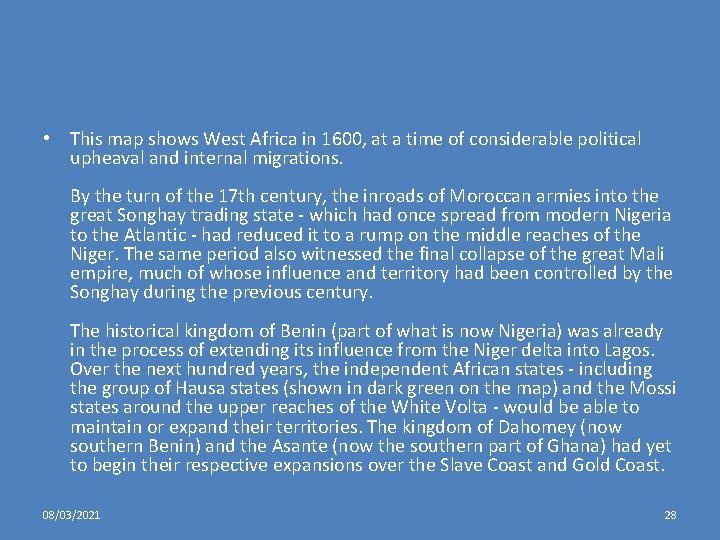
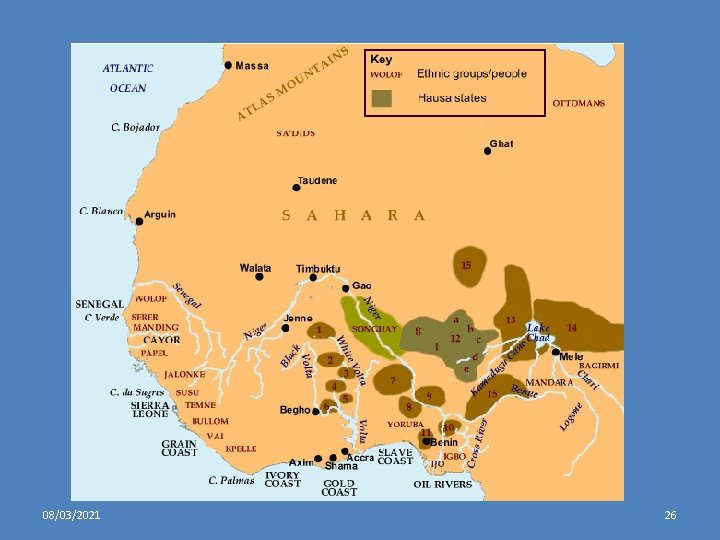
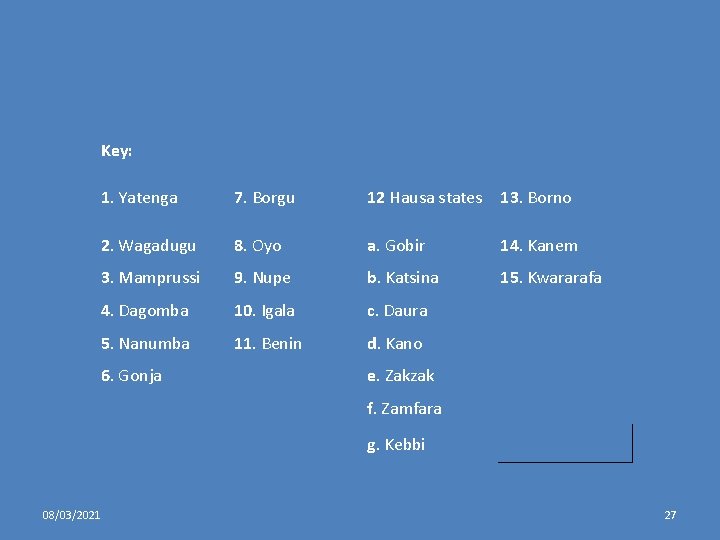
• This map shows West Africa in 1600, at a time of considerable political upheaval and internal migrations. By the turn of the 17 th century, the inroads of Moroccan armies into the great Songhay trading state - which had once spread from modern Nigeria to the Atlantic - had reduced it to a rump on the middle reaches of the Niger. The same period also witnessed the final collapse of the great Mali empire, much of whose influence and territory had been controlled by the Songhay during the previous century. The historical kingdom of Benin (part of what is now Nigeria) was already in the process of extending its influence from the Niger delta into Lagos. Over the next hundred years, the independent African states - including the group of Hausa states (shown in dark green on the map) and the Mossi states around the upper reaches of the White Volta - would be able to maintain or expand their territories. The kingdom of Dahomey (now southern Benin) and the Asante (now the southern part of Ghana) had yet to begin their respective expansions over the Slave Coast and Gold Coast. 08/03/2021 28
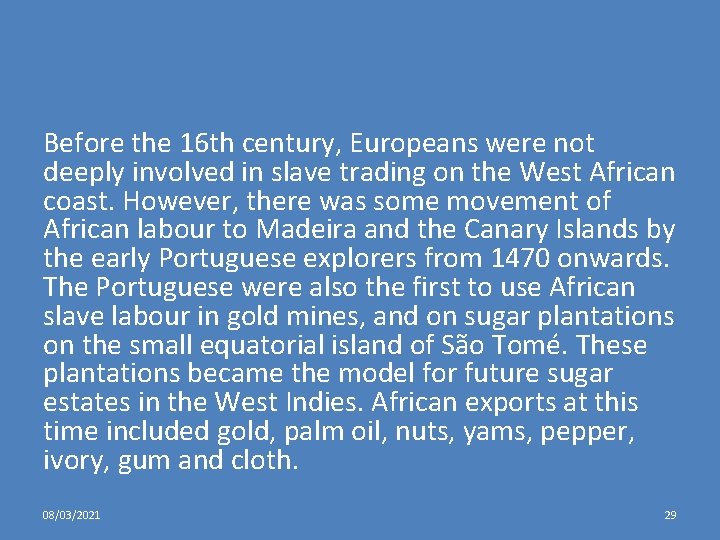
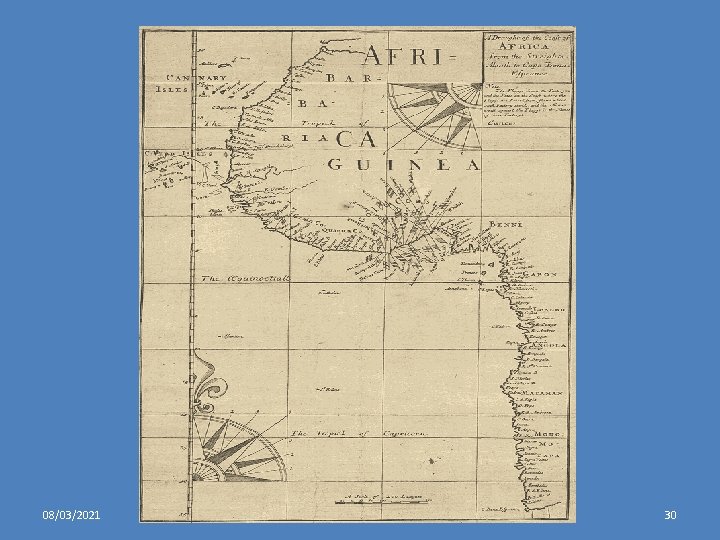
Before the 16 th century, Europeans were not deeply involved in slave trading on the West African coast. However, there was some movement of African labour to Madeira and the Canary Islands by the early Portuguese explorers from 1470 onwards. The Portuguese were also the first to use African slave labour in gold mines, and on sugar plantations on the small equatorial island of São Tomé. These plantations became the model for future sugar estates in the West Indies. African exports at this time included gold, palm oil, nuts, yams, pepper, ivory, gum and cloth. 08/03/2021 29
08/03/2021 30
During the 16 th century the first foundations of globalisation were laid when African rulers forged relationships with European traders. One early English explorer was William Hawkins, father of John Hawkins. In the 1530 s, Hawkins made voyages to Guinea to obtain ivory, dyewoods and gold. At this stage the English seemed to have little interest in taking slaves. This, however, was soon to change. There was intense rivalry for West Africa among Europeans. With no interest in conquering the interior, they concentrated their efforts to obtain human cargo along the West African coast. During the 1590 s, the Dutch challenged the Portuguese monopoly to become the main slave trading nation. Later, Scottish, Swedish and Danish African companies registered their interest. With so many European powers on the coast, conflict was inevitable, culminating in the Anglo-Dutch war of 1665 -7. Forts built by the Portuguese and Dutch on the Gold Coast (modern Ghana) were captured by the British in 1667. West African rulers were instrumental in the slave trade. They exchanged their prisoners of war (rarely their own people) for firearms manufactured in Birmingham and elsewhere in Britain. With their newly acquired weapons, kings and chiefs were able to expand their territories. The slave trade had a profound effect on the economy and politics of West Africa, leading, in many cases, to an increase in tension and violence. 08/03/2021 31
West Africa north of the tropical forest and south of the desert was the location of sub-Saharan Africa’s largest and most sophisticated states in the period before the 19 th century. People could travel and communicate over long distances either on horseback or foot across the dry savanna—a landscape not unlike the North American prairie—or along the water routes of the mighty Niger River. And their location between the trans. Saharan trade routes and the northern parts of commercial networks from gold-producing areas meant that the great empires of Ghana, Mali, and Songhay could profit from the commerce passing through their territories. They also were influenced to varying degrees by Islam, which gradually spread through trade to the lands south of the desert, which the Arabs called the bilad alsudan, or “the land of the blacks. ” 08/03/2021 32
• The earliest of West Africa's big states is known by historians as Ghana, after the title of its king. Not to be confused with the modern country called Ghana, ancient Ghana was located in what is now Mali and Mauritania. Founded probably around 300 CE, it was a powerful trading state by the early 9 th century, when Arabic sources described it as “the land of gold. ” Although most of its people were engaged in agriculture, the basis of Ghana’s power was its ability to tax goods passing through, and its monopoly of the gold trade from Bambuk, at the headwaters of the Senegal River. • Revenues from trade funded the army and bureaucracy of the state. Over time, the empire was built through conquest over lesser states, both north toward the Sahara and south toward the gold fields. Ghana’s system of government expanded as well, with subordinate areas ruled by local governors who funneled taxes to the central administration. 08/03/2021 33
• The most important of Ghana's immediate successor states was that of the Soninke-speaking Soso, which was at the height of its power in the early 13 th century during the rule of Sumanguru Kante. In about 1235 Sumaoro was challenged by the Mandinka people of the little state of Kangaba (also a former Ghana province), near the headwaters of the Niger River. The two armies fought each other in a famous battle, which over the centuries since then has become an important part of West African oral history, handed down over generations by praise singers called griots. Sumaoro was defeated and killed and the leader of the opposing force, Sundiata Keita (1235 -1260), then founded the Mali Empire by incorporating or conquering Sosso and nearby territories. Mali repeated the achievements of Ancient Ghana on a still greater scale. Its rulers secured of the goldproducing lands of Bambuk and as well as new goldfields at Bure, ultimately controlling an extensive system of regional and long-distance trade. • Most subjects were engaged in agriculture, however, which was taxed through provincial governors loyal to the mansa (king) at the capital. 08/03/2021 34
• The Mali Empire enjoyed its greatest power and prosperity under the rule of Mansa Kankan Musa (c. 1312 -37), whose picture adorned the 14 th century map I mentioned at the beginning. The armed horsemen of Musa’s armies extended the reach of the empire to the middle Niger region and Timbuktu, southern trading towns, northern trans-Saharan trading cities, east to the borders of Hausaland (present-day northern Nigeria), and west nearly to the Atlantic coast. Mansa Musa enclosed this huge portion of the Western Sudan within a single system of law and order, guaranteeing safety for traders and travelers. In the 14 th century some two-thirds of the gold in Europe and the Middle East came from the Western Sudan, carried over the Sahara and then to the Mediterranean, and Mali was now recognized as a world power. Under Mansa Musa, Mali's ambassadors were established in Morocco, Egypt and elsewhere, while North African and Egyptian scholars visited Mali’s capital. 08/03/2021 35
In an era of tenuous long-distance communications, and on a continent with low population densities, it was difficult to hold a large empire together. After about 1400, rebellions in Mali’s provinces started to become successful, and the Empire shrunk and weakened. But even as its political power declined, the Mali empire, which was about 200 years old at this point, still commanded respect and fame, especially among tributary states founded by its warriors. In its diminished form, Mali remained viable, but ever weaker, through nearly two more centuries, coexisting with the new ascendant power, Songhay. The Songhay people established themselves at the Niger River trading city of Gao at the beginning of the 7 th century, dominating the previous inhabitants. The settlers were enterprising traders and welcomed Berber merchants who came from the north. Over time, Songhay market-centers prospered and grew. By the 14 th century, Gao was so valuable that the great Mali ruler, Mansa Musa, sent out his generals and armies to bring it within the Mali Empire. But Mali's control of Gao lasted only about fifty years, ending when Gao won its independence in 1375. By the 16 th century, the Songhay state had become the largest ever in tropical Africa before the European conquest. Its strength derived from Songhay’s favorable position along the Niger River, which provided means of communication and trade; the prosperity of commercial cities like Gao, Timbuktu and Jenne; and good leadership, especially under the famous ruler Sunni Ali 08/03/2021 36
But the end of the Songhay Empire came with an attack from the north. In 1582, in an attempt to exert control over the gold trade, the sultan of Morocco sent a force to seize the salt-deposits located in the north of the Songhay Empire. The Moroccan troops were armed with a weapon not seen before on the battlefields of the Western Sudan, an early form of musket called an arquebus. This skirmish in a remote part of the empire opened a war with Morocco which proved disastrous for Songhay. At the same time as it was fighting Moroccan expansion, many of Songhay's subject peoples broke away from the empire. The Moroccan success turned out to be limited, keeping Timbuktu and Gao but not strong enough to rule the former empire, which broke into smaller kingdoms and chieftaincies. Islam continued to expand even after the eclipse of the Songhay Empire. Similarly, trans-Saharan trade continued, joined after about 1500 by the expanding European slave trade on the Atlantic coast 08/03/2021 37
• Alawi / Alaouite Dynasty AD 1664 - Present Day The modern kingdom of Morocco is located on the north-west African coastline, bordered by Algeria to the east, and Western Sahara to the south. It also controls the southern straits of Gibraltar, making it the closest point in Africa to Spain. The kingdom retains its capital at Rabat, although its best-known city (and largest) is probably Casablanca. The Alawi (Alaouites) were natives of southern Morocco. Initially they ruled only in Tafilalt (in the central eastern region of the country) and some parts of southern Morocco, following the death of Ahmad I al. Mansur which allowed the country to slip into anarchy. Completing a process begun by his father, Mulay Al-Rashid united the country under a single ruler and ended any opposition. The dynasty claims the same line of descent as the tenth century Fatamids of Tunisia, from Ali ibn Abi Talib (the Rashidun caliph of 656 -661) and his wife, Fatima. […] 08/03/2021 38
• Algiers is annexed by France and created a colony. Sultan Abderrahmane supports the resistance movement to this occupation, encouraging Algerian Islamic scholar Abd-el-Kader to fight the European invaders. The sultan is also called upon by the inhabitants of the Algerian city of Tlemcen to invade and protect it from the French. This he does, and his nephew, Prince Moulay Ali, is named caliph of Tlemcen. 1859 – 1860: The Spanish-Moroccan War, or African War, begins with a disagreement over the Spanish-controlled coastal city of Ceuta. The Moroccan forces accept defeat after the Battle of Tetuan. […] 1912: Under the terms of the Treaty of Fez, Morocco becomes a French Protectorate, with a small protectorate of northern territories near the Straits of Gibraltar remaining under Spanish control. 1956: Morocco gains independence from France and Spain. The following year, Sultan Mohammed drops his traditional title in favour of calling himself malik, or king of Morocco. Mohammed also captures Spanish Sahara during the Ifni War (which is known as the Forgotten War in Spain). […] 1963: Moroccan. Algerian war, settled by an agreement in 1972. […] 2011: A wave of popular protests against a deeply unpopular and dictatorial government in Tunisia forces the president to flee the country, paving the way for fresh elections and a new start. The protests strike a chord in Arabs across North Africa and the Middle East, and similar protests are triggered in Bahrain, Egypt, Libya, Morocco, Syria and Yemen. Morocco's protests are much less forceful than in some places, with the king enjoying a strong following amongst his people. Force is not used to quell the protests, with the police being told to keep a low profile, and constitutional reform is promised by the king. 08/03/2021 39
08/03/2021 40
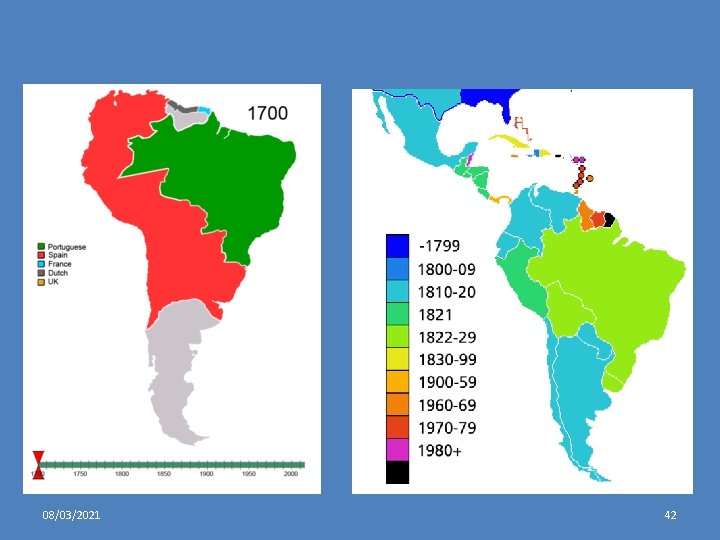
Storia dell’America Latina • Le indipendenze latino-americane (1806 -1825): • • • 08/03/2021 Bolivia, 1809 -1825 Messico, 1810 -1821 Paraguay, 1811 Uruguay, 1811 Argentina, 1816 Cile, 1818 Colombia, 1820 Venezuela, 1821 Perù, 1821 Brasile, 1822 Ecuador, 1822 Cuba, 1899 -1901 41
08/03/2021 42
- Slides: 42