
Store Layout Design Visual Merchandising Source Angela DAuria

- Slides: 18
Store Layout, Design & Visual Merchandising Source: Angela D’Auria Stanton, Ph. D.
Aims and Assessment n n n P 1 describe how visual merchandising techniques are applied to goods in different types of retail outlets P 2 describe how space is used to display goods in three retail outlets M 1 analyse the visual merchandising and display techniques used to present goods in retail outlets
Today n n n Starter Recap P 1 Go through P 2 – layout Prepare for assessment Pleanary
“Shopper found dead in local store; cause of death – boredom” Stanley Marcus, Chairman-Emeritus, Neiman Marcus No other variable in the retailing mix influences the consumer’s initial perceptions of a bricks & mortar retailer as much as the store itself. The store is “where the action is” and includes such minor details as the placement of the merchandise.
Objectives of the Store Environment Get customers into the store (store image) n q q q n Serves a critical role in the store selection process Important criteria include cleanliness, labeled prices, accurate and pleasant checkout clerks, and well-stocked shelves The store itself makes the most significant and last impression Once they are inside the store, convert them into customers buying merchandise (space productivity) q q The more merchandise customers are exposed to that is presented in an orderly manner, the more they tend to buy Retailers focusing more attention on in-store marketing – marketing dollars spent in the store, in the form of store design, merchandise presentation, visual displays, and in-store promotions, should lead to greater sales and profits (bottom line: it is easier to get a consumer in your store to buy more merchandise than planned than to get a new consumer to come into your store)
Objectives of Good Store Design n Design should: q q q be consistent with image and strategy positively influence consumer behavior consider costs versus value be flexible recognize the needs of the disabled – The Americans with Disabilities Act
Types of Floor Space in Store n Back Room – receiving area, stockroom q Department stores (50%) q Small specialty and convenience stores (10%) q General merchandise stores (15 -20%) n Offices and Other Functional Space – employee break room, store offices, cash office, restrooms n Aisles, Service Areas and Other Non-Selling Areas q Moving shoppers through the store, dressing rooms, layaway areas, service desks, customer service facilities n Merchandise Space q Floor q Wall
Store Layout (and Traffic Flow) n Conflicting objectives: q q Ease of finding merchandise versus varied and interesting layout Giving customers adequate space to shop versus use expensive space productively
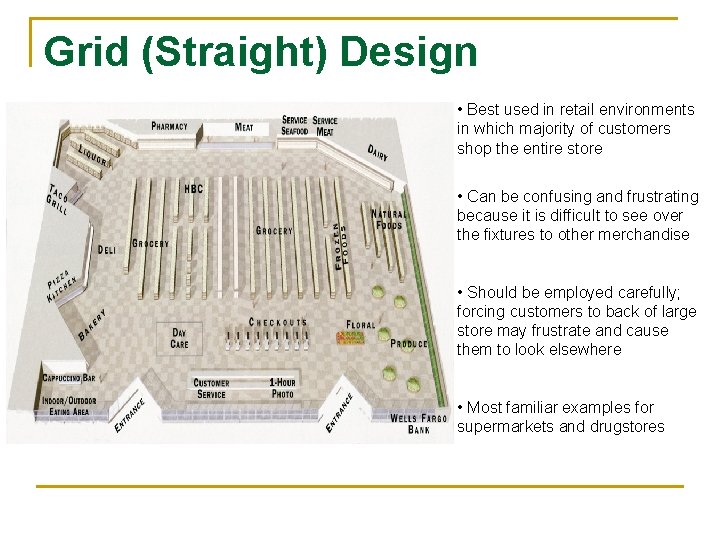
Grid (Straight) Design • Best used in retail environments in which majority of customers shop the entire store • Can be confusing and frustrating because it is difficult to see over the fixtures to other merchandise • Should be employed carefully; forcing customers to back of large store may frustrate and cause them to look elsewhere • Most familiar examples for supermarkets and drugstores
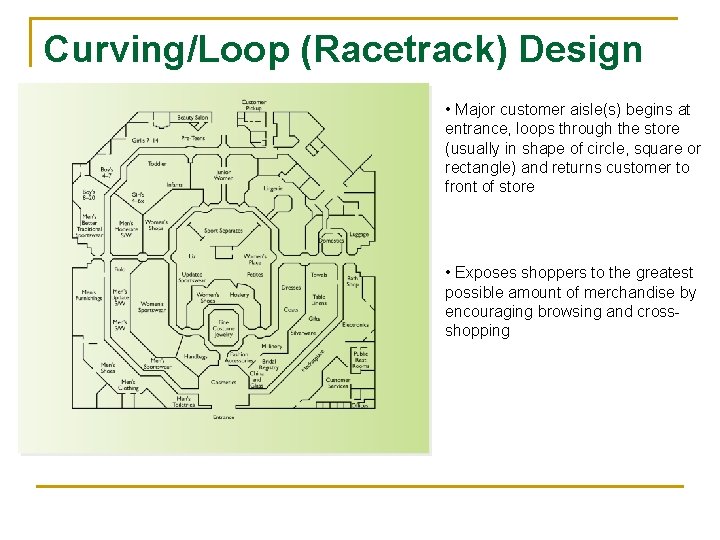
Curving/Loop (Racetrack) Design • Major customer aisle(s) begins at entrance, loops through the store (usually in shape of circle, square or rectangle) and returns customer to front of store • Exposes shoppers to the greatest possible amount of merchandise by encouraging browsing and crossshopping
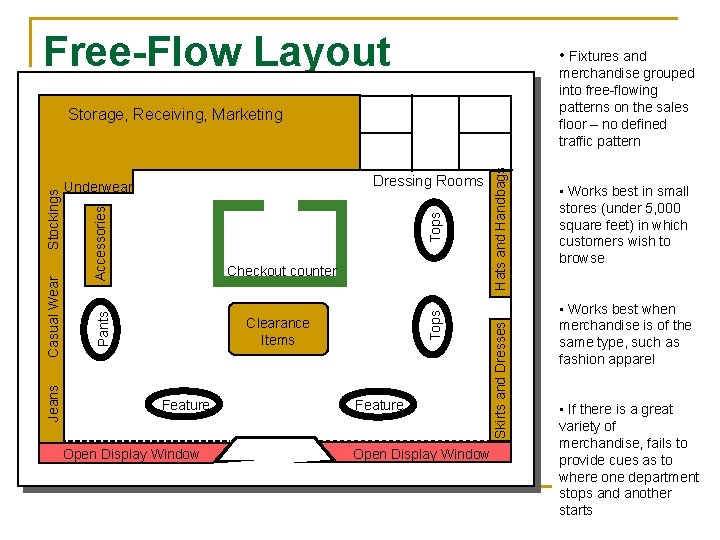
Free-Flow Layout • Fixtures and merchandise grouped into free-flowing patterns on the sales floor – no defined traffic pattern Tops Accessories Tops Pants Checkout counter Clearance Items Feature Open Display Window Hats and Handbags Dressing Rooms Underwear Skirts and Dresses Jeans Casual Wear Stockings Storage, Receiving, Marketing • Works best in small stores (under 5, 000 square feet) in which customers wish to browse • Works best when merchandise is of the same type, such as fashion apparel • If there is a great variety of merchandise, fails to provide cues as to where one department stops and another starts
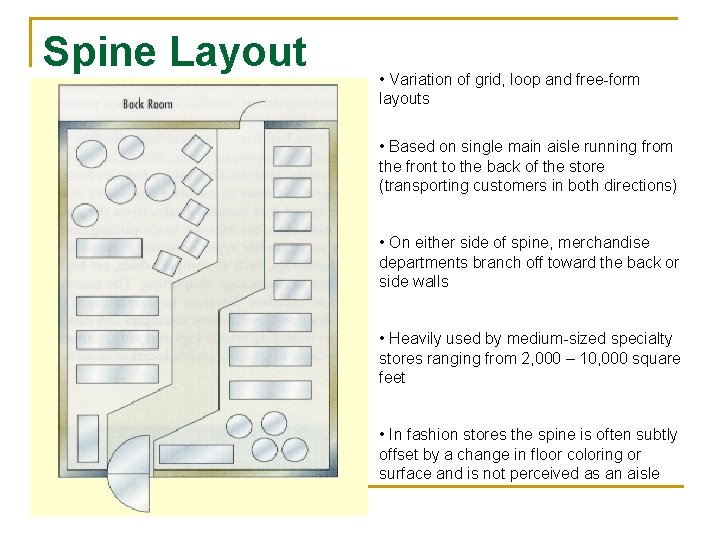
Spine Layout • Variation of grid, loop and free-form layouts • Based on single main aisle running from the front to the back of the store (transporting customers in both directions) • On either side of spine, merchandise departments branch off toward the back or side walls • Heavily used by medium-sized specialty stores ranging from 2, 000 – 10, 000 square feet • In fashion stores the spine is often subtly offset by a change in floor coloring or surface and is not perceived as an aisle
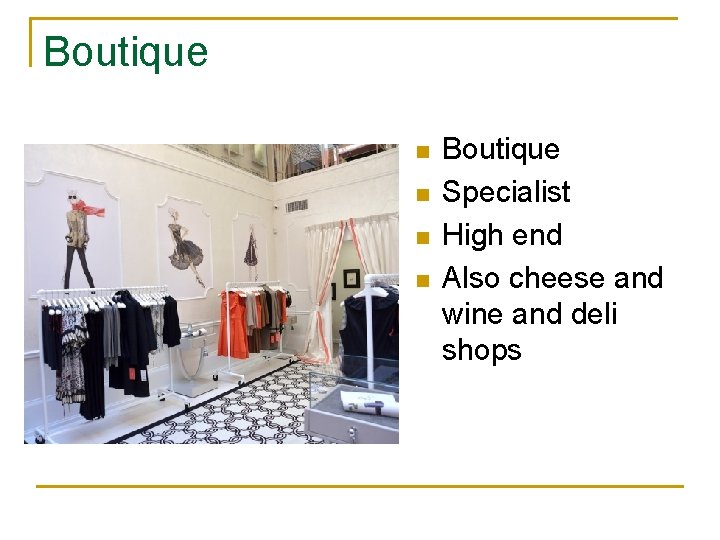
Boutique n n Boutique Specialist High end Also cheese and wine and deli shops
Location of Departments n Relative location advantages n Impulse products n Demand/destination areas n Seasonal needs n Physical characteristics of merchandise n Adjacent departments
Feature Areas n The areas within a store designed to get the customer’s attention which include: q q q End caps – displays located at the end of the aisles Promotional aisle/area Freestanding fixtures Windows Walls Point-of-sale (POS) displays/areas
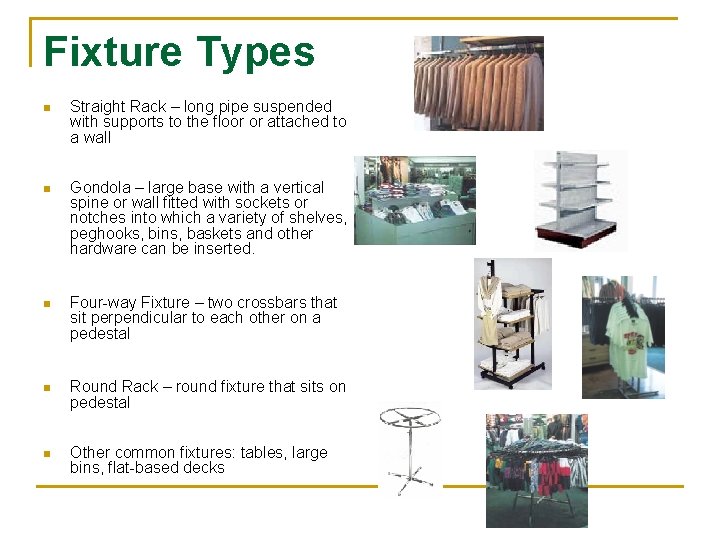
Fixture Types n Straight Rack – long pipe suspended with supports to the floor or attached to a wall n Gondola – large base with a vertical spine or wall fitted with sockets or notches into which a variety of shelves, peghooks, bins, baskets and other hardware can be inserted. n Four-way Fixture – two crossbars that sit perpendicular to each other on a pedestal n Round Rack – round fixture that sits on pedestal n Other common fixtures: tables, large bins, flat-based decks
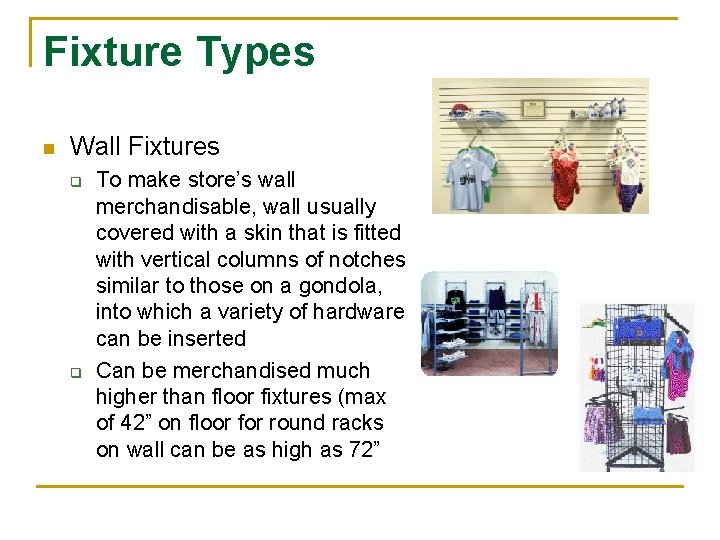
Fixture Types n Wall Fixtures q q To make store’s wall merchandisable, wall usually covered with a skin that is fitted with vertical columns of notches similar to those on a gondola, into which a variety of hardware can be inserted Can be merchandised much higher than floor fixtures (max of 42” on floor for round racks on wall can be as high as 72”
Merchandise Display Planning n Shelving – flexible, easy to maintain n Hanging n Pegging – small rods inserted into gondolas or wall systems – can be labor intensive to display/maintain but gives neat/orderly appearance n Folding – for softlines can be folded and stacked on shelves or tables - creates high fashion image n Stacking – for large hardlines can be stacked on shelves, base decks of gondolas or flats – easy to maintain and gives image of high volume and low price n Dumping – large quantities of small merchandise can be dumped into baskets or bins – highly effective for softlines (socks, wash cloths) or hardlines (batteries, candy, grocery products) – creates high volume, low cost image