
Storage Resource Manager v 2 2 Grid Technology
- Slides: 40
Storage Resource Manager v 2. 2: Grid Technology for Dynamic Storage Allocation and Uniform Access Flavia Donno CERN Flavia. Donno@cern. ch
OGF IPR Policies Apply • • • “I acknowledge that participation in this meeting is subject to the OGF Intellectual Property Policy. ” Intellectual Property Notices Note Well: All statements related to the activities of the OGF and addressed to the OGF are subject to all provisions of Appendix B of GFD-C. 1, which grants to the OGF and its participants certain licenses and rights in such statements. Such statement s include verbal statements in OGF meetings, as well as written and electronic communications made at any time or place, which are addressed to: • • • the OGF plenary session, any OGF working group or portion thereof, the OGF Board of Directors, the GFSG, or any member thereof on behalf of the OGF, the ADCOM, or any member thereof on behalf of the ADCOM, any OGF mailing list, including any group list, or any other list functioning under OGF auspices, the OGF Editor or the document authoring and review process Statements made outside of a OGF meeting, mailing list or other function, that are clearly not intended to be input to an OGF activity, group or function, are not subject to these provisions. Excerpt from Appendix B of GFD-C. 1: ”Where the OGF knows of rights, or claimed rights, the OGF secretariat shall attempt to obtain from the claimant of such rights, a written assurance that upon approval by the GFSG of the relevant OGF document(s), any party will be able to obtain the right to implement, use and distribute the technology or works when implementing, using or distributing technology based upon the specification(s) under openly specified, reasonable, nondiscriminatory terms. The working group or research group proposing the use of the technology with respect to which the proprietary rights are claimed may assist the OGF secretariat in this effort. The results of this procedure shall not affect advancement of document, except that the GFSG may defer approval where a delay may facilitate the obtaining of such assurances. The results wil l, however, be recorded by the OGF Secretariat, and made available. The GFSG may also direct that a summary of the results be included in any GFD published containing the specification. ” OGF Intellectual Property Policies are adapted from the IETF Intellectual Property Policies that support the Internet Standards Process.
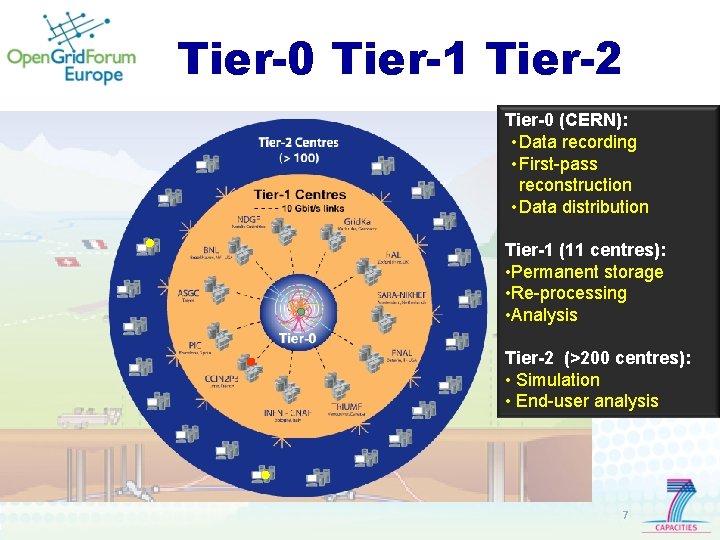
The LHC Grid paradigm • Storage Services are crucial components of the Worldwide LHC Computing Grid (WLCG) infrastructure spanning more than 200 sites and serving computing and storage resources to the High Energy Physics LHC communities. • Up to tens of Petabytes of data are collected every year by the 4 LHC experiments at CERN. • It is crucial to efficiently transfer “raw” data to big computing centers (Tier-1 s). Such centers contribute with their storage and computing power to permanently store the data reliably and to the first pass analysis. • An important role is also covered by the smaller computing centers (Tier 2 s) that provide experiments with the results of the simulation Such results need to be transferred to Tier-1 s, safely stored permanently, and analyzed as well. 5
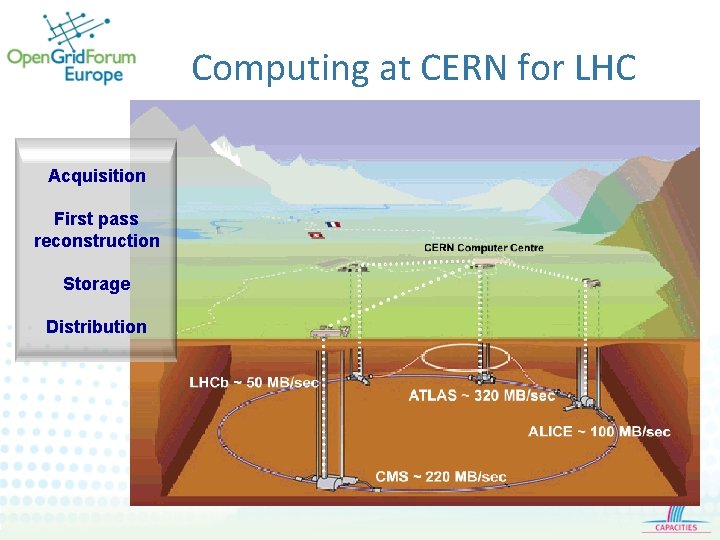
Computing at CERN for LHC Acquisition First pass reconstruction Storage Distribution
Tier-0 Tier-1 Tier-2 Tier-0 (CERN): • Data recording • First-pass reconstruction • Data distribution Tier-1 (11 centres): • Permanent storage • Re-processing • Analysis Tier-2 (>200 centres): • Simulation • End-user analysis 7
The Classic Storage Element • The Classic SE : an optimized FTP server with Grid authentication and authorization. – The first Storage Server in the Grid based on Globus Grid. FTP – Very simple solution that included simple and complex tape-based systems • What are the capabilities of such a service ? – No possibility to query the service itself about its status, space available, etc. (one has to rely on the Information System) • Higher level management and functionalities through implementation specific interfaces – Selection of data pools for specific activities (protocols, data pattern access, paths, etc. ) – Data removal – Copy facilities • How are data accessed access on such a storage server ? – Protocols supported: NFS/file, rfio, root, gsiftp – Discovery of related information • What about space management ? – Sometimes very hard – No explicit support for tape backend (pre-staging, pool selection, etc. ) 8
Requirements by dates • In June 2005 the Baseline Service Working Group published a report: – http: //lcg. web. cern. ch/LCG/peb/bs/BSReport-v 1. 0. pdf – A Grid Storage Service is mandatory and high priority. – The experiment requirements for a Grid storage service are defined – Experiments agree to use only high-level tools as interface to the Grid Storage Service • In May 2006 at FNAL the WLCG Storage Service Memorandum of Understanding (Mo. U) was agreed on: – http: //cd-docdb. fnal. gov/001583/001/SRMLCG-Mo. U-day 2%5 B 1%5 D. pdf 9
Basic Requirements • Support for Permanent Space and Space Management capabilities – Buffer allocations for different activities to avoid interference • Supporting data acquisition • Supporting data reconstruction • Supporting user analysis • Support for Storage Classes (quality of spaces) – Custodial vs. Replica – Online or Nearline • Support for Permanent files (and volatile copies) and their management • Namespace Management and Permission Functions • Data Transfer and File Removal Functions • File access protocol negotiation 10
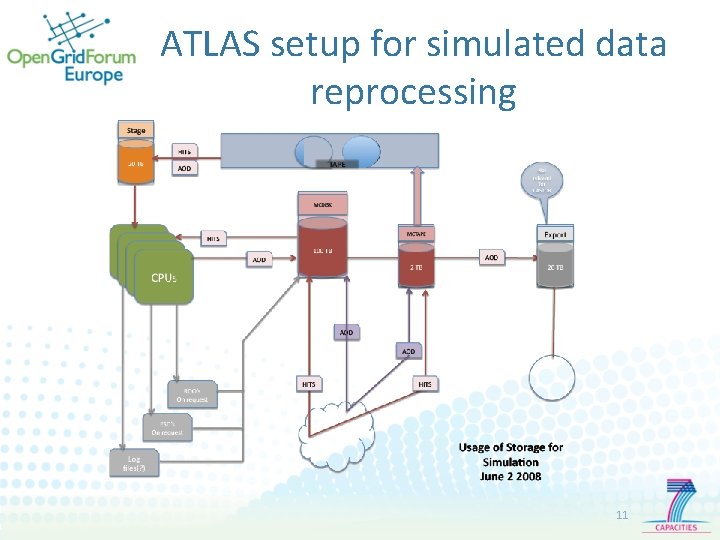
ATLAS setup for simulated data reprocessing 11
More general scenarios • Running a job on a local machine with input files – – – Check space Transfer all needed input files Ensure correctness of files transferred Monitor and recover from errors Manage file streaming Remove files to make space for more files • If storage space is a shared resource – Do the above for many users – Enforce quotas – Ensure fairness of space allocation and scheduling 12
More general scenarios • To do that on a Grid – Access a variety of storage systems – Authentication and authorization – Access mass storage systems • Distributed jobs on the Grid – Dynamic allocation of remote spaces – Move (stream) files to remote sites – Manage file outputs and their movement to destination site(s) 13
The Storage Resource Manager v 2. 2 • The Storage Resource Manager (SRM) is an interface definition and a middleware component whose function is to provide dynamic space allocation and file management on shared storage components on the Grid • More precisely, the SRM is a Grid service with several different implementations. Its main specification documents are: – A. Sim, A. Shoshani (eds. ), The Storage Resource Manager Interface Specication, v. 2. 2, available at http: //sdm. lbl. gov/srmwg/doc/SRM. v 2. 2. pdf. – F. Donno et al. , Storage Element Model for SRM 2. 2 and GLUE schema description, v 3. 5 available at: http: //glueschema. forge. cnaf. infn. it/uploads/Spec/V 13/SE-Model 3. 5. pdf 14
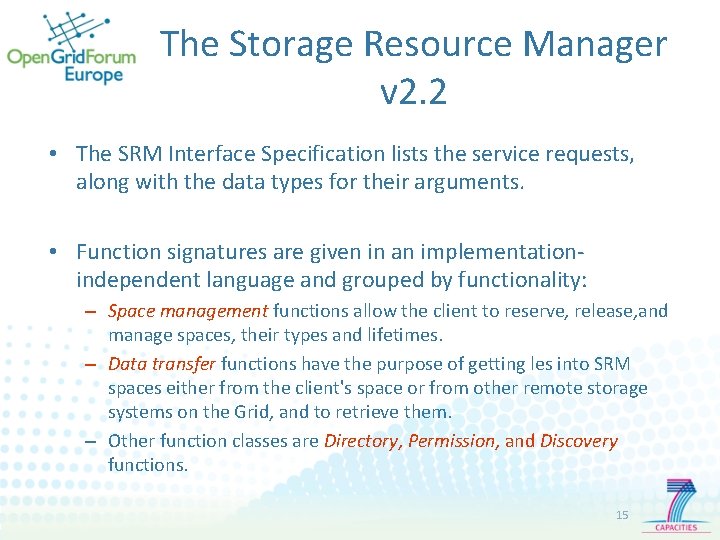
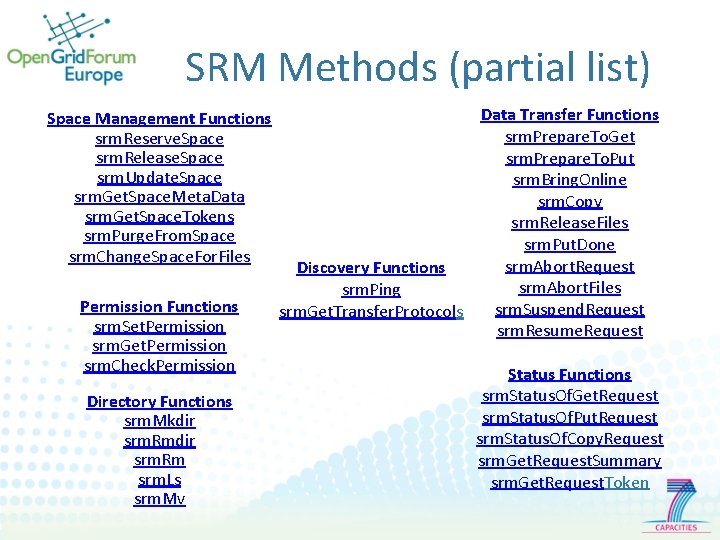
The Storage Resource Manager v 2. 2 • The SRM Interface Specification lists the service requests, along with the data types for their arguments. • Function signatures are given in an implementationindependent language and grouped by functionality: – Space management functions allow the client to reserve, release, and manage spaces, their types and lifetimes. – Data transfer functions have the purpose of getting les into SRM spaces either from the client's space or from other remote storage systems on the Grid, and to retrieve them. – Other function classes are Directory, Permission, and Discovery functions. 15
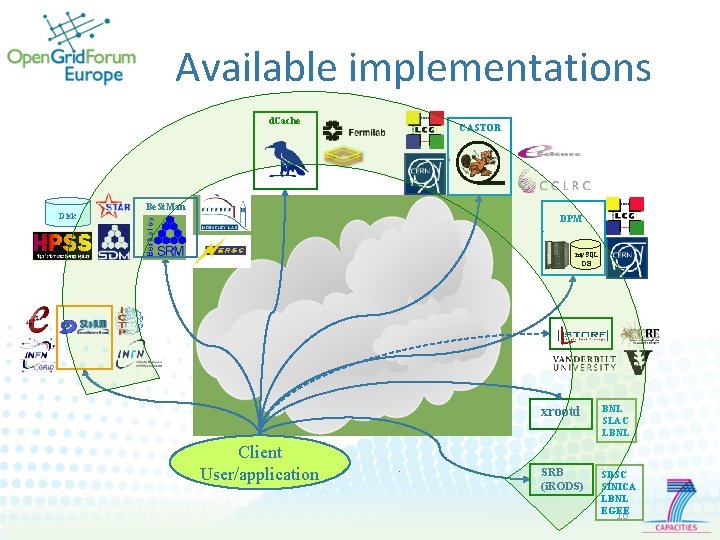
Available implementations d. Cache Disk CASTOR Be. St. Man DPM my. SQL DB Client User/application xrootd BNL SLAC LBNL SRB (i. RODS) SDSC SINICA LBNL EGEE 16
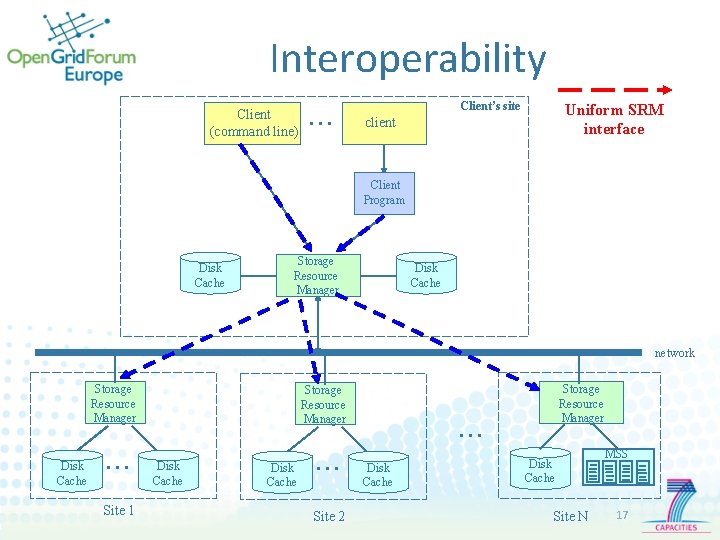
Interoperability Client (command line) . . . Client’s site Uniform SRM interface client Client Program Disk Cache Storage Resource Manager Disk Cache network Storage Resource Manager Disk Cache . . . Site 1 Storage Resource Manager Disk Cache . . . Site 2 Storage Resource Manager . . . Disk Cache Site N MSS 17
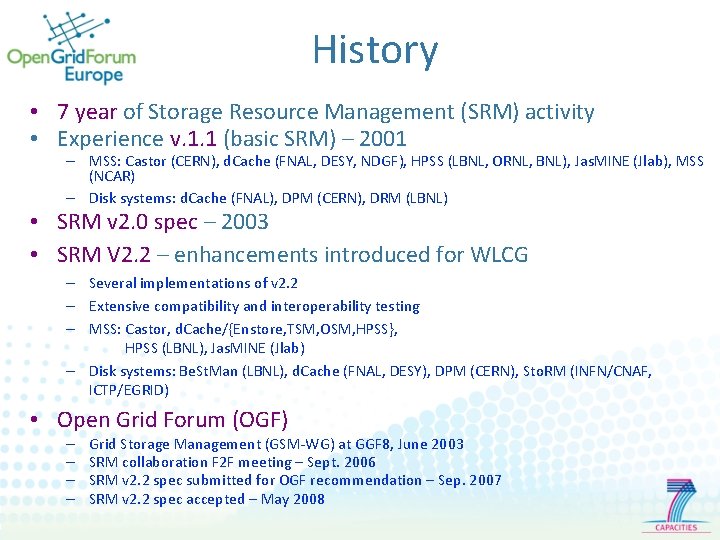
History • 7 year of Storage Resource Management (SRM) activity • Experience v. 1. 1 (basic SRM) – 2001 – MSS: Castor (CERN), d. Cache (FNAL, DESY, NDGF), HPSS (LBNL, ORNL, BNL), Jas. MINE (Jlab), MSS (NCAR) – Disk systems: d. Cache (FNAL), DPM (CERN), DRM (LBNL) • SRM v 2. 0 spec – 2003 • SRM V 2. 2 – enhancements introduced for WLCG – Several implementations of v 2. 2 – Extensive compatibility and interoperability testing – MSS: Castor, d. Cache/{Enstore, TSM, OSM, HPSS}, HPSS (LBNL), Jas. MINE (Jlab) – Disk systems: Be. St. Man (LBNL), d. Cache (FNAL, DESY), DPM (CERN), Sto. RM (INFN/CNAF, ICTP/EGRID) • Open Grid Forum (OGF) – – Grid Storage Management (GSM-WG) at GGF 8, June 2003 SRM collaboration F 2 F meeting – Sept. 2006 SRM v 2. 2 spec submitted for OGF recommendation – Sep. 2007 SRM v 2. 2 spec accepted – May 2008
Who is involved • CERN, European Organization for Nuclear Research, Switzerland – Lana Abadie, Paolo Badino, Olof Barring, Jean-Philippe Baud, Tony Cass, Flavia Donno, Akos Frohner, Birger Koblitz, Sophie Lemaitre, Maarten Litmaath, Remi Mollon, Giuseppe Lo Presti, David Smith, Paolo Tedesco • Deutsches Elektronen-Synchrotron, DESY, Hamburg, Germany • – Patrick Fuhrmann, Tigran Mkrtchan, Paul Millar, Owen Synge Nordic Data Grid Facility – Matthias, Gerd • Fermi National Accelerator Laboratory, Illinois, USA – Matt Crawford, Dmitry Litvinsev, Alexander Moibenko, Gene Oleynik, Timur Perelmutov, Don Petravick • ICTP/EGRID, Italy – Ezio Corso, Massimo Sponza • INFN/CNAF, Italy – Alberto Forti, Luca Magnoni, Riccardo Zappi • LAL/IN 2 P 3/CNRS, Faculté des Sciences, Orsay Cedex, France – Gilbert Grosdidier • Lawrence Berkeley National Laboratory, California, USA – Junmin Gu, Vijaya Natarajan, Arie Shoshani, Alex Sim • Rutherford Appleton Laboratory, Oxfordshire, England – Shaun De Witt, Jensen, Jiri Menjak • Thomas Jefferson National Accelerator Facility (TJNAF), USA – Michael Haddox-Schatz, Bryan Hess, Andy Kowalski, Chip Watson
Some notes • The SRM specification has still inconsistencies and it is incomplete • It is a first attempt to provide a uniform control interface to storage systems • It has been done to demonstrate feasibility and usefulness • We think we are converging toward a useful protocol and interface
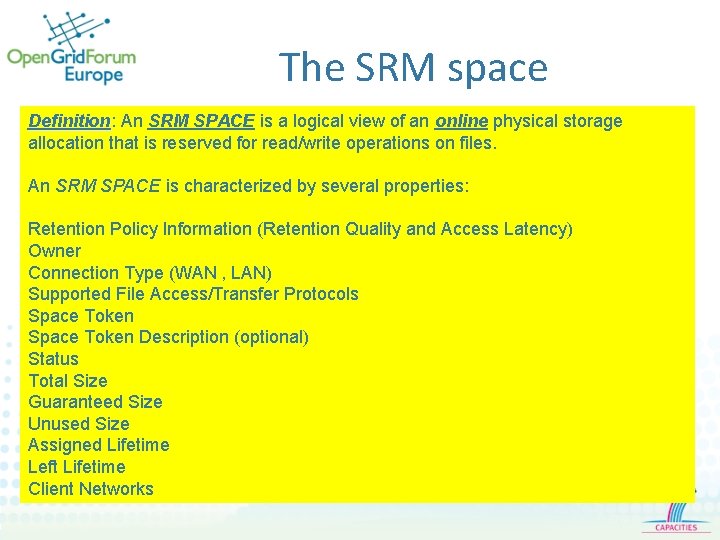
The SRM space Definition: Definition An SRM SPACE is a logical view of an online physical storage allocation that is reserved for read/write operations on files. An SRM SPACE is characterized by several properties: Retention Policy Information (Retention Quality and Access Latency) Owner Connection Type (WAN , LAN) Supported File Access/Transfer Protocols Space Token Description (optional) Status Total Size Guaranteed Size Unused Size Assigned Lifetime Left Lifetime Client Networks
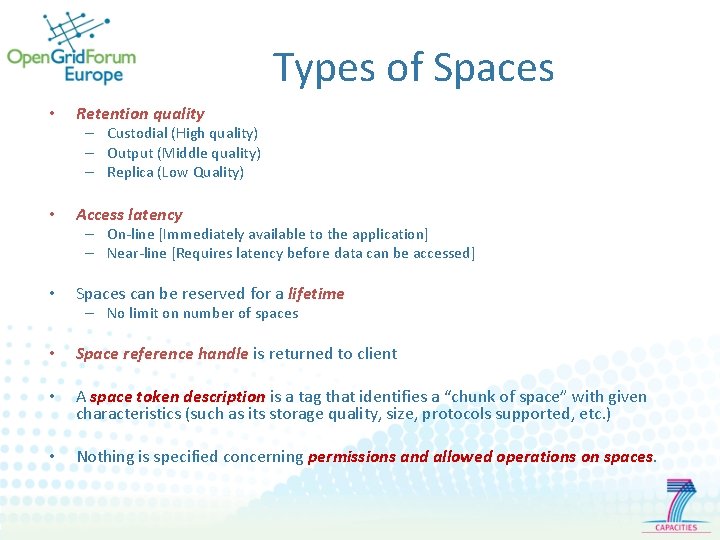
Types of Spaces • Retention quality • Access latency • Spaces can be reserved for a lifetime – Custodial (High quality) – Output (Middle quality) – Replica (Low Quality) – On-line [Immediately available to the application] – Near-line [Requires latency before data can be accessed] – No limit on number of spaces • Space reference handle is returned to client • A space token description is a tag that identifies a “chunk of space” with given characteristics (such as its storage quality, size, protocols supported, etc. ) • Nothing is specified concerning permissions and allowed operations on spaces
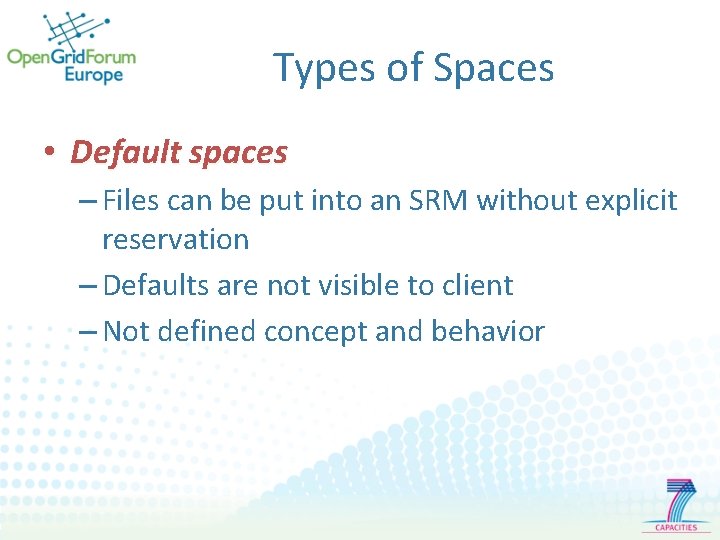
Types of Spaces • Default spaces – Files can be put into an SRM without explicit reservation – Defaults are not visible to client – Not defined concept and behavior
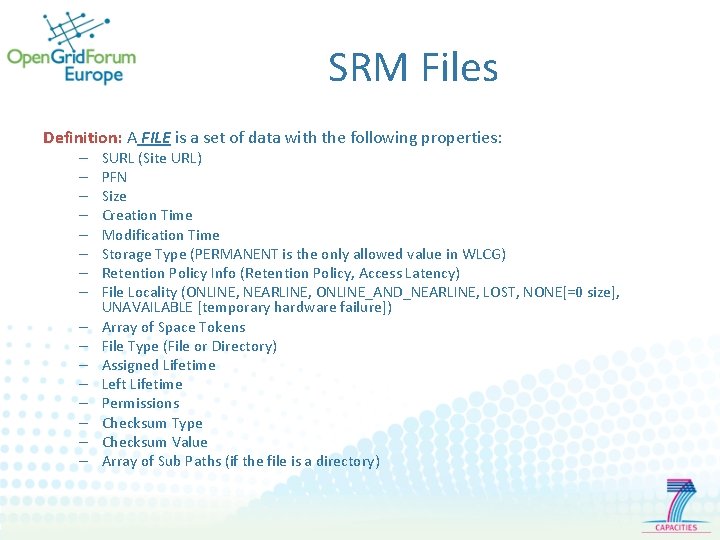
SRM Files Definition: A FILE is a set of data with the following properties: – – – – SURL (Site URL) PFN Size Creation Time Modification Time Storage Type (PERMANENT is the only allowed value in WLCG) Retention Policy Info (Retention Policy, Access Latency) File Locality (ONLINE, NEARLINE, ONLINE_AND_NEARLINE, LOST, NONE[=0 size], UNAVAILABLE [temporary hardware failure]) Array of Space Tokens File Type (File or Directory) Assigned Lifetime Left Lifetime Permissions Checksum Type Checksum Value Array of Sub Paths (if the file is a directory)
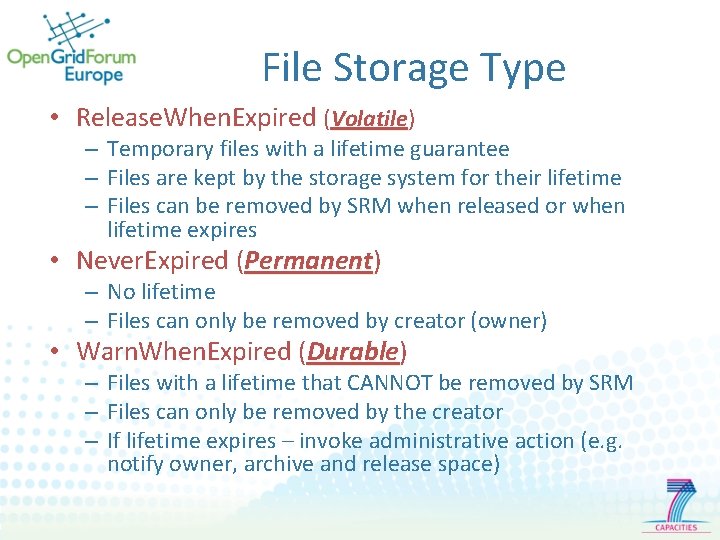
File Storage Type • Release. When. Expired (Volatile) Volatile – Temporary files with a lifetime guarantee – Files are kept by the storage system for their lifetime – Files can be removed by SRM when released or when lifetime expires • Never. Expired (Permanent) Permanent – No lifetime – Files can only be removed by creator (owner) • Warn. When. Expired (Durable) Durable – Files with a lifetime that CANNOT be removed by SRM – Files can only be removed by the creator – If lifetime expires – invoke administrative action (e. g. notify owner, archive and release space)
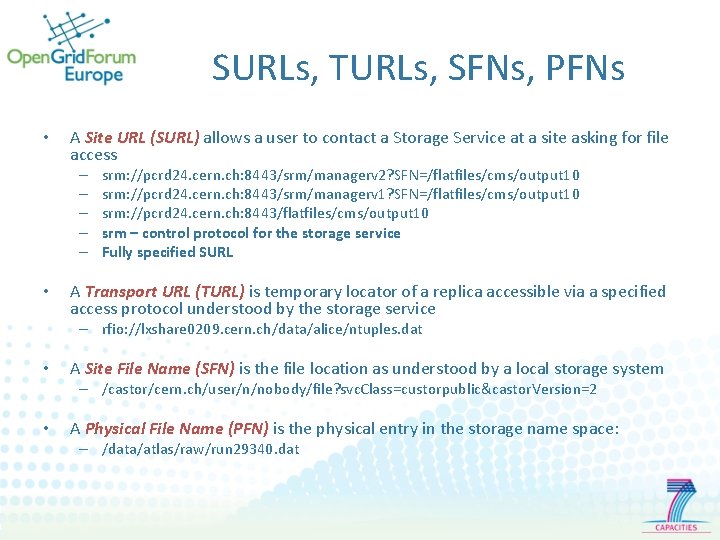
SURLs, TURLs, SFNs, PFNs • A Site URL (SURL) allows a user to contact a Storage Service at a site asking for file access – – – • srm: //pcrd 24. cern. ch: 8443/srm/managerv 2? SFN=/flatfiles/cms/output 10 srm: //pcrd 24. cern. ch: 8443/srm/managerv 1? SFN=/flatfiles/cms/output 10 srm: //pcrd 24. cern. ch: 8443/flatfiles/cms/output 10 srm – control protocol for the storage service Fully specified SURL A Transport URL (TURL) is temporary locator of a replica accessible via a specified access protocol understood by the storage service – rfio: //lxshare 0209. cern. ch/data/alice/ntuples. dat • A Site File Name (SFN) is the file location as understood by a local storage system – /castor/cern. ch/user/n/nobody/file? svc. Class=custorpublic&castor. Version=2 • A Physical File Name (PFN) is the physical entry in the storage name space: – /data/atlas/raw/run 29340. dat
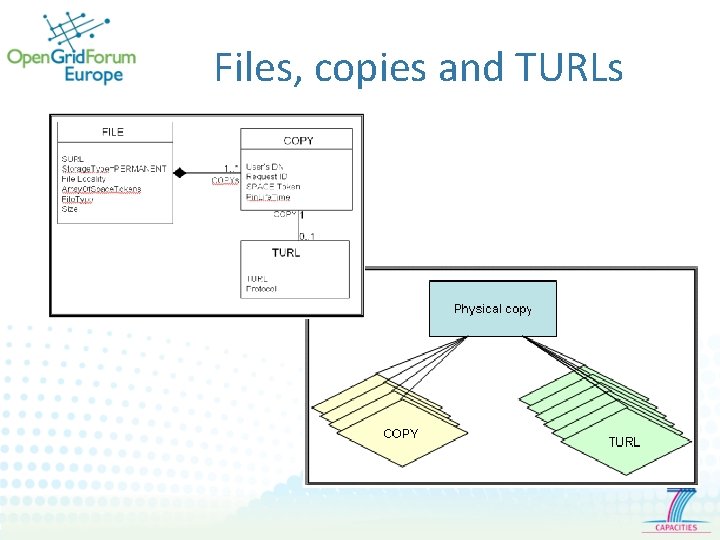
File copies A FILE can have several COPYs in several spaces. Definition: Definition A COPY of a file is a logical view of a physical instance of the file in a given SPACE. It is characterized by the following properties: – User’s DN (the DN of the user who has instantiated this copy) – Request ID (of the request generating the copy: srm. Prepare. To. Put, srm. Prepare. To. Get, srm. Bring. Online) – SPACE Token (of the space where the copy resides – this is optional) – Pin. Lifetime (the time the copy is guaranteed to be in the online space where the copy resides – it is defined in the srm. Bring. Online). The Pin. Lifetime of a copy suggests to the system that the copy is needed by the application and therefore such a copy should not be garbagecollected while its Pin. Lifetime is still valid. At the moment srm. Prepare. To. Put and srm. Copy do not allow to specify the Pin. Lifetime for the resulting created copy.
SRM TURLs Definition: Definition A TURL is the transport URL associated to a COPY of a FILE in a SPACE. It is characterized by the following properties: – TURL (transport URL associated to a file access/transfer protocol) – User’s DN (the DN of the user who has instantiated this TURL) – Request ID (of the request generating the copy: srm. Prepare. To. Put, srm. Prepare. To. Get) – SPACE Token (of the space where the copy resides – this is optional) – Pin. Lifetime (the time for which the TURL must remain valid) – A TURL is generated by the system after a srm. Prepare. To. Get or srm. Prepare. To. Put request and is associated to the request that has generated it. A TURL refers to one COPY of the same file and it might be associated to one or more different physical copies of the same file.
Files, copies and TURLs
File Access protocols • SRM v 2. 2 allows for the negotiation of the file access protocols – The application can contact the Storage Server asking for a list of possible file access protocols. The server responds providing the TURL for the supported protocol • Supported file access protocols in WLCG are: – – [gsi]dcap Gsiftp [gsi]rfio file
SRM Methods (partial list) Space Management Functions srm. Reserve. Space srm. Release. Space srm. Update. Space srm. Get. Space. Meta. Data srm. Get. Space. Tokens srm. Purge. From. Space srm. Change. Space. For. Files Permission Functions srm. Set. Permission srm. Get. Permission srm. Check. Permission Directory Functions srm. Mkdir srm. Rm srm. Ls srm. Mv Data Transfer Functions srm. Prepare. To. Get srm. Prepare. To. Put srm. Bring. Online srm. Copy srm. Release. Files srm. Put. Done srm. Abort. Request Discovery Functions srm. Abort. Files srm. Ping srm. Suspend. Request srm. Get. Transfer. Protocols srm. Resume. Request Status Functions srm. Status. Of. Get. Request srm. Status. Of. Put. Request srm. Status. Of. Copy. Request srm. Get. Request. Summary srm. Get. Request. Token
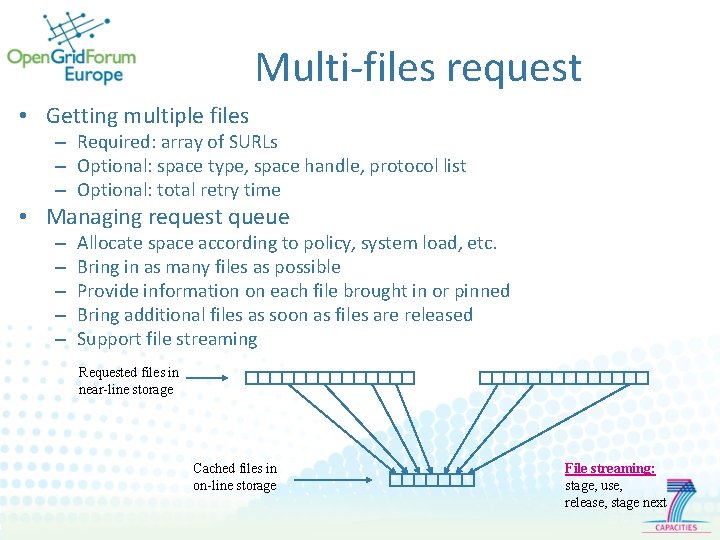
Multi-files request • Getting multiple files – Required: array of SURLs – Optional: space type, space handle, protocol list – Optional: total retry time • Managing request queue – – – Allocate space according to policy, system load, etc. Bring in as many files as possible Provide information on each file brought in or pinned Bring additional files as soon as files are released Support file streaming Requested files in near-line storage Cached files in on-line storage File streaming: stage, use, release, stage next
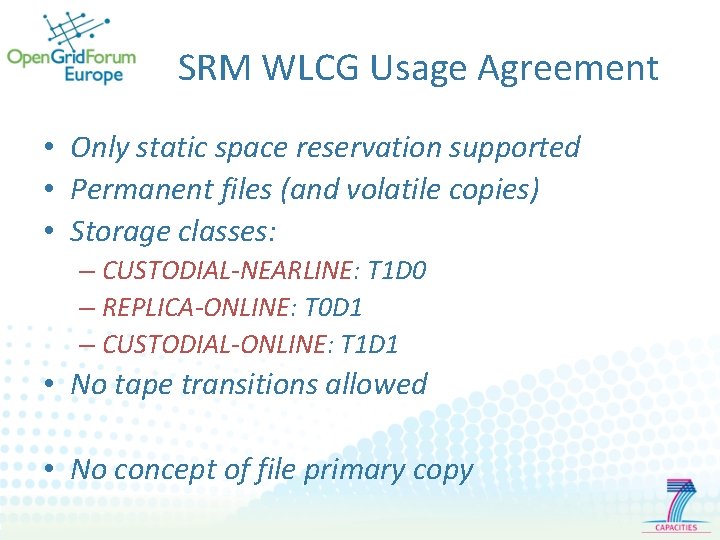
SRM WLCG Usage Agreement • Only static space reservation supported • Permanent files (and volatile copies) • Storage classes: – CUSTODIAL-NEARLINE: T 1 D 0 – REPLICA-ONLINE: T 0 D 1 – CUSTODIAL-ONLINE: T 1 D 1 • No tape transitions allowed • No concept of file primary copy
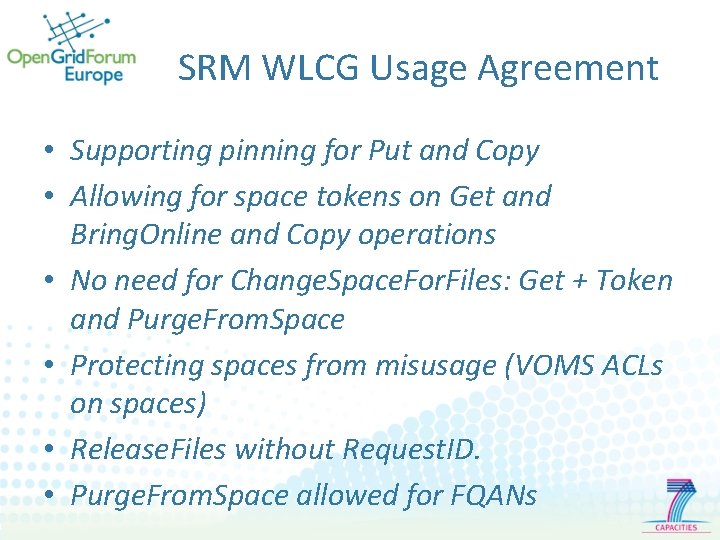
SRM WLCG Usage Agreement • Supporting pinning for Put and Copy • Allowing for space tokens on Get and Bring. Online and Copy operations • No need for Change. Space. For. Files: Get + Token and Purge. From. Space • Protecting spaces from misusage (VOMS ACLs on spaces) • Release. Files without Request. ID. • Purge. From. Space allowed for FQANs
SRM at work • Europe : WLCG/EGEE – 177+ deployments, managing more than 10 PB • • • US 116 DPM/SRM 54 d. Cache/SRM 7 CASTOR/SRM at CERN, CNAF, PIC, RAL, Sinica Sto. RM at ICTP/EGRID, INFN/CNAF – Estimated at about 20 deployments – OSG • d. Cache/SRM from FNAL • Be. St. Man/SRM from LBNL • Be. St. Man-Gateway – Skeleton SRM for local implementation • SRM-Xrootd: using Be. St. Man-Gateway for Xrootd – ESG • DRM/SRM, HRM/SRM at LANL, LBNL, LLNL, NCAR, ORNL – Others • Jas. MINE/SRM from TJNAF • L-Store/SRM from Vanderbilt Univ. • Be. St. Man/SRM adaptation on Lustre file system at Texas Tech
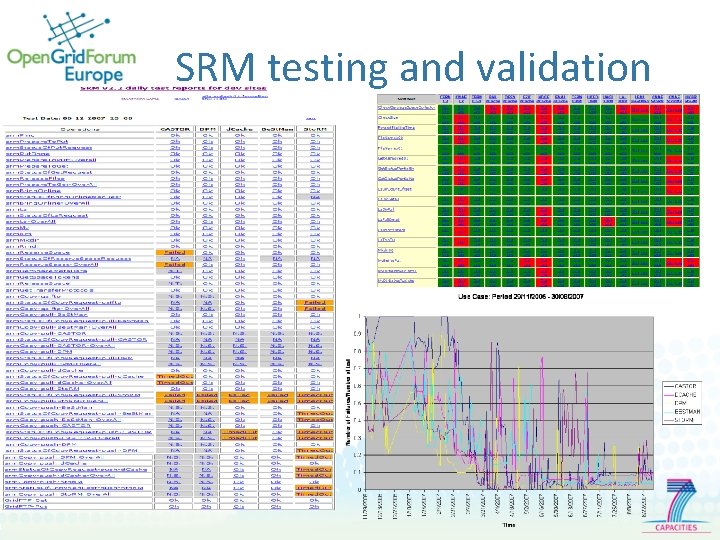
SRM testing and validation • Storage Resource Managers (SRMs) are based on a common interface specification. – SRMs can have different implementations for the underlying storage systems. – Compatibility and interoperability need to be tested according to the specification. – Black box testing • • • Availability test Basic test Use case test Interoperability test Stress test
SRM testing and validation • S 2 test suite for SRM v 2. 2 from CERN – Basic functionality, tests based on use cases, and cross-copy tests, as part of the certification process – Supported file access/transfer protocols: rfio, dcap, gsiftp – S 2 test cron jobs running 5 times per day. • https: //twiki. cern. ch/twiki/bin/view/SRMDev – Stress tests simulating many requests and many clients • Available on specific endpoints, running clients on 21 machines
SRM testing and validation • SRM-Tester from LBNL – Tests conformity of the SRM server interface according to the SRM spec v 1. 1, and v 2. 2 – Supported file transfer protocols: gsiftp, http and https – Test cron jobs running twice a day. • http: //datagrid. lbl. gov – Reliability and stress tests simulating many files, many requests and many clients • Available with options, running clients on 8 node cluster • Planning to use OSG grid resources • Java-based SRM-Tester and C-based S 2 test suite complement each other in SRM v 2. 2 testing
SRM testing and validation
SUMMARY • The SRM specification definition and implementation process has evolved in a world-wide collaboration effort with developers, independent testers, experiments and site administrators. • SRM v 2. 2 based services are now in production. SRM v 2. 2 is the storage interface mostly used in WLCG and OSG. • Many of the SRM v 2. 2 needed functionalities are in place. Further development is needed for meeting the requirements. • The GLUE Information System schema supports SRM v 2. 2. • The SRM-Tester and S 2 testing frameworks provide a powerful validation and certification tool. • Storage coordination and support bodies have been setup to help users and sites. • Cumulative experience in OGF GSM-WG – Specifications SRM v 2. 2 now accepted
More information • SRM Collaboration and SRM Specifications – http: //sdm. lbl. gov/srm-wg – Developer’s mailing list: srmdevel@fnal. gov – OGF mailing list : gsm-wg@ogf. org
Full Copyright Notice Copyright (C) Open Grid Forum (2008). All Rights Reserved. This document and translations of it may be copied and furnished to others, and derivative works that comment on or otherwise explain it or assist in its implementation may be prepared, copied, published and distributed, in whole or in part, without restriction of any kind, provided that the above copyright notice and this paragraph are included on all such copies and derivative works. The limited permissions granted above are perpetual and will not be revoked by the OGF or its successors or assignees.