
STORAGE ALLOCATION MECHANISMS Module 12 2 COP 4020
- Slides: 13
STORAGE ALLOCATION MECHANISMS Module 12. 2 COP 4020 – Programming Language Concepts Dr. Manuel E. Bermudez
TOPICS Types of storage allocation: Static Stack-based Frame management Heap-based
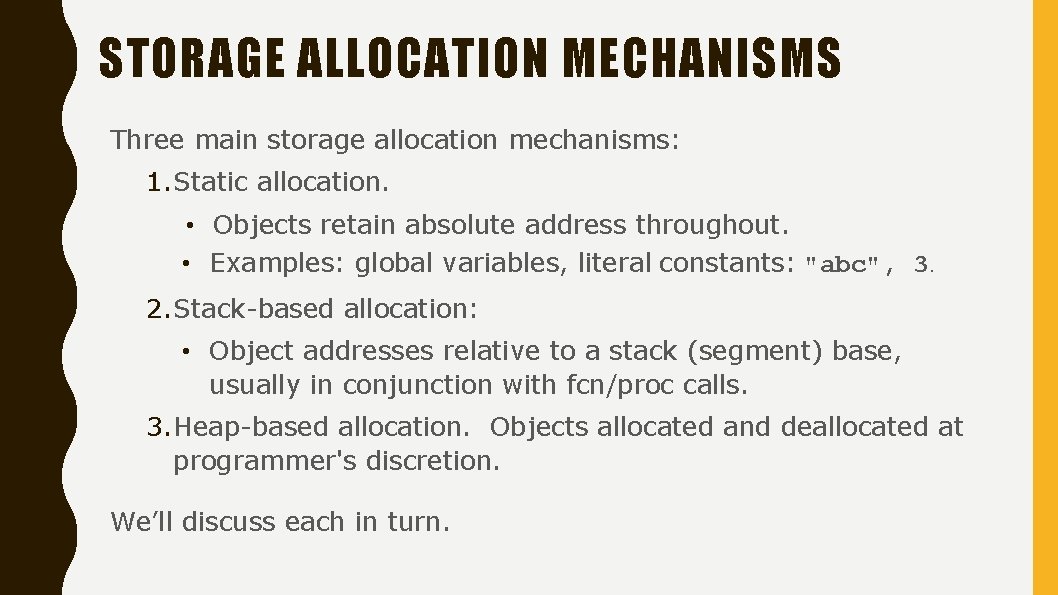
STORAGE ALLOCATION MECHANISMS Three main storage allocation mechanisms: 1. Static allocation. • Objects retain absolute address throughout. • Examples: global variables, literal constants: "abc", 3. 2. Stack-based allocation: • Object addresses relative to a stack (segment) base, usually in conjunction with fcn/proc calls. 3. Heap-based allocation. Objects allocated and deallocated at programmer's discretion. We’ll discuss each in turn.
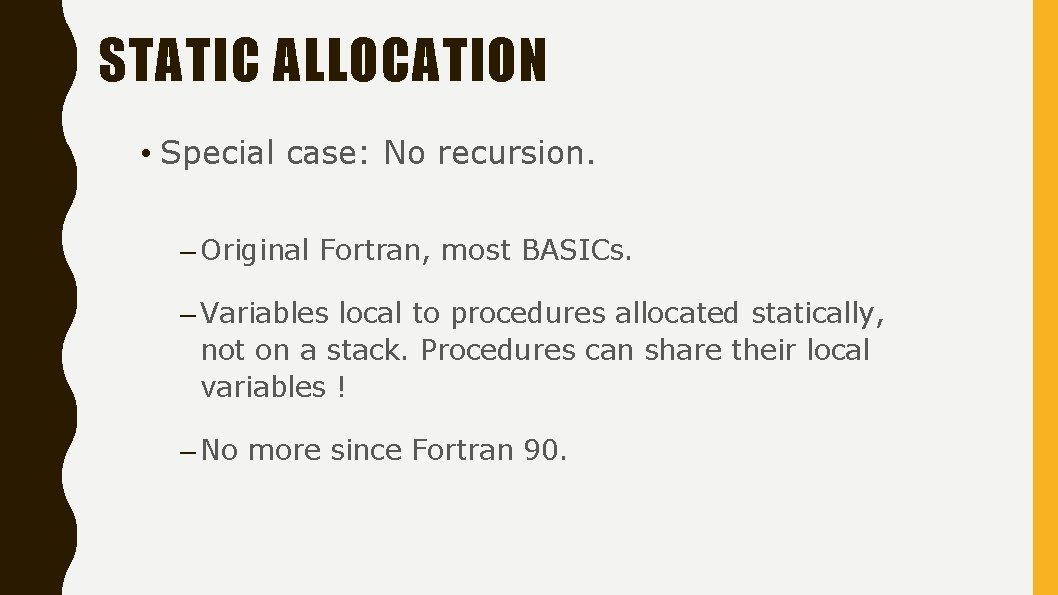
STATIC ALLOCATION • Special case: No recursion. – Original Fortran, most BASICs. – Variables local to procedures allocated statically, not on a stack. Procedures can share their local variables ! – No more since Fortran 90.
STACK-BASED ALLOCATION • Necessary to implement recursion. • Storage is allocated/deallocated/managed on a stack. • Each subroutine that is called gets a stack frame/activation record on top of the stack. • A frame contains: – Arguments that are passed into the subroutine. – Bookkeeping info (caller return address, saved registers). – Local variables / temporaries. • Frame organization varies by language and implementation.
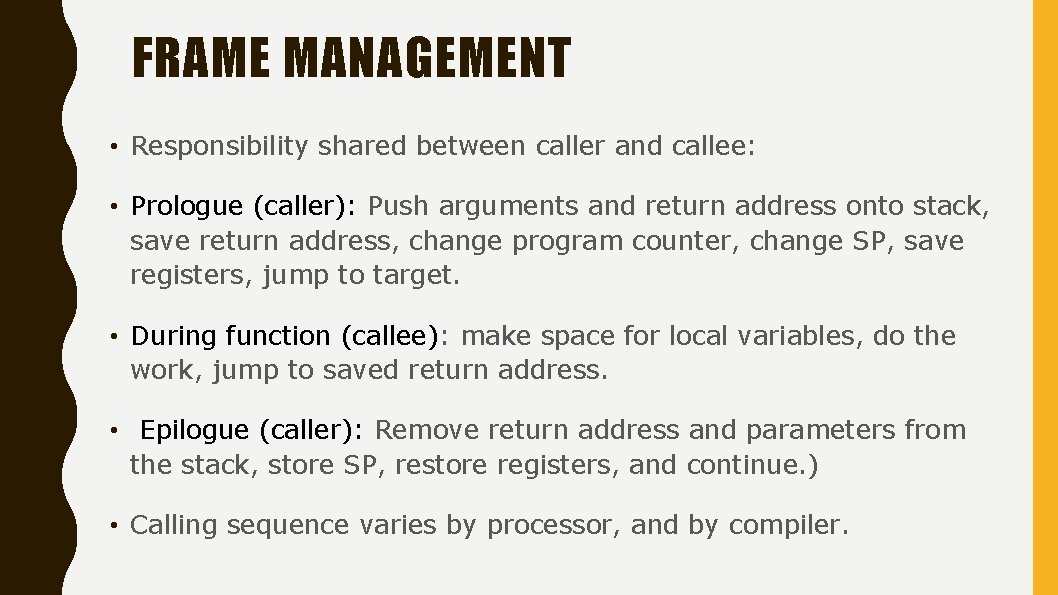
FRAME MANAGEMENT • Responsibility shared between caller and callee: • Prologue (caller): Push arguments and return address onto stack, save return address, change program counter, change SP, save registers, jump to target. • During function (callee): make space for local variables, do the work, jump to saved return address. • Epilogue (caller): Remove return address and parameters from the stack, store SP, restore registers, and continue. ) • Calling sequence varies by processor, and by compiler.
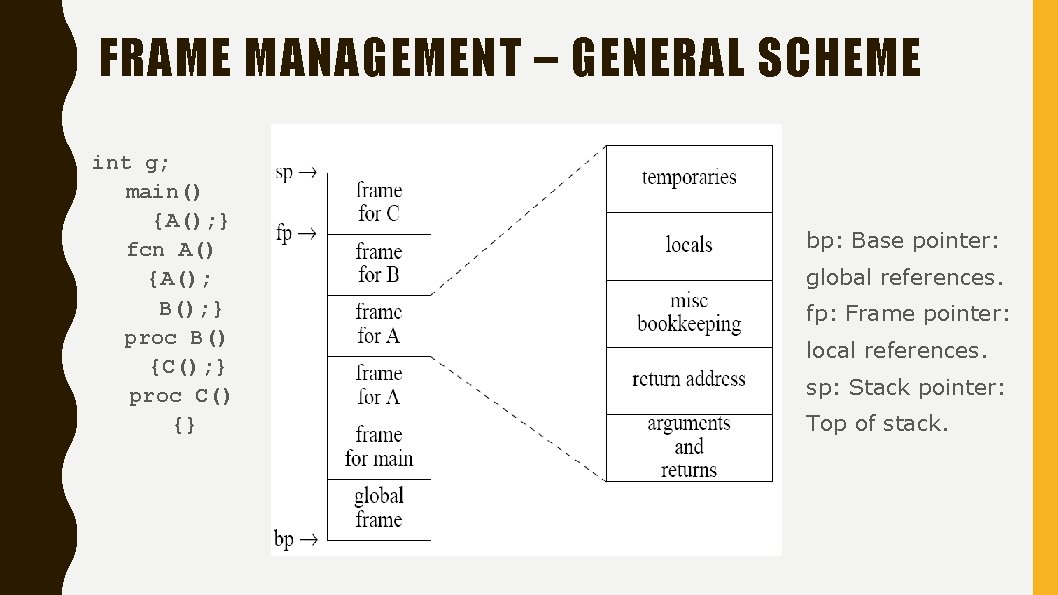
FRAME MANAGEMENT – GENERAL SCHEME int g; main() {A(); } fcn A() {A(); B(); } proc B() {C(); } proc C() {} bp: Base pointer: global references. fp: Frame pointer: local references. sp: Stack pointer: Top of stack.
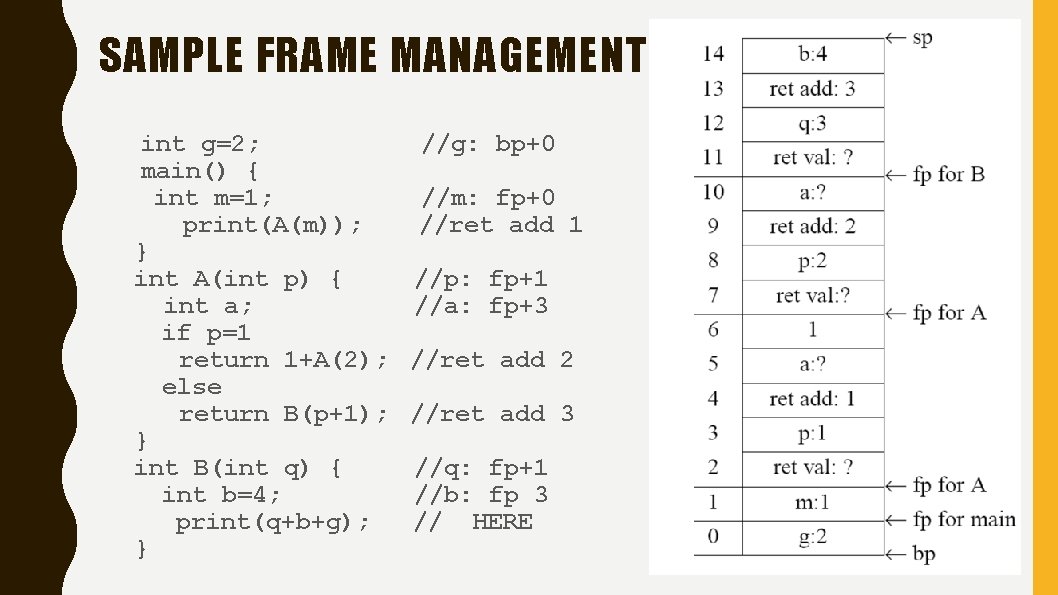
SAMPLE FRAME MANAGEMENT int g=2; main() { int m=1; print(A(m)); } int A(int p) { int a; if p=1 return 1+A(2); else return B(p+1); } int B(int q) { int b=4; print(q+b+g); } //g: bp+0 //m: fp+0 //ret add 1 //p: fp+1 //a: fp+3 //ret add 2 //ret add 3 //q: fp+1 //b: fp 3 // HERE
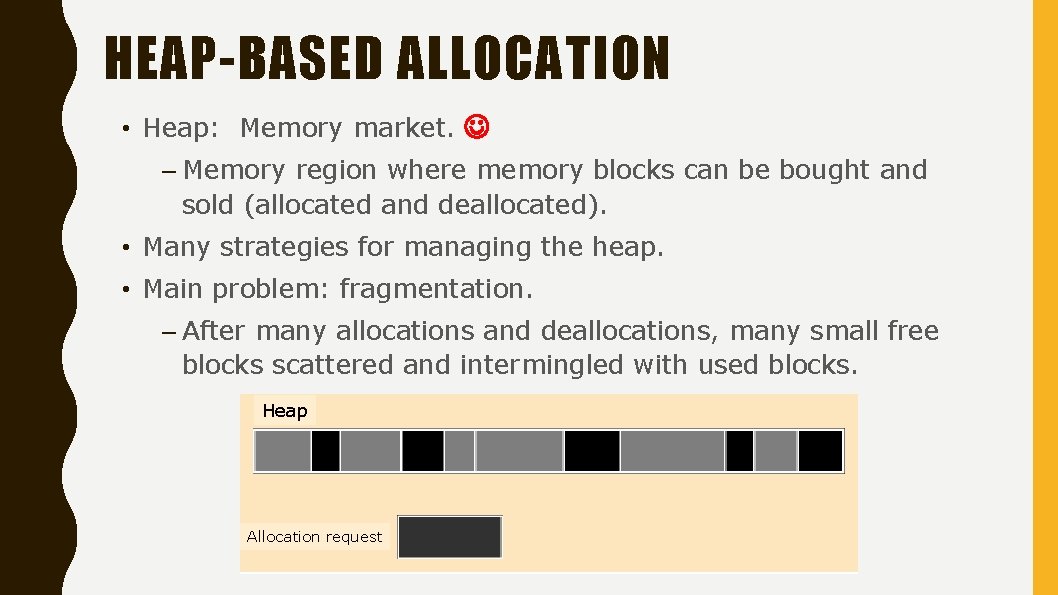
HEAP-BASED ALLOCATION • Heap: Memory market. – Memory region where memory blocks can be bought and sold (allocated and deallocated). • Many strategies for managing the heap. • Main problem: fragmentation. – After many allocations and deallocations, many small free blocks scattered and intermingled with used blocks. Heap Allocation request
HEAP-BASED ALLOCATION Allocation is usually explicit in PL's: malloc, new. Strategies for fragmentation: • Compaction. Expensive. • Internal fragmentation: – Allocate larger block than needed. Space wasted. • External fragmentation: – Can't handle a request for a large block. Plenty of free space, but no large blocks available.
EXTERNAL FRAGMENTATION Use a linked list of free blocks. • First fit strategy: allocate first block that suffices. More efficient, but more fragmentation. • Best fit strategy: allocate smallest block that suffices. Less efficient, less fragmentation. • Maintain "pools" of blocks, of various sizes. • "Buddy system": blocks of size 2 k. Allocate blocks of nearest power of two. If none available, split up one of size 2 k+1. When freed later, "buddy it" back, if possible. • Fibonacci heap: Use block sizes that increase as Fibonacci numbers do: f(n)=f(n-1)+f(n-2), instead of doubling.
HEAP DEALLOCATION • Implicit: Garbage Collection (Java). – Automatic, but expensive (getting better). • Explicit: free (C, C++), dispose (Pascal). – Risky. – Very costly errors, memory leaks, but efficient.
SUMMARY Types of storage allocation: Static Stack-based Frame management Heap-based