
Stop TB Partnership Forum 25 March 2004 The
Stop. TB Partnership Forum 25 March 2004 The Future of TB Diagnostics FIND: Foundation for Innovative New Diagnostics Mark Perkins, MD Giorgio Roscigno, MD
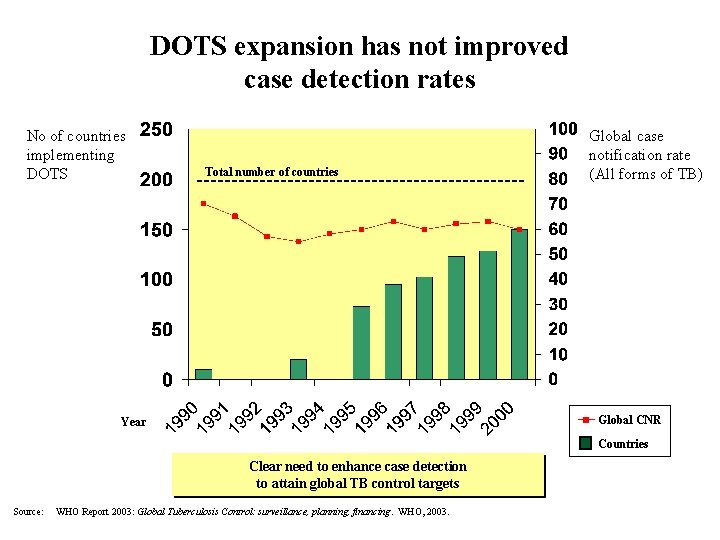
DOTS expansion has not improved case detection rates No of countries implementing DOTS Total number of countries Global case notification rate (All forms of TB) Global CNR Year Countries Clear need to enhance case detection to attain global TB control targets Source: WHO Report 2003: Global Tuberculosis Control: surveillance, planning, financing. WHO, 2003.
TB notification in Zambia, 1974 - 2000 • incidence in Lusaka >900/100, 000 • Disproportionate increase in smear-negative disease • <20% notified pulmonary TB pts are smear-pos
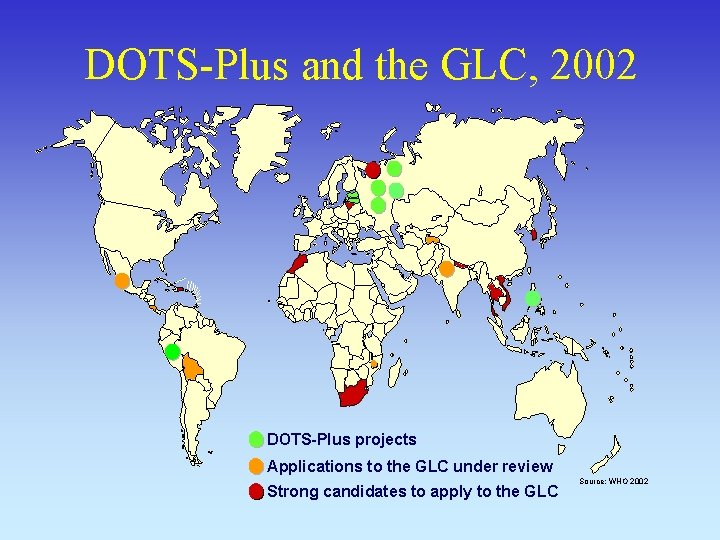
DOTS-Plus and the GLC, 2002 DOTS-Plus projects Applications to the GLC under review Strong candidates to apply to the GLC Source: WHO 2002
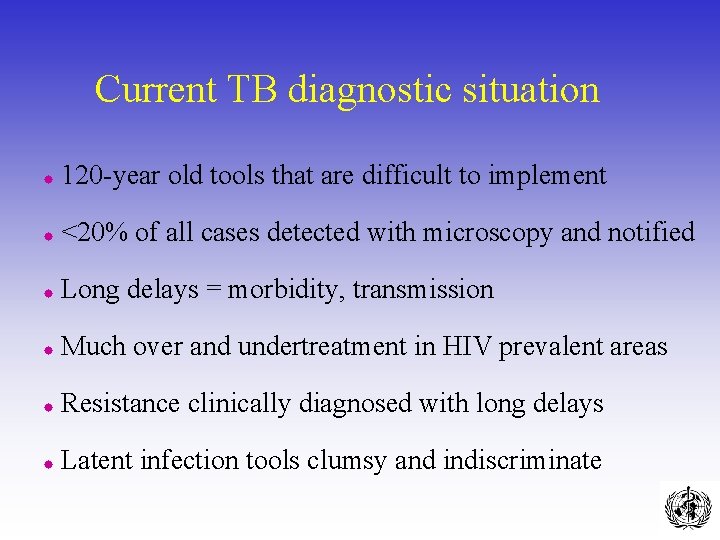
Current TB diagnostic situation ® 120 -year old tools that are difficult to implement ® <20% of all cases detected with microscopy and notified ® Long delays = morbidity, transmission ® Much over and undertreatment in HIV prevalent areas ® Resistance clinically diagnosed with long delays ® Latent infection tools clumsy and indiscriminate
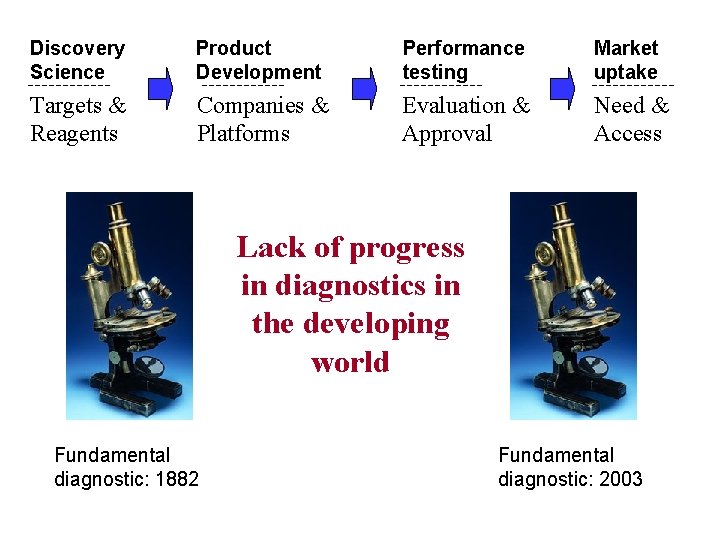
Discovery Science Product Development Performance testing Market uptake Targets & Reagents Companies & Platforms Evaluation & Approval Need & Access Lack of progress in diagnostics in the developing world Fundamental diagnostic: 1882 Fundamental diagnostic: 2003
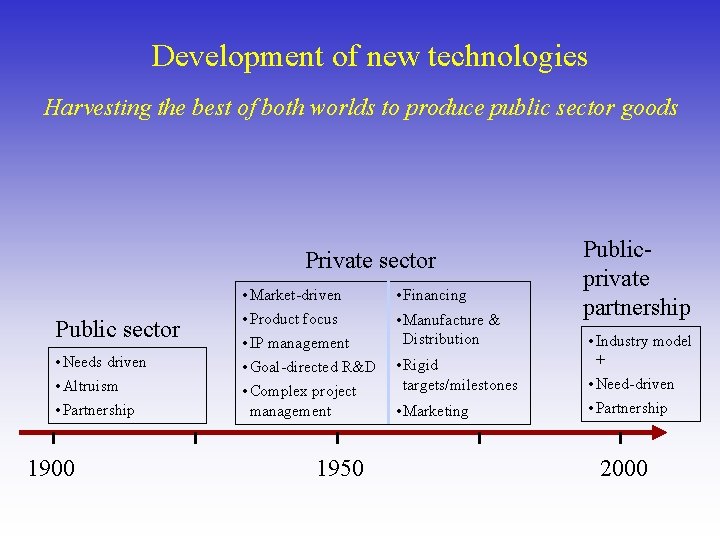
Development of new technologies Harvesting the best of both worlds to produce public sector goods Private sector Public sector • Needs driven • Altruism • Partnership 1900 • Market-driven • Product focus • IP management • Goal-directed R&D • Complex project management 1950 • Financing • Manufacture & Distribution • Rigid targets/milestones • Marketing Publicprivate partnership • Industry model + • Need-driven • Partnership 2000
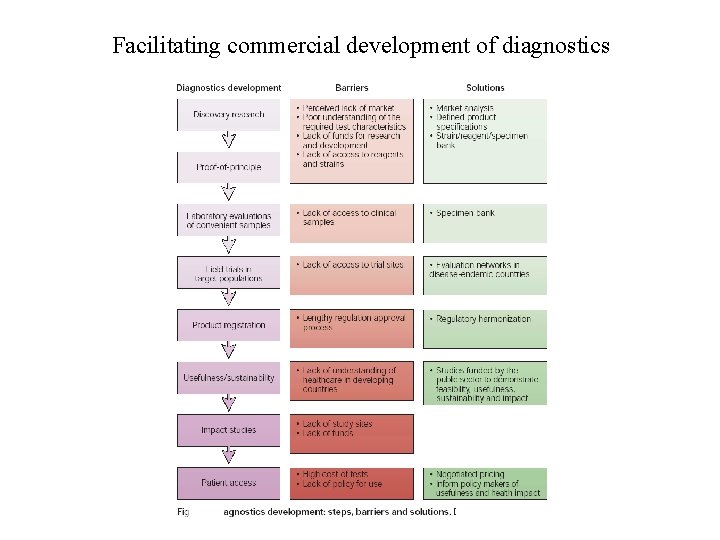
Facilitating commercial development of diagnostics
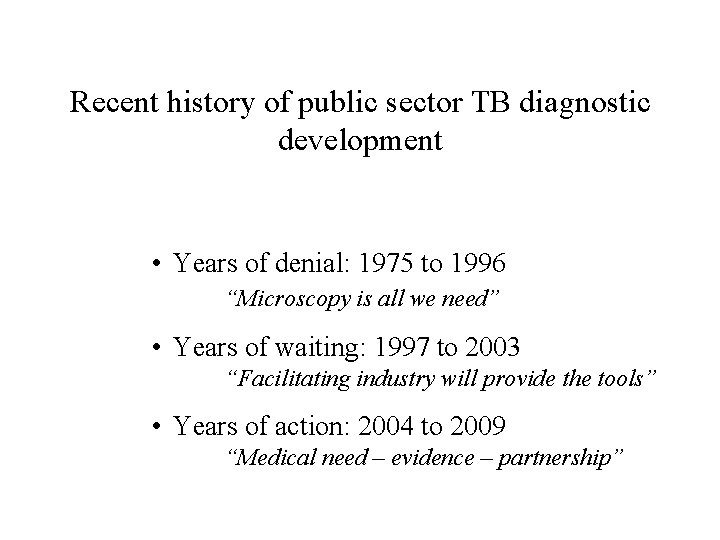
Recent history of public sector TB diagnostic development • Years of denial: 1975 to 1996 “Microscopy is all we need” • Years of waiting: 1997 to 2003 “Facilitating industry will provide the tools” • Years of action: 2004 to 2009 “Medical need – evidence – partnership”
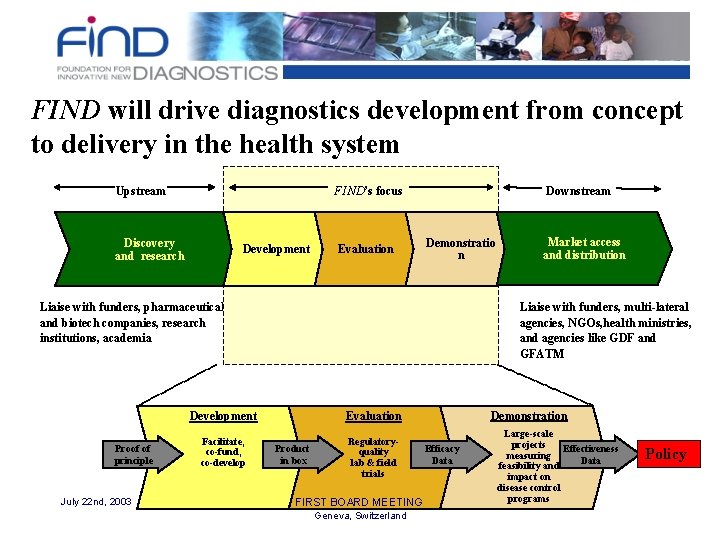
FIND will drive diagnostics development from concept to delivery in the health system Upstream FIND’s focus Discovery and research Development Liaise with funders, pharmaceutical and biotech companies, research institutions, academia July 22 nd, 2003 Facilitate, co-fund, co-develop Demonstratio n Create network of public and private partners to create effective tests and demonstrate their success Development Proof of principle Evaluation Downstream Regulatoryquality lab & field trials FIRST BOARD MEETING Geneva, Switzerland Liaise with funders, multi-lateral agencies, NGOs, health ministries, and agencies like GDF and GFATM Demonstration Evaluation Product in box Market access and distribution Efficacy Data Large-scale projects Effectiveness measuring Data feasibility and impact on disease control programs Policy
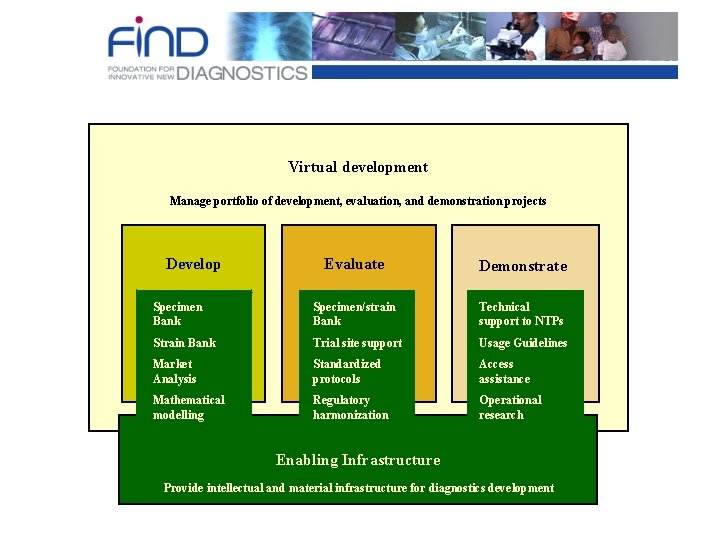
Virtual development Manage portfolio of development, evaluation, and demonstration projects Develop Evaluate Demonstrate Specimen Bank Specimen/strain Bank Technical support to NTPs Strain Bank Trial site support Usage Guidelines Market Analysis Standardized protocols Access assistance Mathematical modelling Regulatory harmonization Operational research Enabling Infrastructure Provide intellectual and material infrastructure for diagnostics development
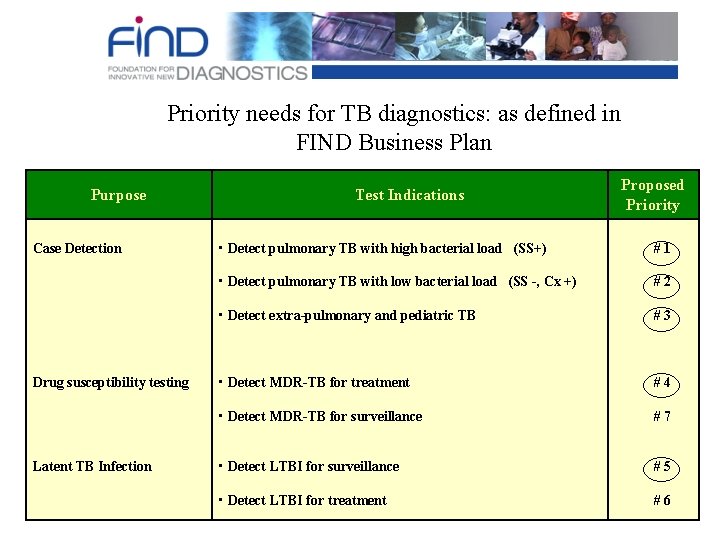
Priority needs for TB diagnostics: as defined in FIND Business Plan Purpose Case Detection Drug susceptibility testing Latent TB Infection Test Indications Proposed Priority • Detect pulmonary TB with high bacterial load (SS+) #1 • Detect pulmonary TB with low bacterial load (SS -, Cx +) #2 • Detect extra-pulmonary and pediatric TB #3 • Detect MDR-TB for treatment #4 • Detect MDR-TB for surveillance #7 • Detect LTBI for surveillance #5 • Detect LTBI for treatment #6
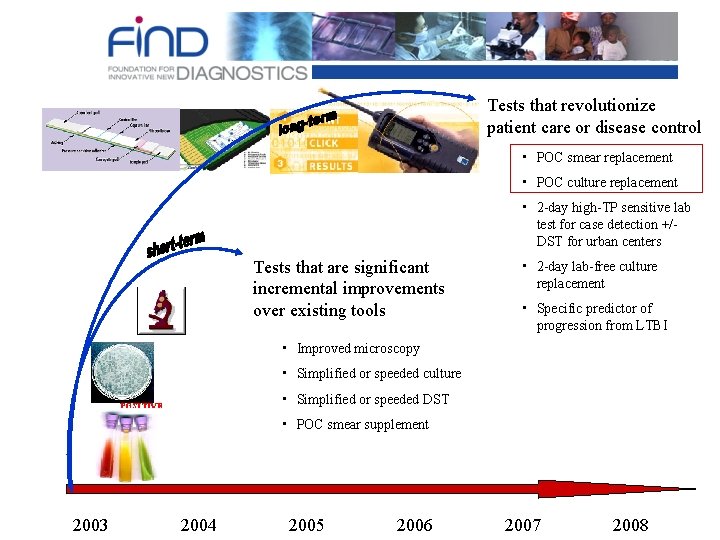
Tests that revolutionize patient care or disease control • POC smear replacement • POC culture replacement • 2 -day high-TP sensitive lab test for case detection +/DST for urban centers Tests that are significant incremental improvements over existing tools • 2 -day lab-free culture replacement • Specific predictor of progression from LTBI • Improved microscopy • Simplified or speeded culture • Simplified or speeded DST POSITIVE • POC smear supplement NEGATIVE 2003 2004 2005 2006 2007 2008
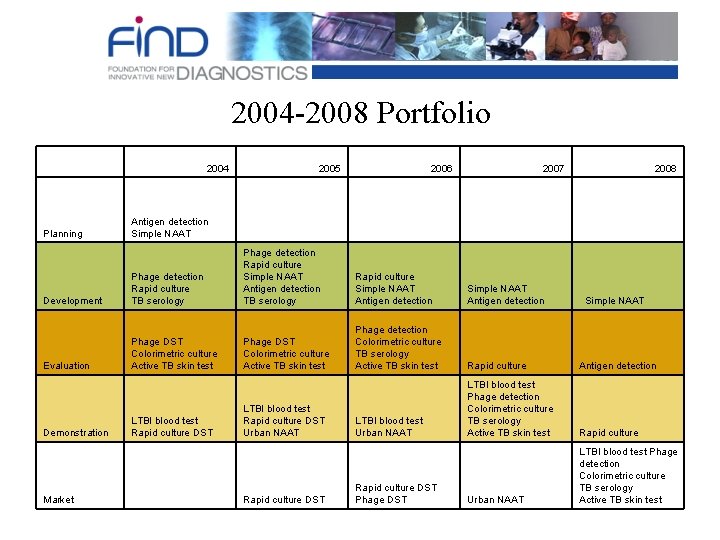
2004 -2008 Portfolio 2004 2005 2006 2007 2008 Antigen detection Simple NAAT Development Phage detection Rapid culture TB serology Phage detection Rapid culture Simple NAAT Antigen detection TB serology Rapid culture Simple NAAT Antigen detection Simple NAAT Evaluation Phage DST Colorimetric culture Active TB skin test Phage detection Colorimetric culture TB serology Active TB skin test Rapid culture Antigen detection LTBI blood test Urban NAAT LTBI blood test Phage detection Colorimetric culture TB serology Active TB skin test Rapid culture Urban NAAT LTBI blood test Phage detection Colorimetric culture TB serology Active TB skin test Planning Demonstration Market LTBI blood test Rapid culture DST Urban NAAT Rapid culture DST Phage DST
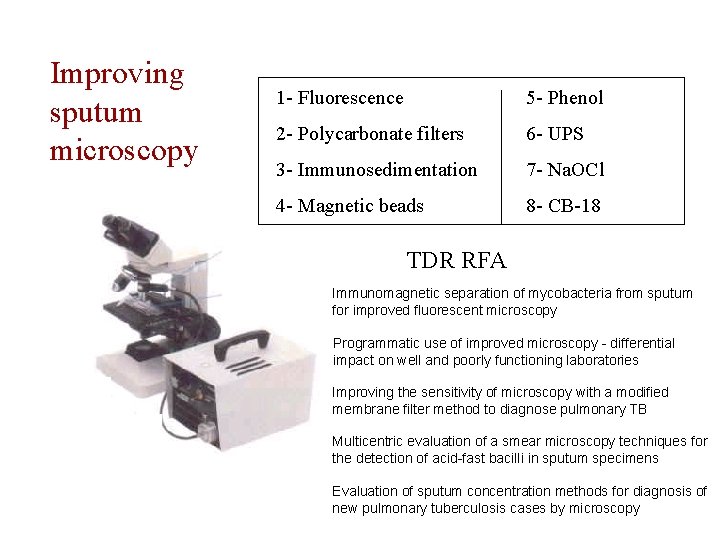
Improving sputum microscopy 1 - Fluorescence 5 - Phenol 2 - Polycarbonate filters 6 - UPS 3 - Immunosedimentation 7 - Na. OCl 4 - Magnetic beads 8 - CB-18 TDR RFA Immunomagnetic separation of mycobacteria from sputum for improved fluorescent microscopy Programmatic use of improved microscopy - differential impact on well and poorly functioning laboratories Improving the sensitivity of microscopy with a modified membrane filter method to diagnose pulmonary TB Multicentric evaluation of a smear microscopy techniques for the detection of acid-fast bacilli in sputum specimens Evaluation of sputum concentration methods for diagnosis of new pulmonary tuberculosis cases by microscopy
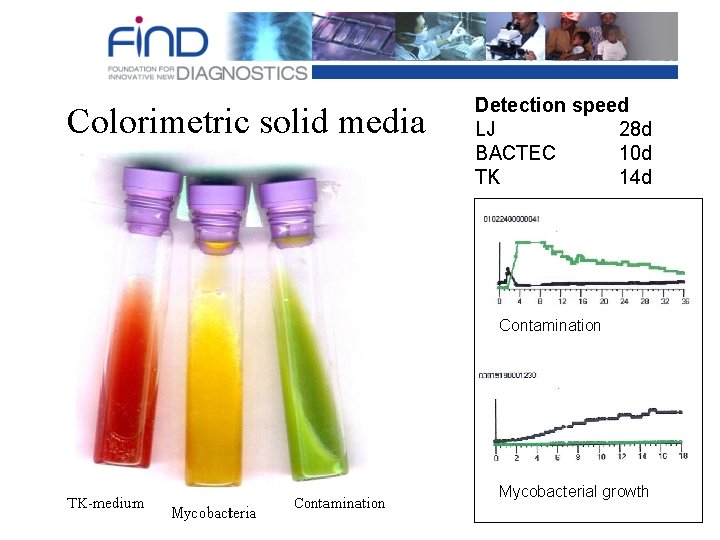
Colorimetric solid media Detection speed LJ 28 d BACTEC 10 d TK 14 d Contamination Mycobacterial growth
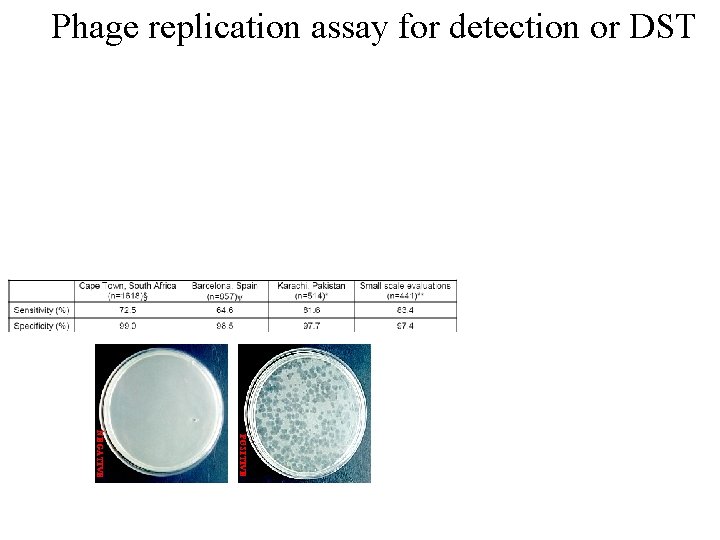
Phage replication assay for detection or DST POSITIVE NEGATIVE
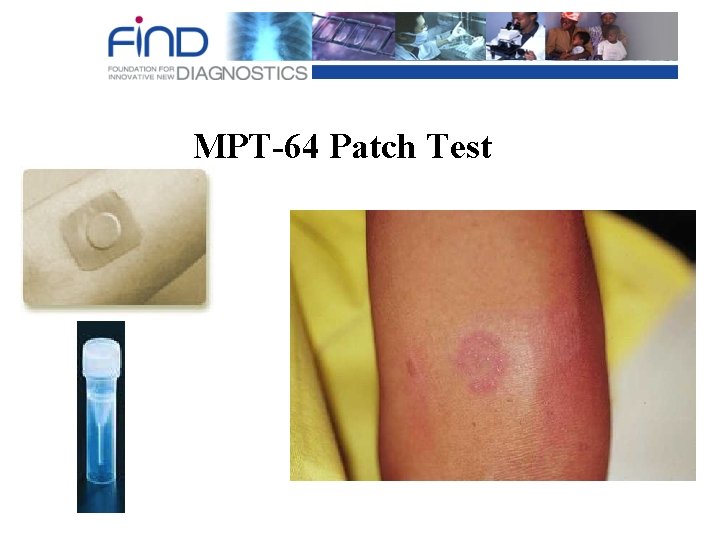
MPT-64 Patch Test
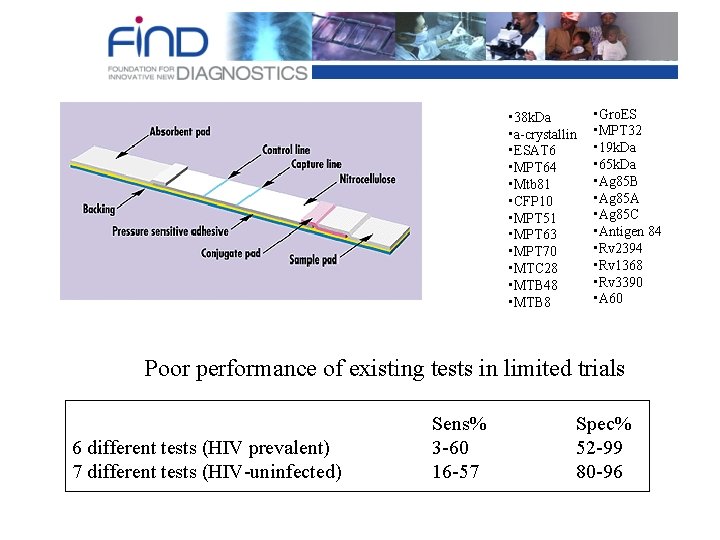
• 38 k. Da • a-crystallin • ESAT 6 • MPT 64 • Mtb 81 • CFP 10 • MPT 51 • MPT 63 • MPT 70 • MTC 28 • MTB 48 • MTB 8 • Gro. ES • MPT 32 • 19 k. Da • 65 k. Da • Ag 85 B • Ag 85 A • Ag 85 C • Antigen 84 • Rv 2394 • Rv 1368 • Rv 3390 • A 60 Poor performance of existing tests in limited trials 6 different tests (HIV prevalent) 7 different tests (HIV-uninfected) Sens% 3 -60 16 -57 Spec% 52 -99 80 -96
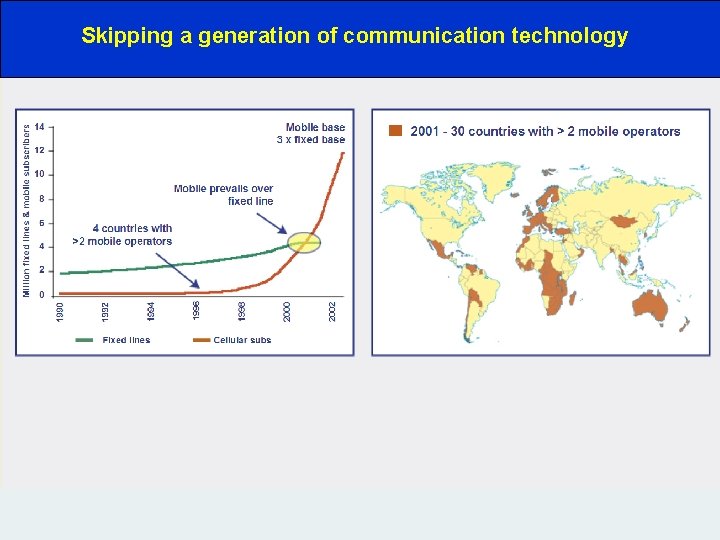
Skipping a generation of communication technology
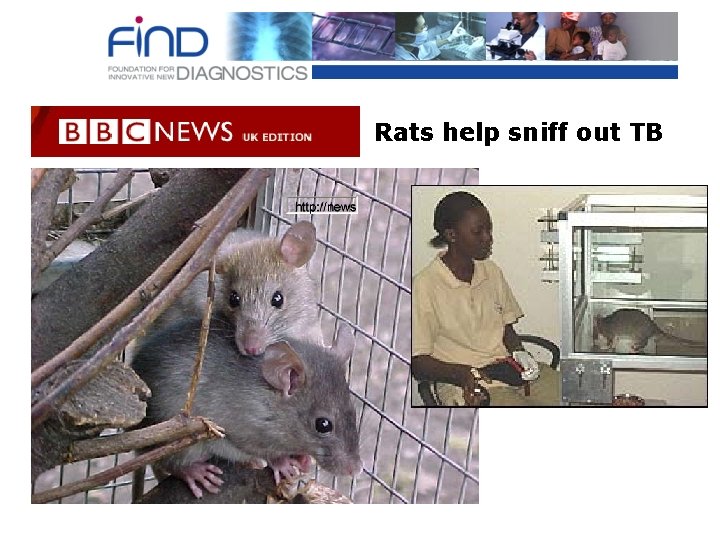
Rats help sniff out TB
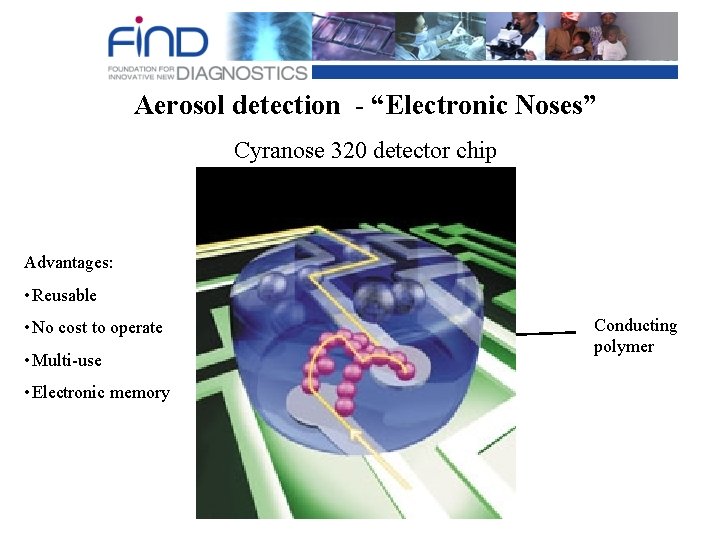
Aerosol detection - “Electronic Noses” Cyranose 320 detector chip Advantages: • Reusable • No cost to operate • Multi-use • Electronic memory Conducting polymer
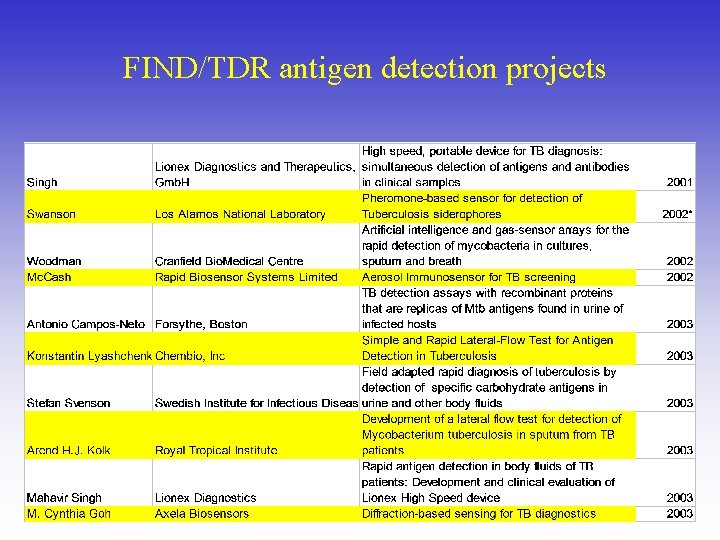
FIND/TDR antigen detection projects
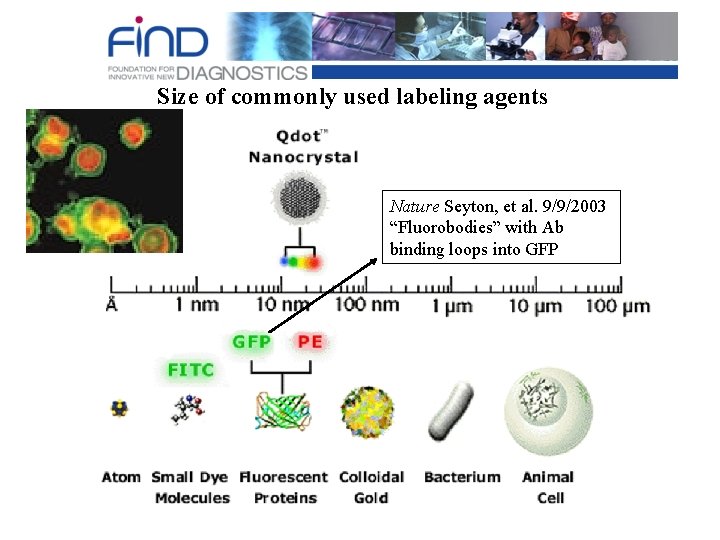
Size of commonly used labeling agents Nature Seyton, et al. 9/9/2003 “Fluorobodies” with Ab binding loops into GFP
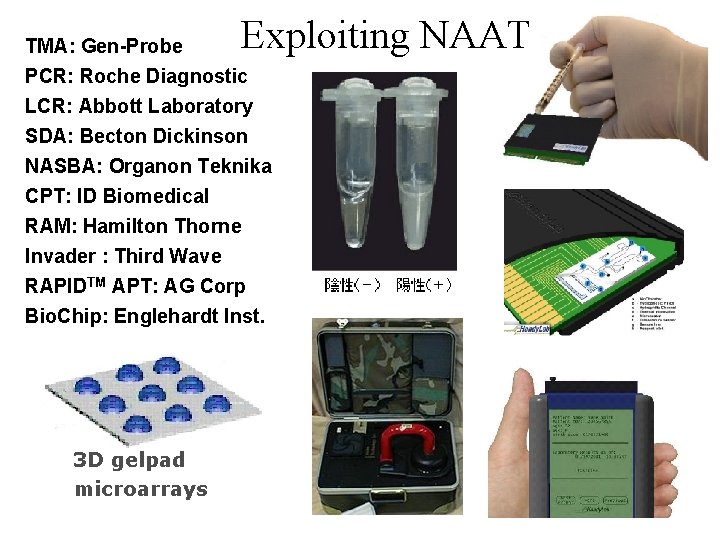
Exploiting NAAT TMA: Gen-Probe PCR: Roche Diagnostic LCR: Abbott Laboratory SDA: Becton Dickinson NASBA: Organon Teknika CPT: ID Biomedical RAM: Hamilton Thorne Invader : Third Wave RAPIDTM APT: AG Corp Bio. Chip: Englehardt Inst. 3 D gelpad microarrays
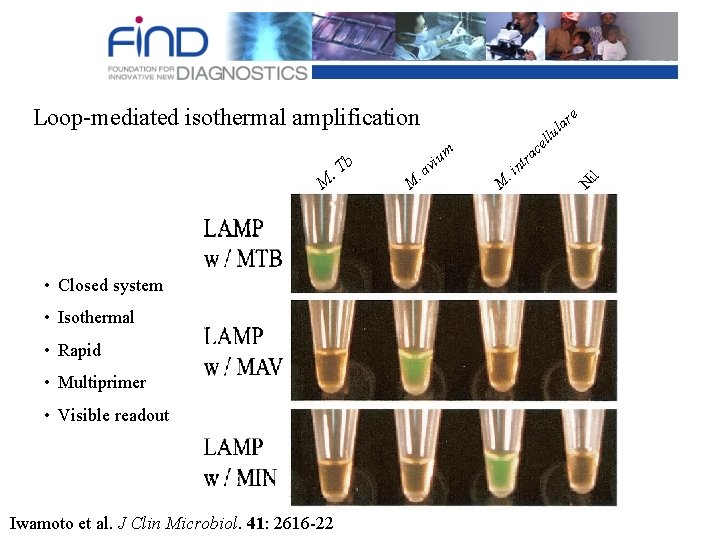
Loop-mediated isothermal amplification • Closed system • Isothermal • Rapid • Multiprimer • Visible readout Iwamoto et al. J Clin Microbiol. 41: 2616 -22 m M . iu av M n. i il lu el c tra N . M Tb re a l
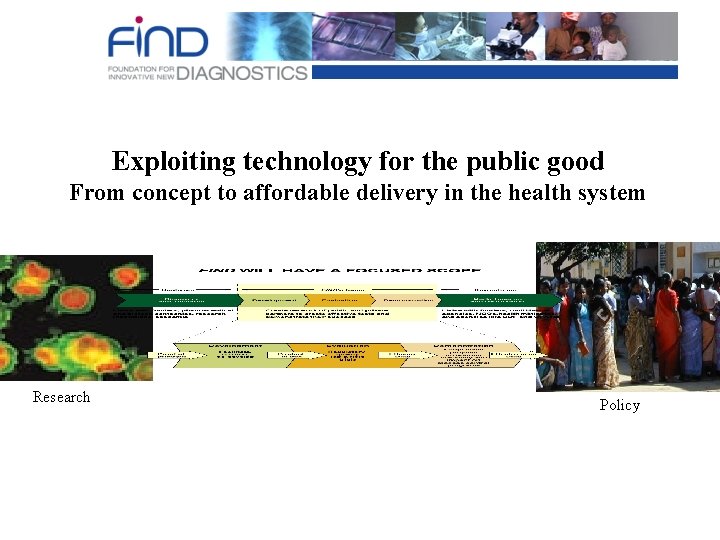
Exploiting technology for the public good From concept to affordable delivery in the health system Research Policy
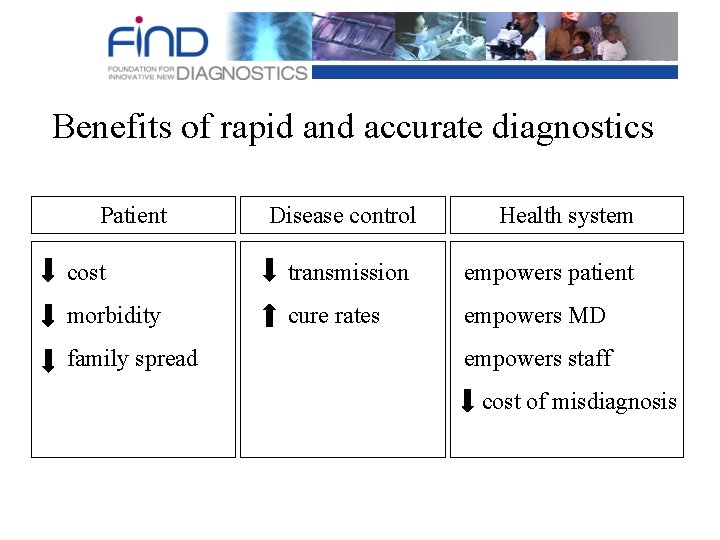
Benefits of rapid and accurate diagnostics Patient Disease control Health system cost transmission empowers patient morbidity cure rates empowers MD family spread empowers staff cost of misdiagnosis
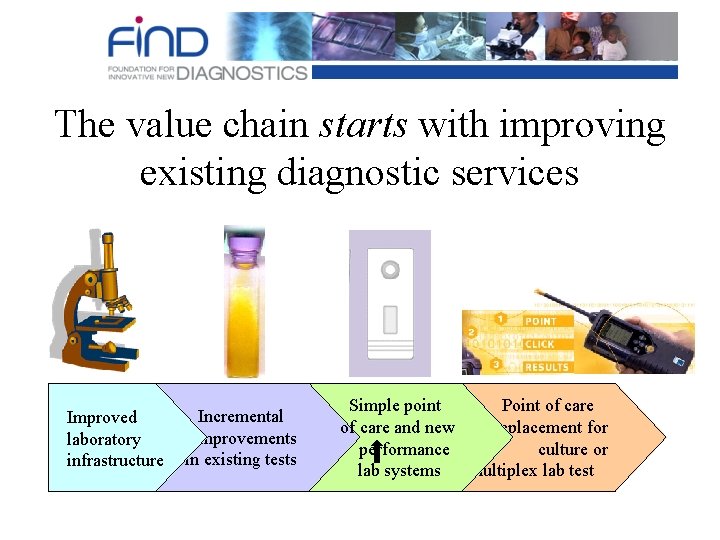
The value chain starts with improving existing diagnostic services Improved laboratory infrastructure Incremental improvements in existing tests Simple point Point of care and new replacement for performance culture or lab systems multiplex lab test
- Slides: 31