
STOP LOOK CARE Awareness Presentation 14 April 2020
- Slides: 12
STOP LOOK CARE Awareness Presentation 14 April 2020
Aims of this Presentation § To provide Care Workers and Carers with an awareness about the Stop Look Care (SLC) framework and how it can be applied in practice § To help build on existing knowledge and support in the delivery of care § To build confidence by exploring how to escalate any concerns to a healthcare professional using the SBAR tool
Background § The first SLC booklet was developed by Brighton and Hove CCG (BHCCG). The CCG won the Care of Older People Award at the Nursing Times Annual Awards § Frimley Integrated Care System (ICS) created a 2 nd revised version, with input and approval from across the Frimley ICS. § BHCCG, have now incorporated Frimley’s version into their own.
What is SLC? § SLC is designed to help you develop a basic awareness of health related conditions § It explains why simple aspects of care and daily living are important in keeping a person at their optimum health § Delivering care means you are in an ideal position to identify changes in a person’s condition. § You can do this by monitoring them and/or recognising any signs of deterioration.
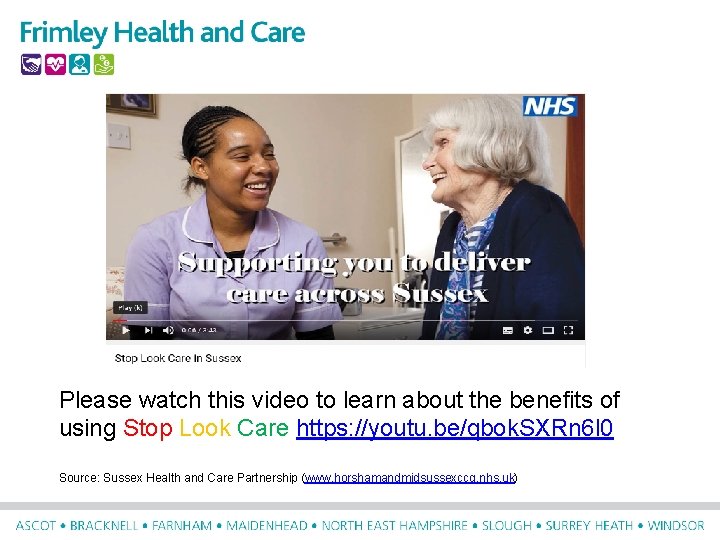
Please watch this video to learn about the benefits of using Stop Look Care https: //youtu. be/qbok. SXRn 6 l 0 Source: Sussex Health and Care Partnership (www. horshamandmidsussexccg. nhs. uk)
How Does SLC Work? § SLC covers the fundamentals of health care and supports carers to do the following: • Understand why different aspects of observation and care important • Supports a carer in what to look for and how to identify change or deterioration • Identify what actions to take should that happen, by using a traffic light system
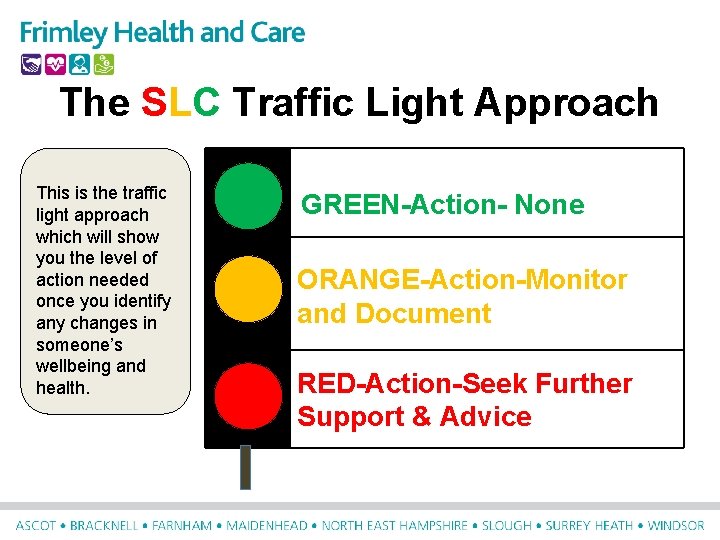
The SLC Traffic Light Approach This is the traffic light approach which will show you the level of action needed once you identify any changes in someone’s wellbeing and health. GREEN-Action- None ORANGE-Action-Monitor and Document RED-Action-Seek Further Support & Advice
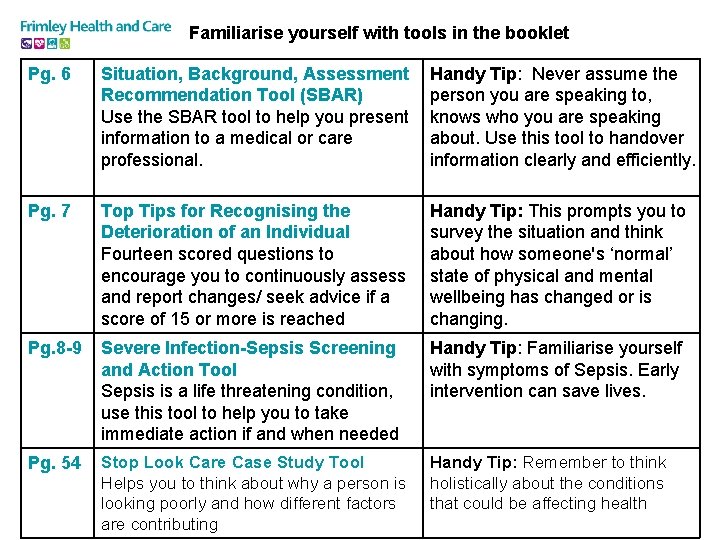
Familiarise yourself with tools in the booklet Pg. 6 Situation, Background, Assessment Recommendation Tool (SBAR) Use the SBAR tool to help you present information to a medical or care professional. Handy Tip: Never assume the person you are speaking to, knows who you are speaking about. Use this tool to handover information clearly and efficiently. Pg. 7 Top Tips for Recognising the Deterioration of an Individual Fourteen scored questions to encourage you to continuously assess and report changes/ seek advice if a score of 15 or more is reached Handy Tip: This prompts you to survey the situation and think about how someone's ‘normal’ state of physical and mental wellbeing has changed or is changing. Pg. 8 -9 Severe Infection-Sepsis Screening and Action Tool Sepsis is a life threatening condition, use this tool to help you to take immediate action if and when needed Handy Tip: Familiarise yourself with symptoms of Sepsis. Early intervention can save lives. Pg. 54 Stop Look Care Case Study Tool Helps you to think about why a person is looking poorly and how different factors are contributing Handy Tip: Remember to think holistically about the conditions that could be affecting health
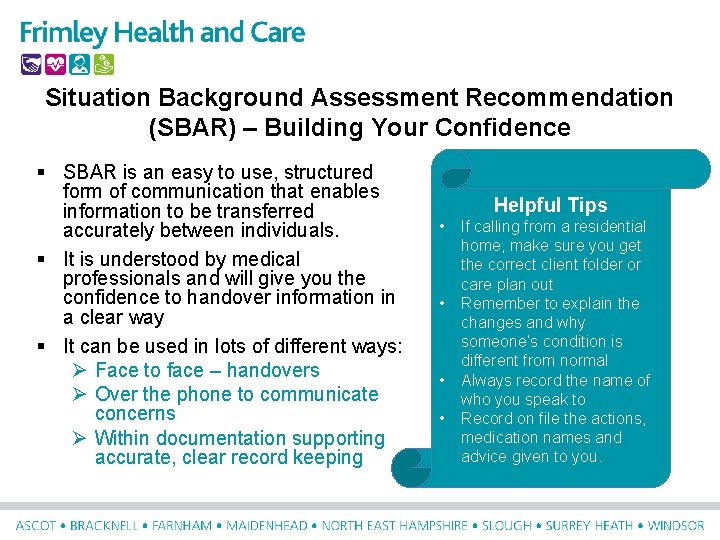
Situation Background Assessment Recommendation (SBAR) – Building Your Confidence § SBAR is an easy to use, structured form of communication that enables information to be transferred accurately between individuals. § It is understood by medical professionals and will give you the confidence to handover information in a clear way § It can be used in lots of different ways: Ø Face to face – handovers Ø Over the phone to communicate concerns Ø Within documentation supporting accurate, clear record keeping Helpful Tips • • If calling from a residential home, make sure you get the correct client folder or care plan out Remember to explain the changes and why someone’s condition is different from normal Always record the name of who you speak to Record on file the actions, medication names and advice given to you.
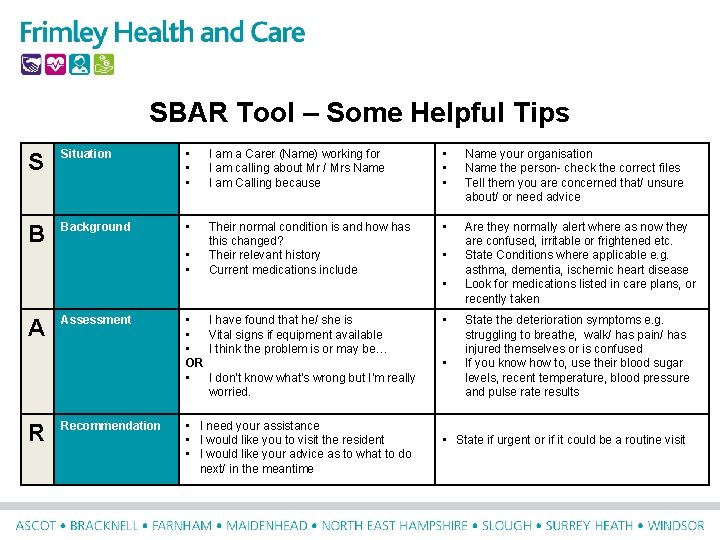
SBAR Tool – Some Helpful Tips S Situation • • • I am a Carer (Name) working for I am calling about Mr / Mrs Name I am Calling because • • • Name your organisation Name the person- check the correct files Tell them you are concerned that/ unsure about/ or need advice B Background • Their normal condition is and how has this changed? Their relevant history Current medications include • Are they normally alert where as now they are confused, irritable or frightened etc. State Conditions where applicable e. g. asthma, dementia, ischemic heart disease Look for medications listed in care plans, or recently taken • • A R Assessment Recommendation • I have found that he/ she is • Vital signs if equipment available • I think the problem is or may be… OR • I don't know what's wrong but I'm really worried. • I need your assistance • I would like you to visit the resident • I would like your advice as to what to do next/ in the meantime • • State the deterioration symptoms e. g. struggling to breathe, walk/ has pain/ has injured themselves or is confused If you know how to, use their blood sugar levels, recent temperature, blood pressure and pulse rate results • State if urgent or if it could be a routine visit
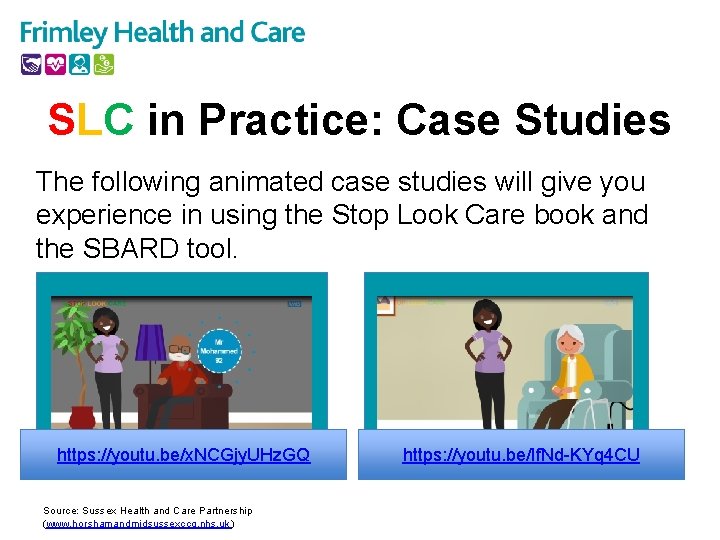
SLC in Practice: Case Studies The following animated case studies will give you experience in using the Stop Look Care book and the SBARD tool. https: //youtu. be/x. NCGjy. UHz. GQ Source: Sussex Health and Care Partnership (www. horshamandmidsussexccg. nhs. uk) https: //youtu. be/If. Nd-KYq 4 CU
Thank You For more information on Stop Look Care, please contact CONTACTS Kiran Kaur Learning & Development Manager –Support Workforce Workstreams Frimley Health and Care Integrated Care Team Kiranjeet. kaur 6@nhs. net Karen Hampton Programme Lead - Care and Support Market & Support Workforce Frimley Health and Care Integrated Care Team Karen. hampton@nhs. net Thank you to Sussex Health & Care Partnership for their support in producing the SLC Awareness Training Materials