
STOMACH By Brittany Vasquez STRUCTURE Food starts to

STOMACH By: Brittany Vasquez
STRUCTURE Food starts to be digested and absorbed in the stomach. The stomach is an expandable, muscular bag, and it keeps swallowed food inside it by contracting the muscular pyloric sphincter.
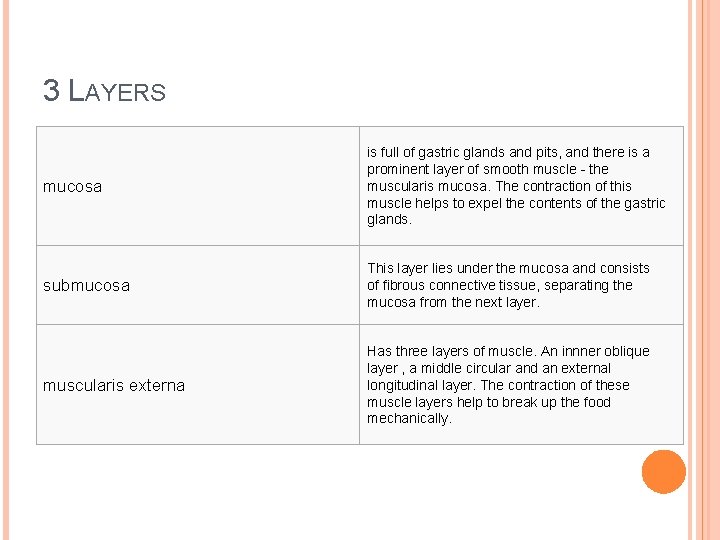
3 LAYERS mucosa is full of gastric glands and pits, and there is a prominent layer of smooth muscle - the muscularis mucosa. The contraction of this muscle helps to expel the contents of the gastric glands. submucosa This layer lies under the mucosa and consists of fibrous connective tissue, separating the mucosa from the next layer. muscularis externa Has three layers of muscle. An innner oblique layer , a middle circular and an external longitudinal layer. The contraction of these muscle layers help to break up the food mechanically.
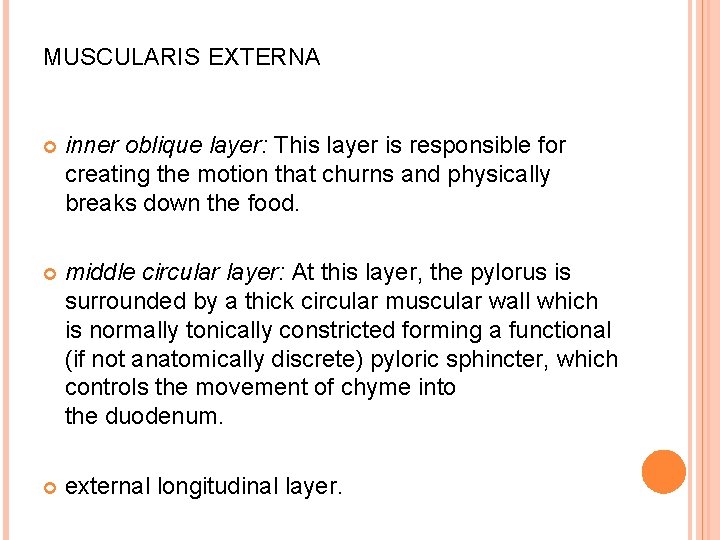
MUSCULARIS EXTERNA inner oblique layer: This layer is responsible for creating the motion that churns and physically breaks down the food. middle circular layer: At this layer, the pylorus is surrounded by a thick circular muscular wall which is normally tonically constricted forming a functional (if not anatomically discrete) pyloric sphincter, which controls the movement of chyme into the duodenum. external longitudinal layer.
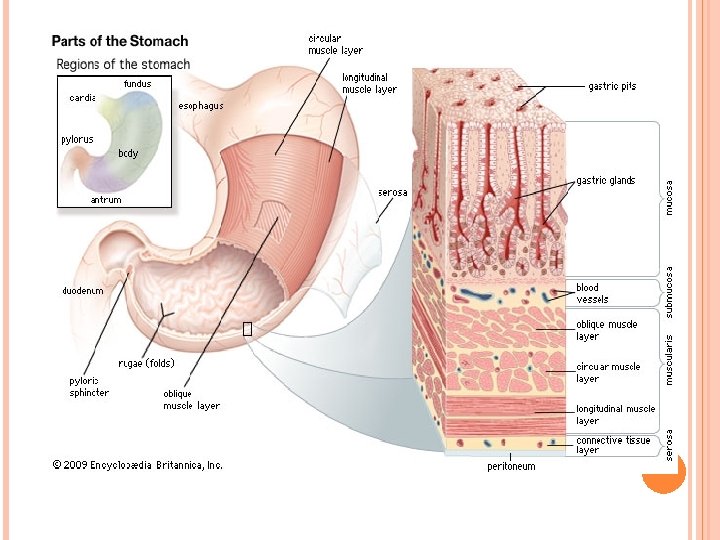
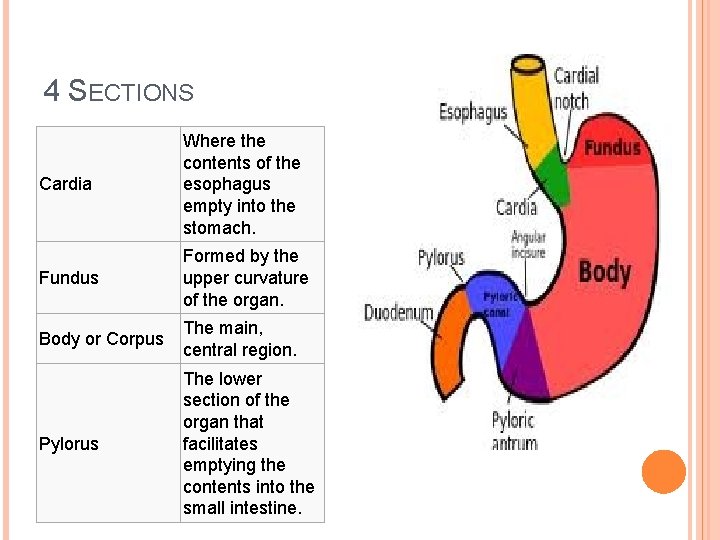
4 SECTIONS Cardia Where the contents of the esophagus empty into the stomach. Fundus Formed by the upper curvature of the organ. Body or Corpus The main, central region. Pylorus The lower section of the organ that facilitates emptying the contents into the small intestine.
HOW FOOD ENTERS THE STOMACH? where the esophagus leads into the stomach, the digestive tube is usually kept shut by muscles of the esophagus and diaphragm. When you swallow, these muscles relax and the lower end of the esophagus opens, allowing food to enter the stomach. If this mechanism does not work properly, acidic gastric juice might get into the esophagus, leading to heartburn or an inflammation.
HOW FOOD IS BROKEN DOWN? chemically: by gastric juice Mechanically: by contraction of the three layers of smooth muscle in the muscular externa layer.
The thick mucosa of the stomach is characterized by closely packed tubular glands beneath a surface of simple columnar epithelium. The surface is indented into numerous short gastric pits which open freely to the lumen. The entire surface consists uniformly of surface mucous cells, which protect the stomach from selfdigestion.
GLANDS The surface is indented into numerous short gastric pits which open freely to the lumen. The entire surface consists uniformly of surface mucous cells, which protect the stomach from self-digestion. Gastric Gland: Gastric parietal cells (oxyntic cells): secrete acid, by pumping chloride and hydrogen ions. These cells are unique not only in function but also in microscopic appearance. Parietal cells may be found at any level in the fundic glands, but they are most common in the middle region. � Gastric chief cells: secrete the digestive enzymes and have typical serous-secretory appearance. Chief cells may be found at any level in the fundic glands, but they are most common in the lower region. �
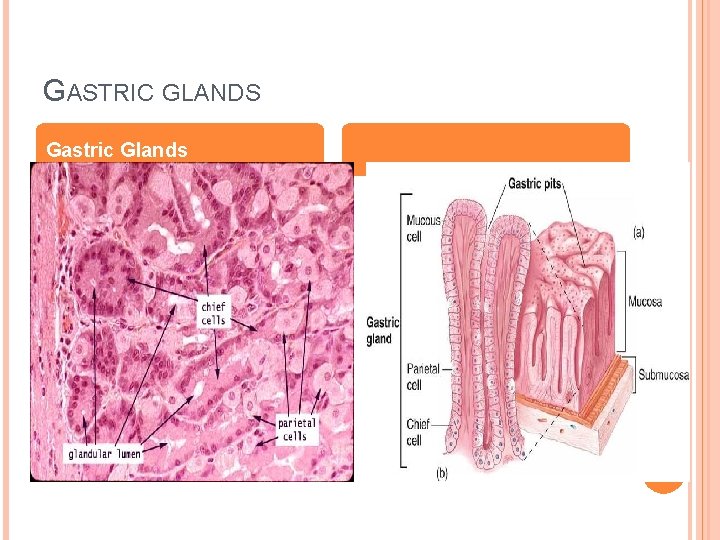
GASTRIC GLANDS Gastric Glands
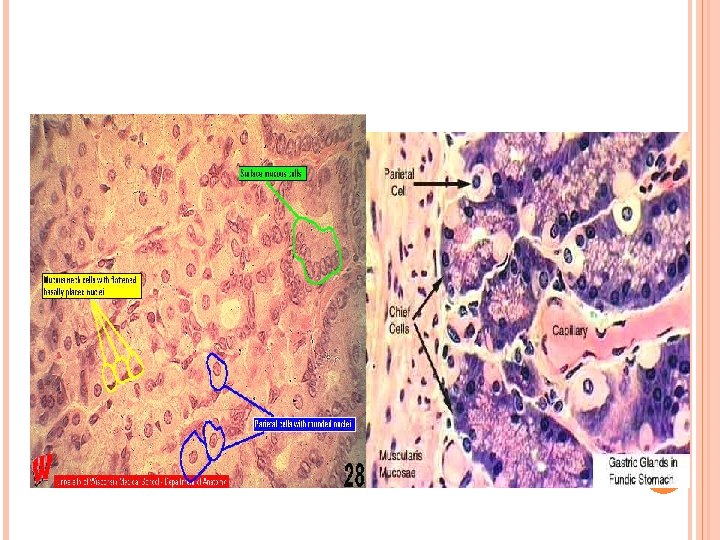
GLANDS CONT… Fundic Glands: � Mucous neck cells: are inconspicuous cells with a typical mucous-secretory appearance. These cells are most common in the upper region of the fundic glands. Their specific function remains unclear. � Stem cells: located at the top of the glands where they open into the pits, are responsible for replenishing the gland cells and also the surface mucous cells that protect the stomach surface. These cells are difficult to notice and even more difficult to identify in routine histological preparations. •
- Slides: 13