
Stoichiometry UNIT 4 Significant Figures Review 1 5



- Slides: 29
Stoichiometry UNIT 4
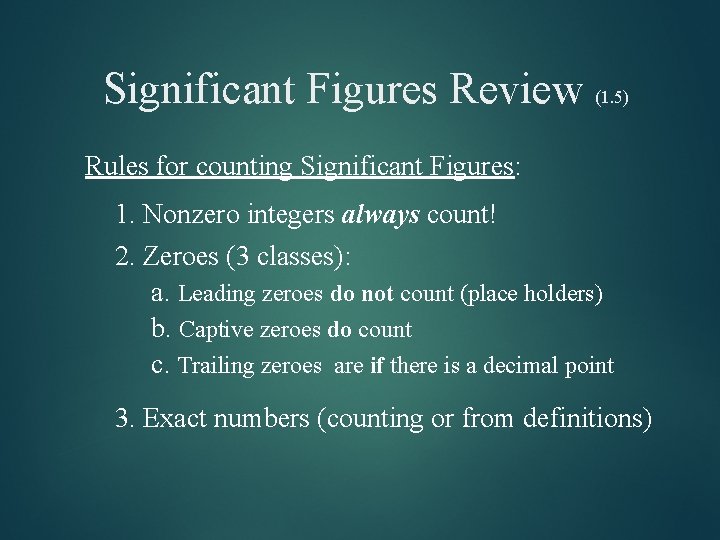
Significant Figures Review (1. 5) Rules for counting Significant Figures: 1. Nonzero integers always count! 2. Zeroes (3 classes): a. Leading zeroes do not count (place holders) b. Captive zeroes do count c. Trailing zeroes are if there is a decimal point 3. Exact numbers (counting or from definitions)
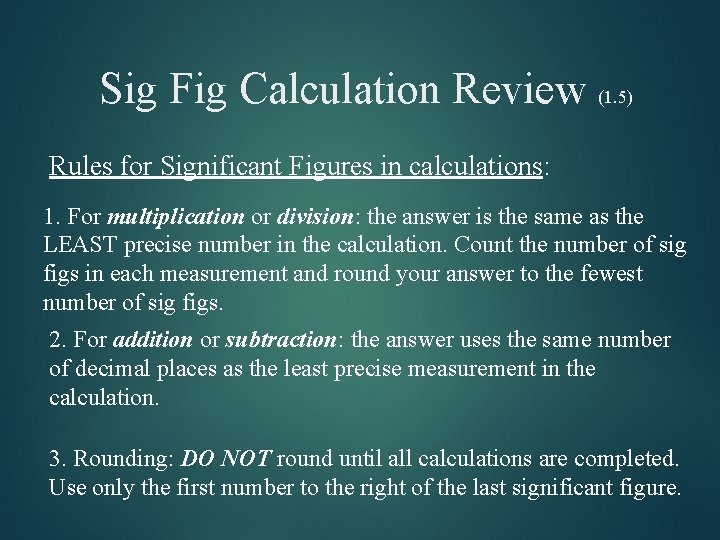
Sig Fig Calculation Review (1. 5) Rules for Significant Figures in calculations: 1. For multiplication or division: the answer is the same as the LEAST precise number in the calculation. Count the number of sig figs in each measurement and round your answer to the fewest number of sig figs. 2. For addition or subtraction: the answer uses the same number of decimal places as the least precise measurement in the calculation. 3. Rounding: DO NOT round until all calculations are completed. Use only the first number to the right of the last significant figure.
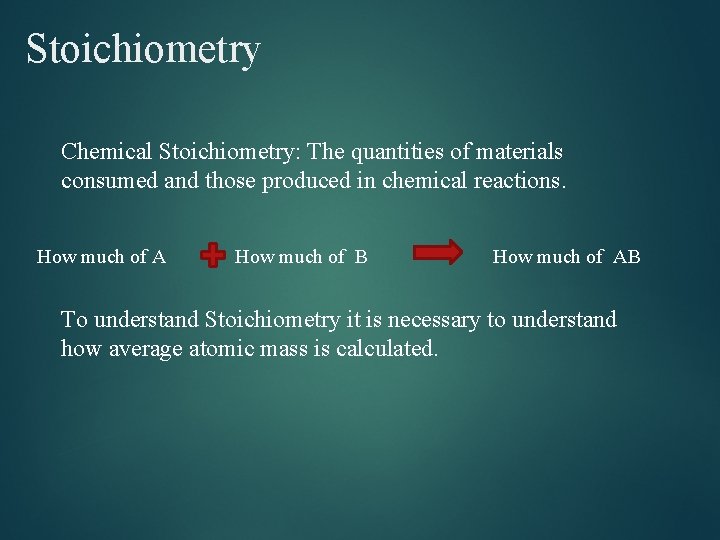
Stoichiometry Chemical Stoichiometry: The quantities of materials consumed and those produced in chemical reactions. How much of A How much of B How much of AB To understand Stoichiometry it is necessary to understand how average atomic mass is calculated.
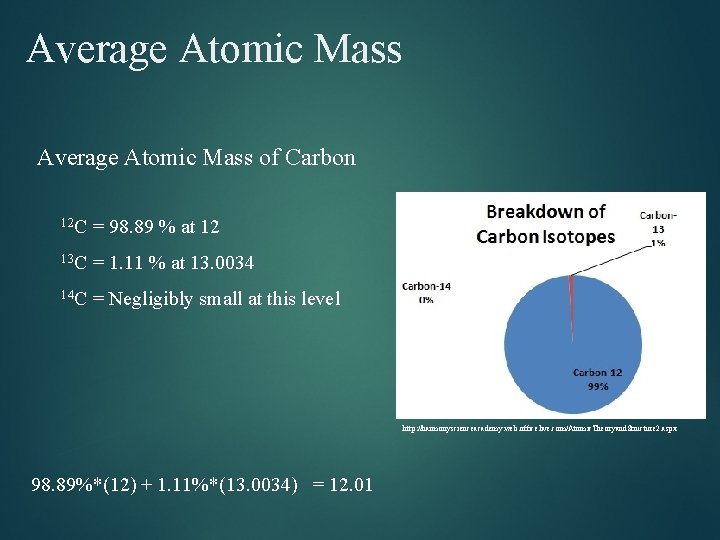
Average Atomic Mass of Carbon 12 C = 98. 89 % at 12 13 C = 1. 11 % at 13. 0034 14 C = Negligibly small at this level http: //harmonyscienceacademy. web. officelive. com/Atomic. Theoryand. Structure 2. aspx 98. 89%*(12) + 1. 11%*(13. 0034) = 12. 01
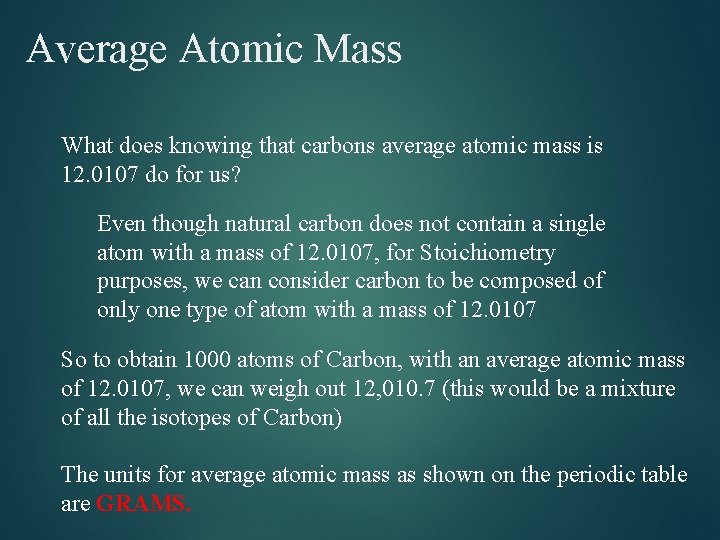
Average Atomic Mass What does knowing that carbons average atomic mass is 12. 0107 do for us? Even though natural carbon does not contain a single atom with a mass of 12. 0107, for Stoichiometry purposes, we can consider carbon to be composed of only one type of atom with a mass of 12. 0107 So to obtain 1000 atoms of Carbon, with an average atomic mass of 12. 0107, we can weigh out 12, 010. 7 (this would be a mixture of all the isotopes of Carbon) The units for average atomic mass as shown on the periodic table are GRAMS.
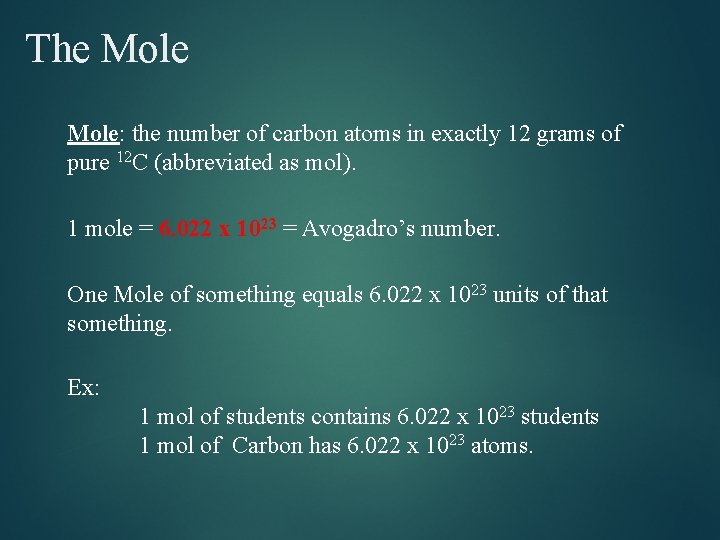
The Mole: the number of carbon atoms in exactly 12 grams of pure 12 C (abbreviated as mol). 1 mole = 6. 022 x 1023 = Avogadro’s number. One Mole of something equals 6. 022 x 1023 units of that something. Ex: 1 mol of students contains 6. 022 x 1023 students 1 mol of Carbon has 6. 022 x 1023 atoms.
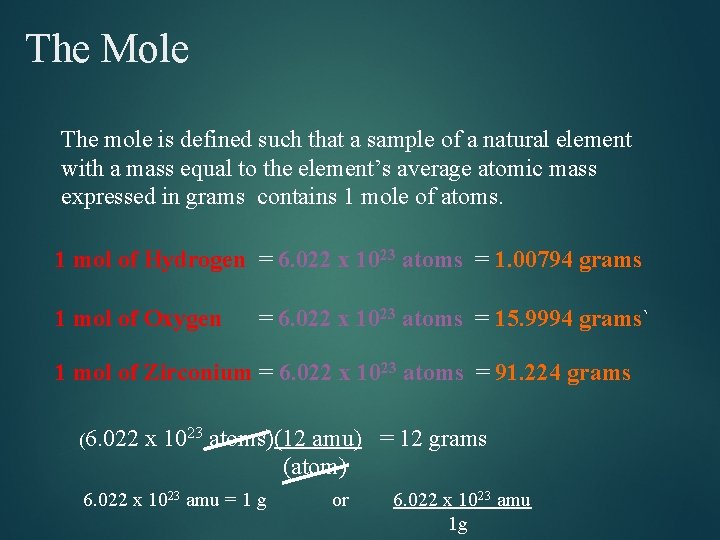
The Mole The mole is defined such that a sample of a natural element with a mass equal to the element’s average atomic mass expressed in grams contains 1 mole of atoms. 1 mol of Hydrogen = 6. 022 x 1023 atoms = 1. 00794 grams 1 mol of Oxygen = 6. 022 x 1023 atoms = 15. 9994 grams` 1 mol of Zirconium = 6. 022 x 1023 atoms = 91. 224 grams (6. 022 x 1023 atoms)(12 amu) = 12 grams (atom) 6. 022 x 1023 amu = 1 g or 6. 022 x 1023 amu 1 g
The Mole: Jelly Beans and Donuts Tyler De. Witt: Introduction to Moles
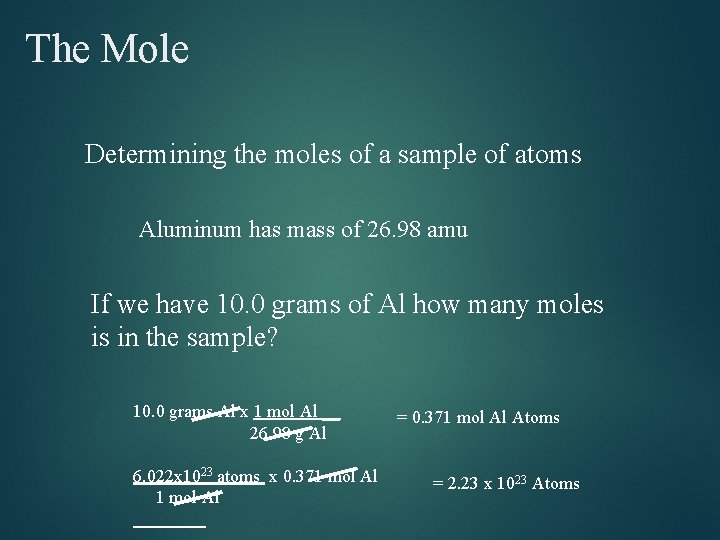
The Mole Determining the moles of a sample of atoms Aluminum has mass of 26. 98 amu If we have 10. 0 grams of Al how many moles is in the sample? 10. 0 grams Al x 1 mol Al __ 26. 98 g Al 6. 022 x 1023 atoms x 0. 371 mol Al = 0. 371 mol Al Atoms = 2. 23 x 1023 Atoms
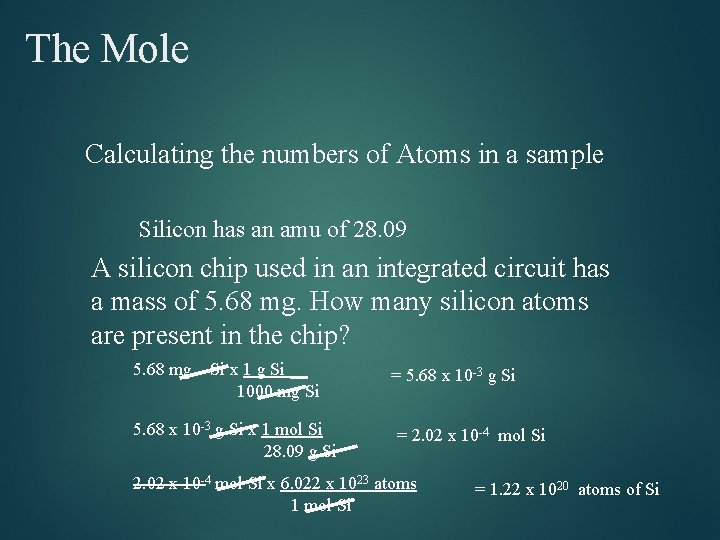
The Mole Calculating the numbers of Atoms in a sample Silicon has an amu of 28. 09 A silicon chip used in an integrated circuit has a mass of 5. 68 mg. How many silicon atoms are present in the chip? 5. 68 mg Si x 1 g Si __ 1000 mg Si 5. 68 x 10 -3 g Si x 1 mol Si 28. 09 g Si = 5. 68 x 10 -3 g Si = 2. 02 x 10 -4 mol Si x 6. 022 x 1023 atoms 1 mol Si = 1. 22 x 1020 atoms of Si
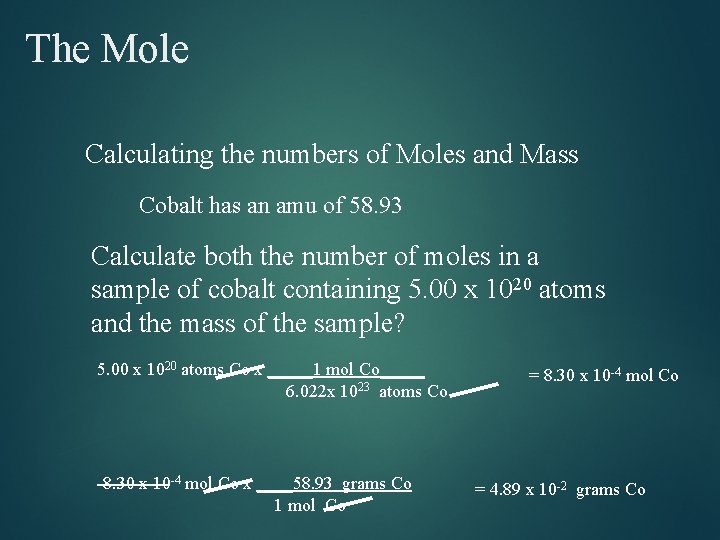
The Mole Calculating the numbers of Moles and Mass Cobalt has an amu of 58. 93 Calculate both the number of moles in a sample of cobalt containing 5. 00 x 1020 atoms and the mass of the sample? 5. 00 x 1020 atoms Co x _____1 mol Co_____ 6. 022 x 1023 atoms Co 8. 30 x 10 -4 mol Co x ____58. 93 grams Co 1 mol Co = 8. 30 x 10 -4 mol Co = 4. 89 x 10 -2 grams Co
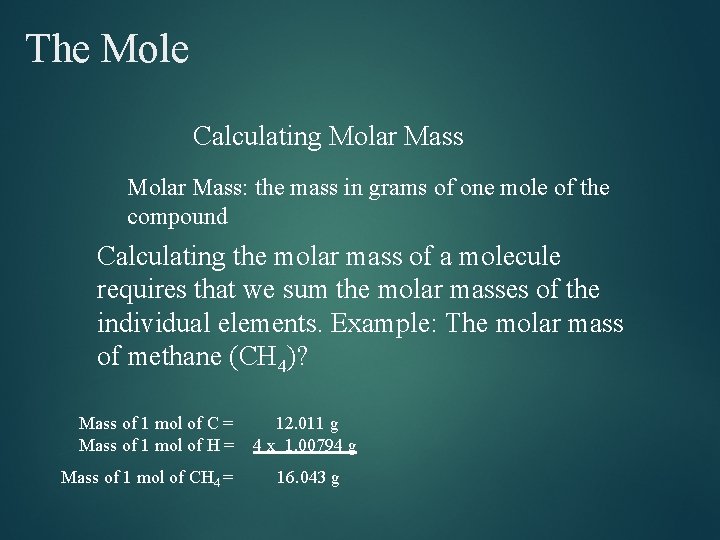
The Mole Calculating Molar Mass: the mass in grams of one mole of the compound Calculating the molar mass of a molecule requires that we sum the molar masses of the individual elements. Example: The molar mass of methane (CH 4)? Mass of 1 mol of C = Mass of 1 mol of H = Mass of 1 mol of CH 4 = 12. 011 g 4 x 1. 00794 g 16. 043 g
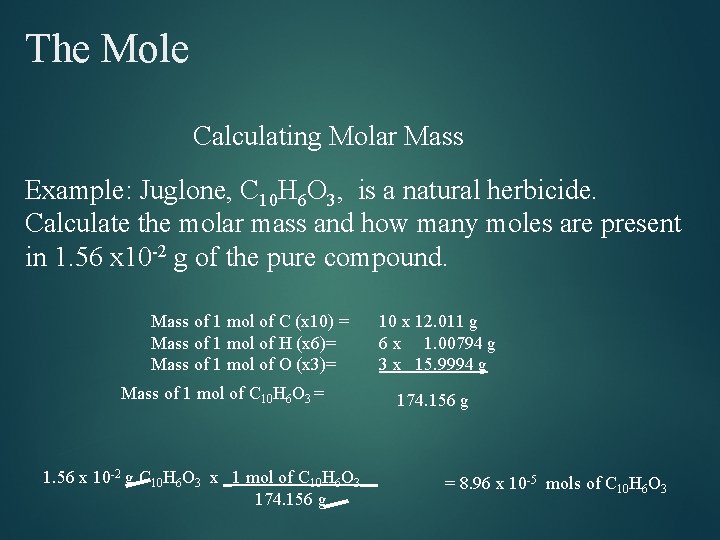
The Mole Calculating Molar Mass Example: Juglone, C 10 H 6 O 3, is a natural herbicide. Calculate the molar mass and how many moles are present in 1. 56 x 10 -2 g of the pure compound. Mass of 1 mol of C (x 10) = Mass of 1 mol of H (x 6)= Mass of 1 mol of O (x 3)= Mass of 1 mol of C 10 H 6 O 3 = 1. 56 x 10 -2 g C 10 H 6 O 3 x _1 mol of C 10 H 6 O 3__ 174. 156 g 10 x 12. 011 g 6 x 1. 00794 g 3 x 15. 9994 g 174. 156 g = 8. 96 x 10 -5 mols of C 10 H 6 O 3
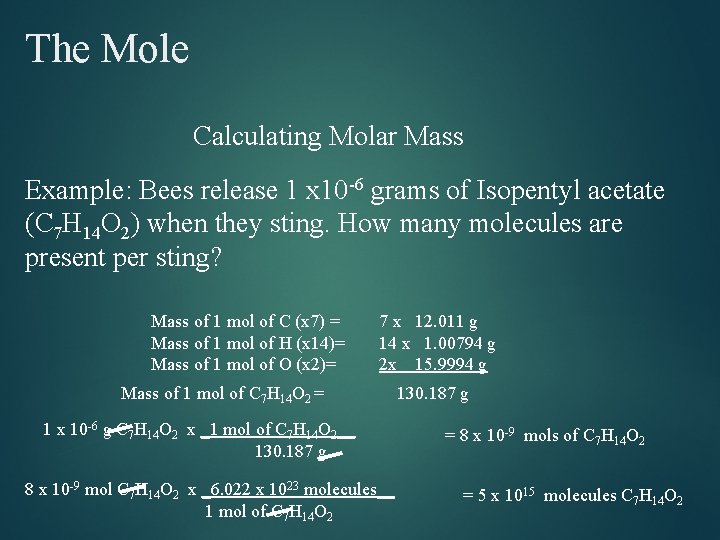
The Mole Calculating Molar Mass Example: Bees release 1 x 10 -6 grams of Isopentyl acetate (C 7 H 14 O 2) when they sting. How many molecules are present per sting? Mass of 1 mol of C (x 7) = Mass of 1 mol of H (x 14)= Mass of 1 mol of O (x 2)= 7 x 12. 011 g 14 x 1. 00794 g 2 x 15. 9994 g Mass of 1 mol of C 7 H 14 O 2 = 1 x 10 -6 g C 7 H 14 O 2 x _1 mol of C 7 H 14 O 2__ 130. 187 g 8 x 10 -9 mol C 7 H 14 O 2 x _6. 022 x 1023 molecules__ 1 mol of C 7 H 14 O 2 130. 187 g = 8 x 10 -9 mols of C 7 H 14 O 2 = 5 x 10¹⁵ molecules C 7 H 14 O 2
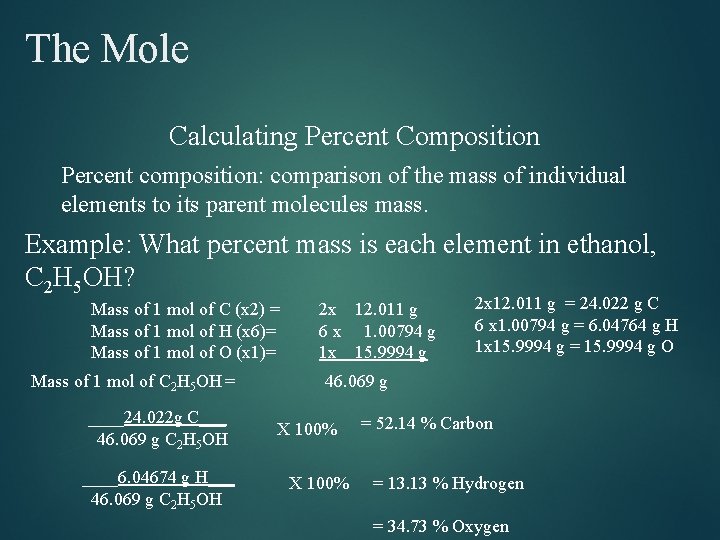
The Mole Calculating Percent Composition Percent composition: comparison of the mass of individual elements to its parent molecules mass. Example: What percent mass is each element in ethanol, C 2 H 5 OH? Mass of 1 mol of C (x 2) = Mass of 1 mol of H (x 6)= Mass of 1 mol of O (x 1)= Mass of 1 mol of C 2 H 5 OH = ____24. 022 g C___ 46. 069 g C 2 H 5 OH ____6. 04674 g H___ 46. 069 g C 2 H 5 OH 2 x 12. 011 g 6 x 1. 00794 g 1 x 15. 9994 g 2 x 12. 011 g = 24. 022 g C 6 x 1. 00794 g = 6. 04764 g H 1 x 15. 9994 g = 15. 9994 g O 46. 069 g X 100% = 52. 14 % Carbon = 13. 13 % Hydrogen = 34. 73 % Oxygen
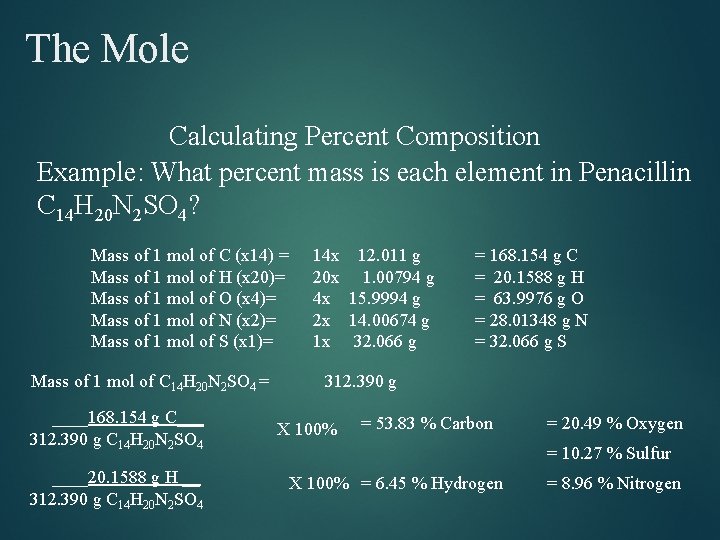
The Mole Calculating Percent Composition Example: What percent mass is each element in Penacillin C 14 H 20 N 2 SO 4? Mass of 1 mol of C (x 14) = Mass of 1 mol of H (x 20)= Mass of 1 mol of O (x 4)= Mass of 1 mol of N (x 2)= Mass of 1 mol of S (x 1)= Mass of 1 mol of C 14 H 20 N 2 SO 4 = ____168. 154 g C___ 312. 390 g C 14 H 20 N 2 SO 4 ____20. 1588 g H __ 312. 390 g C 14 H 20 N 2 SO 4 14 x 12. 011 g 20 x 1. 00794 g 4 x 15. 9994 g 2 x 14. 00674 g 1 x 32. 066 g = 168. 154 g C = 20. 1588 g H = 63. 9976 g O = 28. 01348 g N = 32. 066 g S 312. 390 g X 100% = 53. 83 % Carbon = 20. 49 % Oxygen = 10. 27 % Sulfur X 100% = 6. 45 % Hydrogen = 8. 96 % Nitrogen
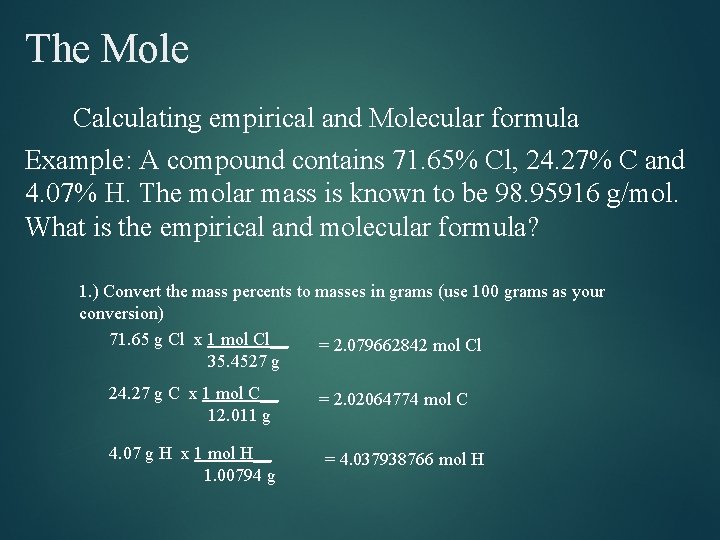
The Mole Calculating empirical and Molecular formula Example: A compound contains 71. 65% Cl, 24. 27% C and 4. 07% H. The molar mass is known to be 98. 95916 g/mol. What is the empirical and molecular formula? 1. ) Convert the mass percents to masses in grams (use 100 grams as your conversion) 71. 65 g Cl x 1 mol Cl__ = 2. 079662842 mol Cl 35. 4527 g 24. 27 g C x 1 mol C__ 12. 011 g 4. 07 g H x 1 mol H__ 1. 00794 g = 2. 02064774 mol C = 4. 037938766 mol H
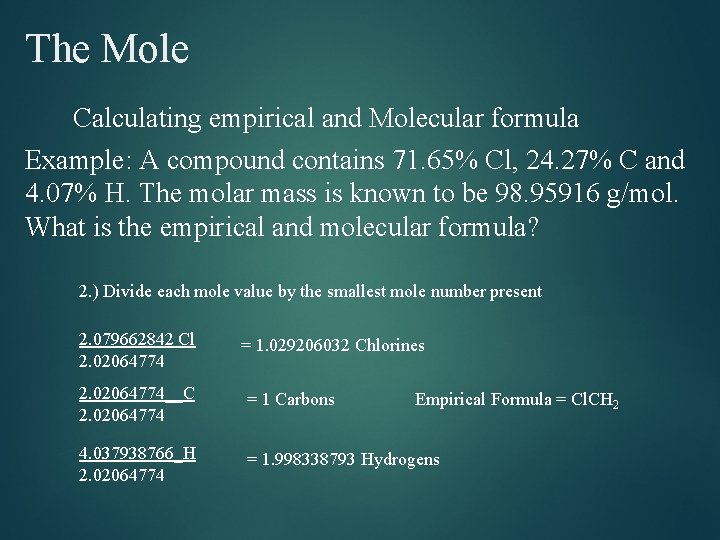
The Mole Calculating empirical and Molecular formula Example: A compound contains 71. 65% Cl, 24. 27% C and 4. 07% H. The molar mass is known to be 98. 95916 g/mol. What is the empirical and molecular formula? 2. ) Divide each mole value by the smallest mole number present 2. 079662842 Cl 2. 02064774 = 1. 029206032 Chlorines 2. 02064774__C 2. 02064774 = 1 Carbons 4. 037938766_H 2. 02064774 = 1. 998338793 Hydrogens Empirical Formula = Cl. CH 2
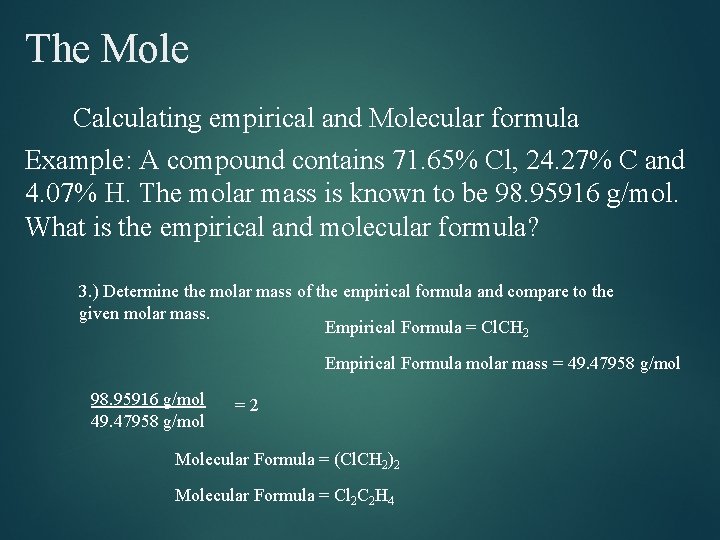
The Mole Calculating empirical and Molecular formula Example: A compound contains 71. 65% Cl, 24. 27% C and 4. 07% H. The molar mass is known to be 98. 95916 g/mol. What is the empirical and molecular formula? 3. ) Determine the molar mass of the empirical formula and compare to the given molar mass. Empirical Formula = Cl. CH 2 Empirical Formula molar mass = 49. 47958 g/mol 98. 95916 g/mol 49. 47958 g/mol =2 Molecular Formula = (Cl. CH 2)2 Molecular Formula = Cl 2 C 2 H 4
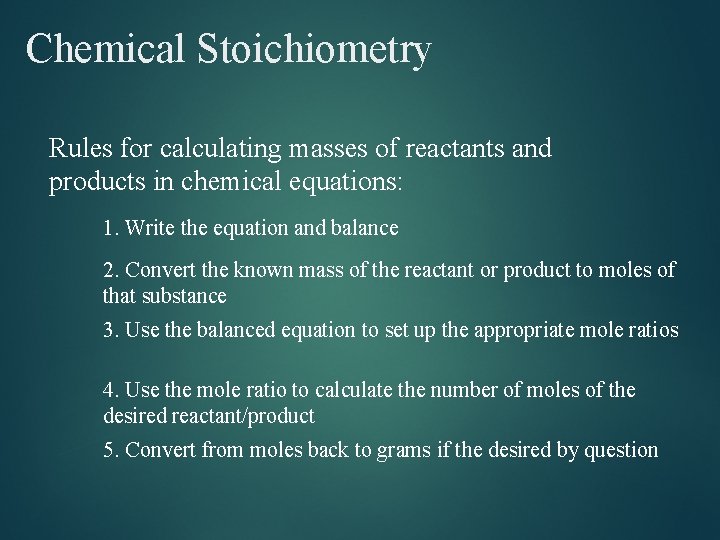
Chemical Stoichiometry Rules for calculating masses of reactants and products in chemical equations: 1. Write the equation and balance 2. Convert the known mass of the reactant or product to moles of that substance 3. Use the balanced equation to set up the appropriate mole ratios 4. Use the mole ratio to calculate the number of moles of the desired reactant/product 5. Convert from moles back to grams if the desired by question
Chemical Stoichiometry Example: Solid lithium hydroxide is used in space vehicles to remove exhaled carbon dioxide forming solid lithium carbonate and liquid water. What mass of carbon dioxide can be absorbed by 1. 00 kg of lithium hydroxide? Step 1: Write the equation and balance 2 Li. OH(s) + CO 2(g) Li 2 CO 3(s) + H 2 O(l) Step 2: Convert the mass of Li. OH to moles 1. 00 kg Li. OH 1000 g Li. OH 1 mol Li. OH x x 1 1. 00 kg Li. OH 23. 948 g Li. OH = 41. 8 moles of Li. OH
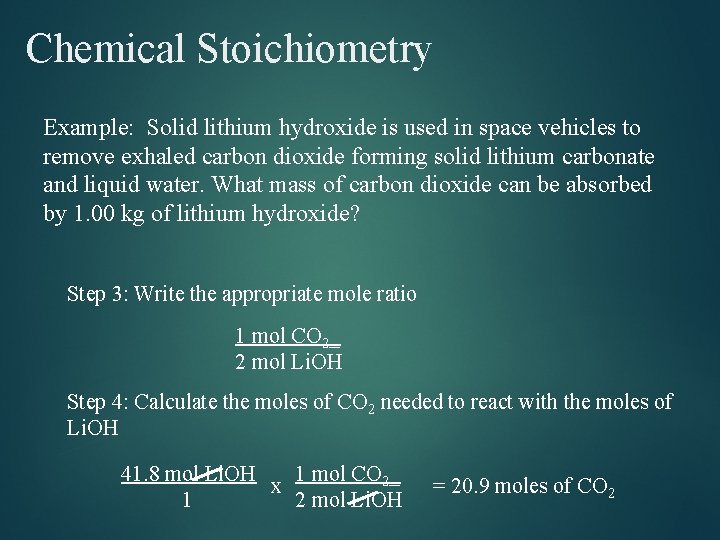
Chemical Stoichiometry Example: Solid lithium hydroxide is used in space vehicles to remove exhaled carbon dioxide forming solid lithium carbonate and liquid water. What mass of carbon dioxide can be absorbed by 1. 00 kg of lithium hydroxide? Step 3: Write the appropriate mole ratio 1 mol CO 2_ 2 mol Li. OH Step 4: Calculate the moles of CO 2 needed to react with the moles of Li. OH 41. 8 mol Li. OH 1 mol CO 2_ x 1 2 mol Li. OH = 20. 9 moles of CO 2
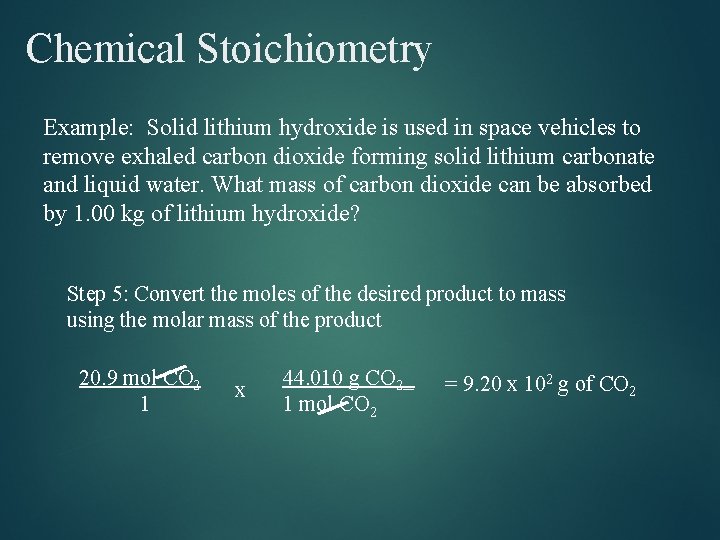
Chemical Stoichiometry Example: Solid lithium hydroxide is used in space vehicles to remove exhaled carbon dioxide forming solid lithium carbonate and liquid water. What mass of carbon dioxide can be absorbed by 1. 00 kg of lithium hydroxide? Step 5: Convert the moles of the desired product to mass using the molar mass of the product 20. 9 mol CO 2 1 x 44. 010 g CO 2_ 1 mol CO 2 = 9. 20 x 102 g of CO 2
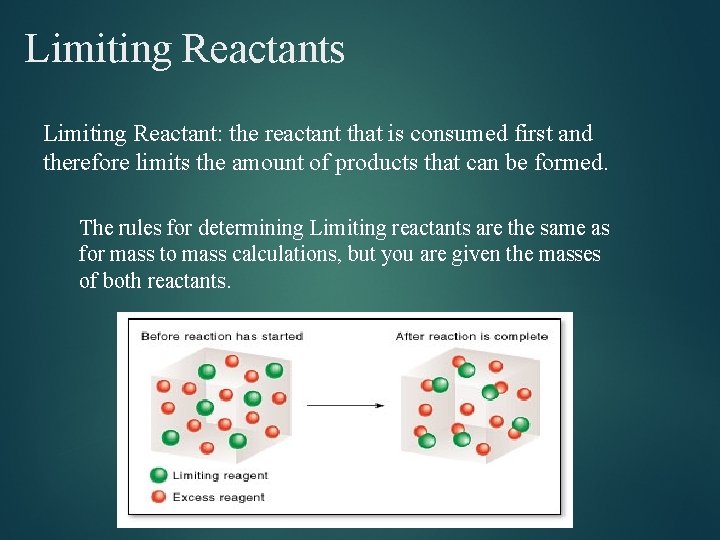
Limiting Reactants Limiting Reactant: the reactant that is consumed first and therefore limits the amount of products that can be formed. The rules for determining Limiting reactants are the same as for mass to mass calculations, but you are given the masses of both reactants.
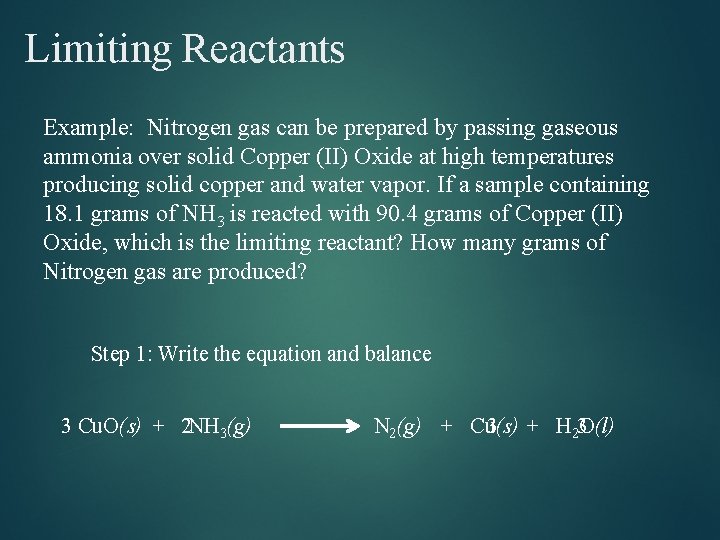
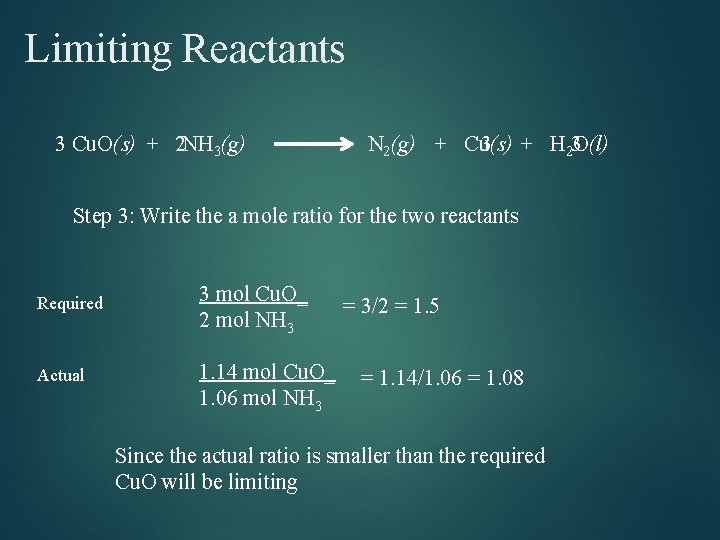
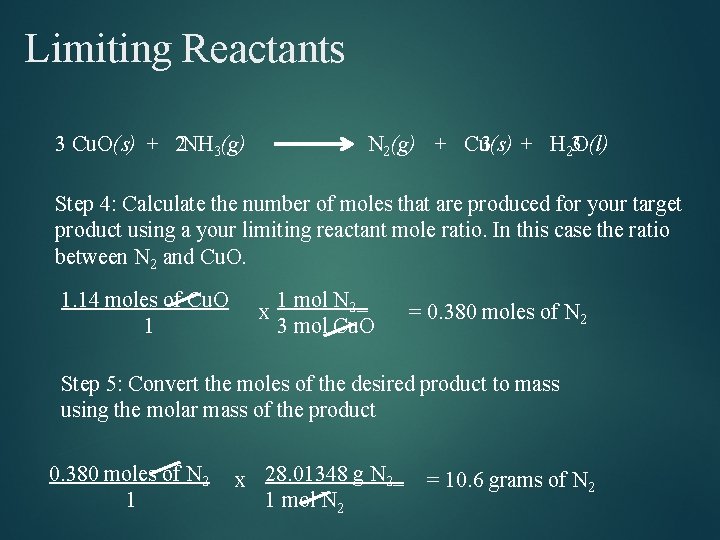
Limiting Reactants Example: Nitrogen gas can be prepared by passing gaseous ammonia over solid Copper (II) Oxide at high temperatures producing solid copper and water vapor. If a sample containing 18. 1 grams of NH 3 is reacted with 90. 4 grams of Copper (II) Oxide, which is the limiting reactant? How many grams of Nitrogen gas are produced? Step 1: Write the equation and balance 3 Cu. O(s) + 2 NH 3(g) N 2(g) + Cu(s) 3 + H 23 O(l)
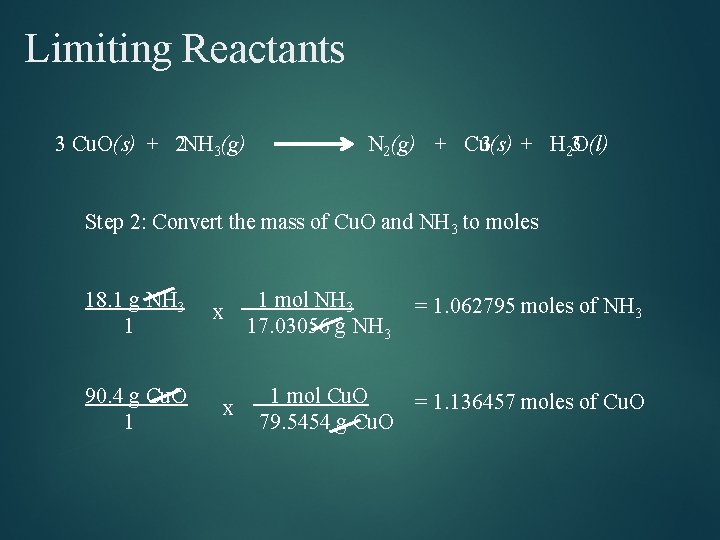
Limiting Reactants 3 Cu. O(s) + 2 NH 3(g) N 2(g) + Cu(s) 3 + H 23 O(l) Step 2: Convert the mass of Cu. O and NH 3 to moles 18. 1 g NH 3 1 90. 4 g Cu. O 1 x x 1 mol NH 3 17. 03056 g NH 3 = 1. 062795 moles of NH 3 1 mol Cu. O = 1. 136457 moles of Cu. O 79. 5454 g Cu. O
Limiting Reactants 3 Cu. O(s) + 2 NH 3(g) N 2(g) + Cu(s) 3 + H 23 O(l) Step 3: Write the a mole ratio for the two reactants Required Actual 3 mol Cu. O_ 2 mol NH 3 1. 14 mol Cu. O_ 1. 06 mol NH 3 = 3/2 = 1. 5 = 1. 14/1. 06 = 1. 08 Since the actual ratio is smaller than the required Cu. O will be limiting
Limiting Reactants 3 Cu. O(s) + 2 NH 3(g) N 2(g) + Cu(s) 3 + H 23 O(l) Step 4: Calculate the number of moles that are produced for your target product using a your limiting reactant mole ratio. In this case the ratio between N 2 and Cu. O. 1. 14 moles of Cu. O 1 x 1 mol N 2_ 3 mol Cu. O = 0. 380 moles of N 2 Step 5: Convert the moles of the desired product to mass using the molar mass of the product 0. 380 moles of N 2 1 x 28. 01348 g N 2_ 1 mol N 2 = 10. 6 grams of N 2