
Stoichiometry Theory of the proportions in which chemical

- Slides: 14
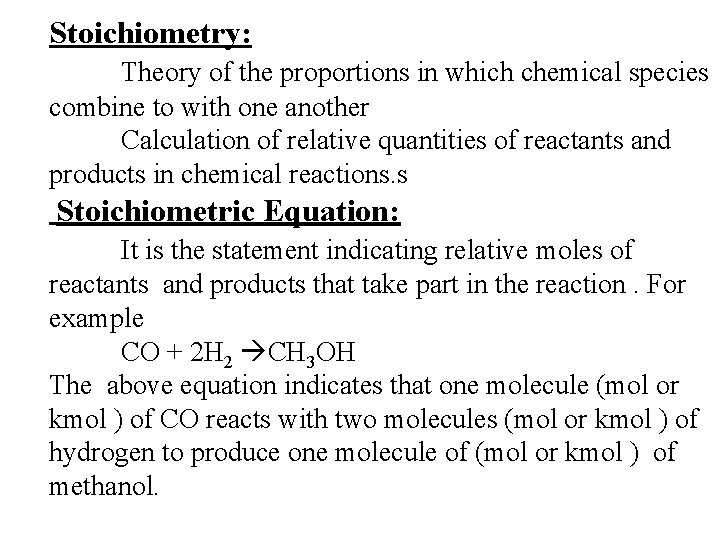
Stoichiometry: Theory of the proportions in which chemical species combine to with one another Calculation of relative quantities of reactants and products in chemical reactions. s Stoichiometric Equation: It is the statement indicating relative moles of reactants and products that take part in the reaction. For example CO + 2 H 2 CH 3 OH The above equation indicates that one molecule (mol or kmol ) of CO reacts with two molecules (mol or kmol ) of hydrogen to produce one molecule of (mol or kmol ) of methanol.
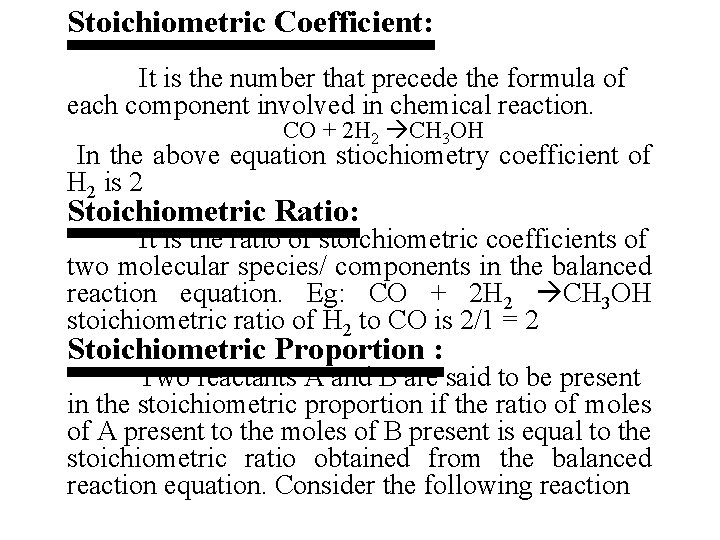
Stoichiometric Coefficient: It is the number that precede the formula of each component involved in chemical reaction. CO + 2 H 2 CH 3 OH In the above equation stiochiometry coefficient of H 2 is 2 Stoichiometric Ratio: It is the ratio of stoichiometric coefficients of two molecular species/ components in the balanced reaction equation. Eg: CO + 2 H 2 CH 3 OH stoichiometric ratio of H 2 to CO is 2/1 = 2 Stoichiometric Proportion : Two reactants A and B are said to be present in the stoichiometric proportion if the ratio of moles of A present to the moles of B present is equal to the stoichiometric ratio obtained from the balanced reaction equation. Consider the following reaction
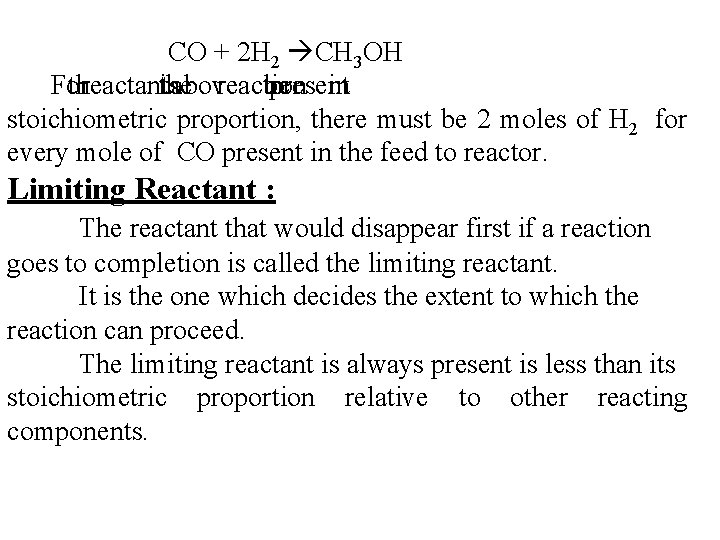
CO + 2 H 2 CH 3 OH For the reactants in the above reaction to be present in stoichiometric proportion, there must be 2 moles of H 2 for every mole of CO present in the feed to reactor. Limiting Reactant : The reactant that would disappear first if a reaction goes to completion is called the limiting reactant. It is the one which decides the extent to which the reaction can proceed. The limiting reactant is always present is less than its stoichiometric proportion relative to other reacting components.
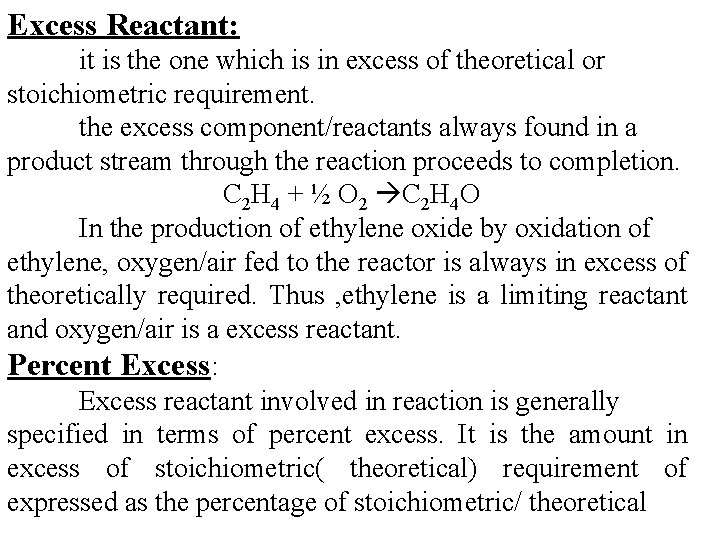
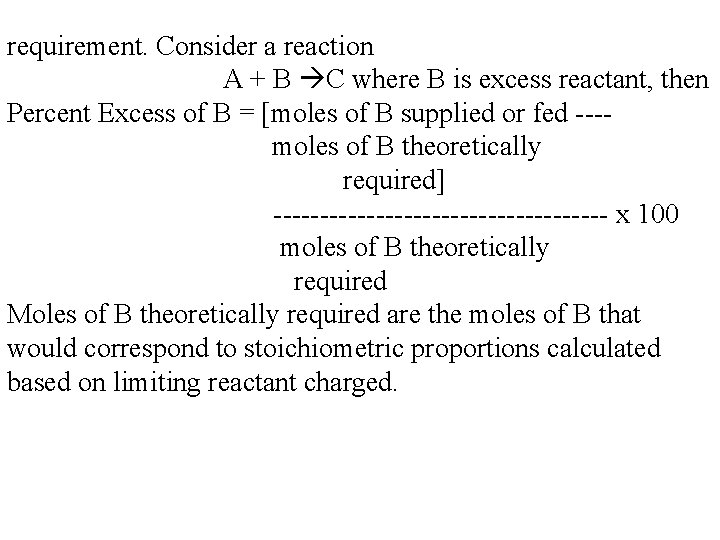
Excess Reactant: it is the one which is in excess of theoretical or stoichiometric requirement. the excess component/reactants always found in a product stream through the reaction proceeds to completion. C 2 H 4 + ½ O 2 C 2 H 4 O In the production of ethylene oxide by oxidation of ethylene, oxygen/air fed to the reactor is always in excess of theoretically required. Thus , ethylene is a limiting reactant and oxygen/air is a excess reactant. Percent Excess: Excess reactant involved in reaction is generally specified in terms of percent excess. It is the amount in excess of stoichiometric( theoretical) requirement of expressed as the percentage of stoichiometric/ theoretical
requirement. Consider a reaction A + B C where B is excess reactant, then Percent Excess of B = [moles of B supplied or fed ---moles of B theoretically required] ------------------ x 100 moles of B theoretically required Moles of B theoretically required are the moles of B that would correspond to stoichiometric proportions calculated based on limiting reactant charged.
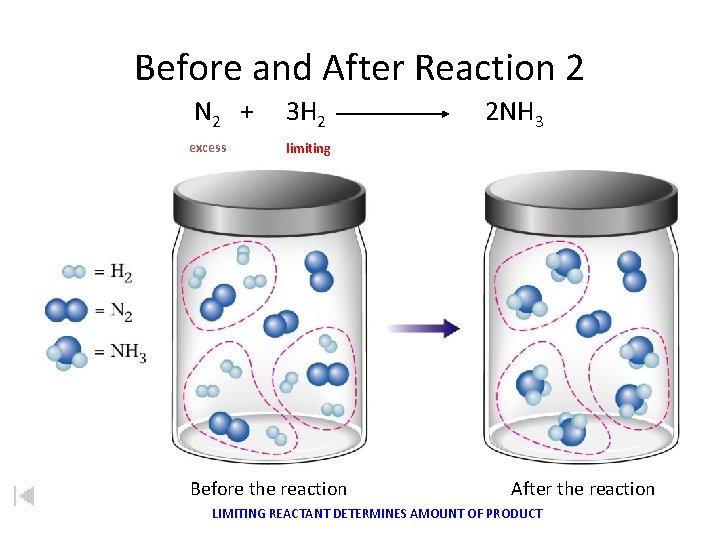
Before and After Reaction 2 N 2 + excess 3 H 2 2 NH 3 limiting Before the reaction After the reaction LIMITING REACTANT DETERMINES AMOUNT OF PRODUCT
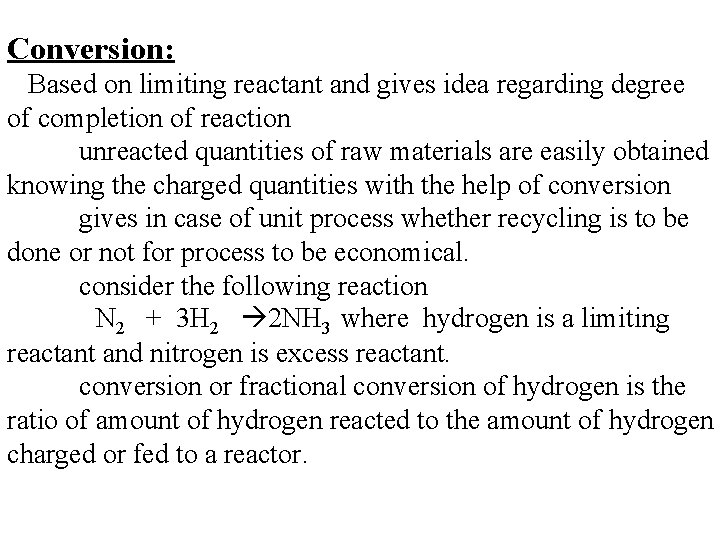
Conversion: Based on limiting reactant and gives idea regarding degree of completion of reaction unreacted quantities of raw materials are easily obtained knowing the charged quantities with the help of conversion gives in case of unit process whether recycling is to be done or not for process to be economical. consider the following reaction N 2 + 3 H 2 2 NH 3 where hydrogen is a limiting reactant and nitrogen is excess reactant. conversion or fractional conversion of hydrogen is the ratio of amount of hydrogen reacted to the amount of hydrogen charged or fed to a reactor.
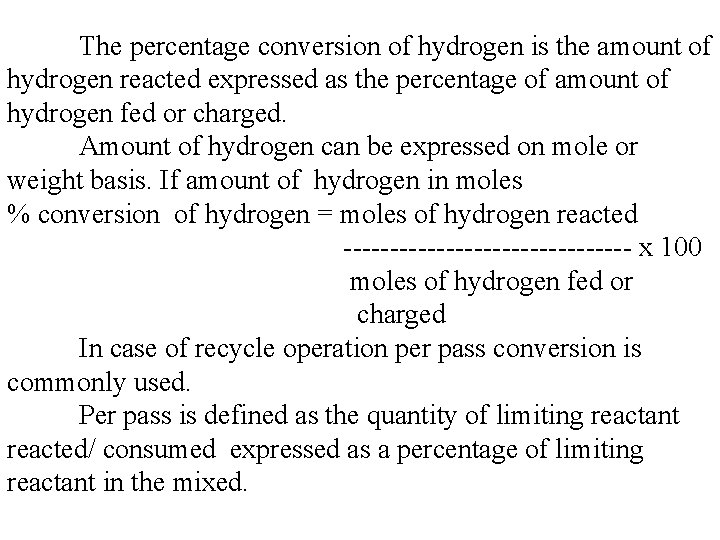
The percentage conversion of hydrogen is the amount of hydrogen reacted expressed as the percentage of amount of hydrogen fed or charged. Amount of hydrogen can be expressed on mole or weight basis. If amount of hydrogen in moles % conversion of hydrogen = moles of hydrogen reacted ---------------- x 100 moles of hydrogen fed or charged In case of recycle operation per pass conversion is commonly used. Per pass is defined as the quantity of limiting reactant reacted/ consumed expressed as a percentage of limiting reactant in the mixed.
Yield and Selectivity:
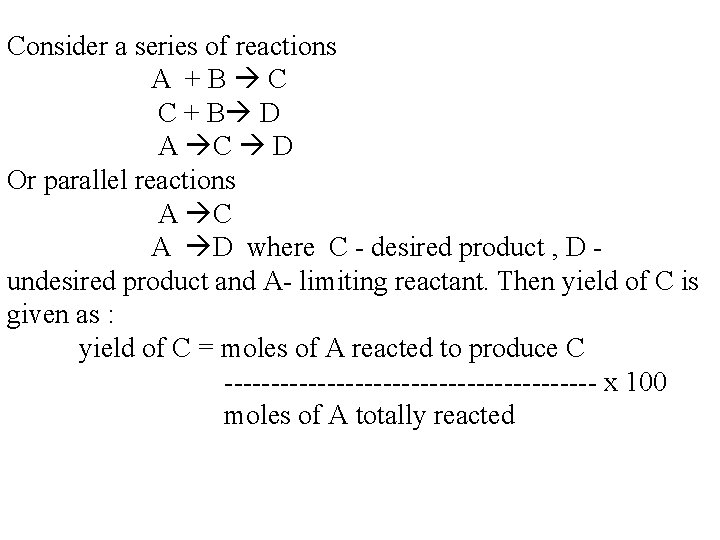
Consider a series of reactions A +B C C + B D A C D Or parallel reactions A C A D where C - desired product , D undesired product and A- limiting reactant. Then yield of C is given as : yield of C = moles of A reacted to produce C -------------------- x 100 moles of A totally reacted
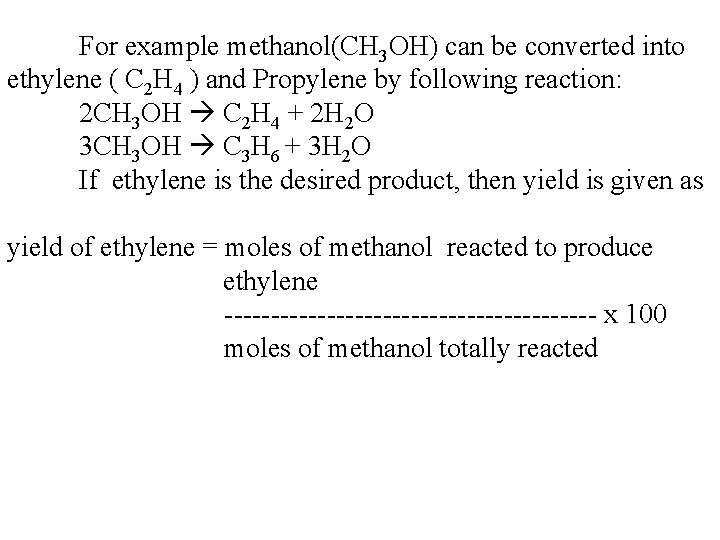
For example methanol(CH 3 OH) can be converted into ethylene ( C 2 H 4 ) and Propylene by following reaction: 2 CH 3 OH C 2 H 4 + 2 H 2 O 3 CH 3 OH C 3 H 6 + 3 H 2 O If ethylene is the desired product, then yield is given as yield of ethylene = moles of methanol reacted to produce ethylene -------------------- x 100 moles of methanol totally reacted
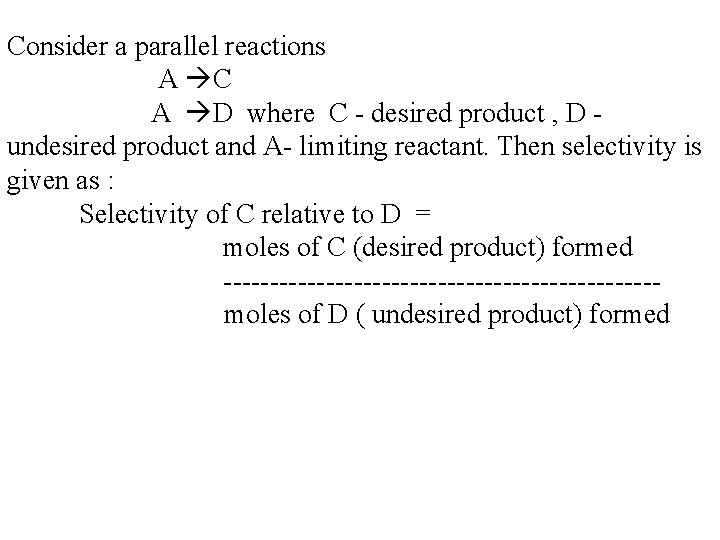
Consider a parallel reactions A C A D where C - desired product , D undesired product and A- limiting reactant. Then selectivity is given as : Selectivity of C relative to D = moles of C (desired product) formed -----------------------moles of D ( undesired product) formed
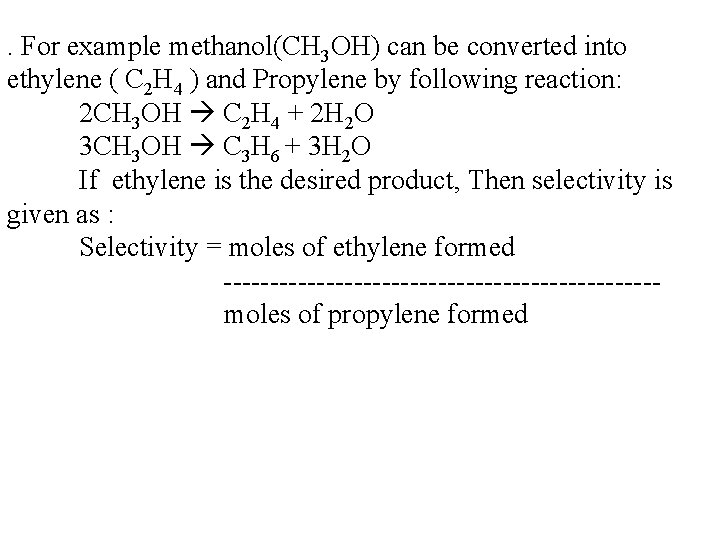
. For example methanol(CH 3 OH) can be converted into ethylene ( C 2 H 4 ) and Propylene by following reaction: 2 CH 3 OH C 2 H 4 + 2 H 2 O 3 CH 3 OH C 3 H 6 + 3 H 2 O If ethylene is the desired product, Then selectivity is given as : Selectivity = moles of ethylene formed -----------------------moles of propylene formed