
Stoichiometry StoichiometryWhat is it 2 types Composition stoichiometrydeals
- Slides: 18
Stoichiometry
Stoichiometry—What is it? ? 2 types ◦ Composition stoichiometry—deals with the mass relationships of elements in compounds. ◦ Reaction stoichiometry—involves mass relationships between the reactants and products in a reaction. ◦ We assume a reaction will happen until one of the reactants is completely used up.
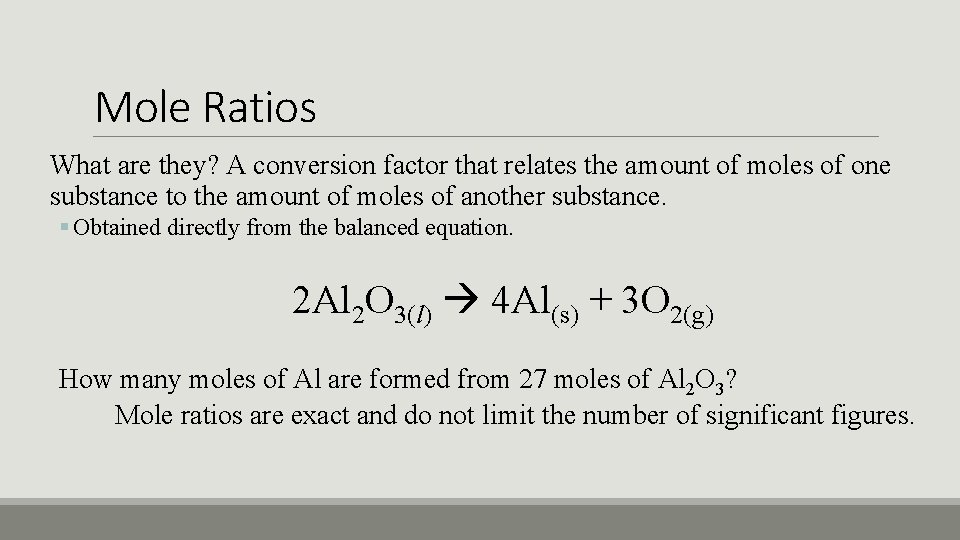
Mole Ratios What are they? A conversion factor that relates the amount of moles of one substance to the amount of moles of another substance. § Obtained directly from the balanced equation. 2 Al 2 O 3(l) 4 Al(s) + 3 O 2(g) How many moles of Al are formed from 27 moles of Al 2 O 3? Mole ratios are exact and do not limit the number of significant figures.
Importance of Mole Ratios • Calculations of the amount of reactants • Can determine how much to use to get a certain amount of product • Can determine how much can be produced from the amount of reactants present
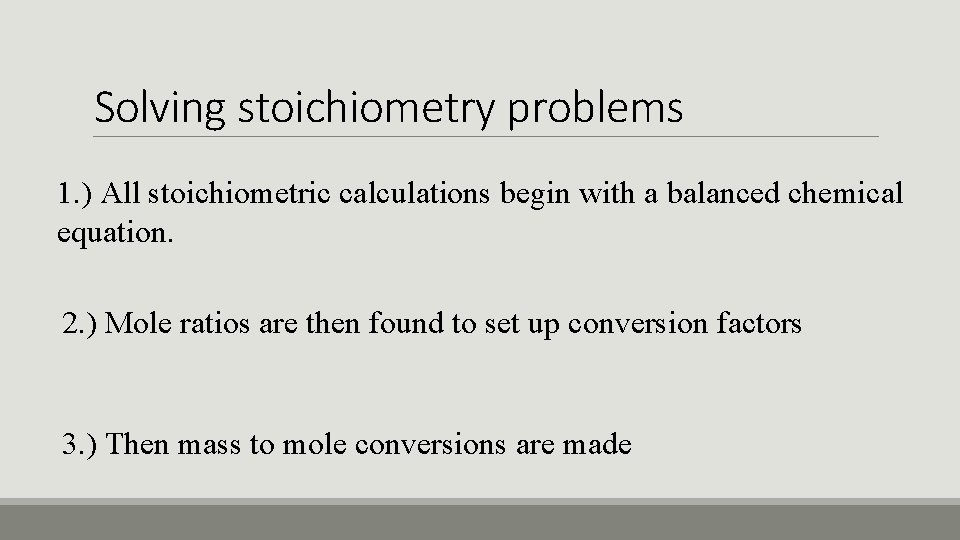
Solving stoichiometry problems 1. ) All stoichiometric calculations begin with a balanced chemical equation. 2. ) Mole ratios are then found to set up conversion factors 3. ) Then mass to mole conversions are made
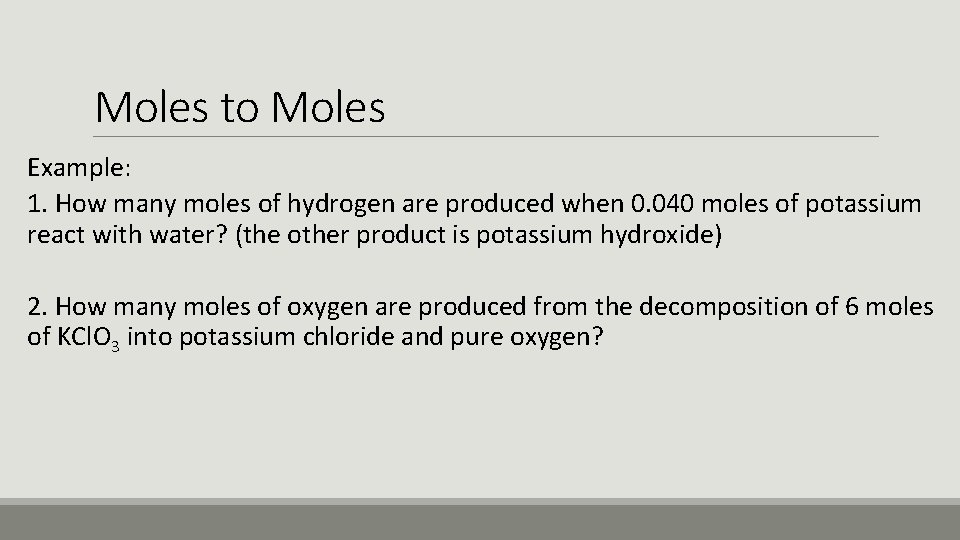
Moles to Moles Example: 1. How many moles of hydrogen are produced when 0. 040 moles of potassium react with water? (the other product is potassium hydroxide) 2. How many moles of oxygen are produced from the decomposition of 6 moles of KCl. O 3 into potassium chloride and pure oxygen?
Mole to Mass Example: What mass of sodium chloride will be produced when 1. 25 moles of chlorine gas reacts with sodium?
Mass to Mass Example: What mass of water is produced from the decomposition of 25. 00 g of solid ammonium hydroxide (by-product is ammonia, NH 3)
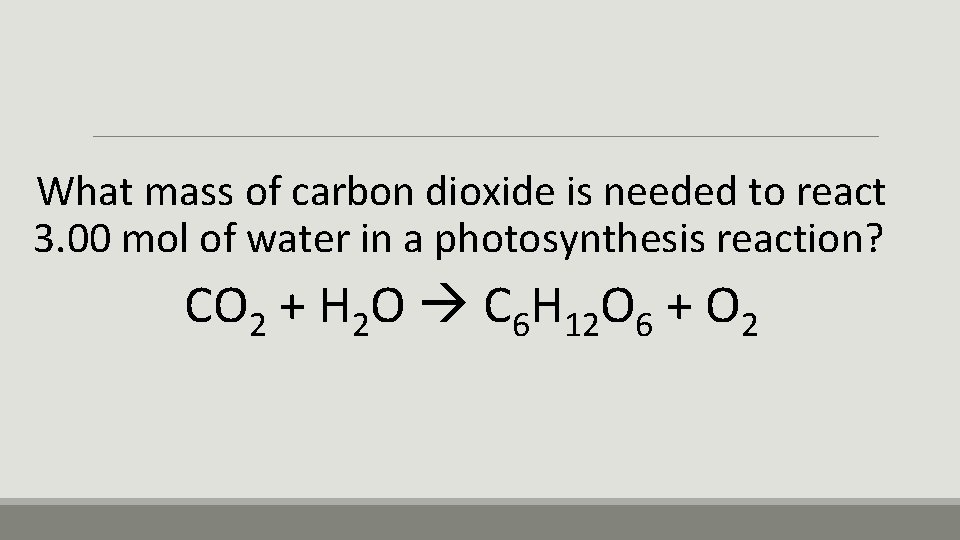
What mass of carbon dioxide is needed to react 3. 00 mol of water in a photosynthesis reaction? CO 2 + H 2 O C 6 H 12 O 6 + O 2
Limiting Reagents Limiting Reagent—the reactant that is used up completely in a reaction and dictates the amount of products formed. Excess Reagent—The substance that is not used up completely in a reaction.
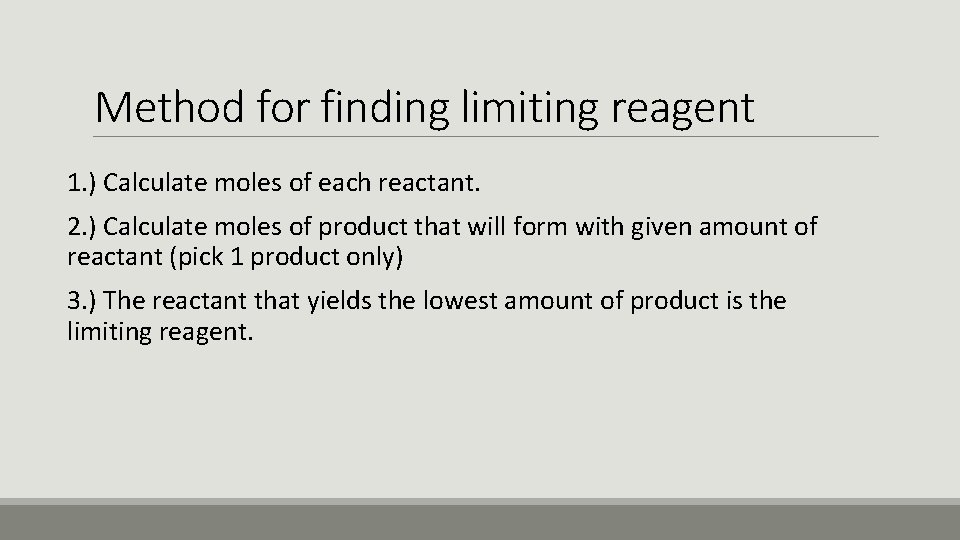
Method for finding limiting reagent 1. ) Calculate moles of each reactant. 2. ) Calculate moles of product that will form with given amount of reactant (pick 1 product only) 3. ) The reactant that yields the lowest amount of product is the limiting reagent.
Practice Silicon dioxide (quartz) reacts readily with hydrofluoric acid to produce silicon tetrafluoride and water. If 6. 0 mol of hydrofluoric acid is added to 4. 5 mol of silicon dioxide, what is the limiting reagent?
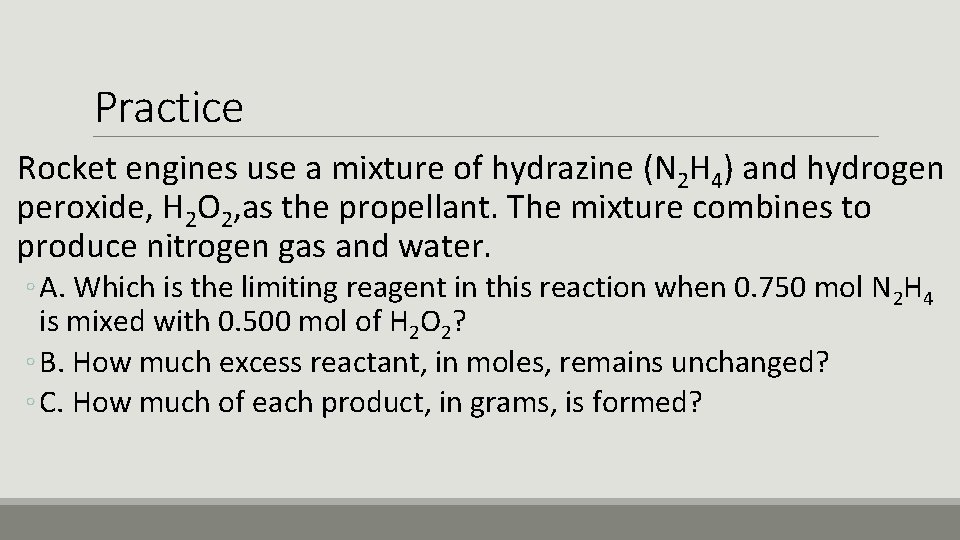
Practice Rocket engines use a mixture of hydrazine (N 2 H 4) and hydrogen peroxide, H 2 O 2, as the propellant. The mixture combines to produce nitrogen gas and water. ◦ A. Which is the limiting reagent in this reaction when 0. 750 mol N 2 H 4 is mixed with 0. 500 mol of H 2 O 2? ◦ B. How much excess reactant, in moles, remains unchanged? ◦ C. How much of each product, in grams, is formed?
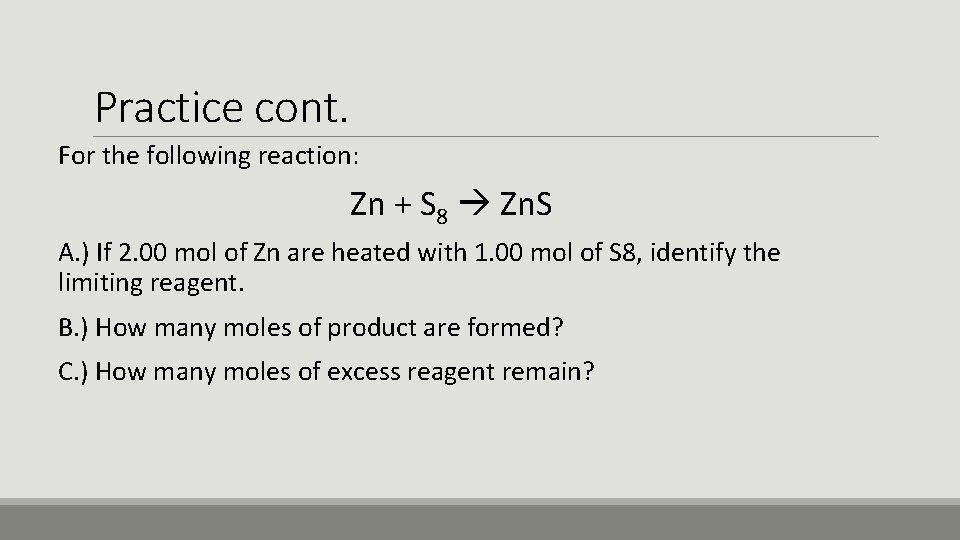
Practice cont. For the following reaction: Zn + S 8 Zn. S A. ) If 2. 00 mol of Zn are heated with 1. 00 mol of S 8, identify the limiting reagent. B. ) How many moles of product are formed? C. ) How many moles of excess reagent remain?
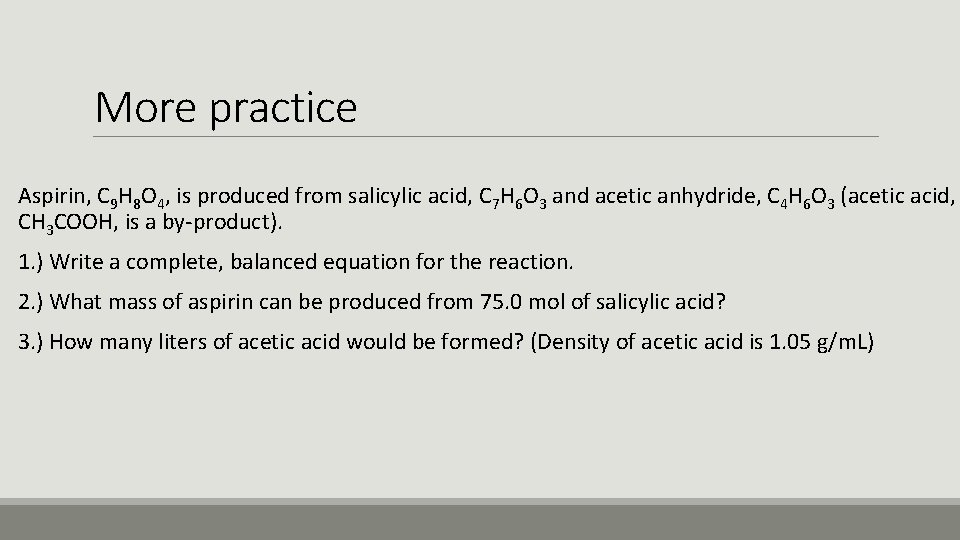
More practice Aspirin, C 9 H 8 O 4, is produced from salicylic acid, C 7 H 6 O 3 and acetic anhydride, C 4 H 6 O 3 (acetic acid, CH 3 COOH, is a by-product). 1. ) Write a complete, balanced equation for the reaction. 2. ) What mass of aspirin can be produced from 75. 0 mol of salicylic acid? 3. ) How many liters of acetic acid would be formed? (Density of acetic acid is 1. 05 g/m. L)
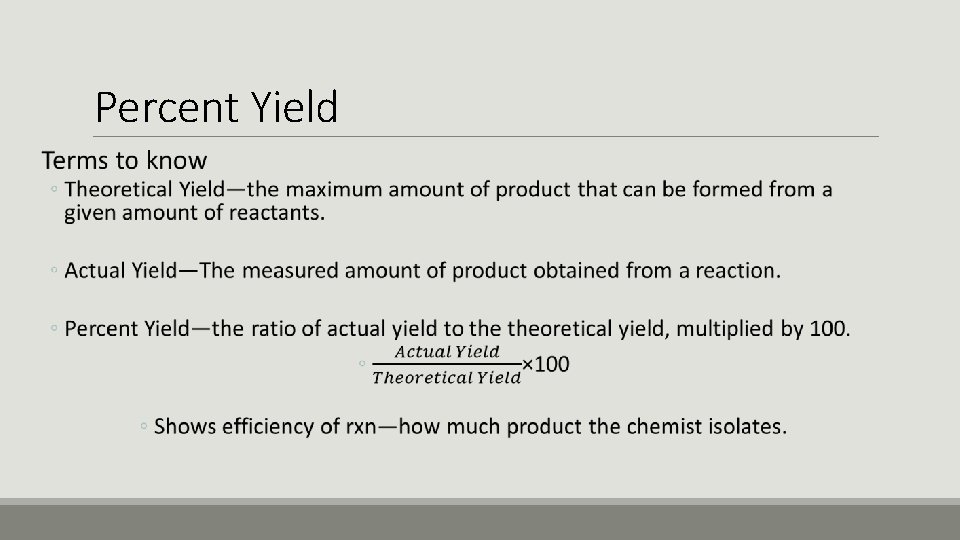
Percent Yield
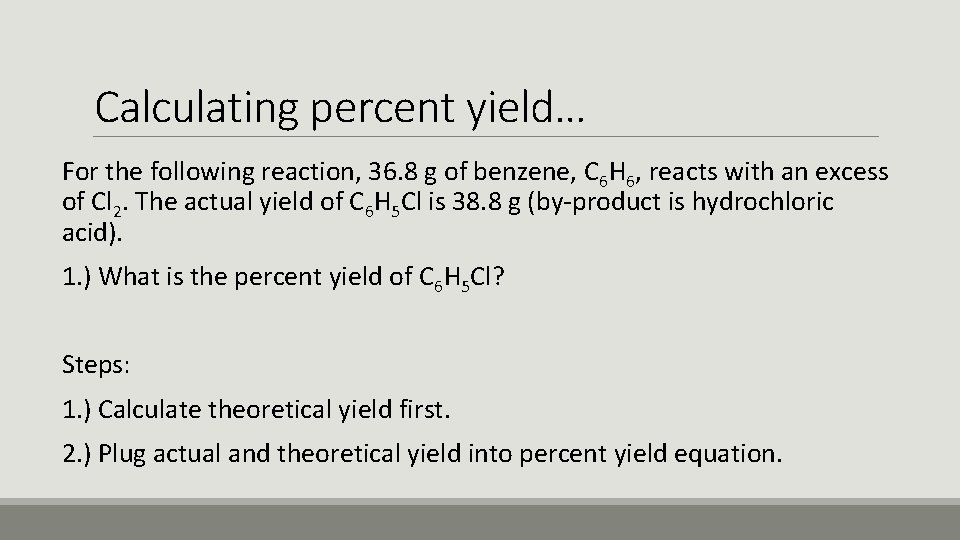
Calculating percent yield… For the following reaction, 36. 8 g of benzene, C 6 H 6, reacts with an excess of Cl 2. The actual yield of C 6 H 5 Cl is 38. 8 g (by-product is hydrochloric acid). 1. ) What is the percent yield of C 6 H 5 Cl? Steps: 1. ) Calculate theoretical yield first. 2. ) Plug actual and theoretical yield into percent yield equation.
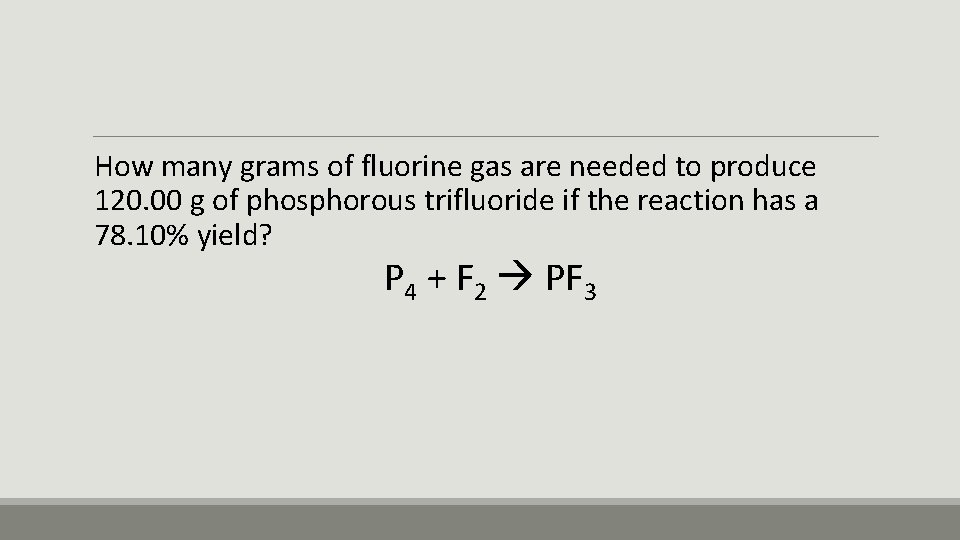
How many grams of fluorine gas are needed to produce 120. 00 g of phosphorous trifluoride if the reaction has a 78. 10% yield? P 4 + F 2 PF 3