
STOICHIOMETRY Reaction Stoichiometry Stoichiometrical Calculations Limiting Reagents Percent


- Slides: 35
STOICHIOMETRY Reaction Stoichiometry Stoichiometrical Calculations Limiting Reagents Percent Yield
Test Analysis: Unit 6 You need your bubble sheet and the half sheet You also need TWO COLORS to color it in!
Let’s review MOLES Before we can start, we need to remember basic mole and mole conversions. We will ALL be practicing , so you need to get out a pencil, periodic table, calculator, and your notebook/paper
Reaction Stoichiometry Reaction stoichiometry is the study of the amount of substances produced and consumed in chemical reactions. Calculations are carried out step-bystep using dimensional analysis.
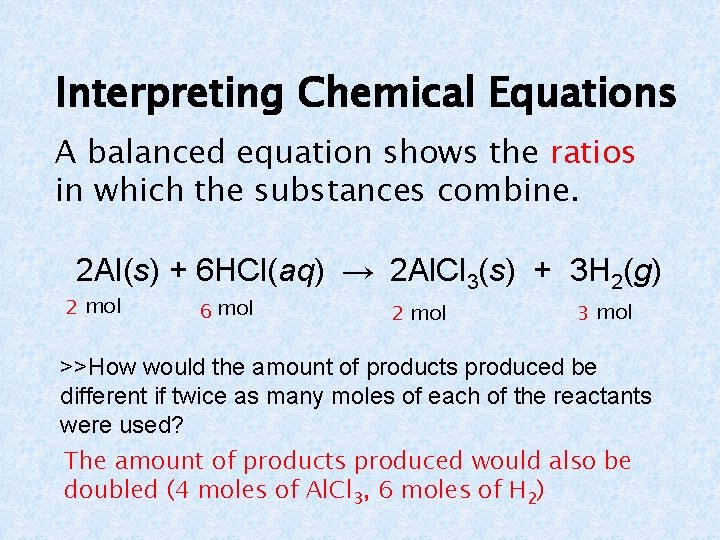
Interpreting Chemical Equations A balanced equation shows the ratios in which the substances combine. 2 Al(s) + 6 HCl(aq) → 2 Al. Cl 3(s) + 3 H 2(g) 2 mol 6 mol 2 mol 3 mol >>How would the amount of products produced be different if twice as many moles of each of the reactants were used? The amount of products produced would also be doubled (4 moles of Al. Cl 3, 6 moles of H 2)
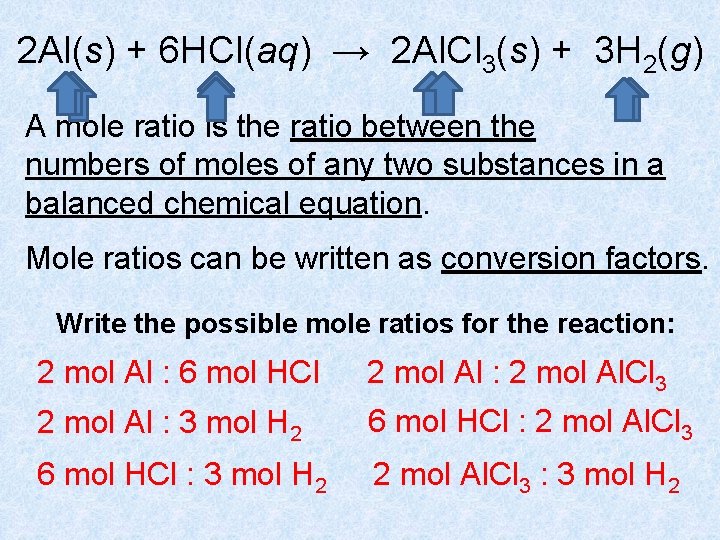
2 Al(s) + 6 HCl(aq) → 2 Al. Cl 3(s) + 3 H 2(g) A mole ratio is the ratio between the numbers of moles of any two substances in a balanced chemical equation. Mole ratios can be written as conversion factors. Write the possible mole ratios for the reaction: 2 mol Al : 6 mol HCl 2 mol Al : 2 mol Al. Cl 3 2 mol Al : 3 mol H 2 6 mol HCl : 2 mol Al. Cl 3 6 mol HCl : 3 mol H 2 2 mol Al. Cl 3 : 3 mol H 2
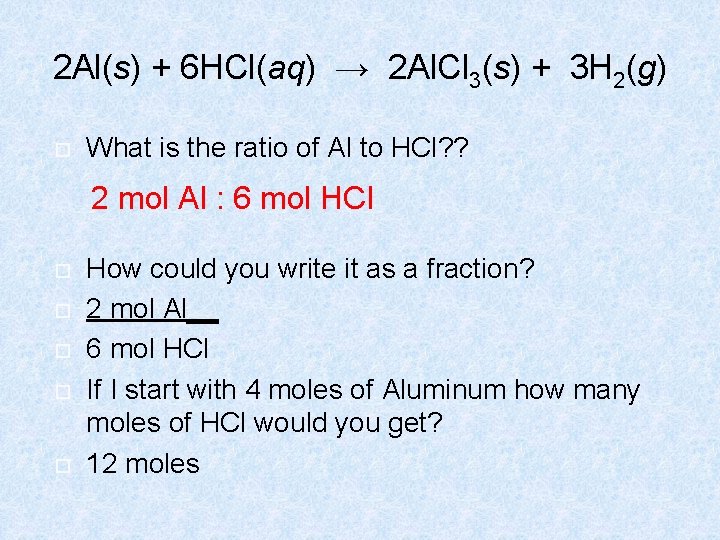
2 Al(s) + 6 HCl(aq) → 2 Al. Cl 3(s) + 3 H 2(g) What is the ratio of Al to HCl? ? 2 mol Al : 6 mol HCl How could you write it as a fraction? 2 mol Al__ 6 mol HCl If I start with 4 moles of Aluminum how many moles of HCl would you get? 12 moles
Mole Ratios Comparing moles of one substance to moles of another substance You must balance the equation FIRST, then compare the coefficients. Practice with me!!!!
Agenda : • You need a laptop for today’s quiz • Website: www. socrative. com • Room code: KILBANESTP • You need to complete 10 questions over conversions. You are turning this in. Use your notes from last time, however, this should be REVIEW. This is not the only thing we are doing today. • After the quiz, get ready for notes! Woohoo! • We will cover: • What is stoichiometry? • Mole-to-mole conversions • Multi-step mole conversions
Agenda : • You need a laptop for today’s quiz • Website: www. socrative. com • Room code: KILBANESTP • After the quiz, get ready for notes! Woohoo! • We will cover: • What is stoichiometry? • Mole-to-mole conversions • Multi-step mole conversions
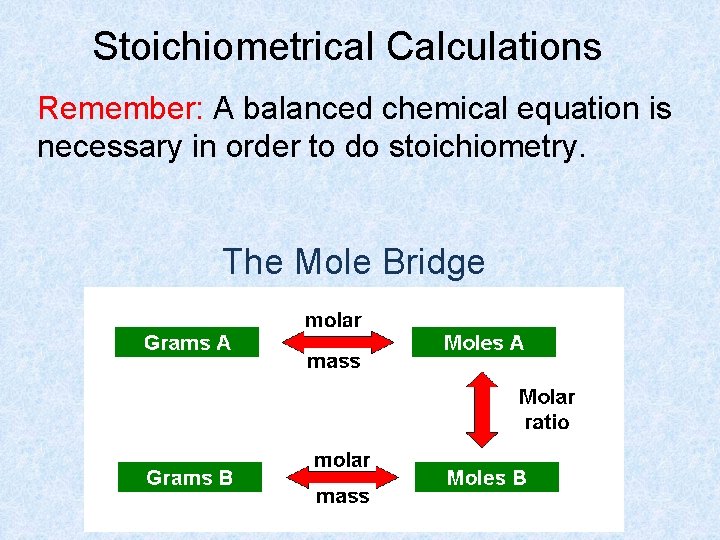
Stoichiometrical Calculations Remember: A balanced chemical equation is necessary in order to do stoichiometry. The Mole Bridge
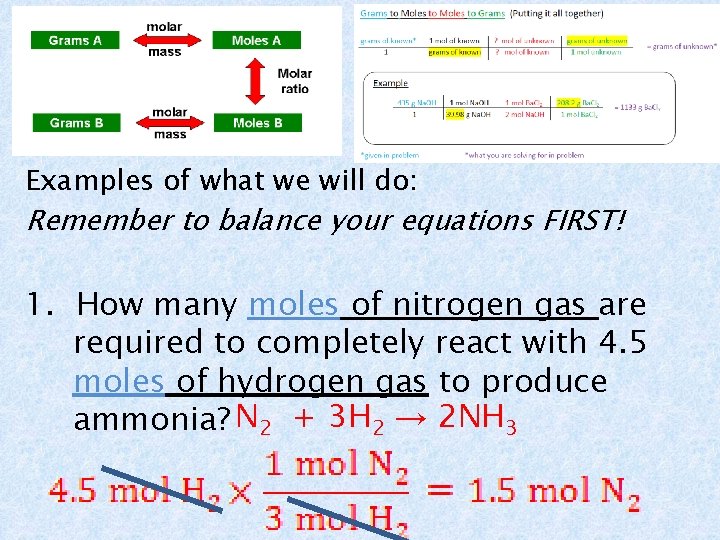
Examples of what we will do: Remember to balance your equations FIRST! 1. How many moles of nitrogen gas are required to completely react with 4. 5 moles of hydrogen gas to produce ammonia? N 2 + 3 H 2 → 2 NH 3
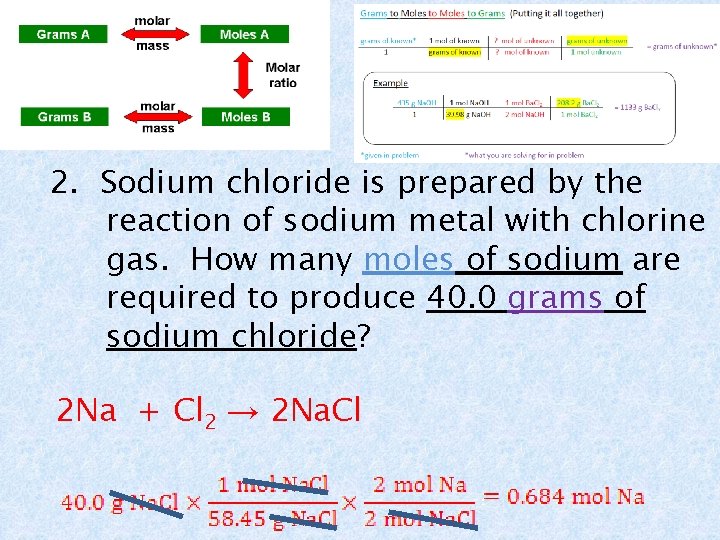
2. Sodium chloride is prepared by the reaction of sodium metal with chlorine gas. How many moles of sodium are required to produce 40. 0 grams of sodium chloride? 2 Na + Cl 2 → 2 Na. Cl
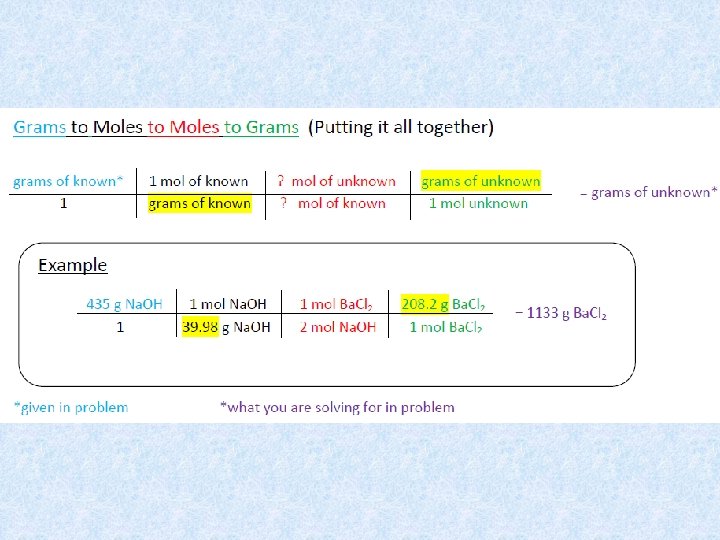
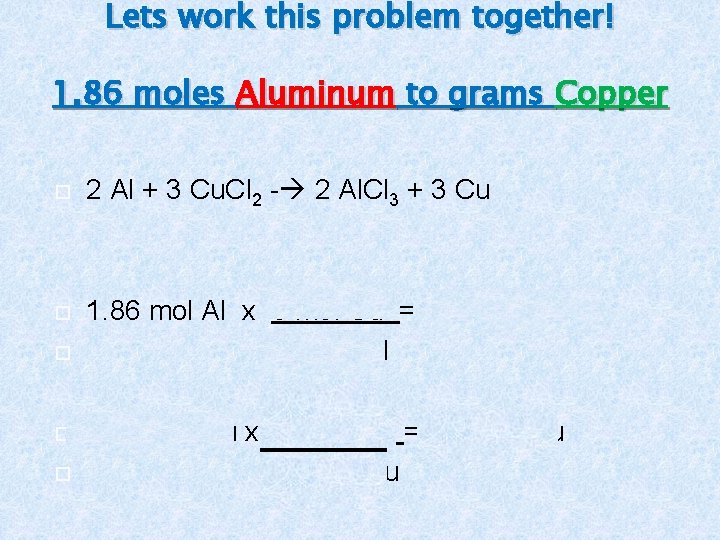
Lets work this problem together! 1. 86 moles Aluminum to grams Copper 2 Al + 3 Cu. Cl 2 - 2 Al. Cl 3 + 3 Cu 1. 86 mol Al x 3 mol Cu = 2. 79 mol Cu 2 mol Al 2. 79 mol Cu x 63. 5 g Cu = 177. 2 g Cu 1 mol Cu
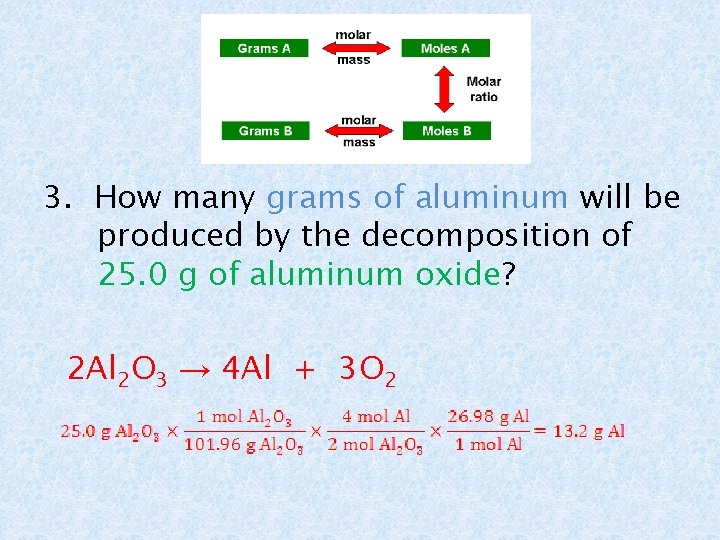
3. How many grams of aluminum will be produced by the decomposition of 25. 0 g of aluminum oxide? 2 Al 2 O 3 → 4 Al + 3 O 2
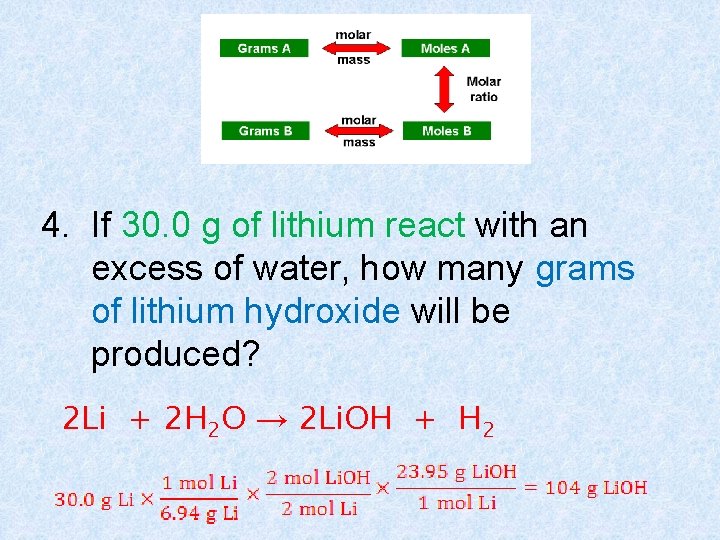
4. If 30. 0 g of lithium react with an excess of water, how many grams of lithium hydroxide will be produced? 2 Li + 2 H 2 O → 2 Li. OH + H 2
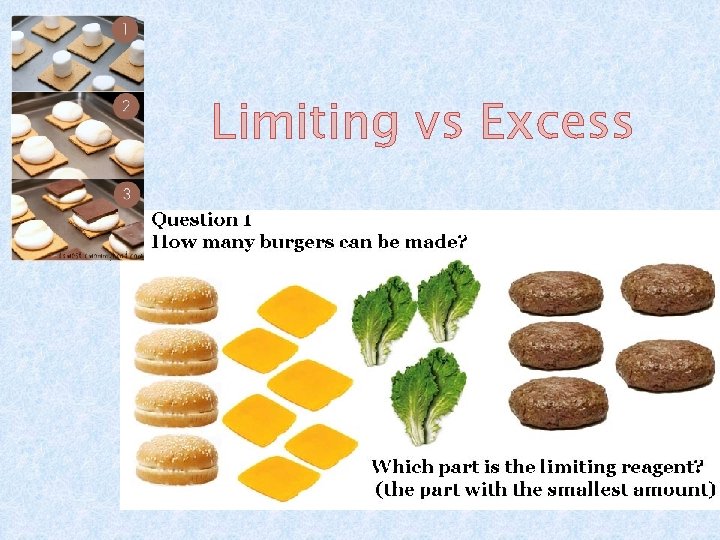
Limiting vs Excess
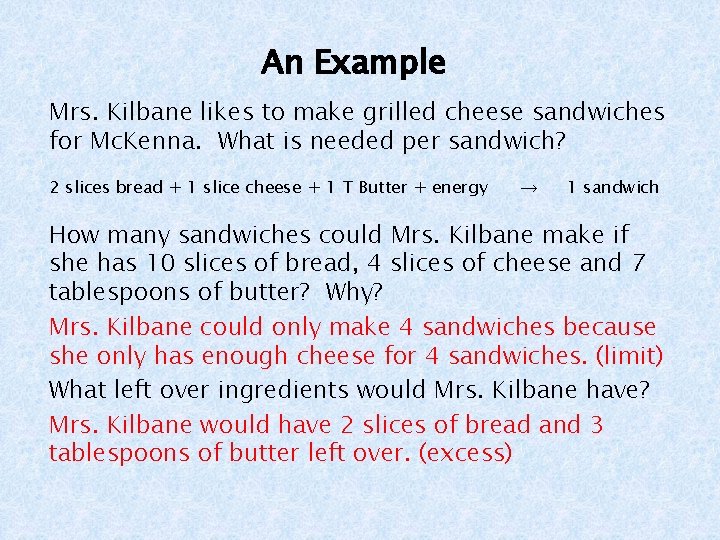
An Example Mrs. Kilbane likes to make grilled cheese sandwiches for Mc. Kenna. What is needed per sandwich? 2 slices bread + 1 slice cheese + 1 T Butter + energy → 1 sandwich How many sandwiches could Mrs. Kilbane make if she has 10 slices of bread, 4 slices of cheese and 7 tablespoons of butter? Why? Mrs. Kilbane could only make 4 sandwiches because she only has enough cheese for 4 sandwiches. (limit) What left over ingredients would Mrs. Kilbane have? Mrs. Kilbane would have 2 slices of bread and 3 tablespoons of butter left over. (excess)
Limiting Reactant The limiting reactant in a chemical reaction limits the amounts of the other reactants that can combine – and the amount of product that can form – in a chemical reaction. The reaction will stop once the limiting reactant runs out.
Excess Reactant The excess reactant in a chemical reaction is the substance that is not used up completely in a chemical reaction.
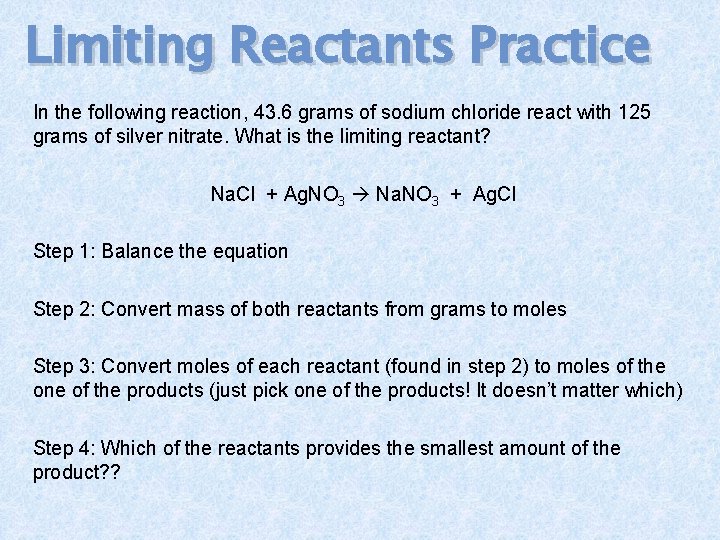
Limiting Reactants Practice In the following reaction, 43. 6 grams of sodium chloride react with 125 grams of silver nitrate. What is the limiting reactant? Na. Cl + Ag. NO 3 Na. NO 3 + Ag. Cl Step 1: Balance the equation Step 2: Convert mass of both reactants from grams to moles Step 3: Convert moles of each reactant (found in step 2) to moles of the one of the products (just pick one of the products! It doesn’t matter which) Step 4: Which of the reactants provides the smallest amount of the product? ?
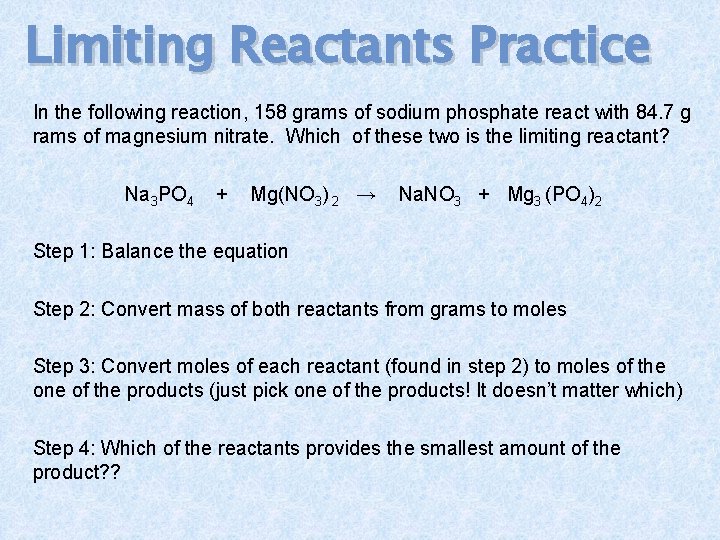
Limiting Reactants Practice In the following reaction, 158 grams of sodium phosphate react with 84. 7 g rams of magnesium nitrate. Which of these two is the limiting reactant? Na 3 PO 4 + Mg(NO 3) 2 → Na. NO 3 + Mg 3 (PO 4)2 Step 1: Balance the equation Step 2: Convert mass of both reactants from grams to moles Step 3: Convert moles of each reactant (found in step 2) to moles of the one of the products (just pick one of the products! It doesn’t matter which) Step 4: Which of the reactants provides the smallest amount of the product? ?
We are starting with limiting reactant practice This means you probably want your notes. You DEFINITELY want a calculator and a periodic table!
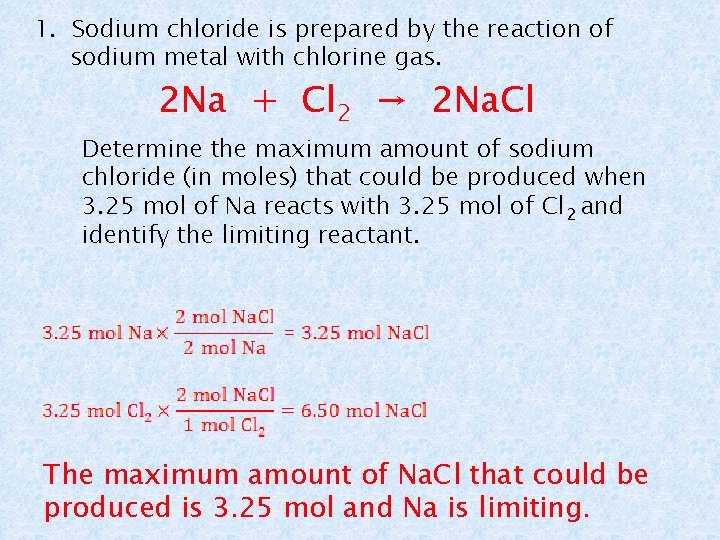
1. Sodium chloride is prepared by the reaction of sodium metal with chlorine gas. 2 Na + Cl 2 → 2 Na. Cl Determine the maximum amount of sodium chloride (in moles) that could be produced when 3. 25 mol of Na reacts with 3. 25 mol of Cl 2 and identify the limiting reactant. The maximum amount of Na. Cl that could be produced is 3. 25 mol and Na is limiting.
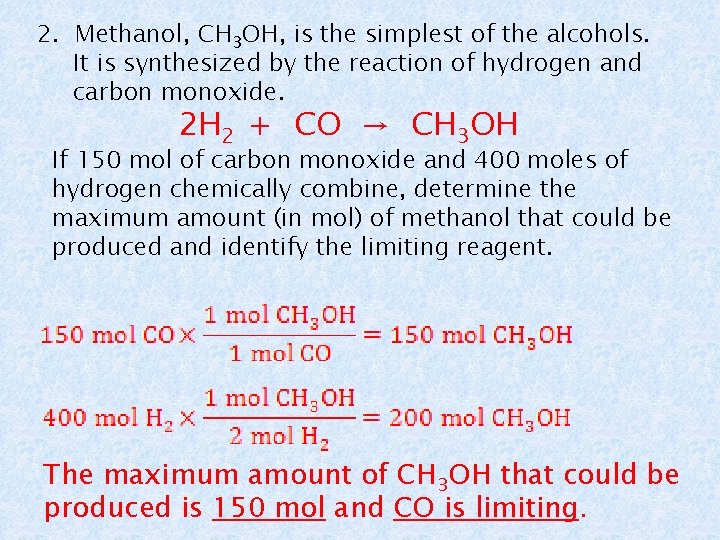
2. Methanol, CH 3 OH, is the simplest of the alcohols. It is synthesized by the reaction of hydrogen and carbon monoxide. 2 H 2 + CO → CH 3 OH If 150 mol of carbon monoxide and 400 moles of hydrogen chemically combine, determine the maximum amount (in mol) of methanol that could be produced and identify the limiting reagent. The maximum amount of CH 3 OH that could be produced is 150 mol and CO is limiting.
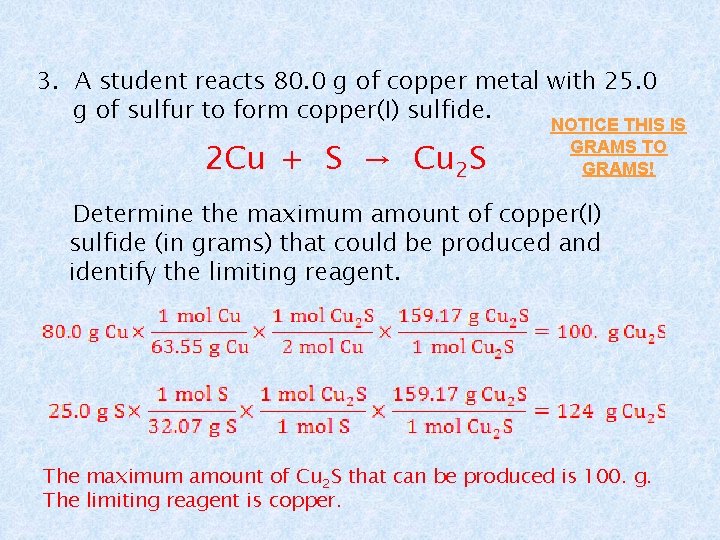
3. A student reacts 80. 0 g of copper metal with 25. 0 g of sulfur to form copper(I) sulfide. 2 Cu + S → Cu 2 S NOTICE THIS IS GRAMS TO GRAMS! Determine the maximum amount of copper(I) sulfide (in grams) that could be produced and identify the limiting reagent. The maximum amount of Cu 2 S that can be produced is 100. g. The limiting reagent is copper.
Percent Yield The theoretical yield is the calculated amount of product that *could* form during a reaction based upon a balanced equation. This is the maximum amount of product that could be formed.
Percent Yield The actual yield is the amount of product that forms when the reaction is carried out in the laboratory. The actual yield is often less than theoretical yield.
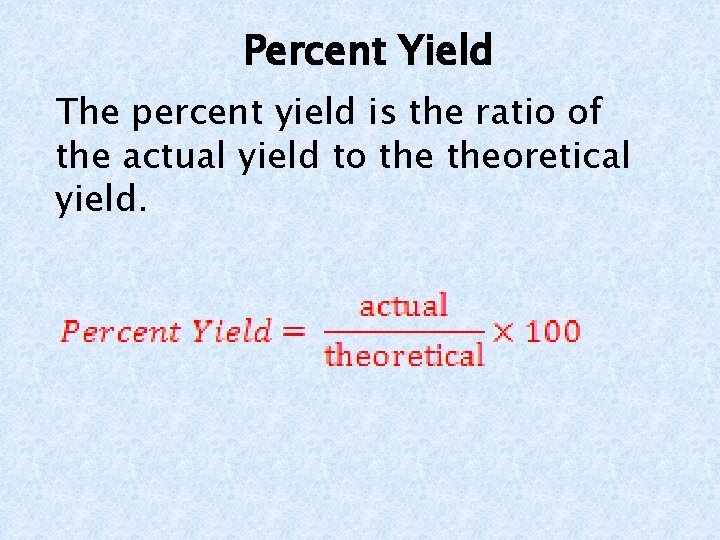
Percent Yield The percent yield is the ratio of the actual yield to theoretical yield.
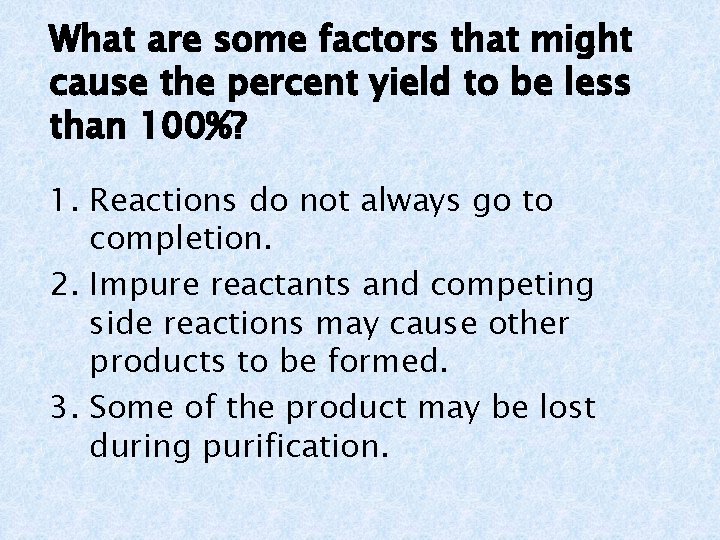
What are some factors that might cause the percent yield to be less than 100%? 1. Reactions do not always go to completion. 2. Impure reactants and competing side reactions may cause other products to be formed. 3. Some of the product may be lost during purification.
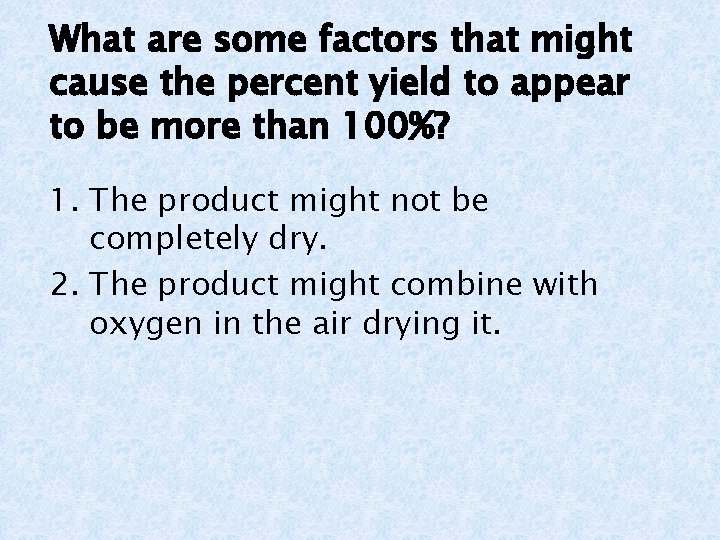
What are some factors that might cause the percent yield to appear to be more than 100%? 1. The product might not be completely dry. 2. The product might combine with oxygen in the air drying it.
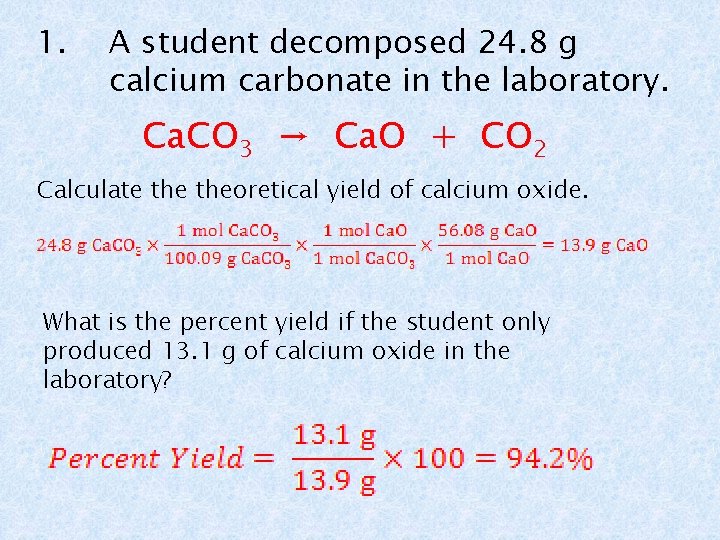
1. A student decomposed 24. 8 g calcium carbonate in the laboratory. Ca. CO 3 → Ca. O + CO 2 Calculate theoretical yield of calcium oxide. What is the percent yield if the student only produced 13. 1 g of calcium oxide in the laboratory?
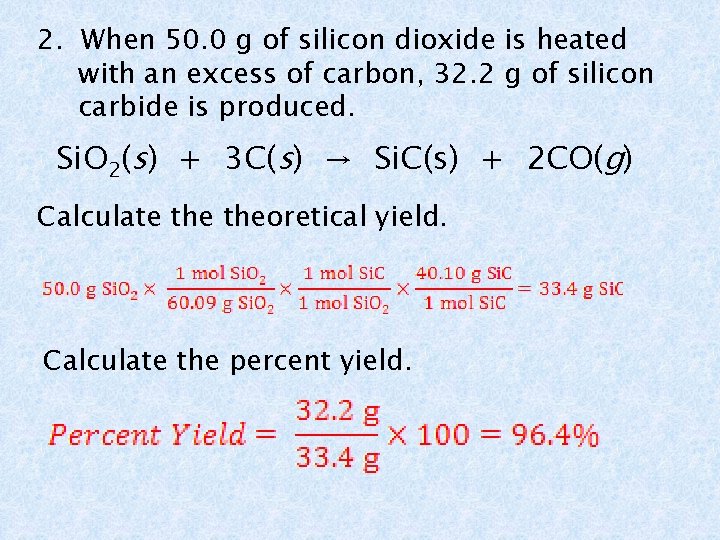
2. When 50. 0 g of silicon dioxide is heated with an excess of carbon, 32. 2 g of silicon carbide is produced. Si. O 2(s) + 3 C(s) → Si. C(s) + 2 CO(g) Calculate theoretical yield. Calculate the percent yield.
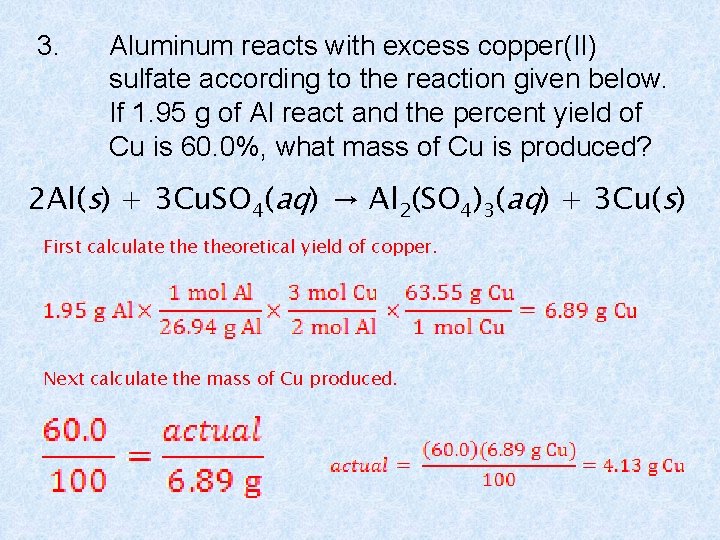
3. Aluminum reacts with excess copper(II) sulfate according to the reaction given below. If 1. 95 g of Al react and the percent yield of Cu is 60. 0%, what mass of Cu is produced? 2 Al(s) + 3 Cu. SO 4(aq) → Al 2(SO 4)3(aq) + 3 Cu(s) First calculate theoretical yield of copper. Next calculate the mass of Cu produced.