
Stoichiometry of Cells Faradays Law Stoichiometry of Electrolytic

- Slides: 11
Stoichiometry of Cells Faraday’s Law
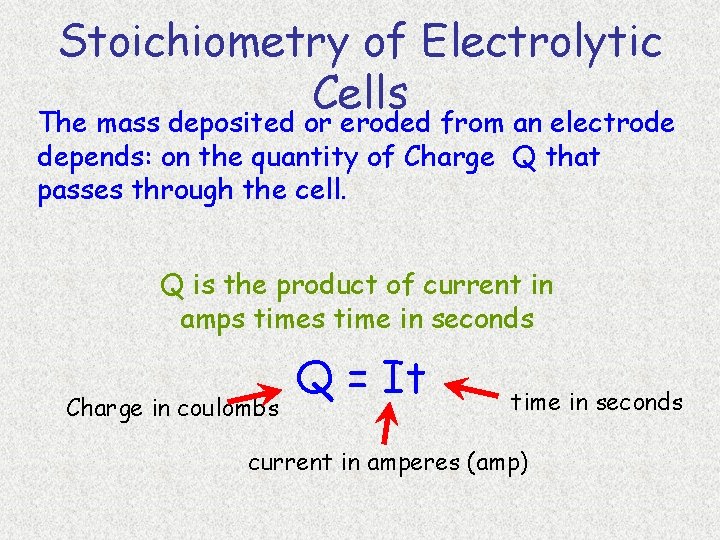
Stoichiometry of Electrolytic Cells The mass deposited or eroded from an electrode depends: on the quantity of Charge Q that passes through the cell. Q is the product of current in amps time in seconds Charge in coulombs Q = It time in seconds current in amperes (amp)
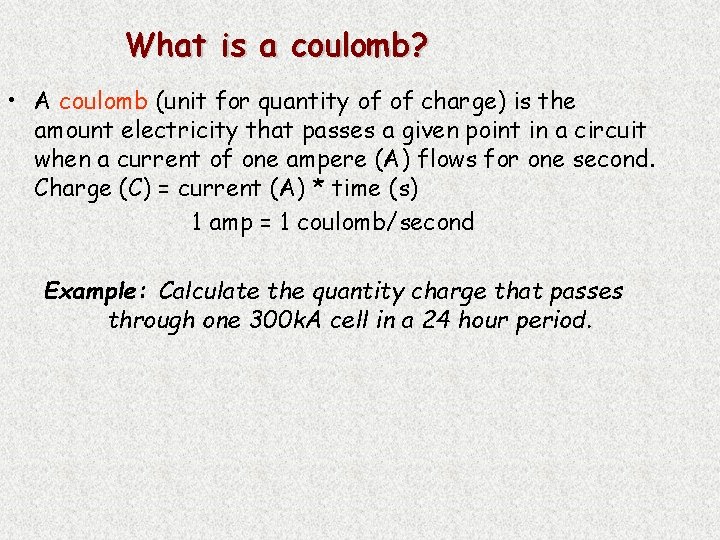
What is a coulomb? • A coulomb (unit for quantity of of charge) is the amount electricity that passes a given point in a circuit when a current of one ampere (A) flows for one second. Charge (C) = current (A) * time (s) 1 amp = 1 coulomb/second Example: Calculate the quantity charge that passes through one 300 k. A cell in a 24 hour period.
Calculate the charge that passes through one 300 k. A cell in a 24 hour period. Q = It = (300 k. A x 1000 A/k. A)(24 h x 3600 s/h) = (300000 C/s )(86400 s) = 2. 6 x 10¹⁰ C
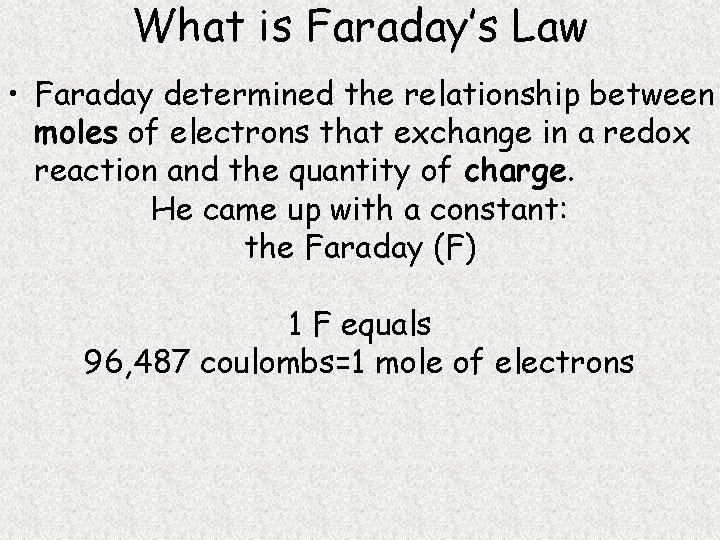
What is Faraday’s Law • Faraday determined the relationship between moles of electrons that exchange in a redox reaction and the quantity of charge. He came up with a constant: the Faraday (F) 1 F equals 96, 487 coulombs=1 mole of electrons
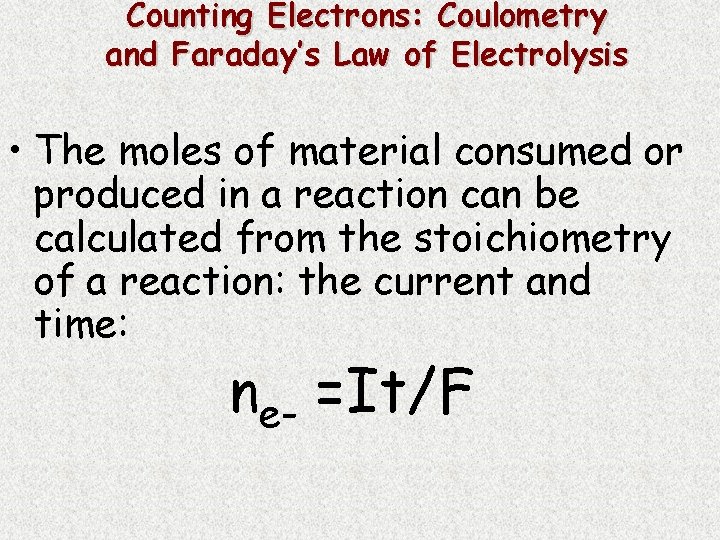
Counting Electrons: Coulometry and Faraday’s Law of Electrolysis • The moles of material consumed or produced in a reaction can be calculated from the stoichiometry of a reaction: the current and time: ne- =It/F
• A metallic object to be plated with copper is placed in a solution of Cu. SO 4. What mass of copper will be deposited if a current of 0. 22 amp flows through the cell for 1. 5 hours?
• Calculate the mass of palladium produced by the reduction of palladium (II) ions during the passage of 3. 20 amperes of current through a solution of palladium (II) sulfate for 30. 0 minutes.
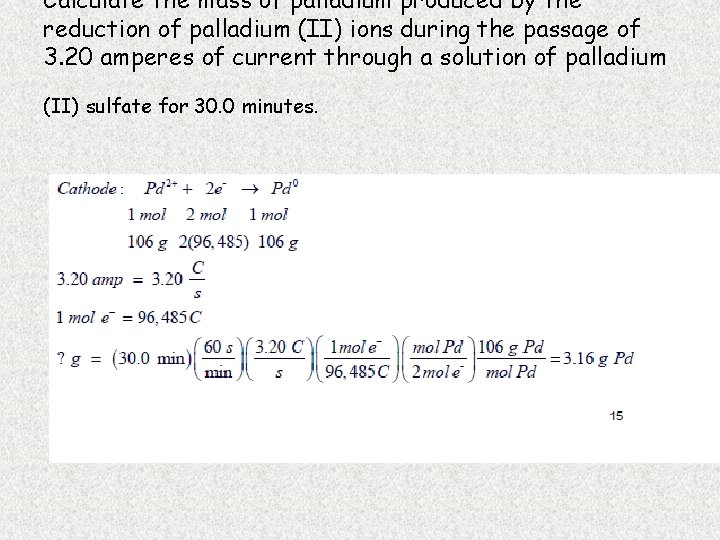
Calculate the mass of palladium produced by the reduction of palladium (II) ions during the passage of 3. 20 amperes of current through a solution of palladium (II) sulfate for 30. 0 minutes.