
STOICHIOMETRY LIMITING AND EXCESS QUANTITIES Chemistry 11 Reactions

- Slides: 9
STOICHIOMETRY – LIMITING AND EXCESS QUANTITIES Chemistry 11 – Reactions and Stoichiometry 12
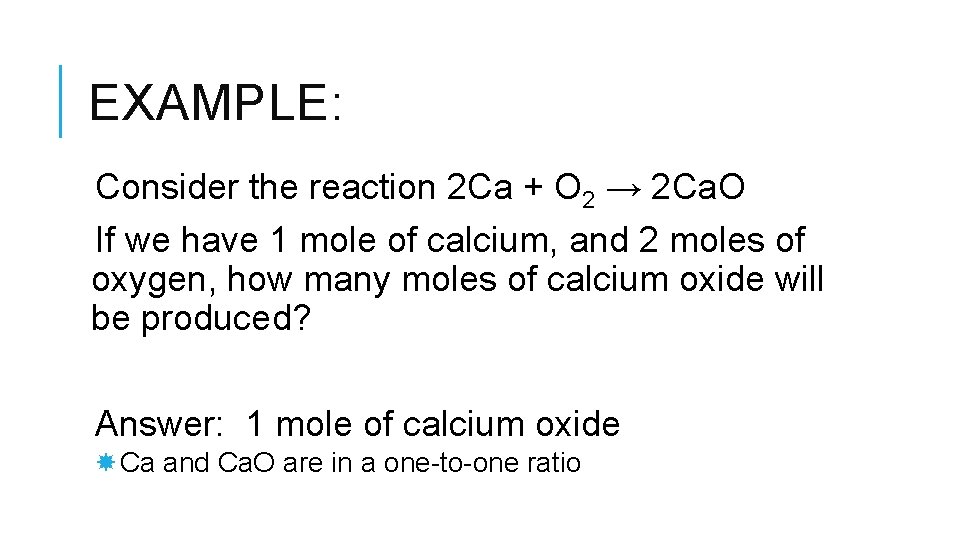
EXAMPLE: Consider the reaction 2 Ca + O 2 → 2 Ca. O If we have 1 mole of calcium, and 2 moles of oxygen, how many moles of calcium oxide will be produced? Answer: 1 mole of calcium oxide Ca and Ca. O are in a one-to-one ratio
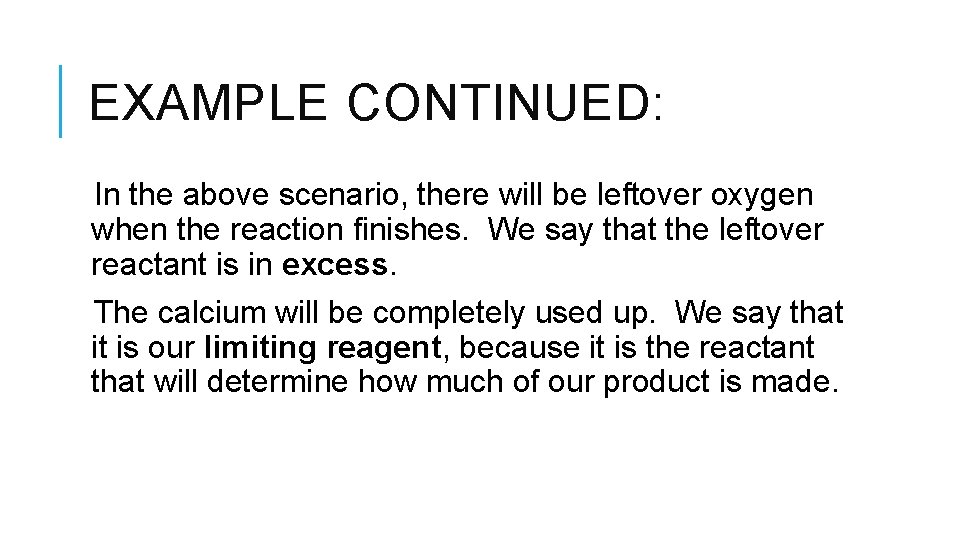
EXAMPLE CONTINUED: In the above scenario, there will be leftover oxygen when the reaction finishes. We say that the leftover reactant is in excess. The calcium will be completely used up. We say that it is our limiting reagent, because it is the reactant that will determine how much of our product is made.
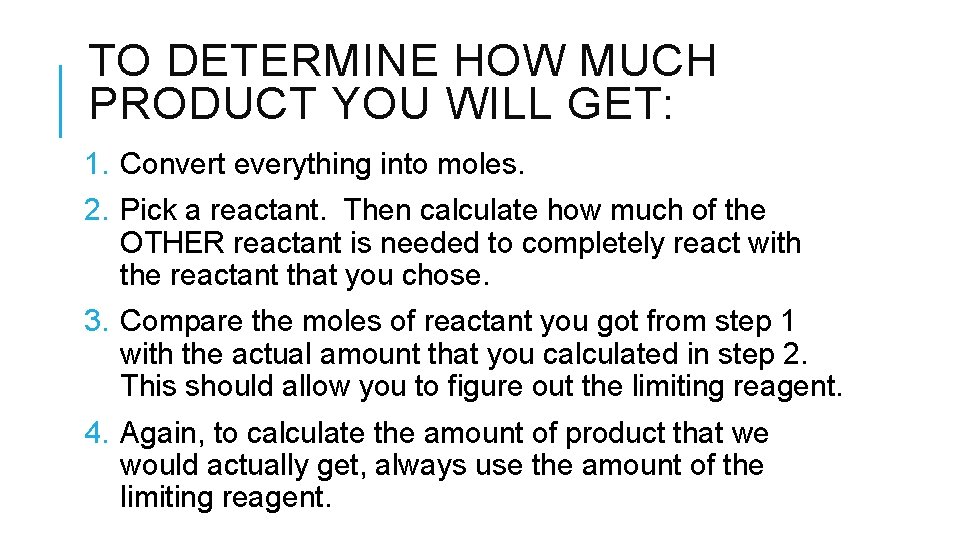
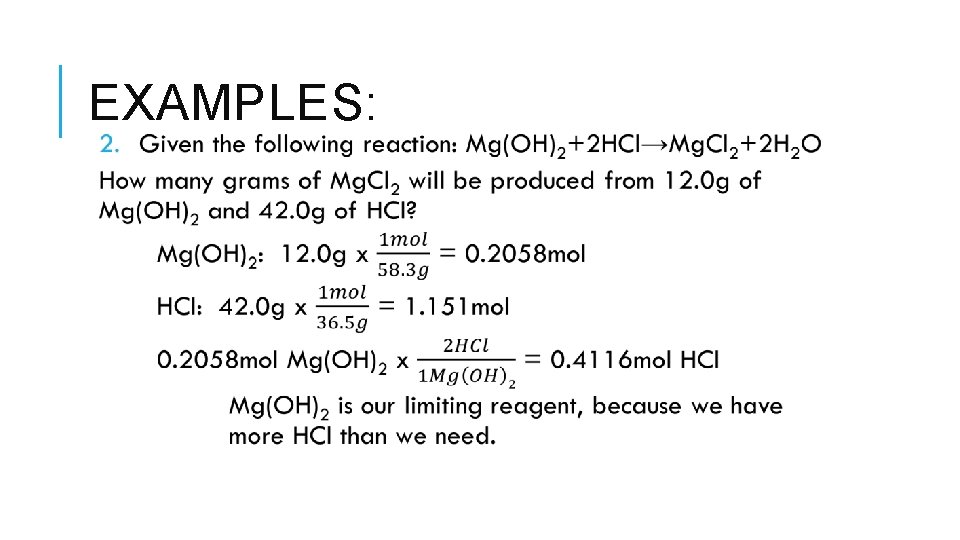
TO DETERMINE HOW MUCH PRODUCT YOU WILL GET: 1. Convert everything into moles. 2. Pick a reactant. Then calculate how much of the OTHER reactant is needed to completely react with the reactant that you chose. 3. Compare the moles of reactant you got from step 1 with the actual amount that you calculated in step 2. This should allow you to figure out the limiting reagent. 4. Again, to calculate the amount of product that we would actually get, always use the amount of the limiting reagent.
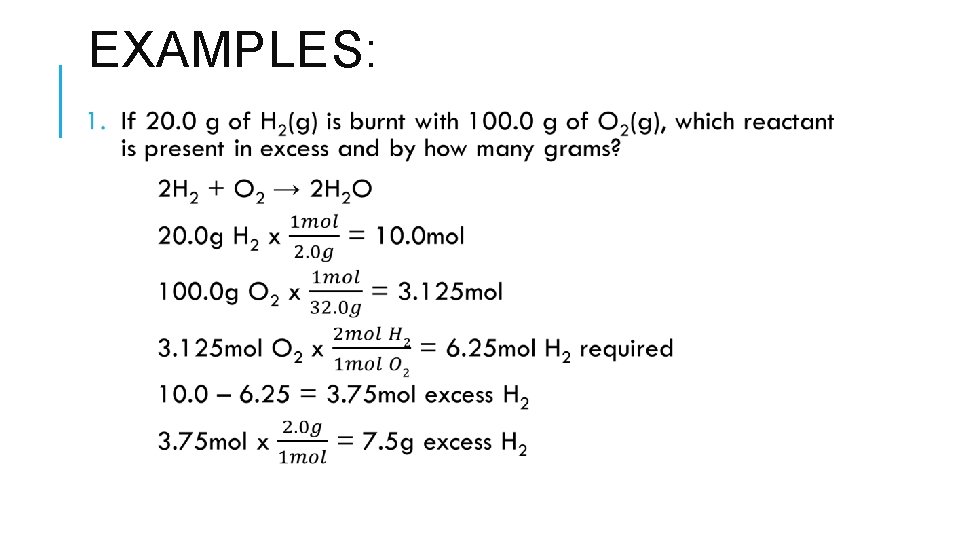
EXAMPLES:
EXAMPLES:
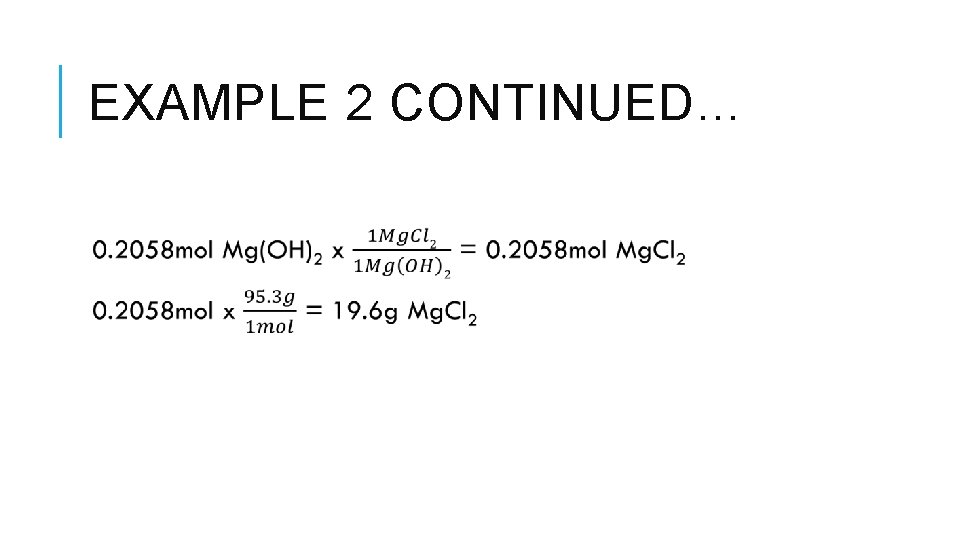
EXAMPLE 2 CONTINUED…
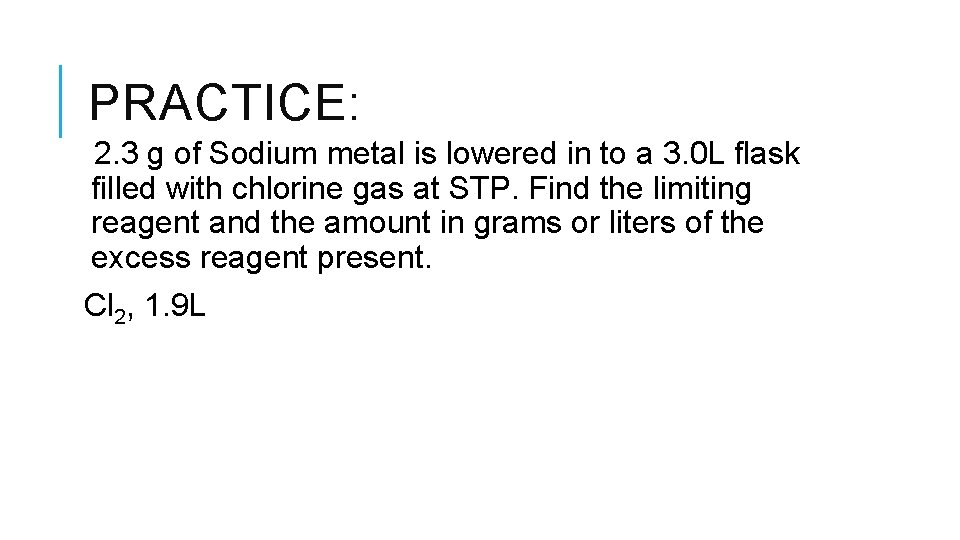
PRACTICE: 2. 3 g of Sodium metal is lowered in to a 3. 0 L flask filled with chlorine gas at STP. Find the limiting reagent and the amount in grams or liters of the excess reagent present. Cl 2, 1. 9 L
ASSIGNMENT Pages 133 -134 #26 -32