
Stoichiometry Chapter 12 the relationship between the relative
Stoichiometry Chapter 12 the relationship between the relative quantities of substances taking part in a reaction or forming a compound, typically a ratio of whole integers. Origin From Greek: • “stoicheion” (= element) • “metron” (= measure)
Warmup – Mole Conversions 1. What is the molar mass of sulfur dioxide (SO 2)? 2. How many moles of SO 2 are in 256 g of SO 2? 3. How many grams SO 2 are in 2. 50 mol SO 2? 4. How many SO 2 molecules are in 2. 50 mol SO 2? 5. How many moles SO 2 are in 1. 82 x 1022 SO 2 molecules?
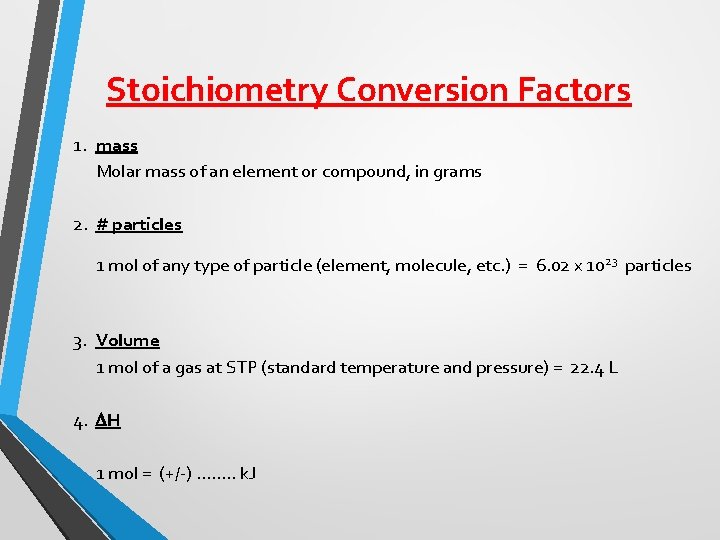
Stoichiometry Conversion Factors 1. mass Molar mass of an element or compound, in grams 2. # particles 1 mol of any type of particle (element, molecule, etc. ) = 6. 02 x 10 23 particles 3. Volume 1 mol of a gas at STP (standard temperature and pressure) = 22. 4 L 4. DH 1 mol = (+/-) ……. . k. J
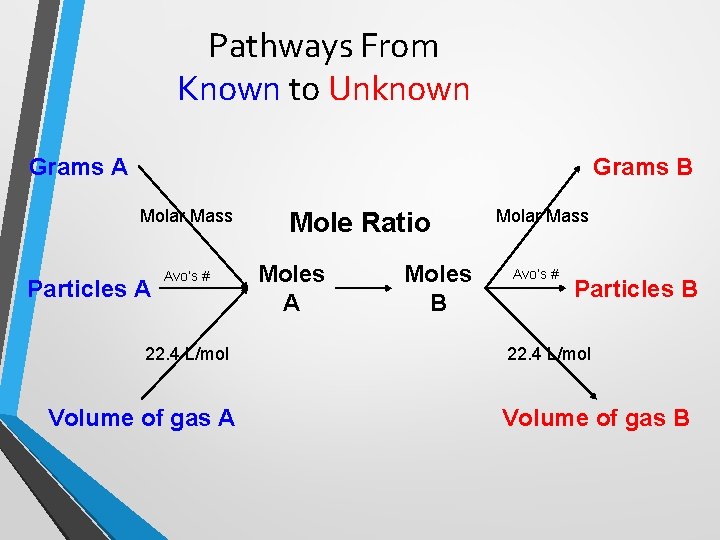
Pathways From Known to Unknown Grams A Grams B Molar Mass Particles A Avo’s # 22. 4 L/mol Volume of gas A Mole Ratio Moles A Moles B Molar Mass Avo’s # Particles B 22. 4 L/mol Volume of gas B
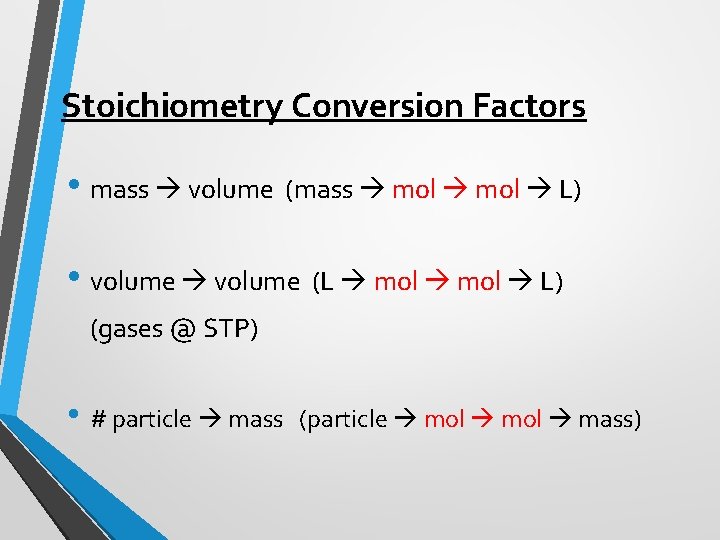
Stoichiometry Conversion Factors • mass volume (mass mol L) • volume (L mol L) (gases @ STP) • # particle mass (particle mol mass)
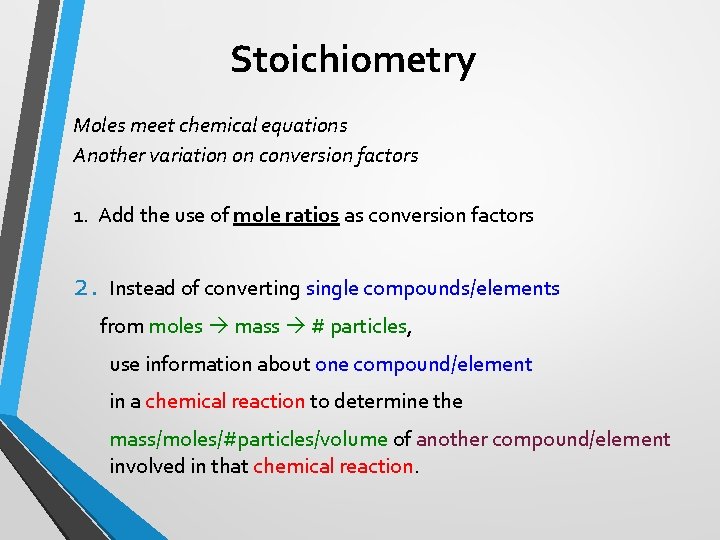
Stoichiometry Moles meet chemical equations Another variation on conversion factors 1. Add the use of mole ratios as conversion factors 2. Instead of converting single compounds/elements from moles mass # particles, use information about one compound/element in a chemical reaction to determine the mass/moles/#particles/volume of another compound/element involved in that chemical reaction.
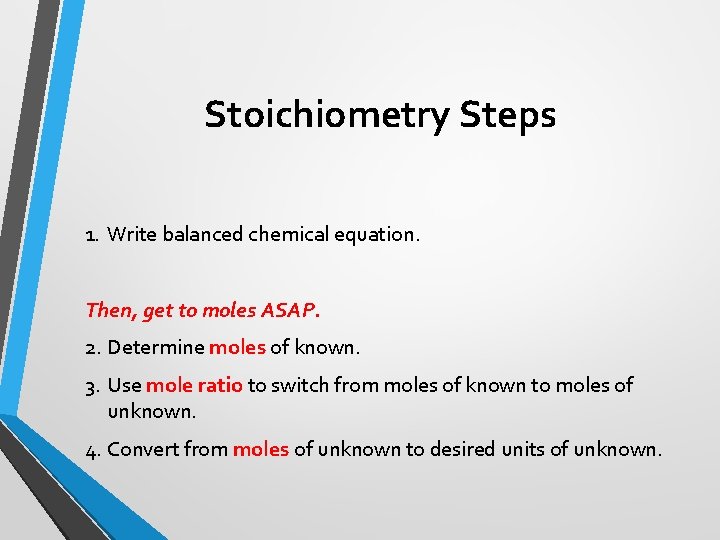
Stoichiometry Steps 1. Write balanced chemical equation. Then, get to moles ASAP. 2. Determine moles of known. 3. Use mole ratio to switch from moles of known to moles of unknown. 4. Convert from moles of unknown to desired units of unknown.
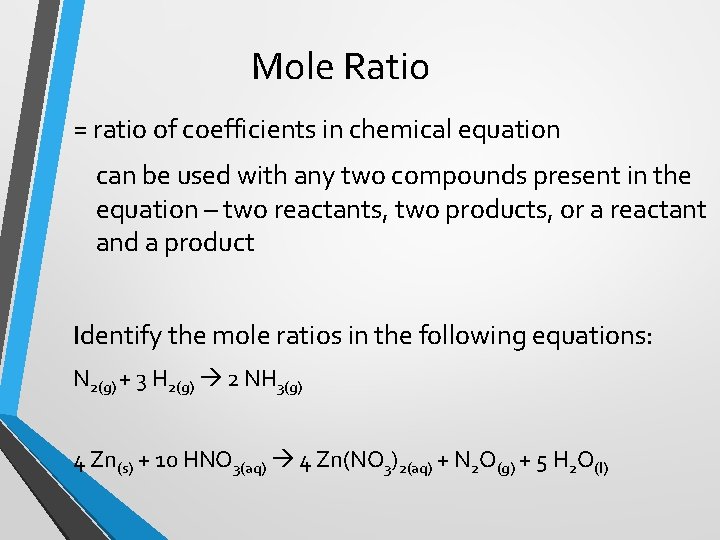
Mole Ratio = ratio of coefficients in chemical equation can be used with any two compounds present in the equation – two reactants, two products, or a reactant and a product Identify the mole ratios in the following equations: N 2(g) + 3 H 2(g) 2 NH 3(g) 4 Zn(s) + 10 HNO 3(aq) 4 Zn(NO 3)2(aq) + N 2 O(g) + 5 H 2 O(l)
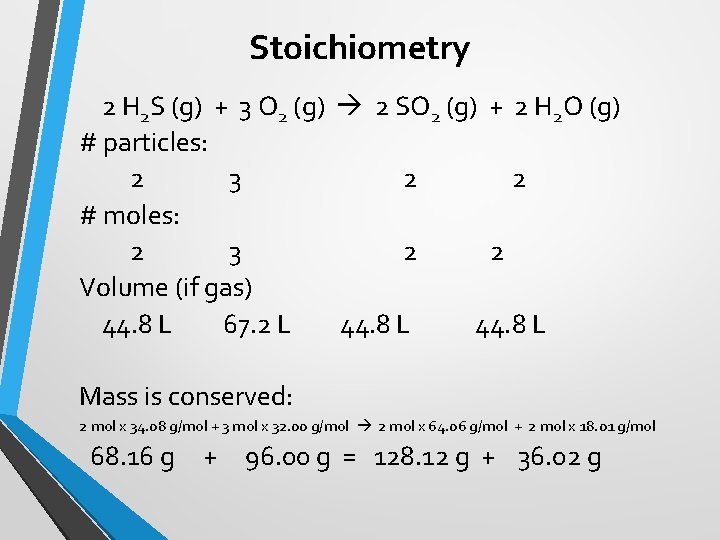
Stoichiometry 2 H 2 S (g) + 3 O 2 (g) 2 SO 2 (g) + 2 H 2 O (g) # particles: 2 3 2 2 # moles: 2 3 2 2 Volume (if gas) 44. 8 L 67. 2 L 44. 8 L Mass is conserved: 2 mol x 34. 08 g/mol + 3 mol x 32. 00 g/mol 2 mol x 64. 06 g/mol + 2 mol x 18. 01 g/mol 68. 16 g + 96. 00 g = 128. 12 g + 36. 02 g
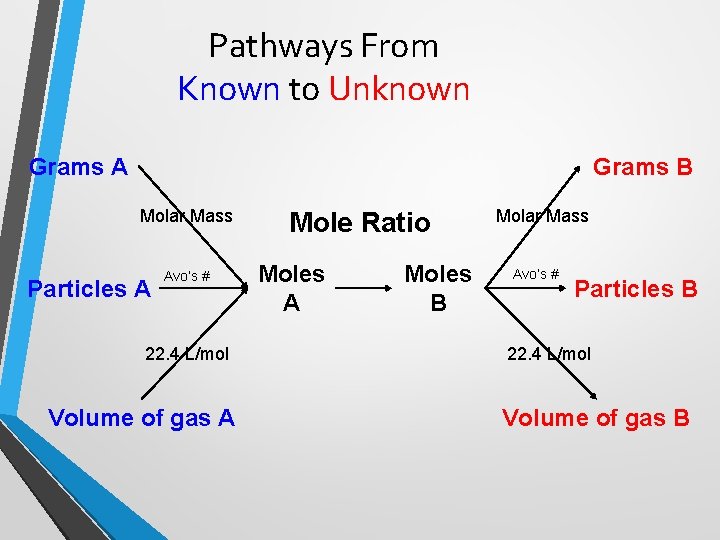
Pathways From Known to Unknown Grams A Grams B Molar Mass Particles A Avo’s # 22. 4 L/mol Volume of gas A Mole Ratio Moles A Moles B Molar Mass Avo’s # Particles B 22. 4 L/mol Volume of gas B
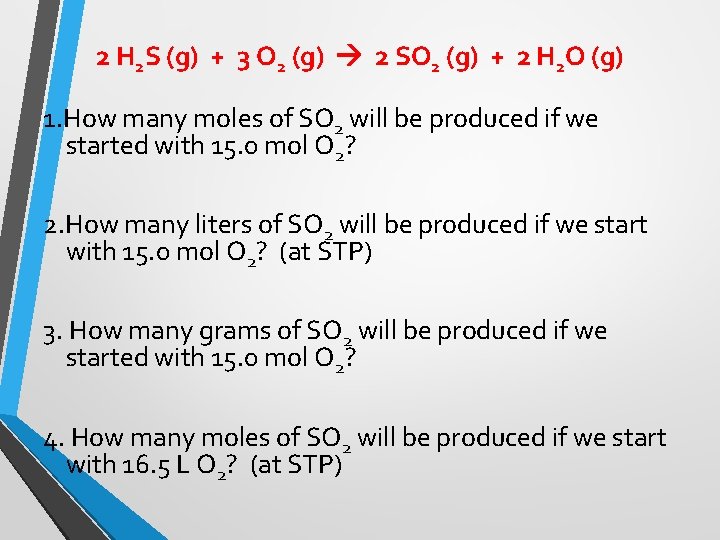
2 H 2 S (g) + 3 O 2 (g) 2 SO 2 (g) + 2 H 2 O (g) 1. How many moles of SO 2 will be produced if we started with 15. 0 mol O 2? 2. How many liters of SO 2 will be produced if we start with 15. 0 mol O 2? (at STP) 3. How many grams of SO 2 will be produced if we started with 15. 0 mol O 2? 4. How many moles of SO 2 will be produced if we start with 16. 5 L O 2? (at STP)
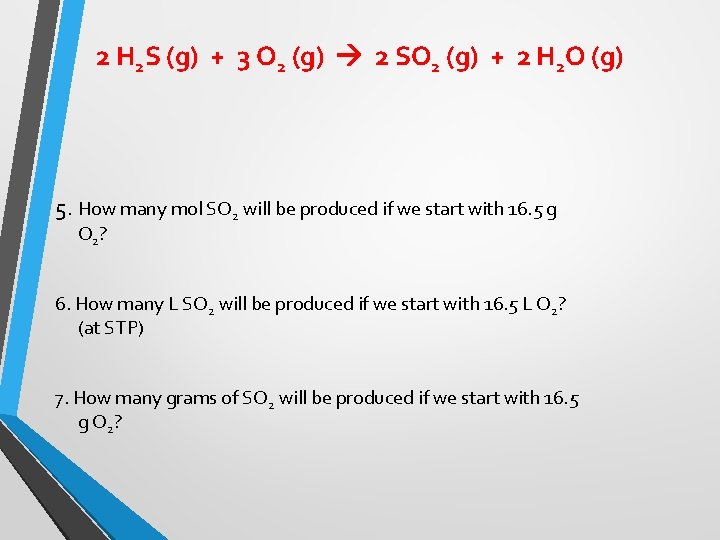
2 H 2 S (g) + 3 O 2 (g) 2 SO 2 (g) + 2 H 2 O (g) 5. How many mol SO 2 will be produced if we start with 16. 5 g O 2 ? 6. How many L SO 2 will be produced if we start with 16. 5 L O 2? (at STP) 7. How many grams of SO 2 will be produced if we start with 16. 5 g O 2?
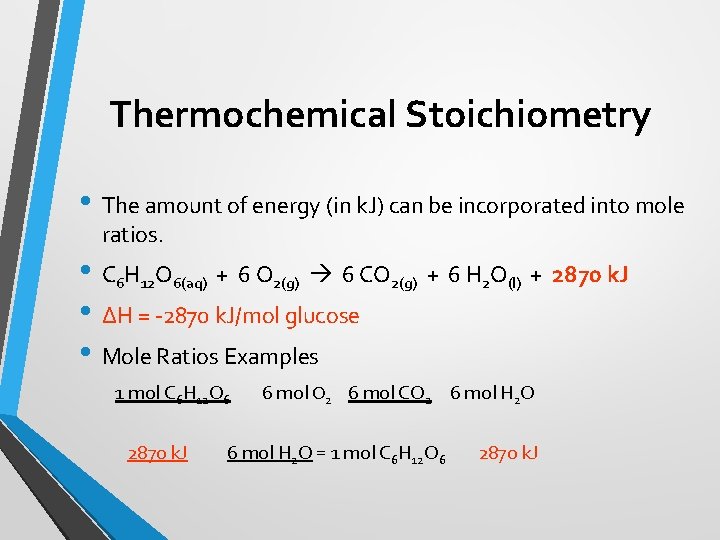
Thermochemical Stoichiometry • The amount of energy (in k. J) can be incorporated into mole ratios. • C 6 H 12 O 6(aq) + 6 O 2(g) 6 CO 2(g) + 6 H 2 O(l) + 2870 k. J • ΔH = -2870 k. J/mol glucose • Mole Ratios Examples 1 mol C 6 H 12 O 6 2870 k. J 6 mol O 2 6 mol CO 2 6 mol H 2 O = 1 mol C 6 H 12 O 6 2870 k. J
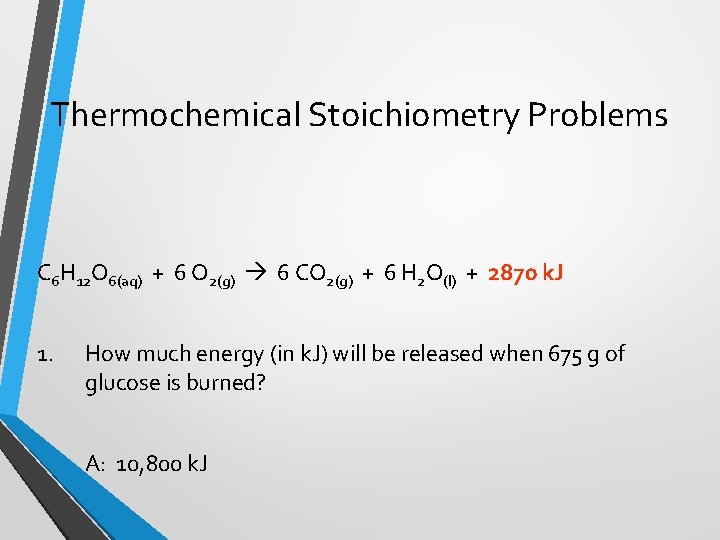
Thermochemical Stoichiometry Problems C 6 H 12 O 6(aq) + 6 O 2(g) 6 CO 2(g) + 6 H 2 O(l) + 2870 k. J 1. How much energy (in k. J) will be released when 675 g of glucose is burned? A: 10, 800 k. J
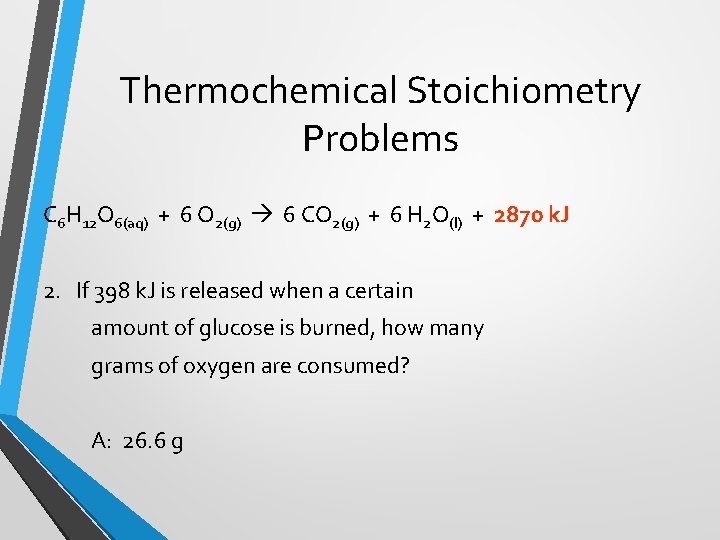
Thermochemical Stoichiometry Problems C 6 H 12 O 6(aq) + 6 O 2(g) 6 CO 2(g) + 6 H 2 O(l) + 2870 k. J 2. If 398 k. J is released when a certain amount of glucose is burned, how many grams of oxygen are consumed? A: 26. 6 g
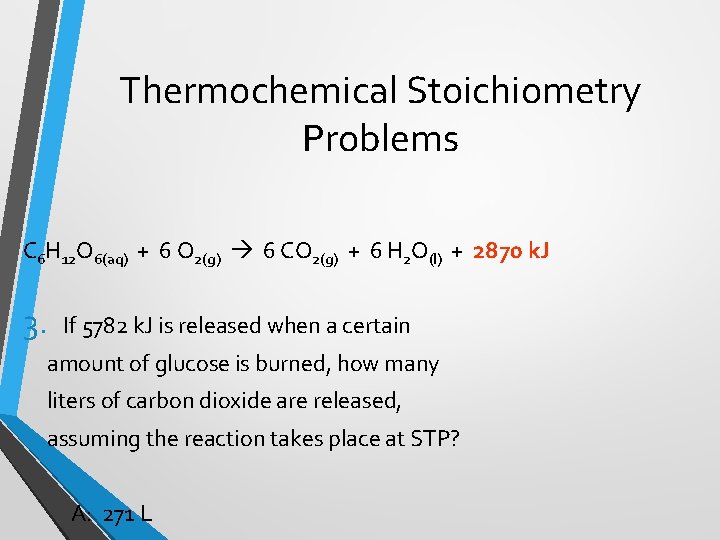
Thermochemical Stoichiometry Problems C 6 H 12 O 6(aq) + 6 O 2(g) 6 CO 2(g) + 6 H 2 O(l) + 2870 k. J 3. If 5782 k. J is released when a certain amount of glucose is burned, how many liters of carbon dioxide are released, assuming the reaction takes place at STP? A: 271 L
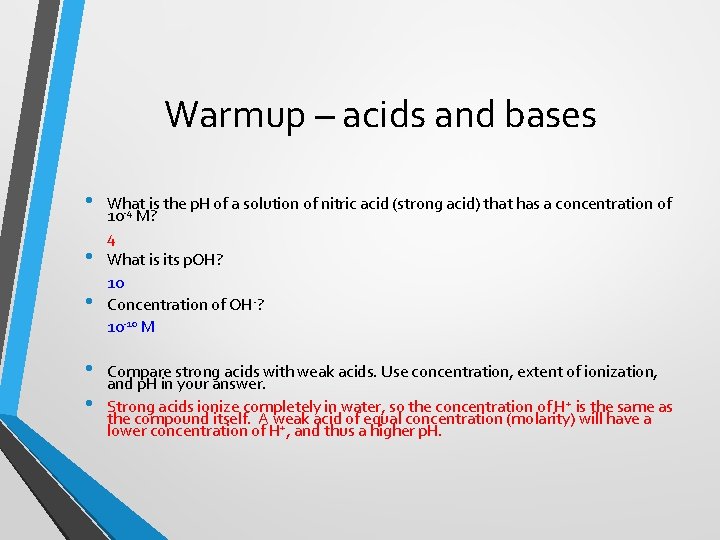
Warmup – acids and bases • • • What is the p. H of a solution of nitric acid (strong acid) that has a concentration of 10 -4 M? 4 What is its p. OH? 10 Concentration of OH-? 10 -10 M Compare strong acids with weak acids. Use concentration, extent of ionization, and p. H in your answer. Strong acids ionize completely in water, so the concentration of H + is the same as the compound itself. A weak acid of equal concentration (molarity) will have a + lower concentration of H , and thus a higher p. H.
- Slides: 17