
STOICHIOMETRY AND THE COMBUSTION OF FUELS GAS LAWS
STOICHIOMETRY AND THE COMBUSTION OF FUELS GAS LAWS
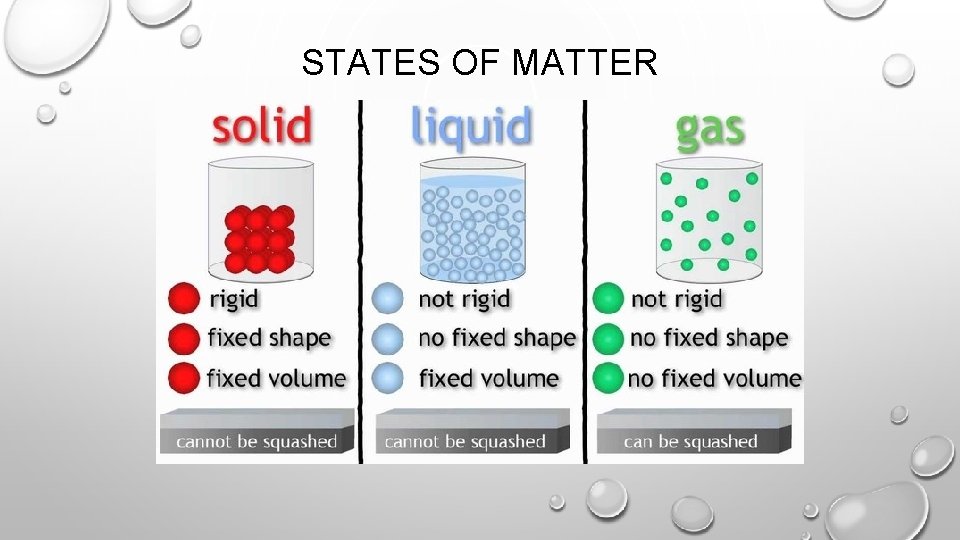
STATES OF MATTER
KINETIC MOLECULAR THEORY • Gases are composed of very small particles. The volume of the particles is negligible compared to the volume occupied by the gas. Most of the volume taken up by the gas is empty space. • Gas particles move randomly, in straight lines. Particles collide with each other and with the walls of the container. These collisions are “elastic” meaning no energy is lost during the collisions. • The forces between particles are very weak. It is assumed the particles move around independently of each other. • The average kinetic energy of the particles increases as the temperature of the gas is increased.
PRESSURE • Pressure is the unit of force measured per unit area (arising from the collisions with the walls of the container). Pressure can be measured in a variety of units. The SI (Systeme Internationale d’Unites) unit for pressure is the Pascal (Pa). Other common units are kilopascals (k. Pa), millimetres of mercury (mm. Hg) and atmospheres (atm). Use the following to convert between units: 101325 Pa = 101. 325 k. Pa = 760 mm. Hg = 1 atm Convert between the following units of pressure: • 4. 00 atm to Pa • 780 mm. Hg to k. Pa • 85. 2 atm to mm. Hg

VOLUME Volume is often measured in litres (L) but can also be measured in millilitres (m. L), cubic metres (m 3), cubic decimetres (dm 3) and cubic centimetres (cm 3). 1 m. L = 1 cm 3 1 L = 1 dm 3 1 L = 1000 m. L 1 m 3 = 1000 dm 3 = 1 x 106 cm 3 Eg. Convert between the following units of volume. a) 1. 42 L = ________m. L. b) 348 cm 3 = ________dm 3 c) 0. 513 m. L = _________ L
TEMPERATURE Temperature is always measured in Kelvin (K). 0 K is equal to – 273 o. C, and is called absolute zero. This corresponds to the point at which the kinetic energy of the substance is theoretically zero. Temperature on the Celsius scale can easily be converted into temperature on the Kelvin scale by using the relationship: T (in K) = T (in o. C) + 273 Convert the following temperatures from the Celsius to the Kelvin scale: a) 25 C b) 237 C c) – 16 C
QUANTITATIVE RELATIONSHIPS – THE GAS LAWS The behaviour of gases under varying conditions has been investigated very extensively. The investigations have led to the proposal of the various GAS LAWS. The Gas Laws are relationships linking the quantities : amount (moles) volume, temperature pressure.
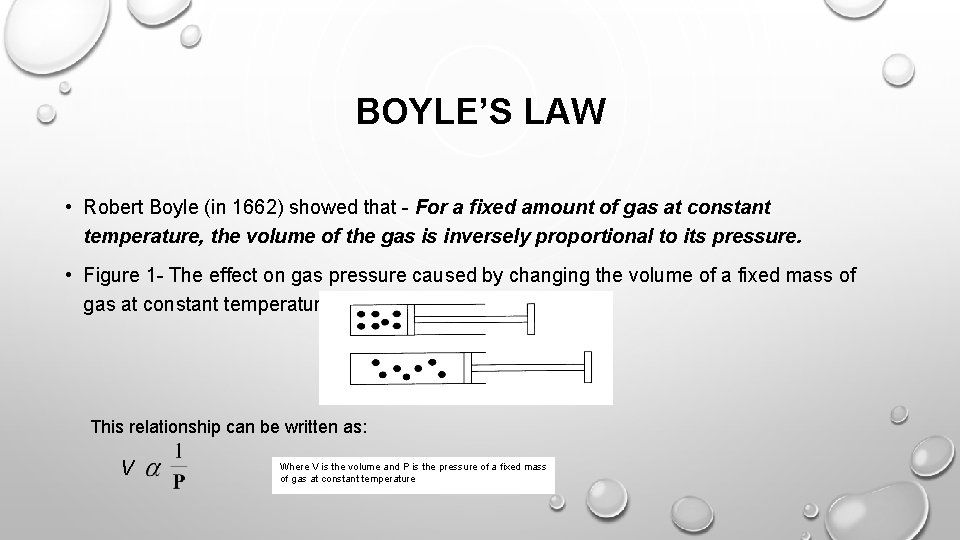
BOYLE’S LAW • Robert Boyle (in 1662) showed that - For a fixed amount of gas at constant temperature, the volume of the gas is inversely proportional to its pressure. • Figure 1 - The effect on gas pressure caused by changing the volume of a fixed mass of gas at constant temperature. This relationship can be written as: V Where V is the volume and P is the pressure of a fixed mass of gas at constant temperature
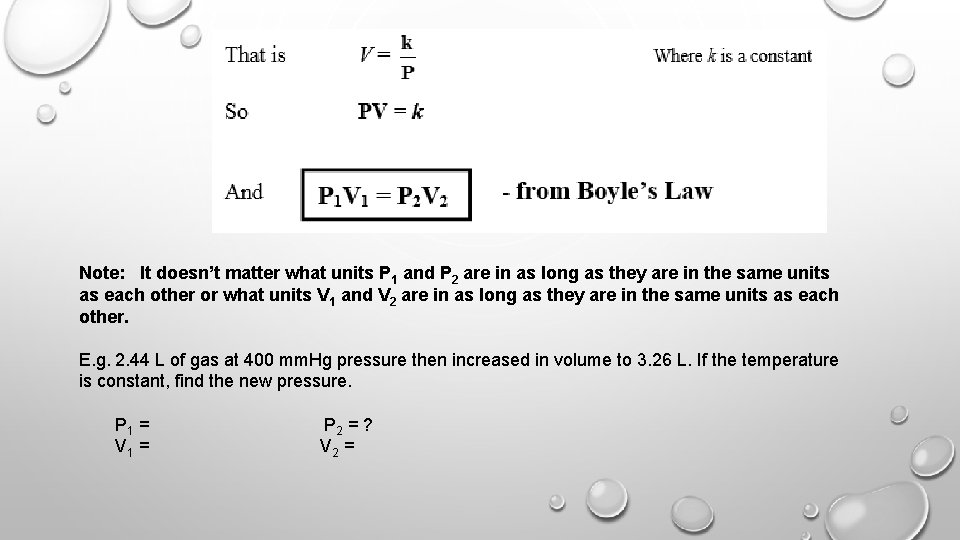
Note: It doesn’t matter what units P 1 and P 2 are in as long as they are in the same units as each other or what units V 1 and V 2 are in as long as they are in the same units as each other. E. g. 2. 44 L of gas at 400 mm. Hg pressure then increased in volume to 3. 26 L. If the temperature is constant, find the new pressure. P 1 = V 1 = P 2 = ? V 2 =
Charles Law • The French physicist, Jacques Charles (1787) investigated the relationship between volume and temperature for a fixed mass of gas at constant pressure. • He noticed that the volume increased as the temperature increased. (As the gas gained kinetic energy, the particles moved more rapidly. To keep the number of collisions with the walls of the container constant (ie to keep pressure constant), the volume of the container must increase). • Charles’ measurements were for temperatures above 0 C.
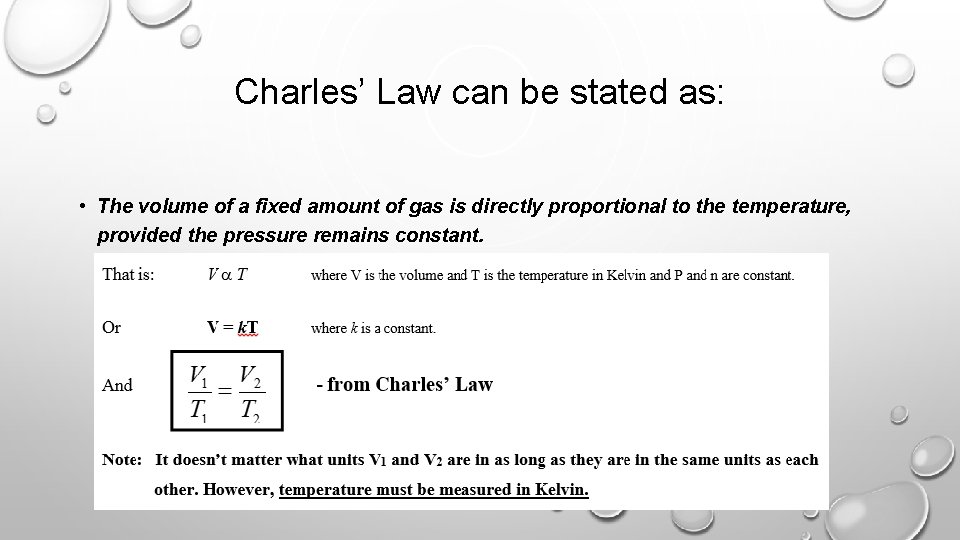
Charles’ Law can be stated as: • The volume of a fixed amount of gas is directly proportional to the temperature, provided the pressure remains constant.
Charles law question • E. g. 360 m. L of gas at 0 o. C is heated to 91 o. C. Find the new volume if the pressure is kept the same.
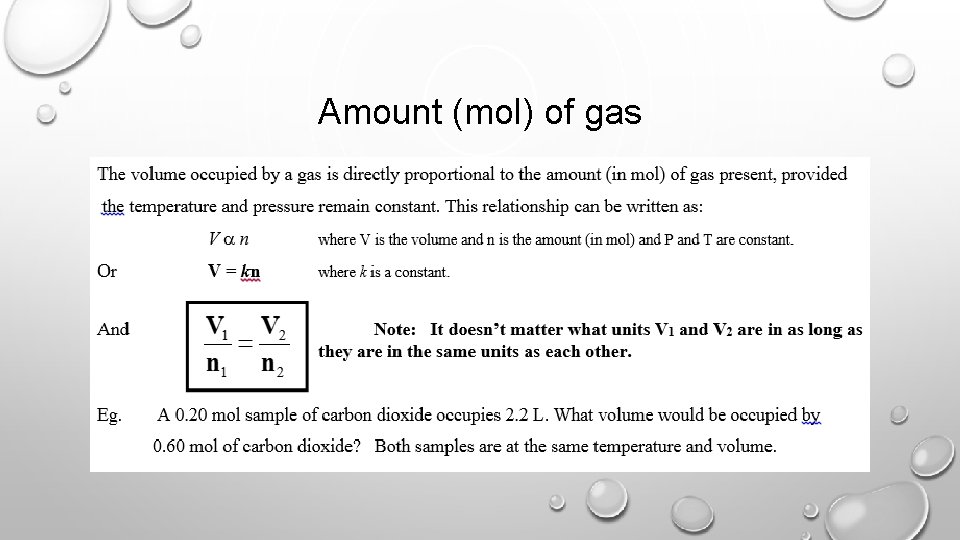
Amount (mol) of gas
MOLAR VOLUME OF A GAS In order to fully describe a sample of a gas we need to know its chemical composition and: • the amount of gas in moles, n • its volume, V • its temperature, T • its pressure, P • Gases, like all matter are made up of particles. It has been determined that, if we have different gases with the same volume, at the same temperature and pressure, we will have the same number of particles.
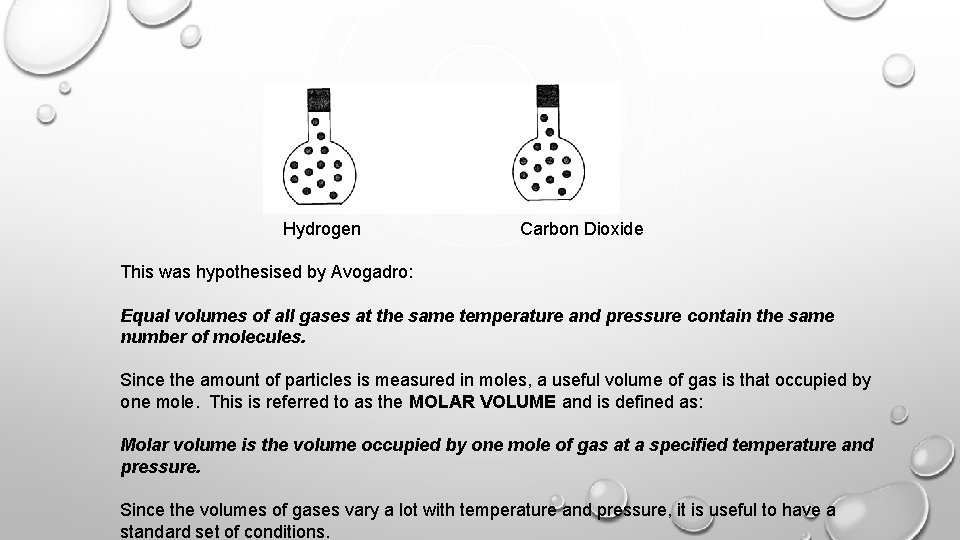
Hydrogen Carbon Dioxide This was hypothesised by Avogadro: Equal volumes of all gases at the same temperature and pressure contain the same number of molecules. Since the amount of particles is measured in moles, a useful volume of gas is that occupied by one mole. This is referred to as the MOLAR VOLUME and is defined as: Molar volume is the volume occupied by one mole of gas at a specified temperature and pressure. Since the volumes of gases vary a lot with temperature and pressure, it is useful to have a standard set of conditions.
Standard Temperature and Pressure (STP) is considered to be 0°C and 100 k. Pa. At STP the Molar Gas Volume is 22. 7 L mol -1 As it would be very uncomfortable and unrealistic to always work in zero degrees, another set of conditions is at 25°C. Standard Lab Conditions (SLC) is considered to be 25°C and 100 k. Pa. At SLC the molar Gas Volume is 24. 8 L mol-1 (this value is in the data book)
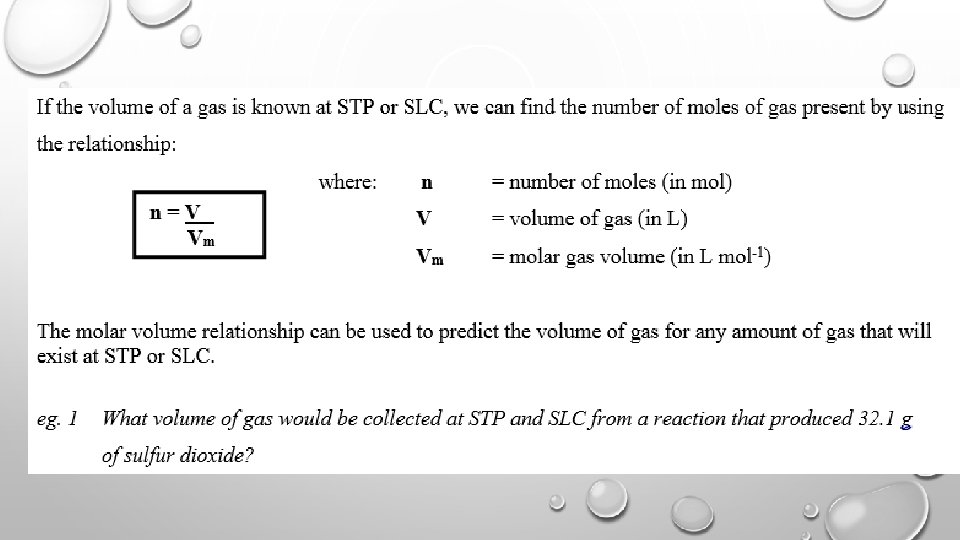
It can also be used to find the number of moles, and hence mass, of a gas that exist at SLC. eg. 2 How many moles of helium gas would be contained in a balloon whose volume at SLC was found to be 2. 8 L? What mass of helium would be in the balloon? M(He) = 4. 0 gmol-1
- Slides: 18