
Stock Valuation Lesson 1 Learning Objectives To be
Stock Valuation Lesson 1
Learning Objectives £ ££ To be able to explain what STOCK is To be able to state the difference between FIFO and AVCO methods of valuation £££ Be able to reconcile stock values with actual stock

Starter Activity
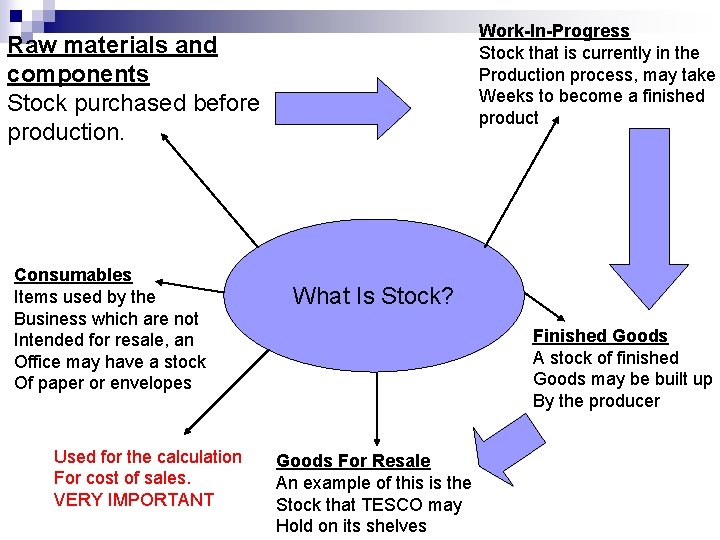
Work-In-Progress Stock that is currently in the Production process, may take Weeks to become a finished product Raw materials and components Stock purchased before production. Consumables Items used by the Business which are not Intended for resale, an Office may have a stock Of paper or envelopes Used for the calculation For cost of sales. VERY IMPORTANT What Is Stock? Finished Goods A stock of finished Goods may be built up By the producer Goods For Resale An example of this is the Stock that TESCO may Hold on its shelves
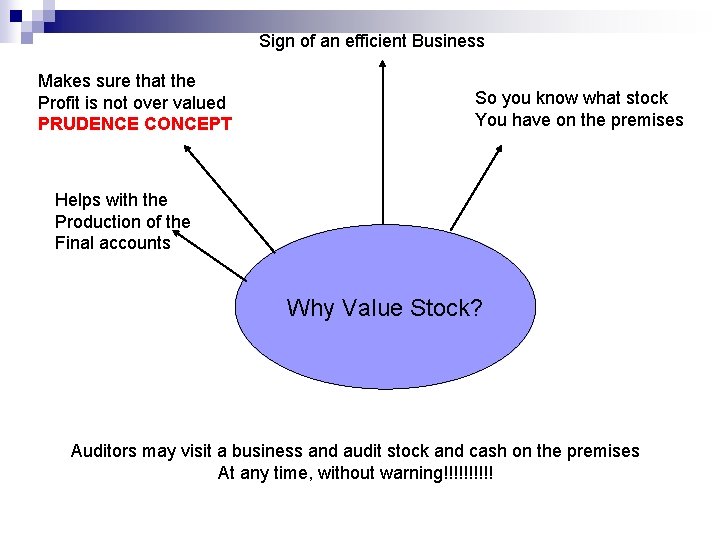
Sign of an efficient Business Makes sure that the Profit is not over valued PRUDENCE CONCEPT So you know what stock You have on the premises Helps with the Production of the Final accounts Why Value Stock? Auditors may visit a business and audit stock and cash on the premises At any time, without warning!!!!!
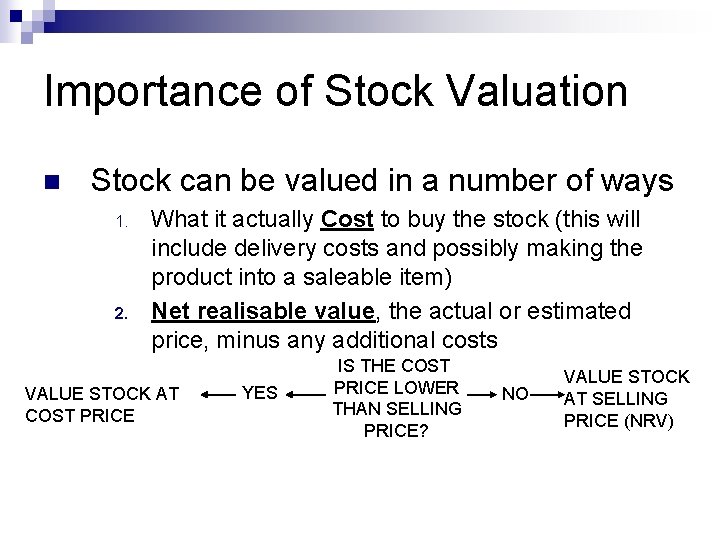
Importance of Stock Valuation n Stock can be valued in a number of ways 1. 2. What it actually Cost to buy the stock (this will include delivery costs and possibly making the product into a saleable item) Net realisable value, the actual or estimated price, minus any additional costs VALUE STOCK AT COST PRICE YES IS THE COST PRICE LOWER THAN SELLING PRICE? NO VALUE STOCK AT SELLING PRICE (NRV)
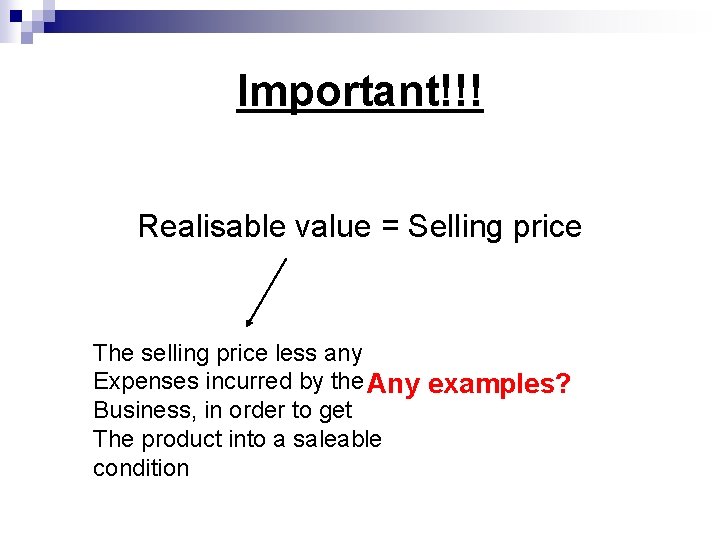
Important!!! Realisable value = Selling price The selling price less any Expenses incurred by the Any examples? Business, in order to get The product into a saleable condition
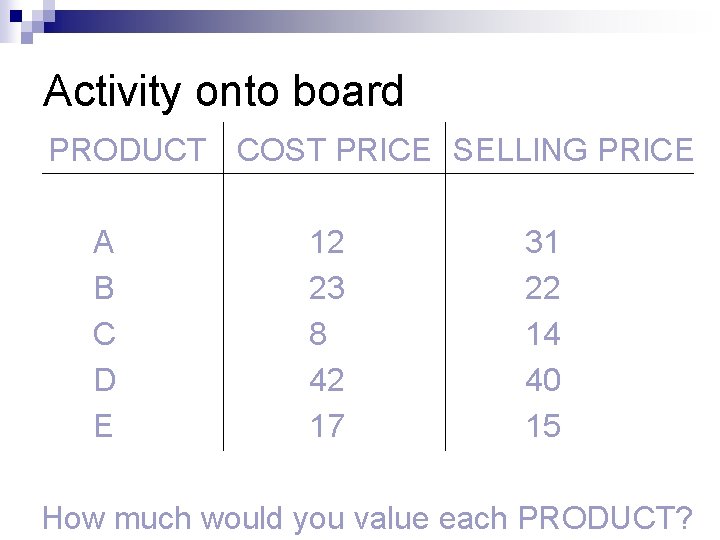
Activity onto board PRODUCT COST PRICE SELLING PRICE A B C D E 12 23 8 42 17 31 22 14 40 15 How much would you value each PRODUCT?
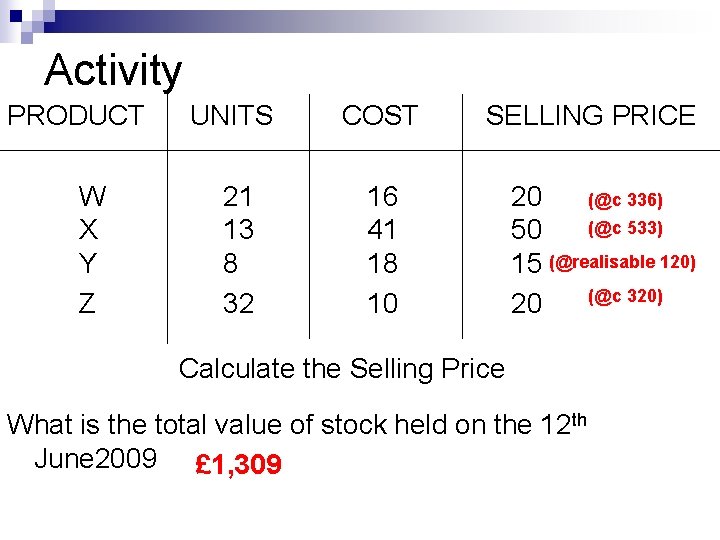
Activity PRODUCT W X Y Z UNITS COST 21 13 8 32 16 41 18 10 SELLING PRICE 20 (@c 336) (@c 533) 50 15 (@realisable 120) (@c 320) 20 Calculate the Selling Price What is the total value of stock held on the 12 th June 2009 £ 1, 309
Methods of Stock Valuation 1. 2. 3. Stock valuation is made tricky because of the purchase price, which may vary over a year (petrol) At the end of the year the business may not know the actual prices of the items left in stock. As a result different methods can be used to value the cost of stocks, Three methods that help us do this are: FIFO first in first out LIFO last in first out AVCO average cost
Get pupils to research from the Rob Jones book- PAGE 194 Research the following: FIFO AVCO
Stock Valuation Lesson 2
Lesson Objectives £ To be able to define FIFO and AVCO ££ To be able to calculate both methods £££ To evaluate the most appropriate method of stock valuation
Starter Activity 1. 2. 3. 4. Why does a business need sources of finance? What is the difference between internal and external sources of finance? State 2 long term sources of finance Name the world cup winners in backwards order from 2006 to the date of your birth.

World Cup 1966 England 1970 Brazil 1974 Germany 1978 Argentina 1982 Italy 1986 Argentina 1990 Germany 1994 Brazil 1998 France 2002 Brazil 2006 Italy
Importance of inventory valuation The value of stock appears on both the trading profit and loss account and also the balance sheet n If the closing stock value is placed too high then both the profit and the assets will be overstated, and vice versa n

After completing your homework you should be able to answer the following 1. 2. 3. 4. 5. Define FIFO Define AVCO State one advantage of using the FIFO method What kind of business would use FIFO? Explain your answer How will fluctuations in unit price impact both methods of valuation?
FIFO This method assumes that stock is used in the order in which it was bought n Any unused stock is therefore the most recently bought n Advantages n A realistic method, n Easily to calculate, using actual prices of stock. Closing stock will be based on the most recent prices n
FIFO cont. . Disadvantages n The stock taken for production may have an out of date price, this may mean that the selling price is not taking into consideration the more recent prices n
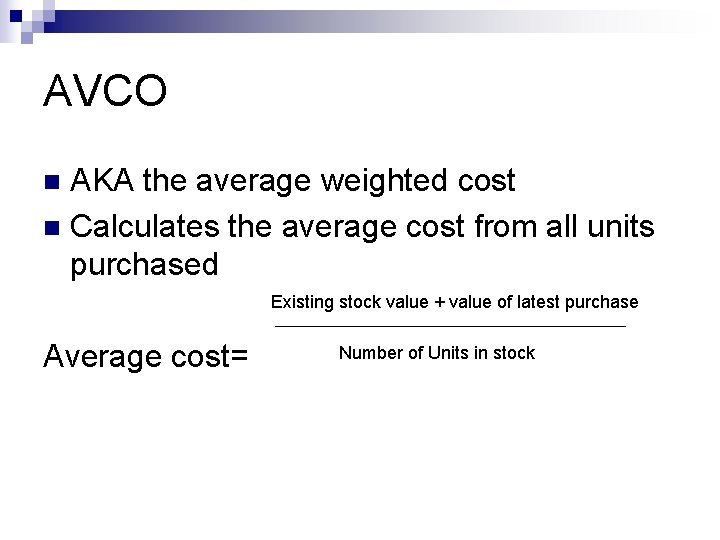
AVCO AKA the average weighted cost n Calculates the average cost from all units purchased n Existing stock value + value of latest purchase Average cost= Number of Units in stock
AVCO continued n n n n Advantages It makes sense to use this method since all units are given equal value Fluctuations in unit price are evened out Conforms to the accounting standards Disadvantages Average cost needs to be re calculated every time that price of purchased stock changes Average cost may not be the same as any of the purchased prices Stock prices rise rapidly, average cost will be much lower than replacement price
LIFO-just for your information Last in first out method, newest stock is always used first n Unused stock is based on the cost of earlier purchases n ADVANTAGES n n n Based on the prices of most recently purchased goods, selling price can reflect this, easy to calculate DISADVANTAGES n May be difficult to use up new stock first, for instance when dealing with food. Closing stock will use out of date prices, so may go against inland revenue requirements
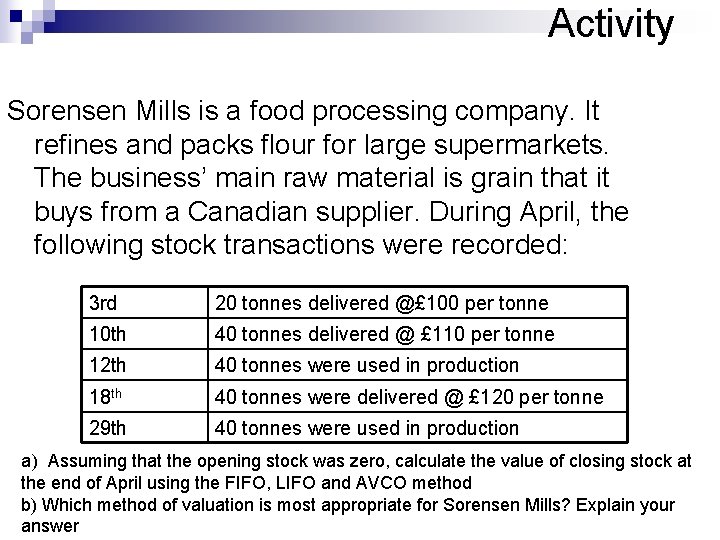
Activity Sorensen Mills is a food processing company. It refines and packs flour for large supermarkets. The business’ main raw material is grain that it buys from a Canadian supplier. During April, the following stock transactions were recorded: 3 rd 20 tonnes delivered @£ 100 per tonne 10 th 40 tonnes delivered @ £ 110 per tonne 12 th 40 tonnes were used in production 18 th 40 tonnes were delivered @ £ 120 per tonne 29 th 40 tonnes were used in production a) Assuming that the opening stock was zero, calculate the value of closing stock at the end of April using the FIFO, LIFO and AVCO method b) Which method of valuation is most appropriate for Sorensen Mills? Explain your answer
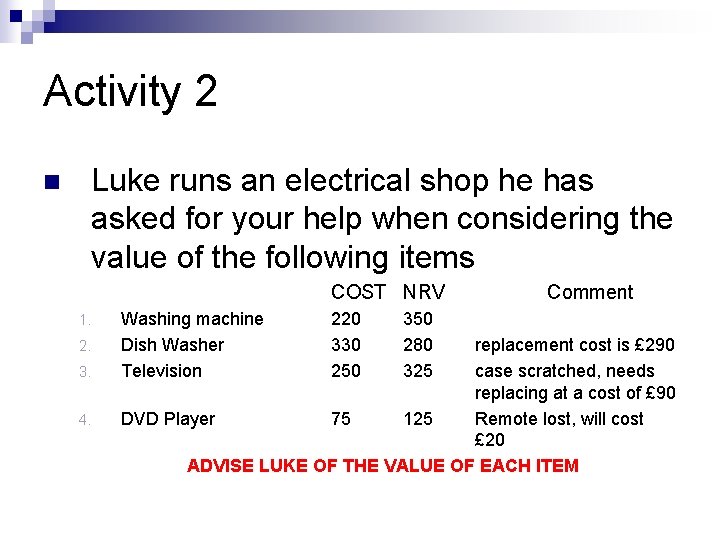
Activity 2 n Luke runs an electrical shop he has asked for your help when considering the value of the following items COST NRV 1. 2. 3. 4. Washing machine Dish Washer Television 220 330 250 350 280 325 Comment replacement cost is £ 290 case scratched, needs replacing at a cost of £ 90 DVD Player 75 125 Remote lost, will cost £ 20 ADVISE LUKE OF THE VALUE OF EACH ITEM
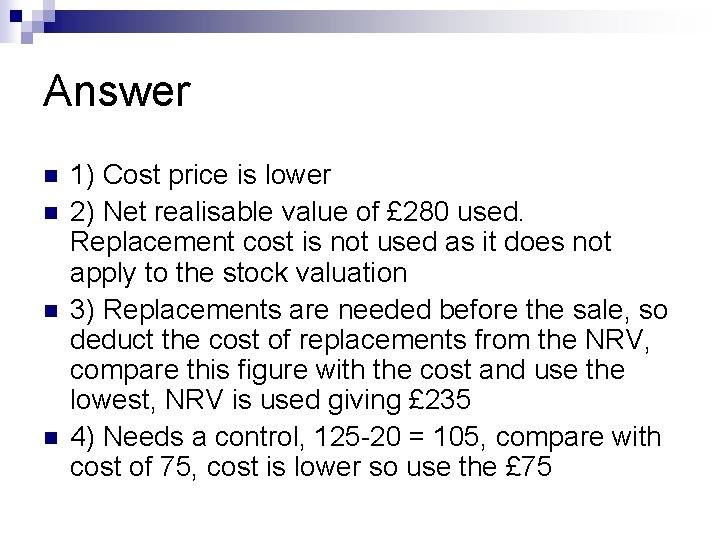
Answer n n 1) Cost price is lower 2) Net realisable value of £ 280 used. Replacement cost is not used as it does not apply to the stock valuation 3) Replacements are needed before the sale, so deduct the cost of replacements from the NRV, compare this figure with the cost and use the lowest, NRV is used giving £ 235 4) Needs a control, 125 -20 = 105, compare with cost of 75, cost is lower so use the £ 75
Homework n Complete sheet n Due in next lesson
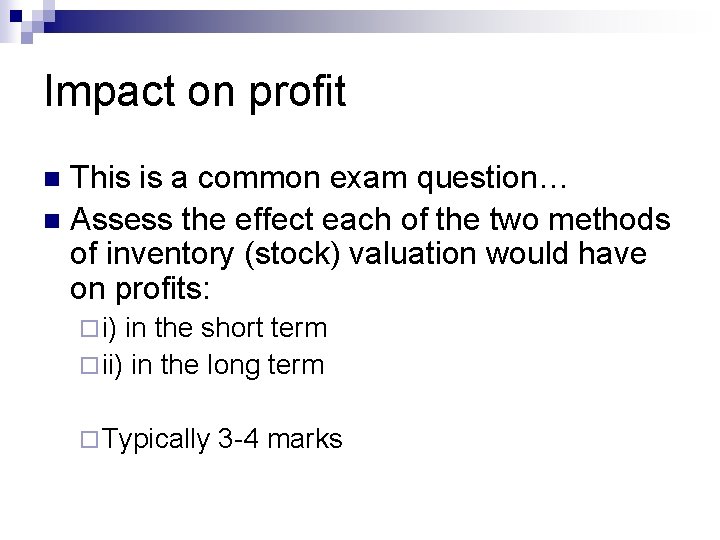
Impact on profit This is a common exam question… n Assess the effect each of the two methods of inventory (stock) valuation would have on profits: n ¨ i) in the short term ¨ ii) in the long term ¨ Typically 3 -4 marks
Impact on profit (answer) n Long term ¨ Profits will be the same, as all stock will be used up n Short term ¨ FIFO produces higher profits than AVCO Any impact on cash? n No as the same price is paid to the suppliers for the stock n
Plenary n Put your name on the POST IT note, and complete the following sentences n I am …. % confident with stock valuation n I would like to …. To help me fully grasp stock valuation n Stick the POST IT note on the door frame,
Lesson Objectives £ To be able to define FIFO and AVCO ££ To be able to calculate both methods £££ To evaluate the most appropriate method of stock valuation
- Slides: 30