
Stochasticity is clearly a fundamental characteristic for realworld

- Slides: 27
Stochasticity is clearly a fundamental characteristic for realworld walking systems. Quantifying metastability Introduction Kinodynamic Planning Optimizing Control
Stochasticity is clearly a fundamental characteristic for realworld walking systems. How can we quantify its effects? Quantifying metastability Introduction Kinodynamic Planning Optimizing Control
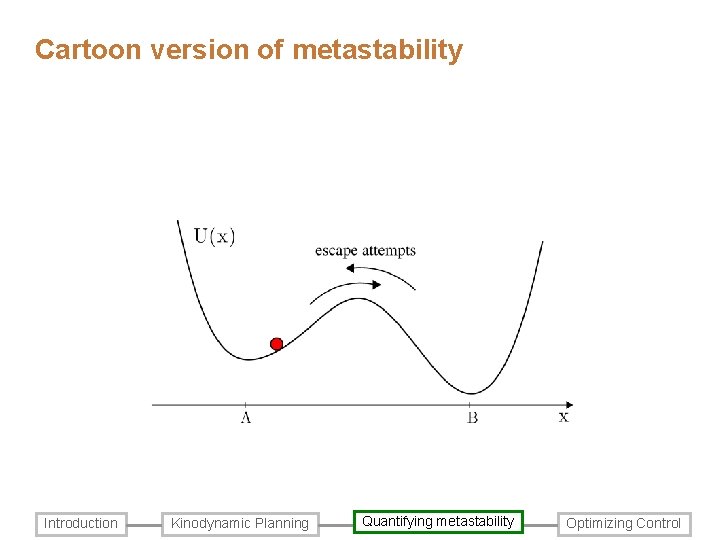
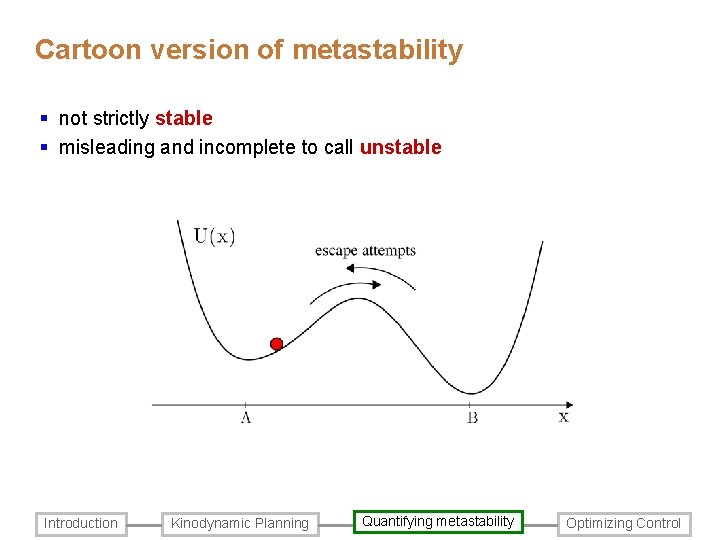
Cartoon version of metastability Introduction Kinodynamic Planning Quantifying metastability Optimizing Control
Cartoon version of metastability § not strictly stable § misleading and incomplete to call unstable Introduction Kinodynamic Planning Quantifying metastability Optimizing Control
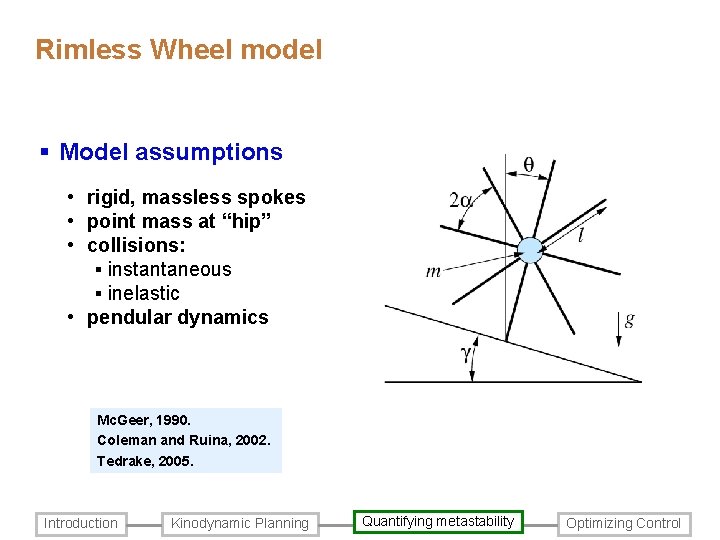
Rimless Wheel model § Model assumptions • rigid, massless spokes • point mass at “hip” • collisions: ▪ instantaneous ▪ inelastic • pendular dynamics Mc. Geer, 1990. Coleman and Ruina, 2002. Tedrake, 2005. Introduction Kinodynamic Planning Quantifying metastability Optimizing Control
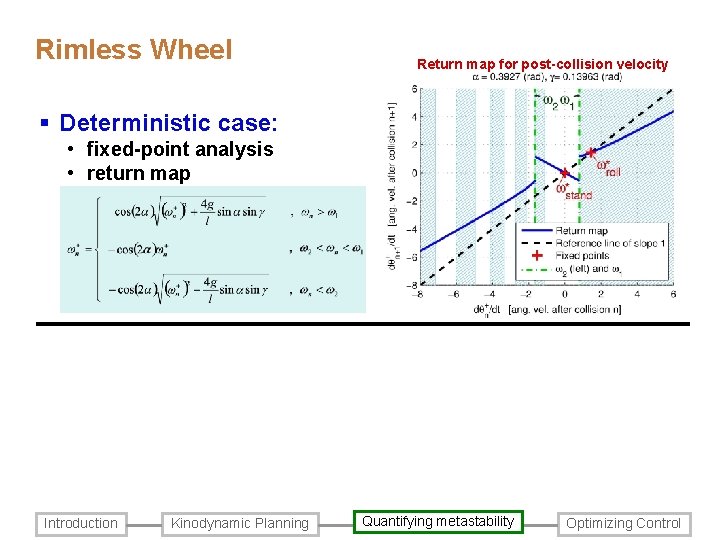
Rimless Wheel Return map for post-collision velocity § Deterministic case: • fixed-point analysis • return map Introduction Kinodynamic Planning Quantifying metastability Optimizing Control
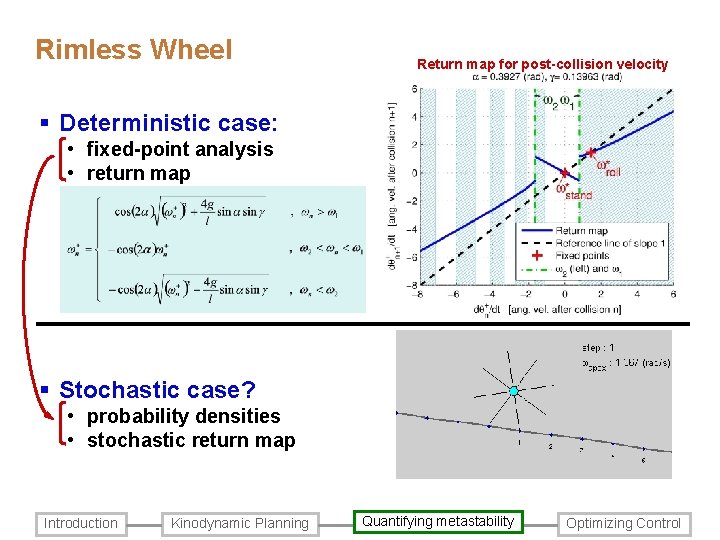
Rimless Wheel Return map for post-collision velocity § Deterministic case: • fixed-point analysis • return map § Stochastic case? • probability densities • stochastic return map Introduction Kinodynamic Planning Quantifying metastability Optimizing Control
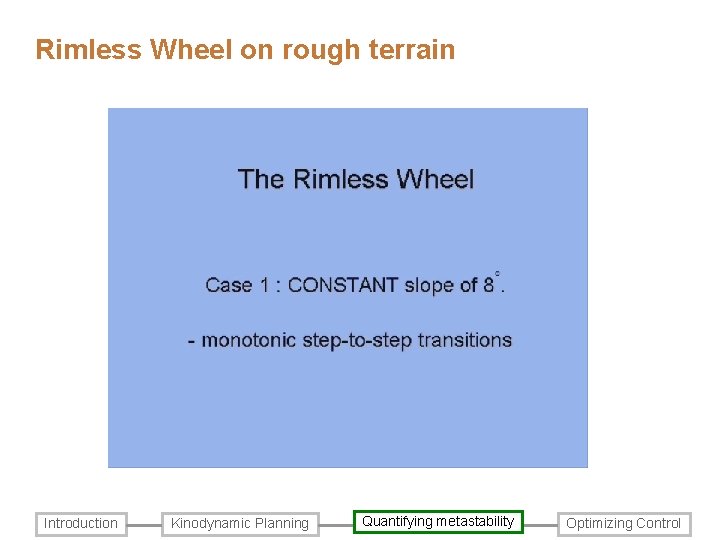
Rimless Wheel on rough terrain Introduction Kinodynamic Planning Quantifying metastability Optimizing Control
Can we optimize control to maximize MFPT on stochastic (rough) terrain? Optimizing Control Introduction Kinodynamic Planning Quantifying metastability
Can we optimize control to maximize MFPT on stochastic (rough) terrain? Yes! Use dynamic programming on our discrete models of dynamics : Value Iteration Optimizing Control Introduction Kinodynamic Planning Quantifying metastability
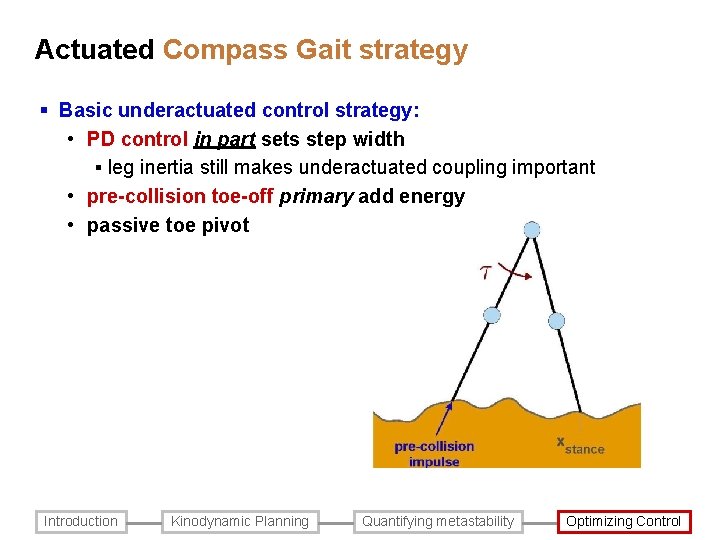
Actuated Compass Gait strategy § Basic underactuated control strategy: • PD control in part sets step width ▪ leg inertia still makes underactuated coupling important • pre-collision toe-off primary add energy • passive toe pivot Introduction Kinodynamic Planning Quantifying metastability Optimizing Control
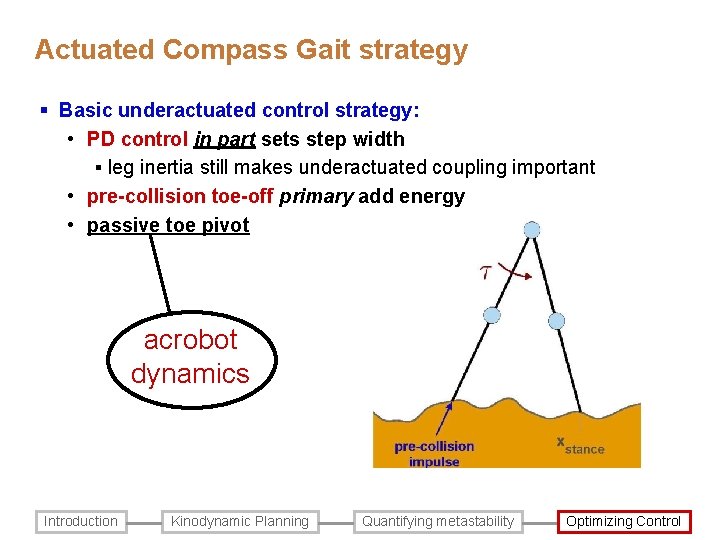
Actuated Compass Gait strategy § Basic underactuated control strategy: • PD control in part sets step width ▪ leg inertia still makes underactuated coupling important • pre-collision toe-off primary add energy • passive toe pivot acrobot dynamics Introduction Kinodynamic Planning Quantifying metastability Optimizing Control
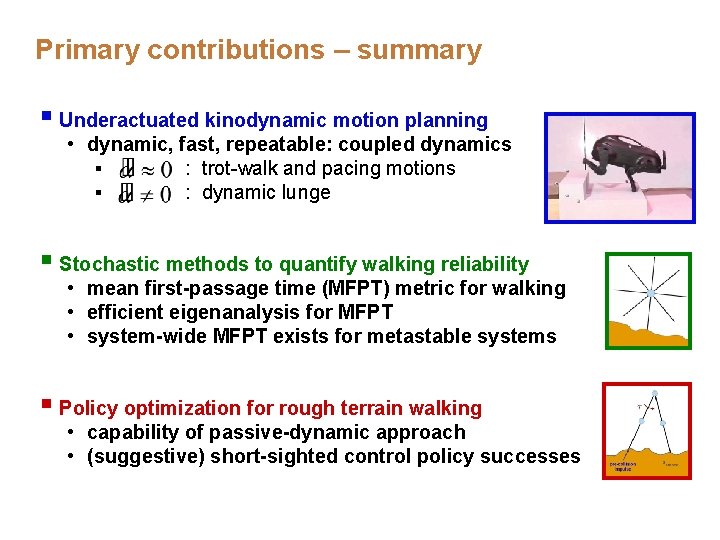
Primary contributions – summary § Underactuated kinodynamic motion planning • dynamic, fast, repeatable: coupled dynamics ▪ : trot-walk and pacing motions ▪ : dynamic lunge § Stochastic methods to quantify walking reliability • mean first-passage time (MFPT) metric for walking • efficient eigenanalysis for MFPT • system-wide MFPT exists for metastable systems § Policy optimization for rough terrain walking • capability of passive-dynamic approach • (suggestive) short-sighted control policy successes
Thanks! Harvard Microrobotics Laboratory Rob Wood J. Peter Whitney Mike Karpelson Ben Finio Pratheev Sreetharan Katie Hoffman Chris Oland Brandon Eum Russ Tedrake Nick Roy Alec Skholnik Khash Rohanimanesh Sam Prentice John Roberts Olivier Chatot Steve Proulx Marc Raibert Cassie Moreira Al Rizzi Gabe Nelson Adam Fastman Aaron Saunders Kevin Blankespoor Learning Locomotion Program Katie Byl Robert Mandelbaum Tom Wagner Larry Jackel Jim Pippine Doug Hacket Adam Watson Metastable Legged-Robot Locomotion
Thanks! Questions? Harvard Microrobotics Laboratory Rob Wood J. Peter Whitney Mike Karpelson Ben Finio Pratheev Sreetharan Katie Hoffman Chris Oland Brandon Eum Russ Tedrake Nick Roy Alec Skholnik Khash Rohanimanesh Sam Prentice John Roberts Olivier Chatot Steve Proulx Marc Raibert Cassie Moreira Al Rizzi Gabe Nelson Adam Fastman Aaron Saunders Kevin Blankespoor Learning Locomotion Program Katie Byl Robert Mandelbaum Tom Wagner Larry Jackel Jim Pippine Doug Hacket Adam Watson Metastable Legged-Robot Locomotion
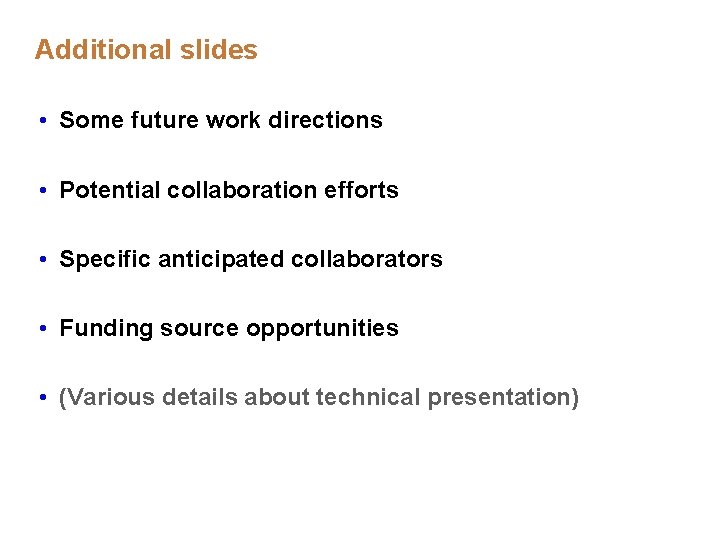
Additional slides • Some future work directions • Potential collaboration efforts • Specific anticipated collaborators • Funding source opportunities • (Various details about technical presentation)
Future work – anticipated directions General lessons (good and bad)? -Failures happen +Underactuated models can handle rough terrain +Short-sighted walking strategies are effective -Discretization only works for low-dimension systems -Dynamics are coupled
Future work – anticipated directions General lessons (good and bad)? -Failures happen +Underactuated models can handle rough terrain +Short-sighted walking strategies are effective -Discretization only works for low-dimension systems -Dynamics are coupled § Plan for failure … but also plan for recovery! • Multi-modal locomotion strategies ▪ Hop+flap+tumble; run+jump; climb+soar • Failure analyses ▪ Predict likely impact scenarios (falling shouldn’t be fatal) • Multi-robot failure analyses ▪ failure events likely to be correlated
Future work – anticipated directions General lessons (good and bad)? -Failures happen +Underactuated models can handle rough terrain +Short-sighted walking strategies are effective -Discretization only works for low-dimension systems -Dynamics are coupled § Study theoretical efficiency of real-world (stochastic) locomotion • When are legs more efficient than wheels (on rough terrain)? • Efficiency of flapping flight in highly agile regime?
Future work – anticipated directions General lessons (good and bad)? -Failures happen +Underactuated models can handle rough terrain +Short-sighted walking strategies are effective -Discretization only works for low-dimension systems -Dynamics are coupled § Further analysis of short-sighted planning • For walking: ▪ each step naturally dissipates energy • For other locomotion (flying, swimming, …): ▪ can designed, piece-wise control strategies give similar effect?
Future work – anticipated directions General lessons (good and bad)? -Failures happen +Underactuated models can handle rough terrain +Short-sighted walking strategies are effective -Discretization only works for low-dimension systems -Dynamics are coupled § Development of methods for higher degree-of-freedom systems • Hierarchical strategies? • Exploitation of short-sighted maneuvers/strategies ▪ Toward desirable neighborhoods in state space ▪ Sequential visits of these neighborhoods over time • Development of evaluation techniques (for such strategies)
Future work – anticipated directions General lessons (good and bad)? -Failures happen +Underactuated models can handle rough terrain +Short-sighted walking strategies are effective -Discretization only works for low-dimension systems -Dynamics are coupled § Trajectory planning required through state space • Example: flapping flight (segue to current work…) ▪ Exploit combination of active and passive stability ▪ Potential reduction of effect dimensionality – Identify “principal components” of motions
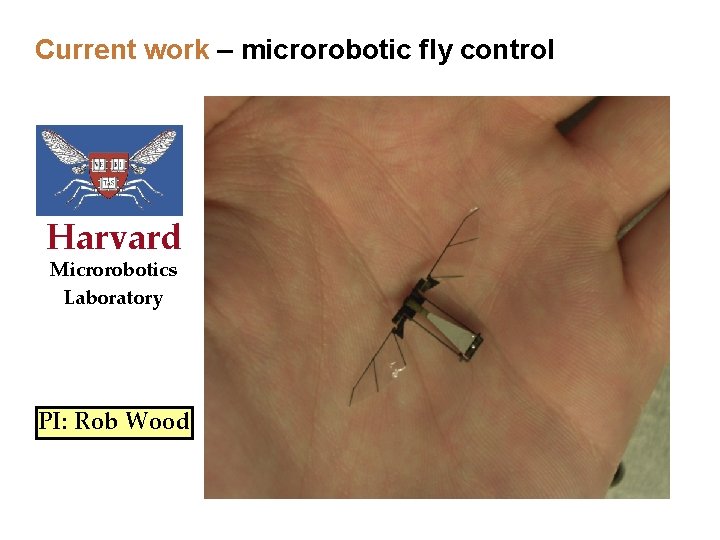
Current work – microrobotic fly control Harvard Microrobotics Laboratory PI: Rob Wood
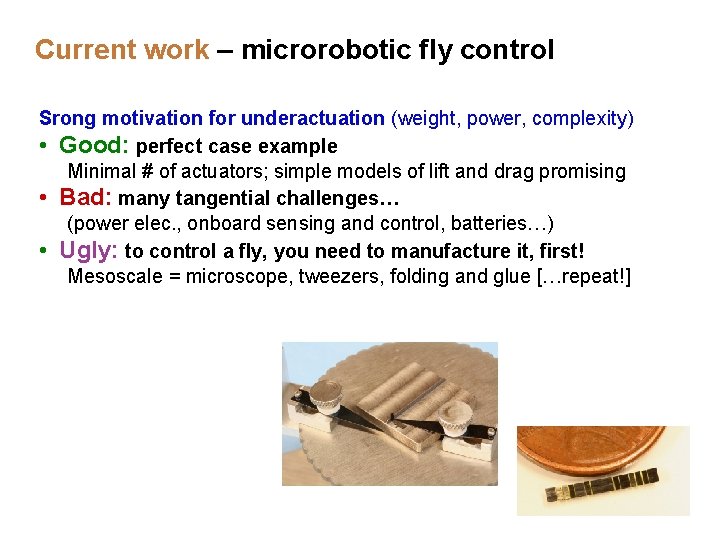
Current work – microrobotic fly control Srong motivation for underactuation (weight, power, complexity) • Good: perfect case example Minimal # of actuators; simple models of lift and drag promising • Bad: many tangential challenges… (power elec. , onboard sensing and control, batteries…) • Ugly: to control a fly, you need to manufacture it, first! Mesoscale = microscope, tweezers, folding and glue […repeat!]
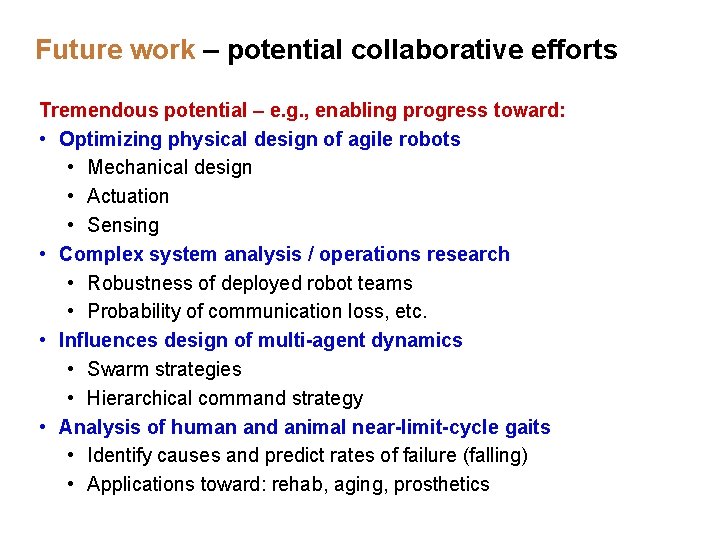
Future work – potential collaborative efforts Tremendous potential – e. g. , enabling progress toward: • Optimizing physical design of agile robots • Mechanical design • Actuation • Sensing • Complex system analysis / operations research • Robustness of deployed robot teams • Probability of communication loss, etc. • Influences design of multi-agent dynamics • Swarm strategies • Hierarchical command strategy • Analysis of human and animal near-limit-cycle gaits • Identify causes and predict rates of failure (falling) • Applications toward: rehab, aging, prosthetics
Some potential research collaborators § § § Russ Tedrake (MIT) Rob Wood (Harvard) Boston Dynamics (Al Rizzi, Rob Playter) Physical Sciences, Inc. (Tom Vanek) Equilibria (Samir Nayfeh) i. Robot (Rodney Brooks, Joe Foley) Peko Hosoi (MIT) Olin College Mike Merznich (Posit Science) Physical Therapy Dept. , UCSF (Nancy Byl) NASA/Ames
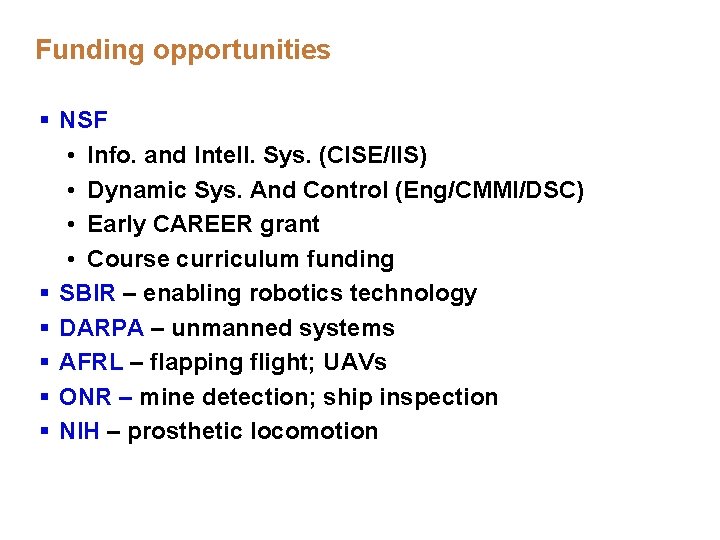
Funding opportunities § NSF • Info. and Intell. Sys. (CISE/IIS) • Dynamic Sys. And Control (Eng/CMMI/DSC) • Early CAREER grant • Course curriculum funding § SBIR – enabling robotics technology § DARPA – unmanned systems § AFRL – flapping flight; UAVs § ONR – mine detection; ship inspection § NIH – prosthetic locomotion