
Stochastic Simulations Six degrees of Kevin Bacon Outline
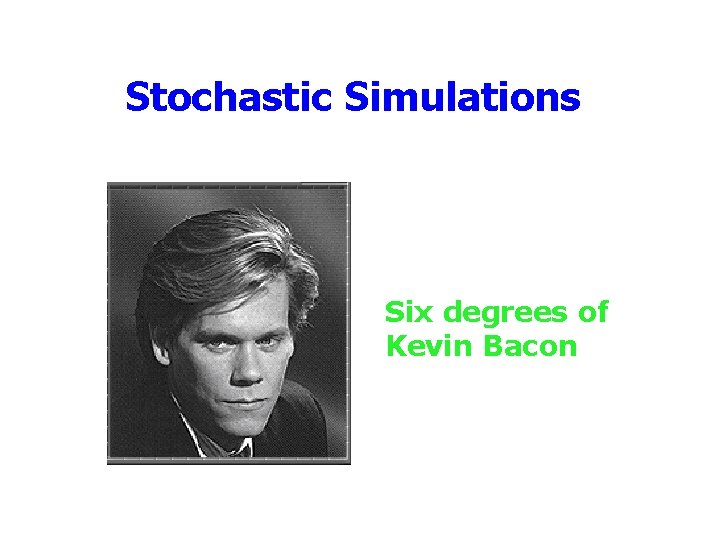
Stochastic Simulations Six degrees of Kevin Bacon
Outline • Announcements: – Homework II: due Today. by 5, by e-mail • Discuss on Friday. – Homework III: on web • Random Numbers • Example--Small Worlds
Random Numbers • Computers are deterministic – Therefore, computers generate “pseudo-random” numbers • Matlab’s random numbers are “good” – “The uniform random number generator in MATLAB 5 uses a lagged Fibonacci generator, with a cache of 32 floating point numbers, combined with a shift register random integer generator. ” – http: //www. mathworks. com/support/solutions/data/8542. shtml
Random functions • rand(m, n) produces m-by-n matrix of uniformly distributed random numbers [0, 1] • randn(m, n) produces random numbers normally distributed with mean=0 and std=1 • randperm(n) is a random permutation of integers [1: n] – I=randperm(n); B=A(I, : ) would scramble the rows of A
Seeds • Random number generators are usually recurrence equations: – r(n)=F(r(n-1)) • Must provide an initial value r(0) – Matlab’s random functions are seeded at startup, but THE SEED IS THE SAME EVERY TIME! – Initialize seed with rand('state', sum(100*clock) ) – How would you ensure rand is always random?
It’s a Small, Small World • Watts & Strogatz (1998) Nature, 393: 440 -442 • Complicated systems can be viewed as graphs – describe how components are connected
Example: Six Degrees of Kevin Bacon • Components (vertices) are actors • Connections (edges) are movies • Hypothesis: 6 or fewer links separate Kevin Bacon from all other actors.
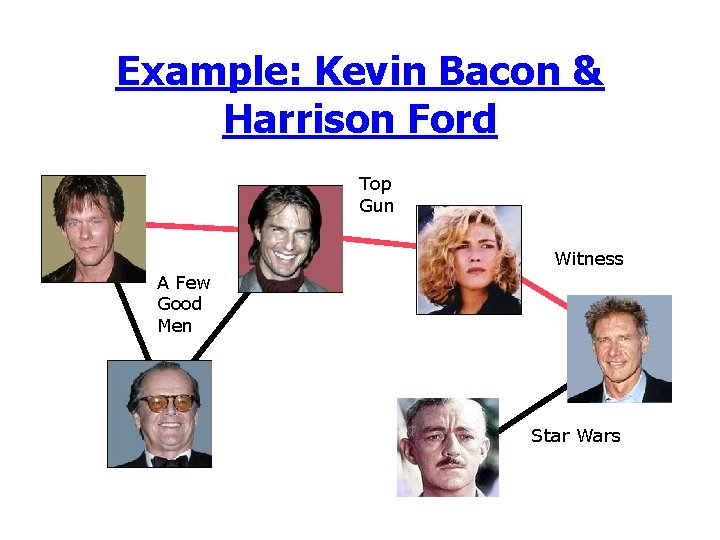
Example: Kevin Bacon & Harrison Ford Top Gun Witness A Few Good Men Star Wars
Other Systems • Power Grid • Food Webs • Nervous system of Caenorhabditis elegans • Goal is to learn about these systems by studying their graphs • Many of these systems are “Small Worlds”--only a few links separate any two points
Watts & Strogatz • Can organize graphs on a spectrum from ordered to random • How do graph properties change across this spectrum? – L=mean path length (# links between points) – C=cluster coefficient (“lumpiness”) • Used a Monte-Carlo approach--created lots of graphs along spectrum and computed L and C
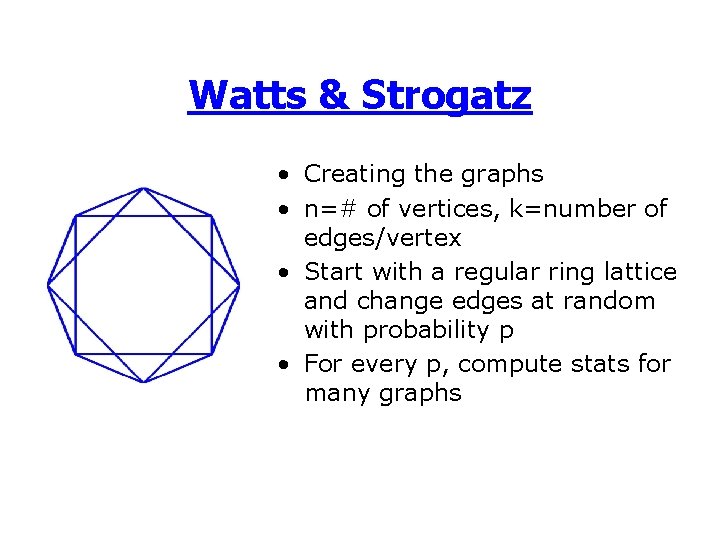
Watts & Strogatz • Creating the graphs • n=# of vertices, k=number of edges/vertex • Start with a regular ring lattice and change edges at random with probability p • For every p, compute stats for many graphs
Small Worlds in Matlab • G=createlattice(n, k, p) – creates a lattice--represented as a sparse matrix • [L, C]=latticestats(G) – computes the path length and clustering stats • [L, C]=Small. Worlds. Ex(n, k, P, N) – Creates N graphs for every P(j) and saves the mean stats in L(j) and C(j) • plotlattice(G) – Plots a lattice
- Slides: 12