
Stochastic Optimization is almost as Easy as Deterministic

- Slides: 26
Stochastic Optimization is (almost) as Easy as Deterministic Optimization Chaitanya Swamy Caltech Joint work with David Shmoys done while at Cornell University
Stochastic Optimization • Way of modeling uncertainty. • Exact data is unavailable or expensive – data is uncertain, specified by a probability distribution. • Want to make the best decisions given this uncertainty in the data. Applications in logistics, transportation models, financial instruments, network design, production planning, … • Dates back to 1950’s and the work of Dantzig.
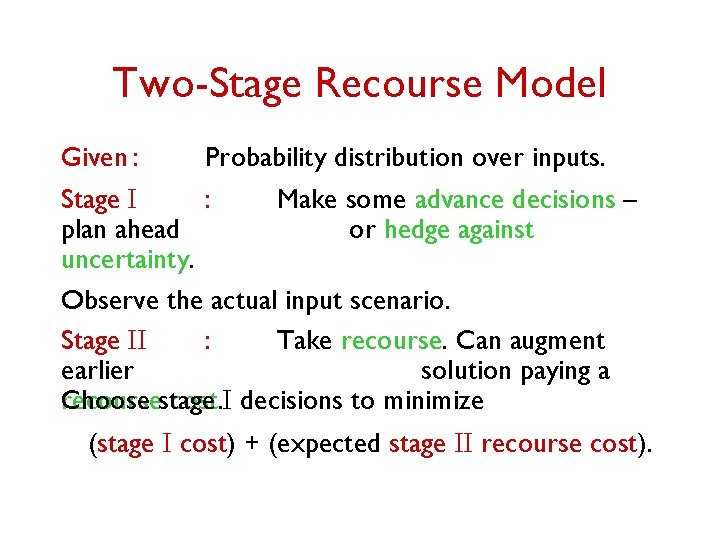
Two-Stage Recourse Model Given : Probability distribution over inputs. Stage I : Make some advance decisions – plan ahead or hedge against uncertainty. Observe the actual input scenario. Stage II : Take recourse. Can augment earlier solution paying a Choose recoursestage cost. I decisions to minimize (stage I cost) + (expected stage II recourse cost).
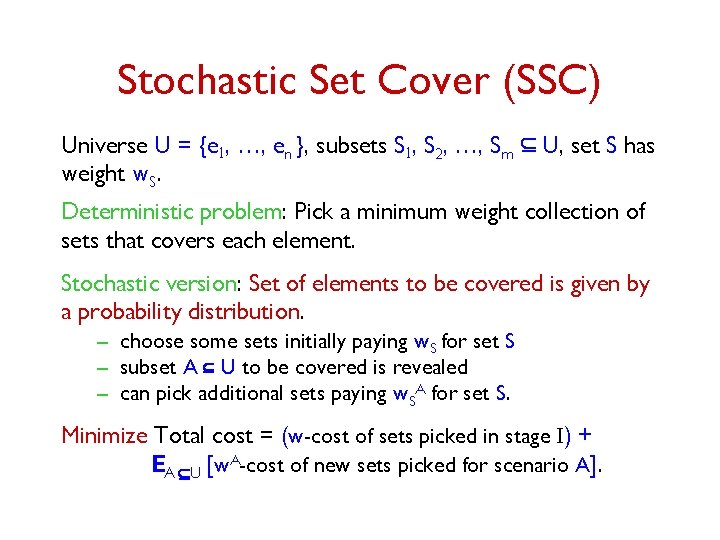
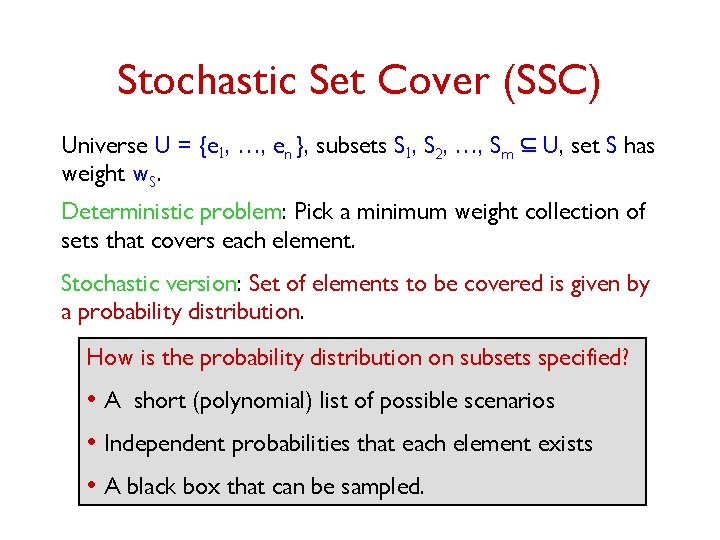
Stochastic Set Cover (SSC) Universe U = {e 1, …, en }, subsets S 1, S 2, …, Sm Í U, set S has weight w. S. Deterministic problem: Pick a minimum weight collection of sets that covers each element. Stochastic version: Set of elements to be covered is given by a probability distribution. – choose some sets initially paying w. S for set S – subset A Í U to be covered is revealed – can pick additional sets paying w. SA for set S. Minimize Total cost = (w-cost of sets picked in stage I) + EA ÍU [w. A-cost of new sets picked for scenario A].
Stochastic Set Cover (SSC) Universe U = {e 1, …, en }, subsets S 1, S 2, …, Sm Í U, set S has weight w. S. Deterministic problem: Pick a minimum weight collection of sets that covers each element. Stochastic version: Set of elements to be covered is given by a probability distribution. How is the probability distribution on subsets specified? • A short (polynomial) list of possible scenarios • Independent probabilities that each element exists • A black box that can be sampled.
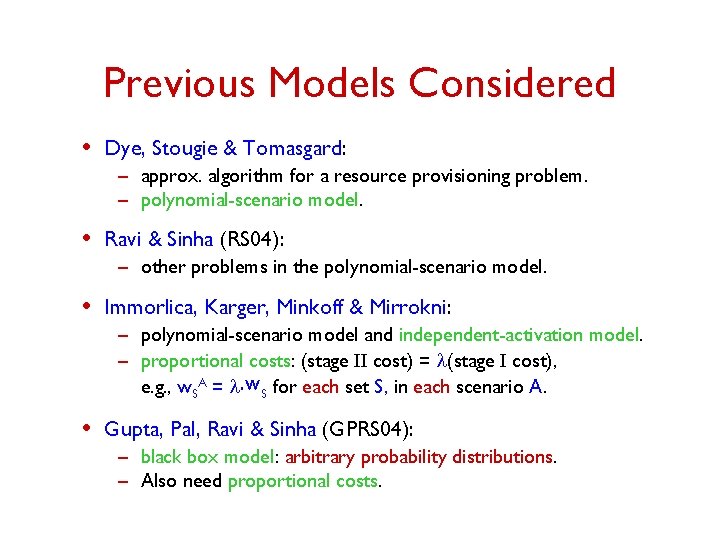
Previous Models Considered • Dye, Stougie & Tomasgard: – approx. algorithm for a resource provisioning problem. – polynomial-scenario model. • Ravi & Sinha (RS 04): – other problems in the polynomial-scenario model. • Immorlica, Karger, Minkoff & Mirrokni: – polynomial-scenario model and independent-activation model. – proportional costs: (stage II cost) = l(stage I cost), e. g. , w. SA = l. w. S for each set S, in each scenario A. • Gupta, Pal, Ravi & Sinha (GPRS 04): – black box model: arbitrary probability distributions. – Also need proportional costs.
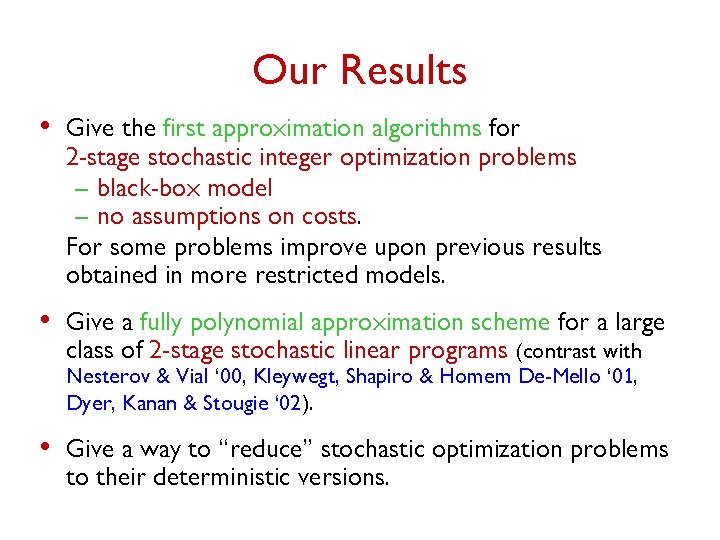
Our Results • Give the first approximation algorithms for 2 -stage stochastic integer optimization problems – black-box model – no assumptions on costs. For some problems improve upon previous results obtained in more restricted models. • Give a fully polynomial approximation scheme for a large class of 2 -stage stochastic linear programs (contrast with Nesterov & Vial ‘ 00, Kleywegt, Shapiro & Homem De-Mello ‘ 01, Dyer, Kanan & Stougie ‘ 02). • Give a way to “reduce” stochastic optimization problems to their deterministic versions.
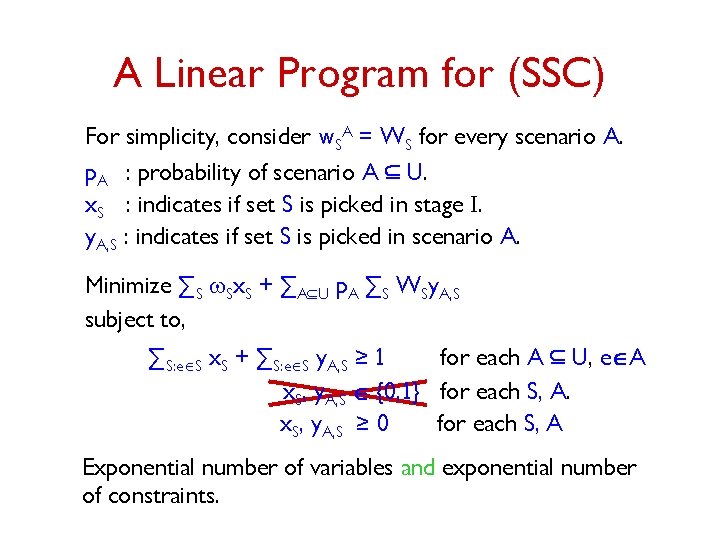
A Linear An Integer. Programfor for(SSC) For simplicity, consider w. SA = WS for every scenario A. p. A : probability of scenario A Í U. x. S : indicates if set S is picked in stage I. y. A, S : indicates if set S is picked in scenario A. Minimize ∑S w. Sx. S + ∑AÍU p. A ∑S WSy. A, S subject to, ∑S: eÎS x. S + ∑S: eÎS y. A, S ≥ 1 for each A Í U, eÎA x. S, y. A, S Î {0, 1} for each S, A. x. S, y. A, S ≥ 0 for each S, A Exponential number of variables and exponential number of constraints.
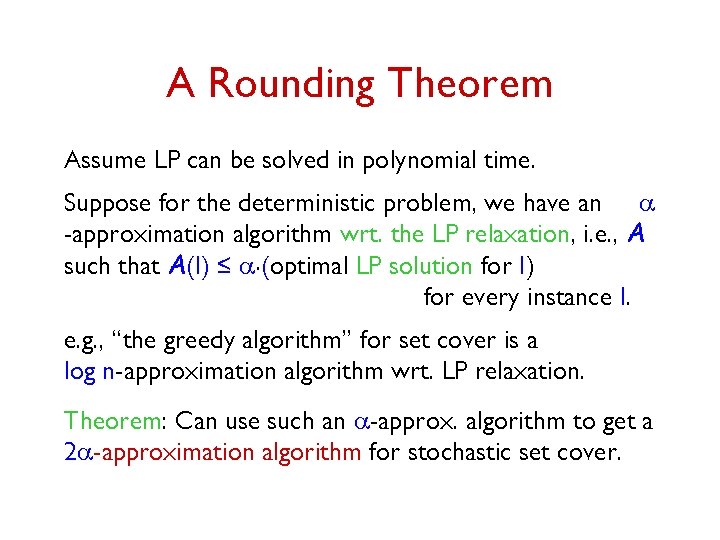
A Rounding Theorem Assume LP can be solved in polynomial time. Suppose for the deterministic problem, we have an a -approximation algorithm wrt. the LP relaxation, i. e. , A such that A(I) ≤ a. (optimal LP solution for I) for every instance I. e. g. , “the greedy algorithm” for set cover is a log n-approximation algorithm wrt. LP relaxation. Theorem: Can use such an a-approx. algorithm to get a 2 a-approximation algorithm for stochastic set cover.
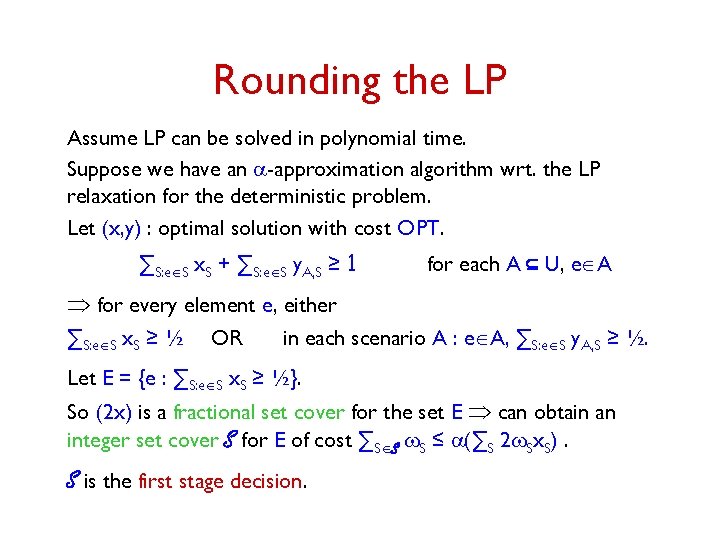
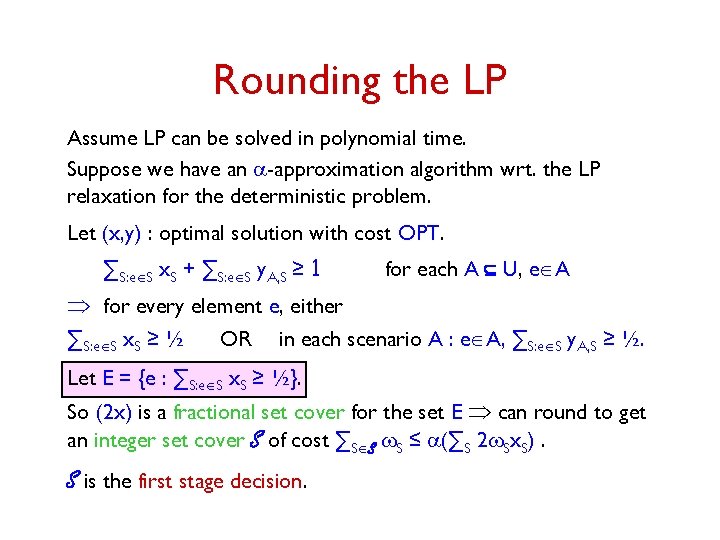
Rounding the LP Assume LP can be solved in polynomial time. Suppose we have an a-approximation algorithm wrt. the LP relaxation for the deterministic problem. Let (x, y) : optimal solution with cost OPT. ∑S: eÎS x. S + ∑S: eÎS y. A, S ≥ 1 for each A Í U, eÎA Þ for every element e, either ∑S: eÎS x. S ≥ ½ OR in each scenario A : eÎA, ∑S: eÎS y. A, S ≥ ½. Let E = {e : ∑S: eÎS x. S ≥ ½}. So (2 x) is a fractional set cover for the set E Þ can obtain an integer set cover S for E of cost ∑SÎS w. S ≤ a(∑S 2 w. Sx. S). S is the first stage decision.
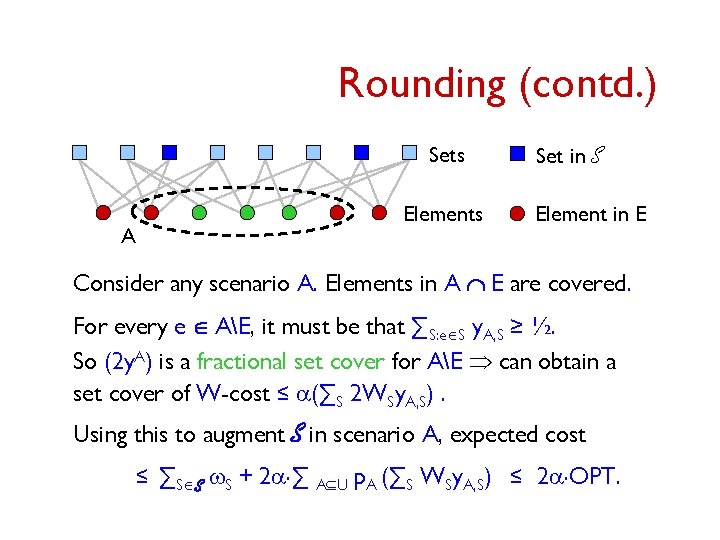
Rounding (contd. ) Sets Elements A Set in S Element in E Consider any scenario A. Elements in A Ç E are covered. For every e Î AE, it must be that ∑S: eÎS y. A, S ≥ ½. So (2 y. A) is a fractional set cover for AE Þ can obtain a set cover of W-cost ≤ a(∑S 2 WSy. A, S). Using this to augment S in scenario A, expected cost ≤ ∑SÎS w. S + 2 a. ∑ AÍU p. A (∑S WSy. A, S) ≤ 2 a. OPT.
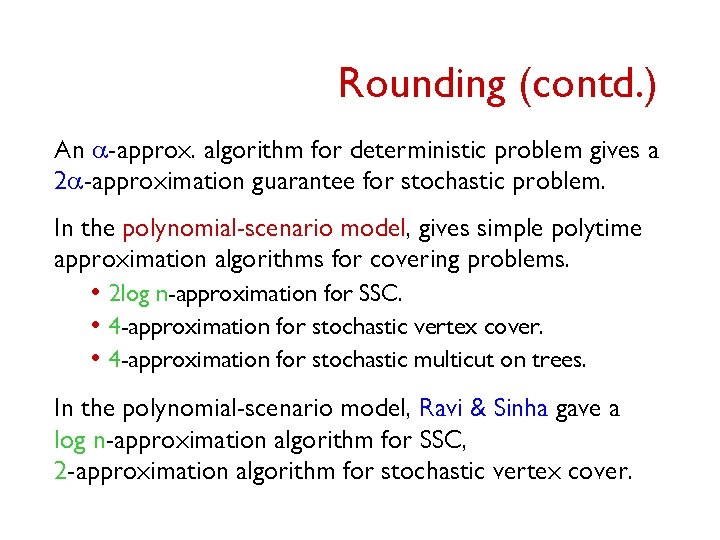
Rounding (contd. ) An a-approx. algorithm for deterministic problem gives a 2 a-approximation guarantee for stochastic problem. In the polynomial-scenario model, gives simple polytime approximation algorithms for covering problems. • 2 log n-approximation for SSC. • 4 -approximation for stochastic vertex cover. • 4 -approximation for stochastic multicut on trees. In the polynomial-scenario model, Ravi & Sinha gave a log n-approximation algorithm for SSC, 2 -approximation algorithm for stochastic vertex cover.
Rounding the LP Assume LP can be solved in polynomial time. Suppose we have an a-approximation algorithm wrt. the LP relaxation for the deterministic problem. Let (x, y) : optimal solution with cost OPT. ∑S: eÎS x. S + ∑S: eÎS y. A, S ≥ 1 for each A Í U, eÎA Þ for every element e, either ∑S: eÎS x. S ≥ ½ OR in each scenario A : eÎA, ∑S: eÎS y. A, S ≥ ½. Let E = {e : ∑S: eÎS x. S ≥ ½}. So (2 x) is a fractional set cover for the set E Þ can round to get an integer set cover S of cost ∑SÎS w. S ≤ a(∑S 2 w. Sx. S). S is the first stage decision.
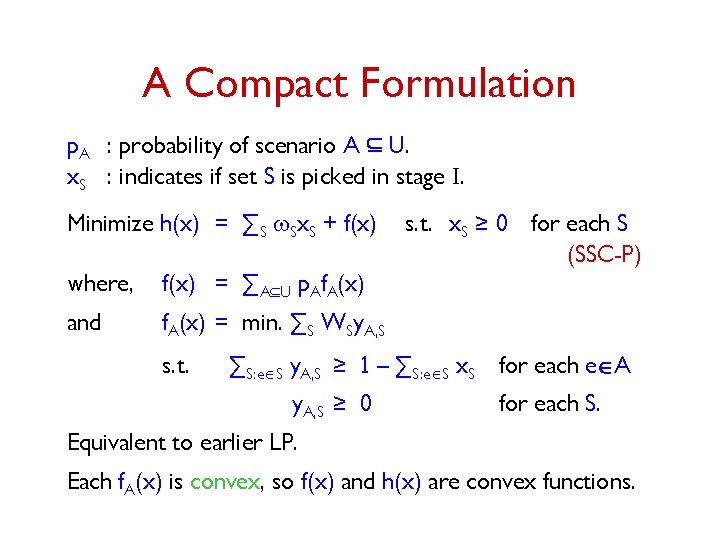
A Compact Formulation p. A : probability of scenario A Í U. x. S : indicates if set S is picked in stage I. Minimize h(x) = ∑S w. Sx. S + f(x) where, f(x) = ∑AÍU p. Af. A(x) and f. A(x) = min. ∑S WSy. A, S s. t. x. S ≥ 0 for each S (SSC-P) ∑S: eÎS y. A, S ≥ 1 – ∑S: eÎS x. S for each eÎA y. A, S ≥ 0 for each S. Equivalent to earlier LP. Each f. A(x) is convex, so f(x) and h(x) are convex functions.
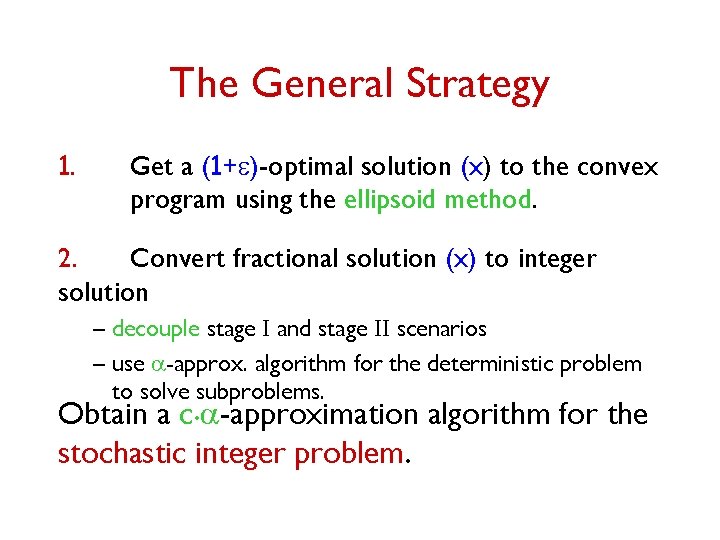
The General Strategy 1. Get a (1+e)-optimal solution (x) to the convex program using the ellipsoid method. 2. Convert fractional solution (x) to integer solution – decouple stage I and stage II scenarios – use a-approx. algorithm for the deterministic problem to solve subproblems. Obtain a c. a-approximation algorithm for the stochastic integer problem.
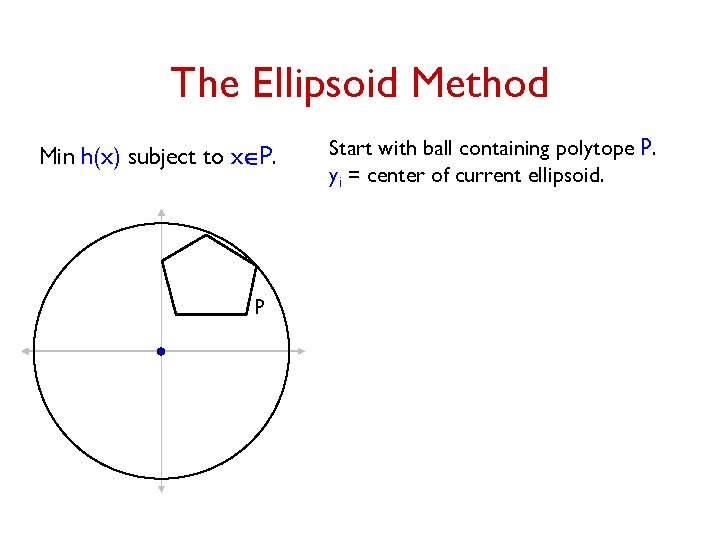
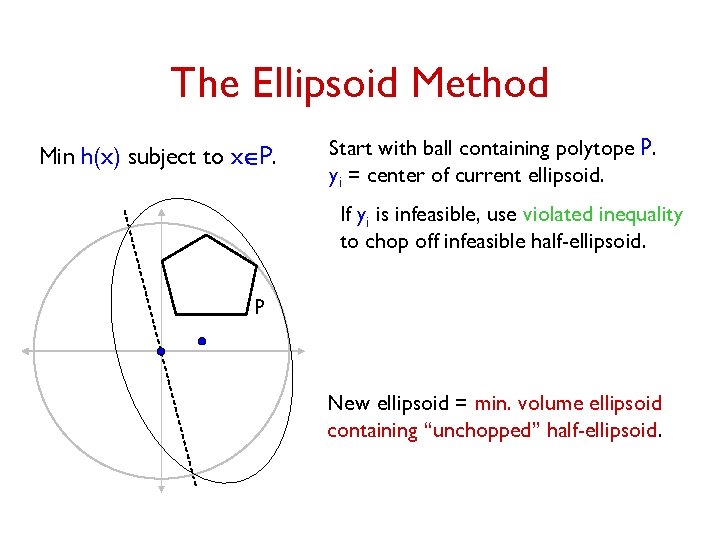
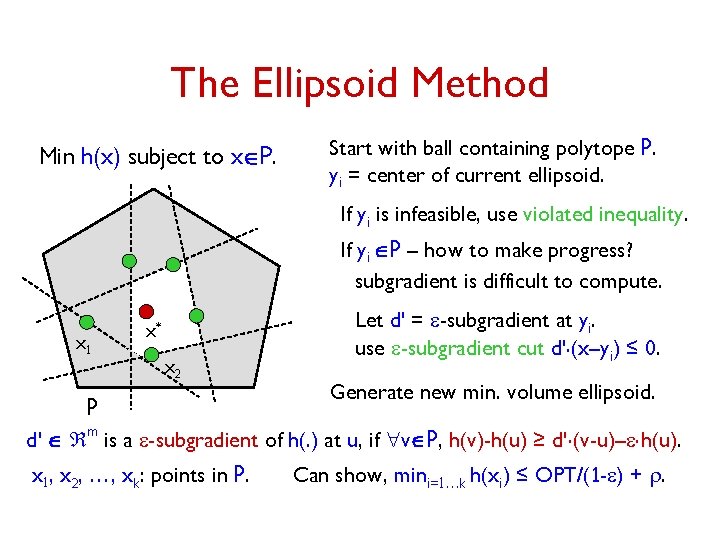
The Ellipsoid Method Min h(x) subject to xÎP. P Start with ball containing polytope P. yi = center of current ellipsoid.
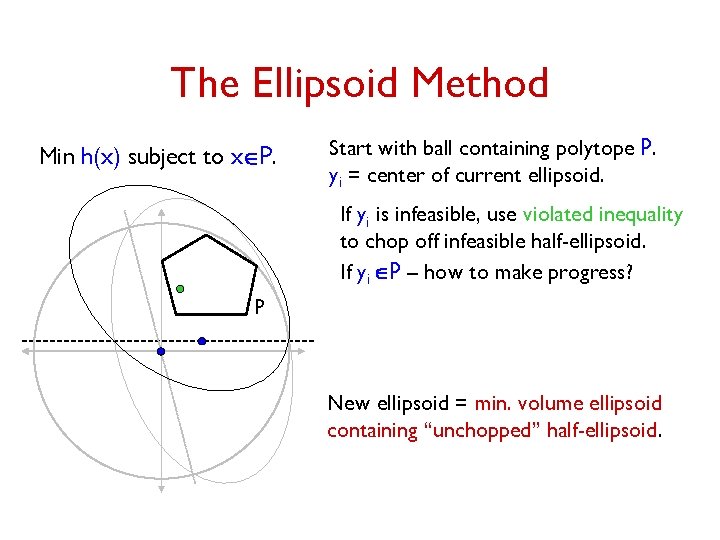
The Ellipsoid Method Min h(x) subject to xÎP. Start with ball containing polytope P. yi = center of current ellipsoid. If yi is infeasible, use violated inequality to chop off infeasible half-ellipsoid. P New ellipsoid = min. volume ellipsoid containing “unchopped” half-ellipsoid.
The Ellipsoid Method Min h(x) subject to xÎP. Start with ball containing polytope P. yi = center of current ellipsoid. If yi is infeasible, use violated inequality to chop off infeasible half-ellipsoid. If yi ÎP – how to make progress? P New ellipsoid = min. volume ellipsoid containing “unchopped” half-ellipsoid.
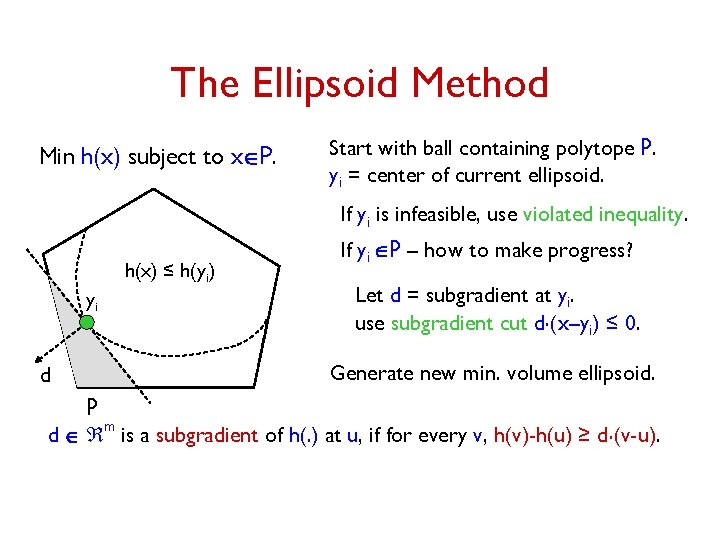
The Ellipsoid Method Min h(x) subject to xÎP. Start with ball containing polytope P. yi = center of current ellipsoid. If yi is infeasible, use violated inequality. h(x) ≤ h(yi) yi d If yi ÎP – how to make progress? Let d = subgradient at yi. use subgradient cut d. (x–yi) ≤ 0. Generate new min. volume ellipsoid. P d Î m is a subgradient of h(. ) at u, if for every v, h(v)-h(u) ≥ d. (v-u).
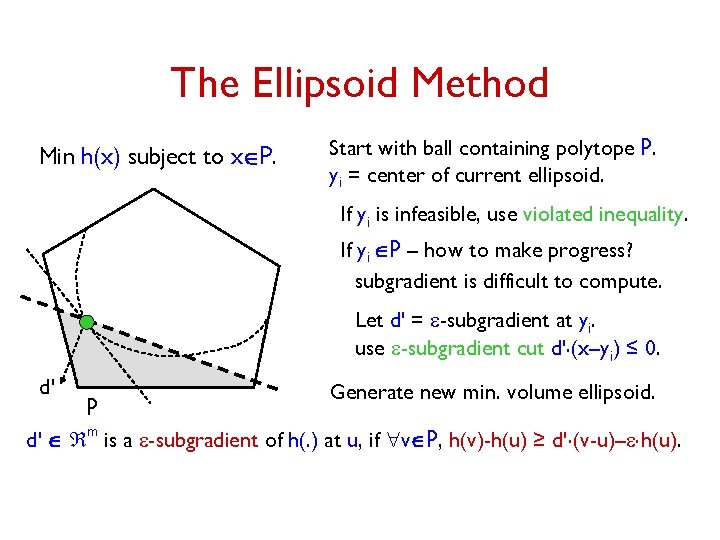
The Ellipsoid Method Min h(x) subject to xÎP. Start with ball containing polytope P. yi = center of current ellipsoid. If yi is infeasible, use violated inequality. If yi ÎP – how to make progress? subgradient is difficult to compute. Let d' = e-subgradient at yi. use e-subgradient cut d'. (x–yi) ≤ 0. d' P Generate new min. volume ellipsoid. d' Î m is a e-subgradient of h(. ) at u, if "vÎP, h(v)-h(u) ≥ d'. (v-u)–e. h(u).
The Ellipsoid Method Min h(x) subject to xÎP. Start with ball containing polytope P. yi = center of current ellipsoid. If yi is infeasible, use violated inequality. If yi ÎP – how to make progress? subgradient is difficult to compute. x 1 x* x 2 P Let d' = e-subgradient at yi. use e-subgradient cut d'. (x–yi) ≤ 0. Generate new min. volume ellipsoid. d' Î m is a e-subgradient of h(. ) at u, if "vÎP, h(v)-h(u) ≥ d'. (v-u)–e. h(u). x 1, x 2, …, xk: points in P. Can show, mini=1…k h(xi) ≤ OPT/(1 -e) + r.
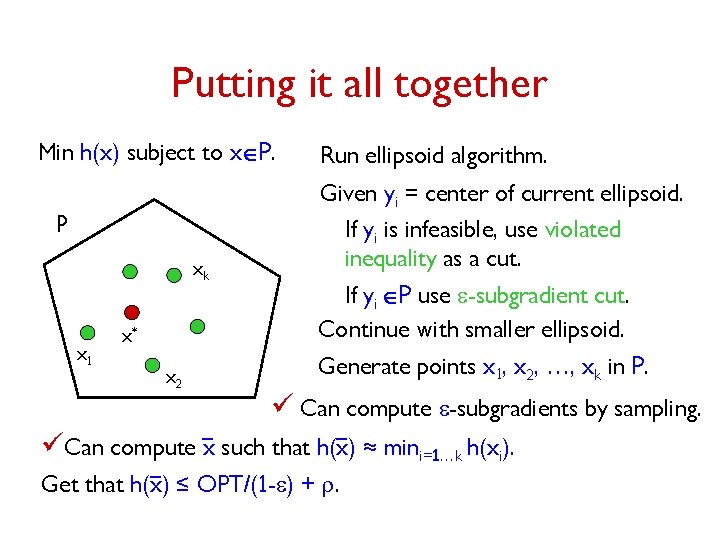
Putting it all together Min h(x) subject to xÎP. Run ellipsoid algorithm. Given yi = center of current ellipsoid. P xk x 1 x* x 2 If yi is infeasible, use violated inequality as a cut. If yi ÎP use e-subgradient cut. Continue with smaller ellipsoid. Generate points x 1, x 2, …, xk in P. ü Can compute e-subgradients by sampling. üCan compute x such that h(x) ≈ mini=1…k h(xi). Get that h(x) ≤ OPT/(1 -e) + r.
Sample Average Approximation (SAA) method: – Sample initially N times from scenario distribution – Solve 2 -stage problem estimating p. A with frequency of occurrence of scenario A How large should N be? Kleywegt, Shapiro & Homem De-Mello (KSH 01): – bound N by variance of a certain quantity – need not be polynomially bounded even for our class of programs. Recently, Charikar & Chekuri, Shmoys & S: – show that for a large class of stochastic LPs, N can be poly-bounded. Nemirovskii & Shapiro: – show that for SSC with non-scenario dependent costs, KSH 01 gives polynomial bound on N for (preprocessing + SAA) algorithm.
Summary of Results • Give an approximation scheme to solve a broad class of stochastic linear programs. • Obtain the first approximation algorithms for 2 -stage stochastic integer problems – no assumptions on costs or probability distribution. – 2 log n-approx. for set cover – 4 -approx. for vertex cover and multicut on trees. – 3. 23 -approx. for uncapacitated facility location (FL). Get constant guarantees for several variants such as FL with penalties, or soft capacities, or services. – (1+e)-approx. for multicommodity flow. Generalize and/or improve results of GPRS 04, Immorlica et al. obtained in restricted models. • Give a general technique to lift deterministic guarantees to stochastic setting.
Open Questions • Practical Impact: Can one use e-subgradients in other deterministic optimization methods, e. g. , cutting plane methods? Interior-point algorithms? • Multi-stage stochastic optimization. • Characterize which deterministic problems are “easy to solve” in stochastic setting, and which problems are “hard”.
Thank You.